A complete, self-contained course for the first grade of the ABRSM Music Theory syllabus: the stave and clefs, note values and rests from the semibreve to the semiquaver, simple time and the grouping of notes within it, accidentals, the first four major keys, tonic triads, intervals above the tonic, the core Italian terms, and simple questions about a melody.
Introduction
Sit down with a page of sheet music and, without training, you see a thicket of dots and lines. With Grade 1 behind you, you see instructions: this note, this long, this loud, in this key. That transformation, from thicket to instructions, is the whole business of this grade, and it is closer than it looks.
The material is deliberately small: two clefs, the note values from semibreve to semiquaver, three time signatures, four major keys and a starter set of Italian terms. What matters is not covering it but making it automatic. Every later grade reads through this one the way English reads through its alphabet, so fluency here is never wasted; it is banked.
Theory learned at an instrument sticks best. Whatever you play, find each new idea under your fingers as you meet it: sound the semitones, play the tonic triads, count real bars in real pieces. The syllabus is examined on a screen, but the knowledge is for music-making, and connecting the two from the start makes both easier.
If a symbol ever puzzles you beyond what this course explains, the companion reference Music Notation documents every mark on the modern stave. The rest of the collection, from Piano Chords to Musical Harmony, waits further down the road this grade begins.
About this guide and the exam
Grade 1 is the entry point of the ABRSM theory syllabus. Nothing is assumed beyond a willingness to learn, so this guide starts from first principles: what pitch is, how the musical alphabet works, and how written music encodes both pitch and time.
The exam itself is taken online, on a computer. Every question is multiple choice or interactive; there is no free composition at this level. The paper carries 75 marks in seven sections. 50 marks pass, 60 earns a Merit and 65 a Distinction. Most well-prepared candidates finish with time to spare, so accuracy matters more than speed.
The seven sections are worth 15, 15, 15, 10, 10, 5 and 5 marks, so the first three between them carry 45 of the 75 marks, three fifths of the paper. Seven areas are assessed, and every question belongs to one of them:
| Area | What it covers | Chapters here |
|---|---|---|
| Rhythm | note and rest values, bars, time signatures, grouping | 5 to 9 |
| Pitch | naming notes in both clefs, and writing a note at the same pitch in the other clef | 1 to 4 |
| Keys and scales | the major scale, key signatures, degrees of the scale | 10 and 11 |
| Intervals | intervals above the tonic, by number | 13 |
| Tonic triads | the tonic triads of the four keys | 12 |
| Terms and signs | Italian terms, dynamics, articulation | 14 |
| Music in context | questions about a short melody | 15 |
Rhythm, pitch, and keys and scales are where the marks are, and they are also where careless slips are easiest to make, so give them the bulk of your practice. This guide takes the seven areas in a teaching order rather than the exam's order, because the later ones need the earlier ones.
One habit will help you more than any other: write music out by hand. Copy scales, key signatures and short rhythms onto manuscript paper as you work through each section. Reading becomes easy only once writing is easy.
What Grade 1 asks of you
By the end of this grade you should be able to:
- read and write notes in the treble and bass clefs, middle C and one ledger line included
- write a given note at the same pitch in the other clef
- use the semibreve, minim, crotchet, quaver and semiquaver, their rests, single-dotted notes, and tied notes
- group and beam notes and rests correctly in the time signatures 2/4, 3/4 and 4/4
- use sharps, flats and naturals, and tell tones from semitones
- write the scales, key signatures and tonic triads of C, G, D and F major, in both clefs and in both directions
- number the degrees of a major scale, and name intervals above the tonic by number
- understand the common Italian terms for tempo, dynamics, character and articulation
- answer simple questions about a short melody in either clef
1. First principles: pitch and the musical alphabet
Pitch
Pitch is how high or low a note sounds. Physically, it comes from vibration: a string, a column of air, or a drumhead vibrating quickly produces a high note, and one vibrating slowly produces a low note. A piccolo plays high pitches. A tuba plays low ones. Everything in written music that concerns pitch is a way of saying "this high" or "this low" precisely.
The seven letter names
Western music names its pitches with the first seven letters of the alphabet:
A, B, C, D, E, F, G
After G the names begin again at A, and the cycle repeats for as high or low as instruments can play. Going up you count forwards (A, B, C...), and coming down you count backwards (C, B, A...). Spend a few minutes each day saying the musical alphabet aloud from different starting points, in both directions. It sounds trivial. It is also the single skill you will use in almost every theory question from now on, and hesitation here slows everything else down.
The keyboard as a map
You do not need to play the piano to pass a theory exam, but you do need the keyboard picture in your head, because it makes pitch visible.
Look at any piano keyboard. The black keys sit in a repeating pattern: a group of two, then a group of three, then two again, and so on. That pattern is your landmark system:
- The white key immediately to the left of any group of two black keys is always C.
- From that C, the white keys going up spell C, D, E, F, G, A, B, and then the next C.
Octaves
Play one C, then the next C above it. The two notes sound alike, one simply higher. The distance between them is an octave. The name comes from "eight": counting both ends, C up to the next C spans eight letter names (C, D, E, F, G, A, B, C). Notes an octave apart share a letter name because, acoustically, they really are the same note in a different register. The higher C vibrates exactly twice as fast as the lower one.
Middle C
Middle C is the C nearest the centre of the piano keyboard, close to the maker's name. It matters in written music because it is the meeting point of the two clefs you learn at this grade. Whenever you feel lost on the stave, find middle C and work outwards from it.
2. The stave
Music is written on a stave (the American word is staff): five horizontal lines with four spaces between them.
---------------  line 5 (top)
                 space 4
---------------  line 4
                 space 3
---------------  line 3 (middle)
                 space 2
---------------  line 2
                 space 1
---------------  line 1 (bottom)
Lines and spaces are always counted from the bottom up. A note sits either on a line (the line passes through the middle of the note-head) or in a space (the note-head fills the space). Height means pitch: the higher a note sits on the stave, the higher it sounds.
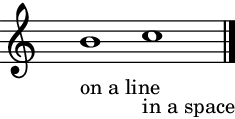
Here is the catch: on its own, the stave tells you nothing about which pitches its lines carry. Five anonymous lines could mean anything. The symbol that gives them meaning is the clef, and it is always the first thing written on every stave.
Ledger lines
Nine positions (five lines and four spaces) cannot hold every note an instrument can play. When a note is too high or too low for the stave, short extra lines called ledger lines are drawn through or beside the note-head, extending the stave upwards or downwards. Count them exactly as you would count extra stave lines and spaces: line, space, line, space, continuing the pattern. Grade 1 keeps to one ledger line above and below each stave, which is exactly enough to reach middle C from either side. Grade 2 extends the range to two.
3. The treble clef
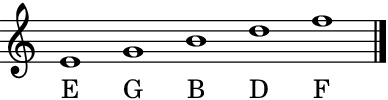
The treble clef serves the higher voices and instruments: violin, flute, recorder, trumpet, the singer's soprano line, and the pianist's right hand. It is also called the G clef, and the name is a genuine instruction. The clef's inner curl wraps around the second line up, and that tells you the second line is G (specifically, the G above middle C). Fix that one line and every other line and space follows from the musical alphabet.
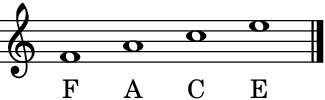
Reading upwards from the bottom of the treble stave:
| Bottom to top | |
|---|---|
| Lines | E, G, B, D, F |
| Spaces | F, A, C, E |
Two traditional memory aids: the lines are "Every Good Boy Deserves Food", and the spaces spell the word FACE. Use the mnemonics to get started, but aim to outgrow them. Fluent readers know the positions directly, the way you recognise words without spelling them out letter by letter.
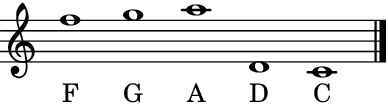
Worked examples of ledger-line notes in the treble clef, going up from the top line: the top line is F, the space just above is G, and the first ledger line above is A. Below the stave: the space under the bottom line is D, and the first ledger line below is middle C.
Drawing the clef
Practise drawing the treble clef until it is automatic. Start the curl on the G line (second line up), spiral outwards, sweep up above the stave, then straight down through it with a small hook at the bottom. Examiners do not award marks for beautiful clefs, but a clef that circles the wrong line changes every note on the stave.
4. The bass clef
The bass clef serves the lower voices and instruments: cello, bassoon, tuba, the bass singer, and the pianist's left hand. Its other name is the F clef, and again the name tells you what it does. The clef begins as a curl on the fourth line up, and its two dots sit either side of that same line. That line is F, the F below middle C.
Reading upwards from the bottom of the bass stave:
| Bottom to top | |
|---|---|
| Lines | G, B, D, F, A |
| Spaces | A, C, E, G |
Memory aids: lines, "Good Boys Deserve Food Always"; spaces, "All Cows Eat Grass".
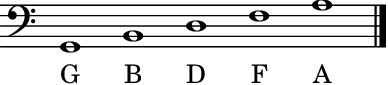
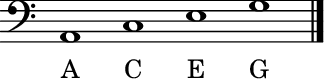
Ledger lines work exactly as before. Above the bass stave: the top line is A, the space above it is B, and the first ledger line above is middle C. Below: the space under the bottom line is F, and the first ledger line below is E.
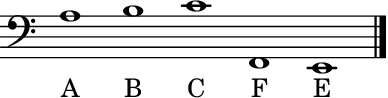
Middle C joins the two clefs
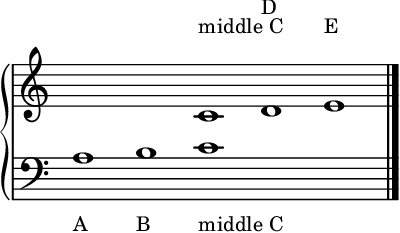
Notice what just happened. Middle C sits on the first ledger line below the treble stave and on the first ledger line above the bass stave. Same key on the piano, two written positions. When piano music braces a treble stave and a bass stave together, the pair is called the grand stave, and middle C floats between the two staves on its own short ledger line. The two clefs are not separate worlds. They are one continuous range of pitches, overlapping at middle C.
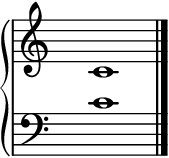
Read the two staves as one ladder and the join becomes obvious. Climb the bass stave to A on its top line, step up to B in the space above, and the next step is middle C on its ledger line. Carry on into the treble stave and the same middle C is the note on the ledger line below it, with D in the space above and E on the bottom line.
Writing a note at the same pitch in the other clef
The pitch section of the exam asks this directly: here is a note in one clef, write it at the same pitch in the other. At Grade 1, with one ledger line allowed, middle C is the one pitch the two staves share, so these questions are about middle C itself. The method is worth learning now because Grade 2's second ledger line widens the overlap and Grade 4 adds a third clef.
Work in three steps. Name the printed note using its own clef's landmarks. Say the name out loud, with the word "middle" if it applies. Then find that named pitch in the target clef by counting from a landmark you trust there, not by copying the shape of the note on the page. A note drawn one ledger line below a treble stave and a note drawn one ledger line above a bass stave look nothing like each other, and they are the same key on the piano.
A practical consequence: if you can already read treble clef, do not learn bass clef by translating ("this looks like an E in treble, so it must be..."). That habit is slow and error-prone. Learn the bass clef's own landmarks, especially the F line (the one with the dots), middle C above the stave, and the bottom-line G.
5. Note values
The stave and clef tell you which note. The shape of the note tells you how long it lasts. Grade 1 uses five note values.
| Note value | Beats in 4/4 | What it looks like |
|---|---|---|
| Semibreve | 4 | a hollow oval head, no stem |
| Minim | 2 | a hollow head with a stem |
| Crotchet | 1 | a filled-in head with a stem |
| Quaver | ½ | a filled-in head with a stem and one tail |
| Semiquaver | ¼ | a filled-in head with a stem and two tails |

Two things separate one shape from the next: whether the head is hollow or filled, and how many tails the stem carries. Hollow head with no stem is the semibreve; hollow with a stem is the minim; from the crotchet down the head is filled and the tails do the counting, none for a crotchet, one for a quaver, two for a semiquaver. Every smaller value in later grades simply adds another tail.
ABRSM uses the British names throughout, and so does this guide. For reference, the American equivalents are whole note (semibreve), half note (minim), quarter note (crotchet), eighth note (quaver) and sixteenth note (semiquaver). Learn the British set; the exam uses no other.
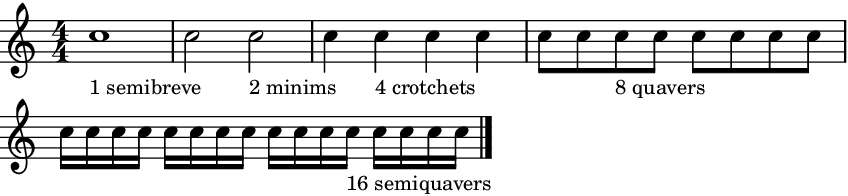
The values relate by doubling. Each note lasts exactly twice as long as the next smaller one:
1 semibreve = 2 minims = 4 crotchets = 8 quavers = 16 semiquavers
That doubling chain is worth memorising cold, because rhythm questions at every grade come back to it. How many quavers fill the time of a minim? Four, because a minim is two crotchets and each crotchet is two quavers. How many semiquavers make a crotchet? Four, by the same reasoning one step further down.
Stems: which way and which side
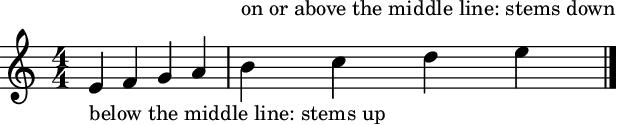
Stem direction follows the note's position on the stave:
- Head below the middle line: stem points up, drawn on the right side of the head.
- Head on or above the middle line: stem points down, drawn on the left side of the head.
- A note on the middle line may take either direction, though down is usual.
The rule exists to keep stems inside the stave rather than poking far above or below it. A stem is roughly an octave long (about three and a half stave-spaces).
Tails and beams
A single quaver carries a curved tail on the end of its stem. The tail always hangs on the right side of the stem, whichever way the stem points. When two or more quavers sit side by side, their tails are usually replaced by a beam, a thick straight line joining the stems. Beaming exists for the reader's benefit: it bundles short notes into beats so the eye can find the pulse at a glance.
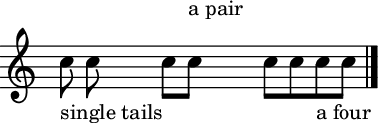
The semiquaver works the same way with one extra layer. On its own it carries two tails; beamed to its neighbours it takes two beams, one above the other. The count never changes: two tails alone, two beams in a group. A quaver and two semiquavers can share a group, and then the beams say which is which. The upper beam runs the whole length of the group, because every note in it is at least a quaver; the lower beam covers only the semiquavers.

Which notes may share a beam, and where a group must stop, is decided by the time signature. Chapter 9 sets out the rules.
6. Rests
Silence is measured just as exactly as sound. Every note value has a matching rest, a symbol meaning "this much silence".
| Rest | Beats in 4/4 | How to draw it |
|---|---|---|
| Semibreve rest | 4, and a whole bar in any time signature (see below) | a small solid block hanging below the fourth line |
| Minim rest | 2 | a small solid block sitting on top of the middle line |
| Crotchet rest | 1 | a vertical squiggle, like a stylised lightning stroke, centred on the stave |
| Quaver rest | ½ | a small mark like the figure 7 with a blob on its upper tip |
| Semiquaver rest | ¼ | the same mark with two blobs on a longer stroke |

The quaver and semiquaver rests count their blobs the way the notes count their tails: one blob for the quaver, two for the semiquaver. Get into the habit of counting them rather than judging by overall shape, because at a glance the two symbols look almost identical.
The two block rests are easy to confuse, and examiners know it. A memory aid that works: the semibreve rest is heavier (four beats), so it hangs below its line; the minim rest is lighter (two beats), so it sits on top of the line.
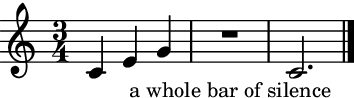
One special convention: a whole bar of silence is shown by a semibreve rest regardless of the time signature. A silent bar of 3/4 still takes a semibreve rest, even though a semibreve note would be too long for the bar. Read the semibreve rest as meaning "rest for the whole bar" and this stops being confusing.
7. The dot and the tie
The dot
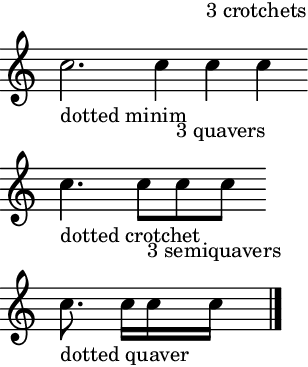
A small dot placed after a note-head makes the note half as long again. The dot adds half of the note's own value, and one useful consequence follows at once: a dotted note always equals three of the next value down.
| Dotted note | Its own value plus half | Equals |
|---|---|---|
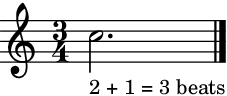
| Dotted minim | 2 + 1 | 3 crotchets, so 3 beats in 4/4 |
| Dotted crotchet | 1 + ½ | 3 quavers, so 1½ beats in 4/4 |
| Dotted quaver | ½ + ¼ | 3 semiquavers, so ¾ of a beat in 4/4 |
The dotted minim is the one you meet first, because it fills a whole bar of 3/4 with a single sound.
The dotted crotchet and the dotted quaver are almost always followed by the small note that completes the beat: a dotted crotchet plus a quaver fills two beats, and a dotted quaver plus a semiquaver fills one. That second pairing is the springy long-short figure you hear in marches and hornpipes, and it is the commonest place a semiquaver turns up at this grade.
Work out any dotted value by writing the sum down rather than guessing. A dotted quaver in a 4/4 bar is ½ + ¼ of a crotchet beat, which is ¾ of a beat, which is three semiquavers. Guessing here is where rhythm marks go missing.
Rests can be dotted too, but the exam does not ask for dotted rests until Grade 2. When a whole bar of 3/4 is silent, use the semibreve rest described above; anywhere else, write two or more plain rests that show the beats.
The tie
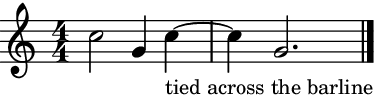
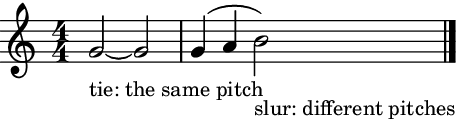
A tie is a short curved line joining two notes of the same pitch, head to head. The two written notes become one continuous sound lasting their combined length. You play the first note and hold it; the second is not struck again.
Ties exist to write durations that a single note cannot show. The clearest case is a sound that lasts across a barline: no single note may cross a barline, so you write a note at the end of one bar, a note at the start of the next, and tie them. Ties are also used inside a bar to keep the beats visible, which is the subject of chapter 9.
Tie or slur? Learn the difference now
A slur looks like a tie: the same curved line. The difference is what it connects. A tie joins two notes of the same pitch and adds their lengths. A slur joins notes of different pitches and is an instruction about playing style: perform them smoothly, in one connected gesture (the Italian word is legato). If the curve joins two G's on the same line, it is a tie. If it arches over a G, an A and a B, it is a slur. Exam questions test this distinction regularly, because it is cheap to test and often gets rushed.
8. Beats, bars and time signatures
The pulse
Nearly all music moves over a steady underlying beat, the pulse you tap your foot to. Beats group themselves naturally into recurring patterns of strong and weak: ONE-two, ONE-two-three, ONE-two-three-four. Written music captures those groups as bars (American: measures), separated by vertical barlines. The end of a piece takes a final barline: a thin line followed by a thick one.
Barlines are a reading aid above all. They chop the music into equal parcels so that performers always know where the strong beat falls.
The time signature
The time signature is the pair of stacked numbers written once at the start of the music, after the clef (and after the key signature, when there is one). It is not a fraction and has no dividing line.
- The top number says how many beats each bar contains.
- The bottom number says which note value carries one beat.
At Grade 1 the bottom number is always 4, meaning a crotchet beat. (Why 4? Because a crotchet is a quarter of a semibreve, and the code uses the American logic of "quarter note". A bottom number of 2 would mean minim beats, and 8 would mean quaver beats. Both arrive in Grade 2.)
| Time signature | Beats per bar | Character |
|---|---|---|
| 2/4 | two crotchet beats | strong-weak; the feel of a march |
| 3/4 | three crotchet beats | strong-weak-weak; the feel of a waltz |
| 4/4 | four crotchet beats | strong-weak-medium-weak; the most common metre of all |
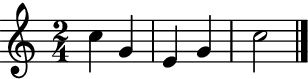
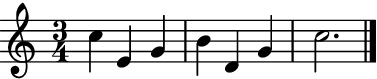
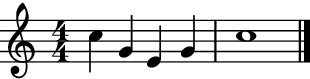
4/4 is so common that it has a nickname, common time, and an alternative symbol: a large C in place of the numbers. The C is not actually short for "common". It survives from a medieval notation system that used a broken circle. But the nickname is harmless and everyone uses it. The C symbol is formally examined from Grade 3; learn to read it as 4/4 now, because printed music is full of it.
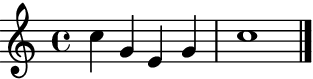
In 4/4, beat 3 carries a secondary stress, lighter than beat 1 but stronger than beats 2 and 4. That is why a bar of 4/4 tends to feel like two halves.
Every bar must add up
The note and rest values in a bar must total exactly the number of beats the time signature promises. Not roughly: exactly. When you complete a bar with rests in an exam question, count what is already there, work out what is missing, and write rests that account for every missing fraction of a beat.
Adding up is only half the job. The contents of the bar also have to be laid out so that a reader can see where each beat begins, and that is the subject of the next chapter.
The anacrusis
Some tunes do not begin on a downbeat. "Happy Birthday" starts with two notes that lead into the first strong beat. Written down, such a piece opens with an incomplete bar, called an anacrusis (also "upbeat"). Two conventions follow:
- The anacrusis bar is not counted as bar 1; the first complete bar is.
- The final bar of the piece is usually shortened so that the anacrusis and the final bar add up to one complete bar between them. A piece in 3/4 opening with a one-beat anacrusis will normally close with a two-beat bar.
So if a piece you are practising opens with a bar that seems too short, check its last bar before deciding something is wrong. Questions on incomplete opening bars belong to a later grade; the convention is worth recognising now because so much music uses it.

9. Grouping notes and rests within the bar
A bar can hold exactly the right number of beats and still be written wrongly. The contents of a bar have to show the beats as well as total them, and the conventions that make them do so are called grouping. A good share of the rhythm section of the exam turns on this, and the rules are short.
The principle
In 2/4, 3/4 and 4/4 the crotchet is the beat. Anything shorter than a crotchet is joined to its neighbours by beams so that each beat appears as one visible bundle. A reader glancing at a bar should be able to see where beat 2 starts without counting up from the barline.
Almost every rule below comes out of that one idea. Where a rule looks arbitrary, ask what it does to the visibility of the beat, and it usually explains itself.
Beaming quavers and semiquavers
- Beam within the beat. Two quavers, or four semiquavers, fill one crotchet beat and take one beam group.
- A group may mix the two values. A quaver plus two semiquavers, or two semiquavers plus a quaver, still fills a beat and still takes one group; the upper beam runs the length of the group and the lower beam covers the semiquavers only.
- In 4/4 you may join two beats into a group of four quavers, but only across beats 1 and 2, or across beats 3 and 4. Nothing beams across the middle of the bar, because beat 3 carries a stress and the eye must be able to find it.
- In 3/4 write three separate pairs of quavers, one to a beat. Beaming six quavers as two groups of three makes a waltz bar look like compound time, which arrives at Grade 3.
- In 2/4 the bar is only two beats long, so four quavers may be beamed as two pairs or all four together. Both are accepted.
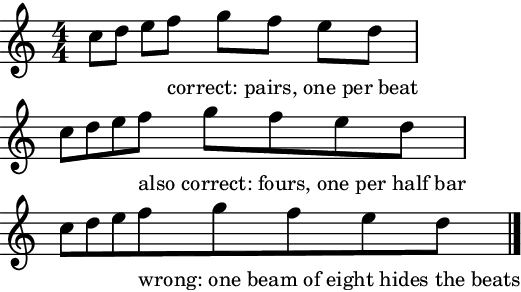
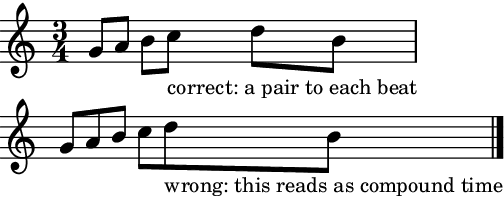
A group also has to stop when something ends it: a note of a crotchet or longer, a rest, or a barline. Beams never cross a barline, and a note is never beamed to a rest.
Grouping rests
Rests follow the same principle, with one difference. Rests are never beamed and never tied, so all the work is done by choosing the right rest and the right number of them.
- Finish the beat you are in before writing a longer rest. Half a beat of silence is a quaver rest; a quarter of a beat is a semiquaver rest.
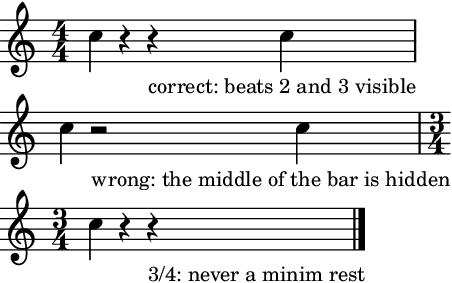
- In 4/4 a minim rest may fill beats 1 and 2, or beats 3 and 4. It may not fill beats 2 and 3, because that hides the middle of the bar. Write two crotchet rests there instead.
- In 3/4 do not use a minim rest at all. Crotchet rests show the three beats; a minim rest would blur two of them together.
- A whole bar of silence takes a semibreve rest in every time signature, as chapter 6 explained.
- Rests are not dotted at this grade.
Ties inside the bar
Notes follow the same principle as rests, and they have one device rests do not: the tie. A note that starts on a weak beat and runs across a stressed one buries that stressed beat, so it is written as two shorter notes tied together instead.
The case to know is 4/4, where beat 3 carries the secondary stress. A minim beginning on beat 2 covers beats 2 and 3, and the middle of the bar disappears from the page. Write two crotchets joined by a tie instead: the same pitch, the same two beats of sound, and beat 3 back where the eye can find it. Chapter 7 introduced the tie for crossing a barline; this is its other job.
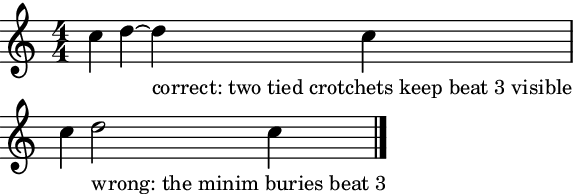
A minim on beat 1 or on beat 3 needs no tie, because each of those fills one half of the bar and stops where the next stress begins. Only the note straddling the middle has to be split. In 3/4 the question hardly arises: beat 1 is the only stressed beat, so a minim on beats 2 and 3 hides nothing and stays a single minim. Rests are the stricter case, as the last section showed, because a rest cannot be tied.
Filling a bar in the exam
A routine that works every time:
- Read the time signature and write down the total the bar must reach.
- Add up what is already printed, beat by beat rather than in one lump.
- Work out what is missing and where it is missing: which beat, and which part of that beat.
- Complete the unfinished beat first, then cover whole empty beats with whole-beat rests.
Take a 4/4 bar containing a crotchet and then a quaver, with nothing else. Beat 1 is complete. Beat 2 is half done, so the first thing you write is a quaver rest. Beats 3 and 4 are empty and form the second half of the bar, so one minim rest is allowed there. The finished bar reads crotchet, quaver, quaver rest, minim rest.
10. Tones, semitones and accidentals
The semitone
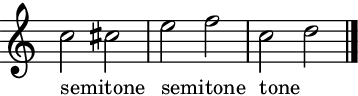
A semitone is the smallest step in standard Western music: the distance from any key on the piano to its nearest neighbour, black or white. C to C♯ is a semitone. E to F is also a semitone, and this is the detail that catches people out: between E and F, and between B and C, there is no black key. Those two pairs of white notes sit a bare semitone apart. The pattern of black keys has gaps at exactly those points, which is what makes the keyboard's geography readable in the first place.
The American name for the semitone is the half step.
The tone
A tone (American: whole step) is two semitones. C to D is a tone: you pass over C♯ on the way. E to F♯ is a tone. B to C♯ is a tone. When you count tones on the keyboard, count keys, not colours, and remember the two gaps at E-F and B-C.
The three accidentals
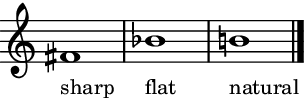
An accidental is a sign placed before a note that alters its pitch:
- The sharp (♯) raises the note by a semitone.
- The flat (♭) lowers the note by a semitone.
- The natural (♮) cancels a sharp or flat, restoring the plain letter-name pitch.
Two rules govern how accidentals behave on the page:
- Position and speech run opposite ways. On the stave the sign comes before the note-head, sitting on the same line or space. In speech and in text the letter comes first: we draw the ♯ and then the note-head, but we say and write "F sharp", F♯.
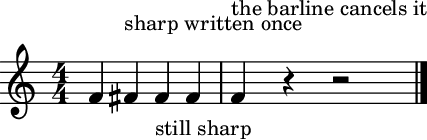
- An accidental lasts until the next barline. It applies to every later note on the same line or space within that bar, without being rewritten. The barline cancels it automatically. If the composer wants the altered pitch again in the next bar, the sign must be written again. (A courtesy reminder natural is often added in the next bar even when not strictly required; it is a kindness to the reader, not a rule.)
Notice the fine print in rule 2: the accidental applies to the same line or space, meaning the same octave position. At Grade 1 questions stay within this simple case.
Enharmonic equivalents
Press the black key between C and D. Approached from C it is C sharp; approached from D it is D flat. One key, two legitimate names. Pairs like this are called enharmonic equivalents: same sound, different spelling. Which spelling is correct depends on musical context, chiefly the key the music is in, and the logic of that will become clear once you know how scales are built. Enharmonic spelling is formally examined from Grade 4, so nothing here is asked of you yet; meeting the idea now makes the key signatures easier to follow. The pairs on the black keys are C♯/D♭, D♯/E♭, F♯/G♭, G♯/A♭ and A♯/B♭.
11. The major scale
What a scale is
A scale is a ladder of notes climbing from a starting note (the keynote, or tonic) to the same letter name an octave higher, using each letter of the musical alphabet exactly once on the way. Scales matter because nearly all the music you will study is built from them. A piece "in G major" draws its notes from the G major scale, opens its ear around G, and comes home to G.
The major scale pattern
What makes a scale major is its exact sequence of tones and semitones:
T, T, S, T, T, T, S
Tone, tone, semitone, tone, tone, tone, semitone. Start on any note, walk that pattern, and a major scale appears. The two semitones always fall between degrees 3 and 4 and between degrees 7 and 8.
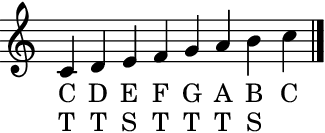
The model is C major, which uses only white notes:
| Degree | 1 | 2 | 3 | 4 | 5 | 6 | 7 | 8 |
|---|---|---|---|---|---|---|---|---|
| Note | C | D | E | F | G | A | B | C |
| Step up to the next note | T | T | S | T | T | T | S |
Check it against the keyboard: E to F is a semitone (no black key between), and so is B to C. The white-note ladder from C happens to place its two natural semitones at exactly the right points. Start anywhere else and you need at least one black key to keep the pattern true.
Building G major, D major and F major
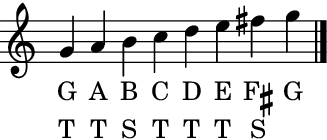
G major. Walk the pattern from G: G to A (tone), A to B (tone), B to C (semitone, correct for degrees 3 to 4), C to D (tone), D to E (tone), E to F? That is only a semitone, but the pattern demands a tone here. Raise the F to F♯: E to F♯ is a tone, and F♯ to G is the required closing semitone. So G major is:
G, A, B, C, D, E, F♯, G
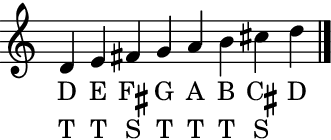
D major. From D: D to E (tone), E to F♯ (tone, so F must be sharpened), F♯ to G (semitone, correct), G to A (tone), A to B (tone), B to C♯ (tone, so C must be sharpened), C♯ to D (semitone). So D major is:
D, E, F♯, G, A, B, C♯, D
F major. From F: F to G (tone), G to A (tone), A to B? That is a tone, but degrees 3 to 4 need a semitone. Lower the B to B♭: A to B♭ is a semitone. Then B♭ to C (tone), C to D (tone), D to E (tone), E to F (semitone). So F major is:
F, G, A, B♭, C, D, E, F
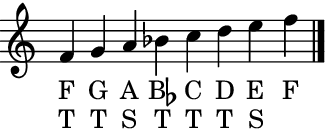
Notice that each scale uses every letter name once. That is why F major needs B♭ and not A♯, even though the two names sound the same: the scale already has an A, and it must have some kind of B.
Degrees of the scale
Each note of a scale is a degree, numbered 1 to 8 from the tonic upwards. Degree 8 is the tonic again, an octave up. At Grade 1, numbers are all you need; the technical names (supertonic, dominant and the rest) arrive at Grade 4. But one word is worth knowing now: degree 1, the keynote, is the tonic, and it gives the scale, the key and the tonic triad their names.
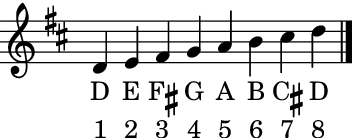
The exam asks the question both ways round. Given a key and a printed note, say which degree it is; given a key and a number, name or write the note. Neither is hard once you can produce the scale itself, and the whole trick is to start from the tonic and count up, out loud, using the letters of that scale. In D major, which degree is B? D is 1, E is 2, F♯ is 3, G is 4, A is 5, B is 6. Which note is degree 7 of F major? F, G, A, B♭, C, D, E: the answer is E.
Two habits save marks here. Always count upwards from the tonic, never downwards from the printed note, because the numbering is defined that way. And use the scale's own spellings as you count: in F major the fourth letter you say is B flat, not B.
Key signatures
A piece in G major needs F♯ throughout. Writing a sharp sign before every single F would clutter the page, so the sharp is declared once, at the start of each line of music, immediately after the clef. That declaration is the key signature. It applies to its note in every octave and for the whole piece, unless cancelled by an accidental or changed by a new key signature.
The Grade 1 keys:
| Key | Key signature |
|---|---|
| C major | no sharps or flats |
| G major | F♯ |
| D major | F♯ and C♯ |
| F major | B♭ |
The order in which sharps or flats appear in a key signature is fixed and universal:
- Sharps: F, C, G, D, A, E, B. A traditional sentence to hold the order: "Father Charles Goes Down And Ends Battle."
- Flats: B, E, A, D, G, C, F, which is the same series reversed: "Battle Ends And Down Goes Charles' Father." The first four flats conveniently spell the word BEAD.
So a one-sharp key signature is always F♯ and never anything else. A two-sharp signature is always F♯ then C♯, written in that order and in their standard positions on the stave. In the treble clef, F♯ sits on the top line and C♯ in the third space; in the bass clef, each sits two positions lower (F♯ on the fourth line, C♯ in the second space).
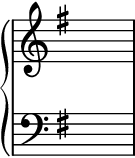
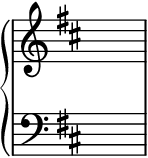
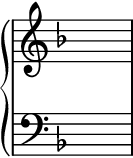
Two quick tricks connect signatures to keys, and they scale up to every key you will ever meet. For sharp keys, the last sharp of the signature is one semitone below the tonic: see F♯, think "one up is G", name G major. For flat keys the trick (the second-to-last flat names the key) needs at least two flats, so at this grade simply learn that one flat means F major.
Writing scales in the exam
A Grade 1 scale question may ask for a scale ascending or descending, in the treble clef or the bass clef, with a key signature or with accidentals written against the notes instead. Read which version is wanted before you write a single note. If accidentals are asked for, place the sharp or flat sign immediately before each note that needs it, on the correct line or space. If a key signature is used, the notes themselves carry no signs.
Check the direction, because a descending scale starts at the top. A beautifully correct ascending G major scale scores nothing if the question said descending. Descending, the tone and semitone pattern is the ascending one read backwards: semitone, tone, tone, tone, semitone, tone, tone. The semitones stay in the same two places, between degrees 8 and 7 and between degrees 4 and 3, because they are the same two gaps seen from the other end.
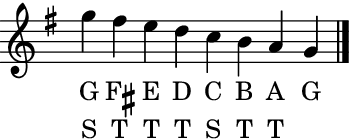
Both clefs are examined, and a scale written in the bass clef is the same eight letters in the same order; only the landmarks change. Take the tonic from its position in the bass clef and step up through the alphabet from there. Choose an octave that keeps the whole scale close to the stave, because a scale that runs off the top needs ledger lines you do not have at this grade.
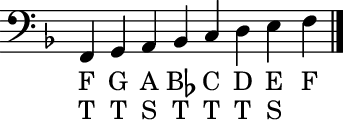
One last check before you move on: count the note-heads. A one-octave scale has eight of them, and a scale with seven or nine is the commonest slip on the page.
12. Tonic triads
A triad is a three-note chord built by stacking thirds. Take a scale, choose a note, add the note two letters above, then add the note two letters above that. The tonic triad is the triad built on degree 1, and it uses degrees 1, 3 and 5 of the scale.
Its three notes have names: the root (degree 1, the note the chord is named after), the third (degree 3) and the fifth (degree 5).
| Key | Tonic triad | Root, third, fifth |
|---|---|---|
| C major | C, E, G | C is the root, E the third, G the fifth |
| G major | G, B, D | G, B, D |
| D major | D, F♯, A | D, F♯, A |
| F major | F, A, C | F, A, C |
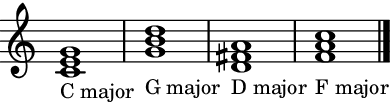
Note the F♯ in the D major triad. The triad takes its notes from the scale, and the scale of D major contains F♯, not F. If the triad is written with a key signature, the signature supplies the sharp; if it is written without one, the ♯ must appear as an accidental. Forgetting it is the most common triad error at this grade.
On the stave, a root-position triad is a tidy stack: all three notes on consecutive lines, or all three in consecutive spaces. If a triad you have written straddles lines and spaces unevenly, look again.
Root position means the tonic is the lowest of the three notes, and at Grade 1 that is the only arrangement asked for. Write the tonic first, then put the other two notes directly above it.
Triads are examined in the bass clef as readily as in the treble, and the picture is the same in both: three note-heads, all on lines or all in spaces, with the tonic at the bottom. Only the landmarks change.
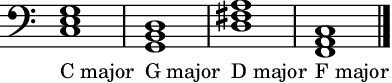
Choose the octave so that the whole triad sits on or near the stave. In the bass clef, C major sits comfortably in the second, third and fourth spaces, and F major reaches one space below the bottom line for its root.
Played together, the tonic triad's three notes make the "home" chord of the key, the sound the music wants to end on. Triads on other degrees of the scale arrive at Grade 4, and chords in other arrangements at Grade 5. At Grade 1, tonic triads of the four keys are all that is asked.
13. Intervals above the tonic
An interval is the distance in pitch between two notes. Grade 1 narrows the topic in three ways, and knowing the narrowing is half the battle.
- The interval is measured above the tonic of a stated key. The lower note is always degree 1; the question is how far above it the other note lies.
- The answer is a number only: a 3rd, a 5th, an octave. Major, minor and perfect are Grade 3 and Grade 4 business.
- The two notes are melodic, written one after the other rather than stacked into a chord.
So an interval question at this grade reads: "this melody is in F major; name the interval between these two notes", and the first of the two notes will be F.
The method: count letter names from the lower note to the upper note, including both ends.
- C up to D: count C, D. Two letters, so a 2nd.
- C up to E: count C, D, E. Three letters, so a 3rd.
- C up to F is a 4th; C up to G a 5th; C up to A a 6th; C up to B a 7th; C up to the next C an 8th, usually called an octave.
- Two notes at the same pitch are a unison, though the exam's interval questions run from the 2nd to the octave.
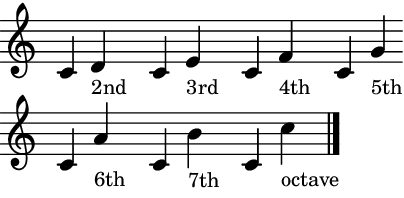
The counting is inclusive: both the bottom note and the top note are counted. This trips people up because ordinary distance-counting counts gaps ("C to E is two steps away"). Interval numbering counts letter names, not gaps, so C to E is a 3rd. Drill the inclusive habit until it feels natural.
Sharps and flats do not change the number. In D major, D up to F♯ counts D, E, F: a 3rd, exactly as D up to F would be. The accidental changes the sound and it changes the interval's quality, but quality is not asked for here, so ignore it and count letters.
A useful shortcut follows from the fact that the lower note is always the tonic: the interval number and the degree number are the same thing. Degree 5 of the scale stands a 5th above the tonic; degree 3 stands a 3rd above it. If you can number the degrees, as chapter 11 showed, you can name these intervals without counting a second time.
A quick visual check on the stave: two notes both on lines, or both in spaces, form an odd-numbered interval (3rd, 5th, 7th). One on a line and one in a space form an even-numbered interval (2nd, 4th, 6th, octave). This will not name the interval for you, but it will catch a miscount.
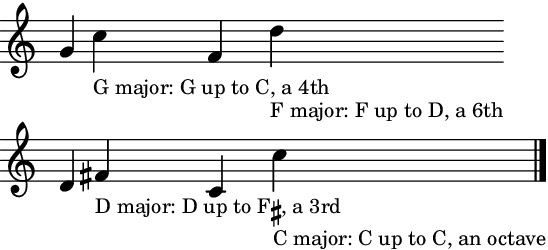
Worked examples, one in each Grade 1 key, each measured from that key's tonic:
- In G major, G up to C: G, A, B, C. A 4th.
- In F major, F up to D: F, G, A, B, C, D. A 6th.
- In D major, D up to F♯: D, E, F. A 3rd.
- In C major, C up to the C above: an octave, also written 8ve.
14. Italian terms and signs
Composers have used Italian for performance directions since the seventeenth century, and the exam expects a working vocabulary from the very first grade. This is the most reliable source of easy marks in the paper: there is nothing to work out, only words to know. Little and often is the way to learn them; flashcards work well.
Tempo: how fast
| Term | Meaning |
|---|---|
| Adagio | slow |
| Andante | at a walking pace |
| Moderato | at a moderate speed |
| Allegretto | fairly quick, not as fast as allegro |
| Allegro | fast, lively |
| Presto | very fast |
Moderato also appears attached to other words, as in allegro moderato, moderately fast.
Changing the tempo
| Term | Abbreviation | Meaning |
|---|---|---|
| Ritardando | ritard. or rit. | gradually getting slower |
| Rallentando | rall. | gradually getting slower |
| Accelerando | accel. | gradually getting faster |
| A tempo | back to the original speed |
Ritardando and rallentando mean the same thing for exam purposes. A tempo typically follows one of them, restoring the earlier pace.
Character: how it should sound
Not every direction is about speed or volume. Two words at this grade describe the manner of playing:
| Term | Meaning |
|---|---|
| Cantabile | in a singing style |
| Dolce | sweetly, gently |
Cantabile comes from cantare, to sing, and it asks for a line shaped and phrased the way a singer would shape it, with the melody carried above whatever else is happening. Dolce is the same family of instruction from the other direction: not louder, not faster, just softer in manner. Both attach to a passage rather than to a single note, and both stay in force until something contradicts them.
Finding your way round the music
Composers repeat sections rather than write them out twice, and a few Italian words act as road signs telling the player where to go next:
| Term | Abbreviation | Meaning |
|---|---|---|
| Da capo | D.C. | from the beginning, so go back to the start |
| Fine | the end | |
| Al fine | as far as Fine |
The two appear together as D.C. al Fine, printed at the end of a section. It means: go back to the beginning and play again as far as the word Fine, which is printed earlier in the piece, and stop there. The word Fine is pronounced "fee-nay" and has nothing to do with the English word spelt the same way.

In the example, the playing order is bars 1 to 4, then bars 1 and 2 again, and the piece ends on the last note of bar 2. Questions about D.C. al Fine usually ask exactly that: which bar does the music finish on, or how many times is a given bar played.
Dynamics: how loud
| Sign | Full Italian | Meaning |
|---|---|---|
| pp | pianissimo | very quiet |
| p | piano | quiet |
| mp | mezzo-piano | moderately quiet |
| mf | mezzo-forte | moderately loud |
| f | forte | loud |
| ff | fortissimo | very loud |
Mezzo means "half", which is why it softens whatever it attaches to. From quietest to loudest, the ladder runs pp, p, mp, mf, f, ff.
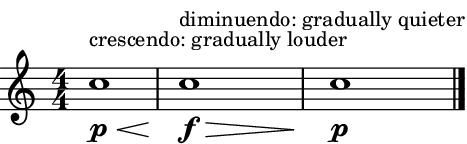
Gradual changes of volume have words and symbols. Crescendo (cresc.) means gradually getting louder; diminuendo (dim.) or decrescendo (decresc.) means gradually getting quieter. Both are often drawn as "hairpins": a pair of lines opening outwards (<) for crescendo, closing inwards (>) for diminuendo. The hairpin's wide end is the loud end.
Articulation and other signs
The signs on the Grade 1 list are five: the crescendo and diminuendo hairpins above, the slur, the tie, and the staccato dot.
| Sign or term | Meaning |
|---|---|
| staccato (stacc.; a dot above or below the note-head) | short, detached |
| legato, shown by a slur | smooth and connected |
| tie (a curve joining two notes of the same pitch) | one sound lasting both values |
Three more signs turn up constantly in real music and are formally examined from Grade 2 or 3. Learn them now; they cost nothing and they appear in the melodies you practise on.
| Sign | Meaning |
|---|---|
| accent (> above or below a note) | attack this note more strongly |
| pause, or fermata (an arc with a dot, over a note or rest) | hold it longer than its written value, at the performer's discretion |
| repeat marks (double barline with two dots) | play the enclosed passage again |


The staccato dot sits above or below the note-head, on the opposite side from the stem, and should not be confused with the duration dot, which sits after the note-head and lengthens it. One dot shortens (staccato), the other lengthens (the added half-value). Position is everything.
15. Questions about a melody
The last section of the paper prints a short melody, in the treble clef or the bass clef, and asks a few questions about it. Nothing new is tested. The questions draw on the rest of the syllabus and apply it to a piece of music rather than to an isolated symbol, which is the point: theory is only worth anything once you can use it on a page of notes.
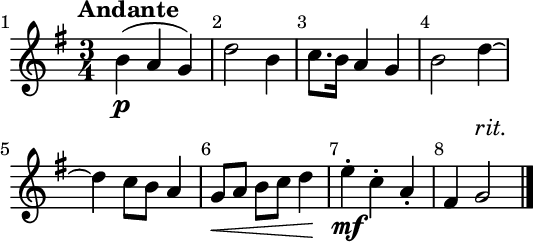
What makes this section feel different is that you have to find the thing before you can answer about it. Here is a melody of the sort used, with its bars numbered as the exam numbers them.
What gets asked
The questions come from a small set of families, and once you recognise the family you know which chapter of this book to reach for.
| Family | Typical question |
|---|---|
| Key | What key is this melody in? |
| Time | How many crotchet beats are there in a bar? |
| Pitch | Give the letter name of the highest note. In which bar is the lowest note? |
| Degrees and intervals | Which degree of the scale is the last note? Name the interval between the first two notes of bar 6. |
| Rhythm | How many semiquavers are there? Which bar contains a dotted quaver? |
| Signs | What does the curved line in bar 1 mean? What do the dots in bar 7 tell the player to do? |
| Terms | What does Andante mean? What does mf mean? |
The melody worked through
Take those questions in order against the melody above.
Key. G major. The key signature has one sharp, F♯, and the only one-sharp major key at this grade is G. The last note is G, the tonic, which confirms it. Get the key first, because the degree and interval questions all depend on it.
Time. 3/4: three crotchet beats to a bar. Count bar 2 to prove it to yourself, a minim and a crotchet, two beats plus one.
Pitch. The highest note is E, in the top space, in bar 7. The lowest is F♯, in the bottom space, in bar 8. Do not answer "the highest note is in bar 6" out of habit because that is where the crescendo is; look at the note-heads.
Degrees and intervals. The last note is G, which is degree 1, the tonic. Bar 6 begins on G and moves to A, so the interval is a 2nd above the tonic.
Rhythm. There is one semiquaver in the whole melody, in bar 3, where it completes the beat begun by the dotted quaver. Bar 3 is therefore also the answer to the dotted-quaver question.
Signs. The curve in bar 1 spans three different pitches, so it is a slur, asking for legato playing. The curve joining bars 4 and 5 links two D's of the same pitch, so it is a tie, and that D lasts two crotchet beats, one on each side of the barline. The dots on the notes in bar 7 are staccato: short and detached. Each dot sits on the opposite side of the head from the stem, which is why the first two are above the head and the third below it.
Terms. Andante means at a walking pace. mf is mezzo-forte, moderately loud. The hairpin in bar 6 is a crescendo, so the melody grows from p into that mf, and rit. over the last bar asks the player to slow down at the end.
A method for the section
Four habits get you through it quickly.
- Read the key signature and the last note before anything else, and fix the key in your head. Half the questions unlock from it.
- Read the time signature and count one bar through to be sure you know what the beat is.
- Scan for the odd symbol out. A melody at this grade usually carries one slur, one tie and one group of staccato dots, and whatever appears once is what you will be asked about.
- Answer in the currency asked for. A letter name is a letter, a degree is a number, an interval is a number, a term wants its English meaning. Writing "quite fast" when the question wanted the bar number scores nothing.
16. Common mistakes at Grade 1
Most lost marks at this grade come from a small set of avoidable errors. Check your own work against this list.
- Counting intervals by gaps instead of letter names, giving answers one too small. C to G is a 5th, not a 4th.
- Measuring an interval from the printed lower note when the question asked for it above the tonic. At this grade the bottom note of the interval is always degree 1 of the stated key.
- Treating a semiquaver as half a beat. It is a quarter of a crotchet beat; the quaver is the half.
- Confusing the semibreve rest (hangs below the fourth line) with the minim rest (sits on the middle line), or the quaver rest with the semiquaver rest. Count the blobs: one for the quaver, two for the semiquaver.
- Writing a tie between two different pitches, or calling a slur a tie. Same pitch: tie. Different pitches: slur.
- Forgetting the F♯ when writing the D major tonic triad without a key signature.
- Writing the sharps of a key signature in the wrong order, or on the wrong lines and spaces. There is exactly one correct layout per clef; copy it until it is automatic.
- Filling a bar with the right number of beats but grouping them so the beats are invisible: beaming all the quavers of a 4/4 bar into one group, beaming across the middle of a 4/4 bar, or writing six quavers in 3/4 as two groups of three.
- Using a minim rest where it hides a beat: across beats 2 and 3 of a 4/4 bar, or anywhere in 3/4.
- Missing the direction of a scale question (ascending versus descending), the clef it is to be written in, or the choice between key signature and accidentals.
- Adding a second ledger line. Grade 1 questions stay within one ledger line above and below each stave.
- Muddling the two kinds of dot: after the note-head means longer; above or below the head means staccato.
- Forgetting that an accidental lasts to the end of the bar, and reading (or writing) the note as if the sign had expired early.
- Placing a written accidental after the note instead of before it. The sign always comes first on the stave, even though we say the letter first.
17. Practice questions
Answers follow in the next section. Attempt everything before looking. The questions run in the order of the exam's seven sections, so a run of wrong answers in one stretch tells you which chapter to go back to.
- How many semiquavers last the same time as one minim?
- How many crotchets last the same time as one dotted minim, and how many quavers make one dotted crotchet?
- A bar of 4/4 begins with a crotchet, then a quaver, and nothing else is printed. Complete the bar with rests, naming them in order.
- A bar of 4/4 contains a minim followed by a crotchet. What single rest completes the bar, and where does it sit on the stave?
- Why may six quavers in a bar of 3/4 not be beamed as two groups of three?
- Give two different rhythms, using different note values, each filling exactly one bar of 3/4.
- A note in a 4/4 bar needs to sound for the last beat of that bar plus the first beat of the next. How is this written, and why can it not be written as a single note?
- On the treble stave, which note sits in the top space? And which note is written on the middle line?
- On the bass stave, which note is written on the fourth line up? How does this connect to the clef's other name?
- A note is printed on the first ledger line above the bass stave. Name it, and say where the same pitch is written in the treble clef.
- Write out the G major scale ascending, and mark where its two semitones fall. Then say where the semitones fall when the same scale descends.
- What is the key signature of D major, and in what order are its sharps written?
- Name the notes of the F major scale ascending, and say which of them needs an accidental when no key signature is used.
- Which degree of the G major scale is E? And which note is degree 4 of F major?
- In F major, name the interval from the tonic up to C.
- In D major, name the interval from the tonic up to F♯, and say why the sharp does not change the number.
- Give the notes of the F major tonic triad, naming each note's role in the chord.
- What does allegretto mean, and is it faster or slower than allegro?
- What does the sign mp mean, and where does it fall on the ladder of dynamics from pp to ff? And what do cantabile and dolce ask the player for?
- A piece has the word Fine printed over bar 8 and D.C. al Fine at the end of bar 16. What does the player do, and on which bar does the music end?
- E to F is a semitone, yet F to G is a tone. Explain, using the keyboard, why these two neighbouring pairs differ.
- Look again at the melody in chapter 15. Which bar holds the only semiquaver, and what note value comes immediately before it? Name the interval between the first two notes of bar 6.
18. Answers
- Eight. A minim is two crotchets, and each crotchet holds four semiquavers.
- Three crotchets fill a dotted minim (2 + 1). Three quavers fill a dotted crotchet (1 + ½). A dotted note always equals three of the next value down.
- Beat 1 is complete and beat 2 is half done, so a quaver rest comes first. Beats 3 and 4 are then empty, and because they are the second half of the bar one minim rest may cover them both. The order is quaver rest, then minim rest.
- The bar so far holds 2 + 1 = 3 beats, so one crotchet beat is missing. A crotchet rest completes it, drawn as the vertical squiggle centred in the middle of the stave.
- Because the grouping must show the crotchet beat, and 3/4 has three of them. Two groups of three divide the bar in two, which is what compound time looks like on the page. Write three pairs instead.
- Any two rhythms totalling three crotchet beats, for example: a dotted minim; a minim plus a crotchet; three crotchets; a crotchet, a beamed pair of quavers and a crotchet; a dotted crotchet, a quaver and a crotchet; four semiquavers beamed together followed by two crotchets.
- Write a crotchet on beat 4, a barline, then a crotchet on beat 1 of the next bar, joined by a tie. It cannot be one note because no single note value may cross a barline; the tie is the device that lets a sound continue through one.
- The top space of the treble stave is E (the spaces spell F, A, C, E going up). The middle line is B (the lines are E, G, B, D, F).
- The fourth line of the bass stave is F, the F below middle C. The bass clef is also called the F clef because its two dots bracket exactly this line.
- Middle C. In the treble clef the same pitch is written on the first ledger line below the stave. One key on the piano, two written positions, and it is the note at which the two staves join.
- G, A, B, C, D, E, F♯, G. Ascending, the semitones fall between B and C (degrees 3 and 4) and between F♯ and G (degrees 7 and 8). Descending, the scale runs G, F♯, E, D, C, B, A, G and the semitones are the same two gaps met from the other side: G down to F♯ at the start, and C down to B in the middle.
- Two sharps: F♯ and C♯, always written in that order, F♯ first.
- F, G, A, B♭, C, D, E, F. Only B♭ needs an accidental. It has to be B flat rather than A sharp because the scale already has an A and every letter is used once.
- E is degree 6 of G major: G 1, A 2, B 3, C 4, D 5, E 6. Degree 4 of F major is B♭: F 1, G 2, A 3, B♭ 4. Count upwards from the tonic both times.
- A 5th. Count inclusively: F, G, A, B♭, C is five letter names.
- A 3rd: D, E, F is three letter names. The sharp alters the pitch but not the letters counted, and Grade 1 asks for the number alone.
- F, A and C. F is the root, A is the third, C is the fifth.
- Allegretto means fairly quick. It is slower than allegro.
- Mp is mezzo-piano, moderately quiet. It sits in the middle of the ladder: louder than p, quieter than mf. Cantabile asks for a singing style, and dolce for sweet, gentle playing; neither is an instruction about speed or volume.
- Play bars 1 to 16, then go back to the beginning and play again as far as the word Fine. The music ends at the end of bar 8, and bars 1 to 8 are therefore played twice.
- On the keyboard there is no black key between E and F, so they are neighbouring keys, one semitone apart. Between F and G there is a black key (F♯/G♭), so the distance from F to G passes through it: two semitones, which is a tone. The same gap-with-no-black-key happens at B to C, and nowhere else.
- Bar 3 holds the only semiquaver, and the note immediately before it is a dotted quaver; together they fill one crotchet beat. Bar 6 begins G then A, which is a 2nd above the tonic of G major.
Next step: Grade 2 adds triplets, a second ledger line above and below each stave, new time signatures with minim and quaver beats, three more major keys, and your first minor keys. Everything in this guide is assumed knowledge there, so make sure it is secure before moving on.