A complete, self-contained course for the second grade of the ABRSM Music Theory syllabus: the semiquaver and the dotted rhythms, triplets, time signatures with minim and quaver beats, two ledger lines above and below each stave, three new major keys, the first minor keys and the harmonic minor scale, degrees and intervals above the tonic, a wider vocabulary of terms and signs, and a printed melody to answer questions about.
Introduction
Grade 2 is where theory starts to pay compound interest. Nothing in it is new in kind: the rhythms extend a system you already own, the added keys repeat patterns you have already written, and the Italian list simply grows. Yet each small addition multiplies what you can read, and by the end of this grade most simple printed music holds no mysteries of pitch or rhythm for you.
Three arrivals deserve particular respect. The semiquaver brings real figuration into range, and with it the dotted rhythms that give melody its spring. The triplet breaks the neat halving that every note value has obeyed until now, fitting three notes into a space built for two. And the minor keys bring the first genuinely new sound since you began: one key signature now serves two homes, one bright and one dark, and telling them apart is a musician's skill as much as a theorist's.
Keep writing music out by hand, and keep playing what you write. The harmonic minor scale in particular refuses to stay memorised as a formula; sung or played a few times it becomes a sound, and the exam's questions about the raised seventh start answering themselves. Triplets are the same: clap two against three a dozen times and the notation stops looking like arithmetic.
The reference shelf grows with you. Music Notation explains any symbol in full, Rhythm and Metre takes grouping and irregular divisions further than any grade needs, and when the minor scales raise questions this course postpones, Technical Names and Roman Numerals and Musical Modes hold the longer answers.
About this guide and the exam
Grade 2 builds directly on Grade 1, and the syllabus is cumulative: anything from Grade 1 can appear in a Grade 2 paper without warning or re-explanation. Before starting, be sure you are fluent with the treble and bass clefs, note values down to the quaver, the time signatures 2/4, 3/4 and 4/4, the keys of C, G, D and F major, tonic triads, and intervals counted by number. If any of that list feels shaky, go back first; the new material leans on all of it.
The exam is online and multiple choice, marked out of 75 across seven sections worth 15, 15, 15, 10, 10, 5 and 5 marks. Fifty marks is a pass, 60 a Merit and 65 a Distinction. The specification names seven things the paper assesses: rhythm, pitch and transposition, keys and scales, intervals, tonic triads, terms and signs, and music in context. Every chapter in this guide feeds one of them.
Three ideas arrive at this grade. The first is that the beat need not be a crotchet: a time signature can hand the beat to a minim or a quaver instead, and the whole rhythmic system scales to fit. The second is the triplet, which fits three notes into the time of two and so breaks the doubling that has governed every note value so far. The third is the minor key, which brings the relative major-minor pairing and a scale whose seventh degree has to be raised by hand. All three run through every later grade.
What Grade 2 asks of you
By the end of this grade you should be able to:
- read and write notes on up to two ledger lines above and below each stave, in both clefs, and rewrite a note of the clefs' overlap in the other clef at the same pitch
- use the semiquaver, and the dotted semibreve, dotted minim, dotted crotchet and dotted quaver, with their rests, grouped correctly
- work in simple time with minim and quaver beats: 2/2, 3/2, 4/2 and 3/8, alongside the Grade 1 signatures
- group and beam notes and rests correctly in every simple time signature you have met
- write and read triplets, including triplet groups that contain rests
- write the scales, key signatures and tonic triads of A, B flat and E flat major
- explain relative major and minor, and write the harmonic minor scales of A, E and D minor, with their tonic triads
- number the degrees of any scale you have learned, and name intervals above the tonic by number
- use a larger set of terms and signs
- answer a mixed set of questions about a short printed melody
1. The semiquaver
Grade 1 introduced the semiquaver, and nothing about it changes here, but it is worth restating before the new time signatures put it to work. The semiquaver halves the quaver: a quarter of a crotchet beat, so four semiquavers fill one crotchet.
On the page a semiquaver looks like a quaver with a second tail. Beamed in groups, it takes a double beam where quavers take a single one. The American name is the sixteenth note.

The doubling chain runs the whole way from the semibreve:
1 semibreve = 2 minims = 4 crotchets = 8 quavers = 16 semiquavers

Keep working the chain in both directions. How many semiquavers in a minim? Eight. What fraction of a semibreve is a semiquaver? A sixteenth.
The semiquaver rest looks like the quaver rest with a second hook, and lasts a quarter of a beat.
Common one-beat patterns
Within a single crotchet beat, semiquavers combine with quavers into a handful of standard shapes, each beamed as one group so the beat stays visible:
- four semiquavers
- a quaver followed by two semiquavers
- two semiquavers followed by a quaver
- a semiquaver, a quaver, then a semiquaver (less common, but it appears)

Learn to recognise these at sight. Rhythm questions often show a beamed group and ask what it adds up to; if you know the standard shapes, no arithmetic is needed.
2. Dotted notes and dotted rests
The dot rule from Grade 1 is unchanged: a dot written after a note adds half the note's own value, so the dotted note lasts one and a half times as long as the plain one. Grade 1 applied it to the minim, the crotchet and the quaver, and all three stay live. Grade 2 adds one more note, the dotted semibreve, and two dotted rests.
The dotted semibreve is a semibreve plus a minim: three minims, which is six crotchet beats. It fills a bar of 3/2 exactly, in the same way that the dotted minim fills a bar of 3/4, and that is the job it is usually there to do. When a question asks for one note to hold a whole bar of 3/2, this is the note.

The dotted minim is a minim plus a crotchet: three crotchet beats. It fills a bar of 3/4 exactly, which is where you meet it most often. In 3/2, where the minim is the beat, the same symbol is worth one and a half beats instead of three, a good reminder that a note value means a proportion and not a fixed number of beats.
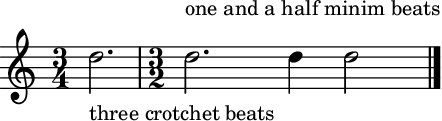
The dotted crotchet is a crotchet plus a quaver: one and a half crotchet beats. Its natural partner is a single quaver, and the pair together fills two beats. This "dotted crotchet, quaver" figure is one of the most common rhythms in all of music; you will find it everywhere from folk songs to symphonies.
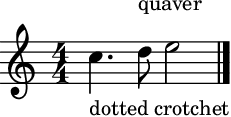
The dotted quaver is a quaver plus a semiquaver: three quarters of a beat. Its natural partner is a single semiquaver, and the pair fills exactly one beat. The "dotted quaver, semiquaver" figure is the classic long-short snap, the rhythm of a swaggering march tune. When beamed, the pair shares a beam, with the semiquaver's second beam shortened to a stub.
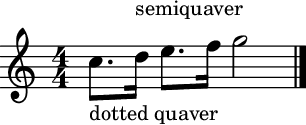
The four of them side by side, measured in crotchet beats:
| Dotted note | Equals | Crotchet beats |
|---|---|---|
| dotted semibreve | semibreve plus minim | six |
| dotted minim | minim plus crotchet | three |
| dotted crotchet | crotchet plus quaver | one and a half |
| dotted quaver | quaver plus semiquaver | three quarters |
Dotted rests
A dot after a rest adds half its value in the same way, and Grade 2 uses two: the dotted crotchet rest, worth one and a half beats of silence, and the dotted quaver rest, worth three quarters of a beat. The dotted quaver rest earns its keep at the start of a beat, where a semiquaver note answers it and the two together fill the beat exactly.
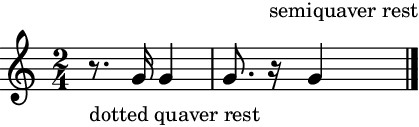
Use dotted rests sparingly in simple time. The purpose of every rest is to let a reader see where the beats fall, so a dotted rest is welcome when it sits inside one beat and unwelcome when its dot swallows the start of the next one. Given the choice between one dotted rest that hides a beat and two plain rests that show it, write the two plain rests. (Compound time, at Grade 3, uses dotted rests as its normal currency, because there the dotted note is the beat.)
A useful habit for any dotted rhythm: convert to the smallest unit and count. A dotted quaver is three semiquavers; a dotted crotchet is three quavers; a dotted minim is three crotchets. If a bar refuses to add up, recount it in semiquavers and the error will show itself.
3. Simple time with minim and quaver beats
The bottom number
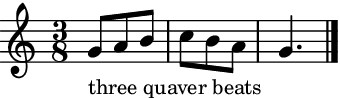
At Grade 1 every time signature had 4 on the bottom: a crotchet beat. The top number said how many beats, and that part does not change. Grade 2 adds two new bottom numbers:
- Bottom number 2: the beat is a minim. (A minim is half a semibreve, and the 2 stands for "halves".)
- Bottom number 8: the beat is a quaver. (A quaver is an eighth of a semibreve, so 8 stands for "eighths".)
Four new signatures are set for this grade:
| Signature | Beats per bar | One beat is |
|---|---|---|
| 2/2 | 2 | a minim |
| 3/2 | 3 | a minim |
| 4/2 | 4 | a minim |
| 3/8 | 3 | a quaver |
All four are still simple time: each beat divides naturally into two halves, just as a crotchet divides into two quavers. (Compound time, where beats divide into three, arrives at Grade 3. Other signatures with 8 on the bottom follow in later grades still.)

Two of the signatures you now know have symbols as well as numbers. A plain C stands for 4/4 and is called common time. The same C with a vertical stroke through it stands for 2/2 and is called alla breve, or informally cut time: two minim beats in a bar. Only the plain C is set for Grade 2; the cut C is formally examined at Grade 4, but printed music will put it in front of you long before then, so learn it now and lose nothing. Fast marches and much older church music use it, and a good deal of Handel is printed that way.
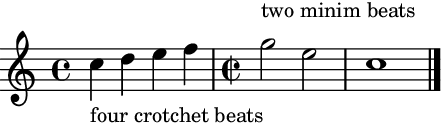
The stroke is doing real arithmetic. Common time counts four crotchets in a bar; cut time counts two minims. The bar holds the same total, but it is felt in two broad beats instead of four brisk ones, which is why a conductor taking a fast movement will say they are beating it in two.
Same feel, different clothes
Here is the insight that makes these signatures easy rather than confusing: 3/4, 3/2 and 3/8 all feel identical. Each is a bar of three beats, strong-weak-weak. What changes is only which written note carries the beat. A waltz rhythm written in 3/4 as crotchet-crotchet-crotchet appears in 3/2 as minim-minim-minim and in 3/8 as quaver-quaver-quaver. The music sounds the same; the notation is scaled.

Practise translating short rhythms between beat values. Take a two-bar rhythm in 3/4 and rewrite it in 3/8 (halve every value) or in 3/2 (double every value). One translation exercise teaches more than an hour of rereading, because it forces you to see values as proportions rather than fixed lengths.
Grouping and beaming in the new signatures
One rule governs all of this, at every grade: group notes and rests so that a reader can see where each beat falls. Everything below is that rule applied to the four new signatures.
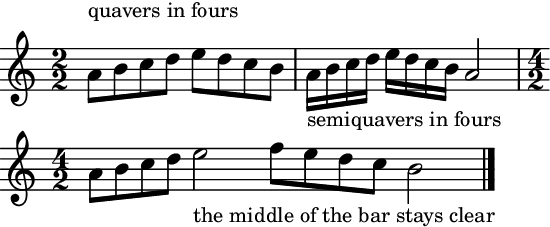
Minim beats: 2/2, 3/2 and 4/2. The beat is a minim, so a beam should cover a minim's worth of notes. Quavers go in groups of four, not in the pairs that suit crotchet time. Semiquavers go in fours as well, each group filling a crotchet, because a beam stretched over eight of them is more than the eye can measure at a glance. Crotchets are the two halves of the beat and carry no beam at all. In 4/2, as in 4/4, the bar also divides down the middle, so nothing is beamed across the join between beats 2 and 3 and the half-bar stays visible.
Quaver beats: 3/8. Here the beat is a quaver, which is already as small as most bars go, so grouping works the other way round and the whole bar is beamed as one. Three quavers take a single beam across the bar. Six semiquavers take a single double beam. A quaver followed by four semiquavers joins into one group too, the quaver's beam running straight on into the semiquavers' pair of beams. A 3/8 bar is short enough to take in whole, and beaming it whole shows the bar rather than hiding it.
Two things interrupt that single beam, and only two. A rest carries no beam, so the beam stops where the rest falls and starts again after it. And a triplet's beam has to show where the triplet begins and ends, so a triplet is beamed on its own and whatever follows it takes a beam of its own. The figure in chapter 4 shows that second case: a semiquaver triplet under its own double beam, then two quavers beamed together.

Rests. Rests obey the same principle, with one addition: a rest must never hide the start of a beat. Work in this order.
- Complete the beat you are in. If a minim beat in 2/2 opens with a crotchet, the silence that follows is a crotchet rest, not part of anything longer.
- Give each whole silent beat a rest of its own value: a minim rest in minim time, a quaver rest in 3/8.
- Only then join whole beats into one larger rest, and only where that rest covers a natural half of the bar. Two silent minim beats in the first or second half of a 4/2 bar make one semibreve rest.
- A completely silent bar takes a semibreve rest, whatever the time signature says, in 3/2 and 3/8 alike. (Printed editions sometimes use a breve rest for a silent bar of 4/2; the breve itself waits until Grade 4.)

Two habits catch nearly every grouping error. Mark where each beat begins before you write a note. Then look at each beam and each rest in turn and ask which single beat it belongs to; if the honest answer is "two of them", the grouping is wrong.
4. Triplets
Every note value you have met so far divides into two: a minim into two crotchets, a crotchet into two quavers, a quaver into two semiquavers. That halving is what simple time is built on. A triplet is the licensed exception. It is three notes of the same value played evenly in the time that two of them would normally take.
You write it as three notes with a small figure 3 printed above or below the group. When the three are beamed together, the beam already shows where the group begins and ends, so the 3 alone is enough. When they are not beamed, or when the group contains a rest, add a bracket over the group (a slur serves the same purpose in vocal music) so that a reader can see how far the triplet reaches.
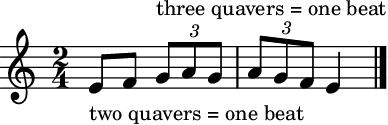
The commonest triplet by a wide margin is the quaver triplet: three quavers in the time of two, filling one crotchet beat. Tap a steady beat, say "one and" across it, then say "one and a" across the same beat, and you have the sound.
The arithmetic
One rule settles every triplet sum. A triplet group lasts as long as two of its notes would, never three. The figure 3 counts the notes printed; the time they occupy is two of them.
| Triplet | Three of these | Occupies the time of | Which is |
|---|---|---|---|
| semiquaver triplet | semiquavers | two semiquavers | one quaver |
| quaver triplet | quavers | two quavers | one crotchet |
| crotchet triplet | crotchets | two crotchets | one minim |
| minim triplet | minims | two minims | one semibreve |

So a bar of 4/4 holding four quaver triplets is exactly full: four groups, each worth a crotchet. A bar of 2/2 holding two crotchet triplets is exactly full as well: each group is worth a minim, and the bar has two minim beats.
Notice which triplet belongs to which beat. The triplet that divides a beat is built from the note one size smaller than the beat itself. Quaver triplets divide a crotchet beat, crotchet triplets divide a minim beat, semiquaver triplets divide a quaver beat. Find the beat, halve it, and you have named the triplet.
Triplet groups with rests
A triplet need not be three notes. Any of its three places may hold a rest instead, and the group still occupies the time of two notes: the rest is simply one of the three even divisions, silent. The figure and the bracket cover the whole group, rests included.
Three patterns account for most of what you will see: rest first, rest in the middle, rest last. A triplet may also combine values inside the group, provided they add up to three of the printed unit. A crotchet followed by a quaver under a triplet 3 fills one crotchet beat, the crotchet taking two of the three divisions and the quaver the third.

Always print the bracket when a triplet contains a rest. A rest carries no beam, so without the bracket nothing on the page says where the group ends.
Triplets in the Grade 2 time signatures
The same rule, dressed four ways:
| Time signature | The beat | The triplet that divides one beat | Groups in a full bar |
|---|---|---|---|
| 2/4, 3/4, 4/4 | crotchet | three quavers | 2, 3 or 4 |
| 2/2, 3/2, 4/2 | minim | three crotchets | 2, 3 or 4 |
| 3/8 | quaver | three semiquavers | 3 |
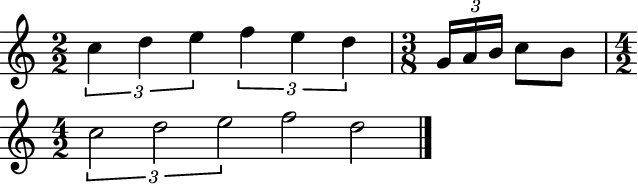
Notice the beaming of the 3/8 bar in the middle. The triplet carries its own beam and the two quavers after it carry another, because a triplet's beam has to enclose the triplet and nothing else. That is the exception to the rule that a 3/8 bar is beamed as one group.
A triplet can also stretch across more than one beat, because the rule speaks of note values and not of beats. Three minims under a 3 occupy the time of two minims, which in 4/2 is two whole beats. Three crotchets under a 3 do the same across beats 1 and 2 of a 4/4 bar. Read the group, work out what two of its notes are worth, and the position in the bar looks after itself.
Triplets are how simple time borrows the threefold division without changing its signature. The metre that divides every beat into three by design is compound time, and that arrives at Grade 3.
Adding up a bar with triplets in it
Replace each complete triplet group by the value of two of its notes, then add the bar up as usual. A 3/4 bar of quaver triplet, crotchet, quaver triplet comes to crotchet plus crotchet plus crotchet: three beats, correct. The commonest slip at this grade is counting a quaver triplet as three quavers and writing a bar half a beat too long, so make the substitution before you count, not after.
5. Two ledger lines above and below
Five lines and four spaces hold nine pitches, and music does not stop at nine. A ledger line is a short piece of stave line drawn only where a note needs it, extending the stave upwards or downwards for that note alone. Grade 1 introduced them. Grade 2 fixes the range you are expected to read and write: two ledger lines above and two below each stave, which adds four more pitches to each end of each clef.
Counting outwards is the whole skill, and the pattern never varies: line, space, line, space, exactly as inside the stave. Start from the outermost stave line, whose name you already know, and step outward one position at a time.
Above and below the treble stave
The treble stave runs from E on the bottom line to F on the top line. Going up from that F: G sits in the space above the stave, A on the first ledger line, B in the space above it, C on the second ledger line. Going down from the bottom line E: D sits in the space below, middle C on the first ledger line, B in the space below that, A on the second ledger line.

Above and below the bass stave
The bass stave runs from G on the bottom line to A on the top line. Going up from that A: B sits in the space above, middle C on the first ledger line, D in the space above it, E on the second ledger line. Going down from the bottom line G: F sits in the space below, E on the first ledger line, D in the space below that, C on the second ledger line.

All eight positions in one table, read outwards from the stave:
| Steps out | Treble above | Treble below | Bass above | Bass below |
|---|---|---|---|---|
| space just outside | G | D | B | F |
| first ledger line | A | middle C | middle C | E |
| space beyond it | B | B | D | D |
| second ledger line | C | A | E | C |
The two staves overlap
Look at the two middle columns, and add to them the treble stave's bottom line E and the bass stave's top line A. Between them, the notes just below the treble stave and the notes just above the bass stave cover the same five pitches: A, B, middle C, D, E. Either clef can write any of them, and which one an editor chooses depends on where the rest of the music sits. A cello line climbing high stays in the bass clef on ledger lines; a piano left hand crossing over may borrow the treble clef instead.

Middle C is the hinge, as it was at Grade 1: first ledger line below the treble stave, first ledger line above the bass stave, one key on the piano.
One kind of question is built directly on this overlap: it prints a note in one clef and asks you to write the same pitch in the other. Work it in two steps. Name the note first, in the clef it is given in. Then find that same letter in the same part of the overlap in the other clef and write it there. Count outwards from middle C and you cannot go wrong, because middle C is one sound with one position in each clef. The note on the second ledger line below the treble stave is A, two steps down from middle C; two steps down from middle C in the bass clef lands on the top line, so that is where the A goes. The pitch does not move at all. Only the picture of it changes.
Writing them properly
Three habits, each worth a mark:
- Draw every ledger line the note needs, not just the last one. A note on the second ledger line above the treble stave needs two short lines drawn: one through the note-head and one below it, evenly spaced like stave lines.
- A note sitting in the space beyond a ledger line still needs that ledger line drawn under it. B above the treble stave floats in a space, but the A line below it must be there or the B has nothing to be measured against.
- Keep the spacing even and the lines short: a ledger line pokes out only a little way each side of the note-head, and sits the same distance apart as the lines of the stave.
Read them by landmark rather than by counting from the bottom of the stave every time. Learn the four ledger-line notes of each clef as pictures, and the spaces between them follow at once. Where a passage would need more than two ledger lines, composers often print an octave sign (8va) instead. Neither is asked of you yet: the stave stretches past two ledger lines at Grade 3, and the octave sign itself is set at Grade 4. Recognise it in print for now and read on.
6. Minor keys and the relative pairing
The sound of minor
Play the C major scale, then play A, B, C, D, E, F, G, A on the white notes. The second ladder sounds different: darker, more serious, often described as sad. That colour difference is the divide between major and minor, and it comes entirely from where the tones and semitones fall relative to the keynote.
Music in a minor key is not gloomy by obligation. Plenty of fiery, dancing music is minor. But the colour is unmistakable once your ear tunes into it, and from this grade onwards you deal with both modes as a matter of course.
Relative major and minor
Every key signature serves two keys: one major, one minor. The two are called relatives. The relative minor of a major key starts on the sixth degree of the major scale. Equivalently, count three semitones down from the major keynote. Both routes land in the same place:
| Major key | Count 3 semitones down | Relative minor | Shared key signature |
|---|---|---|---|
| C major | C, B, B♭, A | A minor | no sharps or flats |
| G major | G, F♯, F, E | E minor | F♯ |
| F major | F, E, E♭, D | D minor | B♭ |
Those three minors, A, E and D minor, are the Grade 2 minor keys.
The relationship runs both ways: to find the relative major of a minor key, count three semitones up. D minor's relative major is F major.
A shared signature means a real ambiguity: a piece with one flat might be F major or D minor. How do you tell? Look at the music. A minor-key piece gravitates to its own tonic (D, in this case), usually ends on it, and typically contains the raised seventh of the minor scale (C♯ for D minor) as an accidental in the music. Signature plus accidentals plus final note together give the answer.
Building the minor scale
The major scale has one form. The minor scale has more than one, and Grade 2 examines just one of them, the harmonic minor. The quickest way to build it, though, is to start from another form, the natural minor, so meet that first.
Start with the natural minor: the notes of the key signature and nothing else, played from the minor tonic up to the tonic an octave higher. A natural minor is A, B, C, D, E, F, G, A, every one of them a white note, because A minor's signature has no sharps or flats.
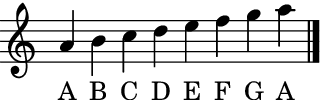
Measured in tones and semitones the pattern is T, S, T, T, S, T, T. Set that beside the major scale's T, T, S, T, T, T, S and you can see the whole difference of colour in one line: the two semitones have moved to different places in the ladder.
The trouble with the natural minor is its seventh degree, a whole tone below the tonic. Music likes a seventh that sits a semitone under the keynote, pulling upward towards home, and that pull is what makes an ending sound final. So the seventh gets raised, and raising it produces the scale this grade examines.
The harmonic minor raises the seventh degree of the natural minor by one semitone, going up and coming down alike. The two directions are identical, which makes it the most straightforward scale in the syllabus to write once you know the rule.
A harmonic minor: A, B, C, D, E, F, G♯, A (the same notes descending)
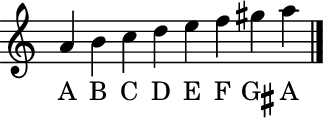
Its pattern of steps, writing TS for the tone and a half, is T, S, T, T, S, TS, S. That TS between degrees 6 and 7 is the scale's fingerprint: F up to G♯ is three semitones, a stride no major scale contains anywhere, and it is why the harmonic minor sounds faintly exotic even in the simplest tune.
Two things follow from the rule, and both carry marks.
The raised seventh is written as an accidental in the music, never in the key signature. A minor key's signature is exactly its relative major's signature, no more and no less. If you catch yourself writing a G♯ into the key signature of A minor, stop; the sharp belongs in front of each G in the music.
Raising a note means one semitone above the key signature's version, spelled with the same letter. Usually that produces a sharp, but not always. It might turn a flat into a natural, or a natural into a sharp; the letter name never changes. Work out what the key signature gives you, then raise that.
(There is a third form, the melodic minor, which changes shape between going up and coming down. It belongs to Grade 3 and no Grade 2 question will ask for it. If you meet the name in a scale book now, note it and move on.)
The Grade 2 minors spelled out
Because each minor key borrows its relative major's signature, there are no new signatures to learn here at all. A minor has none, E minor has F♯, and D minor has B♭, in exactly the stave positions you already write for C, G and F major.
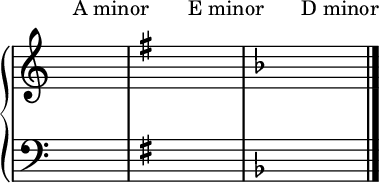
Harmonic form, ascending (descending is the same):
| Key | Scale | The raised 7th |
|---|---|---|
| A minor | A, B, C, D, E, F, G♯, A | G♯ |
| E minor | E, F♯, G, A, B, C, D♯, E | D♯ |
| D minor | D, E, F, G, A, B♭, C♯, D | C♯ |
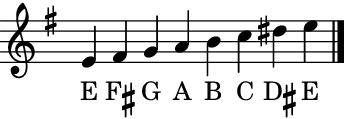
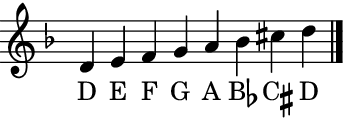
Work each one the same way. Write the key signature of the relative major, write the seven letters from the tonic upwards, then raise the seventh letter by a semitone with an accidental. In E minor the signature already contains F♯, so the seventh letter D becomes D♯. In D minor the signature contains B♭, and the seventh letter C becomes C♯. In A minor there is no signature at all, and G becomes G♯.
Two details decide most of the marks in this topic. The accidental goes immediately before the note-head it affects, on the same line or space, and it holds good for the rest of that bar. And it must appear every time the seventh degree occurs in a new bar, because a bar-line cancels accidentals: a descending harmonic minor written across two bars needs its sharp written again.
Minor tonic triads
The tonic triad of a minor key stacks degrees 1, 3 and 5, exactly as in major. The seventh degree is not involved, so the raised-seventh question never arises here; no accidentals are needed beyond the key signature.
| Key | Tonic triad |
|---|---|
| A minor | A, C, E |
| E minor | E, G, B |
| D minor | D, F, A |
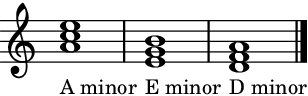
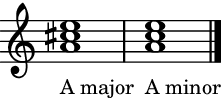
Compare A major's triad (A, C♯, E) with A minor's (A, C, E). One note differs, the third, and that single semitone is the entire difference between the bright sound and the dark one. The fifth is identical in both.
7. Three new major keys: A, B flat and E flat
Grade 2 extends your major keys to three sharps and three flats.
| Key | Signature | In order |
|---|---|---|
| A major | 3 sharps | F♯, C♯, G♯ |
| B♭ major | 2 flats | B♭, E♭ |
| E♭ major | 3 flats | B♭, E♭, A♭ |
The fixed orders from Grade 1 do all the work here. Sharps always accumulate as F, C, G, D, A, E, B ("Father Charles Goes Down And Ends Battle"), so a three-sharp signature can only be F♯, C♯, G♯. Flats accumulate as B, E, A, D, G, C, F ("Battle Ends And Down Goes Charles' Father"), so two flats are always B♭, E♭ and three are B♭, E♭, A♭.
The quick-recognition tricks now become genuinely useful:
- Sharp keys: the last sharp is one semitone below the tonic. Last sharp G♯? One semitone up is A: A major.
- Flat keys: the second-to-last flat is the tonic. Signature B♭, E♭, A♭? Second-to-last is E♭: E♭ major. This trick needs two or more flats, so F major (one flat) remains the case you simply memorise.
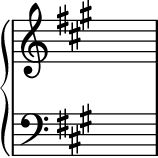
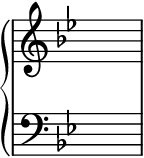
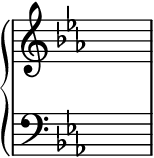
The scales, built with the usual T, T, S, T, T, T, S pattern:
A major: A, B, C♯, D, E, F♯, G♯, A B♭ major: B♭, C, D, E♭, F, G, A, B♭ E♭ major: E♭, F, G, A♭, B♭, C, D, E♭
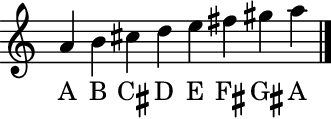
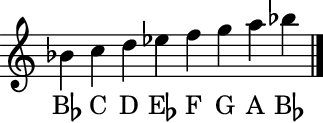
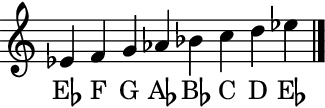
Each of these descends through the same notes in reverse order. The major scale has only one form, so coming down needs nothing new; write the ascent, then read it backwards.
And the tonic triads:
| Key | Tonic triad |
|---|---|
| A major | A, C♯, E |
| B♭ major | B♭, D, F |
| E♭ major | E♭, G, B♭ |
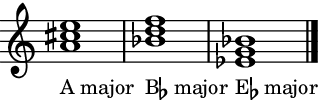
Your complete key list at this grade: majors C, G, D, A, F, B♭ and E♭; minors A, E and D. Practise writing every signature in both clefs. The flats and sharps have fixed stave positions in each clef, and the exam expects them exactly right.
8. Degrees of the scale and intervals above the tonic
Degrees of the scale
Number the notes of a scale from the tonic upwards, 1 to 8, and each number is that note's degree. Degree 1 is the keynote, degree 5 is the fifth note up, and degree 8 is the keynote again an octave higher. The numbering belongs to the key, not to the clef or the octave: the fifth degree of E♭ major is B♭ wherever on the stave it appears.
At this grade the exam asks for the number alone. The technical names, tonic and supertonic and the rest, arrive at Grade 4. Questions run in both directions: "which degree of E♭ major is the note C?" (the sixth) and "name the fifth degree of D minor" (A).
The six keys new to this grade, degree by degree, with the minors in their harmonic form:
| Degree | A major | B♭ major | E♭ major | A minor | E minor | D minor |
|---|---|---|---|---|---|---|
| 1 | A | B♭ | E♭ | A | E | D |
| 2 | B | C | F | B | F♯ | E |
| 3 | C♯ | D | G | C | G | F |
| 4 | D | E♭ | A♭ | D | A | G |
| 5 | E | F | B♭ | E | B | A |
| 6 | F♯ | G | C | F | C | B♭ |
| 7 | G♯ | A | D | G♯ | D♯ | C♯ |
| 8 | A | B♭ | E♭ | A | E | D |
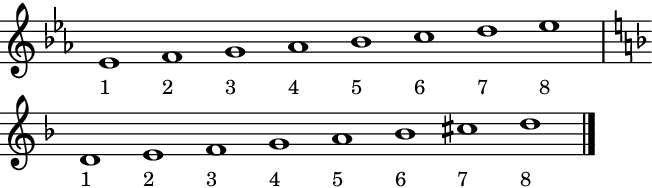
Watch the seventh degree of a minor key. Because the harmonic form is the one this grade uses, the seventh degree carries its accidental: D minor's seventh degree is C♯, not C, and A minor's is G♯.
Intervals above the tonic
An interval number and a degree number are the same count, which makes this section short. The interval from the tonic up to the fourth degree is a 4th, up to the sixth degree a 6th, and up to the eighth an octave. Read the degree table above sideways and you have every interval above the tonic in every new key.
The method itself is unchanged from Grade 1: count letter names from the lower note to the upper, counting both ends. What widens at Grade 2 is the range of keys.
- In A major, A up to F♯: A, B, C, D, E, F is six letters. A 6th.
- In E♭ major, E♭ up to A♭: E, F, G, A is four letters. A 4th.
- In D minor, D up to B♭: D, E, F, G, A, B is six letters. A 6th.
- In E minor, E up to D♯ (the raised 7th): E, F, G, A, B, C, D is seven letters. A 7th.
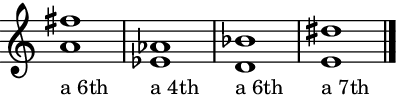
Accidentals still do not affect the number. E up to D and E up to D♯ are both 7ths. The parity shortcut still applies too: line-to-line or space-to-space means an odd number, line-to-space means even. Naming the type of an interval as well as its number, calling one a major 3rd and another a minor 3rd, begins at Grade 3; here the number is the whole answer.
9. New terms and signs
Every Grade 1 term and sign stays live and can appear without explanation: allegro and andante, cantabile and dolce, legato and staccato, the dynamics from pp to ff, the slur, the tie, D.C. and Fine. Add the following.
Tempo and speed
| Term | Meaning |
|---|---|
| Grave | very slow and solemn |
| Largo | slow and broad |
| Lento | slow |
| Presto | fast |
| Vivace, vivo | lively and brisk |
| Allargando | broadening out: slower, and usually fuller in tone |
| Ritenuto (riten., rit.) | held back; the slower speed applies at once |
| Più mosso | more movement, so faster |
| Meno mosso | less movement, so slower |
| Con moto | with movement |
Ritenuto repays care. Ritardando and rallentando both slow down gradually; ritenuto drops to the new speed immediately, like changing gear rather than braking. All three are sometimes shortened to rit., so let the music tell you which is meant.
The tempo words now cover a usable range, slowest first: grave, largo, lento, adagio, andante, moderato, allegretto, allegro, vivace, presto. Learning them as a ladder is easier than learning them as a list, and questions often ask which of two terms is the faster.
Style and expression
| Term | Meaning |
|---|---|
| Alla marcia | in the style of a march |
| Espressivo (espress.) | expressively |
| Grazioso | gracefully |
| fp (fortepiano) | loud, then immediately soft |
fp is one event rather than two markings in a row: attack the note loudly and drop to soft at once, for the length of that note. Beethoven uses it constantly, and it is not the same as f followed by p in the next bar.
The small words
These attach to other terms and multiply your vocabulary at no extra cost:
| Word | Meaning |
|---|---|
| con, col | with |
| senza | without |
| e, ed | and |
| ma | but |
| molto | very, much |
| poco | a little |
| poco a poco | little by little |
| non troppo | not too much |
| più | more |
| meno | less |
So poco rall. is a slight slowing, molto cresc. a big crescendo, allegro ma non troppo fast but not too fast, senza rall. without slowing, dolce ed espressivo sweetly and expressively. (Ed is simply e before a vowel.) Learn the small words and whole families of instructions unlock at once.
Signs
| Sign | Meaning |
|---|---|
| accent | give the note extra attack, then let it settle |
| pause | hold the note or rest longer than its written value, for as long as the performer judges |
| metronome mark, such as crotchet = 96 | how many of those beats fall in a minute |
| repeat marks | play the enclosed music a second time |
| C, common time | 4/4 |
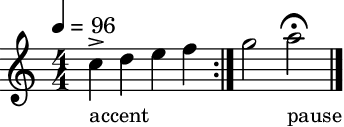
A metronome mark pairs a note value with a number: crotchet = 60 means sixty crotchets a minute, one per second, so crotchet = 120 is twice as fast. The value chosen is normally the beat of the time signature, which is why a 3/2 piece is marked in minims and a 3/8 piece in quavers.
A pause is printed above the note or rest it lengthens, and how much longer to hold it is left to the performer. Where two parts share one stave, the lower part's pause goes underneath instead. A pause printed over a bar-line asks for a moment of silence between the phrases.
Repeat marks are a thin and thick bar-line with two dots. The dots face the music to be repeated, so the opening mark faces forwards and the closing mark faces back. Where there is no opening mark, repeat from the start of the piece.
Navigation signs
| Sign | Meaning |
|---|---|
| D.C. (Da Capo) | go back to the beginning |
| D.S. (Dal Segno) | go back to the sign |
| Fine | the end: the place to stop after a Da Capo or Dal Segno |
Da Capo al Fine is the standard pairing: play from the top again, and stop where the word Fine appears.
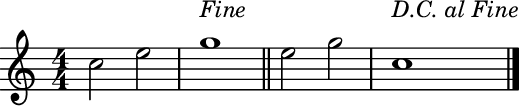
Dal Segno al Fine works the same way but sends you back to a sign rather than to the beginning. The sign is a slanted S with a stroke through it and a dot in each half.

10. Questions about a melody
One section of the paper prints a short melody in a single clef and asks a handful of questions about it. Nothing appears there that the earlier chapters have not taught. What makes it feel different is that you have to find the thing on the page before you can answer about it, and the questions arrive in no particular order.
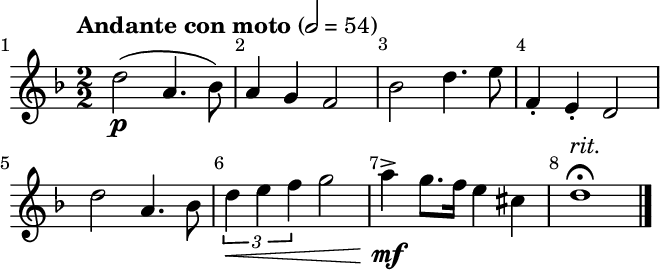
Here is a melody of the kind used, with its bars numbered as the exam numbers them.
What gets asked
The questions come from a small set of families, and naming the family tells you which chapter to reach for.
| Family | Typical question |
|---|---|
| Key | What key is this melody in, and how can you tell? |
| Time | How many minim beats are there in a bar? |
| Pitch | Name the highest note. In which bar is the lowest note? |
| Degrees and intervals | Which degree of the scale is the last note? Name the interval from the tonic up to the first note of bar 3. |
| Rhythm | Which bar contains a triplet, and how long does the group last? |
| Signs | What is the curved line in bar 1? What do the dots on the notes of bar 4 ask for? |
| Terms | What does con moto mean? What does the metronome mark tell a player? |
The melody worked through
Take those families in order against the melody above.
Key. D minor. The key signature holds one flat, B♭, and one flat serves F major and D minor alike, so the signature on its own settles nothing. Two other things settle it. The melody ends on D, and bar 7 contains a C♯, which is the raised seventh of D minor and belongs nowhere in F major. Fix the key before you answer anything else, because the degree and interval questions all rest on it.
Time. 2/2, so two minim beats in a bar. Count bar 2 through to prove it: crotchet, crotchet, minim, which is one beat made of two halves and then one whole beat. Bar 8 holds a single semibreve, and that is both beats at once rather than four of anything.
Pitch. The highest note is A, in bar 7, on the first ledger line above the stave. The lowest is D, in bar 4, in the space just below the stave. Read the note-heads for this and nothing else. Bar 7 also carries the mf and the accent, but that is not what makes it the answer.
Degrees and intervals. The last note is D, which is degree 1, the tonic. The C♯ in bar 7 is degree 7, sharpened because this grade uses the harmonic form of the minor scale. Bar 3 begins on B♭, and D up to B♭ counts D, E, F, G, A, B: six letter names, so a 6th above the tonic.
Rhythm. The triplet is in bar 6. Three crotchets under the figure 3 last as long as two crotchets, which is one minim beat, and the G that follows fills the other. The dotted quaver and semiquaver in bar 7 are the only pair of their kind in the melody. Bars 1, 3 and 5 all share one rhythm, minim then dotted crotchet then quaver, and bar 5 repeats bar 1 note for note as well as beat for beat.
Signs. The curve in bar 1 spans three different pitches, so it is a slur and asks for legato playing. The dots on the two crotchets of bar 4 sit on the opposite side of the note-heads from the stems, so they are staccato: short and detached. The mark above the first note of bar 7 is an accent, so that note takes extra attack and then settles. The sign over the last note is a pause, and the player holds it longer than the two beats written.
Terms. Andante is at a walking pace, and con moto adds "with movement", so the walk presses on a little. The metronome mark reads minim = 54: fifty-four minim beats a minute, the minim being chosen because it is the beat of 2/2. The hairpin through bars 6 and 7 is a crescendo, growing from the p of bar 1 to the mf of bar 7, and rit. over bar 8 asks the player to slow at the end.
A method for the section
Five habits make this section quick.
- Read the key signature, the last note and any accidental in the music, and fix the key before anything else. A shared signature is settled by the raised seventh and the final note, not by the flats and sharps alone.
- Read the time signature and count one bar right through, so that you know what the beat is before a rhythm question arrives.
- Scan for whatever appears once. A melody at this grade usually carries one triplet, one slur, one group of staccato dots, one accent and one pause, and the thing that appears once is the thing you will be asked about.
- Scan for whatever repeats. A bar that comes back note for note, or a rhythm used three times over, is worth spotting before the question asks for it.
- Answer in the currency asked for. A letter name is a letter, a degree is a number, an interval is a number, and a term wants its English meaning.
11. Common mistakes at Grade 2
- Writing the raised seventh of a minor scale into the key signature. The raised note is an accidental in the music; the signature is the relative major's, unaltered.
- Assuming that raising a note always means writing a sharp. Raising means one semitone above the key signature's version of that letter, which sometimes calls for a natural instead.
- Forgetting to write the accidental again in a new bar. A bar-line cancels it, so a harmonic minor spread over two bars needs its sharp written twice.
- Muddling the relative arithmetic and counting three semitones the wrong way. Down from the major tonic finds the relative minor; up from the minor tonic finds the relative major.
- Counting a triplet as three of its own notes. A quaver triplet is worth one crotchet, not three quavers, and a bar counted that way comes out half a beat too long.
- Leaving the bracket off a triplet that contains a rest. A rest carries no beam, so without the bracket nothing on the page shows where the group ends.
- Beaming quavers in pairs in 2/2 or 4/2, where the minim beat calls for groups of four, or running a beam across the middle of a 4/2 bar.
- Chopping a 3/8 bar into separate beamed fragments. The whole bar is beamed as one group, unless a rest or a triplet breaks it.
- Writing a rest that hides the start of a beat. Complete the beat you are in first; a dotted rest spilling into the next beat is the usual offender.
- Misreading 3/8: it is three quaver beats and it is simple time, neither a compressed 3/4 nor a compound signature. Each quaver is a beat in its own right.
- Adding up dotted rhythms carelessly. Convert to semiquavers when in doubt: a dotted quaver is three, a semiquaver is one, and a crotchet beat holds four.
- Drawing only the outer ledger line for a note two lines above or below the stave. Every ledger line between the stave and the note has to be drawn.
- Reading the seventh degree of a minor key straight off the key signature. This grade uses the harmonic form, so degree 7 carries its accidental: D minor's is C♯.
- Confusing ritenuto (immediate) with ritardando (gradual).
- Writing B♭ major's signature as E♭, B♭ instead of B♭, E♭. The order of flats never varies.
12. Practice questions
Answers follow in the next section.
- How many semiquavers last the same time as one dotted crotchet?
- Write the harmonic form of the E minor scale ascending, and name the one accidental that is not in the key signature.
- Which major key is the relative major of D minor, and what key signature do the two share?
- Give the tonic triad of E♭ major.
- A bar is in 3/8. Give three different one-bar rhythms that fit it exactly.
- Name the interval from the tonic up to the sixth degree in A major, giving both the number and the two note names.
- A group of three quavers is marked with a small figure 3. How long does the group last, and how would you write the same length of time without using a triplet?
- What does espressivo mean? What does poco a poco mean? What does ma non troppo mean?
- Rewrite this 3/4 rhythm in 3/2: crotchet, crotchet, two quavers beamed. What does each value become?
- A piece has a key signature of three sharps. Name the major key, list the sharps in order, and name its tonic triad.
- In the treble clef, name the note on the second ledger line above the stave and the note on the second ledger line below it.
- What is the difference in meaning between ritenuto and rallentando?
- A bar of 4/2 begins with a minim on beat 1 and is then silent to the end of the bar. Write out the rests you would use, and say why.
- The last sharp of a key signature is C♯. Which major key is this, and how do you know?
- A triplet group of three quavers has a rest in the middle. Describe exactly what is printed, and say how long the group lasts.
- Which degree of E♭ major is the note C? Which degree of D minor is the note C♯?
- In the bass clef, name the note on the first ledger line above the stave and the note on the second ledger line below it.
- Beat 2 of a 4/4 bar is silent, and so is the first half of beat 3. Why is a single dotted crotchet rest the wrong way to write that silence, and what would you write instead?
- A piece is headed with a plain C where the two numbers would be. Which time signature is that, what is the symbol called, and how many crotchet beats has each bar?
- Which triplet divides one beat of 3/8, and which divides one beat of 3/2?
- The note on the second ledger line below the treble stave is to be written at the same pitch in the bass clef. Name the note, and say exactly where it goes on the bass stave.
- Look at the melody in chapter 10. Name its key, and give the two pieces of evidence that rule out the other key sharing that signature.
- In the same melody: which bar holds the triplet, how long does that group last, and which other bars use bar 1's rhythm?
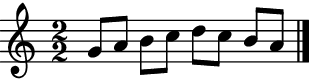
- The bar below is in 2/2, and its beaming is wrong. Say what the beams as printed tell a reader, and how the bar should be beamed.
13. Answers
- Six. A dotted crotchet is one and a half beats; a semiquaver is a quarter of a beat; six quarters make one and a half.
- E, F♯, G, A, B, C, D♯, E. The accidental foreign to the key signature is D♯; the signature, shared with G major, contains only F♯.
- F major. They share one flat, B♭.
- E♭, G, B♭.
- Any three of, for example: three quavers beamed as one group; a dotted crotchet; a quaver followed by four semiquavers, the whole bar under one beam; a crotchet followed by a quaver; six semiquavers beamed as one group; a quaver rest followed by two quavers.
- A up to F♯ is a 6th (A, B, C, D, E, F is six letter names). The notes are A and F♯.
- One crotchet. A triplet group lasts as long as two of its notes, so three triplet quavers occupy the time of two ordinary quavers. Without the triplet you would write a single crotchet, or two plain quavers.
- Espressivo: expressively. Poco a poco: little by little. Ma non troppo: but not too much.
- Double every value: the crotchets become minims and the quavers become crotchets. The bar reads minim, minim, two crotchets.
- A major. The sharps, in order, are F♯, C♯, G♯. The tonic triad is A, C♯, E.
- C above the stave: the first ledger line is A, the space above it is B, and the second ledger line is C. A below the stave: the first ledger line is middle C, the space below it is B, and the second ledger line is A.
- Rallentando is a gradual slowing spread over the passage. Ritenuto is an immediate holding back: the new, slower pace applies at once.
- A minim rest for beat 2, then a semibreve rest for beats 3 and 4. Each whole silent beat takes a rest of the beat's own value, and beats 3 and 4 form the second half of the bar, a natural unit that one semibreve rest may cover.
- D major. In sharp keys the last sharp sits one semitone below the tonic, and one semitone above C♯ is D.
- A quaver, a quaver rest and a quaver, with a bracket drawn over all three and the figure 3 printed at the bracket. The group lasts one crotchet, exactly as it would if all three places held notes.
- C is the sixth degree of E♭ major. C♯ is the seventh degree of D minor, sharpened because this grade uses the harmonic form of the minor scale.
- Middle C above the bass stave: the top line is A, the space above is B, and the first ledger line is middle C. C below the stave: the bottom line is G, the space below is F, the first ledger line is E, the space below that is D, and the second ledger line is C.
- A dotted crotchet rest would begin on beat 2 and run on into beat 3, hiding where beat 3 starts. Complete the beat you are in and then rest for the next one: a crotchet rest for beat 2, followed by a quaver rest for the first half of beat 3.
- 4/4. The symbol is called common time, and each bar holds four crotchet beats. (The same C with a stroke through it stands for 2/2 and is called alla breve, but that sign is set at Grade 4.)
- Three semiquavers divide one quaver beat of 3/8. Three crotchets divide one minim beat of 3/2.
- The note is A. In the bass clef the same pitch is the top line of the stave, needing no ledger line at all. Count from middle C, which is one sound with one position in each clef: A lies two steps below middle C, and in the bass clef middle C sits on the first ledger line above the stave, so two steps down from it lands on the top line.
- D minor. The melody ends on D, and bar 7 contains a C♯, which is D minor's raised seventh. F major shares the one-flat signature but would end elsewhere and would have no reason for that sharp.
- Bar 6. Three crotchets under the figure 3 last as long as two crotchets, which is one minim beat, so the group fills half the bar. Bars 3 and 5 use bar 1's rhythm of minim, dotted crotchet, quaver, and bar 5 repeats bar 1's notes as well.
- As printed, four separate pairs of quavers tell a reader that the bar has four beats, which belongs to 4/4. In 2/2 the beat is a minim, so the eight quavers should be beamed in two groups of four, one group to each beat.
Next step: Grade 3 introduces compound time, where every beat divides into three by design, along with the demisemiquaver, transposition at the octave between the clefs, and all the keys to four sharps and four flats. The triplet is the bridge: compound time makes a habit of the division that a triplet borrows for a single beat. The minor-scale rule you have just learned applies to six more keys there, with the melodic form added beside the harmonic one, so keep the harmonic form fresh.