A complete course for the final grade of the ABRSM Music Theory syllabus: the three augmented sixths, dominant ninths, elevenths and thirteenths, the full chromatic vocabulary and its enharmonic double meanings, modulation to unrelated keys, the Baroque trio sonata, keyboard styles from Haydn onwards, the long melody, counterpoint and motivic development, scores of up to 24 staves with transposing percussion and foreign pitch names, and the last of the three-language vocabulary.
Introduction
Grade 8 is where the theory exams stop asking you to describe music and start asking you to write it. Three of the five questions are composition in a defined style: a Baroque trio sonata to continue, a Classical or Romantic keyboard passage to complete, a melody to carry on for a dozen bars or more. The remaining two put real scores in front of you, bigger and stranger than any earlier grade allowed, and expect you to read them the way a conductor does.
The harmonic syllabus finishes here too. Grade 7 ended with the diminished seventh and the Neapolitan sixth; Grade 8 adds the three augmented sixths, the dominant ninth, eleventh and thirteenth, and with them the syllabus phrase that defines the grade: all standard diatonic and chromatic chords. Nothing harmonic is now off the table. The same completeness applies to keys. Modulation may head anywhere, including to keys with no signature relationship at all, and the chapter on enharmonic pivots explains the machinery that makes such moves sound inevitable rather than arbitrary.
None of this is new in kind. A German sixth is a chord with a bass note, figures and a resolution, like every chord since Grade 6. A trio sonata is figured bass plus two melodies, which is Grade 6 harmony plus Grade 7 fluency. The step up at Grade 8 is one of judgement: the paper stops telling you which chord to write and starts asking whether you can choose one, place it, and make the result sound like music from the period named.
Because so much of the paper is writing, so much of the preparation should be too. Every worked example in this guide exists to be imitated: cover the printed answer, attempt the question yourself, then compare. Play everything, at the keyboard or in your head. A candidate who has written twenty practice melodies and a dozen trio sonata continuations walks into the exam with habits, not just knowledge, and the marking criteria reward exactly that.
This volume completes the series. It assumes Grades 1 to 5 as working knowledge and recaps Grades 6 and 7 only in passing, so keep those volumes within reach. Beyond the exam, Musical Harmony and Roman Numeral Analysis continue the harmony story without a syllabus boundary, and the reference shelf, from Music Notation to Technical Names and Roman Numerals, stands behind every chapter here.
About this guide and the exam
The Grade 8 exam is a written paper of three hours, sat under exam conditions with an invigilator. There are five questions and 100 marks: 66 passes, 80 earns a Merit, 90 a Distinction. The syllabus is fully cumulative, so anything from Grades 1 to 7 may appear in support of the new material.
| Question | Task | Marks |
|---|---|---|
| 1 | Continue the opening of a Baroque trio sonata; the figured continuo is given throughout | 15 |
| 2 | Complete the outline of a short keyboard passage in a style from Haydn onwards | 15 |
| 3 | Continue a given melody opening for a chosen instrument, to at least 12 bars | 20 |
| 4 | Questions on an extract of up to five staves | 25 |
| 5 | Questions on a full score of up to 24 staves sounding together | 25 |
Half the marks sit in the two score questions, and the marking criteria for the writing questions reward "shape and direction" and a style "unified" with the given opening above mere correctness. That balance should steer your revision: harmony must become quick and reliable so that your attention in the exam can go where the marks are, on musical judgement.
What Grade 8 asks of you
By the end of this grade you should be able to:
- construct and resolve the Italian, French and German augmented sixths in any key
- recognise dominant ninths, elevenths and thirteenths, with their inversions, and resolve them
- name any standard chromatic chord: Neapolitan and augmented sixths, secondary dominants, borrowed chords, the diminished seventh
- give the enharmonic equivalent of any chord, and explain what the respelling changes
- modulate to unrelated keys through enharmonic pivots and chains of dominants
- continue a Baroque trio sonata opening above a fully figured continuo
- complete a keyboard passage in a style from Haydn onwards from its outline
- compose a shaped, idiomatic melody of 12 or more bars for a chosen instrument
- identify melodic inversion, augmentation, diminution and motivic development in a score
- read full scores of up to 24 staves, including transposing percussion and parts without key signatures
- translate foreign pitch names (H, B, mi, sib, la#) and advanced technique markings (flz., sul tasto, bouché, cuivré, chiuso)
- command the full Italian, French and German vocabulary of the eight grades
1. From Grade 7 to Grade 8 (what the paper now asks)
Grade 7 trained analysis and refinement: you figured a bass under a given melody, decorated a plain chorale, completed a solo part over a written accompaniment. Every one of those skills reappears at Grade 8, but turned outward. The syllabus states the harmonic scope in one sentence: "The harmonic vocabulary expected will include all standard diatonic and chromatic chords." Everything you can name, you may now be asked to use.
The three writing questions define the grade. Question 1 is, in the syllabus's words, "Continuation of a given opening of a passage from a Baroque trio sonata for two treble instruments and basso continuo. The basso continuo part will be given throughout and fully figured (but a realisation for keyboard will not be required)." You write the two violin (or flute, or oboe) lines; the harmony is dictated to you by the figures, so the task is counterpoint, not chord choice. Question 2 gives "an outline of a short passage for keyboard" and assumes "some knowledge of the styles practised by composers from the time of Haydn onwards": you restore the figuration the outline implies. Question 3 asks for the "continuation of a given opening of a melody for a specified instrument", now at least 12 bars, longer and freer than Grade 7's version.
Questions 4 and 5 keep the shape they have had since Grade 6, questions "designed to test the candidate's knowledge of the elements and notation of music", but the extracts grow to their limits: up to five staves in Question 4, up to 24 sounding staves in Question 5, with transposing percussion, advanced technique markings, foreign pitch names and scores written without key signatures all now fair game.
A useful way to see the grade: Grade 6 taught you the grammar of harmony, Grade 7 made you read the literature, Grade 8 asks for a page of your own prose in the house style. The new chords in the next three chapters are the last vocabulary you need before writing.
Managing the three hours
Three hours, five questions, and no required order. A workable plan: open with Question 1, because the figures make it the most guided of the writing tasks; draft Question 3 next while your invention is fresh, since its 20 marks reward sustained musical thinking; take Question 2's detailed small-scale work in the middle; and keep a clear hour for the two score questions, which carry half the paper. Leave ten minutes at the end to play every written answer through in your head. Silent audition catches parallel fifths, unresolved sevenths and limping rhythms far more reliably than staring at the page does.
2. The chromatic vocabulary I: the three augmented sixths
One interval, three chords
Every augmented sixth chord is built on the same frame: the flattened sixth degree of the scale in the bass, and the sharpened fourth degree above it. In C, that is A flat under F sharp. The interval between them is an augmented 6th, the chord family's name and its engine. Each of the two notes sits a semitone from the dominant, one above, one below, and each resolves onto it: A flat falls to G, F sharp rises to G. The augmented sixth opens outward to an octave on the dominant, and the whole family exists to approach V with maximum pull from both sides.
In a minor key the flattened sixth is simply the sixth degree; in a major key it is borrowed from the minor. The chord works identically in both.
The three versions differ only in the note or notes added between the frame:
| Chord | Notes in C | Added note | Figured bass shape |
|---|---|---|---|
| Italian sixth | A flat, C, F sharp | third only | 6 |
| French sixth | A flat, C, D, F sharp | third and augmented fourth | 6/4/3 |
| German sixth | A flat, C, E flat, F sharp | third and perfect fifth | 6/5 |
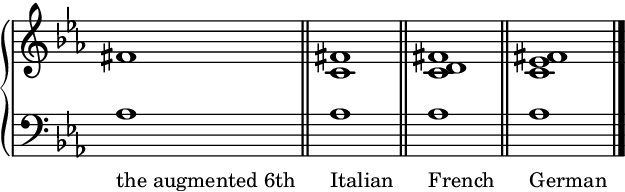
All three share the bass A flat and the tonic C; the nationality is decided by what fills the middle. The Italian is the bare frame plus the third, and in four parts its third is doubled (never the bass or the sharpened note, both of which have fixed destinations). The French adds D, the second degree, which gives it its pungent, slightly whole-tone bite: it is the only one of the three containing two tritones. The German adds E flat, making it the smoothest and the most common in the repertoire, and also, as the next chapter shows, the one that is a dominant seventh in disguise.
Resolution
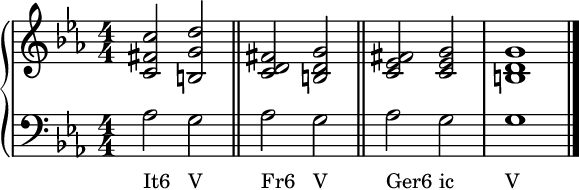
The Italian and French sixths move straight to V. The outer notes close onto the octave G, the third stays or moves by step, and the French sixth's D simply stays put as the fifth of the new chord. Nothing needs care beyond spelling: the sharpened fourth must be written as a sharpened fourth (F sharp, not G flat), because notation is destination, and this note's destination is upward.
The German sixth cannot go straight to V without trouble. Its fifth, E flat, stands a perfect 5th above the bass A flat; move both voices to the dominant chord directly and the pair A flat to G, E flat to D produces consecutive fifths. The standard route interposes the tonic 6/4: the bass falls to G while C and E flat hold still, giving Ic (or ic in minor), and only then does the 6/4 resolve to 5/3 as V arrives. The fifths never form. You will meet direct Ger6 to V resolutions in Mozart with the fifths intact, a licence so characteristic it earned the nickname Mozart fifths, but in your own exam writing take the 6/4 road.
Recognising them in a score
The tell is the interval itself: a flattened submediant in the bass with a sharpened subdominant somewhere above it, usually at a moment of dramatic approach to a cadence or a dominant pedal. Check the middle notes to name the nationality, and check the spelling before you commit: if what looks like a dominant seventh resolves outward instead of falling to a tonic, you are looking at a German sixth wearing the wrong label, and Chapter 4 explains why composers exploit exactly that ambiguity.
3. The chromatic vocabulary II: V9, V11, V13 and the rest
The dominant ninth
Stack another third on top of V7 and the dominant ninth appears: in C major G-B-D-F-A, in C minor G-B-D-F-A flat. The ninth is major or minor with the mode, and the minor ninth is the darker and more common colour in Romantic writing. The new note behaves like the seventh one storey up: it is a dissonance against the root, and it resolves by falling one step to the fifth of the tonic chord, A to G (or A flat to G) as F falls to E and B rises to C.
Five notes will not fit four voices, so in four-part writing the fifth (D) is omitted. Keep the ninth at least a ninth above the root, not a second, or the chord curdles; the wide spacing is part of its sound.
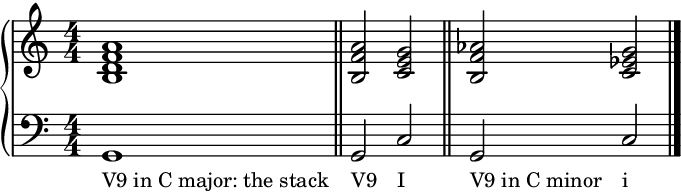
Distinguish the true ninth chord from a 9-8 suspension over a dominant. If the A sounds against the G bass and resolves down to G while the chord stays V, that is a suspension, figured 9-8. It becomes a chord of its own when the music treats it as one, sounding the ninth freely and moving on without an on-the-spot resolution. Exam questions accept the label V9 wherever the five-note spelling is present.
The eleventh and the thirteenth
Keep stacking and the eleventh (G-B-D-F-A-C) and thirteenth (G-B-D-F-A-C-E) complete the series; a thirteenth uses all seven notes of the scale, so there is nowhere further to go. On paper they are towers; in practice composers thin them to the notes that matter, and you should read them by what is present:
- V11: the eleventh, C, is the tonic note sounding over the dominant. The third is usually omitted, since B against C is the one clash the chord does not want. Typical voicing: G in the bass with F, A and C above. The eleventh either stays put to become the root of I or falls to the third, B, where the third is present in the resolution.
- V13: the thirteenth, E, is the coming tonic third sounding early. Typical voicing: G, B, F, E, with the middle storeys omitted. The thirteenth resolves by staying to become the third of I, or by falling a third to the tonic note. The seventh still falls, the third still rises: the old obligations survive however tall the tower.
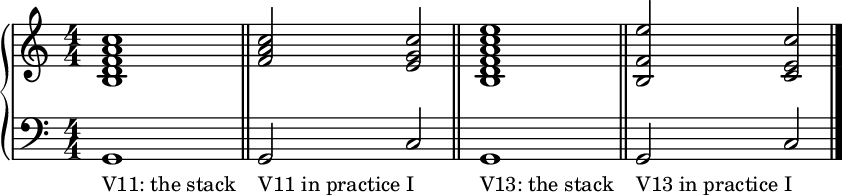
All of these chords invert. In principle any member may be the bass note; in practice you will meet root position and the lower inversions, and the exam asks for recognition, not construction, of the inverted forms. Identify the pile of thirds, find G (the root), name the bass note's position in the pile, and label accordingly. Where the letter system is wanted, the inversion letters run a to d exactly as for V7.
The rest of the chromatic palette
"All standard chromatic chords" is a short list once assembled. Besides the augmented sixths and the tall dominants, it contains:
| Chord | Construction | Normal behaviour |
|---|---|---|
| secondary dominant | the dominant (triad or seventh) of a degree other than the tonic: V7 of V, V7 of ii, and so on | resolves to its own tonic chord as a local perfect cadence |
| Neapolitan sixth | major triad on the flattened supertonic, first inversion (Grade 7) | falls to V, often through Ic |
| diminished seventh | minor thirds on the leading note (Grade 7) | leading note rises, seventh falls |
| borrowed (mode-mixture) chords | minor-key chords in a major key: iv, the flattened submediant, ii with a flattened fifth | as in the minor key; iv-I gives the darkened plagal close |
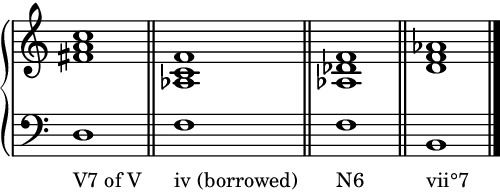
A secondary dominant is the everyday chromatic chord, so common that its accidentals are the first thing to suspect when a score sprouts sharps mid-phrase. F sharp in C major usually means D major or D7 on the way to G: V of V. Read the accidental as a temporary leading note, ask what tonic it points at, and the label writes itself.
Enharmonic equivalence of chords
Grade 7 asked for enharmonic equivalents of triads; Grade 8 extends the idea to whole chords, and two families matter most.
The German sixth and the dominant seventh are the same sound. A flat, C, E flat, F sharp and A flat, C, E flat, G flat sit on identical keys of the piano; only the spelling of the top note differs, and with it the meaning. Spelled G flat, the note is a seventh and falls: the chord is V7 of D flat. Spelled F sharp, it is an augmented sixth and rises: the chord belongs to C. One sonority, two futures.
The diminished seventh is even more prodigal. Its stack of minor thirds divides the octave evenly, so any of its four notes can be spelled as the leading note: B-D-F-A flat, spelled G sharp-B-D-F, becomes the diminished seventh of A instead of C. Four spellings, four keys, one sound (eight keys, counting each tonic's major and minor). The augmented triad divides the octave evenly too and respells the same way, three spellings for three keys.
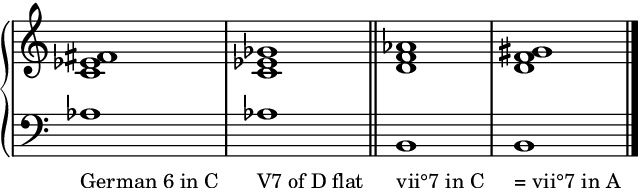
Exam questions test this directly ("give the enharmonic equivalent of this chord and name the key it belongs to"), but the deeper reason to master it is the next chapter: these double meanings are the hinges on which music swings into distant keys.
4. Modulation to unrelated keys
What "unrelated" means
The related keys of Grade 6 share most of their notes with home: the dominant, the subdominant, the relative major or minor, and their satellites, all within one accidental of the home signature. An unrelated key is anywhere else: C major to E major, to A flat major, to B minor. The problem is mechanical. A modulation needs a pivot, a chord both keys can claim, and distant keys have few or no diatonic chords in common. The solutions are to respell a chord so that it changes allegiance (the enharmonic pivot), or to travel in steps too quick to argue with (the chain).
The diminished seventh as pivot
Since a diminished seventh belongs to four keys at once, it is the universal junction. Approach it in the home key, respell one note, and leave in the new key: the listener hears one held sonority and then a resolution that reveals, only in retrospect, where the music was going.
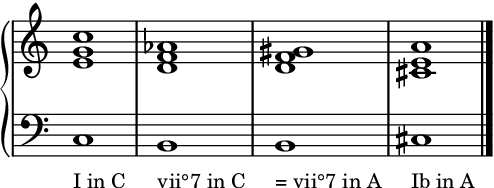
In the example, B-D-F-A flat is reached as the diminished seventh of C. Respell A flat as G sharp and the same sound is the diminished seventh of A; it resolves there, and C major is already behind us. On paper the respelling is visible as an accidental change between two identical-sounding chords; in a score question, that visible respelling, one note written two ways in adjacent chords or between two instruments, is precisely the clue to hunt for. The syllabus names both: "enharmonic change between two consecutive notes in the same part" and "simultaneous enharmonic change between two different instruments".
The German sixth as pivot
The Ger6 = V7 identity works in both directions. Hear a dominant seventh, respell its seventh as an augmented sixth, and the chord resolves not down a fifth but outward, into a key a semitone below the old expectation. The example takes C major's own dominant, G7, respells F as E sharp, and lands in B minor: two keys with no signature relationship and hardly a chord in common, joined by one accidental.
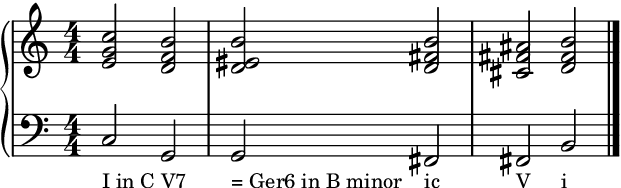
The reverse trip reads a German sixth as V7: approach an augmented sixth in the home key, flatten the sharpened note's spelling, and resolve it as a dominant seventh into the key a semitone up. Schubert, Beethoven and every Romantic after them wore grooves in both roads. When an exam score slides somewhere impossible with hardly a chord in between, look for the four-note chord at the joint and check its spelling on each side.
Chains
The other route to a far key is many small steps. A chain of dominant sevenths does it fastest: each dominant resolves onto a chord that is itself made a dominant, so every arrival is also a departure, and each link moves the music a fifth. Three or four links reach anywhere. Sequences do the same work melodically, a pattern repeated a step higher or lower carrying its harmony with it; Grade 7's descending fifths sequence is the diatonic ancestor of this chromatic engine.
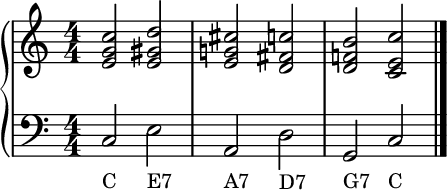
In analysis, do not try to name a key for every link; the point of a chain is that the tonal floor is moving. Name the key it leaves, the key it reaches, and the mechanism between.
Answering modulation questions
For "through what keys does this passage pass": anchor the start and end keys from signatures and cadences, then find each joint. At each joint ask three questions. Which chord do both sides share? Is any note respelled? What kind of pivot is it (diatonic chord, diminished seventh, German sixth, plain chain)? An answer that names the pivot chord and its two meanings ("bar 12's F sharp-A-C-E flat is vii°7 of G, respelled D sharp-F sharp-A-C as vii°7 of E") earns full marks; an answer that only names the keys does not.
5. The Baroque trio sonata
The medium
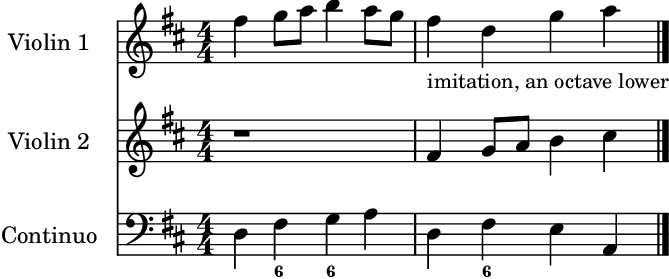
A trio sonata is written on three staves: two treble instruments, most often violins, and basso continuo, the bass line played by a cello or viol with a keyboard player realising the figures. (Three staves, usually four players: the period found nothing odd in the arithmetic.) It was the chamber music of the decades around 1700; Corelli's four sets of a dozen defined the genre, Purcell and Handel wrote them in England, and Bach transplanted the texture whole into his organ trio sonatas. When Question 1 hands you two bars of a movement "from a Baroque trio sonata", this is the world you are completing.
The texture has three roles. The continuo is the floor: it walks, usually in steady crotchets or quavers, and its figures declare the harmony beat by beat. The two trebles are equals above it, and their equality is the genre's signature. They imitate each other's openings, exchange places freely (violin 2 spends half its life above violin 1), run in parallel 3rds and 6ths when agreeing, and suspend against each other when not. No voice accompanies; everyone speaks.
The idiom
A short list of habits covers most of what the style does:
- Imitation at the opening. One treble states the subject, the other answers a bar or so later at the octave, fourth or fifth, while the first continues in counterpoint.
- Chains of suspensions. Over a sequence, the trebles take turns being dissonant: one holds a note until it clashes with the moving harmony, resolves down by step, and the resolution note becomes the next preparation. The 7-6 and 4-3 chains and the descending fifths sequence with sevenths are the classic patterns.
- Parallel 3rds and 6ths. The default for moments of agreement, and the fastest way to make two lines sound like one texture.
- Steady rhythmic flow. The music keeps a constant pulse of movement shared between the parts; when one line holds, the other moves. Genuine simultaneous rests in all parts are rare mid-phrase.
- Formula cadences. Approach through ii or IV, a 4-3 suspension or a trill over V, then the tonic. The trill sits on the supertonic or, where a 7-6 resolution lands there, on the leading note, in whichever treble is leading.
Working Question 1
The figures are the answer key printed on the question. Method:
- Realise the harmony in your head first. Read every figure and pencil the chord above each bass note (letter names are enough: "e: 7 = E minor seventh"). Only then think melody.
- Extract the motif bank. The given opening contains every idea you need: its head motif, its characteristic rhythm, its cadence figure. A continuation that keeps re-using them will sound unified, which is what the criteria reward.
- Plan the dialogue. Decide where each treble leads and where it follows. If the opening shows imitation, continue trading; if violin 1 has just led for two bars, let violin 2 take the next entry.
- Write to the figures, beat by beat. Chord notes on the beats, passing and auxiliary notes between them. A figured 7 is an instruction: some voice must sound that seventh, prepared in the previous chord and resolved down a step in the next. Suspension figures (9-8, 7-6, 4-3) likewise name intervals that must appear against the bass.
- Check ranges and crossings. Both trebles stay in comfortable violin territory (avoid sitting below the open G string or above the E string's easy reach); crossing is welcome, colliding is not.
- Sweep for grammar. No consecutive fifths or octaves between any pair of parts, sevenths resolving down, leading notes rising at cadences.
The figures themselves carry accidentals exactly as notes do, and Grade 8 papers use them freely. A sharp, flat or natural beside a figure alters that interval above the bass: 6# asks for a sharpened sixth, 5♮/3# for a natural fifth with a sharpened third. An accidental standing alone applies to the third above the bass, so a bare # under a bass note in a minor key is the everyday sign for the dominant chord, its sharpened third being the leading note. Read these before you write anything, because an accidental in the figuring is usually the first warning of a modulation.
A worked example
The question, in exam layout, given the opening of an Allegro in D:
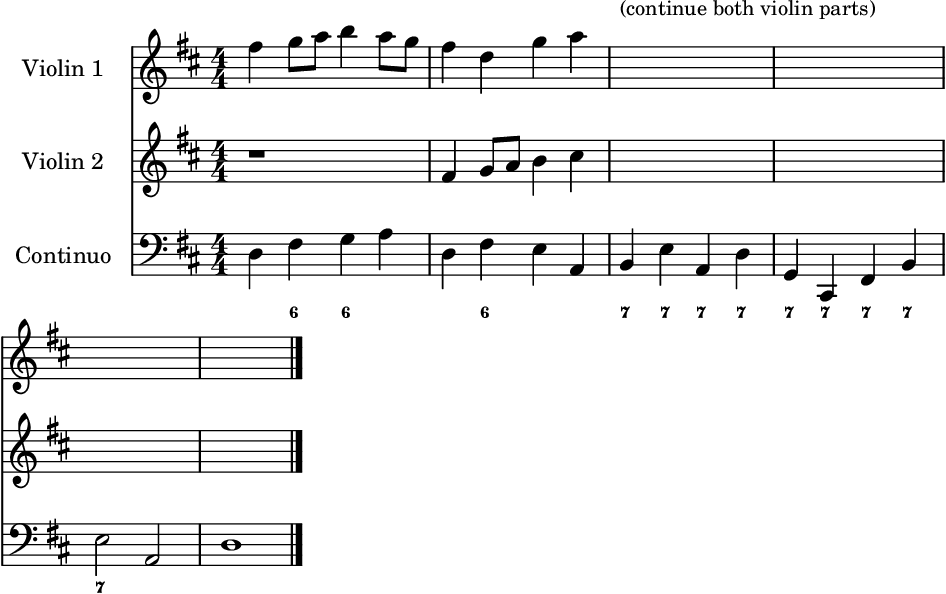
Reading the figures: bar 1 is I with two first-inversion passing chords (6 over F sharp, 6 over G); bar 2 repeats the head of the bass under the second violin's answering entry, confirming the imitation plan; bars 3 and 4 are figured 7 on every beat over a bass falling in fifths, the descending fifths chain of sevenths; bar 5 is 7 over E then a plain dominant; bar 6 closes on D. The opening gives the motif (a rising scale figure in 10ths with the bass) and shows violin 2 entering one bar behind violin 1 at the lower octave.
The completion:
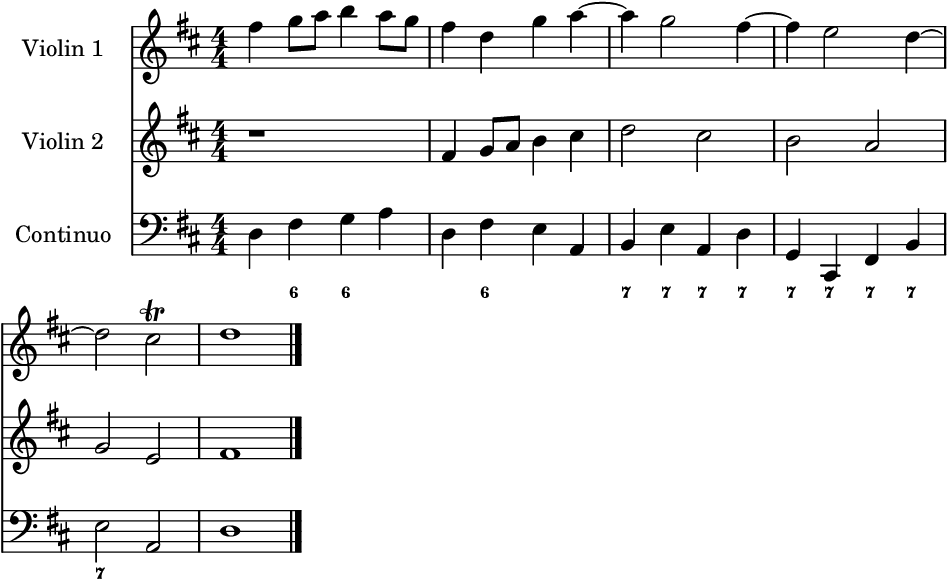
Follow the two violin lines through bars 3 and 4. Each holds a note that the moving bass turns into a seventh, resolves it down a step exactly where the figure demands, and the resolution immediately becomes the next preparation: violin 1 falls a step every two beats (A, G, F sharp, E, D), violin 2 falls the same ladder two beats out of phase. That interlocking is the chain; neither line makes sense alone, both together sound inevitable. At the cadence, violin 1's held D over the E bass sounds the figured seventh, resolves to C sharp with the conventional trill, and closes on D as violin 2 supplies the third. The continuation invents almost nothing: every bar is the opening's material passed through the harmony the figures dictate, which is the whole art of the question.
6. Keyboard styles from Haydn onwards
The question
Question 2 prints a keyboard passage with its flesh removed: the outline gives the structural melody notes and the main bass notes, with one or more bars left complete to show the intended manner. You restore the figuration so that the passage flows as the complete bars promise. "From the time of Haydn onwards" means the sample may speak Classical, Romantic or early twentieth-century idiom, and the single most important rule is: the completed opening is the style sheet. Copy its texture, its harmonic rhythm and its register; invent content, not manner.
The standard textures
Four textures cover most of what the question sets:
| Texture | Left hand | Typical home |
|---|---|---|
| Alberti bass | broken chord in the pattern low, high, middle, high | Haydn, Mozart, early Beethoven |
| broken octaves | the bass note alternating with its octave | Classical bravura passages |
| melody and accompaniment | spread or waltz-pattern chords under a singing right hand | Schubert, Chopin, Field nocturnes |
| chorale (block chords) | full chords in both hands moving together | hymnic slow movements, Brahms |
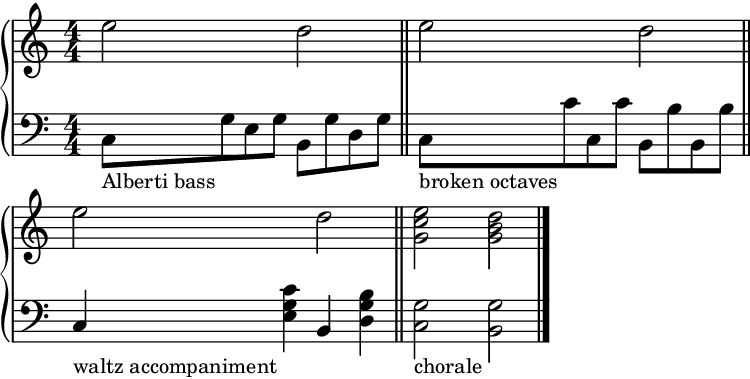
Each is a way of keeping harmony sounding on a percussive instrument whose tone dies as soon as it is struck. The Alberti pattern restrikes the chord four times a beat without weight; broken octaves add brilliance; the waltz pattern puts the harmony after the bass so that the bass note defines and the chord sustains. Recognise which one the given bars use, and reproduce its exact pattern under your added bars.
Working Question 2
- Harmonise the outline first. The given notes imply chords; write them in (Roman numerals or letter names, lightly, in the margin). The outline's bass usually gives roots and the melody confirms or refines the choice. Chromatic colour is welcome where the style invites it, a secondary dominant at a phrase's approach, a diminished seventh at its crisis, but the outline's own notes always take precedence.
- Continue the figuration mechanically. If bar 1 shows Alberti semiquavers, bars 2 to 4 have Alberti semiquavers built from your chords. Keep the pattern's compass and direction; do not let the left hand suddenly leap registers.
- Fill the right hand idiomatically. The outline's melody notes fall on the structural beats; connect them with the passage-work the style uses: scale runs and turning figures in Classical style, arpeggiated reaches and appoggiaturas in Romantic.
- Mind the joins. Where a given bar meets a completed one, the seam must be inaudible: same pattern, compatible register, no repeated-note stutter.
- Cadence properly. The outline nearly always closes with an implied formula (ii-V-I or IV-V-I, often with a cadential 6/4). Realise it with conviction: the bass on the beat, the resolution clean.
A worked example
The outline, with bar 1 complete and three bars of skeleton:
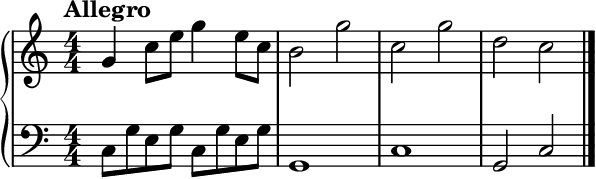
Bar 1 declares everything: C major, Allegro character, a quaver melody in the right hand, a steady quaver Alberti in the left, one harmony per bar. The outline's bass reads G, then C, then G moving to C at the close: dominant and tonic throughout, with bar 4 closing V7 to I. The skeleton right hand gives the melodic pillars: B rising to G in bar 2, C rising to G in bar 3, D falling to C at the close.

The completion keeps the left hand's pattern unbroken until the final bar, where a plain cadence replaces figuration, a standard Classical close. The right hand connects the outline's notes with the turning and scale figures bar 1 promised, placing the outline pitches exactly on their original beats. Nothing in the added bars is new except the notes; every gesture is bar 1's, which is why the result sounds composed rather than assembled.
7. Composing a longer melody
The brief
Question 3 gives the opening of a melody, names a choice of instruments, and asks for a continuation of at least 12 bars in total. Twenty marks, the largest single award for written composition on the paper, and the criteria are explicit: an "excellent overall sense of shape and direction", "unified in style and character" with the opening. Correct grammar is assumed; the marks are for architecture.
Shape
A melody of 12 to 16 bars is a paragraph, and paragraphs have structure:
- Phrase plan. Four-bar phrases are the default currency: a 16-bar answer as four phrases, a 12-bar answer as three. Irregular lengths work when they are deliberate (a two-bar extension delaying a cadence is a classic Romantic gesture), but plan them; do not drift into them.
- One climax. Somewhere around two-thirds of the way through, the melody should reach its highest point (or, more rarely, its lowest), once. Two competing peaks halve each other; a melody that touches its top note in bar 2 and again in bar 9 has spent its capital early. Build towards the climax by sequence or expanding intervals, and come away from it with a sense of descent towards the final cadence.
- Cadential punctuation. End phrases with recognisable cadence points in the implied harmony: an imperfect close at the first phrase boundary, perhaps a modulation's perfect cadence at the second, and a decisive perfect cadence at home to finish. The melody alone must imply these; a good test is whether a listener could harmonise your line at sight.
- Motif economy. The given opening contains one or two cells: a rhythm, an interval shape. The continuation should develop those rather than introduce novelties: sequence them, invert them, extend them, but keep them recognisable. Unity is a marking criterion because in real melody-writing it is the whole game.
- Modulation. A Grade 8 melody is expected to leave home somewhere in its middle, to the relative key, the dominant, or somewhere remoter if the style invites it, and to return convincingly for the final cadence.
Writing for the instrument
The named instrument is not decoration; idiom is marked.
- Stay inside the comfortable range, not just the possible one, and use register with intent: climaxes ring where the instrument speaks best.
- Wind and brass players breathe: phrase in singable spans and leave rests. String players change bows: long slurs are possible, but articulation patterns (slurred pairs, detached quavers) are what sound idiomatic.
- Use the instrument's characteristic strengths: agile scale-work for flute or violin, warm cantabile in the middle register for cello, oboe or clarinet, arpeggiated leaps for horn only with care.
- Mark the music fully: tempo confirmed, dynamics shaped with hairpins, articulation and phrasing slurred deliberately, one expressive marking where it earns its place. An unmarked melody reads as an unfinished one.
A worked example
The given opening, for oboe:
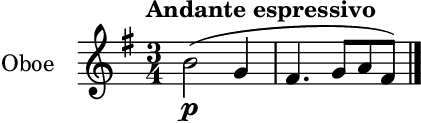
The opening offers two cells: the falling third with its long first note (bar 1), and the dotted turning figure (bar 2). The completion below runs to 16 bars in four phrases:
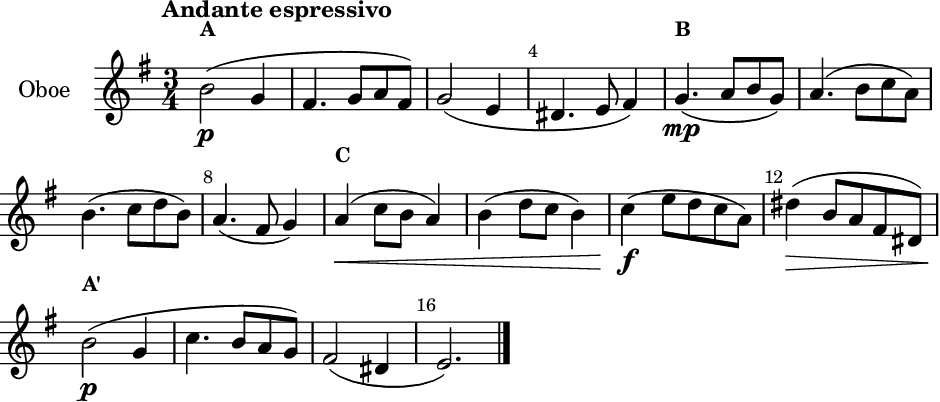
Phrase A (bars 1 to 4) closes on an implied imperfect cadence, the D sharp against the dominant making the punctuation audible. Phrase B (bars 5 to 8) takes bar 2's turning figure and sequences it upward through G major, the relative, cadencing there. Phrase C (bars 9 to 12) develops the same cell in rising sequence to the melody's single top E in bar 11, then unwinds through a dominant-seventh arpeggio: the climax placed at the two-thirds point, approached by step-wise sequence, quitted with purpose. Phrase A' (bars 13 to 16) restates the opening, bends it towards the subdominant colour, and closes with leading note to tonic over an implied V7-i. Every bar traces back to the two given cells; the dynamics rise with the sequence and fall with the close; the whole sits in the oboe's singing octave and a half. That, in miniature, is what 20 marks buys.
8. Counterpoint and development in scores
The score questions expect you to name what composers do with material. Grade 7 covered augmentation and diminution among rhythmic features; Grade 8 adds melodic inversion, contrapuntal features generally, and motivic development, in textures now allowed to exceed four parts.
Melodic inversion
A melody is inverted by mirroring its intervals: every rise becomes an equal fall and vice versa. In tonal music the mirroring is usually diatonic, step for step within the key, so a rising third answers a falling third without leaving the scale. Fugue subjects, canon lines and development sections use inversion constantly; the ear recognises the contour flipped like a reflection in water.
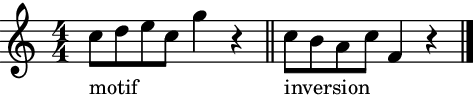
Augmentation and diminution
Recapping Grade 7: augmentation doubles (or more) every note value, diminution halves them. A subject in augmentation strides beneath faster voices, in the bass of a chorale prelude or the close of a fugue; in diminution it chatters above. Identify them by pitch shape, not speed: the intervals are unchanged, only the clock has been reset.
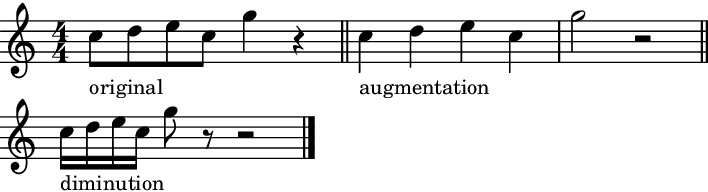
Motivic development
Development is the sum of the small operations a composer applies to a cell: sequence (repetition at a new pitch), fragmentation (detaching a piece of the motif and working it alone), extension (continuing the motif past its expected end), intervallic change (widening or narrowing a characteristic leap), and combination with the devices above. A development section of a sonata, or the middle of almost any Romantic piece, is a chain of such operations; the exam asks you to name them and point at bars.

When answering, be concrete and cite places: "the opening quaver figure returns inverted in the viola, then in diminution in the second violin two bars later". Vague appeals to "development" earn little; named operations at named bars earn everything.
More than four parts
Larger textures do not add new rules, only more pairs of voices to which the old ones apply. The reading skill is to count real parts: an orchestral tutti of twenty staves may be four-part harmony thickly doubled, and a five-voice fugue is five real parts on two keyboard staves. Doubling (the same line at the octave or unison in another instrument) does not add a part; a divisi that gives each half its own line does. In five real parts, expect doubling rather than new dissonance: a seventh chord needs only one member doubled, but five voices on a triad must double two members or triple one, and the writing leans on the extra voice for fuller spacing.
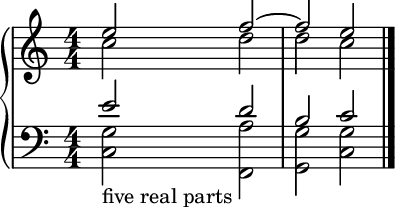
9. Reading the big score
Up to 24 staves
Question 5's limit rises to a full late-Romantic page: "full score up to 24 staves sounding simultaneously". The layout discipline from earlier grades is unchanged, woodwind at the top, then brass, percussion, harp and keyboard, voices, strings at the bottom, and within each family, higher above lower. What changes is the inventory. A large score may carry piccolo, two or three each of flutes, oboes, clarinets and bassoons, cor anglais, bass clarinet, double bassoon, four or more horns, three trumpets, three trombones, tuba, timpani, several percussion staves, harp, celesta, and five string sections, with divisi splitting staves further.
Navigation, not memory, is the skill. Read the instrument names on the first system (later systems often abbreviate or omit them and rely on position), count staves per family, and mark the seams between families with a pencil line. In any bar, find the melody by looking for the stave with the most active rhythm and the dynamic marking a level above its neighbours; find the harmony in the sustained middle; find the bass at the bottom of whichever families are playing.
A representative large score, top to bottom, with the reading each stave demands:
| Stave | Instrument | Clef | Sounds, relative to written |
|---|---|---|---|
| 1 | piccolo | treble | an octave higher |
| 2 to 3 | flutes 1 and 2 | treble | as written |
| 4 to 5 | oboes 1 and 2 | treble | as written |
| 6 | cor anglais | treble | a perfect 5th lower |
| 7 to 8 | clarinets 1 and 2 in B flat or A | treble | a major 2nd or minor 3rd lower |
| 9 | bass clarinet in B flat | treble | a major 9th lower |
| 10 to 11 | bassoons 1 and 2 | bass | as written |
| 12 | double bassoon | bass | an octave lower |
| 13 to 14 | horns 1 to 4 in F, two per stave | treble | a perfect 5th lower |
| 15 to 16 | trumpets in B flat (or D, E flat) | treble | by the named crook |
| 17 to 18 | trombones and tuba | bass (tenor when high) | as written |
| 19 | timpani | bass | as written |
| 20 | glockenspiel | treble | two octaves higher |
| 21 to 22 | harp | treble and bass pair | as written |
| 23 to 25 | violins 1 and 2, violas | treble, treble, alto | as written |
| 26 to 27 | cellos and double basses | bass | cellos as written; basses an octave lower |
Counted through, this roster reaches 27 staves. The syllabus limit of 24 counts staves sounding together, and a printed page keeps within it by pairing instruments on shared staves or resting some of them. The exact roster varies with the piece; the order and the habits do not. Note where the octave transposers sit (piccolo at the top, double bassoon and double bass at the bottoms of their families) and which staves refuse to mean what they show: everything in the clarinet, cor anglais, horn and trumpet block, plus the tuned percussion.
The transposition inventory now includes every case from earlier grades (instruments in B flat, A, F, E flat, D, E and G, plus the octave transposers) and completes the low reeds: the bass clarinet in B flat, written in the treble clef a major 9th above its sound, becomes examinable at Grade 8, while the double bassoon, sounding an octave below its written bass clef, carries forward from Grade 7. Interval questions, including those between transposing instruments, may now involve both.
Transposing percussion
Three tuned percussion instruments are written below their sound to save ledger lines, and the syllabus names them for "more frequent transposition" questions:
| Instrument | Sounds | To find sounding pitch |
|---|---|---|
| glockenspiel | two octaves higher than written | read up two octaves |
| xylophone | one octave higher than written | read up one octave |
| celesta | one octave higher than written | read up one octave |
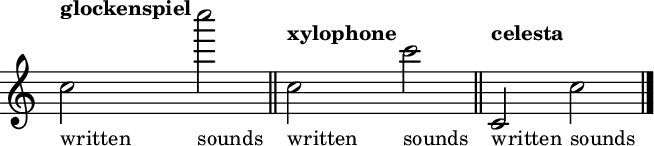
The trap in exam questions is comparing a percussion part with a string or wind part: "what interval sounds between the glockenspiel and the first violin here?" requires the glockenspiel raised two octaves before you measure anything.
Advanced techniques
The technique markings examinable by Grade 8 cluster around wind and brass colour, extending the string list of earlier grades (open strings, double stopping, muting, harmonics, reiteration signs):
- Flutter tonguing: a rolled R blown through flute, clarinet or brass, producing a growling tremolo. Marked flz. (German Flatterzunge), frullato (Italian), or in English "flutter", and notated with tremolo strokes through the stem.
- Sul tasto (Italian; French sur la touche, German am Griffbrett): bow over the fingerboard, giving a veiled, flute-like tone. Its opposite, sul ponticello, bows at the bridge for a glassy hiss.
- Bouché (French): hand-stopped horn, the hand closing the bell to give a tight, buzzing tone; marked with + above the note, cancelled by o for open. Cuivré (French, "brassy") demands a forced, blaring metallic sound, stopped or open; chiuso is the Italian for stopped horn.

Foreign pitch names
Scores and commentaries use local note names, and the syllabus expects the two systems that differ from English usage:
| English | German | French and Italian solfège |
|---|---|---|
| B natural | H | si |
| B flat | B | si bemolle (It), si bémol (Fr), short form sib |
| A sharp | Ais | la diesis (It), la dièse (Fr), short form la# |
| E natural | E | mi (with a natural sign, mi♮, where a cancellation is meant) |
German attaches -is for sharp and -es for flat (Fis, Es, As), with H and B as the historical exceptions that catch everyone out: a German B is our B flat, and H-moll is B minor. Timpani tunings, horn crooks and analytical notes in older editions all use these names; "Pauken in H, Fis" asks for kettledrums on B natural and F sharp.

Scores without key signatures
Some modern scores abandon key signatures entirely, writing every accidental where it occurs; horn and trumpet parts did the same for most of the nineteenth century, and heavily chromatic music gains clarity from it. Nothing about the music need be atonal: E major written without a signature simply carries sharps on every D, C, F and G that needs one.

Reading method: accidentals apply for the bar, as always; establish the key from the notes themselves, the recurring sharpened or flattened letters, the cadences and the bass, exactly as you would establish a modulation's destination. When a question asks "what key is this passage in?", the absence of a signature changes the evidence, not the question.
10. Questions 4 and 5 in practice
Question 4: the extract of up to five staves
The Grade 8 extract is typically chamber music: a string quartet with a wind soloist, a wind quintet, a song with accompaniment on multiple staves. Expect transposing instruments in genuinely mixed company, and expect the questions to move freely across the whole syllabus: chord identification (now including every chromatic chord), intervals between written parts of two different transposing instruments, melodic decoration, ornament realisation, phrase structure, terms, and the underline-the-composer question with up to four choices.
Method before detail:
- Establish the sounding key: signature, final bass, accidental habits. Write each transposing part's interval of transposition in the margin at once.
- Read the texture: who has the melody, who accompanies, where the bass is (it is not always the bottom stave if the cello is resting).
- For any chord question, convert every note to sounding pitch first, then stack in thirds, then name and label. Never identify a chord from written pitches in a transposing score.
- For interval questions between transposing instruments, convert both to concert pitch, measure, and give the answer as the question directs (sounding interval unless it says otherwise).
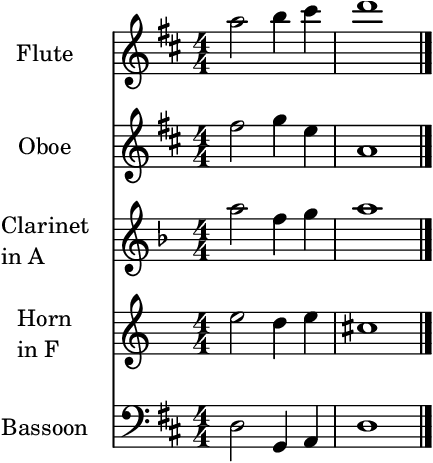
Try the method on the extract above. The clarinet in A is written a minor 3rd above its sound, so its written F major signature sounds D major, agreeing with the flute, oboe and bassoon; the horn in F is written a perfect 5th above its sound with no key signature, its written C sharp sounding F sharp. Beat by beat the sounding harmony is I, then IV and V passing in the third and fourth beats, closing on I: a plain D major progression dressed in three notations. Every Question 4 reduces the same way: translate, stack, name.
Question 5: the full score
The big score adds no new theory; it adds scale, and questions about instruments themselves: name the family and the transposition, explain a2, div., unis., muta in, identify which stave carries a quoted fragment, compare two passages ("describe the differences between bars 1 to 4 and 40 to 43"), name the period and likely composer from a list of up to four.
A reliable order of work:
- Spend the first minutes on the first page: instrument names, transpositions, clefs, families. Everything else depends on this map.
- Answer location questions (which instrument plays X) by rhythm-matching before pitch-matching: rhythms survive transposition.
- For period and composer, reason from evidence you can name: the size and make-up of the orchestra, the presence of valved brass or heavy percussion, the harmonic vocabulary, notation habits like missing key signatures. An answer that says "large brass section, harp and cor anglais with rich chromatic harmony: late Romantic, so Wagner rather than Haydn or Mozart from the list" is exam-ready.
- Leave transcription tasks (write this passage at sounding pitch) until the surrounding questions have forced you to fix each transposition correctly.
11. Terms and signs at Grade 8
The full vocabulary of Grades 1 to 7 remains examinable. These are the additions, and as at Grade 7 they lean towards the words found in Romantic scores.
Italian terms
| Term | Meaning |
|---|---|
| affrettando (affrettare) | hurrying, pressing on |
| ancora | again, still (ancora più forte: still louder) |
| brioso | vigorous, spirited |
| calma, calmato | calm, calmed |
| doppio movimento | twice as fast as the preceding music |
| estinto | as quiet as possible, barely audible |
| incalzando | pressing forward, getting quicker |
| lacrimoso | tearful, mournful |
| legatissimo | as smoothly as possible |
| loco | at normal pitch, cancelling an octave sign |
| lusingando | coaxing, caressing in style |
| mancando | dying away |
| misura | strict time (senza misura: in free time, unmeasured) |
| nobilmente | nobly |
| parlando | in a speaking manner |
| piangevole | plaintive |
| precipitando | rushing headlong |
| scherzo, scherzoso | a joke; playfully |
| stretto | quickening; in a fugue, entries overlapping closer together |
| tosto | swift, rapid (più tosto: rather) |
| volante | flying, light and fast |
French terms
| Term | Meaning |
|---|---|
| en dehors | brought out, prominent |
| légèrement | lightly |
| modérément | moderately |
| peu à peu | little by little |
| presser, pressez | hurry, press on |
German terms
| Term | Meaning |
|---|---|
| bewegt | with movement, agitated |
| breit | broad |
| einfach | simple |
| gesprochen | spoken |
| immer | always (immer leiser: quieter and quieter) |
| lebhafter | livelier |
| leicht | light |
| leise | soft |
| ruhiger | calmer |
| schleppend | dragging (nicht schleppend: do not drag) |
| schneller | faster |
| wenig | a little |
| wieder | again |
Signs
The signs to know at this grade belong to the techniques of Chapter 9: + for stopped horn and o cancelling it, tremolo strokes with flz. or frullato for flutter tonguing, and the local pitch names (H, B, sib, la#) that function as signs when they appear in timpani tunings and crook directions. Everything else, hairpins to volta brackets, carries forward from earlier grades unchanged.
12. Common mistakes at Grade 8
- Spelling the German sixth as a dominant seventh (G flat for F sharp). The sharpened note rises; write it as a note that rises.
- Resolving the German sixth straight to V and creating consecutive fifths. Route it through the tonic 6/4.
- Labelling every A above a G bass as V9. If it resolves down while the chord stays V, it is a 9-8 suspension; the chord label needs the full five-note spelling.
- In the trio sonata, ignoring the figures: a figured 7 or 4-3 is a note some voice must sound, prepared and resolved, not a suggestion.
- Writing trio sonata trebles that accompany instead of converse. If violin 2 has nothing to say for four bars, the answer is not in style.
- In the keyboard question, inventing a new texture instead of continuing the given one. The complete bars are the style sheet; the marks are for matching them.
- Melodies with two climaxes, or none, or a top note spent in the first phrase. One peak, about two-thirds through.
- Forgetting the instrument: oboe lines with nowhere to breathe, horn parts leaping like a violin's, cello melodies parked above the stave.
- Identifying chords from written pitches in transposing scores. Concert pitch first, always.
- Comparing a glockenspiel or xylophone part with strings at written pitch. Raise the percussion its octave or two octaves before measuring.
- Reading German B as B natural. B is our B flat; H is our B natural.
- Naming keys in a modulation question without naming the pivot. The mechanism, respelled diminished seventh, German sixth as V7, chain, is the answer.
13. Practice questions
Answers follow in the next section.
Spell the Italian, French and German sixths in F minor, and state which note of each is doubled in four-part writing (where doubling is needed).
The chord A flat-C-E flat-G flat sounds in a passage. Give its two possible spellings, the key each belongs to, and the resolution each demands.
Write out the notes of V9 in D minor. Which note is omitted in four-part writing, and how does the ninth resolve?
In G major, name the notes of V13 in its practical four-note voicing, and give the two standard resolutions of the thirteenth.
Name the four chords in this extract, each with its key:
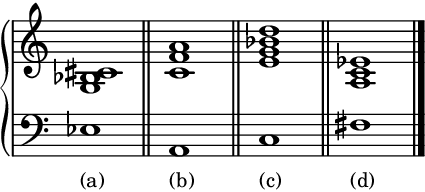
The keys are, in order: G minor, E minor, F major, G major.
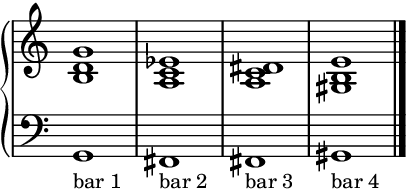
This passage begins in G major and ends elsewhere. Name the destination key, and explain the pivot precisely:
A diminished seventh contains the note D. Spell the four versions of the chord in which D can appear, and name the minor key each resolves to.
In a trio sonata movement, the continuo is figured 7 on four consecutive crotchets whose roots fall by fifths. Describe what the two treble parts should do above it.
A Question 2 outline shows bar 1 complete, with a left hand in Alberti quavers. What are the three things your completion of bars 2 to 4 must copy from bar 1, and what must it add?
List four operations of motivic development, with one sentence each on how the ear recognises them.
A glockenspiel part shows written middle C sharp; the first violin sounds the E a 10th above middle C. What interval sounds between the instruments?
Translate: Pauken in H und Fis (a timpani direction), and the melody direction sib in a French solfège commentary.
What do these markings ask of the player: flz., sul tasto, + over a horn note, cuivré?
A score in a late Romantic style has no key signature on any stave, yet the music closes on an unmistakable E major chord with a preceding B7. What should you conclude, and how would you defend the key in an answer?
Continue this opening for violin to a complete melody of at least 12 bars (written practice; a model plan is described in the answers):
 16. What is doppio movimento, and what is its practical effect on a crotchet pulse of 60?
17. Translate and contrast: incalzando, mancando, schleppend, wieder.
14. Answers
- In F minor the frame is D flat (flattened sixth) under B natural (sharpened fourth). Italian: D flat-F-B, doubling the F. French: D flat-F-G-B, no doubling needed (four different notes). German: D flat-F-A flat-B, no doubling needed. In each, D flat falls to C and B rises to C.
- Spelled A flat-C-E flat-G flat it is V7 of D flat (major or minor): the G flat falls to F as the chord resolves to D flat. Spelled A flat-C-E flat-F sharp it is the German sixth of C (major or minor): A flat falls to G, F sharp rises to G, normally through the tonic 6/4 to avoid consecutive fifths.
- V9 in D minor: A-C sharp-E-G-B flat. The fifth, E, is omitted in four parts. The ninth, B flat, falls one step to A, the fifth of the tonic chord, as G falls to F and C sharp rises to D.
- V13 in G major, practical voicing: D-F sharp-C-B (root, third, seventh, thirteenth). The thirteenth, B, either stays to become the third of G major's tonic chord, or falls a third to G as the tonic arrives.
- (a) E flat-G-B flat-C sharp in G minor: the German sixth. (b) C-F-A over A in E minor: the Neapolitan sixth (F major triad, first inversion). (c) C-E-G-B flat-D in F major: V9 (a dominant ninth on C). (d) F sharp-A-C-E flat in G major: the diminished seventh on the leading note, vii°7.
- The destination is E major. Bar 3's chord sounds as F sharp-A-C-D sharp: it was reached as the diminished seventh of G (F sharp-A-C-E flat), but the E flat is respelled D sharp, converting the chord into the diminished seventh of E (D sharp-F sharp-A-C). It resolves accordingly, and the final chord confirms E major. Naming both spellings and both keys is the full answer.
- D can be the root, third, fifth or seventh: D-F-A flat-C flat resolving to E flat minor; B-D-F-A flat to C minor; G sharp-B-D-F to A minor; E sharp-G sharp-B-D to F sharp minor. (Each spelling's lowest-named note is the leading note of its key.)
- The trebles should form a chain of suspensions: each in turn holds a note that becomes the seventh over the new bass note, resolves it down by step, and lets the resolution become the preparation for its next seventh, the two voices out of phase with each other by one chord. Chord notes fall on the beats; the lines exchange roles rather than doubling each other.
- Copy the texture (the exact Alberti pattern, register and note values), the harmonic rhythm (one chord per bar, or as bar 1 defines), and the melodic manner (the figuration style connecting outline notes). Add the harmony implied by the outline's bass and melody notes, keeping the outline's own pitches on their printed beats, and a properly realised cadence at the close.
- Sequence: the motif repeats at a higher or lower pitch, shape intact. Fragmentation: only a piece of the motif is repeated and worked, so the ear hears the head or tail insistently detached. Extension: the motif begins as expected but continues past its usual ending. Inversion: the contour mirrors, rises becoming equal falls. (Augmentation and diminution, values doubled or halved with pitches intact, complete the standard list.)
- The glockenspiel sounds two octaves above written, so its written C sharp sounds two octaves higher than notated. The violin's sounding E lies a major 6th below that C sharp, so the sounding interval between the instruments is a major 6th. (At written pitch the same notes look like a minor 10th, which is why the conversion must come first.)
- Timpani tuned to B natural and F sharp (German H is B natural; German B would be B flat). Sib is si bémol: B flat.
- Flz.: flutter tonguing, a rolled tremolo of the tongue on a wind or brass note. Sul tasto: bow over the fingerboard for a veiled tone. +: stop the horn with the hand in the bell (bouché/chiuso); o cancels it. Cuivré: a forced, brassy, metallic tone.
- Conclude that the composer writes without key signatures, not that the music is keyless. Defend E major from the evidence: consistent sharpening of F, C, G and D by accidental, a dominant seventh on B resolving to E, and the final cadence B7 to E major, a perfect cadence in E.
- A model plan for the A major opening: phrase 1 (bars 1 to 4) completes the given idea and closes on an imperfect cadence; phrase 2 (bars 5 to 8) sequences the opening figure and cadences in E major, the dominant; phrase 3 (bars 9 to 12) develops the semiquaver cell in rising sequence to a single climax on the violin's bright upper A or B around bar 11, then falls away; phrase 4 (bars 13 to 16) restates the opening and closes V7-I in A major. Dynamics rise to the climax and settle; slurred pairs and detached quavers continue the opening's articulation; everything stays inside first-position violin range with the climax on the E string.
- Twice as fast as the preceding music: the new beat takes half the old duration. A crotchet pulse of 60 becomes, in effect, a pulse of 120 (each old crotchet's worth of time now contains two).
- Incalzando: pressing forward, getting quicker (Italian). Mancando: dying away (Italian). Schleppend: dragging (German), the fault incalzando's energy avoids and nicht schleppend forbids. Wieder: again (German), as in wieder lebhaft, lively again.
This closes the eight-grade course. Grade 8's syllabus phrase, all standard diatonic and chromatic chords, is a quiet way of saying that the toolbox is now complete: what remains is repertoire, and there is no syllabus for that. The reference volumes on the shelf, from Musical Harmony to Music Notation*, are built for the music beyond the exams.*