A complete course for the seventh grade of the ABRSM Music Theory syllabus: secondary sevenths on every degree, the diminished seventh, the Neapolitan sixth, the full figured-bass vocabulary of c.1620 to 1790, suspensions and melodic decoration in earnest, and the reading of full orchestral scores of up to fourteen sounding staves.
Introduction
Grade 7 is the craftsman's grade. Grade 6 handed you the tools of harmony: chords built and figured, cadences chosen, a melody continued in style. Grade 7 asks you to use those tools the way working musicians of the seventeenth and eighteenth centuries used them daily, reading a bass and knowing at sight what the figures demand, hearing where a suspension belongs before it is written, and deciding not just which chord comes next but how the inner voices carry it there.
The new vocabulary is small but potent. Three chord families join the palette: the secondary sevenths, which put a seventh on every degree of the scale rather than just the dominant and supertonic; the diminished seventh, the most flexible dissonance in tonal music; and the Neapolitan sixth, the first truly chromatic chord of the series. Around them sits the complete figuring system that Baroque and Classical composers used to notate harmony above a bass, every number, dash and accidental of it.
The exam questions change character to match. Where Grade 6 asked you to build harmony, Grade 7 asks you to read and refine it. One question gives you a finished passage, melody and bass complete, and asks only for the figures: pure harmonic analysis under another name. Another gives you a plain harmonic skeleton and asks you to dress it with suspensions and decoration, which is the reverse skill, composition as embellishment. The score-reading questions, meanwhile, grow to full orchestral size.
None of this is harder than Grade 6 so much as more exact. A candidate who understands why a suspension must be prepared, why the seventh of a chord falls, and why the Neapolitan's flattened note leans downward will find the paper largely writes itself. A candidate relying on memorised labels will find the same paper full of traps. This volume therefore spends its time on mechanisms: what each dissonance actually does, and why the conventions formed as they did.
Work with an instrument at hand. Every progression in this book is short enough to play, and the figures, suspensions and resolutions only become obvious to the eye after they are familiar to the ear. Ten minutes of playing 4-3 suspensions in different keys teaches the species better than an evening of reading about them.
About this guide and the exam
Grades 6 to 8 are written papers, sat under exam conditions with an invigilator, and Grade 7 allows three hours. There are five questions, marked out of 100: Question 1 carries 15 marks, Question 2 carries 15, Question 3 carries 20, and Questions 4 and 5 carry 25 each. The result categories are unchanged from Grade 6: 66 for a Pass, 80 for a Merit, 90 for a Distinction. The syllabus is cumulative, so everything from Grades 1 to 6 remains examinable, and the paper assumes it freely.
The official syllabus adds, on top of the preceding grades, "recognition of all diatonic secondary seventh chords and their inversions, the Neapolitan sixth and the diminished seventh chords, and of all figures commonly used by composers during the period c.1620-1790 to indicate harmonies above a bass part". Those three additions, and the question types that exercise them, are the whole of what is new; the depth comes from how thoroughly they are tested.
The five questions take a fixed shape:
| Question | Marks | Task |
|---|---|---|
| 1 | 15 | Figure the bass of a passage in which both melody and bass are given |
| 2 | 15 | Rewrite a passage to include suspensions and notes of melodic decoration |
| 3 | 20 | Complete a solo part over a fully given keyboard accompaniment, or compose a melody on a given chord progression or melodic figure |
| 4 | 25 | Questions on a short score extract featuring a transposing solo instrument, including C clefs |
| 5 | 25 | Questions on a full score of up to fourteen sounding staves |
What Grade 7 asks of you
By the end of this grade you should be able to:
- build the seventh chord on every degree of the major and minor scale, name its quality, and label all four positions in both letters and figures
- construct, figure and resolve the diminished seventh, and respell it enharmonically to reach other keys
- construct, approach and resolve the Neapolitan sixth
- read and write every figure in common use c.1620 to 1790, including 4-3, 7-6 and 9-8 suspensions and compound figures with accidentals
- write suspensions correctly prepared and resolved, singly and in chains, in any voice including the bass
- decorate a plain line with accented passing notes, chromatic auxiliary notes, appoggiaturas, changing notes and anticipations, and strip a decorated line back to its skeleton
- recognise pedal points, sequences, false relation and the Tierce de Picardie in repertoire
- read alto and tenor clefs fluently in score, and handle instruments in D and E flat, horns in E flat, E and G, the double bassoon, and octave-transposing pitched percussion
- know the standard instrument names and pitch names in Italian, German and French, and the notation of open strings, double stopping, muting, harmonics, flutter tonguing and playing on the fingerboard
- command the accumulated Italian, French and German vocabulary, with the Grade 7 additions
1. From Grade 6 to Grade 7
Grade 6 closed with a particular set of skills: chords of 5/3, 6/3 and 6/4 on any degree, the dominant seventh in all four positions, the supertonic seventh in two, the figuring for all of them, and the writing of four-part harmony above a given bass. Keep all of it warm; every bar of the Grade 7 paper stands on it.
What changes is the direction of travel. At Grade 6 you mostly built harmony from instructions: given a figured bass, realise it; given a melody, choose chords. At Grade 7 the paper hands you music that is already complete and asks you to account for it or refine it. Question 1 gives you melody and bass together, everything sounding already decided, and asks you to write the figures that describe it. That is analysis. Question 2 gives you a plain, correct, dull passage and asks you to add the suspensions and decorations a composer of the period would have written. That is style.
The new chords serve that shift. Secondary sevenths appear constantly in real basses, so figuring a real passage demands them. The diminished seventh and the Neapolitan sixth are the two chromatic colours that Baroque and Classical composers reached for most often at moments of tension, so recognising them at sight matters in the score questions too. And the full figuring vocabulary is simply the language the period wrote its harmony in: learn it as a language, not a list.
One habit is worth forming from the first day of preparation. Whenever you meet a chord, name it three ways: by its notes (D-F-A-C), by its Roman numeral and position (ii7b in C major), and by its figures (6/5). The exam moves freely among all three, and fluency means never having to translate consciously.
Managing the three hours
The paper allows three hours, and the questions may be answered in any order. Half the marks sit in the two score questions, so leave them a full hour between them; they reward unhurried reading more than any other part of the paper. Many candidates do best opening with Question 1, whose method is the most mechanical, then giving Question 3 its twenty marks' worth of drafting time while fresh, and keeping Question 2 for a spell of detailed, small-scale work. Whatever the order, budget time at the end to play every written answer through in your head: silent checking catches the consecutive octaves, unresolved sevenths and unprepared suspensions that cost the easiest marks to save.
2. Secondary sevenths on every degree
What a seventh chord is
Any triad becomes a seventh chord when a third is stacked on top, making four notes: root, third, fifth, seventh. The interval from root to seventh gives the chord its bite; sound any seventh chord and you hear a mild dissonance asking to move. That dissonance is the engine of the whole chapter, because a seventh is not a colour added for its own sake: it is a tension with an agreed release. The seventh falls by step in the next chord. Almost every rule that follows is that one sentence in different clothing.
Grade 6 used two sevenths: the dominant seventh V7 and the supertonic seventh ii7. A secondary seventh is what you get by building the same four-note stack on any other degree. Since every degree of the scale will carry one, the family is best learned as qualities, not as individual chords.
The five qualities
Stack thirds from a scale and only five shapes of seventh chord can result. Each is named for its triad plus its seventh:
| Quality | Triad | Seventh above root | Example on C |
|---|---|---|---|
| major seventh | major | major 7th | C-E-G-B |
| dominant seventh | major | minor 7th | C-E-G-B♭ |
| minor seventh | minor | minor 7th | C-E♭-G-B♭ |
| half-diminished seventh | diminished | minor 7th | C-E♭-G♭-B♭ |
| diminished seventh | diminished | diminished 7th | C-E♭-G♭-B♭♭ |

The names do real work. "Dominant seventh" describes the shape found on the dominant, wherever the shape occurs; "half-diminished" means the triad is diminished but the seventh is only minor, one rung short of the fully diminished seventh, which shrinks the seventh too and gets the whole of the next chapter to itself.
The sevenths of the major key
Build a seventh on each degree of C major using only white notes and the qualities fall out in a fixed pattern, the same in every major key:
| Degree | Chord | Notes in C | Quality |
|---|---|---|---|
| 1 | I7 | C-E-G-B | major seventh |
| 2 | ii7 | D-F-A-C | minor seventh |
| 3 | iii7 | E-G-B-D | minor seventh |
| 4 | IV7 | F-A-C-E | major seventh |
| 5 | V7 | G-B-D-F | dominant seventh |
| 6 | vi7 | A-C-E-G | minor seventh |
| 7 | vii7 | B-D-F-A | half-diminished seventh |

Notice what is unique. Only V7 has the dominant-seventh quality, which is why that shape alone can announce a key by itself. Only vii7 is half-diminished. The three minor sevenths (ii7, iii7, vi7) are the workhorses of sequences, and the two major sevenths (I7, IV7) are the gentlest of the family, their major seventh rubbing directly against the root's octave.
The sevenths of the minor key
Minor keys are reckoned with the harmonic minor, and its raised seventh degree reshapes the pattern. In A minor:
| Degree | Chord | Notes | Quality |
|---|---|---|---|
| 1 | i7 | A-C-E-G♯ | minor triad with major 7th |
| 2 | ii7 | B-D-F-A | half-diminished seventh |
| 3 | III7 | C-E-G♯-B | augmented triad with major 7th |
| 4 | iv7 | D-F-A-C | minor seventh |
| 5 | V7 | E-G♯-B-D | dominant seventh |
| 6 | VI7 | F-A-C-E | major seventh |
| 7 | vii°7 | G♯-B-D-F | diminished seventh |

Two entries carry almost all the traffic. The half-diminished ii7 is the minor key's favourite approach to V, exactly as ii7 is in the major. And the seventh on the leading note is now fully diminished, the chord of the next chapter. The chords on 1 and 3, with their clashing major sevenths against minor and augmented triads, are rare in the period's music and rarer still in exam papers; know their construction, and do not force them into your own writing.
Inversions and their figures
A four-note chord has four possible bass notes, so sevenths have a third inversion where triads stop at two. The ABRSM letters run a to d; the figures count intervals above the bass, abbreviated by convention to the numbers a player actually needs:
| Position | Bass note | Letter | Full figures | Usual figures |
|---|---|---|---|---|
| root position | root | a | 7/5/3 | 7 |
| first inversion | third | b | 6/5/3 | 6/5 |
| second inversion | fifth | c | 6/4/3 | 4/3 |
| third inversion | seventh | d | 6/4/2 | 4/2 (or 2) |
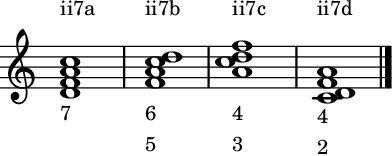
The pattern behind the abbreviations: each figuring keeps just enough numbers to be unambiguous, and the numbers shrink as the chord inverts (7, then 6/5, then 4/3, then 4/2) because the seventh of the chord sits ever closer above the bass. In third inversion the seventh is the bass, and the dissonant 2nd it makes with the root above gives the 4/2 its distinctive crunch.
Letters and figures name the same fact. In C major, D-F-A-C with F in the bass is ii7b, or 6/5 on a bass F; with C in the bass it is ii7d, or 4/2 on a bass C. Practise converting until the translation is instant.
How sevenths resolve
The seventh of the chord behaves like a suspension that arrives with its chord: it is a dissonance, and it resolves by falling one step in the following chord. Everything else about a good resolution follows from counting where that step lands:
- ii7 to V: the seventh of ii7 is the tonic degree (C in D-F-A-C). It falls to the leading note, which is the third of V. This is the single most common seventh progression in the literature, and ii7b in particular, 6/5 on the subdominant bass note, is the textbook approach to a cadence.
- V7 to I: the seventh (F in G-B-D-F) falls to the third of I, while the leading note rises. Grade 6 material, unchanged.
- vii7 to I: every note leans; the seventh falls, the leading-note root rises.
- Sequences of sevenths: chain the falling-seventh logic around the circle of fifths (I7-IV7-vii7-iii7-vi7-ii7-V7-I) and each chord's seventh is prepared by the previous chord and resolves into the next. Baroque composers ran this engine constantly; if a Question 1 bass moves in fifths with sevenths everywhere, you are looking at it.
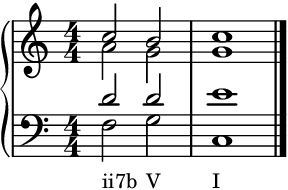
In four parts, one practical consequence: a complete seventh chord uses all four voices, so nothing is doubled; where a voice must be sacrificed, drop the fifth, never the seventh, the third or the root. And never double the seventh itself: it is a dissonance with a fixed destination, and two voices cannot both go there.
3. The diminished seventh
Construction
Take the leading note of a minor key and stack three minor 3rds on it. In A minor: G♯, B, D, F. The result is the diminished seventh chord, named for the interval from root to seventh (G♯ up to F is a diminished 7th). Its symbol is vii°7.
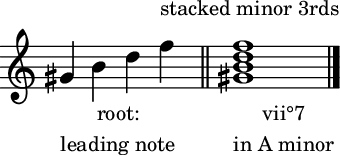
The chord is a study in symmetry: every adjacent pair of notes is a minor 3rd, and the two outer pairs form two interlocking tritones (G♯-D and B-F). No other chord in the vocabulary is built from a single repeated interval, and that symmetry is the source of both its sound and its usefulness. Because no interval distinguishes root from third from fifth from seventh, the ear cannot tell which note is the root until the chord resolves.
In the major key the same degree carries the half-diminished vii7 (B-D-F-A in C major), but composers freely borrow the fully diminished version (B-D-F-A♭) in major keys, flattening the sixth degree to get it. The exam expects you to recognise it in both contexts.
Figures
In root position the full figuring is 7/5/3. The raised leading note is the bass note itself, so its accidental is written on the stave beside the bass note, not in the figures, and in the harmonic minor the 7th, 5th and 3rd above it are all diatonic. Accidentals join the figures when a note above the bass leaves the key signature: the diminished seventh borrowed into a major key must show its flattened seventh (♭7), and in the inversions the raised leading note sits above the bass and takes a sharpened number. The inversions otherwise figure exactly as any other seventh chord: 6/5, 4/3, 4/2. What makes diminished-seventh figuring distinctive is how often accidentals ride along with the numbers, because at least one note of the chord is always foreign to the key signature. Chapter 5 gathers the conventions.
Resolution
Resolve the chord by letting its tensions do what they lean toward. The root is the leading note: it rises to the tonic. The seventh (F in G♯-B-D-F) falls one step to E, the fifth of the tonic chord. The two tritones close inward or open outward by step, and the whole chord collapses onto the tonic with every voice moving by step or staying put. That stepwise totality is why the chord resolves so smoothly despite its harshness.
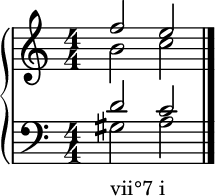
In four-part writing the practical rules are few: resolve the leading note upward, resolve the seventh downward, and let the middle notes fall as the tritones direct. The tonic chord that results often has a doubled third, and that doubling is correct and normal here; forcing a doubled root instead is what produces consecutive 5ths in this progression.
Enharmonic reach
Divide an octave (twelve semitones) into minor 3rds (three semitones each) and it comes out exact: four notes, no remainder. The diminished seventh is therefore the chord that repeats itself every minor 3rd: respell any of its notes enharmonically and you get another correctly spelled diminished seventh with a different root. G♯-B-D-F resolves to A minor. Respell the G♯ as A♭ and the same four keys of the piano read B-D-F-A♭: a diminished seventh on B, resolving to C. Keep the fingers where they were and the seventh, A♭, now lies at the bottom of the voicing, so the respelled chord stands in third inversion, vii°7d, and resolves onto Ic. Respell again and it resolves to E♭; again, to F♯ (G♭).

Count the consequence: there are only three distinct diminished-seventh sounds on the piano, each answering to four spellings, and each spelling belongs to a different tonic. Composers exploit this as a trapdoor between keys, entering the chord in one spelling and leaving it in another, and remote modulations in Bach, Haydn, Mozart and Beethoven pivot on it constantly. At Grade 7 you need the principle and the respelling skill; the score questions may ask you to identify the enharmonic equivalent of a triad (the four-note version arrives at Grade 8), and the figured-bass and analysis questions expect the spelling that matches the key of the moment.
A note on spelling discipline. Write the chord for where it is going, not for where the fingers fall: the leading note of the destination key is the root, and the other three notes stack in minor 3rds above it. Two checks catch a misspelling: the root up to the seventh must read as a diminished 7th, never a major 6th (G♯ up to F, not G♯ up to E♯), and every adjacent pair must read as a minor 3rd, never an augmented 2nd.
4. The Neapolitan sixth
Construction
Take the supertonic of a minor key, flatten it, and build a major triad on the flattened note. In C minor the supertonic D becomes D♭, and the triad is D♭-F-A♭. Now put the chord in first inversion, so that F, the unaltered subdominant degree, is in the bass. That first-inversion position is so nearly universal that the chord is named for it: the Neapolitan sixth, written N6 or ♭II b, figured as a plain 6 above the bass with whatever accidentals the altered notes need.
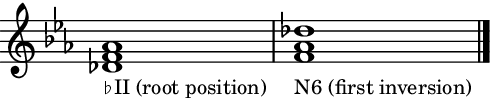
The name honours the early eighteenth-century opera composers working in Naples who made it a signature, though the chord is older and everyone from Purcell to Beethoven used it. It lives most naturally in minor keys, where only one note (the flattened supertonic) is foreign; in major keys it needs two accidentals and appears more rarely.
Hear what the alteration does. The ordinary supertonic chord in minor is diminished, tense and greyish. Flattening its root turns it into a full major triad, unexpectedly warm, sitting a semitone above the tonic. That combination, warmth in a foreign place, is the chord's expressive signature, and composers reach for it at moments of pathos or drama.
Approach and resolution
The Neapolitan is a subdominant-family chord: it stands where ii or iv would stand, one step before the dominant. Approach it from the tonic, from iv, or from VI, all of which share notes with it or move smoothly onto it. Its one destination is V, reached either directly or through the cadential 6/4.
The part-writing turns on the flattened supertonic itself. That note leans downward: it falls to the leading note, either directly, which writes a diminished 3rd into the line (D♭ to B♮ in C minor), or through the tonic on the way (D♭-C-B♮), which is the smoother and commoner path, and exactly what the cadential 6/4 provides. In four parts, double the bass note, the subdominant degree: it is the one note of the chord that is neither altered nor obliged to move anywhere in particular. Doubling the flattened note itself is the error to avoid, since both copies would need to fall to the same place.
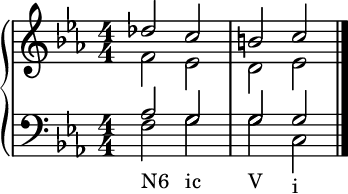
The characteristic sound to memorise for score questions: a first-inversion major chord on the subdominant bass note, one semitone's worth of foreignness in an inner or upper voice, resolving to V. Once heard a few times it is unmistakable, and examiners like it precisely because it is identifiable from the page by its accidental alone: a flattened supertonic in a minor-key passage, harmonised as a major chord, is the Neapolitan announcing itself.
5. The full figured-bass vocabulary, c.1620 to 1790
The system in one idea
Figured bass is shorthand written for a keyboard player who already knows the key. Under (or over) each bass note, numbers name the intervals to be sounded above it, counted within the key signature; anything the key signature already provides goes unwritten, and the commonest chord of all, the root-position triad, usually gets no figure at all. Everything else in the system is abbreviation, exception, or accidental.
The syllabus asks for "all figures commonly used by composers during the period c.1620-1790". Here is that vocabulary as one table, followed by the conventions that make it readable.
The complete figure table
| Figure | Full form | Meaning |
|---|---|---|
| (none) or 5 or 5/3 | 5/3 | root-position triad |
| 6 | 6/3 | first-inversion triad |
| 6/4 | 6/4 | second-inversion triad |
| 7 | 7/5/3 | root-position seventh chord |
| 6/5 | 6/5/3 | seventh chord, first inversion |
| 4/3 | 6/4/3 | seventh chord, second inversion |
| 4/2 or 2 | 6/4/2 | seventh chord, third inversion |
| 9 | 9/5/3 | ninth above the bass, usually a 9-8 suspension |
| 4 or 5/4 | 5/4 | 4th suspended above the bass, resolving to 3 |
| 4-3 | suspension: 4th resolving to 3rd over the same bass | |
| 7-6 | suspension: 7th resolving to 6th over the same bass | |
| 9-8 | suspension: 9th resolving to octave over the same bass | |
| 6/4-5/3 | the cadential 6/4: double suspension resolving over a dominant bass |
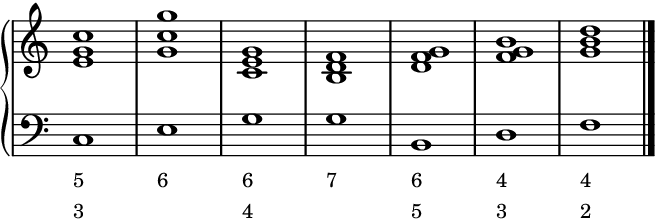
Read the table's logic rather than memorising it raw. Triads figure by their inversion (nothing, 6, 6/4). Sevenths figure by where the dissonant 2nd sits (7 on top, 6/5, 4/3, 4/2 as it works down toward the bass). Everything with a dash in it is a suspension, two numbers over one bass note, sounding in that order. Chapter 6 takes the suspensions apart properly.
Accidentals in figures
Composers of the period wrote accidentals into the figures whenever the harmony left the key signature, and the conventions are compact:
- An accidental standing alone, with no number, applies to the 3rd above the bass. A bare ♯ under a bass note means "major 3rd above this bass, whatever the key signature says"; a bare ♭ means flatten that 3rd; a bare ♮ means restore it. Minor-key dominants are the constant customers, since the leading note always needs raising: a bass on the dominant of A minor typically carries ♯ alone, meaning G♯ in the chord above.
- An accidental beside a number alters that interval: 6♯ or ♯6 means a sharpened 6th above the bass, ♭7 a flattened 7th.
- A stroke through a figure (as in 6 with a slash, or 4+) is an alternative way of writing "raise this note a semitone"; it means the same as a sharp beside the number.
- Compound figures combine freely: 6♯/4, ♯4/2, 6/5/♭3, 9♭. When a figure stack carries several accidentals, each applies only to its own number, and a lone accidental at the bottom of a stack still means the 3rd.
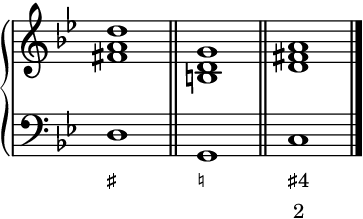
One rule of thumb covers most real cases in minor keys: wherever the harmony contains the leading note, the figures must show its raising, because the key signature does not. Scan any minor-key figured bass and count the sharps and naturals; nearly all of them are leading notes.
Realising and unrealising
At Grade 7 you are more often asked to write figures than to realise them, but the two skills are one. Given a realised passage, figure it by measuring: name the chord, find which note is in the bass, write the standard figure for that position, then add accidentals for every note that departs from the key signature. Given figures, realise by reversing the process. The traps are always the same three: forgetting the accidental conventions (a bare ♯ is a 3rd), misreading 4/2 as a triad shape rather than a third-inversion seventh, and treating suspension figures (4-3, 7-6, 9-8) as two chords when they are one chord with a moving note.
6. Suspensions
What a suspension actually does
Harmony moves in blocks; melody prefers to linger. A suspension is the collision, on purpose: one voice holds its note while the chord changes under it, becomes a dissonance against the new chord, and then steps down onto the note the new chord wanted all along. The listener hears expectation, delay, release: three sensations from one held note. Nothing else in the period's toolkit produces tension so cheaply or resolves it so satisfyingly, which is why the exam devotes a whole question to putting suspensions back into plain passages.
Every true suspension has three phases, and each phase has rules:
- Preparation. The note that will be suspended must first sound as a consonance, in the same voice, in the previous chord. Usually it is tied or repeated into the suspension.
- Suspension. The held note sounds against the new chord on a strong beat, making the dissonance. Strong beat is not optional: a suspension that arrives on a weak beat loses its accent and its point.
- Resolution. The voice falls one step, onto a note of the prevailing chord, on a weaker beat. Downward is the norm; the rare upward resolution (sometimes called a retardation, most often the leading note pushing up to the tonic) is an ornament of the norm.
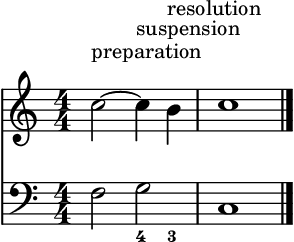
While the suspension sounds, the note of resolution should not also be sounding in another upper voice; the clash of the dissonance with its own destination spoils both. (The one standard exception is the 9-8, where the resolution note is the bass itself, safely far away.)
The three upper-voice species
Suspensions are named by their figures: the interval the held note makes with the bass, then the interval it resolves to. Three species cover the upper voices:
| Species | Held note is | Resolves to | Typical setting |
|---|---|---|---|
| 4-3 | a 4th above the bass | the 3rd | over a root-position chord; the cadential staple |
| 7-6 | a 7th above the bass | the 6th | over a first-inversion chord; the sequence staple |
| 9-8 | a 9th above the bass | the octave | over a root-position chord; needs the root in the bass only |
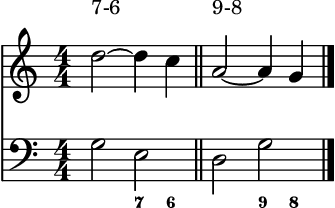
The figures are exactly what a continuo player would read: 4-3 under a bass note means "sound the 4th, then the 3rd, over me". This is where Chapter 5's dashes come from. When you figure a Question 1 passage and an upper voice moves by step over a stationary bass, strong beat to weak, check it against this table: you are probably looking at a suspension, and the figures must show both numbers.
The bass suspension
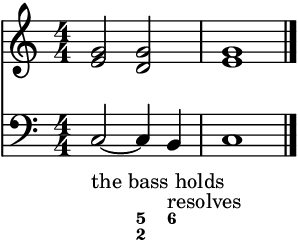
The bass can suspend too. The bass holds its note while the upper voices change, so that the true bass of the new chord lies a step below the sounding bass. The dissonance now reads upside down: an upper voice sits a 2nd (or 9th) above the held bass, and the standard figuring is 2 (often 5/2 or 4/2 as the voicing dictates), resolving to a 6 when the bass falls to its proper note and the chord turns out to be a first inversion.
Chains
Because a resolution lands on a consonance, and a consonance can serve as the preparation for another suspension, suspensions link into chains: each resolution is immediately re-suspended against the next chord. The classic chain runs 7-6 over a bass falling by step, or 4-3 around a circle of fifths, and Corelli built whole movements from little else. In a chain, the rules do not relax; every link still prepares, suspends on the strong beat, and resolves down.
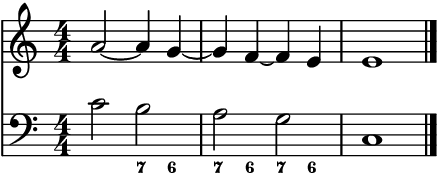
Chains are the highest-value pattern to master for Question 2, because a plain descending passage invites one, and a correctly written chain earns several suspensions' worth of marks from a single decision.
7. Melodic decoration completed
The family, assembled
Earlier grades introduced decoration a species at a time: unaccented passing notes and diatonic auxiliary notes at Grade 6 for writing, with appoggiaturas, changing notes and anticipations known from Grade 6's recognition list. Grade 7 completes the writing vocabulary: accented passing notes, chromatic auxiliary notes, and the full family deployed together. Here is the complete kit, defined by how each note relates to the chord it decorates:
| Decoration | Approach | Leaves by | Beat | The idea |
|---|---|---|---|---|
| passing note (unaccented) | step | step, same direction | weak | fills a 3rd between chord notes |
| passing note (accented) | step | step, same direction | strong | the same fill, displaced onto the beat |
| auxiliary note (diatonic or chromatic) | step | step, returning | weak | leans away from a note and back |
| appoggiatura | leap | step, usually down | strong | an unprepared leaning dissonance |
| suspension | held over | step down | strong | Chapter 6's prepared dissonance |
| anticipation | step or leap | none: it stays | weak | sounds the next chord's note early |
| changing note (échappée) | step away | leap back a 3rd | weak | steps off the path, then leaps across it |
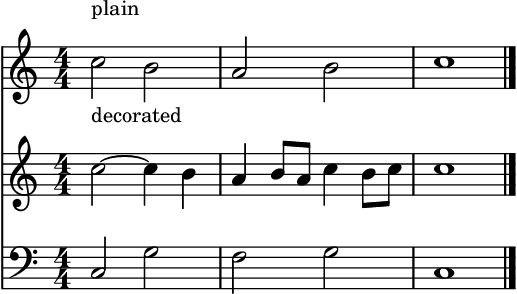
The distinctions that matter at Grade 7 are the accented and chromatic ones. An accented passing note does exactly what an unaccented one does, but on the beat, so the dissonance strikes with the chord and resolves just after; it is the passing note's answer to the suspension. A chromatic auxiliary sharpens or flattens the neighbouring note to tighten the lean, most often raising a lower auxiliary to a semitone below its note (C-B♮-C decorated as C-B♯-C would be wrong spelling in C major; the chromatic auxiliary below G is F♯ even though F♮ is diatonic). The échappée (changing note) steps away from the direction of travel and then leaps a 3rd back across it: descending from C to B, the line touches D first (step up, then falling leap of a 3rd).

Grace notes belong to this family for recognition purposes: an acciaccatura or appoggiatura printed small is simply a decoration written in shorthand, and the score questions may ask you to name them. Their realisation was Grade 5 work and still applies.
Decorating a line
Question 2 gives you a plain passage and asks for suspensions and melodic decoration. Method matters more than inspiration:
- Analyse first. Name every chord of the given passage and mark the strong beats. Decoration is defined against harmony; you cannot place a dissonance until you know what is consonant.
- Hunt suspension sites. Anywhere a voice moves down by step from one chord to the next, and the first note is consonant, a suspension will fit: hold the first note across the change. Prefer the sites that put the dissonance on the strong beat, and check each against the 4-3, 7-6, 9-8 table.
- Fill 3rds with passing notes. Rising or falling 3rds in any voice take a passing note; decide unaccented or accented by where you want the weight.
- Add auxiliaries and the rarer species sparingly. One appoggiatura at a cadence, an échappée or anticipation where the line invites it. The style is seasoned, not saturated.
- Check the grammar. Every dissonance approached and left correctly; no new consecutive 5ths or octaves manufactured by the added notes (decoration can create them between voices where the plain version had none, and examiners look); no decoration doubling the note it clashes with.
Un-decorating a line
The reverse skill serves analysis and Question 1. To find the skeleton of a florid line, keep the notes that belong to the prevailing chord and strike out the rest, then check that what remains moves sensibly. Every removed note should answer to one of the table's species; a note that answers to none of them is either a chord note you misjudged or a spelling you misread. Practising both directions, dressing and stripping, is the fastest way to make the whole family automatic.
8. Harmonic features in repertoire
The score questions expect you to name what composers do with harmony over spans longer than a chord. Pedal points, sequences and false relation entered the syllabus at Grade 6; Grade 7 adds suspensions (Chapter 6), the Tierce de Picardie, and the identification of a triad's enharmonic equivalent, and it expects the whole set recognised quickly in real textures.
Pedal points
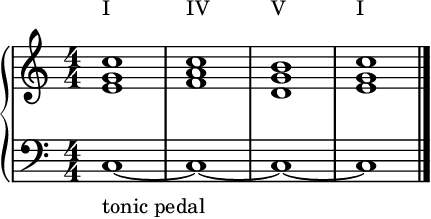
A pedal point is a note sustained (or persistently repeated) in one voice, usually the bass, while the harmony above it changes, passing through chords that may be quite foreign to it. The two standard pedals are on the tonic, which fixes the music to its home while colour moves overhead, and on the dominant, which builds expectancy toward a return or a cadence. A pedal in an upper voice is called an inverted pedal. When you meet one in analysis, name the chords above it as usual and note the pedal separately; the pedal note is not part of every chord it underlies.
Sequences
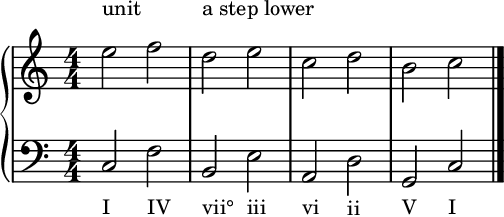
A sequence is a pattern immediately repeated at a different pitch. It is harmonic if the chord progression repeats transposed, melodic if the tune does, and most real sequences are both. The workhorse is the descending circle of fifths, roots falling a 5th (or rising a 4th) each step, often with sevenths chained through it as Chapter 2 described; the descending 5-6 sequence over a stepwise bass is nearly as common. To describe a sequence in an exam answer, give the unit, the interval of repetition, and the direction: "a one-bar pattern repeated sequentially, each time a step lower".
False relation
A false relation occurs when a note and its chromatic alteration (say F♮ and F♯) sound in different voices either simultaneously or in immediately adjacent chords. To modern ears trained on later music it reads as a mistake; in sixteenth- and seventeenth-century style it is an expressive fingerprint, common in English composers such as Byrd and Purcell, and it usually arises from the collision of a rising melodic line (using the sharpened note) with a falling one (using the natural). In minor keys the melodic scale's variable sixth and seventh degrees are the usual site. Recognise it, name the two notes and voices involved, and do not "correct" it when it appears in a given passage.
Tierce de Picardie
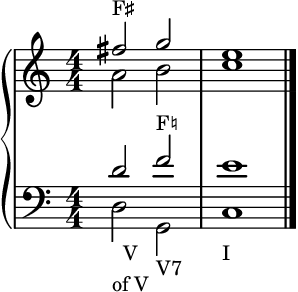
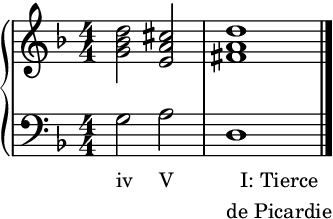
A Tierce de Picardie is a major third in the final tonic chord of a passage in a minor key: the music ends on the major tonic. Baroque composers ended minor-key works this way almost by default, the major third being felt as the more stable and resonant close. Spot it by the accidental on the third of the last chord, and name it precisely: the term describes that raised third, not any general major ending.
Enharmonic equivalents of triads
A score question may ask for the enharmonic equivalent of a chord: the same sounds under different names. Respell each note enharmonically and name the resulting triad; C♯ major (C♯-E♯-G♯) is enharmonically D♭ major (D♭-F-A♭). The skill matters because remote keys are often notated in whichever spelling reads more easily, and because the diminished seventh's respellings (Chapter 3) are the special case you will meet most.
The same recognition extends to melody. A part may respell a note between two consecutive soundings, G♯ becoming A♭ while the pitch holds, which usually marks the seam of an enharmonic modulation; and two different instruments may notate the same sounding pitch in two spellings simultaneously where their lines pull in different directions. Both are named in the syllabus as Grade 7 recognition skills, and both are answered the same way: state that the notes are enharmonically equivalent, and say which spelling belongs to which key or line.
Augmentation and diminution
The rhythmic features list also grows at this grade. Augmentation restates a melodic idea in longer note values, typically doubled, so a crotchet figure returns in minims; diminution is the reverse, the figure compressed into shorter values. Both are ways of developing a motif while keeping its identity, and fugue subjects, chorale preludes and symphonic development sections use them constantly. To claim one in an answer, name the original figure, its restatement, and the ratio: "the opening figure returns in the bass in augmentation, at twice its original note values".
9. Question 1 in practice: figuring a given bass
Question 1 prints a short passage, typically Baroque in style, with the melody and the bass both fully written out, and asks you to add the figures that describe the harmony, including the movement of inner parts. Fifteen marks, and no note of yours to compose: this is reading, not writing. The examiners are testing whether you can see harmony that is already there.
Method
- Fix the key, from the signature and the cadences, and note where the passage modulates; most do, usually to the dominant or relative major at the halfway cadence.
- Name each chord. Bar by bar, take the bass note and the melody notes above it and ask which chord they spell. Two outer voices usually imply the harmony completely once you assume the style's habits: cadences perfect, approach chords ii or IV, sequences in fifths.
- Write the position figure. Root position needs nothing (or 5/3 where clarity demands); first inversion 6; and so on through the table of Chapter 5. Figure what the bass note carries, not what the root is: a ii7 with the subdominant in the bass is figured 6/5, never 7.
- Add every accidental the key signature does not supply. Leading notes in minor keys above all: a bare ♯ or ♮ for a raised 3rd, an accidental beside the number for anything else.
- Catch the moving parts. Where the melody (or an implied inner voice) steps over a held bass, strong beat to weak, write the double figure: 4-3, 7-6, 9-8, or 6/4-5/3 at a cadential 6/4. This is where the "movement of the inner parts" marks live.
- Play it back mentally against the melody. Any figure that contradicts a melody note is wrong by definition: the melody is part of the chord, and your figures must agree with it.
Worked example
Here is a four-bar passage in G minor, melody and bass given, as the exam would print it:
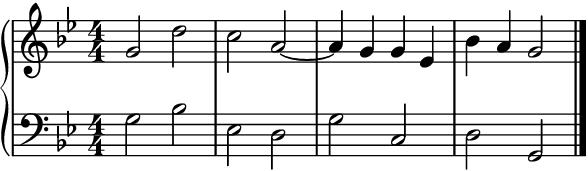
Reasoning, bar by bar. Bar 1 opens on G in the bass with the tonic note in the melody: root position, no figure needed. The bass then rises to B♭ with the harmony unchanged, D in the melody: first inversion, figure 6. Bar 2 puts E♭ in the bass under a melody C: the notes spell C minor over its third, iv b, another 6. The bass then steps down to D under a melody A: the dominant chord, root position, but its third is F♯ and the key signature supplies F natural, so the figure is a bare ♯, the naked accidental that means "sharpen the 3rd above me". Bar 3 is the suspension bar. The melody's A was consonant in the dominant chord and is tied over the barline; against the returning tonic bass G it is now a 9th, and it resolves down to G, the octave: figure 9-8. The rest of the bar moves to C in the bass with chord notes above: iv, root position, unfigured. Bar 4 cadences. The bass D first carries B♭ in the melody, a 6th, with the tonic G implied as the 4th: the cadential 6/4, resolving on the next beat to the 5/3 with its third sharpened, so the figures read 6/4 then 5/♯3 (or ♯ alone beside the 5, as period sources abbreviate it). The final chord on G closes with B♮, a Tierce de Picardie; since the key signature flattens B, the figure this time is a bare ♮, not a sharp. The two accidental figures in this passage make the distinction worth memorising: an accidental in figures restates the note against the key signature, so F♯ takes ♯ (the signature leaves F alone) but B♮ takes ♮ (the signature flattens it).
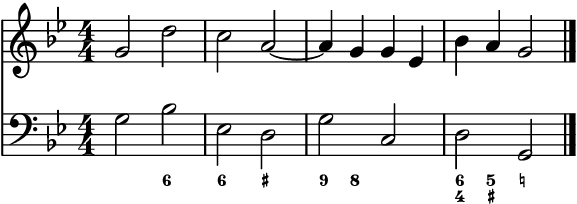
The habits to take from the example: figures describe the bass note's intervals, accidentals are the difference between the sounding notes and the key signature, and every held-then-falling upper note over a moving or stationary bass earns a double figure. Practise on any Baroque bass line you can find, figuring first and checking against the harmony afterwards.
10. Question 2 in practice: the reconstruction question
Question 2 prints a passage in plain, undecorated harmony, block chords, no dissonance, and asks you to rewrite it "to include appropriate suspensions and notes of melodic decoration". The official specification names the two styles it draws on: an extract in the manner of a Bach chorale, or an extract from a simple piano piece. Fifteen marks. The passage's chords are not yours to change; the art is adding tension to harmony that already works.
The chorale-style version
Chorale style means four voices, SATB, mostly one chord per beat. The method is Chapter 7's, applied conservatively:
- Label the given chords and strong beats.
- Find the suspension sites: any upper voice falling by step across a chord change, plus the bass where it falls by step onto a first inversion. Convert the best two or three into suspensions, tied or repeated, dissonance on the beat, resolving down. Favour cadences: a 4-3 at the final cadence is practically obligatory in the style.
- Fill a few melodic 3rds with passing notes, in quavers, especially in the tenor and bass where the given lines are dullest.
- Add at most one or two auxiliaries or an appoggiatura. Bach's own chorales decorate lightly; density is not the goal.
- Re-check every pair of voices for consecutives created by the additions, and make sure no voice now clashes with a suspension's resolution note.
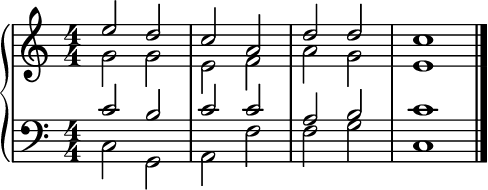
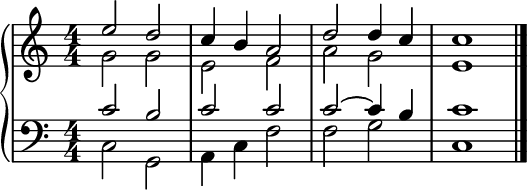
Compare the two versions closely: nothing harmonic has changed. Every chord, every bass note, every cadence is where it was. What changed is the surface: the tenor's held C first makes a seventh over the supertonic chord, then a 4-3 suspension against the dominant; the soprano fills its falling 3rd with a passing note and sounds the final tonic early as an anticipation; the bass walks between its chord notes. That is the whole question.
The piano-style version
The piano version applies identical logic to a two-stave texture: melody with accompaniment. The decoration budget shifts toward the melody, appoggiaturas and accented passing notes carry more of the expression, and the accompaniment accepts passing notes in its figuration rather than voice-by-voice suspensions. Suspensions still appear, but often as ties in the melody over the barline or across beats.
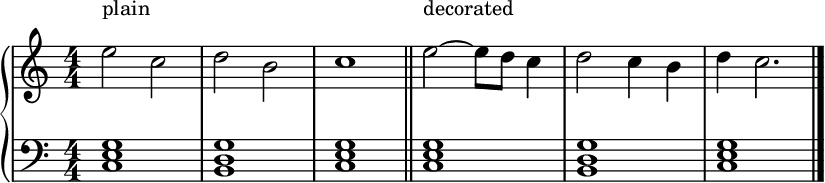
In both styles, examiners reward correctness before abundance: three suspensions that prepare, strike and resolve by the book outscore eight decorations of which two break the grammar. Write, then check each added note against its species' definition.
11. Question 3 in practice: the composition question
Question 3 offers a choice of two tasks for twenty marks, and you should decide which suits you well before exam day, then practise that one hard. The syllabus expects a melody of at least eight bars in either case.
Option A: completing a solo part over a given accompaniment
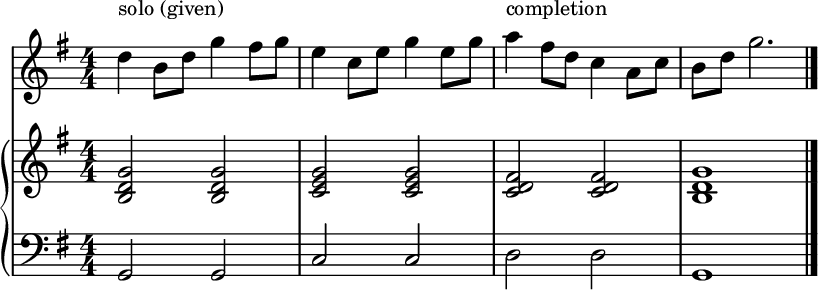
You are given the opening of a passage for solo instrument with keyboard accompaniment. The accompaniment is printed in full from first bar to last; the solo part is given for the opening only, and you complete it. The instrument will be named, with a choice offered.
The accompaniment is the question's gift: it fixes the harmony, the phrasing and the cadences for you. Method:
- Analyse the accompaniment first. Write the chords lightly above it, find the modulations, and mark the cadences; your solo line must agree with all of it.
- Take inventory of the given opening: its rhythmic cells, its characteristic intervals, its register. The continuation must sound like the same piece; examiners mark the maintenance of "style and character" explicitly.
- Compose to the harmony: chord notes on the strong beats, decoration between them, using the full Chapter 7 kit. Where the accompaniment cadences, the solo must cadence too, and the final note should close on a strong degree of the home key, almost always the tonic.
- Shape one climax. A single highest note, placed around two-thirds of the way through, gives the line direction; two competing peaks give it none.
- Respect the instrument: stay within a comfortable range for the named instrument, breathe if it blows, and keep string crossings and leaps idiomatic. Write nothing you could not sing or play slowly yourself.
Option B: composing on a given progression or figure
The alternative supplies a chord progression (or a melodic figure) and an instrument choice, and asks for a melody built on it. The progression plays the role the accompaniment played in Option A: it is the harmonic ground plan, and the melody must express it, chord notes carrying the frame, decoration animating the surface. Treat each chord as a bar's (or half-bar's) worth of available notes, place the strongest chord notes at the strong beats, and let the progression's cadences shape your phrase ends. If a melodic figure is given instead, build by sequence and development: state it, repeat it transposed, extend or invert it, and close with a reference to it.
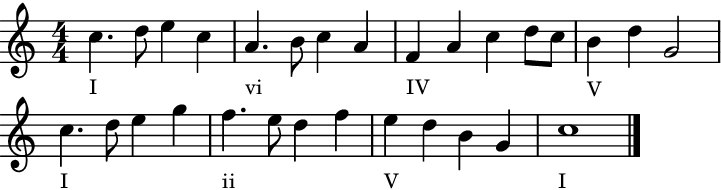
Either way, the marking criteria ask for "an excellent overall sense of shape and direction", unity of style, and idiomatic instrumental writing. Balanced phrases (commonly two plus two plus four), one climax, a real cadence at the end, and a melody you have silently sung through twice: that is the checklist.
12. Questions 4 and 5 in practice: reading the score
Questions 4 and 5 carry half the paper between them, twenty-five marks each, and they examine everything at once: notation, harmony, phrase structure, instruments, terms and style. Question 4 is a short score extract whose soloist is now a transposing instrument, with C clefs in play. Question 5 is a full score of up to fourteen staves sounding at once, roughly five woodwind, four or five brass, percussion and strings. The questions themselves are short and factual; the skill is finding your way around the page quickly.
C clefs in score
The alto clef (middle C on the third line) and tenor clef (middle C on the fourth line) have been yours since Grades 4 and 5. In Question 4 and 5 scores they simply appear in context: the viola lives in the alto clef, and cello, bassoon and tenor trombone climb into the tenor clef when their lines rise. Expect questions that ask you to rewrite a C-clef phrase in treble or bass clef at the same pitch, or to compare notes between staves in different clefs.

Fluency is the only preparation: read viola and high cello parts daily in the run-up, and always anchor on the clef's middle C before naming any note.
The Grade 7 transposing instruments
The rule from Grade 5 still runs everything: an instrument "in X" sounds X when it reads a written C. Grade 6 added the standard cast (instruments in F, B♭ and A, plus the octave transposers). Grade 7 adds instruments in D and E flat, horns in E flat, E and G, and the double bassoon:
| Instrument | Sounds, relative to written | To write a concert pitch |
|---|---|---|
| trumpet in D | a major 2nd higher | write a major 2nd lower |
| trumpet in E♭, clarinet in E♭ | a minor 3rd higher | write a minor 3rd lower |
| horn in E♭ | a major 6th lower | write a major 6th higher |
| horn in E | a minor 6th lower | write a minor 6th higher |
| horn in G | a perfect 4th lower | write a perfect 4th higher |
| double bassoon | an octave lower | write an octave higher |
The pattern worth noticing: the small, bright trumpets in D and E♭ and the clarinet in E♭ sound above their written notes (their written C answers to the nearest D or E♭ above), while every horn sounds below, written C answering the E♭, E or G beneath. The letter alone does not settle the direction; the instrument does, and the E♭ pair is the standing trap, since an E♭ clarinet rises a minor 3rd while an E♭ horn falls a major 6th. The double bassoon joins the double bass as an octave-down transposer, written in the bass clef an octave above its sound to save ledger lines. Classical scores also carry horn and trumpet parts with no key signature at all, the accidentals written in as needed; do not let an unsignatured horn stave mislead you about the key of the piece.
Pitched percussion transposes too, though only by octaves and only occasionally at this grade. The glockenspiel sounds two octaves higher than written, the xylophone and the celesta one octave higher, all written low to keep their parts on the stave. Treat them exactly as any other transposing instrument: convert to concert pitch before naming or comparing notes.
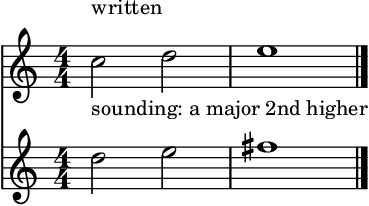
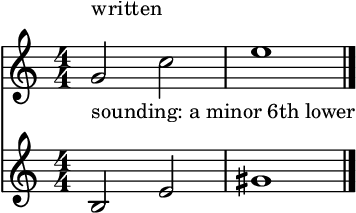
Interval questions between two transposing instruments in different keys are fair game at this grade. The method never varies: convert both notes to concert pitch first, then measure. Never try to measure between written notes directly.
Finding your way in fourteen staves
The score order is the Grade 5 rule grown to full size, top to bottom: woodwind (piccolo, flutes, oboes, cor anglais, clarinets, bassoons, double bassoon), brass (horns, trumpets, trombones, tuba), percussion (timpani first), then strings (first violins, second violins, violas, cellos, double basses). Two players often share a stave, so fourteen staves can mean more than fourteen instruments; the marks that manage the sharing are examinable:
| Sign | Meaning |
|---|---|
| a 2 | both players on this stave play the same line |
| I. or II. (1., 2.) | first player only, second player only |
| div. | divisi: the section splits between the notes |
| unis. | unison: the divided section rejoins on one line |
| tutti | everyone, after a solo passage |
| muta in... | change of crook or instrument, for example muta G in A: retune from G to A |
String techniques
The string questions at Grade 7 turn on four techniques and their notation:
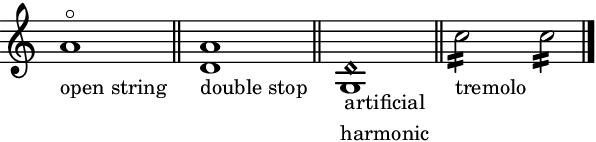
- Open strings: a small circle o above a note asks for the unstopped string. The four open strings of each instrument are worth memorising (violin G-D-A-E, viola and cello C-G-D-A, double bass E-A-D-G), because "which open string could play this note" is a standing question.
- Double stopping: two (or more) notes bowed together on adjacent strings, written as an ordinary chord in one part. Three- and four-note chords are spread; the question to expect is whether a given double stop is possible, which it is when the two notes lie on different strings and at least one is an open string or both are reachable by one hand.
- Muting: con sordino (Italian), avec sourdine (French), mit Dämpfer (German) all ask for the mute; senza sordino, sans sourdine, ohne Dämpfer cancel it. The mute clips the instrument's edge and softens its tone; a passage cannot switch instantly, since the player needs a moment to fit or remove it.
- Harmonics: a small circle over the note marks a natural harmonic (a node of the open string, touched lightly, sounding a pure, flute-like tone); a diamond-shaped note head marks the touched note of an artificial harmonic. At Grade 7 any string instrument may carry them, and recognising the notation is what is examined.
- Reiteration signs: strokes through a stem mean repeated notes (tremolo if unmeasured); a slash mark repeats the previous beat or bar figure. These abbreviations are everywhere in orchestral string parts, and questions ask you to write them out in full.
More advanced instrumental features
The syllabus names two newer effects at this grade. Flutter tonguing belongs to wind and brass players, flutes and trumpets especially: the player rolls an r on the tongue while blowing, and the note comes out as a whirring tremolo. It is written as tremolo strokes through the stem with a word of instruction beside the note, Flatterzunge (abbreviated Flz.) in German, frullato in Italian, often plain flt. in English scores. Playing on the fingerboard is a string effect: sul tasto in Italian, sur la touche in French, am Griffbrett in German all direct the bow over the end of the fingerboard, where the tone turns veiled and flute-like; ord. or naturale restores the normal bowing place. Expect to name these from the score or explain what the player does, not to compose with them.
Instrument names in four languages
Grade 6 asked for the commonly used names; Grade 7 extends to the less common ones. The full working table, English, Italian, German, French:
| English | Italian | German | French |
|---|---|---|---|
| piccolo | ottavino (flauto piccolo) | kleine Flöte | petite flûte |
| flute | flauto | Flöte | flûte |
| oboe | oboe | Oboe | hautbois |
| cor anglais | corno inglese | Englischhorn | cor anglais |
| clarinet | clarinetto | Klarinette | clarinette |
| bassoon | fagotto | Fagott | basson |
| double bassoon | controfagotto | Kontrafagott | contrebasson |
| horn | corno | Horn | cor |
| trumpet | tromba | Trompete | trompette |
| trombone | trombone | Posaune | trombone |
| timpani | timpani | Pauken | timbales |
| cymbals | piatti | Becken | cymbales |
| bass drum | gran cassa | grosse Trommel | grosse caisse |
| side drum | tamburo militare | kleine Trommel | caisse claire |
| harp | arpa | Harfe | harpe |
| violin | violino | Violine (Geige) | violon |
| viola | viola | Bratsche | alto |
| cello | violoncello | Violoncello | violoncelle |
| double bass | contrabbasso | Kontrabass | contrebasse |
The names that catch candidates are the unguessable ones: hautbois is the oboe (and the word English "hautboy" came from), Posaune the trombone, Bratsche the viola, Pauken the timpani, and the French alto is the viola, not a voice. The percussion rows repay the same care, because nothing in Becken, gran cassa or caisse claire looks like a cymbal or a drum. Read the left margin of every score you meet and translate it as a habit.
Pitch names in other languages
Scores name their notes, not just their instruments, in the language of their country, and the Grade 7 questions may quote them. German uses letters, with one famous trap: the letter H is B natural, and the letter B, on its own, is B flat. Sharpening adds the suffix -is (Fis is F sharp, Cis is C sharp) and flattening adds -es (Des is D flat), with the contracted forms Es for E flat and As for A flat. France and Italy use fixed sol-fa names in place of letters: Italian do, re, mi, fa, sol, la, si and French ut (or do), ré, mi, fa, sol, la, si always mean C, D, E, F, G, A, B, whatever the key of the piece. Accidentals follow as separate words: dièse (sharp), bémol (flat) and bécarre (natural) in French; diesis, bemolle and bequadro in Italian. So si♭ is B flat, la♯ is A sharp, and mi♮ is E natural.
| English | German | French | Italian |
|---|---|---|---|
| B natural | H | si | si |
| B flat | B | si bémol (si♭) | si bemolle |
| E flat | Es | mi bémol | mi bemolle |
| F sharp | Fis | fa dièse | fa diesis |
| A sharp | Ais | la dièse (la♯) | la diesis |
Meet a German B in a question and translate before you answer: it is the English B flat, and H is the English B. The -is and -es suffixes read at sight once you know they exist; the sol-fa names only need matching to their letters.
Working the questions
For either question, spend the first two minutes on reconnaissance before reading any question: name the key and time, scan the instrument list and note every transposing stave, find the cadences, and mark anything eye-catching (a pedal, a sequence, an enharmonic respelling, a Neapolitan chord). Most questions then answer themselves from your map. Ornaments belong on the map too: a question may ask you to name a trill, turn, mordent, acciaccatura or appoggiatura, or to write out its realisation in full, and the realisation rules learned at Grade 5 apply unchanged. For harmony questions in a transposing score, always convert to concert pitch before naming any chord; a written-pitch reading of a clarinet stave will name the wrong chord every time.
Two further habits earn marks here. First, a more modern extract may carry no key signature at all, every accidental written where it falls; establish the tonal centre (if there is one) from the bass and the cadences rather than from the empty signature. Second, the composer-and-period question at this grade offers up to four choices, all from the Baroque period onwards, and asks you to underline one; decide from the evidence you can point to (texture, instruments present, harmonic vocabulary, notation style), because a follow-up may ask your reasons.
13. Terms and signs at Grade 7
Everything from Grades 1 to 6 remains examinable. The Grade 7 additions:
Italian terms
| Term | Meaning |
|---|---|
| brillante | brilliant, sparkling |
| colla parte | follow the solo part (the accompaniment yields to the soloist) |
| facile | easy, fluent |
| fuoco (con fuoco) | fire (with fire) |
| legg. (leggiero) | light, nimble |
| l'istesso | the same (l'istesso tempo: at the same speed) |
| lunga, lunga pausa | long, a long pause |
| marc. (marcato) | marked, accented |
| ossia | or, alternatively: an alternative version of a passage |
| piacevole | pleasant, agreeable |
| pochettino (poch.) | a very little |
| pochiss. (pochissimo) | very, very little |
| segue | go straight on, or continue in the same manner |
| sopra | above (come sopra: as above) |
| veloce | swift, rapid |
French terms
| Term | Meaning |
|---|---|
| 1er mouvt. (premier mouvement) | at the first speed |
| assez | enough, fairly |
| au mouvt. (au mouvement) | in time, back to the main speed |
| cédez | yield: hold the tempo back |
| en animant | becoming more lively |
| en serrant | getting quicker, pressing on |
| mais | but |
| moins | less |
| ralentir | slow down |
| sonore | sonorous, full-toned |
| vif | lively, quick |
German terms
| Term | Meaning |
|---|---|
| aber | but |
| doch | yet, still |
| Empfindung (mit Empfindung) | feeling (with feeling) |
| fröhlich | cheerful, joyful |
| gesangvoll | songlike, singing |
| langsamer als | slower than |
| süss | sweet |
| voll | full |
| zart | tender, delicate |
Signs
The sign vocabulary at this grade is instrumental: the small circle for an open string or natural harmonic, diamond note heads for artificial harmonics, stem strokes and beat-slashes for reiteration, tremolo and flutter tonguing, a 2 and div. markings for shared staves, and the muting and fingerboard terms (con sordino, sul tasto and their French and German equivalents). All appear in Chapter 12; expect to name them, explain them, or write out in full what an abbreviation stands for.
14. Common mistakes at Grade 7
- Figuring the root instead of the bass. A seventh chord with its third in the bass is 6/5, whatever its root; figures always count from the lowest sounding note.
- Forgetting the accidentals in figures. In minor keys nearly every dominant chord needs a ♯ or ♮ for its leading note, and a bare accidental means the 3rd above the bass. An accidental restates the note against the key signature: F♯ in G minor takes ♯, but B♮ takes ♮.
- Doubling the seventh of a seventh chord, or letting it rise. The seventh is a dissonance with one exit: down by step in the next chord.
- Writing a suspension without a preparation, or resolving it on the strong beat. The order is consonant preparation, strong-beat dissonance, weak-beat resolution.
- Sounding the resolution note against its own suspension in another upper voice. Only the 9-8, resolving to the bass note's octave, escapes this rule.
- Spelling the diminished seventh for the wrong destination. The root is the leading note of the key being approached; check that root to seventh reads as a diminished 7th, not a major 6th, and that no adjacent pair reads as an augmented 2nd.
- Doubling the flattened note of the Neapolitan sixth. Double the bass (the subdominant degree); the flattened supertonic must fall, and two voices cannot both fall to the same note.
- Treating 4-3, 7-6 and 9-8 as two chords. Each is one chord with one moving voice, and both numbers belong under one bass note.
- Measuring intervals between transposing instruments at written pitch. Convert both parts to concert pitch first, always.
- Guessing a transposition's direction from its letter. Trumpets in D and E♭ and clarinets in E♭ sound above their written notes; horns in E♭, E and G all sound below, so an E♭ horn falls a major 6th where an E♭ clarinet rises a minor 3rd.
- Decorating Question 2 until the harmony drowns. Marks come from correct suspensions and clean grammar, not from density, and added notes that create consecutives lose more than they gain.
- Ignoring the accompaniment in Question 3. The solo line must agree with the printed harmony bar by bar; a beautiful phrase over the wrong chord is a wrong phrase.
15. Practice questions
Answers follow in the next section.
- Name the quality of the seventh chord built on each degree of a major key.
- Spell ii7 in F minor and name its quality.
- A bass note carries the figure 4/2. What position of what kind of chord is sounding, and where is the chord's root?
- Spell the diminished seventh on the leading note of C minor, and state where its root and its seventh resolve.
- The chord G♯-B-D-F resolves to A minor. Respell it so that it resolves to E♭, naming every note.
- Spell the Neapolitan sixth of F minor, name the bass note, and say which note should be doubled in four parts.
- In a figured bass in D minor, what does a bare ♯ beneath a bass note A mean? What figure would ask for F♯ above a final bass note D?
- An upper voice holds a note that forms a 7th above the bass, then falls one step to a 6th while the bass stays put. Name the device and write its figure.
- Name the three phases of a suspension and the beat placement each requires.
- The bass holds its note across a chord change and then falls a step, and the figures read 2 then 6. What has happened?
- Name the decoration: (a) a note approached by step that then leaps a 3rd back across its starting note; (b) a note that sounds the next chord's note before the chord arrives; (c) an on-beat step between two chord notes.
- A horn in E reads a written G in the space above the top line of the treble stave. What note sounds? What does a trumpet in D sound when it reads the same written G?
- Give the English for Bratsche, Pauken, hautbois and Posaune.
- What is a Tierce de Picardie, and how do you spot one in a score?
- Write the figures for a cadential 6/4 resolving to the dominant chord in B minor, including any accidental the resolution needs.
- Give the German, French and Italian names for the viola.
- A score is marked colla parte over the accompaniment. What does it ask for?
- May a violinist play the two notes G (bottom of its range) and the D a 5th above as a double stop? Explain.
16. Answers
- Degree 1: major seventh. 2: minor seventh. 3: minor seventh. 4: major seventh. 5: dominant seventh. 6: minor seventh. 7: half-diminished seventh.
- G-B♭-D♭-F: a half-diminished seventh (diminished triad, minor 7th), the standard quality of ii7 in minor keys.
- A seventh chord in third inversion: the bass note is the chord's seventh. The root lies a 2nd above the bass (the note making the "2" of the full figuring 6/4/2).
- B♮-D-F-A♭. The root B, the leading note, rises to C; the seventh A♭ falls to G, the fifth of the tonic chord.
- D-F-A♭-C♭: the same four sounds with G♯ respelled as A♭ and B as C♭, rearranged so that D, the leading note of E♭, is the root, with minor 3rds stacked above it.
- The Neapolitan sixth of F minor is the major triad on G♭ (G♭-B♭-D♭) in first inversion, so B♭, the subdominant degree, is the bass note, and B♭ is the note to double.
- A bare ♯ under A asks for a sharpened 3rd above the bass: C♯, the leading note, making the dominant chord major. Above a final D, F♯ is a raised 3rd against the key signature's F♮, and since the signature does not flatten F the figure is again a bare ♯ (the Tierce de Picardie).
- A 7-6 suspension: figure 7-6 beneath the single bass note.
- Preparation (the note sounds as a consonance, same voice, before the suspension), suspension (the dissonance strikes on a strong beat), resolution (the voice falls by step on a weaker beat).
- A bass suspension: the bass held into the new chord a step above its true note, figured 2 (the dissonant 2nd with an upper voice), then resolved down to the first inversion, figured 6.
- (a) A changing note (échappée). (b) An anticipation. (c) An accented passing note.
- The horn in E sounds a minor 6th lower than written, so the written G sounds the middle-line B a minor 6th below it. The trumpet in D sounds a major 2nd higher: the same written G sounds the A above it.
- Viola, timpani, oboe, trombone.
- A major 3rd in the final tonic chord of a minor-key passage: the music ends on the major tonic. Spot it by the raising accidental on the 3rd of the last chord (a ♯ or ♮ foreign to the key signature).
- Under the dominant bass F♯: 6/4 followed by 5/♯3 (the ♯ raising the 3rd above F♯ to A♯, the leading note of B minor; period basses often abbreviate the resolution to 5/♯ or a bare ♯).
- German Bratsche, French alto, Italian viola.
- The accompanist should follow the solo part flexibly, yielding in tempo and rhythm to whatever the soloist does.
- Yes. The low G is the open G string, and the D a 5th above is the open D string; two adjacent open strings bow together as the easiest of all double stops.
This completes Grade 7. What remains for Grade 8 is the full chromatic vocabulary, the trio sonata and keyboard reconstruction questions, and scores of up to twenty-four staves; every technique rehearsed here, figuring, suspension, decoration and score navigation, carries forward directly. More immediately, the skills of this grade are the working skills of continuo players, arrangers and analysts, and the music of c.1620 to 1790 reads differently once you can see its figures for yourself.