Writing lines that sound well together and keep their own lives
A complete course in counterpoint from the ground up: what makes two lines independent, the five species in strict style with worked examples against an original cantus firmus, suspensions and florid writing, invertible counterpoint at the octave, tenth and twelfth, imitation and every kind of canon, the two-part invention, fugue dissected stage by stage, counterpoint on a chorale, the differences between Palestrina's practice and Bach's, a catalogue of the faults that spoil student work, and exercises with full answers.
Introduction
Harmony asks what chord this is. Counterpoint asks what these two people are singing, and whether either of them would be worth hearing alone. The two questions meet at every moment of tonal music, because vertical intervals and horizontal lines are two readings of the same notes, but they start from opposite ends and they train different habits. A harmony student thinks in blocks and then smooths them; a counterpoint student thinks in threads and discovers that the blocks have written themselves.
The discipline is old and its teaching method is nearly as old. In 1725 Johann Joseph Fux published Gradus ad Parnassum, a dialogue in which the pupil Josephus learns from Aloysius, a fictional Palestrina, by adding notes to a fixed melody in five graded stages called species. Haydn worked through it, Mozart taught from it, Beethoven copied out its exercises, and every conservatoire since has taught some descendant of it. The method survives because it isolates one problem at a time. First species allows only note against note, so the only question is which intervals may follow which. Second species adds one rhythmic level and with it the passing note. By the fifth species the student is writing free melody under full control, and every decision has been met before in a simpler setting.
Strict species counterpoint is not a style anyone composes in. It is a training instrument, tuned to sixteenth-century vocal practice, and it prohibits many things Bach does on every page. This guide teaches it anyway, and teaches it properly, because the constraints expose the mechanism: you cannot understand why a suspension needs preparation until you have spent an hour in fourth species finding out what happens without it. Then chapters 6 onwards take the training into real textures, where a leap of a seventh may be exactly right and a hidden octave between inner parts nobody will ever hear.
The second half of the guide is about pieces. Two-part Baroque texture, invertible counterpoint, imitation and canon, the invention, the fugue in full, and the chorale-based forms of the north German organ tradition. Every technique is shown at work in an example engraved for this guide, written in the style under discussion. No notation is reproduced from any existing piece; where a real work is named, and many are, the reader is expected to go and look at the score, which is where the real learning happens.
Counterpoint rewards the pen more than the eye. Nothing in this guide takes longer to read than to try, and the exercises in chapter 14 are the point of the exercise chapters everywhere: a rule you have obeyed once is worth ten you have read.
How to use this guide
Chapters 1 to 5 are the strict course, and they are meant to be worked in order with a pen. Chapter 1 sets out the ideas the whole subject rests on; chapters 2 to 5 take the five species in turn, each with a fully worked example against the same original cantus firmus so that the stages can be compared directly. Chapters 6 to 10 apply the training: free two-part writing, invertible counterpoint, imitation and canon, the invention, the fugue, and chorale-based textures. Chapter 11 compares Renaissance and Baroque norms rule by rule, which is the chapter to read if the strict prohibitions and Bach's practice seem to contradict each other, because they do. Chapter 12 catalogues the faults that cost marks, each engraved wrong and right. Chapters 13 and 14 are the quick reference and the exercises.
Companion documents cover the neighbouring ground. Musical Harmony handles chords, progressions, inversions and the full treatment of dissonance from the vertical side, and its chapters on suspensions and non-chord notes are the direct partner to chapters 3 and 4 here. Roman Numeral Analysis gives the labelling system used whenever this guide names a chord that the counterpoint has implied. Musical Form and Analysis covers fugue as a shape among other shapes, where this guide covers it as a technique; read chapter 9 here with that guide's chapter 8 beside it. ABRSM Music Theory Grade 6, Grade 7 and Grade 8 examine two-part and four-part writing, figured bass and score analysis at the levels where counterpoint starts to be assessed, and the faults catalogue in chapter 12 is drawn from what those papers penalise.
A note on terms and notation
Naming follows British convention: stave and bar, semibreve, minim, crotchet, quaver, semiquaver for the note values, leading note for the seventh degree. Notes are sharpened and flattened. Cadences are perfect, imperfect, plagal and interrupted.
Intervals are counted inclusively and named by number and quality: a major third, a perfect fifth, a diminished fifth. Chord spellings run C-E-G. Progressions run ii-V-I. Ranges run "1 to 5". A suspension is named by the two intervals it makes against the bass, so 4-3 is a fourth resolving to a third, 7-6 a seventh to a sixth.
In the engraved examples the numbers printed between the staves are the intervals between the two sounding voices at that moment, counted from the lower part. Where a note is labelled by function, the label sits above the note it belongs to.
1. What counterpoint is
1.1 Two things at once
Counterpoint is the art of combining melodic lines that keep their identity. The word comes from punctus contra punctum, note against note, the medieval phrase for adding a second line above or below a given one. What makes the result counterpoint rather than accompaniment is that both lines would bear singing on their own.
That is the test, and it is worth applying literally. Cover the lower stave of any two-part passage and sing the upper part alone. Then cover the upper and sing the lower. If either line turns out to be a string of leaps with no shape, or a series of notes chosen only because they completed a chord, the passage is harmony written in two colours, not counterpoint.
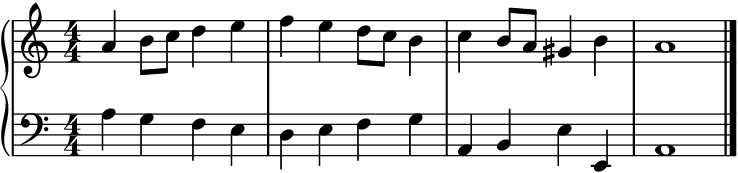
Both lines above are singable. The upper rises to its highest note once and comes down; the lower moves mostly by step in the opposite direction. They agree at every beat on a consonance, but neither was written by filling in a chord.
1.2 The four kinds of independence
Lines stay distinct by differing, and there are only four things they can differ in.
Rhythm. If both parts move together throughout, the ear fuses them into one thickened line. Species counterpoint attacks this problem first: from second species onwards, one voice moves while the other holds.
Direction. Two voices moving the same way at the same distance are heard as one voice with a doubling. Contrary motion is the strongest guarantee of two.
Contour. Each line should have its own high point, reached once, and its own path to it. Two lines that peak in the same bar sound like one gesture.
Register. Parts that cross or collide lose their identity for the ear, which tracks pitch height before it tracks timbre. Keeping a workable distance apart, and not overlapping, keeps the threads visible.
None of these is absolute. A composer may double a line in thirds for colour, and Bach frequently has both parts peak together at a cadence. The point is that every one of these devices spends independence, and independence is the currency the texture runs on.
1.3 The four motions
Any two voices moving from one interval to the next do so in one of four ways, and almost every rule in the subject is stated in terms of these four words.
| Motion | What happens | Effect |
|---|---|---|
| contrary | the voices move in opposite directions | maximum independence |
| oblique | one voice holds, the other moves | strong independence, cheap to write |
| similar | both move the same way, by different intervals | mild fusion |
| parallel | both move the same way, by the same interval | maximum fusion |
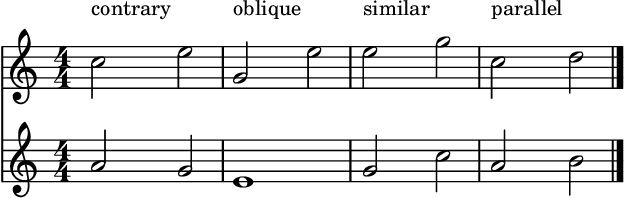
Parallel motion is not forbidden. Parallel thirds and sixths are the most useful sound in two-part writing. What is forbidden in strict style, and avoided in free style, is parallel motion in perfect consonances, because a perfect fifth or octave already sounds like one note with reinforcement; move it in parallel and the second voice audibly disappears for the duration. That single mechanism is the whole reason behind the ban on consecutive fifths and octaves, and it explains why the ban weakens as soon as the parts are far apart, thickly scored or moving fast.
1.4 Consonance and dissonance
The intervals divide into three classes, and the classification is the backbone of every species rule.
| Class | Intervals | Behaviour |
|---|---|---|
| perfect consonance | unison, perfect fifth, octave | stable, but empty; use sparingly and never in parallel |
| imperfect consonance | major and minor third, major and minor sixth | stable and full; the normal currency |
| dissonance | second, fourth, seventh, all augmented and diminished intervals | unstable; must be controlled |
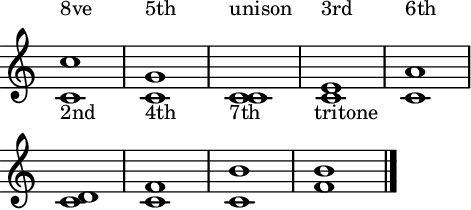
Two entries in that table surprise people. The perfect fourth is a dissonance in two-part counterpoint, though it sounds mild and though it is a consonance inside a chord when a third voice supports it below. The reason is acoustic and historical at once: a bare fourth above the bass demands resolution, which is why the cadential six-four in Musical Harmony behaves as a double suspension rather than as a chord in its own right. In counterpoint the rule is simply stated: a fourth between the two outer sounding voices is a dissonance and needs the same handling as a seventh.
The other is the tritone, the augmented fourth or diminished fifth. It is dissonant vertically, and in strict style it is also avoided melodically, both as a leap and as the outline of a phrase that turns around after covering that distance.
Dissonance is not an error. It is the source of motion, and the entire species course is a graded introduction to it: forbidden in first species, allowed as a passing note in second, as passing and auxiliary in third, as a prepared suspension in fourth, and in all these forms at once in fifth. The rule that governs every case is the same. A dissonance must be approached and left in a way that makes it audibly subordinate to the consonances around it.
1.5 The contract between voices
Put the ideas together and two-part counterpoint amounts to a contract with four clauses.
- Each voice will be a melody: mostly stepwise, with a shape, one climax, no aimless repetition, no tritone outlines and no leap left unbalanced.
- On every structural beat the voices will agree on a consonance.
- Dissonances will occur only in the approved patterns, and will resolve by step.
- Neither voice will be swallowed by the other: no parallel perfects, no unnecessary doubling of direction, no crossing without reason.
Everything in chapters 2 to 5 is a way of keeping this contract under progressively harder conditions, and everything in chapters 6 to 10 is a demonstration of which clauses real composers renegotiate.
1.6 The species method
Fux's five species add one difficulty at a time to a fixed melody called the cantus firmus, a plain line in semibreves which the student may not alter.
| Species | Counterpoint moves | New problem introduced |
|---|---|---|
| first | semibreves, note against note | choice and succession of consonances |
| second | two minims per semibreve | the passing note |
| third | four crotchets per semibreve | auxiliary notes, the cambiata, dissonance in quantity |
| fourth | minims tied across the bar | syncopation and the suspension |
| fifth | mixed values, florid | combining all of the above, plus ornament |
The order is not arbitrary. Each species is the previous one with a single new freedom, and each new freedom introduces exactly one new class of dissonance. Work them in order, in two parts, before adding a third voice, and the rules will start predicting themselves.
2. First species: note against note
2.1 The cantus firmus
The exercise begins with a given melody. A good cantus firmus is dull on purpose: it must offer the counterpoint plenty of room and no distractions.

The eleven notes above are the cantus firmus used for every worked example in chapters 2 to 5, so that the five species can be compared on identical ground. It is in the Dorian mode on D, the mode Fux starts from, and it shows the features every cantus firmus should have:
- It begins and ends on the final, D, and approaches that last note by step.
- It moves mostly by step; the only leaps are a third and a fourth, and each is followed by movement in the opposite direction.
- It has one high point, the A in bar 7, sounded once.
- It never repeats a note, never outlines a tritone, and stays inside a ninth.
- It has no accidentals of its own. In the Dorian mode on D the B is natural, and the C is sharpened only at the very end, and only by the counterpoint, not by the cantus.
Write your own before working the species. The discipline of making eleven plain notes shapely is the same discipline as writing the counterpoint above them.
2.2 The rules, and why each exists
In first species the counterpoint sets one semibreve against each semibreve of the cantus firmus. There is no rhythm to think about, which leaves nothing to think about except intervals, and that is the point.
| Rule | The reason behind it |
|---|---|
| every interval must be a consonance | there is no weak beat for a dissonance to hide on, and nothing to resolve it |
| no perfect fourth between the two voices | in two parts the fourth is a dissonance (1.4) |
| no two perfect fifths in a row, and no two octaves in a row | parallel perfects fuse the voices into one (1.3) |
| no perfect fifth or octave reached by similar motion | the direct or hidden fifth: the ear supplies the parallel that was skipped |
| unisons only in the first and last bars | a unison is the total loss of two-part texture |
| prefer imperfect consonances in the body of the exercise | thirds and sixths sound full and leave both voices audible |
| no more than three parallel thirds or sixths in a row | beyond three the second voice stops being a voice |
| the counterpoint must be a good melody by the same standards as the cantus | it is a line, not a filler |
| avoid a leap larger than a sixth, apart from the octave, and follow every leap with a step in the other direction | leaps unbalance a vocal line and open gaps in the contour |
| do not let the voices cross or overlap | crossed voices swap identities for the ear |
| both voices should not reach their climax in the same bar | one gesture, not two lines (1.2) |
Two rules deserve expanding because they are the ones most often misunderstood.
The direct fifth. If the upper voice moves C to E while the lower moves F to A, the parts arrive at a perfect fifth in similar motion. No parallel fifth is written, but the ear hears the second fifth as the destination of a motion that behaves like a parallel one, and in two parts, with nothing to mask it, the effect is nearly as bare. The prohibition is absolute in strict two-part writing. In four parts the same motion is tolerated between inner voices and forbidden only between the outer ones, for the simple reason that the outer voices are the ones the ear tracks.
The unison. A unison is not dissonant; it is the extreme case of fusion. Two voices at the same pitch are one voice. First and last bars may use it because the texture is starting or stopping anyway.
2.3 Starting and finishing
The first bar must be a perfect consonance: unison, fifth or octave if the counterpoint is above, unison or octave if it is below, since a fifth below the cantus would put the cantus in the position of a fifth above a bass that is not the modal final.
The last bar must be a unison or an octave. The bar before it must be a major sixth if the counterpoint is above, or a minor third if it is below, so that the outer voices converge on the final by step from either side, one of them through the leading note. In a mode with a flattened seventh, and Dorian is one, that leading note is supplied by an accidental in the counterpoint: C sharp in the D Dorian exercises here. This is musica ficta, the sung convention that a cadence must have a semitone approach whatever the key signature says.
2.4 A worked first species counterpoint
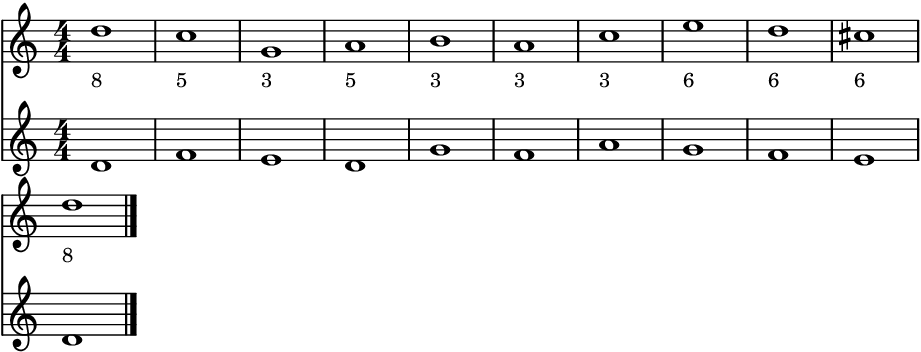
The numbers between the staves give the interval above the cantus in each bar. Read the exercise bar by bar and every decision can be justified.
Bar 1. An octave. A perfect consonance is required, and the octave places the counterpoint clear of the cantus with room to descend.
Bar 2. A fifth, reached by contrary motion: the cantus rises D to F and the counterpoint falls D to C. A perfect consonance is safe here only because the motion is contrary; approached in similar motion this would be a direct fifth.
Bar 3. A third. The counterpoint leaps a fourth down to G, its only leap of that size, and the next note steps back up, balancing it.
Bar 4. A fifth, again by contrary motion.
Bars 5 to 7. Thirds, three in succession, with the parts moving in parallel for two of them. Three is the working limit.
Bar 8. A sixth, reached by contrary motion, and the counterpoint's high E, its climax, sounded once. The cantus reached its own climax in bar 7, so the two peaks fall in different bars.
Bars 9 and 10. Sixths in parallel as the counterpoint descends. Bar 10 carries the C sharp: the major sixth before the close, and the leading note of the mode.
Bar 11. The octave, the two voices converging by step from a sixth, the cantus falling E to D and the counterpoint rising C sharp to D.
Now sing the counterpoint alone: D, C, G, A, B, A, C, E, D, C sharp, D. It has one leap, a single high point, no repeated note, and it lands on the final. That is the real test, and it is the one students skip.
2.5 Counterpoint below the cantus
Writing below the given melody is the same exercise with two changes. The intervals are counted from the new lower voice, so what was a sixth above becomes a third below and the harmonic implication changes; and the final cadence approaches the octave from a minor third rather than a major sixth, the lower voice falling by step while the cantus rises to the final.
The commonest error is to forget that the lower voice is now the bass, and to write a line which implies second-inversion chords by placing a fifth below the cantus at a structural point. Sing the lower line and ask what harmony it suggests, then check that the suggestion is one you would have written on purpose.
2.6 Checking finished work
Work through this list on every exercise. It catches almost everything.
- Number every interval. Are they all consonances? Any fourths?
- Look at consecutive numbers. Any 5-5 or 8-8? Any 5 or 8 arrived at by both voices moving the same way?
- Count runs of thirds or sixths. More than three?
- Sing the counterpoint alone. Shape? One climax? Balanced leaps? Any tritone outlined between a turning point and the next?
- Check the first bar, the last bar and the bar before it against 2.3.
- Check that the voices never cross, and that the counterpoint's climax is not in the same bar as the cantus firmus's.
3. Second and third species: dissonance under control
3.1 The rhythmic hierarchy
Once the counterpoint moves faster than the cantus firmus, the bar acquires strong and weak positions, and the whole treatment of dissonance depends on them. A note on a strong position is heard as structural: the ear takes it as the real harmony. A note on a weak position is heard as decoration, something passed through on the way somewhere else. Dissonance is admitted exactly where the ear is already treating a note as decoration.
| Species | Note values | Strong positions | Where dissonance may fall |
|---|---|---|---|
| second | two minims per bar | first minim | second minim, passing only |
| third | four crotchets per bar | first crotchet, and to a lesser degree the third | second and fourth crotchets freely, third crotchet if passing |
| fourth | tied minims | the tied first minim | the strong beat itself, prepared and resolved |
Fourth species reverses the arrangement, which is what makes it interesting, and it has its own chapter. Here the rule is simple: the strong position must be consonant, and a dissonance on a weak position must be a note the ear can hear being passed through.
3.2 Second species: the passing note
The counterpoint now sets two minims against each semibreve of the cantus. The last bar keeps a semibreve, and the first bar usually begins with a minim rest so that the counterpoint enters after the cantus, which announces at once that these are two voices and not one.
Second species adds exactly one new resource: the passing note. The second minim of a bar may be dissonant provided it is approached by step and quitted by step in the same direction, filling in a third between two consonances. Anything else on the second minim must be consonant, and a consonant second minim may be reached by leap.
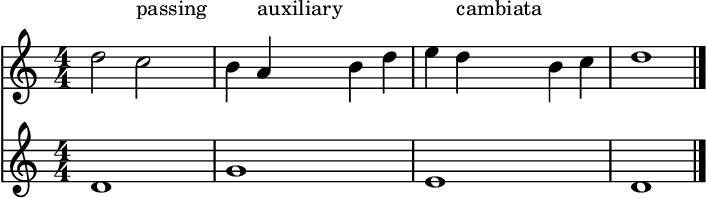
Two second-species points are easy to miss.
Fifths and octaves on successive downbeats. Two perfect fifths a bar apart, on the first minim of consecutive bars, are still consecutive fifths to the ear; the intervening minim does not cancel them unless it moves by step in a way that genuinely breaks the parallel. The safe habit is to treat the downbeats as a first-species exercise in their own right and check them by the rules of 2.2, then check the weak minims separately.
The second minim as an escape. Because a consonant second minim may be reached by leap, second species is where a student first learns to buy freedom of line by finding a consonance a third or a fourth away. Use it to change register, not as a way of avoiding the harder stepwise solution.
3.3 A worked second species counterpoint
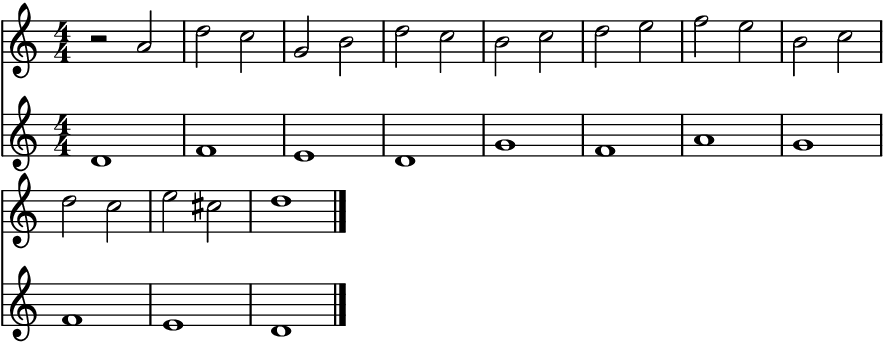
The exercise opens with a minim rest and enters on the fifth, then places the counterpoint an octave above by bar 4. Four things in it are worth naming.
The dissonances are all passing and all on the weak minim: the C in bar 4 between D and B, the C in bars 5 and 8 between B and D, the E in bar 6 between D and F. Nowhere is a dissonance on a downbeat, and nowhere is one approached or left by leap.
The perfect consonances are handled by three different devices. The fifth in bar 2 arrives by oblique motion, the cantus firmus holding while the counterpoint steps down. The octave in bar 4 arrives by contrary motion. The octave in bar 10 arrives by contrary motion again, and is followed at once by the sixth that carries the leading note.
The leaps are few and each is answered. The counterpoint leaps down a fourth from C to G in bar 3 and steps back up; it leaps down a fourth from E to B in bar 8 and steps back up. Both leaps happen across a bar line, from a weak minim to a strong one, which is where second species tolerates them most easily.
The climax, F in bar 7, is sounded once, one bar after the cantus firmus reaches its own high point.
3.4 Third species: dissonance in quantity
Four crotchets to the bar changes the character of the exercise. There are now three weak positions per bar, the line must keep moving for forty notes, and the danger is no longer dissonance but aimlessness.
The dissonance rules extend the second-species one in two directions.
Passing notes work as before, on any weak crotchet: approached and quitted by step in the same direction. Two dissonant passing notes may occur in the same bar.
Auxiliary notes, also called neighbour notes, are new. A note may step away from a consonance and step back to the same note, upper or lower, and may be dissonant while it does so. The figure is the smallest possible ornament: it decorates a note by leaving and returning to it. Auxiliaries belong on the second or fourth crotchet; on the third, which carries some weight, prefer a passing note.
The nota cambiata is a licensed exception, and the only dissonance in strict counterpoint that is left by leap. The figure descends a step to a dissonance, leaps down a third, then steps up: from C, the notes C-B-G-A over a bass that makes the B dissonant. The ear accepts it because the leap lands on a consonance and the final step recovers the note the dissonance skipped. It is worth learning as a shape rather than as a rule, since it appears constantly in Palestrina and almost never anywhere else. The third bar of the illustration above shows it.
The double neighbour, or changing notes, is the other licensed figure: from a consonance, step above, leap down a third to the note below, and step back up to the original note, so that the ornamented note is surrounded before being restated. Both decorating notes may be dissonant.
3.5 A worked third species counterpoint
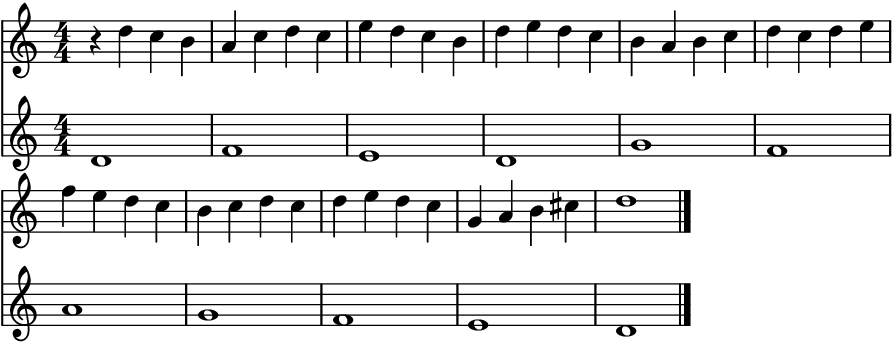
Read this one for line first and rules second, since the difficulty of third species is melodic. The counterpoint runs in scales wherever it can, turns at the top and bottom of each run, and reaches its high F once, in bar 7, before the descent to the cadence. The last bar but one climbs a scale G-A-B-C sharp into the final D, which is the plainest and best of all third-species endings.
The dissonances repay listing bar by bar, because seeing that a forty-note exercise contains only twelve of them corrects the usual impression that third species is a licence to write anything.
| Bar | Dissonance | Type |
|---|---|---|
| 1 | C, third crotchet | passing, D to B |
| 3 | D, second crotchet | passing, E to C |
| 4 | E, second crotchet | upper auxiliary to D |
| 4 | C, fourth crotchet | passing, D to B |
| 5 | A, second crotchet | lower auxiliary to B |
| 5 | C, fourth crotchet | passing, B to D |
| 6 | E, fourth crotchet | passing, D to F |
| 7 | D, third crotchet | passing, E to C |
| 8 | C, second and fourth crotchets | passing, then lower auxiliary to D |
| 9 | E, second crotchet | upper auxiliary to D |
| 10 | A, second crotchet | passing, G to B |
Every one of them is on a weak crotchet, every one is approached by step, and every one is left by step. The exercise contains no cambiata, because none was needed; do not manufacture opportunities for a figure.
3.6 What to watch in third species
Four faults account for most lost marks.
Wandering. A line that changes direction every crotchet has no shape. Write in runs of three or four notes going somewhere, and turn deliberately.
The repeated bar shape. If bars 4, 6 and 8 all have the pattern step up, step down, leap, the exercise sounds like an exercise. Vary the internal rhythm of direction, not the note values, which are fixed.
Dissonance on the third crotchet by leap. The third crotchet carries enough weight that a leap on to a dissonance there is audible as an error. Reserve leaps for consonances, always.
Fifths and octaves between the strong crotchets of consecutive bars. As in second species, check the downbeats alone as a first-species skeleton.
4. Fourth species: syncopation and the suspension
4.1 Dissonance on the strong beat
The first three species keep dissonance off the strong position. Fourth species puts it there deliberately, and controls it by a different means: not by weakness of position but by the listener's memory of the note.
The counterpoint moves in minims tied across the bar line, so that every note begins on the weak half of one bar and is held into the strong half of the next. The device is syncopation, and its consequence is the suspension: a note which was consonant when it was struck becomes dissonant when the other voice moves under it, and then resolves by stepping down to a consonance.
The mechanism is worth stating precisely, because everything else follows from it. The dissonance is not attacked. It is a note the ear already knows, held over a change of harmony, and the ear grants it a licence it would never grant to a new note struck against the beat. That is why preparation is compulsory and why the resolution must be a step down: the suspended note is a delayed arrival, and the delay pays for itself by arriving.
4.2 The three stages
Every suspension has three parts, and every rule attaches to one of them.
| Stage | Position | Requirement |
|---|---|---|
| preparation | weak half of the bar | the note is struck as a consonance |
| suspension | strong half of the next bar | the same note, tied, now dissonant against the moving voice |
| resolution | weak half of that bar | a step down to a consonance |
Three failures are the ones to know. A suspension struck rather than tied is not a suspension at all, it is an accented dissonance, and in strict style it is an error. A suspension prepared by a dissonance has nothing to be delayed from, and sounds like two errors in a row. A suspension resolving upwards is a retardation, which tonal music uses freely, most often with the leading note rising to the tonic, but which strict species work does not permit.
4.3 The suspension family
Suspensions are named by the interval they make against the lower voice and the interval they resolve to.
| Name | Where it lives | Behaviour |
|---|---|---|
| 4-3 | upper voice, over a rising or repeated bass | the commonest of all; the fourth is the classic two-part dissonance |
| 7-6 | upper voice, over a falling bass | chains beautifully, since each resolution prepares the next |
| 9-8 | upper voice, over a falling bass | weaker, because the resolution is a bare octave |
| 2-3 | lower voice suspended against a moving upper voice | the bass holds, the upper part moves, and the bass falls to a third |
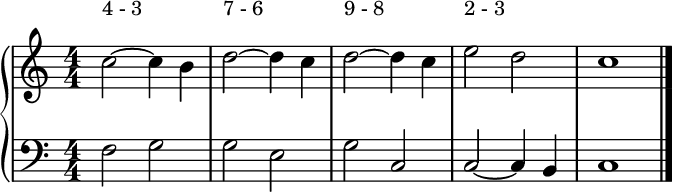
The 9-8 is the one to use least. Its resolution lands on an octave, a perfect consonance and the emptiest available sound, so the release is thinner than the tension deserved. Where a 9-8 offers itself, look for a 7-6 or a 4-3 instead.
The 2-3 works upside down and is easy to misidentify. The suspended note is in the lower voice, so it is the lower voice that resolves downward, and the interval it resolves to is a third above rather than below. Bach uses it constantly at cadences; the suspended bass note under a moving upper part is one of the characteristic sounds of a Baroque trio texture.
4.4 The chain, and how to break it
Because a 7-6 resolution leaves the counterpoint a sixth above the cantus, and a sixth becomes a seventh as soon as the cantus falls another step, a descending cantus firmus will generate a chain of 7-6 suspensions that could run for ever. Chains are the point of fourth species and the source of its sound: a long line of prepared dissonances, each resolution becoming the next preparation.
Sooner or later the chain runs into a note it cannot use, most often because the next suspension would be a diminished fifth or would resolve on to a unison. Then the counterpoint is allowed to break the syncopation: write one bar of two untied minims in the manner of second species, land on a consonance, and start a new chain from there. The break is not a failure; unbroken syncopation for eleven bars is monotonous, and examiners expect to see the licence used once.
4.5 A worked fourth species counterpoint
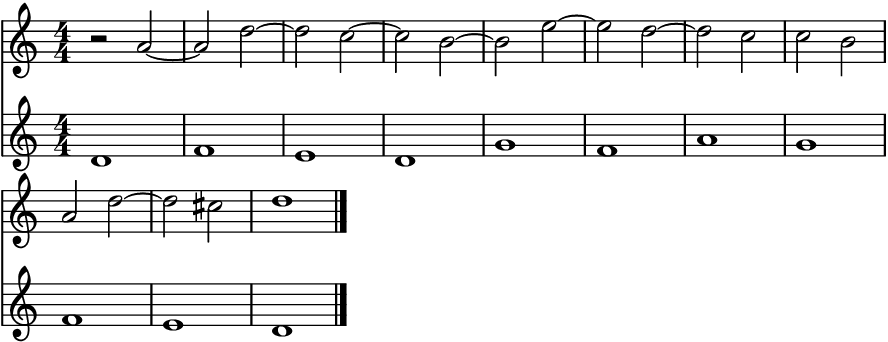
Bar by bar, the exercise contains six suspensions and one deliberate break.
Bar 2 is preparation only: the counterpoint's A is a third above the cantus, and the D taken on the second minim is a sixth, tied forward.
Bars 3 and 4 are a 7-6 chain. The D held into bar 3 becomes a seventh against the cantus's E and steps down to C; that C, tied forward, becomes a seventh against the cantus's D and steps down to B.
Bar 5 carries a consonant syncopation. The B held over is a third above G, so nothing needs resolving, and the counterpoint uses the freedom to leap up to E in preparation for what follows.
Bar 6 is another 7-6, E against F resolving to D.
Bar 7 is a 4-3, the D held against the cantus's A resolving to C, and it is the plainest suspension in the exercise.
Bar 8 is the break. The C makes a second 4-3 against G, resolves to B, and the tie is dropped, because carrying B into bar 9 would sound it against F as a diminished fifth. Bar 9 therefore begins with a fresh minim.
Bar 10 is the cadential 7-6: D against E resolving to C sharp, the leading note, which rises to the final in bar 11. That is the standard fourth-species ending and it is worth memorising as a unit.
4.6 Fourth species in real music
Nothing in the species course transfers to actual composition as directly as this one. The suspension is the single most reliable device for making two lines sound as though they need each other, and the chain of suspensions is the engine of the Corelli sequence, the Handel adagio and half the slow movements of the Baroque. Musical Harmony covers the same device from the chordal side, where the suspended note is described as a non-chord tone; the two accounts agree, and the contrapuntal one explains why the rules take the shape they do.
5. Fifth species: florid counterpoint
5.1 All the species at once
Fifth species removes the restriction to one note value. The counterpoint may use semibreves, minims, crotchets, dotted notes, ties and quavers, mixing them from bar to bar. Everything learned in species 1 to 4 still applies, applied to whichever value is present: a crotchet dissonance obeys the third-species rules, a tied minim obeys the fourth-species rules.
Two new freedoms come in, and both concern quavers.
Quavers appear only in pairs, and only on the weak half of a beat. Two quavers may fill the second half of a crotchet beat; they may not begin a bar, and four in a row is out of style. Both are normally stepwise.
The resolution of a suspension may be ornamented. Instead of a plain step down, the resolution may be decorated with quavers, or delayed by a note that leaps away and returns, so long as the resolution note itself arrives on the beat it was due. This is the device that turns fourth species from an exercise into music.
5.2 The rhythm of a florid line
The hardest thing in fifth species is not the dissonance treatment but the rhythm, because the student now has to invent one. Three habits produce a convincing line.
Never repeat a bar's rhythm immediately. If bar 4 is crotchet, quaver, quaver, minim, bar 5 should not be. Fux's own rule of thumb was that no two consecutive bars should look alike on the page.
Do not let the fastest values arrive too early. Quavers heard in bar 2 leave nowhere to go. The usual shape saves the quickest movement for the approach to the middle, and quietens down for the cadence.
Approach the last bar with the fourth-species cadence. Almost every good florid exercise ends with a suspension in the penultimate bar, resolving to the leading note. It is the strongest ending available, and after ten bars of varied rhythm the ear wants the regularity.
5.3 A worked fifth species counterpoint
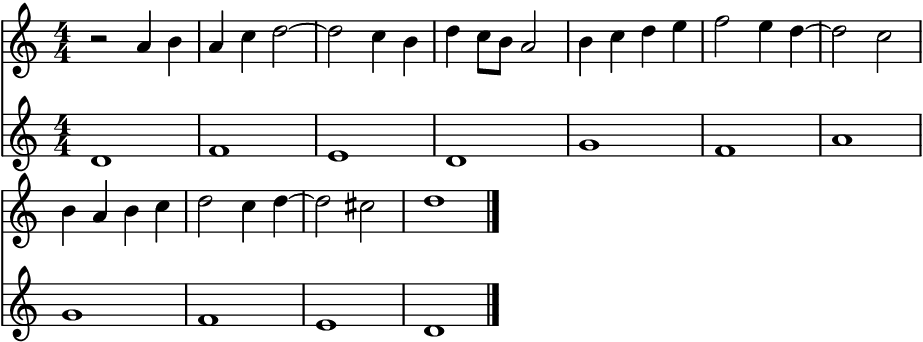
The exercise uses every species inside eleven bars.
Bars 1 and 2 are second and third species in effect: a minim rest, then crotchets and a minim tied forward. The tie sets up the suspension in bar 3, where the D against E resolves to C in fourth-species fashion, and the bar finishes with a crotchet step down to B.
Bar 4 is third species with a quaver pair, D-C-B filling the descent from the octave while the cantus holds; the quavers sit on the second half of the first beat, which is the only place they are allowed. The bar then settles on to a minim.
Bar 5 is plain third species, a rising scale from the third to the sixth, and bar 6 takes the counterpoint to its high F, its only appearance, before descending in crotchets to the D that is tied into bar 7.
Bar 7 is a 4-3 suspension, the simplest possible, and its plainness is deliberate: it steadies the exercise after the busiest two bars.
Bar 8 is third species with a lower auxiliary. Bar 9 places a minim and two crotchets, tying the last of them forward into the cadential suspension of bar 10, which resolves to the C sharp. Bar 11 is the octave.
Sing it and the shape is audible: quiet entry, activity through the middle, a single climax, and a settled cadence.
5.4 Combining species
Everything so far has been two voices. Three-part species work adds a third, and the rules change in three ways that are worth knowing before the free chapters.
The fourth becomes usable. A fourth between the two upper voices is a consonance when a third voice sounds a third or fifth below it, because the lowest sounding note governs. The prohibition in two-part work was always a special case of "the fourth above the bass is dissonant".
Complete chords become the target. With three voices, each strong beat should ideally give a full triad, root, third and fifth. The third is the note that must not be omitted; the fifth is the note that may.
Only one voice moves fast. In combined species one voice takes the fast values and the others move more slowly, because three voices in crotchets against a cantus in semibreves is unreadable and unsingable. A typical exercise sets the cantus in semibreves, one voice in second species and one in third, so that every crotchet is heard against a moving minim and a held semibreve.
Work three-part species only after two-part fifth species is comfortable. The commonest cause of unmusical three-part writing is a student solving the vertical problem, arriving at complete chords on every beat, and forgetting that each of the three lines still has to be a melody.
6. Two-part writing beyond the species
6.1 What free style changes
Species counterpoint is modal, vocal and sixteenth century. Leave it for the Baroque duo and five things change at once.
Harmony becomes the frame. In species work the vertical intervals are checked one by one. In free two-part writing the two lines imply chords, and the chords move in progressions the ear already knows. A leap that outlines a dominant seventh is good writing, not a broken rule, because the harmony it implies is complete in the listener's head.
The fourth relaxes. A fourth between the two parts is still not a point of rest, but it passes freely, appears on weak beats, and occurs as part of an implied chord whose bass is understood rather than sounded.
The melodic range widens. Instrumental lines leap sevenths and octaves and arpeggiate through triads and sevenths. What survives from strict style is the principle rather than the letter: a large leap still wants recovery, and a line still wants a shape.
Rhythm becomes motivic. Species work has no motifs. Free two-part writing lives on them: a figure stated in one voice comes back in the other, and the texture is held together by the recurrence.
Sequence becomes structural. Almost every Baroque two-part passage of any length contains a sequence, a pattern repeated at a new pitch, usually falling by step or by fifths.
6.2 The Baroque duo texture
The characteristic two-part texture of Bach and his contemporaries can be described in one sentence: one voice carries the figure while the other supplies a line that is both bass and counterpoint, and the roles change places without warning.
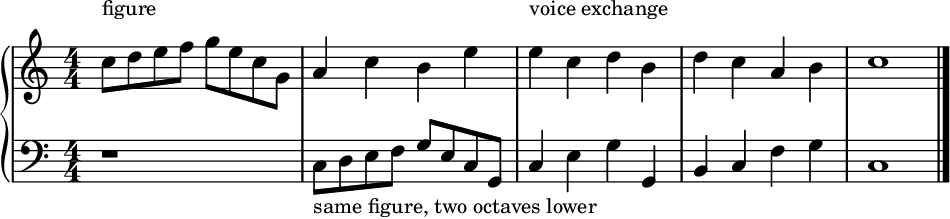
The upper voice states a figure in bar 1 while the lower is silent. The lower voice repeats the figure exactly, two octaves down, in bar 2, and the upper part supplies a counterpoint above it. That is the whole engine of the invention and the fugue in miniature.
Bar 3 shows a voice exchange. The upper part moves from E down to C while the lower moves from C up to E: the two pitches swap places between the parts, over what is still the same chord of C major. Voice exchange is a device for keeping a texture alive when the harmony is standing still, and it appears everywhere from thirteenth-century organum to Brahms.
6.3 Invertible counterpoint
Two lines are in invertible counterpoint if they still work when the upper becomes the lower. It is the technique that lets a composer state a pair of lines, then restate them with the parts swapped, so that the same material sounds new.
The interval by which the swap happens is what gives the technique its name. Invertible counterpoint at the octave moves one voice by an octave; at the tenth, by a tenth; at the twelfth, by a twelfth. In practice a composer moves one part up an octave, or moves one part down an octave and the other up a third or a fifth: the total displacement is what counts.
The arithmetic is simple and it decides everything. At the octave, an interval and its inversion add up to 9. At the tenth they add up to 11, and at the twelfth to 13. Subtract from the magic number and the answer is what the interval becomes.
| Original interval | At the octave (9) | At the tenth (11) | At the twelfth (13) |
|---|---|---|---|
| unison | 8 | 10 | 12 |
| 2nd | 7 | 9 | 11 |
| 3rd | 6 | 8 | 10 |
| 4th | 5 | 7 | 9 |
| 5th | 4 | 6 | 8 |
| 6th | 3 | 5 | 7 |
| 7th | 2 | 4 | 6 |
| 8ve | 1 | 3 | 5 |
Read the table for the traps and each species of invertible counterpoint gets one rule.
At the octave, the fifth becomes a fourth. A fifth that was a perfect consonance turns into a dissonance with nothing to resolve it, so avoid the fifth as a point of rest, and use it only as a passing or unaccented interval. Everything else takes care of itself: thirds become sixths, sixths become thirds, and octaves become unisons, which is why the two parts must stay within an octave of each other in the first place.
At the tenth, thirds become octaves and sixths become fifths. So no parallel thirds and no parallel sixths, since either becomes parallel perfects in the inversion. This is the most restrictive of the three, and its compensation is that the original and the inversion can be played together, giving three-part texture out of two lines.
At the twelfth, the sixth becomes a seventh. So treat the sixth as a dissonance: pass through it, do not rest on it. Thirds become tenths and fifths become octaves, both harmless. The twelfth is the workhorse of fugal writing, and Bach's Art of Fugue contains a fugue built on it.
6.4 Invertible counterpoint at the octave
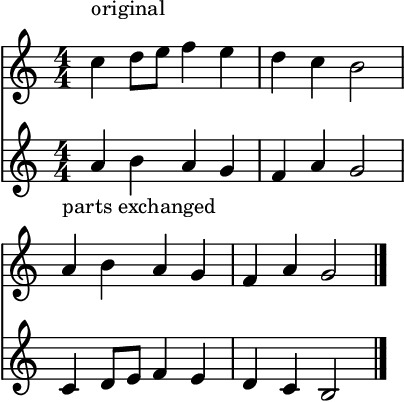
The upper system is the original. Its intervals, beat by beat, are third, third, sixth, sixth, sixth, third, third: nothing but imperfect consonances, and not one fifth, which is what makes the inversion safe.
The lower system is the same two bars with the upper voice moved down an octave, so that the parts have changed places. Every third has become a sixth and every sixth a third. Nothing else has been altered, and no note has been rewritten: that is the test of genuine invertible counterpoint, and the reason composers plan for it in advance rather than discovering it afterwards.
6.5 Invertible counterpoint at the twelfth
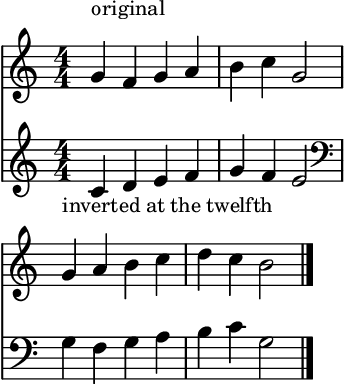
The original here is built from thirds and fifths, with the sixth avoided entirely. In the second system the lower voice has moved up a fifth and the upper down an octave, a total displacement of a twelfth. Every third has become a tenth and every fifth an octave, and the passage is as consonant as it was before.
Try the same fragment at the tenth, though, and it collapses: the string of parallel thirds in the first bar becomes a string of parallel octaves. That is not a defect of the writing but a demonstration that a composer must decide which inversion is wanted before writing a note, because the three inversions want three different kinds of line.
6.6 Where to hear it
Invertible counterpoint is used wherever material has to be restated without being repeated. In a fugue, the subject and countersubject are written invertible at the octave as a matter of course, so that the countersubject can appear above or below any later entry. In the two-part invention, the two bars of the opening usually return with the parts swapped at the double bar. In the finale of Mozart's Jupiter symphony, five themes are combined and recombined in every vertical order, which is only possible because each pair was designed to invert. Look for the sign in a score: material heard in the treble comes back note for note in the bass a few bars later, with a new line above it.
7. Imitation and canon
7.1 Imitation
Imitation is one voice repeating what another has just sung. It is the oldest device in polyphony and the most useful, because it solves two problems at once: it gives the second voice something to sing, and it makes the listener recognise the material.
Three facts describe any point of imitation.
| Question | Answer is called | Typical values |
|---|---|---|
| after how long? | the time interval | one bar, two bars, one beat |
| at what pitch? | the interval of imitation | unison, fourth, fifth, octave |
| how exactly? | strict or free | free imitation copies the shape, strict copies the intervals |
Free imitation is the everyday kind: the second voice takes the rhythm and the contour, alters an interval or two to fit the harmony, and abandons the copy after a few notes. Strict imitation copies exactly, and when it is maintained to the end of a passage the result is a canon.
7.2 Real and tonal imitation
When a subject is imitated at the fifth, an awkwardness appears at once: an exact transposition takes the music out of the key. Answering C-G-E-F-G exactly at the fifth above gives G-D-B-C-D, which pulls towards the dominant of the dominant. Composers therefore developed two kinds of answer.
A real answer transposes every interval exactly. A tonal answer alters one or two notes near the beginning, typically answering the subject's tonic with the dominant and its dominant with the tonic, so that the music stays anchored in the home key while the second voice enters.
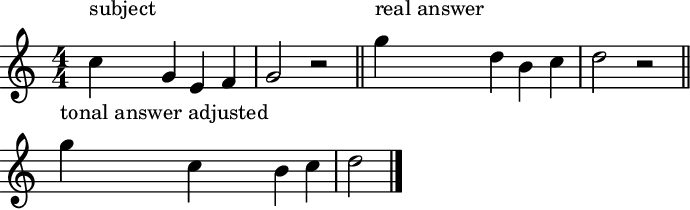
The subject leaps from tonic down to dominant. The real answer transposes that leap exactly, from dominant down to supertonic. The tonal answer replaces the second note, answering the subject's dominant with the tonic, and then continues as an exact transposition. The adjustment is over within two notes, and after it the answer is indistinguishable from a real one.
The rules of thumb for when a tonal answer is needed are given in full in chapter 9, since the question belongs to fugue. For imitation generally the principle is enough: if the exact transposition would drag the music out of the key in its first bar, adjust it.
7.3 Canon
A canon is imitation maintained. One voice, the leader, sings a melody; another, the follower, sings the same melody after a fixed delay and at a fixed interval, and the two must be good counterpoint throughout. Older writing calls the two parts dux and comes, leader and companion.
Writing a canon is not a matter of inspiration. It is a mechanical procedure done in a particular order.
- Choose the delay and the interval, and write the first unit of the leader.
- Copy that unit into the follower, moved by the delay and the interval.
- Write the leader's next unit as a counterpoint against what the follower is now singing.
- Copy that unit into the follower.
- Repeat until the canon has run its course, then write a free ending.
Every canon is written this way, and the difficulty is entirely in step 3, where the composer's choices are constrained by material already committed. The reward is that a canon, once running, generates its own second voice.
Almost every canon ends freely. Strictness is abandoned in the last bar or two so that the parts can cadence together, because a strict canon has no natural stopping point: the follower is always one delay behind. The alternative is the perpetual canon, which is designed to be repeated for ever and never to cadence at all.
7.4 Canon at the octave
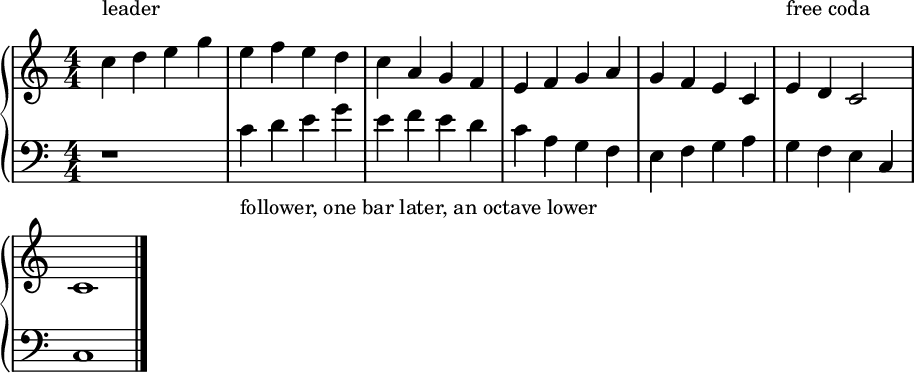
The follower enters one bar after the leader, an octave lower, and copies it note for note for five bars. Every bar of the leader after the first was written against the follower's copy of the bar before, which is why the leader's line keeps changing direction: it is answering itself.
The last two bars are free. The leader abandons the canon and steps down to the final, and the two voices arrive together on an octave. Cover the last two bars and the canon could run for ever; that is the point at which a composer must decide to stop.
7.5 Canon by inversion
In a canon by inversion, also called canon al rovescio or in contrary motion, the follower turns the leader upside down: every rising interval becomes a falling one of the same size, and every falling interval a rising one.
The inversion is calculated about an axis, a pitch that stays fixed. Choose the axis to keep the music diatonic. In a piece in D, inverting about D itself sends the scale D-E-F-G-A-B-C on to D-C-B-A-G-F-E, which is the same set of notes, so no accidentals arise.
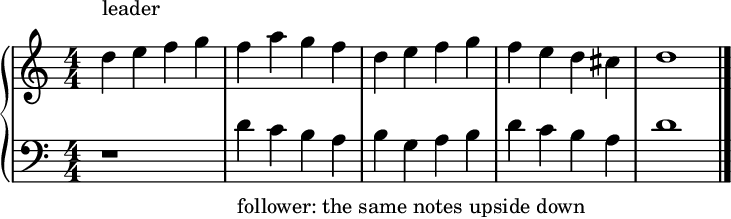
The leader rises D-E-F-G in bar 1; the follower answers in bar 2 by falling D-C-B-A. The rest follows the same mirror, and the free ending in the last bar brings both voices to D with the sharpened leading note that a Dorian cadence requires.
Inversion has a practical advantage beyond the ingenuity. When one voice rises and the other falls, contrary motion is guaranteed, which is the strongest form of independence available. That is why so many inversion canons sound better than their composers deserve.
7.6 Augmentation, diminution and the crab
Three further transformations turn up in canon, and all three come back in chapter 9 as fugal devices.
Augmentation doubles every note value, so the follower moves at half speed. The follower quickly falls a long way behind, so an augmentation canon is nearly always short or has a leader that stops and lets the follower finish.
Diminution halves the values, so the follower overtakes the leader. It is far rarer, since the follower runs out of material.
The crab canon, or canon cancrizans, has the follower play the leader's notes backwards. Bach's Musical Offering contains the famous one. The trick to writing it is that every vertical pair must be consonant in both directions, since the same two notes will meet again with the parts reversed. Thirds, sixths, octaves and unisons qualify; fifths do not, because a fifth becomes a fourth when the voices swap.
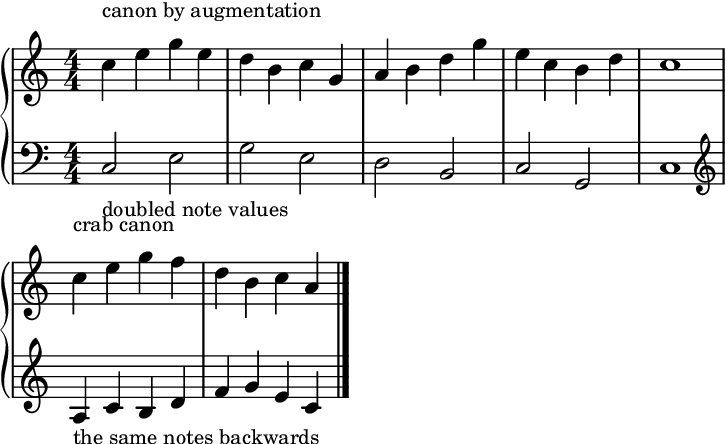
In the first system, the lower voice sings the upper voice's notes in doubled values while the upper voice continues freely once its canonic material has run out. In the second, the lower voice sings the upper voice's eight notes in reverse order, and the two lines meet in nothing but thirds, sixths and tenths, which is what makes the reversal possible.
7.7 Rounds and perpetual canons
A round is a canon at the unison, in equal phrases, designed to be sung indefinitely. Every voice sings the same tune at the same pitch, entering one phrase apart, so that a tune of three phrases becomes a three-part texture as soon as the third voice is in.
The construction is neatly circular. If the phrases are called A, B and C, then once all three voices are singing, one voice has A, another B and another C at the same moment; so A, B and C must fit together vertically. In effect the composer writes three lines of counterpoint and then joins them end to end.
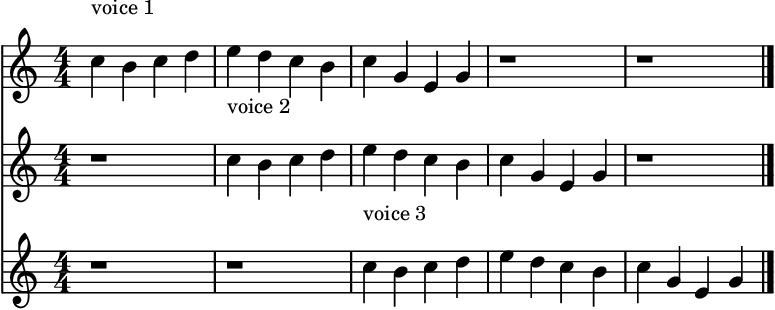
The tune here is three bars long and every bar of it fits above and below every other. Behind it lies an alternation of chords, C major on the first and third beats and G on the second and fourth, and each of the three phrases takes its notes from that frame. Nearly every successful round in the English tradition is built the same way, on a harmonic cycle of two or three chords that repeats every phrase.
Rounds are worth writing, and worth writing badly at first. They are the shortest possible complete lesson in counterpoint: three lines, mutual dependence, and an audible verdict as soon as the third voice comes in.
8. The two-part invention
8.1 What an invention is
Bach's fifteen two-part inventions were written for his eldest son and copied into the Clavier-Büchlein in 1720. The title page of the fair copy calls them an honest guide showing how to play cleanly in two parts, and, more to the point here, how to arrive at good ideas and develop them properly. They are teaching pieces in the best sense: each takes one short idea and shows what can be got out of it in twenty to forty bars.
For a student of counterpoint the invention is the ideal first piece, because it demands everything the species course taught and nothing it did not. Two voices, one idea, a clear key plan, and no room to hide.
8.2 The anatomy
An invention has three kinds of material and a standard order for them.
| Section | What happens | Key |
|---|---|---|
| exposition | the subject in one voice, then in the other an octave away, each with a counterpoint against it | tonic |
| episode | material derived from the subject, in sequence, modulating | moving |
| middle entries | the subject stated in a related key | dominant, relative major or minor, supertonic |
| final entries | the subject back in the tonic, often with the parts inverted | tonic |
The usual key plan of a short invention is tonic, then the dominant by the double bar, then a return through the relative minor or major, then the tonic. In a piece in the minor, the first destination is the relative major. Inventions written in two halves put a double bar and repeat marks at the dominant cadence; several of Bach's do exactly this, which makes them binary form as well as invention texture, and the Musical Form and Analysis volume treats that side of the question.
8.3 The subject
An invention subject is short, usually half a bar to two bars, and it must contain enough distinct features to survive being chopped up. The features to build in are a recognisable rhythm, a head that can be quoted on its own, and at least one interval large enough to be heard as a gesture.
What the subject must not be is complete. A tune that ends satisfyingly gives the composer nothing to do. The subject should stop in mid-air, on a note that demands continuation, since the whole piece consists of continuing it.
8.4 A worked exposition
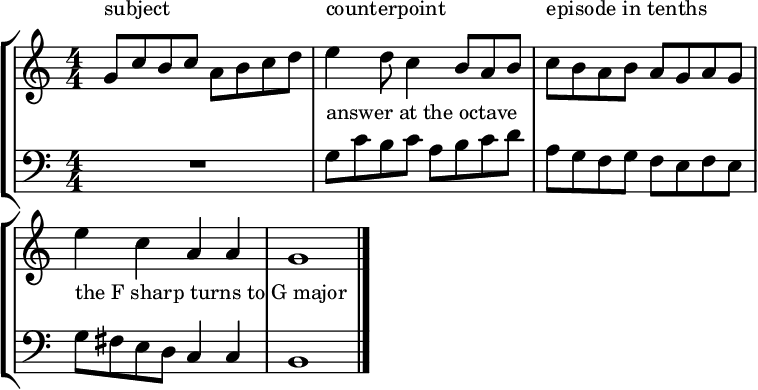
Bar 1. The subject, alone in the upper voice. It rises from the dominant through a turn round the tonic and then climbs a scale, ending on the supertonic: an unfinished note, which is what makes the second bar necessary. Its head, the three notes G-C-B, is short enough to be quoted later on its own.
Bar 2. The lower voice states the subject an octave below, note for note. This is an octave answer rather than a fifth answer, which is the invention's normal practice and the main way an invention differs from a fugue. Above it the upper voice supplies a counterpoint that is nearly all contrary motion: as the subject climbs, the counterpoint steps down through E, D, C and B. This counterpoint is the piece's second idea, and it can be used later above or below any entry.
Bar 3. An episode. The upper voice takes the three-note descent from the counterpoint and sequences it downwards, and the lower voice shadows it a tenth below, note for note. Episodes in parallel tenths are the commonest of all invention episodes because they are easy to write and easy to hear as a single gesture, and because the two parts can swap ends of the tenth to renew the sound.
Bar 4. The sequence turns into a cadence. The F sharp announces the new key, the lower voice runs down the scale to C, the seventh of the dominant seventh of G, and the upper voice follows it down in sixths.
Bar 5. The cadence lands in the dominant, G major. The seventh, C, falls to B in the lower voice; the upper voice steps A to G.
Five bars is not an invention, but it is the whole exposition and the start of the first episode, and everything after it in a real piece is more of the same: subject entries in new keys, episodes derived from the subject, and a return home.
8.5 Writing your own
The procedure below produces a workable invention. Follow it in order and resist the temptation to compose the ending first.
- Write a subject of one bar. Sing it. If it sounds finished, shorten it.
- Write a counterpoint against the subject that is good in itself, moves mostly in contrary motion, and would work equally well an octave lower. Check it for invertibility at the octave: no fifths on strong beats (6.3).
- Set the subject in the other voice an octave down, with that counterpoint above it.
- Take a two-beat fragment of either line and sequence it downwards through a circle of fifths or a stepwise descent, in tenths or sixths, until the music has reached the dominant.
- State the subject in the dominant, in whichever voice is free.
- Sequence again, this time returning towards the tonic, passing through the relative key if there is room.
- State the subject once more in the tonic, with the two voices exchanged from their positions in bar 2, and cadence.
Steps 4 and 6 are where inventions are won or lost. An episode must be recognisably made of subject material, must go somewhere harmonically, and must not outstay its welcome: two bars is usually enough, four is the limit.
9. Fugue
9.1 What a fugue is
A fugue is a piece in which a single theme, announced alone at the start, is worked through a fixed number of voices by imitation, and returns in different keys and different relationships until it has been exhausted. Everything in the previous eight chapters exists to make a fugue possible: the species taught dissonance control, invertible counterpoint made the accompanying lines reusable, and imitation supplied the mechanism.
A fugue is not a form in the sense that sonata form is a form. It is a texture and a procedure, and the shape it produces varies from piece to piece. What every fugue has is an exposition; what happens afterwards is negotiable. Musical Form and Analysis treats fugue from the outside, as a design; this chapter treats it from the inside, as a way of writing.
9.2 Subject and answer
The subject is the theme, announced by one voice alone. The answer is the same theme in the next voice to enter, at the dominant, a fifth above or a fourth below.
If the answer transposes every interval exactly, it is a real answer. If one or more intervals are altered, it is a tonal answer. The alteration is not a licence taken for variety; it is a repair, and there are two situations that call for it.
The first is a subject that leaps early from tonic to dominant. Transposed literally, that leap becomes dominant to supertonic, and the answer drags the ear away from the key before the fugue has established it. The tonal answer bends the dominant note back to the tonic, so the pair of entries between them state the key rather than fight over it.
The second is a subject that begins on the dominant. It is answered by the tonic, for the same reason.
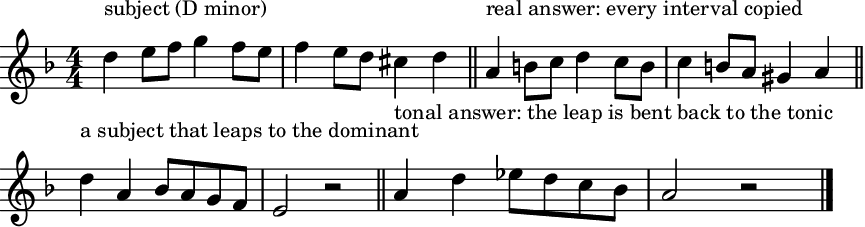
Everything else in the answer follows the subject exactly. The join between the altered note and the resumption of literal transposition should be inaudible, which in practice means putting it at the first convenient step.
9.3 The countersubject
While the second voice sings the answer, the first voice is still playing. What it plays is the countersubject, and if the same material returns against later entries it earns that name properly; if the first voice simply improvises, the fugue is said to have free counterpoint rather than a countersubject.
A countersubject has to satisfy three demands at once. It must be good counterpoint against the subject. It must be invertible with it, because subject and countersubject will change places later, so no fourths above the lower part and no unresolved ties. It must be different in character from the subject, usually by moving where the subject rests and resting where the subject moves, so that the two lines stay audible as two things.
9.4 The exposition
The exposition is finished when every voice has stated the subject or the answer once. The entries alternate: subject, answer, subject, answer, in whatever order of voices the composer chooses.
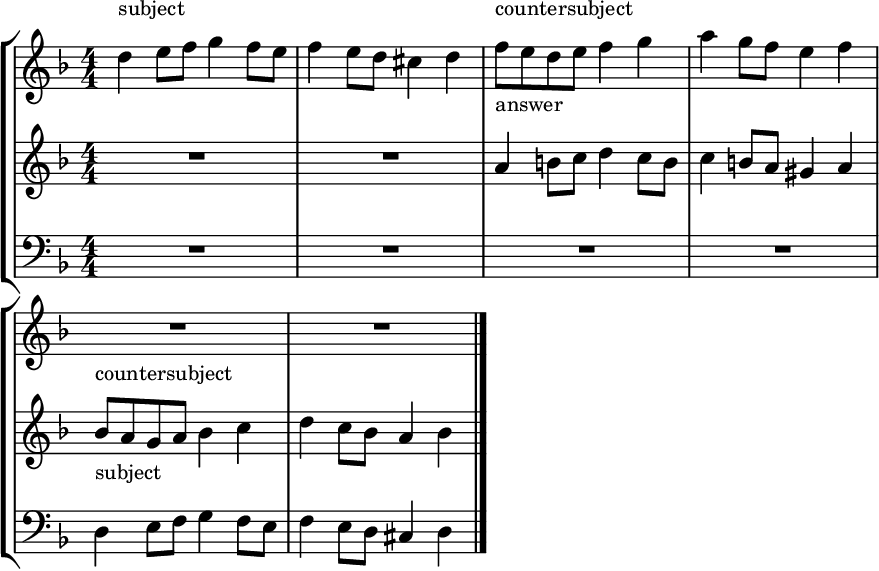
Three details in that specimen are worth naming. The countersubject in bars 3 and 4 moves in quavers where the answer holds crotchets, so the two lines separate on the ear. When the bass takes the subject in bar 5, the countersubject follows it in the alto, transposed to fit, exactly as invertible counterpoint promised it could. And the soprano falls silent for those two bars, which is not laziness: dropping a voice is the standard way to let a new entry be heard in a texture that would otherwise be thickening with every bar.
Between entries a composer may write a link, a bar or two of free material that carries one voice back to where the next entry needs it.
9.5 Episodes
An episode is a passage in which no complete subject entry occurs. Its work is to move the music from one key to the next, and its material is almost always a fragment of the subject or the countersubject, treated in sequence.
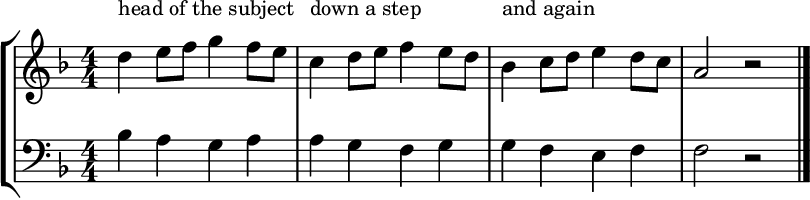
The technique is the one from chapter 6 applied on a larger scale: take a short figure, write it against a second voice, then move the whole pair down a step and repeat. Two or three steps of a sequence is the usual limit, because the ear works out the pattern quickly and then wants something else.
9.6 Middle entries
After the exposition, entries return in related keys: the relative major from a minor-key fugue, the dominant, the subdominant, the mediant. Each is normally approached through an episode that modulates to it. A middle entry may be complete or partial, and may appear in any voice.
The plan of a fugue is therefore an alternation: exposition, episode, entry, episode, entry, and so on until the final entry in the tonic. What makes one fugue different from another is the order of keys and the intensity of the devices used along the way.
9.7 The devices
Four transformations are available, and a composer under pressure to raise the temperature reaches for them in roughly this order.
Inversion turns every interval upside down: a rising third becomes a falling third. Augmentation doubles every note value, so the subject arrives in slow motion, often in the bass, and often at the end. Diminution halves the values. Stretto overlaps two entries, bringing in the second before the first has finished, and it is the most exciting of the four because it compresses the theme against itself.
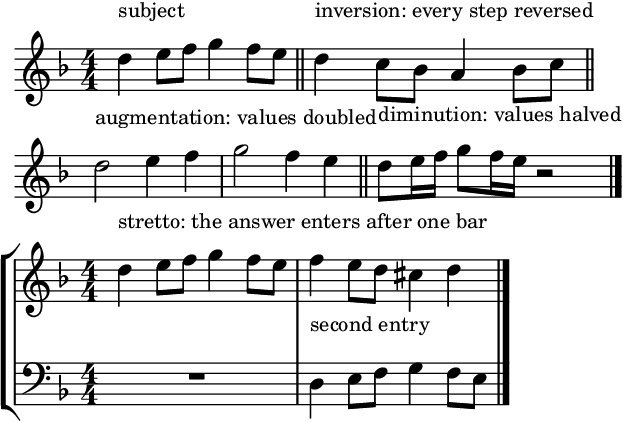
Whether stretto is possible at a given distance is a property of the subject, not a decision. Composers test their subjects against themselves at one bar, two bars, a half bar, and at various intervals, and build the last section of the fugue around whichever combinations work.
9.8 Endings
Most fugues end with a final entry in the tonic, often over a tonic pedal, with the texture at its fullest and the harmonic motion slowing to a stop. A dominant pedal in the bars before it is the standard way of building the expectation. In a minor-key fugue the final chord frequently takes a tierce de Picardie.
9.9 Writing your own
Start with the subject and be ruthless about it. A good fugue subject is short, has a clear rhythmic profile, contains one memorable interval, and outlines the tonic chord clearly enough that the key is not in doubt after two bars. Test it before going further: transpose it up a fifth and see whether a real answer works, then try it against itself at a bar's distance for stretto, then invert it and see whether the inversion is still musical. A subject that survives those three tests will carry a fugue; one that fails all three will fight you for pages.
10. Counterpoint on a chorale
10.1 The chorale as a cantus firmus
A Lutheran chorale melody is a cantus firmus with a congregation attached: a tune everyone in the building already knows, in long notes, with clear phrase divisions. Writing counterpoint around one is the oldest continuous practice in the tradition, and the techniques below all treat the melody as fixed and the surrounding parts as the composer's contribution.
10.2 The chorale prelude
In the simplest kind, the melody is stated in long notes in one voice while the other voices move quickly around it.
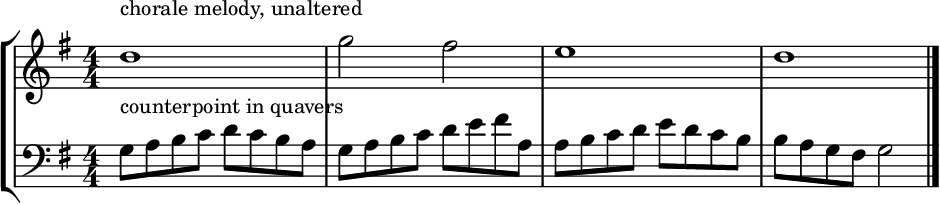
The counterpoint's job is to keep the harmony alive between the melody's slow arrivals. Two habits make it work. It moves in a consistent rhythmic value, so it reads as one continuous line rather than as an accompaniment that changes its mind. And its notes on the strong parts of the beat are consonant with the melody note above, which is what stops the running voice from turning into decoration without direction.
10.3 The other treatments
Ornamented melody. The chorale itself is decorated with passing notes, turns and appoggiaturas until it is nearly hidden. The congregation still hears it; the technique depends on that.
Fore-imitation. Before each phrase of the chorale arrives, the lower voices imitate its opening notes in shorter values, so that the phrase is announced before it is sung.
Canonic treatment. The chorale is set in canon with itself, one voice following another at a fixed distance.
Chorale fugue. Each phrase of the melody in turn becomes a fugue subject, worked briefly before the next phrase arrives.
10.4 Why the exercise still matters
The chorale prelude puts a fixed line in front of you and asks what you can do around it. That is the situation of almost all practical writing: an existing melody, an accompaniment to invent, and a fixed harmonic implication to respect. The four-part harmonisation of the same melodies belongs to SATB Part-Writing and Figured Bass; what this chapter adds is the habit of thinking of the added parts as lines rather than as chord tones that happen to be sounding.
11. Renaissance and Baroque norms
11.1 Two styles, one medium
The species course teaches Renaissance habits, because they are the strictest and therefore the most instructive. Almost all the counterpoint anyone actually plays is Baroque. The two styles use the same medium and disagree about several important things, and knowing which set of habits you are working in prevents a good deal of confusion.
11.2 What changes
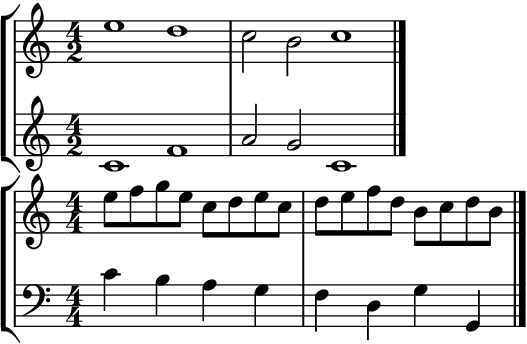
| Renaissance (Palestrina) | Baroque (Bach) | |
|---|---|---|
| Governing system | modal, with the church modes | tonal, with major and minor keys |
| Direction | driven by line and by cadence | driven by harmony and by key |
| Dissonance | passing notes and suspensions only, tightly controlled | the same, plus appoggiaturas, accented passing notes and free figuration |
| Leaps | small, and answered by a step in the opposite direction | freely arpeggiated, whole chords outlined |
| The fourth | a dissonance in two parts | a dissonance against the bass only |
| Rhythm | flexible, each voice with its own accents | metrical, all voices sharing the barline |
| Chromaticism | rare, mostly at cadences | ordinary, and structural |
| Sequence | occasional and short | everywhere, and structural |
| Text setting | the words control the rhythm | the affect controls the figuration |
11.3 Which rules to keep
The strict rules are permanently useful in one respect: they force a habit of hearing each line separately. Everything in the Renaissance column can be relaxed in a Baroque exercise, but the relaxation is a choice, and knowing what you are relaxing is what separates free counterpoint from careless counterpoint.
Three rules survive both styles intact. Consecutive perfect fifths and octaves between the same two voices are still avoided. A dissonance must still be approached and left in a way the ear can follow. And the voices must still be able to be sung, which means singable intervals and sensible ranges.
12. Common faults
12.1 The catalogue
Most work fails on a small number of recurring faults. Each of these appears below as written and then corrected.
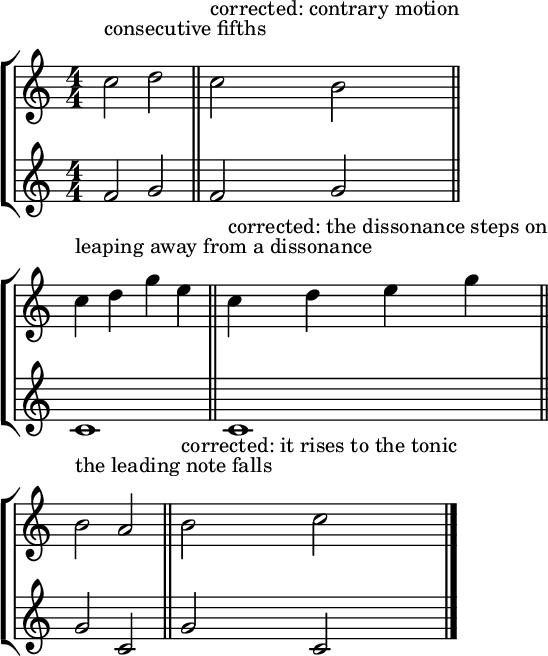
Consecutive perfect intervals. Fifths and octaves between the same pair of voices in consecutive notes. The correction is nearly always contrary motion in one of the two voices.
Leaping away from a dissonance. A dissonant note must resolve by step. Leaping from it leaves the dissonance unexplained, and the ear hears a wrong note rather than a passing one.
The leading note not rising. At a cadence, the leading note rises to the tonic. In an inner voice of a four-part texture it may fall to the dominant; in two-part counterpoint it may not.
12.2 The rest of the list
Both voices leaping in the same direction. Two leaps the same way sound like one voice in octaves rather than two independent lines. Let one voice step.
Hidden or exposed octaves and fifths. Similar motion into a perfect interval with the upper voice leaping. Avoid it at the outer edges of the texture, where it is most audible.
A climax repeated. The counterpoint's highest note should occur once. Twice, and the line has no shape.
A leap not filled in. After a leap of a fourth or more, the line should turn back and step through the space it jumped over.
Too many notes in the same direction. Five or six steps the same way and the line becomes a scale. Turn it.
A tritone outlined. Even when no single interval is a tritone, a line that moves from F to B by any route outlines one, and in strict style it is corrected.
Crossing without reason. Voices may cross, but the listener loses track of which line is which. Reserve it for a specific effect.
Static counterpoint. Repeating the same note across a barline in strict species is not allowed at all; in free style it is allowed but wastes the voice.
13. Quick reference
13.1 The species at a glance
| Species | Rhythm against the cantus | Dissonance permitted |
|---|---|---|
| First | one note to one | none |
| Second | two notes to one | passing notes on weak beats |
| Third | four notes to one | passing and auxiliary notes on weak beats |
| Fourth | syncopated, tied across the bar | suspensions on strong beats, resolving down by step |
| Fifth | mixed values | all of the above, plus the anticipation |
13.2 The intervals
| Interval | Status in two parts |
|---|---|
| unison, octave, perfect fifth | perfect consonances: use sparingly, never consecutively |
| major and minor third, major and minor sixth | imperfect consonances: the working material |
| perfect fourth | dissonant in two parts, consonant above a bass in three or more |
| second, seventh, all augmented and diminished intervals | dissonances: prepare and resolve |
13.3 The devices
| Device | What it does |
|---|---|
| imitation | a second voice restates a figure after a delay |
| canon | imitation maintained continuously |
| invertible counterpoint | the voices exchange upper and lower position |
| inversion | every interval of the line reversed in direction |
| augmentation, diminution | note values doubled or halved |
| stretto | entries overlapped |
| sequence | a figure restated at successive pitch levels |
13.4 The checking routine
- Sing each line alone. Is it a tune?
- Number the intervals between the voices. Any consecutive perfect intervals?
- Circle every dissonance. Is each one prepared and resolved by step?
- Mark the climax of each line. Does each occur once, and in different places?
- Check the cadence. Leading note rising, contrary motion, correct final interval?
14. Exercises
Answers follow the questions.
14.1 Questions
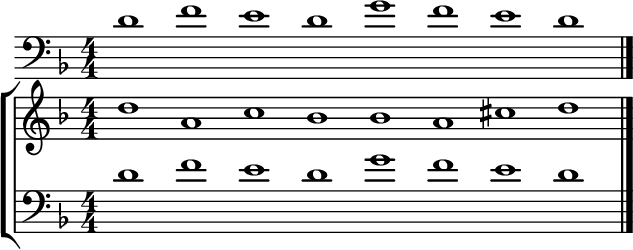
- Write a first species counterpoint above the cantus firmus below, in D minor.
- Name the four kinds of independence a contrapuntal voice can have.
- In second species, on which part of the bar may a dissonance fall, and by what motion must it be approached and left?
- Write out the three stages of a suspension and name them.
- Why is a 9-8 suspension weaker than a 7-6?
- A subject begins on the dominant. Does it take a real answer or a tonal answer, and why?
- What are the two conditions a countersubject must satisfy that ordinary free counterpoint need not?
- Two voices sound a perfect fifth, then both move up a step. Name the fault and give two corrections.
- What is the difference between an episode and a middle entry in a fugue?
- Which interval of inversion permits parallel thirds to survive as parallel tenths, and why is that useful?
14.2 Answers
1. One correct solution is engraved above. Its intervals against the cantus, in order, are octave, third, sixth, sixth, third, third, sixth, octave, so it begins and ends on a perfect consonance and uses imperfect consonances in between. It begins and ends by contrary motion, its climax at the C in bar 3 occurs once, and the C sharp in bar 7 is the raised leading note required at the cadence. Other answers are possible; any solution meeting the checklist in 13.4 is correct.
2. Rhythmic, melodic, directional and registral. Two lines that share their rhythm, contour, direction and register are heard as one thickened line.
3. On the weak half of the bar, that is the second minim. It must be approached and left by step, in the same direction, as a passing note.
4. Preparation, in which the note sounds as a consonance; suspension, in which the same note is held while the other voice moves, making it a dissonance; resolution, in which it steps down to a consonance.
5. Because it resolves on to an octave, a perfect consonance and the emptiest interval available, so the release is thinner than the tension it discharges. The 7-6 resolves on to a sixth, an imperfect consonance, which sounds fuller and also prepares the next suspension in a chain.
6. A tonal answer. The dominant is answered by the tonic rather than by the literal fifth above, so that the two entries between them establish the key instead of pulling away from it.
7. It must be invertible with the subject, since the two exchange positions at later entries; and it must contrast with the subject rhythmically, so that both remain audible when they sound together.
8. Consecutive fifths. Corrections: move one voice in contrary motion so the second interval is a third or a sixth, or change one of the two notes so that the second interval is imperfect. Inserting a passing note does not help, because the fifths still sound on consecutive strong beats.
9. An episode contains no complete statement of the subject and exists to modulate, usually by sequence on a fragment of subject material. A middle entry is a complete statement of the subject in a new key after the exposition.
10. Inversion at the twelfth. Thirds invert to tenths, which are consonant, so parallel thirds survive the inversion; at the octave they would become sixths, which is also usable, but at the twelfth a passage in thirds inverts into a passage in tenths without any adjustment, which is why Bach favoured it in the inventions.
Counterpoint is the oldest working discipline in Western music and the one that repays practice most directly. The species are a ladder, not a destination: climb them, then write the music that made you want to climb them in the first place.