The symbols of the modern stave
A complete reference to modern notation on the stave: the stave itself and its clefs, every note value and rest, dots, ties and tuplets, accidentals and key signatures, time signatures, barlines and navigation signs, dynamics, articulation, the ornaments, octave signs, the standard performance directions, and the marks peculiar to particular instruments.
Introduction
Western stave notation is a remarkable machine. With five lines and a bag of symbols, it records pitch, duration, volume, articulation, phrasing, tempo, ornamentation, fingering and structure all at once, precisely enough that players who have never met can sit down together and produce the same piece. It grew by accretion over roughly a thousand years, which is why it is full of oddities: symbols borrowed from medieval proportion signs, Italian words frozen in the 18th century, and three different clefs that all mark the same C.
This guide documents the system as it stands in modern printed music. It is a reference rather than a tutor: each chapter defines its symbols, shows what they look like, explains what they mean in performance, and notes the traps. Read it front to back and you will have toured the whole notational machine; more likely you will dip in when a score throws something unfamiliar at you, and for that the chapter titles and the index tables in chapter 17 are the fastest way in.
Symbols are shown with their printed glyphs where a text document can carry them, for instance the clefs 𝄞, 𝄢 and 𝄡 and the accidentals ♯, ♭ and ♮. A few marks, mostly ornament signs, do not travel reliably outside engraved music, and those are described in words and by their realisations instead.
The guide assumes nothing beyond the ability to read English. Terms are defined as they arrive, British naming is used throughout, and every Italian direction is translated where it appears.
How to use this guide
Chapters 1 and 2 cover the stave and the clefs, the frame everything else hangs on. Chapters 3 to 6 cover duration: note values, rests, dots and ties, and tuplets. Chapters 7 to 9 cover pitch modification and metre: accidentals, key signatures and time signatures. Chapters 10 to 15 cover everything written around the notes: barlines and repeats, dynamics, articulation, ornaments, octave signs and performance directions. Chapter 16 covers instrument-specific marks, chapter 17 is the quick reference, and chapter 18 is a set of exercises with answers.
Companion documents cover what the notes mean rather than how they are written: Piano Chords, Musical Modes, Musical Harmony and the five ABRSM grade guides, which teach much of this material progressively rather than documenting it exhaustively.
A note on terms and notation
Naming follows British convention throughout: stave for the five-line grid, bar for the metrical unit and barline for the line that marks it off, semibreve, minim, crotchet, quaver, semiquaver and their relatives for the note lengths, pause for the hold sign, and leading note, tone and semitone where scale degrees and steps arise. Where a note is raised or lowered it is sharpened or flattened.
Accidentals are printed ♯, ♭, ♮, 𝄪 and ♭♭. Middle C is written C4 where an octave must be pinned down, the convention in which each octave runs from C to B and C4 sits on the ledger line below the treble stave. The diagrams are written in Mermaid; in the Word version they are pictures.
1. The stave
1.1 Lines, spaces and ledger lines
The stave is a grid of five horizontal lines enclosing four spaces, read bottom to top: the lowest line is the first line, the lowest space the first space. Each line and each space carries one letter name, so the stave spans nine notes before any help is needed. Pitch outside that span is written on ledger lines, short private line segments drawn through or beside a note. Two or three ledger lines are routine; more than about four and engravers reach for an octave sign (chapter 14) or a different clef instead, because towers of ledger lines are slow to read.
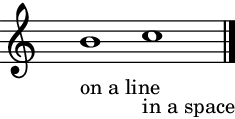
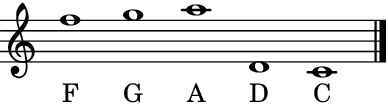
A stave on its own says nothing about which nine notes it spans. That assignment is the clef's job, and until a clef appears the lines are anonymous. Percussion writing exploits exactly that anonymity, as chapter 2.6 shows.
1.2 Systems, braces and brackets
Music for one line of one player sits on a single stave. Everything larger stacks staves into a system, the group of staves read simultaneously, joined at the left margin by a systemic barline. Two markings show how staves within a system belong together:
- The brace (a curly bracket) joins staves played by one player at one instrument: the two staves of piano music, the two or three of organ music.
- The bracket (a square bracket) joins the staves of a family or ensemble: the four staves of a string quartet, the woodwind of an orchestral score.
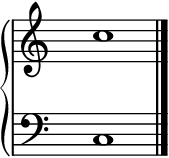
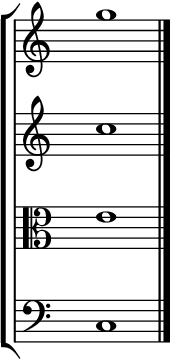
In an orchestral score the instruments appear in a fixed order, woodwind at the top, then brass, percussion, soloists and voices, and strings at the bottom. Within each family the higher instruments sit above the lower.
1.3 One stave, two voices
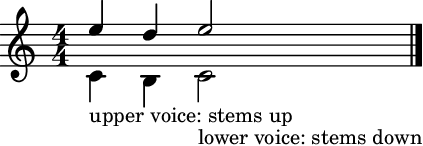
A single stave can carry more than one musical line at once. Where it does, the lines are distinguished by stem direction: the upper voice takes stems up, the lower voice stems down, and each voice fills the bar's time independently. Keyboard music, choral music on two staves and drum kit notation all lean on this device constantly. The rule breaks the ordinary stem-direction convention of chapter 3.4 on purpose: in multi-voice writing, stem direction marks voice membership, not stave position.
2. Clefs
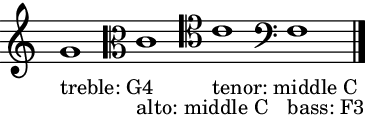
A clef fixes one named pitch to one line of the stave, and every other line and space follows from it. Three clef shapes exist in modern use, each anchoring a different note: the G clef 𝄞, the F clef 𝄢 and the C clef 𝄡. The shapes are medieval letters G, F and C worn smooth by centuries of copying. Each shape can in principle sit on any line, and history has tried most of the combinations; modern practice keeps four in daily service and a few more within reach.
2.1 The G clef family
The treble clef is the G clef with its spiral curled around the second line, fixing that line as G4, the G above middle C. It is the most used clef in existence: violin, flute, oboe, clarinet, trumpet, horn, soprano and alto voices, guitar, and the right hand of keyboard music all live on it. Middle C sits one ledger line below the stave.
One other G clef survives only in old French editions: the French violin clef, with the G on the first line. It is met in facsimiles and scholarly editions of Baroque French music and nowhere else.
2.2 The F clef family
The bass clef is the F clef with its two dots bracketing the fourth line, fixing it as F3, the F below middle C. It serves cello, double bass, bassoon, trombone, tuba, timpani, bass voice and the left hand of keyboard music. Middle C sits one ledger line above the stave.
Two other F clefs are effectively historical: the baritone clef (F on the third line) and the sub-bass clef (F on the fifth line), the latter used by some Baroque composers for the lowest organ pedal parts. Neither appears in modern engraving outside editions of early music.
2.3 The C clef family
The C clef fixes middle C, C4, on whichever line its centre sits. Two of its five positions remain in daily use:
- The alto clef, C on the third line, is the viola's home clef, and the viola is nearly its only modern tenant; trombone parts in older editions use it too.
- The tenor clef, C on the fourth line, serves the upper registers of cello, bassoon and trombone, sparing them ledger lines without pushing them into the treble clef.
The soprano clef (C on the first line), mezzo-soprano clef (C on the second line) and baritone clef (C on the fifth line, the same notes as the F baritone clef) survive only in older vocal scores and scholarly editions. Singers met them routinely into the 19th century; a modern reader meets them mainly in Bach facsimiles.
2.4 Octave clefs
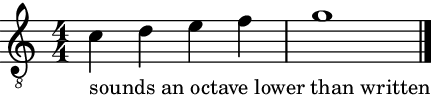
A small 8 attached to a clef moves everything an octave. By far the most common is the octave treble clef, a treble clef with an 8 below it, reading an octave lower than written: this is the standard clef of the tenor voice in choral music, and of guitar music too, though guitar parts usually omit the 8 and rely on convention. An 8 above the treble clef (sounding an octave higher) appears for descant recorder and piccolo in some editions; a 15 moves the reading two octaves. These attachments spare instruments whose range sits awkwardly against the plain clefs from perpetual ledger lines or octave signs.
2.5 Clef changes
A clef holds until cancelled. Mid-piece, even mid-bar, a smaller change clef can appear, and instruments whose range straddles the plain clefs (cello, bassoon, trombone, viola at its top) change clef routinely. The change is purely notational; the instrument's sound does not move. A courtesy clef at the end of a line warns that the next line begins in a new clef.
2.6 Clefs that fix no pitch
The percussion clef, two thick vertical strokes (or a rectangle) where a clef would sit, declares that the stave carries unpitched instruments: lines and spaces are assigned to drums and cymbals by a legend, not by letter name. Drum kit notation conventionally puts the bass drum in the first space and the snare in the third, with cymbals above, but the assignment is the publisher's choice and a legend settles it.
Tablature replaces the stave entirely for fretted instruments: six lines for a guitar's six strings, with fret numbers instead of noteheads. The letters TAB stand where the clef would. Tablature records where the fingers go rather than what pitch results, and modern guitar editions usually print it in parallel with an octave treble stave.
%%{init: {'theme':'neutral'}}%%
flowchart TD
  S["The three clef shapes"] --> G["G clef 𝄞<br/>fixes G4"]
  S --> C["C clef 𝄡<br/>fixes middle C"]
  S --> F["F clef 𝄢<br/>fixes F3"]
  G --> G2["treble<br/>2nd line<br/>in daily use"]
  G --> G1["French violin<br/>1st line<br/>historical"]
  C --> C3["alto<br/>3rd line<br/>viola"]
  C --> C4["tenor<br/>4th line<br/>cello, bassoon,<br/>trombone high"]
  C --> C5["soprano, mezzo,<br/>baritone<br/>historical"]
  F --> F4["bass<br/>4th line<br/>in daily use"]
  F --> F35["baritone, sub-bass<br/>historical"]
  classDef live fill:#dce8f5,stroke:#3b5f8a,stroke-width:2px
  class G2,C3,C4,F4 live
3. Note values
3.1 The family of values
Every note length in modern notation belongs to one family in which each member lasts half as long as the one before. The British names describe the chain of halvings outright:
| Symbol | British name | Relative length | In a 4/4 bar |
|---|---|---|---|
| 𝅜 | breve | 8 crotchets | two bars' worth |
| 𝅝 | semibreve | 4 crotchets | the whole bar |
| 𝅗𝅥 | minim | 2 crotchets | half the bar |
| 𝅘𝅥 | crotchet | 1 crotchet | one beat |
| 𝅘𝅥𝅮 | quaver | 1/2 crotchet | half a beat |
| 𝅘𝅥𝅯 | semiquaver | 1/4 crotchet | a quarter beat |
| 𝅘𝅥𝅰 | demisemiquaver | 1/8 crotchet | an eighth of a beat |
| 𝅘𝅥𝅱 | hemidemisemiquaver | 1/16 crotchet | a sixteenth of a beat |
The breve, the longest survivor of the medieval long values, appears mainly in early music and in the final bars of slow church music. One further halving, the semihemidemisemiquaver with five tails, exists and is met in florid cadenzas; beyond it notation gives up and writes ad libitum runs as small notes.

A note value fixes duration relative to the beat, never absolute time: a crotchet at ♩ = 60 lasts a second, at ♩ = 120 half a second. Tempo (chapter 15) owns absolute time.
%%{init: {'theme':'neutral'}}%%
flowchart TD
  A["breve 𝅜"] -- "÷2" --> B["semibreve 𝅝"]
  B -- "÷2" --> C["minim 𝅗𝅥"]
  C -- "÷2" --> D["crotchet 𝅘𝅥"]
  D -- "÷2" --> E["quaver 𝅘𝅥𝅮"]
  E -- "÷2" --> F["semiquaver 𝅘𝅥𝅯"]
  F -- "÷2" --> G["demisemiquaver 𝅘𝅥𝅰"]
  G -- "÷2" --> H["hemidemisemiquaver 𝅘𝅥𝅱"]
  classDef common fill:#dce8f5,stroke:#3b5f8a,stroke-width:2px
  class B,C,D,E,F common
3.2 The parts of a note
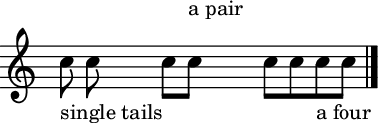
A note is assembled from up to three parts. The notehead, oval, is filled black for crotchets and shorter, hollow for minims and longer; the breve adds vertical strokes either side. The stem, a vertical line, attaches to every value except breve and semibreve. The tail (one or more curved flags on the stem) marks the quaver and each further halving adds another tail: one for quavers, two for semiquavers, three for demisemiquavers, four for hemidemisemiquavers.
3.3 Beams
Where two or more tailed notes fall inside one beat group, their tails are drawn as beams, straight strokes joining the stems: one beam for quavers, two for semiquavers, and so on. Beaming is purely graphical, the durations are identical to tailed notes, but it is graphical with a purpose: beams group notes by beat, so a 4/4 bar of running quavers is beamed in twos or fours and the reader sees the beat structure at a glance. Vocal music once beamed only melismas, tailing each syllable's note separately; modern vocal engraving has largely adopted instrumental beaming.
3.4 Stem direction
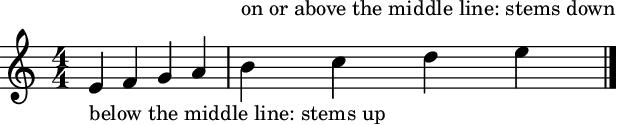
On a single-voice stave, stems point down from noteheads on or above the middle line and up from noteheads below it, the stem hanging on the left of the head when down and standing on the right when up. A beamed group takes its direction from the note furthest from the middle line. In multi-voice writing this rule gives way to the voice-membership rule of chapter 1.3.
4. Rests
4.1 The family of rests
Silence is written as precisely as sound. Each note value has a rest of identical duration:
| Symbol | Rest | Duration equals |
|---|---|---|
| 𝄺 | breve rest | breve |
| 𝄻 | semibreve rest | semibreve, or a whole bar |
| 𝄼 | minim rest | minim |
| 𝄽 | crotchet rest | crotchet |
| 𝄾 | quaver rest | quaver |
| 𝄿 | semiquaver rest | semiquaver |
| 𝅀 | demisemiquaver rest | demisemiquaver |
| 𝅁 | hemidemisemiquaver rest | hemidemisemiquaver |
The semibreve rest hangs below the fourth line; the minim rest sits on the third. The two are easily confused and the mnemonic is weight: the heavier value hangs, the lighter sits. Quaver rests and shorter carry the same number of hooks as their notes carry tails.

4.2 The whole-bar rest
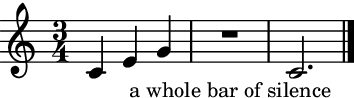
Whatever the time signature, a completely silent bar takes the semibreve rest, centred in the bar. In 3/4, where a semibreve's worth of silence does not even fit, the semibreve rest still means "this bar is silent". The one modern exception: a fully silent bar of 4/2 or longer takes the breve rest.
4.3 Multi-bar rests
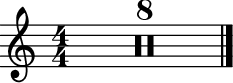
In parts, long silences are compressed: a thick horizontal bar with a number above it means "count this many silent bars". Orchestral players spend much of their lives reading these. In scores the bars are usually written out so the eye can track the texture.
5. Dots and ties
5.1 The dot
A small dot after a notehead lengthens the note by half its value: a dotted minim lasts three crotchets, a dotted crotchet three quavers. A double dot adds half plus a quarter, so a double-dotted minim lasts three and a half crotchets; double dots are the signature rhythm of the French overture. A triple dot exists in late Romantic scores and is read on the same principle. Dots apply to rests identically, though engravers prefer separate rests where the metre would be obscured.

5.2 The tie
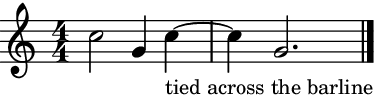
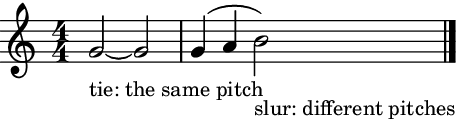
A tie is a small curve joining two noteheads of the same pitch, welding them into one unbroken sound lasting their combined value. Ties exist because barlines and beat groups interrupt: a note lasting from beat 4 of one bar into the next physically cannot be written as one symbol, so it is written as two, tied. Chains of ties can extend a note indefinitely.
The tie is distinguished from the slur (chapter 12) by what it joins: a tie always joins the same pitch to itself and means "do not re-strike"; a slur arches over different pitches and means "play smoothly". The symbols look alike and beginners misread one as the other; the pitches under the curve settle it instantly.
5.3 Where dots and ties divide the labour
Inside a beat group, use a dot; across a barline, a tie is compulsory; across a beat boundary, engraving convention prefers whichever keeps the beat visible. The convention is why 4/4 writes a crotchet tied to a crotchet across beats 2 and 3 rather than a minim sitting astride the middle of the bar: the notation is longer but the reader never loses beat 3.
6. Tuplets
6.1 The triplet
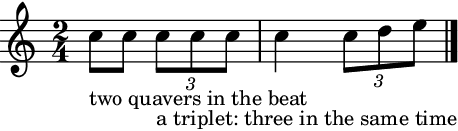
A triplet, three notes bracketed with a figure 3, squeezes three equal notes into the time two of the same value would occupy. Triplet quavers fill a crotchet; triplet crotchets fill a minim. The bracket is omitted where a beam already groups the three.
6.2 The general tuplet
The same machinery generalises. A figure n over a bracket means "n equal notes in the time this space normally holds": the duplet (2 in the time of 3, the reverse trade, common in compound time), the quadruplet, the quintuplet (5), sextuplet (6) and septuplet (7) and beyond. Editions of Chopin print tuplets of 11, 13 and 22 small notes over a single accompaniment bar. Where ambiguity threatens, a ratio is printed instead of a bare number: 5:4 means five in the time of four.

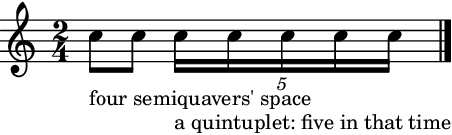
Tuplets are the notation's escape from its own arithmetic: the value family of chapter 3 divides only by two, and tuplets buy every other division.
7. Accidentals
7.1 The five signs
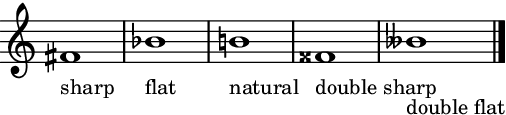
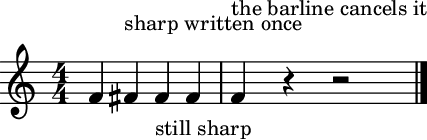
An accidental alters the pitch of a note by semitone steps, holding for the rest of its bar on its own line or space, in its own octave, unless cancelled:
| Symbol | Name | Effect |
|---|---|---|
| ♯ | sharp | raises a semitone |
| ♭ | flat | lowers a semitone |
| ♮ | natural | cancels any other sign |
| 𝄪 | double sharp | raises two semitones |
| ♭♭ | double flat | lowers two semitones |
The double signs arise from the logic of keys and chords rather than perversity: in G♯ minor the sharpened leading note is F𝄪, because the leading note must be some kind of F. Cancelling half of a double sign, from F𝄪 back to F♯, takes a plain ♯ in modern practice (older editions print ♮♯).
7.2 Scope and courtesy
The accidental's scope, this bar, this line, this octave, is a standing source of misreadings, and engraving supplements the rule with the courtesy accidental (also called a cautionary): an accidental, sometimes bracketed, that the rule does not strictly require, printed where a reader might otherwise carry the alteration in their head. After a bar containing F♯, the next bar's F often carries a courtesy ♮. Good engraving spends courtesy accidentals freely; they cost ink and save rehearsals.
7.3 Microtones
Modern scores that divide the semitone use extended accidentals. The commonest convention takes half-sharp and half-flat signs (a one-stroke sharp; a mirrored flat) for quarter-tones, with three-quarter versions built by combination. The symbols vary by publisher and period; a legend in the score's front matter is normal and should be trusted over habit.
8. Key signatures
8.1 What the signature says
A key signature is a fixed set of sharps or flats printed after the clef on every line, applying to every octave of the named letters for as long as it stands. It abbreviates: instead of sharpening every F and C by hand in D major, the signature does it wholesale. It also announces: a reader sees two sharps and narrows the music to D major or B minor before playing a note. The signature cannot distinguish that pair; only the music's behaviour, its cadences and its tonal centre, tells major from relative minor. Nor does it distinguish the modes on the same parent, for which see Musical Modes.
8.2 The order of the signs
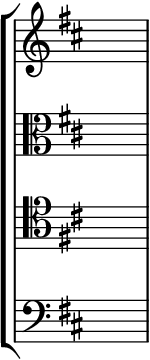
Sharps enter in fifths rising: F, C, G, D, A, E, B. Flats enter in the exact mirror, fifths falling: B, E, A, D, G, C, F. The orders never vary and neither does the printed pattern: each signature is the previous one plus one sign in its fixed position. Up to seven of each exists, giving the 15 major and 15 minor keys documented in Technical Names and Roman Numerals.
8.3 Position on the stave
Each sign of a signature has a home position for each clef, chosen to sit within the stave, and the pattern shifts with the clef: the treble clef's first sharp sits on the top line, the bass clef's on the fourth. The tenor clef breaks the treble and bass zigzag for sharps, placing the F♯ low. Engraving software handles all this, but a copyist, or anyone reading C-clef parts, needs the patterns.
8.4 Changing signature
A mid-piece key change prints the new signature at the change, preceded where signs must be removed by cancelling naturals (older practice) or simply replacing the signature (modern practice). A courtesy signature at a line's end warns of a change beginning the next line.
9. Time signatures
9.1 The fraction that is not a fraction
A time signature, two stacked numbers after the key signature, declares the bar's contents: the lower number names a note value (4 = crotchet, 8 = quaver, 2 = minim), the upper counts how many fill the bar. So 3/4 is three crotchets a bar, 6/8 six quavers. The signature prints once and holds until a new one appears; unlike clefs and key signatures it is never reprinted at each line.
9.2 Simple and compound time
The same bar-filling arithmetic supports two different beat feels, and the distinction is the most useful fact about metre:
- Simple time has beats that divide in two. 2/4, 3/4 and 4/4 are simple duple, triple and quadruple: the beat is a crotchet, its halves are quavers.
- Compound time has beats that divide in three. 6/8, 9/8 and 12/8 are compound duple, triple and quadruple: the beat is a dotted crotchet, its thirds are quavers.
6/8 and 3/4 contain identical quavers per bar and are nothing alike: 3/4 is three beats of two (ONE-and TWO-and THREE-and), 6/8 two beats of three (ONE-and-a TWO-and-a). Beaming shows which is meant, grouping quavers 2+2+2 in 3/4 and 3+3 in 6/8.

9.3 The two letter signatures
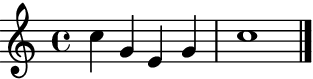
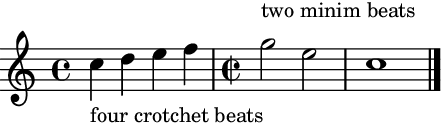
Two survivals of medieval proportion signs stand in for numbers: 𝄴, read common time, means 4/4, and 𝄵, read alla breve or cut common time, means 2/2, two minim beats. The C shape is not the letter C for "common"; it is the medieval half-circle that marked duple metre. Alla breve conventionally signals a faster pulse counted in minims, as in marches and much Baroque music.
9.4 Irregular and additive metres
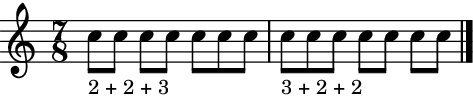
Upper numbers 5, 7, 11 and friends give irregular metres, felt as unequal beat groups: 5/4 as 3+2 or 2+3, 7/8 as 2+2+3 or 3+2+2. Where the grouping matters, composers print it: an additive signature such as 3+2+2/8 fixes the internal grouping outright, a practice Bartók and Balkan-influenced music made standard. Beaming follows the declared groups.
9.5 Changing and open metre
Metre changes freely mid-piece; each change prints a new signature, with a courtesy signature at line ends. Passages alternating two signatures can print both once at the start (6/8 3/4 side by side) and swing between them, a device familiar from Bernstein's "America". Unmetred music, cadenzas, some chant editions and much contemporary writing, omits the signature and barlines entirely, or replaces barlines with dashed reference lines.
10. Barlines, repeats and navigation
10.1 The barlines
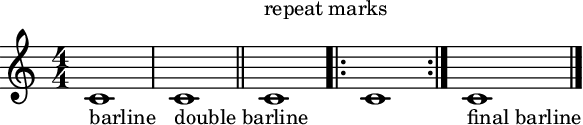
| Symbol | Name | Meaning |
|---|---|---|
| 𝄀 | barline | end of a bar |
| 𝄁 | double barline | end of a section, or warning of a change of key, metre or tempo |
| 𝄂 | final barline | end of the piece or movement |
| 𝄆 | start repeat | beginning of a repeated passage |
| 𝄇 | end repeat | repeat from the matching 𝄆, or from the start if none |
A dashed barline subdivides long bars as a counting aid; a thick single barline appears in some modern editions for structural divisions. Barlines also carry the metre's accent pattern by position alone: the note after a barline is beat one, and the notation never marks the downbeat any other way.
10.2 Repeats of small units
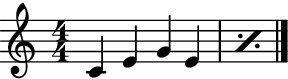
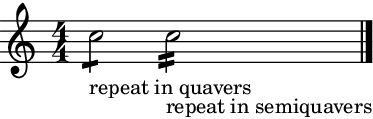
Three shorthand signs compress repetition inside a part. The simile mark 𝄎 on a stave means "repeat the previous bar"; its two-bar version spans two staves' worth. A slash through a note's stem means "repeat this note in quavers (one slash), semiquavers (two)" and is the standard tremolo shorthand (chapter 13.8 for the two-note form). The word simile after a marked passage means "continue in the same manner", sparing the copyist a page of identical articulation.
10.3 First and second time bars
Repeats whose ending differs use volta brackets: a bracket numbered 1 over the bars played the first time through, a bracket numbered 2 over the replacement bars played the second time. On reaching the end repeat inside bracket 1, the player returns to the start repeat; on the second pass, skips bracket 1 and plays bracket 2. Numbers stack (1.2. over one bracket, 3. over another) where a passage repeats more than twice.

10.4 Da capo, dal segno, coda
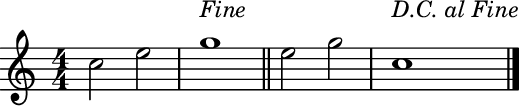
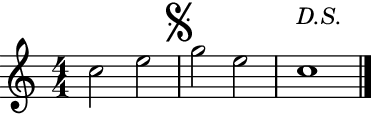
Longer-range navigation uses Italian instructions and two signs, the segno 𝄋 and the coda sign 𝄌:
| Instruction | Literally | Meaning |
|---|---|---|
| D.C. (da capo) | from the head | go back to the beginning |
| D.S. (dal segno) | from the sign | go back to the 𝄋 |
| al Fine | to the end | ...and play until the bar marked Fine |
| al Coda | to the coda | ...and play until to Coda 𝄌, then jump to the 𝄌 section |
So D.C. al Fine means: return to the top, play through, stop at Fine. D.S. al Coda means: return to 𝄋, play until the to Coda mark, jump to the coda and play it to the end. By convention, repeats inside the recapped passage are not taken on the second pass unless the score says otherwise.
%%{init: {'theme':'neutral'}}%%
flowchart TD
  A["Play from the top"] --> B["reach D.S. al Coda"]
  B -- "jump back" --> C["𝄋 segno"]
  C --> D["play on"]
  D --> E["reach 'to Coda' 𝄌"]
  E -- "jump forward" --> F["𝄌 coda section"]
  F --> G["end"]
  classDef jump fill:#dce8f5,stroke:#3b5f8a,stroke-width:2px
  class C,F jump
11. Dynamics
11.1 The letter dynamics
Volume is marked in italic letters below the stave (above, for vocal music), abbreviations of Italian words:
| Mark | Word | Meaning |
|---|---|---|
| pp | pianissimo | very quiet |
| p | piano | quiet |
| mp | mezzo-piano | moderately quiet |
| mf | mezzo-forte | moderately loud |
| f | forte | loud |
| ff | fortissimo | very loud |
The scale extends outwards as composers shout louder: ppp and fff are common, pppp and ffff not rare, and Tchaikovsky famously reaches pppppp in the Sixth Symphony. The marks are relative, not calibrated: an f for full orchestra and an f for solo lute are different absolute volumes, and each player scales the marks to instrument, room and context.
11.2 Accents within the scale
| Mark | Word | Meaning |
|---|---|---|
| fp | fortepiano | loud attack, instantly quiet |
| sf, sfz | sforzando | a sudden strong accent on one note or chord |
| rf, rfz | rinforzando | reinforced, a heavier stress over a note or short group |
| fz | forzando | as sfz |
11.3 Gradual change
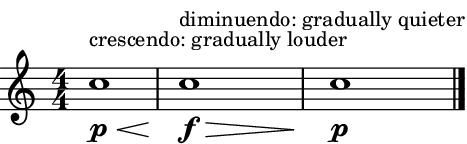
Crescendo (growing louder) and diminuendo or decrescendo (growing quieter) are marked either by the abbreviations cresc. and dim. (often with trailing dashes showing extent) or by hairpins, the pairs of converging or diverging lines under the stave: opening outwards for crescendo, closing for diminuendo. A hairpin's length shows exactly where the change lives, which the word cannot; the word can span pages, which a hairpin cannot. Al niente ("to nothing") and dal niente ("from nothing") take a hairpin to or from silence, sometimes marked with a small circle at the hairpin's point.
12. Articulation
12.1 The marks on single notes
Articulation signs sit above or below the notehead and shape the attack, length and weight of individual notes:
| Mark | Name | Meaning |
|---|---|---|
| dot above/below the head | staccato | detached, roughly half length |
| small wedge | staccatissimo | as short as speaks cleanly |
| short horizontal line | tenuto | held full length, slightly leaned on |
| > | accent | attacked more strongly |
| ^ | marcato | heavily accented, detached |
| dot under a line | portato | half-detached, carried |
Combinations compose their meanings: staccato under a slur is portato; accent plus staccato is a short strong note. The precise length of a staccato crotchet is the player's judgement, not arithmetic; the sign frees the note from its written length rather than specifying a new one.

12.2 The slur
The slur, a curve over two or more different pitches, binds them into one gesture: no re-articulation between them beyond the minimum the instrument needs. For strings the slur is a bowing instruction, one bow per slur; for wind, one tongue-stroke; for voice, one syllable; for piano, a phrasing gesture executed by legato touch. Long slurs over whole phrases are phrase marks, showing musical sentences rather than literal technique, and a passage can carry both at once, small slurs nested inside a long phrase mark.
12.3 Pauses and breaks
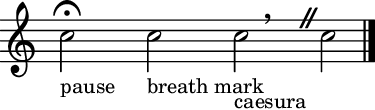
The pause 𝄐 (fermata) over a note, chord or rest holds it beyond its written length, at the performer's or conductor's discretion; over a barline it marks a silence of breath between sections. The breath mark, a comma above the stave, licenses a quick breath or a lift without disturbing the pulse more than necessary. The caesura, two oblique strokes through the top of the stave, cuts the sound dead for an unmeasured instant before continuing, the "railway lines" of orchestral slang.
13. Ornaments
Ornaments are the notation's shorthand for decorative figuration: small signs standing for stock melodic formulas that would be tedious to write out. Their realisations varied by century and nation, and the summaries here give modern default readings; in Baroque repertoire, the composer's own ornament table (Bach left one) or a stylistic edition outranks any general rule.

13.1 The trill
Marked tr (often with a wavy line showing extent) over a note: a rapid alternation of the written note with the note a step above, at the prevailing key signature unless a small accidental over the sign alters the upper note. Modern default begins on the written note; Baroque practice began on the upper note, and editors of 18th-century music still argue the cases. A trill commonly ends with a two-note turn into the following note.
13.2 The upper mordent
A short wavy sign over the note: a single rapid alternation, written note, note above, written note. Sometimes called simply the mordent, or a pralltriller in German sources.
13.3 The lower mordent
The same sign with a vertical stroke through it: written note, note below, written note. The terminology trap is real: some older British texts call this "the mordent" and the stroke-less sign "the inverted mordent", exactly reversing the modern labels. The signs are unambiguous; the words are not. When writing about ornaments, name the auxiliary note and no one is misled.
13.4 The turn
An S lying on its side over or after a note: a four-note figure around the written note, note above, written note, note below, written note. Placed directly over the note it replaces it; placed between two notes it is executed between them. The inverted turn (the sign with a stroke, or mirrored) runs the figure the other way, starting below.
13.5 The acciaccatura
A small note with a stroke through its stem and tail, printed before a main note: a crush note, struck as close to simultaneously with the beat as makes sense and released instantly, stealing no measurable time. The name is from the Italian for "to crush". In keyboard music before 1800 the same sign can carry other meanings; in modern notation the crush reading is safe.
13.6 The appoggiatura
A small note without a stroke, printed before a main note: a leaning note that takes real time from its host, conventionally half of an undotted note or two-thirds of a dotted one, then resolves. The appoggiatura carries expressive weight precisely because it displaces the harmony note on the beat. Classical-period editions rely on the convention; modern composers write the rhythm out in full-size notes instead, which is why the small-note appoggiatura is now mainly met in older repertoire.

13.7 The glissando and portamento
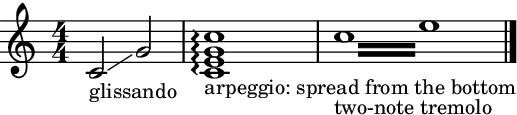
A straight or wavy line between two notes, often labelled gliss.: sweep through the intervening pitches. On piano and harp the sweep is over discrete notes; on trombone, strings and voice it is a continuous slide, for which the stricter term is portamento. Harp glissandi specify a pedal setting so the sweep sounds a chosen scale.
13.8 The tremolo
Slashes between two notes (or through a single note's stem, chapter 10.2): rapid alternation between the pair, or rapid repetition of the one, for the note's full written value. String sections live on the single-note form; the two-note form is a measured or unmeasured shake between chord notes.
13.9 The arpeggio sign
A vertical wavy line before a chord: spread the chord rapidly from the bottom, each note held as struck. An arrowhead reverses the direction. The spread starts on the beat in modern default; anticipating it, so the top note lands on the beat, is a legitimate stylistic choice in Romantic piano music.
13.10 Small-note runs
Groups of small notes before or between main notes, cadenza-style, are unmeasured decoration: fitted into the available time, gracefully, without disturbing the main rhythm more than the style permits. Chopin's fioriture are the textbook case.
14. Octave signs
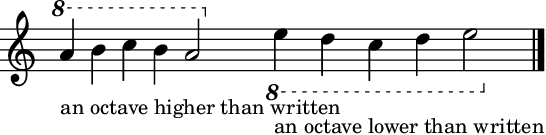
8va above the stave (ottava alta) moves everything under its dotted line an octave up; 8vb below the stave (ottava bassa) an octave down; 15ma and 15mb two octaves. The instruction ends where the dotted line ends, often confirmed by loco ("in place"). The signs exist to kill ledger lines: a right-hand passage five lines above the treble stave is unreadable at speed until 8va brings it home. They are notational only; nothing about the sound changes except what the notation says it should be.
15. Performance directions
15.1 Tempo words
Tempo is set by an Italian word at the top left, a metronome mark, or both. The standard ladder, slowest to fastest:
| Term | Meaning |
|---|---|
| grave | very slow, weighty |
| largo | broad |
| lento | slow |
| adagio | slow, at ease |
| andante | at a walking pace |
| moderato | moderate |
| allegretto | fairly quick |
| allegro | quick, lively |
| vivace | lively, brisk |
| presto | very fast |
| prestissimo | as fast as possible |
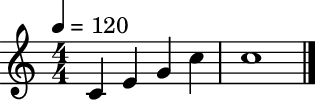
The words were never precise speeds; they are characters, which is why composers add the metronome mark, ♩ = 120, fixing the beat value and its rate per minute. A bracketed or "c." (circa) metronome mark admits the number is advisory.
15.2 Modifying and changing tempo
| Term | Meaning |
|---|---|
| molto / assai | very |
| poco / un poco | a little |
| più / meno mosso | more / less movement |
| rallentando (rall.) | gradually slowing |
| ritardando (rit.) | gradually slowing |
| ritenuto (riten.) | held back at once, not gradually |
| accelerando (accel.) | gradually speeding up |
| stringendo | pressing forward, tightening |
| allargando | broadening, slowing and swelling |
| rubato | flexible time, stolen and repaid |
| a tempo | resume the previous speed |
| Tempo I (primo) | resume the opening speed |
15.3 Character and expression words
The commonest of the Italian expression vocabulary met on modern scores:
| Term | Meaning |
|---|---|
| cantabile | in a singing style |
| dolce | sweetly |
| espressivo | expressively |
| grazioso | gracefully |
| giocoso | playfully |
| maestoso | majestically |
| agitato | agitated |
| tranquillo | calm |
| con moto | with movement |
| con brio | with vigour |
| con fuoco | with fire |
| sostenuto | sustained |
| leggiero | lightly |
| pesante | heavily |
| morendo | dying away |
| calando | dying away, slowing too |
| sempre | always (sempre legato: legato throughout) |
| subito | suddenly (subito p: suddenly quiet) |
| simile | continue in the same manner |
| attacca | go straight on to the next movement |
Composers also write directions in their own languages, German expression marks saturate Mahler, French ones Debussy, and modern scores freely use English. The Italian set remains the shared baseline every trained musician reads.
16. Instrument-specific notation
16.1 Keyboard
Piano music marks the sustaining pedal with Ped. and a release star, or with a bracketed line below the stave whose notches show changes; una corda and tre corde work the left pedal. Fingering is numbered 1 to 5 from the thumb. Hand distribution between staves is shown by beams crossing the staves, and m.d. / m.s. (mano destra, sinistra) or r.h. / l.h. assign passages to a hand.
16.2 Strings
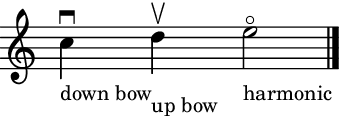
Bowing signs: a squared-off down-bow sign and a V-shaped up-bow sign; slurs bind notes into one bow. pizz. (pluck) holds until arco (bow) cancels it. A small circle over a note is a harmonic (natural harmonics at the marked node; artificial harmonics print a diamond notehead for the touching finger).
con sord. and senza sord. apply and remove the mute; sul ponticello and sul tasto move the bow to the bridge or the fingerboard; col legno strikes with the wood of the bow. Left-hand fingering is numbered 0 (open string) to 4, and Roman numerals or string names (sul G) choose the string.
16.3 Guitar and fretted instruments
Beyond tablature (chapter 2.6): chord symbols and fretboard grids above the stave; right-hand fingers lettered p, i, m, a (thumb, index, middle, ring); barré indications (C with a fret number); bends, hammer-ons, pull-offs and slides marked with arrows, slurs and the letters H, P and S in tab. Notated guitar sounds an octave lower than written, the octave treble clef convention.
16.4 Wind and brass
Tonguing is articulation: unslurred notes are tongued, slurred ones not, and double-tonguing passages are simply written fast and left to technique. Brass mutes come and go with con sord. / senza sord. or named mutes (straight, cup, harmon) in jazz scores. + and o over horn notes mark hand-stopped and open; the same pair marks closed and open hi-hat for drummers and muted and open plunger for jazz brass. Breath marks (chapter 12.3) matter structurally for wind players and singers.
16.5 Percussion and drum kit
Pitched percussion reads ordinary staves. Unpitched percussion reads the percussion clef with a legend (chapter 2.6); noteheads distinguish instruments where lines run short, an x head for cymbals and hi-hat, a circled x for open hi-hat, diamond heads for special strokes. Rolls use the tremolo slashes; sticking is lettered R and L. Kit parts combine two voices on one stave: cymbals and snare stems up, bass drum stems down, the chapter 1.3 device at its hardest working.
16.6 Voice
Vocal music aligns syllables under notes, hyphenating within words and drawing extender lines after a syllable that lasts through several notes; a slur over those notes marks the melisma. Verse numbers stack multiple verses under one melody. 8 below a treble clef marks the tenor octave (chapter 2.4). Sprechstimme, pitch-approximate speech-song, prints x noteheads or crossed stems, with the composer's front-matter note governing.
17. Quick reference
17.1 Note values and rests
| Value | Note | Rest | Crotchets |
|---|---|---|---|
| breve | 𝅜 | 𝄺 | 8 |
| semibreve | 𝅝 | 𝄻 | 4 |
| minim | 𝅗𝅥 | 𝄼 | 2 |
| crotchet | 𝅘𝅥 | 𝄽 | 1 |
| quaver | 𝅘𝅥𝅮 | 𝄾 | 1/2 |
| semiquaver | 𝅘𝅥𝅯 | 𝄿 | 1/4 |
| demisemiquaver | 𝅘𝅥𝅰 | 𝅀 | 1/8 |
| hemidemisemiquaver | 𝅘𝅥𝅱 | 𝅁 | 1/16 |
17.2 Clefs in use
| Clef | Fixes | Line | Users |
|---|---|---|---|
| treble 𝄞 | G4 | 2nd | violin, wind, right hand, voices |
| octave treble | G3 | 2nd | tenor voice, guitar |
| alto 𝄡 | C4 | 3rd | viola |
| tenor 𝄡 | C4 | 4th | cello, bassoon, trombone (high) |
| bass 𝄢 | F3 | 4th | cello, bass, left hand, low brass |
| percussion | nothing | unpitched percussion |
17.3 The ornaments at a glance
| Sign | Ornament | Realisation |
|---|---|---|
| tr | trill | rapid alternation with the note above |
| wavy sign | upper mordent | note, note above, note |
| wavy sign with stroke | lower mordent | note, note below, note |
| sideways S | turn | above, note, below, note |
| small note, stroked stem | acciaccatura | crushed in, no measurable time |
| small note, plain | appoggiatura | leans on the beat, takes half its host |
| wavy vertical line | arpeggio | spread the chord from the bottom |
| slashes | tremolo | rapid repetition or alternation |
| straight line between notes | glissando | sweep through the pitches between |
17.4 Navigation in one table
| Mark | Action |
|---|---|
| 𝄆 𝄇 | repeat the enclosed passage |
| volta 1, 2 | different endings per pass |
| D.C. al Fine | top, then stop at Fine |
| D.C. al Coda | top, then jump 𝄌 at 'to Coda' |
| D.S. al Fine | back to 𝄋, stop at Fine |
| D.S. al Coda | back to 𝄋, jump at 'to Coda' |
| 𝄎 | repeat previous bar |
18. Exercises
Answers follow at the end.
- Name the three clef shapes and the note each one fixes.
- Which two C clefs remain in daily use, and which instruments read them?
- How many demisemiquavers fill a dotted crotchet?
- What is the difference between a tie and a slur, in symbol and in meaning?
- A completely silent bar of 3/4 takes which rest, and why that one?
- Write the order of sharps as they enter a key signature. What is the order of flats?
- 6/8 and 3/4 both contain six quavers. How do they differ, and how does beaming show it?
- What does the C-shaped time signature mean, and what is its origin?
- Distinguish the acciaccatura from the appoggiatura in notation and in performance.
- A passage is marked D.S. al Coda. Describe the route the player takes.
- What do sfz, fp and rfz each ask for?
- On a drum kit stave, how are the drummer's two "voices" separated, and which way do the bass drum's stems point?
Answers
- The G clef 𝄞 fixes G4, the C clef 𝄡 fixes middle C (C4), and the F clef 𝄢 fixes F3. Each takes its meaning from the line its centre sits on.
- The alto clef (C on the third line), read by the viola; and the tenor clef (C on the fourth line), read by cello, bassoon and trombone in their upper registers.
- Twelve. A crotchet is eight demisemiquavers, and the dot adds half the note's value again, four more, twelve in all. Equivalently: three quavers, each of four demisemiquavers.
- A tie joins two noteheads of the same pitch and welds them into one unstruck continuation; a slur arches over different pitches and asks for smooth connection. The curve looks the same; the pitches beneath it settle which is which.
- The semibreve rest, hanging under the fourth line. By convention it means "whole bar of silence" in any metre, even where a sounding semibreve would not fit.
- Sharps: F, C, G, D, A, E, B, rising in fifths. Flats: B, E, A, D, G, C, F, the same series reversed.
- 3/4 is simple triple: three crotchet beats, each dividing in two, quavers beamed 2+2+2. 6/8 is compound duple: two dotted-crotchet beats, each dividing in three, quavers beamed 3+3.
- 𝄴 means 4/4, and is read "common time"; the symbol is the medieval half-circle that marked duple proportion, not the letter C.
- The acciaccatura is a small note with a stroke through its stem: crushed against the main note, taking no measurable time. The appoggiatura is a small note without the stroke: it takes real time on the beat, conventionally half of an undotted host note, and resolves.
- Play from the top; on reaching the D.S. al Coda instruction, return to the segno 𝄋; play on to the 'to Coda' mark 𝄌; jump to the coda section and play it to the end. Internal repeats are not retaken unless marked.
- sfz (sforzando): a sudden strong accent on that note or chord. fp (fortepiano): a loud attack collapsing at once to quiet. rfz (rinforzando): a reinforced, heavier stress spread over a note or short group.
- By stem direction, the chapter 1.3 two-voice device: cymbals and snare take stems up as the upper voice, bass drum (and hi-hat foot) stems down as the lower. The bass drum's stems point down.