Building them, playing them, and working out what they are
Every chord type a pianist meets, from the plain triad to the altered thirteenth: how it is built, where it sits under the hand, how it is written, and a reliable method for identifying any chord from a stave, a keyboard, a symbol or the sound alone.
Introduction
Sit at a piano, press three keys together, and you have played a chord. Perhaps it sounded sweet; perhaps it clashed. Either way it has a name, and that name tells any musician who reads it exactly which notes you chose. This guide is about those names: what they mean, how the chords behind them are built, and how to go the other way, from a handful of notes back to the name.
Chords matter more at the piano than on almost any other instrument. A violinist or a singer carries one line at a time; a pianist is handed the whole harmony at once. Sheet music, lead sheets and song books all assume you can turn a symbol such as Fm7 or G7sus4 into keys under your fingers without stopping to work it out. That skill is not a gift. It is a system, and the system is small enough to learn: a dozen interval sizes, a few families of shapes, and a naming convention that is more regular than it first appears.
The guide makes three promises. First, every chord type you will meet on printed music is here, from the plain major triad to the altered thirteenth, each with its notes, its keyboard picture and its symbol. Second, nothing is left as a bare list to memorise: each new chord is shown as a small change to one you already know, because that is how pianists actually hold them in mind. Third, chapter 11 gives you a method that works on any chord at all, including ones this guide never shows you, whether it arrives as a symbol, on a stave, under someone's fingers or as a sound.
You do not need to read the chapters in order, and you do not need much theory to start. If you can find middle C and count up the keys one at a time, chapter 1 will carry you from there. Readers who already know their triads can go straight to the seventh chords in chapter 4, and anyone with a mystery chord in front of them right now should turn directly to chapter 11.
Take the chords to an instrument as you read. A chord on the page is a diagram; a chord under the fingers is a sound with a character you will recognise the next time you meet it. That recognition, more than any table in this guide, is what fluent chord playing is made of.
How to use this guide
The guide runs from the simplest chord to the most involved, and each chapter follows the same shape: what the chord is made of, what it looks like on the keys, what it is called, and where it turns up. Chapters 1 to 8 build the vocabulary. Chapter 9 covers chord symbols. Chapter 10 puts chords into keys. Chapter 11 is the identification method, and it is the chapter to come back to. Chapter 12 covers playing chords rather than spelling them. Chapters 13 to 15 are practice and reference.
If you only want to look something up, go to chapter 14. If you have a chord in front of you and no idea what it is, go to chapter 11.
Companion documents cover neighbouring ground. Technical Names and Roman Numerals gives every scale degree and chord in all 30 keys. Musical Harmony covers the acoustics and the voice leading. Roman Numeral Analysis covers analysing a passage rather than naming a single chord.
Reading the keyboard pictures
Chords are drawn on a plain keyboard map. The upper pair of rows is the black keys, the lower pair the white keys, and the columns line up:
  black keys     C#  D#      F#  G#  A#
                 .   .       .   .   .
  white keys   C   D   E   F   G   A   B   C
               R   .   3   .   5   .   .   .
A full stop means the key is not held. A label means it is, and the label says which part of the chord it is: R for the root, 3 for the 3rd, 5 for the 5th, 7 for the 7th, and so on up through 9, 11 and 13. A b or # in front of the number means that note is flattened or sharpened, so b7 is a flattened 7th and #11 a sharpened 11th.
Black keys are labelled with their sharp name to keep the picture narrow, so the key marked C# is the same key as D♭. The properly spelled notes are always printed beside the picture, and those are the spellings to write down. The picture tells you which keys to press; the note list tells you how to notate them.
Where a chord runs past an octave the picture simply widens to two octaves.
A note on terms and notation
Naming follows British convention throughout: stave rather than the American word, bar rather than the American word, tone and semitone for the two step sizes, leading note for the seventh degree, and semibreve, minim, crotchet, quaver for the note lengths. Cadences are perfect, imperfect, plagal and interrupted. Where a note is raised or lowered it is sharpened or flattened.
Accidentals use the printed symbols ♯, ♭, ♮, 𝄪 and ♭♭. Chord symbols are the ones printed on British sheet music. Roman numeral figures that are stacked vertically in a score appear on one line here, so a first inversion dominant seventh is written V6/5.
Notes of a chord are separated by commas: C, E, G. Chord progressions are joined with hyphens: ii-V-I.
The diagrams are written in Mermaid. In the Word version they are pictures. In the markdown version the diagram source sits in a fenced block, which most markdown viewers render on sight.
1. What a chord is
1.1 Chords and intervals
A chord is three or more notes sounding together. Two notes together make an interval, not a chord, though pianists play plenty of two-note shapes and chapter 8 covers them.
An interval is measured two ways at once, and both matter. The number counts letter names inclusively, so C up to E is a 3rd because C, D, E is three letters. The quality counts semitones, so C up to E is a major 3rd at four semitones, while C up to E♭ is a minor 3rd at three. At the keyboard the number tells you which letter to write and the quality tells you which key to press.
1.2 Why chords are built in thirds
Stack thirds on top of one another and you get the whole standard chord vocabulary. Each new third adds one more note and one more name:
%%{init: {'theme':'neutral'}}%%
flowchart LR
  R["root<br/>C"] --> T3["add a 3rd<br/>C, E<br/>an interval"] --> T5["add a 3rd<br/>C, E, G<br/>a triad"] --> T7["add a 3rd<br/>C, E, G, B♭<br/>a 7th chord"] --> T9["add a 3rd<br/>plus D<br/>a 9th chord"] --> T11["add a 3rd<br/>plus F<br/>an 11th chord"] --> T13["add a 3rd<br/>plus A<br/>a 13th chord"]
  classDef core fill:#dce8f5,stroke:#3b5f8a,stroke-width:2px
  class T5,T7 core
Add one more third above the 13th and you are back on the root, so the 13th chord is the largest chord that can be built this way. Every chord in chapters 2 to 7 is either one of these stacks, or one of these stacks with a note swapped, added or altered.
Building in thirds is not a law of nature. It is a habit of European music from roughly 1600 onwards, and chapter 8 covers the shapes that break it.
1.3 Naming the notes of a chord
Each note of a chord is named by the interval it makes with the root, and the name sticks to that note no matter where it ends up in the texture. In C major the E is the 3rd whether it is played above the C, below it, or three octaves away.
Numbers above 7 mean the same letter as the number less seven, but the larger number implies the chord also contains the notes below it. A 9th is the same letter as a 2nd; writing 9 rather than 2 says that a 7th is present as well. That is the difference between Cadd9 and C9: the first has no 7th, the second does.
1.4 The intervals, counted in semitones
Identification comes down to counting semitones and reading off the name. Two intervals can share a semitone count and still have different names, because the letter they are spelled with differs. The pairs to know are the augmented 4th against the diminished 5th, both six semitones, and the augmented 5th against the minor 6th, both eight.
| Semitones above the root | Interval | Example from C |
|---|---|---|
| 1 | minor 2nd | C to D♭ |
| 2 | major 2nd | C to D |
| 3 | augmented 2nd | C to D♯ |
| 3 | minor 3rd | C to E♭ |
| 4 | major 3rd | C to E |
| 5 | perfect 4th | C to F |
| 6 | augmented 4th | C to F♯ |
| 6 | diminished 5th | C to G♭ |
| 7 | perfect 5th | C to G |
| 8 | augmented 5th | C to G♯ |
| 8 | minor 6th | C to A♭ |
| 9 | major 6th | C to A |
| 9 | diminished 7th | C to B♭♭ |
| 10 | minor 7th | C to B♭ |
| 11 | major 7th | C to B |
| 13 | minor 9th | C to D♭ |
| 14 | major 9th | C to D |
| 15 | augmented 9th | C to D♯ |
| 17 | perfect 11th | C to F |
| 18 | augmented 11th | C to F♯ |
| 20 | minor 13th | C to A♭ |
| 21 | major 13th | C to A |
At the keyboard, count the semitones by counting keys, black and white alike. From C to G is seven keys upward not counting C itself, which is a perfect 5th.
2. The four triads
2.1 The four qualities
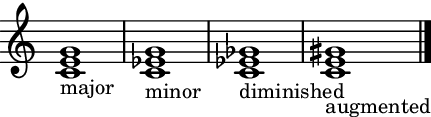
A triad is a root with a 3rd and a 5th above it. The quality of those two intervals gives four possible triads, and every one of them turns up constantly.
| Chord | Symbol on C | Built from the root | Notes on C |
|---|---|---|---|
| major | C | root, major 3rd, perfect 5th | C, E, G |
| minor | Cm | root, minor 3rd, perfect 5th | C, E♭, G |
| diminished | Cdim | root, minor 3rd, diminished 5th | C, E♭, G♭ |
| augmented | Caug | root, major 3rd, augmented 5th | C, E, G♯ |
The two intervals stacked as thirds tell the story. A major triad is a major 3rd with a minor 3rd on top. A minor triad is the reverse. A diminished triad is two minor thirds, and an augmented triad two major thirds.
2.2 The shapes under the hand
C major (C, E, G)
  black keys     C#  D#      F#  G#  A#
                 .   .       .   .   .
  white keys   C   D   E   F   G   A   B   C
               R   .   3   .   5   .   .   .
C minor (C, E♭, G)
  black keys     C#  D#      F#  G#  A#
                 .   b3      .   .   .
  white keys   C   D   E   F   G   A   B   C
               R   .   .   .   5   .   .   .
C diminished (C, E♭, G♭)
  black keys     C#  D#      F#  G#  A#
                 .   b3      b5  .   .
  white keys   C   D   E   F   G   A   B   C
               R   .   .   .   .   .   .   .
C augmented (C, E, G♯)
  black keys     C#  D#      F#  G#  A#
                 .   .       .   #5  .
  white keys   C   D   E   F   G   A   B   C
               R   .   3   .   .   .   .   .
Learn these four as distances rather than as note names, because the distances never change. Counting semitones from the bottom key upward:
- Major: 4 then 3.
- Minor: 3 then 4.
- Diminished: 3 then 3.
- Augmented: 4 then 4.
That is the entire content of the four triads. A pianist who knows those four numbers can build any triad on any key without knowing the key signature.
2.3 Moving a shape to another root
Because the shape is a pattern of distances, it transposes by sliding. The hand keeps its span and the fingers land on whatever keys fall at the right distances, which is why chords rooted on black keys feel different but are built identically.
F♯ major, every note on a black key (F♯, A♯, C♯)
  black keys     C#  D#      F#  G#  A#      C#  D#      F#  G#  A#
                 .   .       R   .   3       5   .       .   .   .
  white keys   C   D   E   F   G   A   B   C   D   E   F   G   A   B   C
               .   .   .   .   .   .   .   .   .   .   .   .   .   .   .
E♭ minor, every note on a black key (E♭, G♭, B♭)
  black keys     C#  D#      F#  G#  A#
                 .   R       b3  .   5
  white keys   C   D   E   F   G   A   B   C
               .   .   .   .   .   .   .   .
D♭ major, the shape moved up one semitone from C (D♭, F, A♭)
  black keys     C#  D#      F#  G#  A#
                 R   .       .   5   .
  white keys   C   D   E   F   G   A   B   C
               .   .   .   3   .   .   .   .
The written spelling still has to follow the letter rule. F♯ major is F♯, A♯, C♯, and never F♯, B♭, D♭, even though those are the same three keys. A triad written on a stave always uses three alternate letters, so its notes sit either all on lines or all in spaces.
2.4 Every triad on every root
| Root | major | m | dim | aug |
|---|---|---|---|---|
| C | C, E, G | C, E♭, G | C, E♭, G♭ | C, E, G♯ |
| D♭ | D♭, F, A♭ | D♭, F♭, A♭ | D♭, F♭, A♭♭ | D♭, F, A |
| D | D, F♯, A | D, F, A | D, F, A♭ | D, F♯, A♯ |
| E♭ | E♭, G, B♭ | E♭, G♭, B♭ | E♭, G♭, B♭♭ | E♭, G, B |
| E | E, G♯, B | E, G, B | E, G, B♭ | E, G♯, B♯ |
| F | F, A, C | F, A♭, C | F, A♭, C♭ | F, A, C♯ |
| F♯ | F♯, A♯, C♯ | F♯, A, C♯ | F♯, A, C | F♯, A♯, C𝄪 |
| G | G, B, D | G, B♭, D | G, B♭, D♭ | G, B, D♯ |
| A♭ | A♭, C, E♭ | A♭, C♭, E♭ | A♭, C♭, E♭♭ | A♭, C, E |
| A | A, C♯, E | A, C, E | A, C, E♭ | A, C♯, E♯ |
| B♭ | B♭, D, F | B♭, D♭, F | B♭, D♭, F♭ | B♭, D, F♯ |
| B | B, D♯, F♯ | B, D, F♯ | B, D, F | B, D♯, F𝄪 |
Notice the double flats in a few of the diminished triads. D♭dim is D♭, F♭, A♭♭, which is correct spelling and horrible reading. In practice a chord that would need double flats is nearly always written from its enharmonic root instead, so a player meets C♯dim rather than D♭dim.
2.5 The augmented triad divides the octave evenly
An augmented triad is two major thirds stacked, and three major thirds make an octave exactly. That means the shape repeats when inverted, so one set of keys carries three names, and nothing in the sound alone tells you which is the root.
| The same three keys, named three ways | Notes of the first spelling |
|---|---|
| Caug, Eaug, A♭aug | C, E, G♯ |
| D♭aug, Faug, Aaug | D♭, F, A |
| Daug, F♯aug, B♭aug | D, F♯, A♯ |
| E♭aug, Gaug, Baug | E♭, G, B |
There are only four different augmented triads in all. The same evenness makes the augmented triad useful as a pivot between distant keys, and makes it impossible to name from the sound in isolation. Only the context, or the way it is written, decides which note is the root.
3. Inversions
3.1 What an inversion is
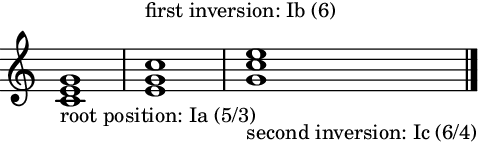
A chord keeps its name whichever of its notes is at the bottom. Moving the lowest note up an octave produces an inversion: the same notes, a different arrangement, the same chord.
C major, root position, C at the bottom (C, E, G)
  black keys     C#  D#      F#  G#  A#
                 .   .       .   .   .
  white keys   C   D   E   F   G   A   B   C
               R   .   3   .   5   .   .   .
C major, first inversion, E at the bottom (C, E, G)
  black keys     C#  D#      F#  G#  A#      C#  D#      F#  G#  A#
                 .   .       .   .   .       .   .       .   .   .
  white keys   C   D   E   F   G   A   B   C   D   E   F   G   A   B   C
               .   .   3   .   5   .   .   R   .   .   .   .   .   .   .
C major, second inversion, G at the bottom (C, E, G)
  black keys     C#  D#      F#  G#  A#      C#  D#      F#  G#  A#
                 .   .       .   .   .       .   .       .   .   .
  white keys   C   D   E   F   G   A   B   C   D   E   F   G   A   B   C
               .   .   .   .   5   .   .   R   .   3   .   .   .   .   .
%%{init: {'theme':'neutral'}}%%
flowchart LR
  RP["Root position<br/>C, E, G<br/>root at the bottom"] -- "move the C up an octave" --> FI["First inversion<br/>E, G, C<br/>3rd at the bottom"] -- "move the E up an octave" --> SI["Second inversion<br/>G, C, E<br/>5th at the bottom"] -- "move the G up an octave" --> RP2["Root position again<br/>an octave higher"]
  classDef home fill:#dce8f5,stroke:#3b5f8a,stroke-width:2px
  class RP,RP2 home
A triad has three notes and therefore three positions: root position and two inversions. A seventh chord has four notes and three inversions.
3.2 Writing inversions down
Two systems are in use, and both appear on British sheet music.
| Position | Lowest note | Figured bass | Written as | ABRSM letter |
|---|---|---|---|---|
| Root position | root | 5/3 | I | Ia |
| First inversion | 3rd | 6/3 | I6 | Ib |
| Second inversion | 5th | 6/4 | I6/4 | Ic |
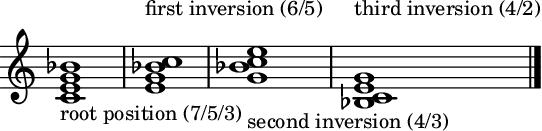
For a seventh chord:
| Position | Lowest note | Figured bass | Written as | ABRSM letter |
|---|---|---|---|---|
| Root position | root | 7/5/3 | V7 | V7a |
| First inversion | 3rd | 6/5/3 | V6/5 | V7b |
| Second inversion | 5th | 6/4/3 | V4/3 | V7c |
| Third inversion | 7th | 6/4/2 | V4/2 | V7d |
Chord symbols handle the same thing with a slash. C/E means a C chord with E in the bass, which is C major in first inversion. Chapter 8.1 covers the case where the bass note is not part of the chord at all.
3.3 The interval fingerprint
This is the single most useful identification trick for written music, because it works without moving any notes about. Measure from the lowest note up to each of the others, and the pattern names the position:
| Intervals above the lowest note | Position | Where the root is |
|---|---|---|
| a 3rd and a 5th | root position | the lowest note |
| a 3rd and a 6th | first inversion | the top note |
| a 4th and a 6th | second inversion | the middle note |
The rule behind it: the root is the note directly above the interval of a 4th, if there is one. In first inversion E, G, C the 4th is G to C, so C is the root. In second inversion G, C, E the 4th is G to C, so again C. In root position there is no 4th at all.
For seventh chords the same idea works with a 2nd standing in for the 4th, because the 7th and the root sit next to each other. Find the two notes a 2nd apart and the upper one is the root.
3.4 Why inversions matter at the piano
Three practical reasons, and they are the reason inversions get practised rather than merely understood.
The first is hand economy. Playing C major then F major in root position throws the hand across the keyboard. Playing C major then F major in second inversion, C, F, A, moves two fingers and keeps one still.
The second is the bass line. The lowest note is the one the ear tracks. Choosing an inversion is choosing a bass note, which is how a pianist writes a smooth bass under a fixed sequence of chords.
The third is weight. Root position sounds settled and final. First inversion sounds lighter and keeps the music moving. Second inversion is the least stable of the three, which is why it is nearly always passing through rather than arriving.
4. Seventh chords
4.1 The qualities
Add a third above the 5th and the chord gains a 7th. The quality of the triad underneath and the quality of the 7th on top combine to give the family below.
| Chord | Symbol on C | Built from the root | Notes on C |
|---|---|---|---|
| dominant 7th | C7 | root, major 3rd, perfect 5th, minor 7th | C, E, G, B♭ |
| major 7th | Cmaj7 | root, major 3rd, perfect 5th, major 7th | C, E, G, B |
| minor 7th | Cm7 | root, minor 3rd, perfect 5th, minor 7th | C, E♭, G, B♭ |
| half-diminished 7th | Cm7♭5 | root, minor 3rd, diminished 5th, minor 7th | C, E♭, G♭, B♭ |
| diminished 7th | Cdim7 | root, minor 3rd, diminished 5th, diminished 7th | C, E♭, G♭, B♭♭ |
| minor-major 7th | Cm(maj7) | root, minor 3rd, perfect 5th, major 7th | C, E♭, G, B |
| augmented 7th | Caug7 | root, major 3rd, augmented 5th, minor 7th | C, E, G♯, B♭ |
| augmented major 7th | Cmaj7♯5 | root, major 3rd, augmented 5th, major 7th | C, E, G♯, B |
| dominant 7th suspended 4th | C7sus4 | root, perfect 4th, perfect 5th, minor 7th | C, F, G, B♭ |
Only three of these are common enough to be reflexes. The dominant 7th is a major triad with a minor 7th, and it is the engine of tonal music. The major 7th is a major triad with a major 7th, and sounds soft and unhurried. The minor 7th is a minor triad with a minor 7th, and is the ordinary minor chord of popular music.
The half-diminished 7th is a diminished triad with a minor 7th. Its usual British symbol is m7♭5, which describes it exactly: a minor 7th chord with the 5th flattened.

4.2 The shapes
C7, the dominant 7th (C, E, G, B♭)
  black keys     C#  D#      F#  G#  A#
                 .   .       .   .   b7
  white keys   C   D   E   F   G   A   B   C
               R   .   3   .   5   .   .   .
Cmaj7, the major 7th (C, E, G, B)
  black keys     C#  D#      F#  G#  A#
                 .   .       .   .   .
  white keys   C   D   E   F   G   A   B   C
               R   .   3   .   5   .   7   .
Cm7, the minor 7th (C, E♭, G, B♭)
  black keys     C#  D#      F#  G#  A#
                 .   b3      .   .   b7
  white keys   C   D   E   F   G   A   B   C
               R   .   .   .   5   .   .   .
Cm7♭5, the half-diminished 7th (C, E♭, G♭, B♭)
  black keys     C#  D#      F#  G#  A#
                 .   b3      b5  .   b7
  white keys   C   D   E   F   G   A   B   C
               R   .   .   .   .   .   .   .
Cdim7, the diminished 7th (C, E♭, G♭, B♭♭)
  black keys     C#  D#      F#  G#  A#
                 .   b3      b5  .   .
  white keys   C   D   E   F   G   A   B   C
               R   .   .   .   .   bb7 .   .
The gap between the 5th and the 7th is what your ear should latch onto. A minor 7th sits three semitones above the 5th, a major 7th four, and the diminished 7th only two, which is why a diminished 7th chord sounds so tightly packed.
4.3 Inversions of a seventh chord
C7, root position (C, E, G, B♭)
  black keys     C#  D#      F#  G#  A#
                 .   .       .   .   b7
  white keys   C   D   E   F   G   A   B   C
               R   .   3   .   5   .   .   .
C7, first inversion, the 3rd at the bottom (C, E, G, B♭)
  black keys     C#  D#      F#  G#  A#      C#  D#      F#  G#  A#
                 .   .       .   .   b7      .   .       .   .   .
  white keys   C   D   E   F   G   A   B   C   D   E   F   G   A   B   C
               .   .   3   .   5   .   .   R   .   .   .   .   .   .   .
C7, second inversion, the 5th at the bottom (C, E, G, B♭)
  black keys     C#  D#      F#  G#  A#      C#  D#      F#  G#  A#
                 .   .       .   .   b7      .   .       .   .   .
  white keys   C   D   E   F   G   A   B   C   D   E   F   G   A   B   C
               .   .   .   .   5   .   .   R   .   3   .   .   .   .   .
C7, third inversion, the 7th at the bottom (C, E, G, B♭)
  black keys     C#  D#      F#  G#  A#      C#  D#      F#  G#  A#
                 .   .       .   .   b7      .   .       .   .   .
  white keys   C   D   E   F   G   A   B   C   D   E   F   G   A   B   C
               .   .   .   .   .   .   .   R   .   3   .   5   .   .   .
Third inversion is worth singling out. It puts the 7th in the bass, and the 7th is a dissonance that has to fall by step, so a chord in third inversion always leads somewhere specific. In C major, G7 in third inversion has F at the bottom, and that F falls to E, which means the next chord is nearly always C major in first inversion.
4.4 Every seventh chord on every root
| Root | 7 | maj7 | m7 | m7♭5 | dim7 |
|---|---|---|---|---|---|
| C | C, E, G, B♭ | C, E, G, B | C, E♭, G, B♭ | C, E♭, G♭, B♭ | C, E♭, G♭, B♭♭ |
| D♭ | D♭, F, A♭, C♭ | D♭, F, A♭, C | D♭, F♭, A♭, C♭ | D♭, F♭, A♭♭, C♭ | D♭, F♭, A♭♭, C♭♭ |
| D | D, F♯, A, C | D, F♯, A, C♯ | D, F, A, C | D, F, A♭, C | D, F, A♭, C♭ |
| E♭ | E♭, G, B♭, D♭ | E♭, G, B♭, D | E♭, G♭, B♭, D♭ | E♭, G♭, B♭♭, D♭ | E♭, G♭, B♭♭, D♭♭ |
| E | E, G♯, B, D | E, G♯, B, D♯ | E, G, B, D | E, G, B♭, D | E, G, B♭, D♭ |
| F | F, A, C, E♭ | F, A, C, E | F, A♭, C, E♭ | F, A♭, C♭, E♭ | F, A♭, C♭, E♭♭ |
| F♯ | F♯, A♯, C♯, E | F♯, A♯, C♯, E♯ | F♯, A, C♯, E | F♯, A, C, E | F♯, A, C, E♭ |
| G | G, B, D, F | G, B, D, F♯ | G, B♭, D, F | G, B♭, D♭, F | G, B♭, D♭, F♭ |
| A♭ | A♭, C, E♭, G♭ | A♭, C, E♭, G | A♭, C♭, E♭, G♭ | A♭, C♭, E♭♭, G♭ | A♭, C♭, E♭♭, G♭♭ |
| A | A, C♯, E, G | A, C♯, E, G♯ | A, C, E, G | A, C, E♭, G | A, C, E♭, G♭ |
| B♭ | B♭, D, F, A♭ | B♭, D, F, A | B♭, D♭, F, A♭ | B♭, D♭, F♭, A♭ | B♭, D♭, F♭, A♭♭ |
| B | B, D♯, F♯, A | B, D♯, F♯, A♯ | B, D, F♯, A | B, D, F, A | B, D, F, A♭ |
4.5 The diminished seventh and its several names
A diminished 7th is three minor thirds stacked, and four minor thirds make an octave, so this chord divides the octave evenly just as the augmented triad does. Invert it and the shape is unchanged, which means one set of four keys carries four different names.
| The same four keys, named several ways | Notes of the first spelling |
|---|---|
| Cdim7, E♭dim7, F♯dim7, Adim7, D♯dim7, G♭dim7 | C, E♭, G♭, B♭♭ |
| C♯dim7, Edim7, Gdim7, B♭dim7, D♭dim7, A♯dim7 | C♯, E, G, B♭ |
| Ddim7, Fdim7, A♭dim7, Bdim7, G♯dim7 | D, F, A♭, C♭ |
There are only three different diminished 7th chords in all twelve keys. This is the chord that most often defeats identification by ear, because the sound genuinely does not tell you which note is the root. What decides it is the spelling on the page and where the chord goes next: the root is the note a semitone below the chord that follows.
The evenness is also why the diminished 7th was the standard nineteenth-century pivot for a sudden change of key. One shape, four possible resolutions.
5. Sixths, suspensions and added notes
5.1 The chords
These three families all modify a triad rather than extending it.
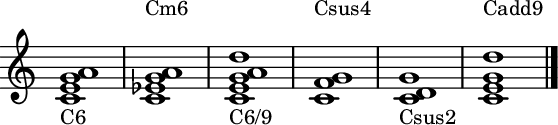
A sixth chord adds a major 6th above the root. The result has four notes and no 7th.
| Chord | Symbol on C | Built from the root | Notes on C |
|---|---|---|---|
| major 6th | C6 | root, major 3rd, perfect 5th, major 6th | C, E, G, A |
| minor 6th | Cm6 | root, minor 3rd, perfect 5th, major 6th | C, E♭, G, A |
| six-nine | C6/9 | root, major 3rd, perfect 5th, major 6th, major 9th | C, E, G, A, D |
A suspended chord replaces the 3rd, either with the 4th above the root or with the 2nd. Because the 3rd is the note that makes a chord major or minor, a suspended chord is neither.
| Chord | Symbol on C | Built from the root | Notes on C |
|---|---|---|---|
| suspended 4th | Csus4 | root, perfect 4th, perfect 5th | C, F, G |
| suspended 2nd | Csus2 | root, major 2nd, perfect 5th | C, D, G |
| fifth (open fifth) | C5 | root, perfect 5th | C, G |
An added note chord keeps the 3rd and adds another note on top.
| Chord | Symbol on C | Built from the root | Notes on C |
|---|---|---|---|
| added 9th | Cadd9 | root, major 3rd, perfect 5th, major 9th | C, E, G, D |
| minor added 9th | Cm(add9) | root, minor 3rd, perfect 5th, major 9th | C, E♭, G, D |
| added 4th | Cadd4 | root, major 3rd, perfect 4th, perfect 5th | C, E, F, G |
5.2 The shapes
Csus4 (C, F, G)
  black keys     C#  D#      F#  G#  A#
                 .   .       .   .   .
  white keys   C   D   E   F   G   A   B   C
               R   .   .   4   5   .   .   .
Csus2 (C, D, G)
  black keys     C#  D#      F#  G#  A#
                 .   .       .   .   .
  white keys   C   D   E   F   G   A   B   C
               R   2   .   .   5   .   .   .
C6 (C, E, G, A)
  black keys     C#  D#      F#  G#  A#
                 .   .       .   .   .
  white keys   C   D   E   F   G   A   B   C
               R   .   3   .   5   6   .   .
Cadd9 (C, E, G, D)
  black keys     C#  D#      F#  G#  A#      C#  D#      F#  G#  A#
                 .   .       .   .   .       .   .       .   .   .
  white keys   C   D   E   F   G   A   B   C   D   E   F   G   A   B   C
               R   .   3   .   5   .   .   .   9   .   .   .   .   .   .
5.3 Every one of them on every root
| Root | 6 | m6 | sus4 | sus2 | 5 |
|---|---|---|---|---|---|
| C | C, E, G, A | C, E♭, G, A | C, F, G | C, D, G | C, G |
| D♭ | D♭, F, A♭, B♭ | D♭, F♭, A♭, B♭ | D♭, G♭, A♭ | D♭, E♭, A♭ | D♭, A♭ |
| D | D, F♯, A, B | D, F, A, B | D, G, A | D, E, A | D, A |
| E♭ | E♭, G, B♭, C | E♭, G♭, B♭, C | E♭, A♭, B♭ | E♭, F, B♭ | E♭, B♭ |
| E | E, G♯, B, C♯ | E, G, B, C♯ | E, A, B | E, F♯, B | E, B |
| F | F, A, C, D | F, A♭, C, D | F, B♭, C | F, G, C | F, C |
| F♯ | F♯, A♯, C♯, D♯ | F♯, A, C♯, D♯ | F♯, B, C♯ | F♯, G♯, C♯ | F♯, C♯ |
| G | G, B, D, E | G, B♭, D, E | G, C, D | G, A, D | G, D |
| A♭ | A♭, C, E♭, F | A♭, C♭, E♭, F | A♭, D♭, E♭ | A♭, B♭, E♭ | A♭, E♭ |
| A | A, C♯, E, F♯ | A, C, E, F♯ | A, D, E | A, B, E | A, E |
| B♭ | B♭, D, F, G | B♭, D♭, F, G | B♭, E♭, F | B♭, C, F | B♭, F |
| B | B, D♯, F♯, G♯ | B, D, F♯, G♯ | B, E, F♯ | B, C♯, F♯ | B, F♯ |
5.4 Suspension against added note
The distinction is about what the note does next, not what it sounds like on its own.
A true suspension is a note held over from the previous chord, sounding against the new one, then falling by step to the note it displaced. Csus4 resolving to C major is F falling to E. The tension and the release are the point.
%%{init: {'theme':'neutral'}}%%
flowchart LR
  P["preparation<br/>the F is consonant<br/>in the previous chord"] --> S["suspension<br/>Csus4<br/>C, F, G<br/>the F is now a dissonance"] --> R["resolution<br/>C major<br/>C, E, G<br/>the F falls to E"]
  classDef tension fill:#f5ecdc,stroke:#8a6a3b,stroke-width:2px
  classDef rest fill:#dce8f5,stroke:#3b5f8a,stroke-width:2px
  class S tension
  class R rest
An added note does not resolve. Cadd9 is a colour, complete in itself, and can be the last chord of a piece. Much popular and film music uses sus chords the same way, leaving them hanging without resolution, which is a real usage rather than a mistake, but it is worth knowing what the name originally described.
A 6th chord and a minor 7th chord contain the same four notes. C6 is C, E, G, A, and Am7 is A, C, E, G. Which name is right depends on which note the music treats as the root, and the bass usually decides it.
6. Extended chords
6.1 The 9th, 11th and 13th
An extended chord is a seventh chord with more thirds piled on. The name says how far the stack goes, and implies everything below it.
| Chord | Symbol on C | Built from the root | Notes on C | Points to watch |
|---|---|---|---|---|
| dominant 9th | C9 | root, major 3rd, perfect 5th, minor 7th, major 9th | C, E, G, B♭, D | |
| major 9th | Cmaj9 | root, major 3rd, perfect 5th, major 7th, major 9th | C, E, G, B, D | |
| minor 9th | Cm9 | root, minor 3rd, perfect 5th, minor 7th, major 9th | C, E♭, G, B♭, D | |
| dominant 11th | C11 | root, perfect 5th, minor 7th, major 9th, perfect 11th | C, G, B♭, D, F | the 3rd is normally left out, because it clashes with the 11th |
| minor 11th | Cm11 | root, minor 3rd, perfect 5th, minor 7th, major 9th, perfect 11th | C, E♭, G, B♭, D, F | |
| dominant 13th | C13 | root, major 3rd, minor 7th, major 9th, major 13th | C, E, B♭, D, A | the 5th and 11th are normally left out |
| major 13th | Cmaj13 | root, major 3rd, major 7th, major 9th, major 13th | C, E, B, D, A | |
| minor 13th | Cm13 | root, minor 3rd, minor 7th, major 9th, major 13th | C, E♭, B♭, D, A |
Names get confusing here, so hold on to one rule: a plain number means a dominant chord with a minor 7th. C9 contains B♭. maj before the number means a major 7th, so Cmaj9 contains B. m means a minor triad with a minor 7th.
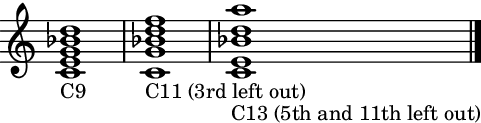
6.2 The shapes
C9 (C, E, G, B♭, D)
  black keys     C#  D#      F#  G#  A#      C#  D#      F#  G#  A#
                 .   .       .   .   b7      .   .       .   .   .
  white keys   C   D   E   F   G   A   B   C   D   E   F   G   A   B   C
               R   .   3   .   5   .   .   .   9   .   .   .   .   .   .
C11, with the 3rd left out (C, G, B♭, D, F)
  black keys     C#  D#      F#  G#  A#      C#  D#      F#  G#  A#
                 .   .       .   .   b7      .   .       .   .   .
  white keys   C   D   E   F   G   A   B   C   D   E   F   G   A   B   C
               R   .   .   .   5   .   .   .   9   .   11  .   .   .   .
C13, with the 5th and 11th left out (C, E, B♭, D, A)
  black keys     C#  D#      F#  G#  A#      C#  D#      F#  G#  A#
                 .   .       .   .   b7      .   .       .   .   .
  white keys   C   D   E   F   G   A   B   C   D   E   F   G   A   B   C
               R   .   3   .   .   .   .   .   9   .   .   .   13  .   .
6.3 Which notes to leave out
A 13th chord in full has seven notes, which is more than a hand can hold and more than the ear wants. Extended chords are always played incomplete, and the conventions for what goes are consistent.
The 5th goes first. It adds nothing to the identity of the chord unless it is altered. The root can go too, particularly in the right hand, because the left hand or a bass player has it. What must stay is the 3rd and the 7th, because that pair is what makes the chord the quality it is, together with whichever extension the name promises.
The 3rd and 7th together are called a shell voicing, and it is the most useful two-note shape a pianist can learn. For C7 the shell is E and B♭. Put the root underneath in the left hand and you have a complete-sounding chord in three notes.
The dominant 11th is a special case: the natural 11th sits a semitone above the major 3rd and the clash is ugly, so the 3rd is dropped rather than the 11th. In minor chords there is no clash, because the 11th sits a whole tone above the minor 3rd, so m11 keeps everything.
6.4 Every extended chord on every root
| Root | 9 | maj9 | m9 | 13 |
|---|---|---|---|---|
| C | C, E, G, B♭, D | C, E, G, B, D | C, E♭, G, B♭, D | C, E, B♭, D, A |
| D♭ | D♭, F, A♭, C♭, E♭ | D♭, F, A♭, C, E♭ | D♭, F♭, A♭, C♭, E♭ | D♭, F, C♭, E♭, B♭ |
| D | D, F♯, A, C, E | D, F♯, A, C♯, E | D, F, A, C, E | D, F♯, C, E, B |
| E♭ | E♭, G, B♭, D♭, F | E♭, G, B♭, D, F | E♭, G♭, B♭, D♭, F | E♭, G, D♭, F, C |
| E | E, G♯, B, D, F♯ | E, G♯, B, D♯, F♯ | E, G, B, D, F♯ | E, G♯, D, F♯, C♯ |
| F | F, A, C, E♭, G | F, A, C, E, G | F, A♭, C, E♭, G | F, A, E♭, G, D |
| F♯ | F♯, A♯, C♯, E, G♯ | F♯, A♯, C♯, E♯, G♯ | F♯, A, C♯, E, G♯ | F♯, A♯, E, G♯, D♯ |
| G | G, B, D, F, A | G, B, D, F♯, A | G, B♭, D, F, A | G, B, F, A, E |
| A♭ | A♭, C, E♭, G♭, B♭ | A♭, C, E♭, G, B♭ | A♭, C♭, E♭, G♭, B♭ | A♭, C, G♭, B♭, F |
| A | A, C♯, E, G, B | A, C♯, E, G♯, B | A, C, E, G, B | A, C♯, G, B, F♯ |
| B♭ | B♭, D, F, A♭, C | B♭, D, F, A, C | B♭, D♭, F, A♭, C | B♭, D, A♭, C, G |
| B | B, D♯, F♯, A, C♯ | B, D♯, F♯, A♯, C♯ | B, D, F♯, A, C♯ | B, D♯, A, C♯, G♯ |
7. Altered chords
7.1 The alterations
An altered chord is a dominant 7th with its 5th or its 9th, or both, raised or lowered. The alterations sharpen the pull toward the chord that follows.
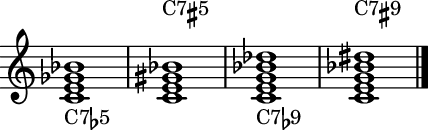
| Chord | Symbol on C | Built from the root | Notes on C |
|---|---|---|---|
| dominant 7th, flattened 5th | C7♭5 | root, major 3rd, diminished 5th, minor 7th | C, E, G♭, B♭ |
| dominant 7th, sharpened 5th | C7♯5 | root, major 3rd, augmented 5th, minor 7th | C, E, G♯, B♭ |
| dominant 7th, flattened 9th | C7♭9 | root, major 3rd, perfect 5th, minor 7th, minor 9th | C, E, G, B♭, D♭ |
| dominant 7th, sharpened 9th | C7♯9 | root, major 3rd, perfect 5th, minor 7th, augmented 9th | C, E, G, B♭, D♯ |
| dominant 7th, sharpened 11th | C7♯11 | root, major 3rd, perfect 5th, minor 7th, augmented 11th | C, E, G, B♭, F♯ |
| dominant 7th, flattened 13th | C7♭13 | root, major 3rd, perfect 5th, minor 7th, minor 13th | C, E, G, B♭, A♭ |
C7♭9 (C, E, G, B♭, D♭)
  black keys     C#  D#      F#  G#  A#      C#  D#      F#  G#  A#
                 .   .       .   .   b7      b9  .       .   .   .
  white keys   C   D   E   F   G   A   B   C   D   E   F   G   A   B   C
               R   .   3   .   5   .   .   .   .   .   .   .   .   .   .
C7♯9 (C, E, G, B♭, D♯)
  black keys     C#  D#      F#  G#  A#      C#  D#      F#  G#  A#
                 .   .       .   .   b7      .   #9      .   .   .
  white keys   C   D   E   F   G   A   B   C   D   E   F   G   A   B   C
               R   .   3   .   5   .   .   .   .   .   .   .   .   .   .
C7♯11 (C, E, G, B♭, F♯)
  black keys     C#  D#      F#  G#  A#      C#  D#      F#  G#  A#
                 .   .       .   .   b7      .   .       #11 .   .
  white keys   C   D   E   F   G   A   B   C   D   E   F   G   A   B   C
               R   .   3   .   5   .   .   .   .   .   .   .   .   .   .
7.2 Where they turn up
Altered dominants appear where a dominant chord is about to resolve, and the alteration nearly always moves by semitone into a note of the target chord. In C major, G7♭9 has A♭, which falls a semitone to G, a note of the tonic chord.
Two useful observations. A dominant 7♭9 with its root removed is a diminished 7th chord, which is why the two are so often interchangeable. And a dominant 7♯11 shares three of its notes with the dominant 7th a tritone away, which is the basis of the tritone substitution: playing D♭7 where G7 was expected.
The symbol alt on a lead sheet means the player chooses the alterations. It is an instruction to use judgement rather than a specific chord.
8. Chord shapes that break the pattern
8.1 Slash chords
A slash chord names the chord before the slash and the bass note after it: C/E, spoken "C over E". If the bass note belongs to the chord, the slash is just a way of writing an inversion. If it does not, the result is a genuinely different sound, and one worth knowing.
C/D is C, E, G over a D bass. It is not an inversion of anything, and it functions as a compact D11. Composers reach for these when they want an ambiguous, floating harmony, and they are common in film and worship music.
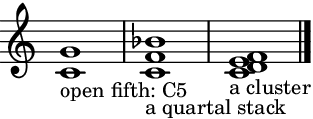
8.2 Open fifths
Two notes, root and 5th, no 3rd. Written C5. Without a 3rd the chord is neither major nor minor, which makes it useful for modal writing and for loud low passages where a 3rd would sound muddy. On the piano, a low third is genuinely unpleasant, so open fifths in the bass are a practical choice as much as a stylistic one.
8.3 Quartal chords
Stack 4ths instead of 3rds and you get a quartal chord: C, F, B♭. The sound is open and neutral, without the pull of tertian harmony, and it is a staple of twentieth-century writing. Quartal shapes are easy on the hand, since a stack of fourths spans a 7th.
8.4 Clusters
Three or more adjacent notes played together. Notated with a filled block on the stave or with the outer notes and an instruction. Clusters are texture rather than harmony, and they are played with the flat of the hand or the forearm as often as with the fingers.
8.5 Polychords
Two recognisable chords stacked and heard as two layers rather than one. C major over D major is a common example. On the piano they lie naturally, one chord per hand, which is why pianists write them more often than other musicians do.
9. Chord symbols
9.1 The anatomy of a symbol
Every chord symbol is read in the same order, left to right, and the parts are always in this sequence.
%%{init: {'theme':'neutral'}}%%
flowchart LR
  A["1. Root<br/>the letter, with any<br/>sharp or flat<br/>C, F♯, B♭"] --> B["2. Quality<br/>nothing = major<br/>m = minor<br/>dim, aug"] --> C["3. Number<br/>7, 9, 11, 13<br/>6 for a 6th"] --> D["4. Alterations<br/>♭5, ♯5, ♭9, ♯9, ♯11<br/>sus4, add9"] --> E["5. Bass note<br/>after a slash<br/>/E, /G"]
  classDef must fill:#dce8f5,stroke:#3b5f8a,stroke-width:2px
  class A must
Only the root is compulsory. C on its own means C major, because major is the default and gets no marking at all.
9.2 The variants you will meet
Chord symbols were never standardised, so the same chord appears several ways depending on the publisher and the decade.
| Chord | Symbols in use |
|---|---|
| Major triad | C, CM, Cmaj, C△ |
| Minor triad | Cm, Cmin, Cmi, C- |
| Diminished triad | Cdim, C° |
| Augmented triad | Caug, C+, C(♯5) |
| Major 7th | Cmaj7, CM7, C△7, Cj7 |
| Dominant 7th | C7, Cdom7 |
| Minor 7th | Cm7, Cmin7, C-7 |
| Half-diminished 7th | Cm7♭5, Cø7, Cø |
| Diminished 7th | Cdim7, C°7 |
| Suspended 4th | Csus4, Csus, C4 |
| Added 9th | Cadd9, C(add9), C2 |
| Six-nine | C6/9, C69 |
| Altered dominant | C7alt, C alt |
The one that causes real trouble is the dash. C-7 means C minor 7th, not C7 with something taken away. Where a modern edition writes Cm7, an older jazz chart often writes C-7.
9.3 Turning a symbol into keys
A reliable order of operations, which works for any symbol however cluttered:
- Find the root and put a finger on it.
- Decide major or minor from the quality letter, and place the 3rd: four semitones up for major, three for minor.
- Place the 5th, seven semitones above the root, unless the symbol says ♭5, ♯5, dim or aug.
- Add the 7th if there is a number of 7 or higher: ten semitones for a plain number, eleven for maj.
- Add the extensions the number promises, then apply any alterations in brackets.
- Handle sus and add last, since they change or supplement the 3rd.
- Put the slash note in the bass, in the left hand.
Then drop whatever will not fit, following the rules in 6.3: the 5th first, then the root if the left hand has it.
10. Chords in a key
10.1 The triads of a major key
Build a triad on each degree of a major scale, using only notes of that scale, and the pattern of qualities is the same in every key: major, minor, minor, major, major, minor, diminished.
| Key | I | ii | iii | IV | V | vi | vii° |
|---|---|---|---|---|---|---|---|
| C major | C | Dm | Em | F | G | Am | Bdim |
| D♭ major | D♭ | E♭m | Fm | G♭ | A♭ | B♭m | Cdim |
| D major | D | Em | F♯m | G | A | Bm | C♯dim |
| E♭ major | E♭ | Fm | Gm | A♭ | B♭ | Cm | Ddim |
| E major | E | F♯m | G♯m | A | B | C♯m | D♯dim |
| F major | F | Gm | Am | B♭ | C | Dm | Edim |
| F♯ major | F♯ | G♯m | A♯m | B | C♯ | D♯m | E♯dim |
| G major | G | Am | Bm | C | D | Em | F♯dim |
| A♭ major | A♭ | B♭m | Cm | D♭ | E♭ | Fm | Gdim |
| A major | A | Bm | C♯m | D | E | F♯m | G♯dim |
| B♭ major | B♭ | Cm | Dm | E♭ | F | Gm | Adim |
| B major | B | C♯m | D♯m | E | F♯ | G♯m | A♯dim |
The three major chords, I, IV and V, are the primary triads. Between them they contain every note of the scale, which is why they can harmonise most simple tunes on their own.

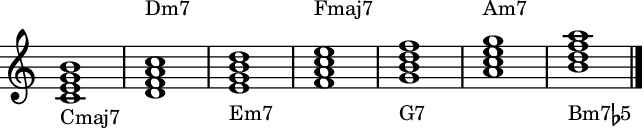
10.2 The seventh chords of a major key
| Key | IMaj7 | ii7 | iii7 | IVMaj7 | V7 | vi7 | viiø7 |
|---|---|---|---|---|---|---|---|
| C major | Cmaj7 | Dm7 | Em7 | Fmaj7 | G7 | Am7 | Bm7♭5 |
| D♭ major | D♭maj7 | E♭m7 | Fm7 | G♭maj7 | A♭7 | B♭m7 | Cm7♭5 |
| D major | Dmaj7 | Em7 | F♯m7 | Gmaj7 | A7 | Bm7 | C♯m7♭5 |
| E♭ major | E♭maj7 | Fm7 | Gm7 | A♭maj7 | B♭7 | Cm7 | Dm7♭5 |
| E major | Emaj7 | F♯m7 | G♯m7 | Amaj7 | B7 | C♯m7 | D♯m7♭5 |
| F major | Fmaj7 | Gm7 | Am7 | B♭maj7 | C7 | Dm7 | Em7♭5 |
| F♯ major | F♯maj7 | G♯m7 | A♯m7 | Bmaj7 | C♯7 | D♯m7 | E♯m7♭5 |
| G major | Gmaj7 | Am7 | Bm7 | Cmaj7 | D7 | Em7 | F♯m7♭5 |
| A♭ major | A♭maj7 | B♭m7 | Cm7 | D♭maj7 | E♭7 | Fm7 | Gm7♭5 |
| A major | Amaj7 | Bm7 | C♯m7 | Dmaj7 | E7 | F♯m7 | G♯m7♭5 |
| B♭ major | B♭maj7 | Cm7 | Dm7 | E♭maj7 | F7 | Gm7 | Am7♭5 |
| B major | Bmaj7 | C♯m7 | D♯m7 | Emaj7 | F♯7 | G♯m7 | A♯m7♭5 |
Exactly one dominant 7th occurs in each major key, on the fifth degree. That is why hearing a dominant 7th tells you the key so strongly: G7 belongs to C major and nowhere else among the major keys.
10.3 The chords of a minor key
Minor keys have a variable sixth and seventh degree, so their chords vary too. The set below uses the harmonic minor, which is the form that supplies the raised leading note and therefore the major chord V.
| Key | i | ii° | III+ | iv | V | VI | vii° |
|---|---|---|---|---|---|---|---|
| C minor | Cm | Ddim | E♭aug | Fm | G | A♭ | Bdim |
| D♭ minor | D♭m | E♭dim | F♭aug | G♭m | A♭ | B♭♭ | Cdim |
| D minor | Dm | Edim | Faug | Gm | A | B♭ | C♯dim |
| E♭ minor | E♭m | Fdim | G♭aug | A♭m | B♭ | C♭ | Ddim |
| E minor | Em | F♯dim | Gaug | Am | B | C | D♯dim |
| F minor | Fm | Gdim | A♭aug | B♭m | C | D♭ | Edim |
| F♯ minor | F♯m | G♯dim | Aaug | Bm | C♯ | D | E♯dim |
| G minor | Gm | Adim | B♭aug | Cm | D | E♭ | F♯dim |
| A♭ minor | A♭m | B♭dim | C♭aug | D♭m | E♭ | F♭ | Gdim |
| A minor | Am | Bdim | Caug | Dm | E | F | G♯dim |
| B♭ minor | B♭m | Cdim | D♭aug | E♭m | F | G♭ | Adim |
| B minor | Bm | C♯dim | Daug | Em | F♯ | G | A♯dim |

Two of these need a caveat. The augmented III+ is what the harmonic minor produces when you stack thirds on the third degree, but composers overwhelmingly use the plain major chord from the natural minor instead. And the chord on the seventh degree of the natural minor, a major chord a tone below the tonic, is extremely common in folk and popular music even though it does not appear in the table.
Technical Names and Roman Numerals gives all 15 major and all 15 minor keys in full, including the natural and melodic forms.
10.4 Cadences
A cadence is the pair of chords that ends a phrase. British naming:
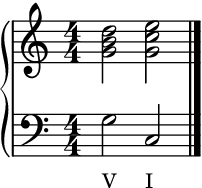
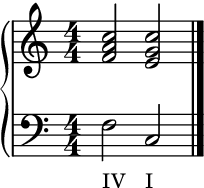
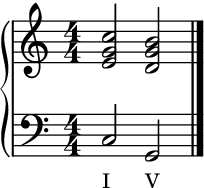
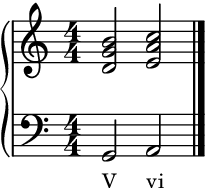
| Cadence | Chords | Effect |
|---|---|---|
| Perfect | V-I | a full stop, the strongest ending |
| Imperfect | any chord to V | a comma, the phrase stays open |
| Plagal | IV-I | a softer ending, the "amen" |
| Interrupted | V-vi | the expected tonic is dodged |
%%{init: {'theme':'neutral'}}%%
flowchart LR
  V1["V<br/>G, B, D"] -- "perfect" --> I1["I<br/>C, E, G"]
  IV1["IV<br/>F, A, C"] -- "plagal" --> I2["I<br/>C, E, G"]
  V2["V<br/>G, B, D"] -- "interrupted" --> VI["vi<br/>A, C, E"]
  X["any chord"] -- "imperfect" --> V3["V<br/>G, B, D"]
  classDef closed fill:#dce8f5,stroke:#3b5f8a,stroke-width:2px
  classDef open fill:#f5ecdc,stroke:#8a6a3b,stroke-width:2px
  class I1,I2 closed
  class VI,V3 open
10.5 Progressions worth having in the fingers
- I-IV-V-I, the backbone of almost everything.
- I-vi-IV-V, the fifties progression.
- ii-V-I, the standard jazz cadence, usually played Dm7-G7-Cmaj7.
- I-V-vi-IV, the four chords behind a great many pop songs.
- vi-IV-I-V, the same four chords started elsewhere.
- i-♭VII-♭VI-V, the descending minor progression.
Practise each in several keys, and practise them with inversions chosen so the top notes move as little as possible. That last instruction is the whole of 12.4 in one sentence.
11. Identifying a chord
11.1 The method
Whatever the chord is written on, the procedure is the same, and it is worth following in order rather than guessing from the sound.
%%{init: {'theme':'neutral'}}%%
flowchart TB
  S["Collect the notes<br/>ignore doublings and octaves"] --> T["Stack them in thirds<br/>reorder until every gap is a 3rd"]
  T --> U{"Do they stack<br/>into thirds?"}
  U -- yes --> V["The bottom of the stack is the root"]
  U -- no --> W["Try a suspended, added-note<br/>or quartal reading<br/>see 11.6"]
  V --> X["Count the intervals<br/>from the root upward"]
  X --> Y["Name the quality<br/>from the table in 14.1"]
  Y --> Z["Look at the lowest sounding note<br/>to name the inversion"]
  classDef start fill:#dce8f5,stroke:#3b5f8a,stroke-width:2px
  classDef finish fill:#f5ecdc,stroke:#8a6a3b,stroke-width:2px
  class S start
  class Z finish
11.2 From written notation
On a stave, a chord in root position looks tidy: every note on a line, or every note in a space. That is because thirds skip a letter each time. If the notes are not all lines or all spaces, the chord is inverted, and moving the lowest note up an octave until they line up tells you both the root and the inversion.
The procedure written out:
- Read the notes, applying the key signature and any accidentals in the bar.
- Remove duplicates. A chord with C in the bass and C in the melody has one C for naming purposes.
- Stack in thirds, moving notes up by octaves until each gap is a 3rd.
- Take the bottom note of that stack as the root.
- Count each interval above the root and name the quality.
- Look back at the actual lowest note in the music to name the inversion.
The commonest error is stopping at step 4 and reading the lowest written note as the root. Check the interval fingerprint in 3.3 before committing.
11.3 From the keyboard
If you can see the keys held down, count semitones from the bottom upward and compare with the shapes in 2.2 and 4.2. Two counts do most of the work: the gap from the lowest note to the next, and the gap from there to the one above.
Watch for the same trap. The lowest key held is not necessarily the root. If the two lowest notes are four semitones apart and the next gap is five, you are looking at a first inversion major triad, not a root position anything.
11.4 From a chord symbol
Read the symbol as in 9.3. The only real difficulty is unfamiliar notation, which 9.2 covers.
11.5 By ear
Ear identification goes by quality first, then by extension.
- Major sounds bright and settled.
- Minor sounds darker, with the 3rd noticeably lower.
- Diminished sounds tense and unresolved, and wants to move.
- Augmented sounds unsettled and directionless, because it is symmetrical.
- Dominant 7th sounds like it is leaning somewhere, because of the tritone inside it.
- Major 7th sounds soft, still, slightly wistful.
- Minor 7th sounds mellow and neutral.
Test yourself against the bass note rather than the top note, since the bass is what the ear locks to and it is where inversions announce themselves.
The honest limitation: a diminished 7th and an augmented triad cannot be identified by ear alone, because each shape carries several equally valid names. You need the notation, or the chord that follows.
11.6 The awkward cases
A chord that will not stack in thirds. Try reading one note as a suspension: if the notes are C, F, G, the F is a 4th and the chord is Csus4. If a stack in fourths works, consider a quartal chord.
A diminished 7th. All four spellings are equally valid on paper. The root is the note a semitone below the root of the chord it resolves to.
An augmented triad. Same problem, three names. The spelling in the score decides.
A 6th chord against a minor 7th. C6 and Am7 have the same four notes. Whichever note the bass sounds is nearly always the root.
A dominant 7♭9 without its root. This is a diminished 7th. Look at what comes next: if it behaves like a dominant, name it as one.
Enharmonic spelling. A chord written with double flats is usually a hint that the notation is following a key signature rather than the easiest reading. The keys are the same; the name follows the letters written.
11.7 Worked examples
The notes G, B, D, F. They stack in thirds already, so the root is G. G to B is four semitones, a major 3rd. G to D is seven, a perfect 5th. G to F is ten, a minor 7th. Major triad with a minor 7th, so this is G7, the dominant 7th.
The notes E, G, C, low to high. Not a tidy stack, since E to G is a 3rd but G to C is a 4th. The 4th tells us the root is the note on top of it, C. Rewritten as C, E, G, the intervals are a major 3rd and a perfect 5th, so this is C major. The lowest note is E, which is the 3rd, so it is in first inversion: written C/E, or Ib in a Roman numeral analysis.
The notes A, C, E♭, G♭. Stacked in thirds already. A to C is three semitones, a minor 3rd. A to E♭ is six, a diminished 5th. A to G♭ is nine, a diminished 7th. Diminished triad with a diminished 7th, so Adim7. And by 4.5, the same four keys are also Cdim7, E♭dim7 and G♭dim7.
The notes F, A, C, D. Stacking in thirds gives F, A, C, D with a 2nd at the top, which is not a clean stack. Rearranged as D, F, A, C the gaps are all thirds, so D is the root: minor 3rd, perfect 5th, minor 7th, which is Dm7. But if the bass is playing F, the chord is more sensibly named F6. Both readings are correct; the context decides.
The notes B, E, A. Two perfect 4ths stacked. No reading in thirds works. This is a quartal chord, or in a pop context, Esus4 with the notes rearranged, since E, A, B is a root, a 4th and a 5th.
12. Playing chords well
12.1 Close and open position
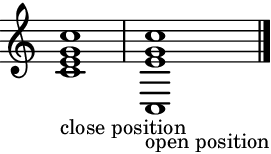
A chord in close position has its notes packed as tightly as they will go: C, E, G within one octave. In open position the notes are spread wider, usually by taking a middle note up an octave: C, G, E.
Close position is compact and easy to read. Open position sounds clearer, especially low down, because the notes are further apart and the overtones interfere less. A useful default for the left hand below middle C is to play only root and 5th, or root and 7th, and leave the thirds to the right hand.
12.2 Dividing the work between the hands
The standard arrangement for accompanying at the piano is the left hand on the root, sometimes with the 5th or the 7th, and the right hand on the rest of the chord. This keeps the bass clear and the harmony out of the muddy register.
Once the left hand has the root, the right hand does not need it, which frees a finger for an extension. That is why a jazz pianist plays E and B♭ in the right hand for C7 and lets the left hand supply the C.
12.3 Doubling and leaving notes out
In four-part writing, double the root by preference, the 5th next, and avoid doubling the 3rd, especially in a major chord, since the 3rd is the strongest colour in the chord and doubling it makes the texture heavy. Never double the leading note, and never double any note that has to resolve, since you would then have two of them moving to the same place in parallel.
Notes that may be left out, in order: the 5th first, then the root if another instrument or the other hand has it. The 3rd and the 7th stay.
12.4 Voice leading and common tones
The single biggest improvement available to most pianists is moving between chords by the shortest route rather than by jumping between root positions.
%%{init: {'theme':'neutral'}}%%
flowchart TB
  C1["C major<br/>C, E, G"] -- "hold the C,<br/>E moves to F, G moves to A" --> F1["F major, second inversion<br/>C, F, A"]
  F1 -- "no note is shared,<br/>so every note moves by a step" --> G1["G major, first inversion<br/>B, D, G"]
  G1 -- "hold the D and the G,<br/>B rises a semitone to C" --> C2["C major<br/>C, E, G"]
  classDef home fill:#dce8f5,stroke:#3b5f8a,stroke-width:2px
  class C1,C2 home
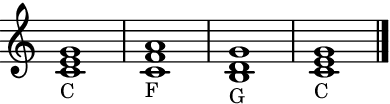
The working rules: hold any note the two chords share, move the rest by step, and let the left hand take the leaps. Applied to I-IV-V-I in C major, the right hand barely moves at all while the bass walks C, F, G, C.
12.5 Fingering
Right hand, root position triad: 1, 3, 5. First inversion: 1, 2, 5. Second inversion: 1, 3, 5.
Left hand, root position triad: 5, 3, 1. First inversion: 5, 3, 1. Second inversion: 5, 2, 1.
Seventh chords in the right hand: 1, 2, 3, 5. In the left hand: 5, 3, 2, 1.
The finger that changes between positions is the middle one, because the inversion changes which gap is the wide one. Practise the three positions of one triad as a single exercise, up and down, watching that middle finger move.
For chords with a black key in the middle, keep the thumb and little finger away from the far end of the white keys and let the hand sit forward, closer to the black keys. Sliding the whole hand forward for black-key chords and back for white-key ones is a habit worth building early.
12.6 Accompaniment patterns
The same chord can be played many ways, and the pattern does as much work as the harmony.
- Block chords: all notes together. Direct, and the default for hymns.
- Broken chords: the notes one after another, in order. Gentle, and forgiving of a slow hand.
- Alberti bass: lowest, highest, middle, highest, repeated. The sound of Classical-period keyboard writing.
- Waltz bass: bass note on the first beat, chord on the second and third.
- Arpeggios: the chord spread over two or more octaves.
- Comping: irregular, syncopated chord stabs, usually in the right hand over a bass line.
12.7 The pedal
The sustaining pedal holds everything sounding, so it must change when the harmony changes or the chords blur into each other.
The technique is syncopated pedalling, sometimes called legato pedalling: play the new chord, and lift and re-press the pedal immediately after the notes sound rather than with them. Lifting on the chord leaves a gap; lifting just after it joins the two chords smoothly and still clears the old harmony.
Two cautions. Low chords blur far more than high ones, so a bass line moving under a held pedal needs more frequent changes than a treble line does. And a chord containing a suspension or a passing note needs the pedal cleared as the dissonance resolves, or the resolution is lost in the wash.
13. A practice routine
Work through these in one key until they are automatic, then change key. Fifteen minutes a day covers it.
- The four triads on one root. Play C major, C minor, C diminished, C augmented, hands separately then together. Say the quality aloud as you play it.
- One triad through its three positions. Root, first, second, back down. Watch the middle finger.
- Triads on every degree of a scale. Play the seven triads of C major in order, then in inversions chosen to keep the top note still.
- The primary triads with smooth voice leading. I-IV-V-I with the right hand barely moving.
- Shell voicings. The 3rd and 7th of each seventh chord, left hand on the root.
- ii-V-I in all twelve keys. Dm7-G7-Cmaj7 and its transpositions, using shells first, then full voicings.
- Identification drill. Have someone play a chord, or write four notes at random, and name it using the method in 11.1. Check with the tables in chapter 14.
14. Quick reference
14.1 The formulas, in semitones from the root
| Chord | Symbol | Semitones |
|---|---|---|
| Major | C | 0, 4, 7 |
| Minor | Cm | 0, 3, 7 |
| Diminished | Cdim | 0, 3, 6 |
| Augmented | Caug | 0, 4, 8 |
| Suspended 4th | Csus4 | 0, 5, 7 |
| Suspended 2nd | Csus2 | 0, 2, 7 |
| Open 5th | C5 | 0, 7 |
| Major 6th | C6 | 0, 4, 7, 9 |
| Minor 6th | Cm6 | 0, 3, 7, 9 |
| Dominant 7th | C7 | 0, 4, 7, 10 |
| Major 7th | Cmaj7 | 0, 4, 7, 11 |
| Minor 7th | Cm7 | 0, 3, 7, 10 |
| Half-diminished 7th | Cm7♭5 | 0, 3, 6, 10 |
| Diminished 7th | Cdim7 | 0, 3, 6, 9 |
| Minor-major 7th | Cm(maj7) | 0, 3, 7, 11 |
| Added 9th | Cadd9 | 0, 4, 7, 14 |
| Dominant 9th | C9 | 0, 4, 7, 10, 14 |
| Major 9th | Cmaj9 | 0, 4, 7, 11, 14 |
| Minor 9th | Cm9 | 0, 3, 7, 10, 14 |
| Dominant 13th | C13 | 0, 4, 10, 14, 21 |
14.2 Identification at a glance
| What you see or hear | What it is |
|---|---|
| Two stacked thirds, 4 then 3 | major triad |
| 3 then 4 | minor triad |
| 3 then 3 | diminished triad |
| 4 then 4 | augmented triad |
| A 3rd and a 5th above the lowest note | root position |
| A 3rd and a 6th above the lowest note | first inversion |
| A 4th and a 6th above the lowest note | second inversion |
| Four notes, all a minor 3rd apart | diminished 7th |
| A major triad with a note ten semitones above the root | dominant 7th |
| No 3rd, but a 4th or a 2nd | suspended chord |
| Two stacked 4ths | quartal chord |
14.3 Inversion figures
| Chord | Root position | 1st inversion | 2nd inversion | 3rd inversion |
|---|---|---|---|---|
| Triad, figures | I | I6 | I6/4 | not applicable |
| Triad, letters | Ia | Ib | Ic | not applicable |
| Seventh, figures | V7 | V6/5 | V4/3 | V4/2 |
| Seventh, letters | V7a | V7b | V7c | V7d |
| Chord symbol | C | C/E | C/G | C7/B♭ |
15. Exercises
- Name the chord C, E♭, G♭, B♭♭, and give one other name for the same four keys.
- Which triad is F♯, A, C♯, and what is its quality?
- A chord is written, low to high, as G, C, E. Name it and its inversion.
- Give the notes of B♭maj7, and say which two of them make up its shell voicing.
- What is the difference between Cadd9 and C9?
- A chord symbol reads Am7♭5. Give the notes.
- Why does a dominant 11th chord usually leave out its 3rd?
- Which two notes of a seventh chord should never be left out, and why?
- A four-note chord contains D, F, A and C. Give two possible names, and say what would decide between them.
- Write the chords of a perfect cadence in E♭ major, in root position.
- Explain, in one sentence, why an augmented triad cannot be identified by ear on its own.
- A pianist plays C7 with the left hand on C and the right hand on E and B♭. Which note of the chord is missing, and why does the chord still sound complete?
Answers
- Cdim7. The same four keys are also E♭dim7, F♯dim7 and Adim7, because the diminished 7th divides the octave evenly.
- F♯ minor. F♯ to A is three semitones, a minor 3rd, and F♯ to C♯ is seven, a perfect 5th.
- C major in second inversion, written C/G or Ic. G to C is a 4th, and the root is the note above the 4th.
- B♭, D, F, A. The shell is the 3rd and the 7th, so D and A.
- Cadd9 is C, E, G, D and contains no 7th. C9 is C, E, G, B♭, D and does contain one. The number 9 rather than 2 promises the 7th below it; the word add cancels that promise.
- A, C, E♭, G. A minor 7th chord with the 5th flattened, which is the half-diminished 7th.
- The natural 11th sits a semitone above the major 3rd, and the clash is harsh. Since the 11th is the note the name promises, the 3rd is the one that goes. Minor 11th chords keep both, because there the interval is a whole tone.
- The 3rd and the 7th. Between them they fix the quality of the chord: the 3rd decides major or minor, the 7th decides which kind of seventh. The 5th and even the root can go without changing what the chord is.
- Dm7 if D is the root, F6 if F is the root. The bass note nearly always decides, since the ear takes the lowest note as the root unless something contradicts it.
- B♭, D, F then E♭, G, B♭. That is V-I in E♭ major.
- Because it is symmetrical: three major thirds fill the octave exactly, so inverting it produces the same shape, and each of its three notes is an equally plausible root.
- The 5th, G, is missing. The chord still sounds complete because the root is in the left hand and the 3rd and 7th, E and B♭, are the two notes that fix the chord's quality. The 5th adds nothing that the ear needs.
Companion documents: Technical Names and Roman Numerals for every degree and chord in all 30 keys; Musical Harmony for voice leading and the acoustics behind these chords; Roman Numeral Analysis for analysing a passage rather than naming a single chord.