A complete, self-contained course for the third grade of the ABRSM Music Theory syllabus: compound time and its grouping rules, the demisemiquaver, the stave extended beyond two ledger lines, octave transposition between the treble and bass clefs, every key to four sharps and four flats with both forms of every minor scale, intervals above the tonic by number and type, and the next layer of Italian vocabulary.
Introduction
Grade 3 explains music you have been hearing all your life. Jigs, barcarolles, lullabies and a large share of everything else move in compound time, where the beat divides into three, and until now your notation could not write them down. After this grade it can: 6/8 stops being a mysterious signature and becomes the obvious way to spell a lilt.
The grade also unlocks the edges of the page. The stave stops being a fixed ladder of nine pitches with two rungs bolted on at each end, and becomes what it always was, a window that can be extended as far as the music needs. Once you can read four or five ledger lines, you can read almost any piano score, and the same skill makes octave transposition between the treble and bass clefs a matter of counting rather than guesswork.
The rest of the grade is consolidation at scale. The key system grows to eighteen keys, nine majors and nine minors, every one built from the same two patterns you already know, and each minor now needs both of its forms. Nothing here is new in principle; what the grade examines is fluency, speed and certainty across the whole set, and that comes only from writing the scales and signatures out until they bore you. The one genuinely new idea in the key work is small and lasting: intervals above the tonic now carry a type as well as a number, so a 3rd becomes a major 3rd or a minor 3rd, and the difference is the difference between the two modes.
Compound time rewards physical practice more than any earlier topic. Clap the groupings, conduct two beats in a bar while counting quavers in threes, and the grouping rules of chapters 1 and 2 turn from regulations into descriptions of what your hands are already doing.
For any symbol beyond the syllabus, the companion Music Notation is the reference; for where the growing key system finally leads, Technical Names and Roman Numerals maps all thirty keys in full.
About this guide and the exam
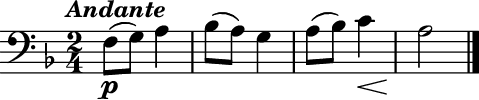
Grade 3 rests on everything from Grades 1 and 2, and the exam can test any of it. You should arrive fluent in both clefs, in note values from the semibreve to the semiquaver, in the dotted crotchet and dotted quaver, in triplets, in two ledger lines above and below each stave, in simple time with crotchet, minim and quaver beats, in the major keys to three sharps and flats, in the minors of A, E and D with their harmonic form, and in intervals above the tonic by number. The exam is online, marked out of 75 across seven sections worth 15, 15, 15, 10, 10, 5 and 5 marks, and its questions mix multiple choice with entering notes and rests on the screen. Fifty marks is a pass, 60 a Merit and 65 a Distinction.
The headline of this grade is compound time, the system in which each beat splits into three rather than two. It explains a large share of the music you already know, from "Greensleeves" to barcarolles to nearly every jig ever danced. Around it sit four smaller additions that between them finish off the basic reading kit: the demisemiquaver at the bottom of the note-value chain, ledger lines without a fixed limit, octave transposition between the two clefs you already read, and a near doubling of your key knowledge, from ten keys to eighteen.
The syllabus statement for the grade is short enough to quote. Added to everything in the preceding grades: "compound time signatures of 6/8, 9/8 and 12/8, and the grouping of notes and rests within these times; the demisemiquaver (32nd note) and its equivalent rest"; "extension of the stave beyond two ledger lines; transposition at the octave from the treble clef to the bass clef, and vice versa"; "scales and key signatures of all major and minor keys up to and including four sharps and flats, including both harmonic and melodic forms of minor scales, with their tonic triads (root position), degrees (number only), and intervals above the tonic (number and type)"; and "more terms and signs".
Read the last of those clauses twice. Intervals above the tonic now want a type as well as a number, which is the one place where this grade asks something your earlier answers would no longer satisfy.
What Grade 3 asks of you
By the end of this grade you should be able to:
- tell simple time from compound time, and read and write in 6/8, 9/8 and 12/8 with correct grouping of notes and rests
- write and recognise the demisemiquaver and its rest, and beam demisemiquavers correctly in both kinds of time
- read and write notes on three, four and more ledger lines above and below either stave
- rewrite a treble-clef melody an octave lower in the bass clef, and a bass-clef melody an octave higher in the treble clef
- write the scales, key signatures and tonic triads of every major and minor key up to four sharps and four flats, harmonic and melodic minor forms included
- number the degrees of any of those scales
- name intervals above the tonic by number and by type: major, minor and perfect
- use a wider range of Italian terms and signs
1. Simple and compound time
The idea
Take a steady beat and divide it. If it splits naturally into two equal halves, the music is in simple time. Everything you have met so far is simple time: a crotchet beat divides into two quavers, a minim beat into two crotchets, a quaver beat into two semiquavers.
But a beat can also split naturally into three. Say "strawberry, strawberry" evenly and you are dividing beats into three. Music that works this way is in compound time, and its beat is always a dotted note, because only a dotted note divides into three equal parts. A dotted crotchet is three quavers; there is no way to split an undotted crotchet into three equal quavers.
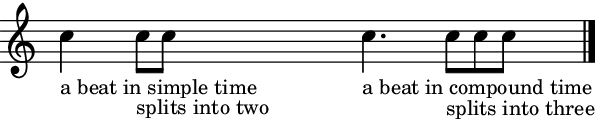
The lilting, rocking, swinging character of jigs, lullabies and boat songs is the sound of compound time. Once you can hear the difference between a beat that goes "ONE-and, TWO-and" and one that goes "ONE-and-a, TWO-and-a", the theory falls into place behind the ear.
Reading a compound time signature
Compound signatures look alarming at first because the top number does not mean what it meant before. In 6/8, there are not six beats. The top number counts the divisions (the quavers), and the real beats are the dotted crotchets those quavers group into. Divide the top number by three to find the beats:
| Signature | Beats per bar | One beat is | The quavers group as |
|---|---|---|---|
| 6/8 | 2 | a dotted crotchet | 3 + 3 |
| 9/8 | 3 | a dotted crotchet | 3 + 3 + 3 |
| 12/8 | 4 | a dotted crotchet | 3 + 3 + 3 + 3 |

The bottom number 8 still means quavers, but now a quaver is one division of a beat rather than a beat (or a half-beat) in itself.
The instant test, worth making a reflex: look at the top number. Tops of 2, 3 and 4 mean simple time and count beats directly. Tops of 6, 9 and 12 mean compound time; divide by three for the beats.
Two beats in a bar is duple time, three is triple, four is quadruple, and those words apply on both sides of the divide. So 2/4 is simple duple and 6/8 compound duple; 3/4 is simple triple and 9/8 compound triple; 4/4 is simple quadruple and 12/8 compound quadruple. Every compound signature at this grade has a partner in simple time that shares its number of beats and its pattern of strong and weak ones.
| Beats in the bar | Simple time | Compound time |
|---|---|---|
| 2, duple | 2/4 | 6/8 |
| 3, triple | 3/4 | 9/8 |
| 4, quadruple | 4/4 | 12/8 |
The stresses follow the same map as they always did. In 6/8 the first beat is strong and the second weaker; in 9/8, strong, weak, weak; in 12/8, strong, weak, medium, weak, exactly as in 4/4. Inside each beat the first of the three quavers takes a small stress of its own, which is what gives compound time its rocking gait.
Counting a compound bar
Counting out loud is the fastest way to make compound time reliable, and the words matter less than the shape. Most players count "ONE-and-a, TWO-and-a" in 6/8, giving each beat three syllables, and reserve the numbers for beats rather than for quavers. Counting "one, two, three, four, five, six" through a 6/8 bar is not wrong so much as unhelpful: it tells you the bar is full but hides where the two beats fell, and it is exactly the habit that makes candidates group 6/8 as though it were 3/4.
Conducting settles the point physically. A 6/8 bar takes the two-beat pattern, down and up, with three quavers running under each stroke. A 9/8 bar takes the three-beat pattern and a 12/8 bar the four-beat pattern. If your hand is beating six times in a bar of 6/8, the tempo is very slow indeed and the metre has effectively become six quaver beats in the ear, two bars of 3/8 rather than a lilting two-in-a-bar.
Bars that do not start on a downbeat
An anacrusis works the same way in compound time as in simple. A 6/8 piece may open with a single quaver, or with two, before the first complete bar arrives, and the closing bar is then shortened so that the two incomplete bars make one whole bar between them. A 6/8 tune opening with one quaver normally ends with a bar of five quavers' worth.
The one extra care is grouping. The quavers of an anacrusis belong to the end of a notional beat, so a two-quaver upbeat in 6/8 is beamed as a pair, standing for the second and third quavers of a beat that was never written.

3/4 versus 6/8: the classic comparison
Both hold six quavers' worth of music per bar, and exam questions return to this pair year after year. The difference is entirely in the grouping and the feel:
- 3/4 is simple time: three crotchet beats, the quavers grouped 2 + 2 + 2. It feels like a waltz: ONE-two-three.
- 6/8 is compound time: two dotted-crotchet beats, the quavers grouped 3 + 3. It feels like a jig or a march-in-two with a lilt: ONE-and-a-TWO-and-a.
Same ingredients, different recipe. The beaming tells the reader instantly which metre is in force, which is exactly why the grouping rules matter.

The same logic separates 3/8 (simple, three quaver beats) from 9/8 (compound, three dotted-crotchet beats), and 2/4 from 6/8.
2. Grouping notes and rests in compound time
The golden rule survives unchanged from the earlier grades: group so that the beats are visible. Everything in this chapter is that one sentence applied to a beat worth three quavers instead of two.
Beaming the quavers
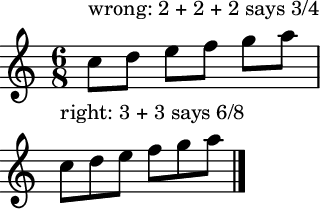
Beam quavers in threes, one group to each dotted-crotchet beat. In 6/8, beam 3 + 3, never 2 + 2 + 2, which would disguise the bar as 3/4. In 9/8, three groups of three; in 12/8, four groups. Semiquavers within a beat join the same group, so a beat of six semiquavers is beamed as one group of six, and a beat of one quaver plus four semiquavers is beamed as one group with the beams stepping in and out as the values change.
The rule holds even when the notes are far apart or the beam would be steep. Beaming follows the metre, not the convenience of the beam.

The commonest wrong answer and its correction sit side by side below. The upper bar has the right notes in the right order and is still wrong, because its beams describe 3/4.
Notes longer than a quaver
Longer values follow the same principle: one note may fill a beat, or a whole number of beats, but it should not straddle a beat boundary and hide it.
| The value | What it fills | Where it may stand |
|---|---|---|
| dotted crotchet | one whole beat | any beat of any compound bar |
| dotted minim | two whole beats | any two adjacent beats, though in 12/8 not across the middle of the bar |
| dotted semibreve | four whole beats | the whole of a 12/8 bar |
| crotchet plus quaver | one beat, long then short | anywhere within a single beat |
A dotted minim covering beats 1 and 2 of a 9/8 bar is fine, and so is one covering beats 2 and 3, because both start where a beat starts. What you must not write is a note that begins part-way through one beat and ends part-way through the next. Where the music genuinely does that, use a tie.
Inside a beat, a crotchet followed by a quaver gives the characteristic long-short lilt of a jig, and a quaver followed by a crotchet gives its reverse. Both are correct because both begin at the start of the beat. The one to avoid is a crotchet that begins part-way through a beat: two quavers and then a crotchet, so that the crotchet covers the last quaver of one beat and the first quaver of the next. It swallows the join between the beats and the reader loses the metre.
Ties across beat boundaries
A tie is the tool for any sound that starts inside one beat and continues into the next. Write the part that belongs to the first beat, write the part that belongs to the second, and tie them. The ear hears one long note; the eye still sees where the beats fall.
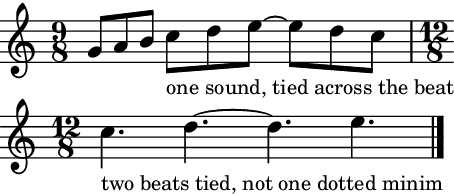
In 12/8 the middle of the bar counts as a boundary worth showing as well. A note running from beat 2 into beat 3 is usually written as two tied notes even though it could be spelt as a single dotted minim, because the halfway point of a quadruple bar is where a reader looks to check position.
Rests in compound time
Rests are grouped by beat, and the rule is stricter than for notes, because a rest gives the eye nothing to hold on to.
- A whole silent beat takes a dotted crotchet rest.
- Two whole silent beats in 9/8 or 12/8 are written as two dotted crotchet rests, not as a dotted minim rest. In 6/8 two beats are the whole bar, so the last rule below applies instead.
- Within a beat, silence is built from quaver rests, with one refinement: a plain crotchet rest may stand for the first two-thirds of a beat, that is, silence on the first two quavers, but never for the last two-thirds. If the silence falls on the second and third quavers, write two quaver rests so that the start of the beat stays visible.
- A completely silent bar takes a semibreve rest, in compound time as everywhere else, whatever the time signature says.
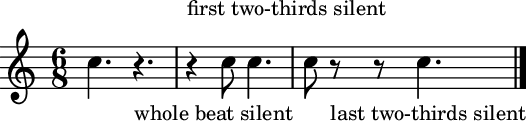
The reasoning behind the crotchet rest rule is worth holding on to, because it explains a dozen smaller conventions at once. A rest at the start of a beat is easy to place: the reader has just arrived at the beat and the rest begins there. A rest that starts half-way through a beat has to be measured from something, and the only thing available is the beat's start, which is exactly what a long rest laid across it hides.
The checklist for a compound bar
Four questions, in order, settle almost every grouping problem at this grade:
- How many beats does the signature give, and what is the beat worth? Top number divided by three; the beat is a dotted crotchet.
- Does the bar add up to that many beats?
- Is every beam confined to one beat, with three quavers' worth in each group?
- Does every rest either fill a whole beat or sit inside one, with nothing longer than a crotchet rest starting at the beat's beginning?
3. The demisemiquaver
The chain of note values has been halving itself since Grade 1: semibreve, minim, crotchet, quaver, semiquaver. Grade 3 adds one more link at the bottom. The demisemiquaver is half a semiquaver, and its name says so twice over: a semiquaver is a half-quaver, and a demisemiquaver is a half of that. Thirty-two of them fill a semibreve, which the American name, thirty-second note, states outright.
The note and its rest
A single demisemiquaver has three tails on its stem. Its rest has three hooks on the diagonal stroke. Wherever a semiquaver takes two of anything, a demisemiquaver takes three: two tails become three, a double beam becomes a triple beam, two hooks on the rest become three.

The full chain, as it now stands:
1 semibreve = 2 minims = 4 crotchets = 8 quavers = 16 semiquavers = 32 demisemiquavers
Each rest halves in step with its note, and the two families keep the same shapes they always had. If you can count how many of a value fit into a crotchet, you can count the rests as well: two quavers, four semiquavers, eight demisemiquavers to a crotchet beat.
| Note | Rest | To a crotchet | To a semibreve |
|---|---|---|---|
| quaver | quaver rest | 2 | 8 |
| semiquaver | semiquaver rest | 4 | 16 |
| demisemiquaver | demisemiquaver rest | 8 | 32 |
Beaming demisemiquavers
Demisemiquavers beam exactly as semiquavers do, with one more beam. The grouping rule is the one you already have: keep each group inside a single beat, and let the beams show the beat.
Where a group mixes values, the beams split part-way along. The outer beam runs the whole length of the group, because every note in it is at least a quaver; the second beam covers the semiquavers and shorter; the third beam covers the demisemiquavers alone. A group of one semiquaver and two demisemiquavers therefore shows two beams throughout and a third beam over the last two notes only.
In compound time nothing changes except the size of the container. A dotted-crotchet beat holds twelve demisemiquavers, and they are beamed as one group of twelve, not as three groups of four, because the beat is the unit and the beat is undivided.
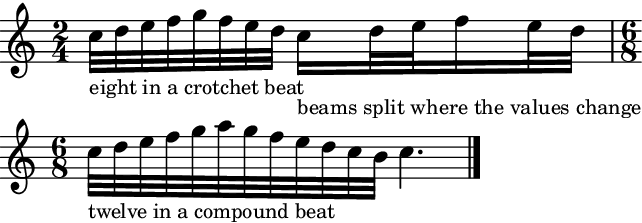
The dotted semiquaver
The demisemiquaver brings its own dotted partner into range. A dot adds half again, so a dotted semiquaver is worth a semiquaver plus a demisemiquaver, that is three demisemiquavers. It nearly always pairs with a single demisemiquaver to fill one quaver, giving the same snap as the familiar dotted quaver plus semiquaver, at half the size.
- dotted quaver + semiquaver = one crotchet
- dotted semiquaver + demisemiquaver = one quaver
The rests keep step. A dotted semiquaver rest is a semiquaver rest with a dot beside it, worth three demisemiquavers, on the principle that already gives you the dotted crotchet rest and the dotted quaver rest. So a dotted semiquaver rest followed by a demisemiquaver rest fills one quaver of silence, exactly as a dotted quaver rest and a semiquaver rest fill a crotchet.
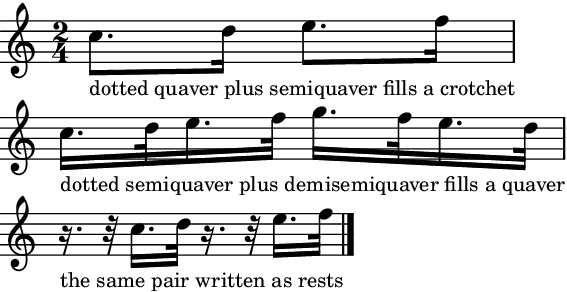
Written in a slow tempo, that pattern is the sharp, clipped rhythm of a march or a French overture. Written fast, it is barely more than an ornament on the beat.
Triplets: a recap
Triplets belong to Grade 2 and this grade assumes them, so one paragraph is enough. A triplet is three notes of the same value played evenly in the time that two of them would normally take, marked with a small figure 3 and, where no beam shows the extent of the group, a bracket. The arithmetic never varies: a triplet group lasts as long as two of its printed notes, so a quaver triplet fills one crotchet and a crotchet triplet fills one minim.
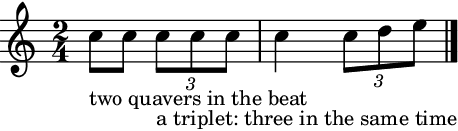
The same device works at every value you know, and the group may mix values inside itself provided they add up to three of the printed unit.
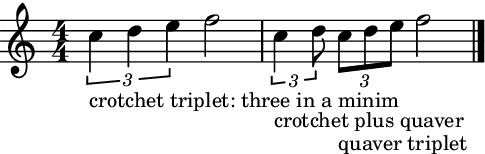
What Grade 3 adds to that stock is the smallest triplet the syllabus asks for, triplet demisemiquavers: three demisemiquavers in the time of two, filling one semiquaver. They appear in fast decorative writing and in the written-out turns of Classical slow movements, and they are read exactly like every other triplet. Three printed notes, the time of two.
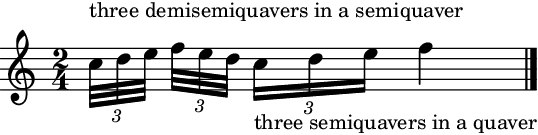
A bar of 2/4 filled with quaver triplets sounds, for that bar, exactly like 6/8. Triplets are how simple time visits compound time without changing its signature. The reverse visitor, the duplet, which squeezes two notes into a compound beat, arrives at Grade 4.
4. Beyond two ledger lines
Grade 2 fixed a limit of two ledger lines above and below each stave. Grade 3 removes it. From here on a note may sit three, four or five lines clear of the stave, and you are expected to name it and to write it.
Nothing new has to be learnt, which is the point of the topic. A ledger line is a short piece of stave line drawn for one note, and the alternation of line and space carries on outwards for ever, exactly as it does inside the stave. What changes is your confidence: counting one position at a time is reliable but slow, and slow counting is where mistakes breed.
The ladder of ledger lines
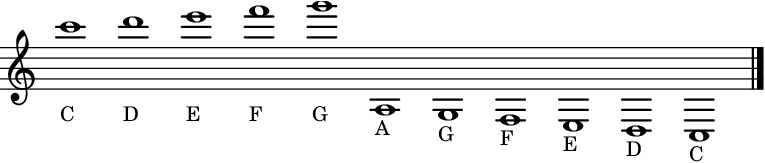
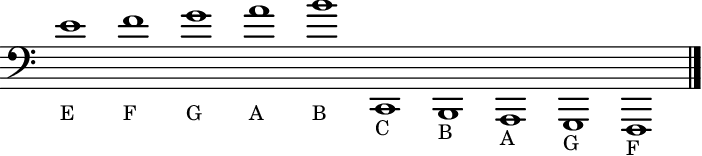
Start from the outermost line of the stave, whose name you know, and step outward. Each step is one letter. Because you leave the stave on a line and the next position out is a space, the ledger lines themselves land on every other letter, and that is the pattern worth memorising.
| Stave and direction | Outermost stave line | The ledger lines, outwards |
|---|---|---|
| above the treble stave | F | A, C, E, G, B |
| below the treble stave | E | C, A, F, D, B |
| above the bass stave | A | C, E, G, B, D |
| below the bass stave | G | E, C, A, F, D |
Five names to a row, each row every other letter counted in one direction. Learn the first three of each row and the rest follow. The spaces need no separate learning: a space is always the letter lying between the two ledger lines that surround it.
Landmarks beat counting
Two landmarks do most of the work in the treble clef. The second ledger line above the stave is C, two octaves above middle C, and it is worth knowing by sight the way you know middle C itself. The second ledger line below is A, with middle C on the first ledger line below, as it has been since Grade 1.
In the bass clef the anchors are the same letter. Middle C sits on the first ledger line above the stave, and the C two octaves below middle C sits on the second ledger line below. From either anchor you can reach any neighbour in a move or two.
Octaves are the other shortcut. An octave spans seven positions, which is an odd number, so a note on a line always has its octave in a space and a note in a space always has its octave on a line. If the second ledger line above the treble stave is C, then counting outwards gives D, E on the third ledger line, F, G on the fourth ledger line, A, B on the fifth, and the C an octave higher stands in the space just beyond it.
Writing them properly
Three habits, unchanged from Grade 2 and now more exposed:
- Draw every ledger line the note needs, evenly spaced, at the same distance apart as the lines of the stave. A note on the fourth ledger line has four short lines under it, not one.
- A note in the space beyond the outermost ledger line still needs that line drawn. The space has to be measured against something.
- Keep the lines short, projecting only a little either side of the note-head, and keep them parallel. A ragged ladder of ledger lines is the hardest thing on a page to read at speed.
When editors stop using them
Beyond about four ledger lines most editors give up and print an octave sign instead. The 8va sign tells the player to sound the passage an octave higher than written, or, printed below the stave, an octave lower, and the music returns to its written register at the end of the dotted line.
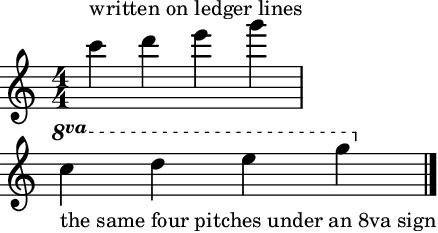
The two versions sound identical, but only one of them is Grade 3 business. The octave sign itself is set at Grade 4, and a Grade 3 question will always print the ledger lines, which is the whole point of the topic. Recognise the sign when your own music uses it, and read on.
5. Transposing at the octave between the clefs
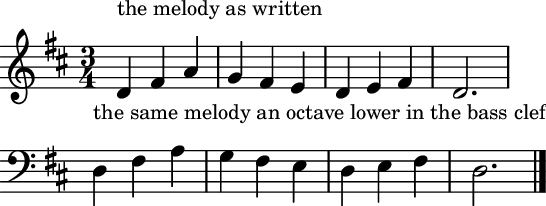
To transpose is to rewrite music at a different pitch. Grade 3 asks for the gentlest case there is, and the one that piano and vocal music use constantly: take a melody written in the treble clef and rewrite it an octave lower in the bass clef, or take a bass-clef melody and rewrite it an octave higher in the treble clef.
What actually changes
Only the register and the clef. Letter names stay the same, the key signature stays the same, and so do the time signature, the note values, the rests, the ties and slurs, the dynamics and every word of Italian. If the original begins on F sharp, the transposition begins on F sharp, one octave away.
That is worth stating flatly, because it removes most of the anxiety. You are not calculating intervals from scratch. You are writing the same tune in a different part of the page.
The mechanics of the move
Two facts make the placing quick, and both are worth proving to yourself on the page rather than taking on trust.
The first is that lines become spaces. An octave is seven positions, an odd number, so a note that sat on a line in the treble clef lands in a space in the bass clef, and a note in a space lands on a line. Anything you write that keeps a line note on a line is wrong before you look at anything else.
The second is that a handful of pairs, once learnt, place everything else by neighbourhood:
| Treble clef | An octave lower, in the bass clef |
|---|---|
| bottom line, E | third space |
| second line, G | fourth space |
| middle line, B | space above the top line |
| top line, F | space above the second ledger line |
| first ledger line below, middle C | second space |
Middle C is the anchor to trust, because you already know it in both clefs: first ledger line below the treble stave, first ledger line above the bass stave. The C an octave below middle C is the second space of the bass stave, and every other note can be counted from there.
Going the other way, from bass clef up to the treble, the same table read backwards applies. The bass stave's top line A becomes the second space of the treble stave; its third line D becomes the space just below the treble stave; its second space C is middle C, the first ledger line below.
These are checks, not a substitute for reading. Use them to settle the first note, then work by shape.
A method that does not slip
- Copy the new clef, then the key signature in its correct shape for that clef, then the time signature.
- Take the first note, name its pitch precisely, and write the same letter an octave away in the new clef. Confirm that a line note has become a space note, or the other way about.
- Work through the rest by interval, not by naming every note. If the tune rises a 3rd, your copy rises a 3rd. This is far faster, and it makes an error visible at once because the shape stops matching.
- Copy every accidental exactly where it stood. An accidental holds good for the rest of its bar in the original, so it must do the same in the copy.
- Copy the rests, ties, slurs, dynamics and words.
- Check the first note, the last note and every accidental against the original.
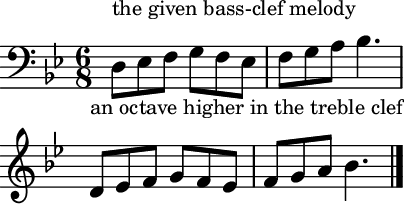
Where the marks go
Three faults account for nearly every lost mark on this question.
The first is copying the shape correctly but landing in the wrong octave, usually because the first note was misjudged. Settle the first note carefully and the rest is safe.
The second is the key signature: forgetting it, or drawing it in the treble-clef pattern on a bass stave. The sharps and flats occupy different lines and spaces in the two clefs, and a signature drawn in the wrong shape is a signature spelt wrong.
The third is dropping the detail. Slurs, dynamics, articulation marks and the tempo word all belong to the music, and a transposition that leaves them out is unfinished.
6. The keys to four sharps and four flats
Grade 3 completes the key map out to four accidentals in the signature. The machinery is all familiar; only the inventory grows.
The new major keys
| Key | Signature | In order |
|---|---|---|
| E major | 4 sharps | F♯, C♯, G♯, D♯ |
| A♭ major | 4 flats | B♭, E♭, A♭, D♭ |
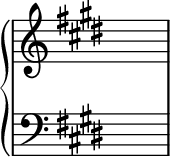
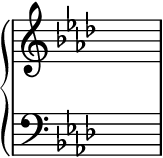
The scales:
E major: E, F♯, G♯, A, B, C♯, D♯, E A♭ major: A♭, B♭, C, D♭, E♭, F, G, A♭
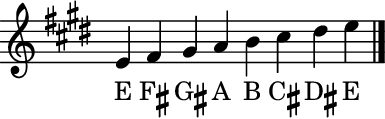
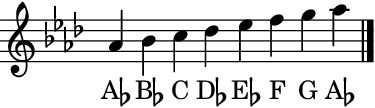
Your full set of majors is now C, G, D, A and E on the sharp side, and F, B♭, E♭ and A♭ on the flat side. The recognition tricks are unchanged: last sharp is a semitone below the tonic; second-to-last flat names the flat key.
The new minor keys
Every minor shares its relative major's signature, three semitones up from the minor tonic. Filling in the whole table to four accidentals:
| Minor key | Signature | Relative major | Raised 7th (harmonic) |
|---|---|---|---|
| A minor | none | C major | G♯ |
| E minor | 1 sharp | G major | D♯ |
| B minor | 2 sharps | D major | A♯ |
| F♯ minor | 3 sharps | A major | E♯ |
| C♯ minor | 4 sharps | E major | B♯ |
| D minor | 1 flat | F major | C♯ |
| G minor | 2 flats | B♭ major | F♯ |
| C minor | 3 flats | E♭ major | B♮ |
| F minor | 4 flats | A♭ major | E♮ |
The new arrivals are B, F♯ and C♯ minor on the sharp side, and G, C and F minor on the flat side.
Spelling the raised seventh
The table's final column repays close study, because it contains the two traps of this grade.
Trap one: in the sharpest minors, the raised seventh lands on a note most people have never written. F♯ minor's seventh degree is E (well, E♯ once raised): the natural minor has a plain E, and one semitone up from E, keeping the letter E, is E♯. It sounds identical to F, but writing F would be wrong, because the scale already has an F♯ and every scale uses each letter exactly once. The same logic gives C♯ minor a raised seventh of B♯, which sounds like C.
Trap two: in the flat minors, raising the seventh often produces a natural sign rather than a sharp. C minor's seventh degree is B♭ (from the signature); one semitone up is B♮. F minor's is E♭, raised to E♮. The rule is always "one semitone higher, same letter", and the accidental that achieves it depends on where you started.
Building any minor scale: a worked routine
Here is a routine that never fails, shown for G minor.
- Find the key signature. G minor's relative major is three semitones up: B♭ major. So the signature is two flats, B♭ and E♭.
- Write the natural minor: the plain signature notes. G, A, B♭, C, D, E♭, F, G.
- For the harmonic form, raise the seventh a semitone, same letter, both directions: F becomes F♯. G, A, B♭, C, D, E♭, F♯, G.
- For the melodic form, raise the sixth and seventh on the way up (E♭ to E♮, F to F♯), and restore both on the way down.
G melodic minor ascending: G, A, B♭, C, D, E♮, F♯, G G melodic minor descending: G, F♮, E♭, D, C, B♭, A, G
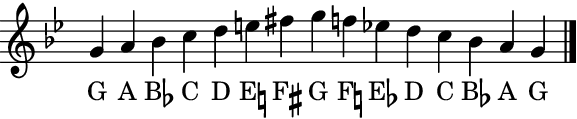
Run the same routine for each new minor until it is automatic.
The harmonic form of the six new minors
| Key | Harmonic minor scale |
|---|---|
| B minor | B, C♯, D, E, F♯, G, A♯, B |
| F♯ minor | F♯, G♯, A, B, C♯, D, E♯, F♯ |
| C♯ minor | C♯, D♯, E, F♯, G♯, A, B♯, C♯ |
| G minor | G, A, B♭, C, D, E♭, F♯, G |
| C minor | C, D, E♭, F, G, A♭, B♮, C |
| F minor | F, G, A♭, B♭, C, D♭, E♮, F |
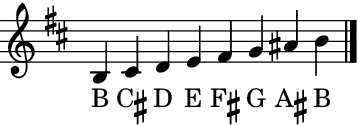
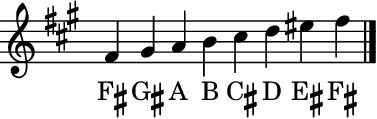
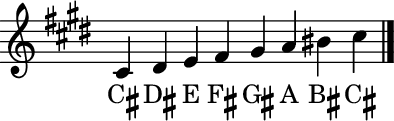
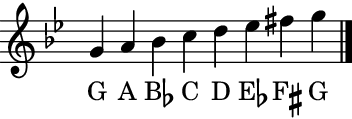
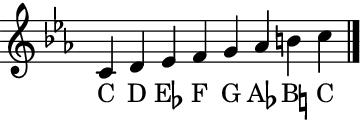
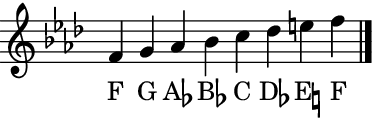
Notice what the harmonic form does to the gap between the sixth and seventh degrees. Raising the seventh but not the sixth stretches that step to three semitones, a step and a half where every other step in the scale is a tone or a semitone, and it is the sound most people mean when they call a tune "oriental" or "exotic". B minor's G to A♯, F♯ minor's D to E♯ and F minor's D♭ to E♮ are all the same stride. Grade 4 gives it a name; for now it is enough to hear it and to spell it.
The melodic form of every minor set for the grade
The melodic form exists to remove that stride. Raise the sixth as well as the seventh on the way up, so the scale climbs to the tonic in ordinary tones and semitones; then, coming down, restore both to the key signature, because a descending line has no leading note to lean on and the flattened notes sound more natural.
Every melodic minor therefore has two spellings, and both are examinable.
The table below covers all nine minors of the grade, not only the six new ones. A, E and D minor were taught at Grade 2 in the harmonic form alone, so their melodic form is new material here and is asked for in exactly the same way as the rest.
| Key | Ascending | Descending |
|---|---|---|
| A minor | A, B, C, D, E, F♯, G♯, A | A, G♮, F♮, E, D, C, B, A |
| E minor | E, F♯, G, A, B, C♯, D♯, E | E, D♮, C♮, B, A, G, F♯, E |
| B minor | B, C♯, D, E, F♯, G♯, A♯, B | B, A♮, G♮, F♯, E, D, C♯, B |
| F♯ minor | F♯, G♯, A, B, C♯, D♯, E♯, F♯ | F♯, E♮, D♮, C♯, B, A, G♯, F♯ |
| C♯ minor | C♯, D♯, E, F♯, G♯, A♯, B♯, C♯ | C♯, B♮, A♮, G♯, F♯, E, D♯, C♯ |
| D minor | D, E, F, G, A, B♮, C♯, D | D, C♮, B♭, A, G, F, E, D |
| G minor | G, A, B♭, C, D, E♮, F♯, G | G, F♮, E♭, D, C, B♭, A, G |
| C minor | C, D, E♭, F, G, A♮, B♮, C | C, B♭, A♭, G, F, E♭, D, C |
| F minor | F, G, A♭, B♭, C, D♮, E♮, F | F, E♭, D♭, C, B♭, A♭, G, F |
The two minors you met at Grade 2, where only the harmonic form was asked for, now have a melodic form to learn as well.
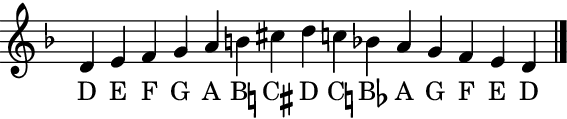
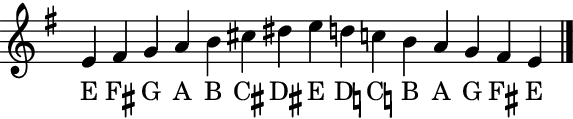
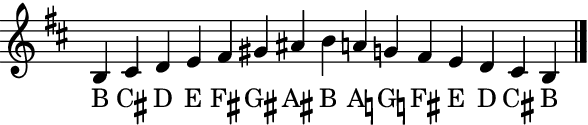


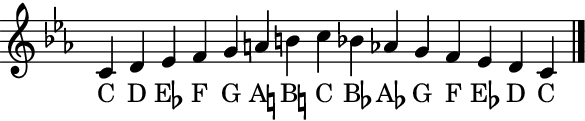

Two points of spelling carry most of the marks. In the sharp minors the raised sixth and seventh often need signs the signature has not supplied: C♯ minor's A♯ and B♯ are both written in, and B♯ looks alarming until you remember it is only "B, one semitone up". In the flat minors the raising is done by natural signs, so C minor rises through A♮ and B♮ and falls back through A♭ and B♭.
Coming down, write the restoring accidentals even where the key signature would have supplied them anyway. If the ascent sharpened a note with an accidental, the descent must cancel it, because an accidental holds good for the rest of its bar.
Which form to write
An exam question that says "write the harmonic minor scale of C minor" wants the raised seventh in both directions and nothing else altered. A question that says "melodic" wants the two different spellings, up and down. A question that just says "the scale of C minor" is asking you to choose, and either form is accepted provided it is spelt consistently and, if melodic, altered in both directions.
7. Degrees of the scale and tonic triads
Degrees by number
Number the notes of a scale from the tonic upwards, 1 to 8, and each number is that note's degree. Degree 1 is the keynote, degree 5 the fifth note up, degree 8 the keynote an octave higher. The number belongs to the key, not to the clef or the octave: the third degree of A♭ major is C wherever on the page it appears, on a ledger line or in the middle of the stave. That cuts both ways. A note printed below the tonic keeps its degree number too, because the number belongs to the letter and not to the register: in E major the C♯ written under the tonic E is the sixth degree, exactly as the C♯ above it is.
The exam asks for the number alone at this grade; the technical names, tonic and supertonic and the rest, arrive at Grade 4. Questions run in both directions. "Which degree of E major is the note C♯?" is the sixth. "Name the fourth degree of F minor" is B♭. And the note asked about need not lie above the tonic: "which degree of A♭ major is this D♭?" is the fourth, whether the D♭ is printed above the keynote or below it.
The two keys new to the majors, and two of the new minors, degree by degree:
| Degree | E major | A♭ major | C♯ minor (harmonic) | F minor (harmonic) |
|---|---|---|---|---|
| 1 | E | A♭ | C♯ | F |
| 2 | F♯ | B♭ | D♯ | G |
| 3 | G♯ | C | E | A♭ |
| 4 | A | D♭ | F♯ | B♭ |
| 5 | B | E♭ | G♯ | C |
| 6 | C♯ | F | A | D♭ |
| 7 | D♯ | G | B♯ | E♮ |
| 8 | E | A♭ | C♯ | F |
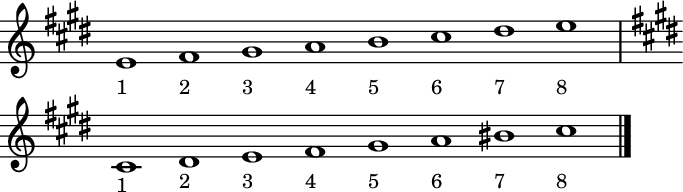
Watch the seventh degree of a minor key, as always. In the harmonic form it carries its accidental: C♯ minor's seventh degree is B♯, F minor's is E♮. In the melodic form the sixth and seventh degrees each have two versions, one for the ascent and one for the descent, so a question about them will say which form it means.
Tonic triads of the new keys
Degrees 1, 3 and 5, as always. Minor triads take the plain key-signature third; the raised seventh plays no part, because the seventh degree is not in the triad.
| Key | Tonic triad | Key | Tonic triad | |
|---|---|---|---|---|
| E major | E, G♯, B | B minor | B, D, F♯ | |
| A♭ major | A♭, C, E♭ | F♯ minor | F♯, A, C♯ | |
| C♯ minor | C♯, E, G♯ | |||
| G minor | G, B♭, D | |||
| C minor | C, E♭, G | |||
| F minor | F, A♭, C |
When a triad is written without a key signature, every accidental the key demands must appear against the notes: E major's triad needs its G♯ marked, G minor's needs its B♭.

8. Intervals above the tonic: number and type
This is the one genuinely new idea in the Grade 3 key work, and it is small. Up to now "a 3rd" was a complete answer. From now on an interval measured above the tonic wants a type as well: major, minor or perfect.
The syllabus is precise about the scope, and the limits are a gift. The two notes are always the tonic and one other note of the key, the tonic is always the lower note, and the interval never exceeds an octave. Intervals between any two notes, and the words augmented and diminished, wait until Grade 4.
Step one: the number, as before
Count letter names inclusively from the tonic. The number and the degree are the same count, which is why the last chapter's degree tables are also interval tables read sideways: the interval from the tonic up to the fourth degree is a 4th, up to the sixth degree a 6th, up to the eighth an octave.
Accidentals never change the number, because the number lives in the letters alone. In G minor, G up to E♭ is a 6th, and G up to E♮, the raised sixth of the ascending melodic form, is a 6th as well. Only the type tells them apart.
Step two: the type
Because the lower note is always the tonic, the type falls out of the key without any calculation at all.
In a major key, the interval from the tonic up to any degree of the scale is:
| From the tonic up to degree | Interval |
|---|---|
| 2 | major 2nd |
| 3 | major 3rd |
| 4 | perfect 4th |
| 5 | perfect 5th |
| 6 | major 6th |
| 7 | major 7th |
| 8 | perfect octave |
Two words cover the whole scale: 4ths, 5ths and octaves are perfect; 2nds, 3rds, 6ths and 7ths are major. Nothing is ever called a major 5th or a perfect 3rd. If you have written one of those, either the number or the type is wrong.
In a minor key three of the intervals shrink by a semitone, and the ones that shrink are exactly the notes that make the key minor:
| From the tonic up to degree | Natural, and descending melodic | Harmonic | Ascending melodic |
|---|---|---|---|
| 2 | major 2nd | major 2nd | major 2nd |
| 3 | minor 3rd | minor 3rd | minor 3rd |
| 4 | perfect 4th | perfect 4th | perfect 4th |
| 5 | perfect 5th | perfect 5th | perfect 5th |
| 6 | minor 6th | minor 6th | major 6th |
| 7 | minor 7th | major 7th | major 7th |
| 8 | perfect octave | perfect octave | perfect octave |
The harmonic form is the one to watch, because it raises the seventh and leaves the sixth alone. A harmonic minor therefore has a minor 6th above its tonic and a major 7th, and only the ascending melodic form gives a major 6th.
The 3rd is the one that never varies. A minor key has a minor 3rd above its tonic and a major key has a major 3rd, and that single interval is the whole difference between the two modes. Everything else in the table follows from which form of the minor scale the question is using: raise the sixth degree and the minor 6th becomes a major 6th; raise the seventh and the minor 7th becomes a major 7th.

Worked examples
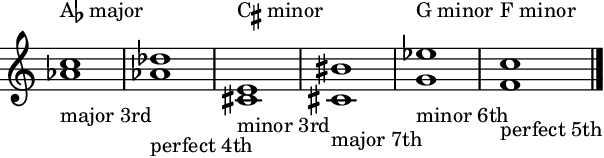
- In A♭ major, A♭ up to C. A, B, C is three letters, so a 3rd. The key is major and C is its third degree: a major 3rd.
- In A♭ major, A♭ up to D♭. Four letters, a 4th. Fourth degree of a major scale: a perfect 4th.
- In C♯ minor, C♯ up to E. Three letters, a 3rd. Third degree of a minor scale: a minor 3rd.
- In C♯ minor, C♯ up to B♯. Seven letters, a 7th. B♯ is the raised seventh of the harmonic form: a major 7th. Plain B, the seventh of the natural form, would give a minor 7th.
- In G minor, G up to E♭. Six letters, a 6th. E♭ is the sixth degree as the signature gives it: a minor 6th. In the ascending melodic form the same degree is E♮, a major 6th.
- In F minor, F up to C. Five letters, a 5th, and 5ths above the tonic are always perfect: a perfect 5th.
The check that catches slips
Count the semitones if you are unsure. The tonic to the second degree of any scale in this syllabus is two semitones, a major 2nd; a minor 2nd would be one, and no scale here has one above its tonic. The useful sizes:
| Interval above the tonic | Semitones |
|---|---|
| major 2nd | 2 |
| minor 3rd | 3 |
| major 3rd | 4 |
| perfect 4th | 5 |
| perfect 5th | 7 |
| minor 6th | 8 |
| major 6th | 9 |
| minor 7th | 10 |
| major 7th | 11 |
| perfect octave | 12 |
Six semitones is missing from that list, and its absence is worth noticing: no interval above the tonic of any major or minor scale spans six semitones. If your count reaches six, you have miscounted or misread an accidental.
9. New Italian terms and signs
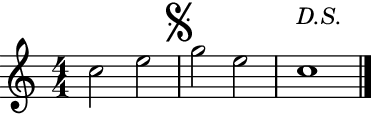
Everything from Grades 1 and 2 remains examinable and can appear without explanation: the tempo ladder from grave to presto, the dynamics from pp to ff, legato and staccato, the small words con, senza, ma, molto, poco, più and meno, and the navigation signs D.C., D.S. and Fine. The Grade 3 list adds words of character, of weight, and of continuation.
Two more tempo words
| Term | Meaning |
|---|---|
| andantino | slightly faster than andante |
| prestissimo | as fast as possible, faster than presto |
Andantino is the only genuinely ambiguous term in the syllabus. It is a diminutive of andante, and composers have used it to mean both a little faster and a little slower. Take it as slightly faster than andante unless the music says otherwise, which is the reading exams expect.
Words of character
| Term | Meaning |
|---|---|
| agitato | agitated, restless |
| animato | animated, lively |
| energico | energetic |
| giocoso | playful, merry |
| maestoso | majestic, stately |
| pesante | heavy, weighty |
| risoluto | resolute, bold |
| scherzando | playfully, jokingly |
| semplice | simple, plain |
| tranquillo | calm |
| triste, tristamente | sad, sadly |
These attach to a tempo word rather than replacing it: allegro giocoso, andante tranquillo, adagio maestoso. A character word tells you how the tempo should sound, not how fast it is.
Weight, attack and touch
| Term | Meaning |
|---|---|
| con forza | with force |
| leggiero | light and nimble |
| marcato (marc.) | marked, each note emphasised |
| sforzando, sforzato (sfz, sf) | forced: a sudden strong accent on one note or chord |
| sostenuto (sost.) | sustained, each note held to its full length |
Sforzando is the one to be exact about. It is not a dynamic level but an event: a single note attacked harder than its surroundings, whatever the prevailing dynamic. An sf inside a quiet passage is a sharp accent within that quietness, not a sudden forte.
The words that keep an instruction running
| Term | Meaning |
|---|---|
| ben | well (as in ben marcato, well marked) |
| sempre | always, throughout |
| simile (sim.) | in the same way: carry on as just shown |
| subito (sub.) | suddenly (as in subito piano, suddenly quiet) |
| prima, primo | first (as in tempo primo, the first tempo) |
Simile saves a composer from printing the same articulation or pedalling over every bar. Once the pattern is established, sim. means "and so on until told otherwise". Sempre does the same job for a dynamic or a manner: sempre staccato holds until something cancels it.
Tempo primo usually appears after a passage at a different speed, or after a D.S. or D.C., telling you to resume the opening tempo.
Four signs of articulation
| Sign | Looks like | Meaning |
|---|---|---|
| tenuto | a short horizontal line above or below the note-head | held for its full value, slightly stressed |
| strong accent (marcato) | a vertical wedge, like a pointed accent | a heavier accent than the ordinary one |
| staccatissimo | a small pointed wedge above or below the note-head | very short and detached, shorter than staccato |
| semi-staccato | dots under a slur | detached, but gently: neither joined nor sharply separated |
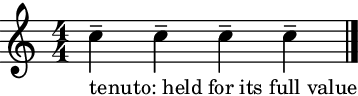
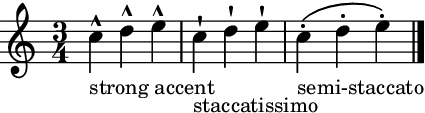
The four form a scale of length and weight. Tenuto asks for the note's full value with a slight lean; semi-staccato shortens it a little and separates it gently; staccato shortens it about half; staccatissimo cuts it to a point. The strong accent works on a different axis altogether, adding weight rather than removing length, which is why a note may carry an accent and a staccato dot at once.
10. Common mistakes at Grade 3
- Reading the top number of 6/8 as six beats. Compound tops count divisions; divide by three. A 6/8 bar has two beats.
- Beaming a 6/8 bar as 2 + 2 + 2 quavers. That is 3/4's grouping; 6/8 must show 3 + 3.
- Writing a crotchet rest for the last two-thirds of a compound beat. The start of the beat must stay visible; use quaver rests there.
- Writing a dotted minim rest for two silent beats of a 9/8 or 12/8 bar. Two dotted crotchet rests, one per beat. In 6/8 two silent beats are the whole bar, which takes a semibreve rest.
- Giving a demisemiquaver two tails instead of three, or its rest two hooks instead of three. Everything about the demisemiquaver comes in threes.
- Beaming a compound beat of twelve demisemiquavers as three groups of four. The beat is the group, whatever it contains.
- Miscounting the dotted semiquaver. It is worth three demisemiquavers, and with one demisemiquaver after it the pair fills a quaver, not a crotchet.
- Losing count on ledger lines by starting again from the bottom of the stave each time. Use the landmark notes, then step.
- Forgetting to draw the inner ledger lines. A note on the fourth ledger line needs all four drawn, evenly spaced.
- Transposing an octave but landing in the wrong one, usually because the first note was misjudged in the original clef. Fix the first note, then work by interval.
- Copying a key signature into the new clef in the shape it had in the old one. The sharps and flats sit on different lines in the treble and bass clefs.
- Spelling F♯ minor's raised seventh as F instead of E♯, or C♯ minor's as C instead of B♯. Same letter, one semitone up, always.
- Using a sharp sign to raise the seventh in C or F minor, where the correct accidental is a natural.
- Letting the melodic descent keep its raised notes. On the way down, both the sixth and seventh revert to the key signature, and the accidentals that cancel them must be written in.
- Naming an interval above the tonic by number alone. Grade 3 wants the type as well: not "a 3rd" but "a major 3rd".
- Calling something a major 4th or a perfect 3rd. 4ths, 5ths and octaves are perfect; 2nds, 3rds, 6ths and 7ths are major or minor.
- Reading the type from the wrong form of a minor scale. The 6th and 7th above a minor tonic change type with the scale form, so check which form the question means.
- Adding a triplet's notes at face value when totalling a bar. Three triplet quavers occupy one crotchet, not a crotchet and a half.
- Mixing up the relative-major arithmetic for the new minors: B minor pairs with D major (two sharps), not with B♭ or G major.
- Treating sforzando as a dynamic level. It is one accented note, at whatever dynamic is already in force.
11. Practice questions
Answers follow in the next section.
1. In 9/8, how many beats are in a bar, and what note value carries one beat?
2. Both 6/8 and 3/4 contain six quavers' worth of music per bar. How do they differ in feel and in grouping?
3. Rewrite the following two bars with correct grouping for 6/8, changing no pitch and no total duration:

4. A silent beat is needed as the second beat of a 6/8 bar. What rest do you write? What would you write instead if only the second and third quavers of that beat were silent?
5. How many demisemiquavers fill a crotchet, and how many fill a semibreve? How many tails does a single demisemiquaver carry, and how many hooks has its rest?
6. A dotted semiquaver is followed by one other note, and together they fill exactly one quaver. What is the second note?
7. Name these six notes:
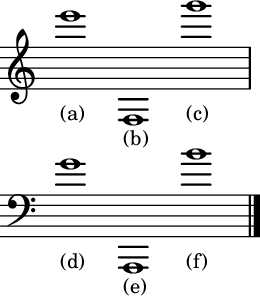
8. Rewrite this melody an octave lower in the bass clef, keeping everything else:
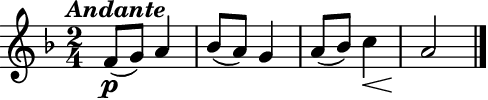
9. Give the key signature of A♭ major, naming the flats in order, and say which minor key shares it.
10. Write the harmonic minor scale of C♯ minor ascending, naming the raised seventh correctly.
11. Write the melodic minor scale of G minor, ascending and descending, marking every accidental.
12. Explain why F♯ minor's raised leading note is written E♯ and not F.
13. Which minor key has four flats, what is its relative major, and what accidental raises its seventh?
14. Name the tonic triads of F minor and B minor.
15. Which degree of E major is the note C♯? Name the fourth degree of F minor.
16. In E major, name the interval from the tonic up to G♯, and the interval from the tonic up to A. Give the number and the type of each.
17. In C minor, name the interval from the tonic up to the sixth degree, first as the key signature gives it and then as the ascending melodic form gives it.
18. A bar of 12/8 contains a dotted minim followed by quavers. How many quavers are needed to complete the bar, and how are they beamed?
19. Give the meanings of pesante, sempre, andantino, ben, risoluto and simile.
20. What exactly does sf ask for, and how does it differ from f?
21. Describe the tenuto, strong accent, staccatissimo and semi-staccato signs, and say what each asks the player to do.
22. Three demisemiquavers are printed under a figure 3. What is the group worth?
12. Answers
1. Three beats per bar, each a dotted crotchet.
2. 6/8 is compound: two dotted-crotchet beats, quavers grouped 3 + 3, a lilting two-in-a-bar feel. 3/4 is simple: three crotchet beats, quavers grouped 2 + 2 + 2, a waltz-like three-in-a-bar feel. The total content matches; the stresses and the beaming do not.
3. The first bar needs its quavers beamed 3 + 3 instead of 2 + 2 + 2. In the second bar the middle crotchet straddles the two beats, so it is split into two tied quavers, one closing the first beat and one opening the second:

4. A dotted crotchet rest, which is one whole compound beat of silence. If only the second and third quavers of the beat were silent, you would write two quaver rests, because a crotchet rest may not stand for the last two-thirds of a beat.
5. Eight demisemiquavers fill a crotchet and thirty-two fill a semibreve. A single demisemiquaver has three tails, and its rest has three hooks.
6. A demisemiquaver. A dotted semiquaver is worth three demisemiquavers, and one more makes four, which is a quaver.
7. (a) E, on the third ledger line above the treble stave. (b) F, on the third ledger line below the treble stave. (c) G, on the fourth ledger line above the treble stave. (d) G, on the third ledger line above the bass stave. (e) A, on the third ledger line below the bass stave. (f) B, on the fourth ledger line above the bass stave.
8. Every note keeps its letter name. On the page it moves up five stave positions as the clef changes, even though it sounds an octave lower, so every line note becomes a space note and every space note a line note: the treble stave's first-space F becomes the fourth-line F of the bass stave. The key signature is redrawn in its bass-clef shape and everything else is copied unchanged:
9. Four flats: B♭, E♭, A♭, D♭, in that order. F minor shares the signature.
10. C♯, D♯, E, F♯, G♯, A, B♯, C♯. The raised seventh is B♯, which sounds like C but must keep the letter B.
11. Ascending: G, A, B♭, C, D, E♮, F♯, G (the E♮ and F♯ are written as accidentals). Descending: G, F♮, E♭, D, C, B♭, A, G (the F takes a natural sign to cancel the F♯, and the E takes a flat to cancel the E♮ of the ascent, even though the key signature already gives E♭).
12. The seventh degree of F♯ natural minor is the letter E. A scale uses each letter name exactly once, so raising that degree a semitone must keep the letter: E♯. It sounds the same as F, but the scale already owns an F, the tonic F♯, so E♯ is the only correct spelling.
13. F minor. Its relative major is A♭ major, and the seventh degree, E♭, is raised with a natural sign, to E♮.
14. F minor: F, A♭, C. B minor: B, D, F♯.
15. C♯ is the sixth degree of E major. The fourth degree of F minor is B♭.
16. E up to G♯ is a major 3rd: three letter names, and the third degree of a major scale. E up to A is a perfect 4th: four letter names, and 4ths above the tonic are always perfect.
17. C up to A♭ is a minor 6th. In the ascending melodic form the sixth degree is A♮, so C up to A♮ is a major 6th. The number is a 6th either way; only the type changes.
18. A dotted minim covers two of the four beats, which is six quavers' worth. Six more quavers are needed, beamed 3 + 3, one group to each remaining beat.
19. Pesante: heavy, weighty. Sempre: always, throughout. Andantino: slightly faster than andante. Ben: well, as in ben marcato. Risoluto: resolute, bold. Simile: in the same way, carry on as just shown.
20. Sf (sforzando) asks for one note or chord to be attacked harder than those around it. It is an event on a single note, not a dynamic level, so an sf inside a quiet passage is a sharp accent within that quietness. F sets a loud dynamic that stays in force until something changes it.
21. Tenuto is a short horizontal line above or below the note-head: hold the note for its full value, with a slight stress. The strong accent is a vertical wedge: a heavier accent than the ordinary one. Staccatissimo is a small pointed wedge: very short and detached, shorter than staccato. Semi-staccato is dots under a slur: detached, but gently.
22. One semiquaver. Three demisemiquavers under a 3 occupy the time of two demisemiquavers, and two demisemiquavers make a semiquaver.
Next step: Grade 4 opens the alto clef, doubles your accidentals with the double sharp and double flat, names every scale degree, adds the breve and the double dot, and extends interval type to every pair of notes in the key, augmented and diminished included.