A complete, self-contained course for the fourth grade of the ABRSM Music Theory syllabus: the alto clef, double sharps and flats, enharmonic equivalents, the breve and double dots, every duple, triple and quadruple time signature with its grouping, duplets, keys to five sharps and flats, the chromatic scale, the technical names of the scale degrees, interval quality, the triads and chords on tonic, subdominant and dominant, transposition at the octave and between clefs, ornaments, the standard orchestral instruments, and the first French terms.
Introduction
Grade 4 changes what kind of subject theory is. The first three grades taught you a notation; this one begins teaching music's internal machinery. The technical names give each scale degree a personality, interval quality measures the exact distance between any two notes, and the three chords built on tonic, subdominant and dominant show what the degrees are for. All three ideas will still be earning their keep in Grade 8 harmony and far beyond.
The reading list widens as well: a third clef, the double accidentals, the breve at the top of the note-value chain, and the whole family of duple, triple and quadruple time signatures, simple and compound. Each is quickly learned, and together they mean that very little printed music now sits outside your reading range.
This is also the grade at which the printed page stops being the only subject. Questions about a passage of music can now ask which instrument plays it, which family that instrument belongs to and which clef it reads, so a chapter here surveys the standard orchestra.
Give interval quality the lion's share of your practice. It is the tool that every chord, cadence and transposition question at Grade 5 silently assumes, and it only becomes useful once naming an interval takes no visible thought. Write intervals daily, from any note, up and down, until the answers arrive whole.
Among the companions, Music Notation documents the ornaments and clefs in reference depth, Technical Names and Roman Numerals takes the degree names introduced here and works them through all thirty keys, and Orchestration and Instruments goes far past what Grade 4 asks if the orchestra catches your interest.
About this guide and the exam
Grade 4 is where theory stops being mostly notation and starts being mostly musicianship. The reading skills widen (a third clef, two new accidentals, longer and shorter note values), but the intellectual centre of the grade is the interval-quality system, which underpins every chord, cadence and transposition question you will ever meet at Grade 5 and beyond. Give that section more time than any other.
Everything from Grades 1 to 3 remains examinable. In particular, you need instant recall of all keys to four sharps and flats, the three minor-scale forms, compound time, and interval numbers. The exam is online and multiple choice, marked out of 75 across seven sections: 50 marks pass, 60 earns a Merit and 65 a Distinction.
The syllabus statement is worth quoting, because it is precise about how far each topic goes. Added to everything in the preceding grades: "all simple and compound duple, triple and quadruple time signatures, and the grouping of notes and rests within these times; the breve and its equivalent rest; double-dotted notes and rests; duplets"; the "alto clef (C clef centred on 3rd line)", "notes of the same pitch written in different clefs (treble, alto, bass) and transposition at the octave from the treble or the bass clef to the alto clef, and vice versa", "double sharp and double flat signs, and their cancellation" and "enharmonic equivalents"; "scales and key signatures of all major and minor keys up to and including five sharps and flats, with both forms of minor scales", "technical names for the notes of the diatonic scale", "construction of the chromatic scale" and "all intervals, not exceeding an octave, between any two diatonic notes in any of the keys set for this grade"; "triads (root position) on the tonic, subdominant and dominant notes" and "chords in root position" on those same three degrees, with "the harmonic form of the scale used in minor keys"; and "more terms and signs, including the recognition and naming of the trill, turn, upper and lower mordent, acciaccatura and appoggiatura", with "questions about a passage of music" that "will include simple related questions about standard orchestral instruments".
Two clauses in that list catch people out. Intervals are now measured between any two notes of the key, not just upward from the tonic, and the questions about a passage can reach past the notation to the instrument playing it.
What Grade 4 asks of you
By the end of this grade you should be able to:
- read and write in the alto clef, and rewrite a passage from one clef into another at the same pitch
- use double sharps and double flats, cancel them, and name the enharmonic equivalent of any note
- use the breve and its rest, and double-dotted notes and rests
- read and write every simple and compound duple, triple and quadruple time signature, grouping notes and rests correctly in each, and write duplets
- write the scales, key signatures and tonic triads of every key to five sharps and five flats
- write the chromatic scale from any note
- give the technical name of any scale degree
- describe any interval up to an octave, between any two notes of a key, by number and quality
- build and recognise the triads and chords on the tonic, subdominant and dominant of any of the grade's keys
- transpose a melody at the octave, from one clef into another, and both at once
- recognise the standard ornaments by sign and name
- name the standard orchestral instruments, their families, their clefs and roughly their ranges
- understand the first French terms alongside the growing Italian vocabulary
1. The alto clef
C clefs
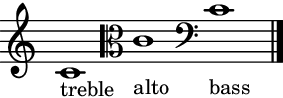
The treble clef fixes G; the bass clef fixes F. The third family of clefs fixes middle C. A C clef looks like two back-to-back brackets whose centre points at a line, and whichever line it points at is middle C. Placed on the middle line of the stave, it is called the alto clef.
With middle C on the middle line, the alto stave reads:
| Bottom to top | |
|---|---|
| Lines | F, A, C, E, G |
| Spaces | G, B, D, F |
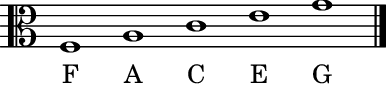
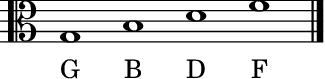
The middle line is the same middle C that hangs below the treble stave and floats above the bass stave. One pitch, three written homes. If you ever lose your place in the alto clef, come back to the centre line and count outwards.
Who uses it, and why
The alto clef is the everyday clef of the viola (and occasionally the alto trombone). The viola's range sits awkwardly between the violin's and the cello's: written in treble clef it would drown in ledger lines below the stave, and in bass clef it would drown in ledger lines above. The alto clef centres the viola's range on the stave, which is the entire reason the clef survives.
Learning to read it
Do not read alto clef by mentally shifting treble clef ("everything looks a line too high..."). Translation tricks feel clever and stay slow forever. Learn the alto stave's own landmarks: middle C on the centre line, G at the top line and bottom space, F at the bottom line, E in the third space. Then practise, ideally by writing short melodies into alto clef by hand. A few focused sessions make it stick.
Key signatures in the alto clef
A key signature is not a picture to be copied from one clef into another. Each sharp or flat stands on the line or space that names the note it alters, so changing the clef moves every one of them. The alto clef sets each letter one place lower on the stave than the treble clef does, and the bass clef one place lower again, and that is exactly how far the key signature shifts.
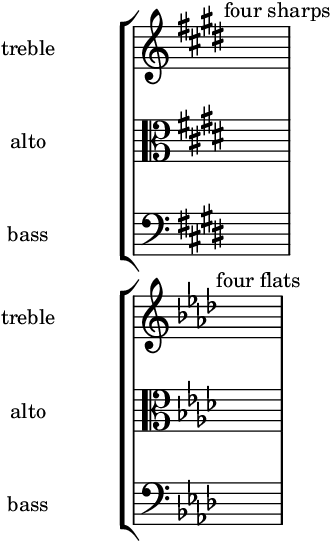
The flats keep their familiar zig-zag in all three clefs and only change height. The sharps are the ones to watch. In the treble clef the third sharp, G♯, has to be written in the space above the top line, and that outlier is what most people remember about the pattern. In the alto clef it comes back down on to the top line, so the whole group sits inside the stave: F♯ in the top space, C♯ on the middle line, G♯ on the top line, D♯ in the space just above the middle line.
Write both patterns out a few times in the alto clef before you need them. Chapter 11 puts them to work, because a passage rewritten into the alto clef needs its key signature rewritten as well.
2. Double sharps and double flats
A sharp raises a note one semitone. A double sharp, written 𝄪, raises it two semitones, a whole tone. F𝄪 sounds the same as G. A double flat, written ♭♭, lowers a note a whole tone: B♭♭ sounds the same as A.
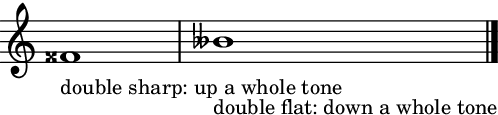
Why would anyone write F𝄪 instead of plain G? For the same reason F♯ minor's raised seventh is E♯ rather than F: spelling. A scale or chord must use the letter names its structure demands. If a note that is already sharp in the key signature needs raising another semitone, the letter must stay put, and only a double sharp can say "this F, already sharpened, goes up one more". You will meet the flagship example shortly: G♯ minor, whose harmonic form needs F𝄪.
Cancelling works as you would expect: a natural sign wipes out a double just as it wipes out a single. (Older scores sometimes wrote ♮♯ to step a double sharp down to a single sharp; the modern convention is simply to write the sign you now want.) To move from F𝄪 to F♯, write ♯ before the note.
3. Enharmonic equivalents
Press the black key between C and D. What is that note called? It depends on where the music is going. Approached from below and rising, it is C♯, a raised C. Approached from above and falling, it is D♭, a lowered D. One sound, two names. Notes that share a pitch but not a spelling are enharmonic equivalents of each other, and the idea runs right through the rest of theory.
Every one of the five black keys has two ordinary names, and the white keys have them too:
| Note | Enharmonic equivalent |
|---|---|
| C♯ | D♭ |
| D♯ | E♭ |
| F♯ | G♭ |
| G♯ | A♭ |
| A♯ | B♭ |
| B | C♭ |
| C | B♯ |
| E | F♭ |
| F | E♯ |

Bring the double accidentals in and the pairs multiply. F𝄪 sounds as G; B♭♭ sounds as A; C𝄪 sounds as D. Almost any pitch can be written three ways once double signs are allowed, which is why the last three pairs in that engraving matter more than they look: B♯ and C are the same piano key, E and F♭ are another, and F𝄪 lands squarely on G.
Finding one in a hurry
The mechanical rule works every time. To respell a sharpened note with a flat, move up one letter and flatten; to respell a flattened note with a sharp, move down one letter and sharpen.
- G♯: up one letter to A, and flatten it: A♭.
- E♭: down one letter to D, and sharpen it: D♯.
- B: up one letter to C, and flatten it: C♭.
- F𝄪: up one letter to G, no accidental needed: G♮.
Count semitones afterwards if you want to check. Both spellings must sit on the same piano key, and no other test is required.
Why the spelling is not arbitrary
An enharmonic equivalent sounds identical, so a beginner reasonably asks why composers do not simply write whichever is easier. The answer is that notation carries two kinds of information at once: which key to press, and what the note is doing. The letter name reports the second.
Three cases where the choice is forced:
- Inside a scale. A scale uses each letter once. D♭ major must run D♭, E♭, F, G♭, A♭, B♭, C: writing F♯ instead of G♭ would give the scale two F's and no G.
- On a raised leading note. G♯ minor's harmonic seventh is F𝄪, not G, because the tonic already owns the letter G.
- Inside an interval. C up to F♯ is an augmented 4th; C up to G♭ is a diminished 5th. Same sound, different letters, different names, as chapter 9 sets out in full.
Exam questions test this directly. A typical one shows a note and asks you to write the same pitch with a different name, or gives four spellings and asks which one sounds the same as the note printed. Answer by pitch, and write the letter the question forces on you. (Whole keys can be enharmonic equivalents too. C♭ major, with seven flats, sounds the same as B major, with five sharps, and F♯ major and G♭ major are the pair with six accidentals each. Key signatures that large wait for Grade 5.)
4. Longer, shorter, and double-dotted
The breve
Above the semibreve sits the breve, worth two semibreves, or eight crotchet beats. It is drawn as a hollow note-head with a short vertical stroke on each side (some editions box it in completely). Its rest is a small filled block filling the whole space between two stave lines. The breve is rare in modern music but common in older vocal writing, and it completes the family tree at the top.
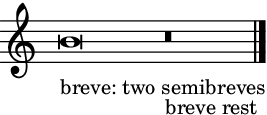
For the exam, a whole silent bar takes a semibreve rest in every time signature. Printed editions do use a breve rest for a silent bar of 4/2, which is why you may meet one, but the answer the examiner wants is still the semibreve rest. Where the breve rest properly belongs is a stretch of silence two semibreves long that is actually counted out, which in modern scores is rare and in older vocal parts is not.
The demisemiquaver again
Grade 3 introduced the demisemiquaver, half a semiquaver and an eighth of a crotchet, carrying three tails or a triple beam in groups. Thirty-two of them fill a semibreve, which its American name (thirty-second note) states outright. It reappears here only because the breve now completes the chain at the other end.

The full chain now runs:
1 breve = 2 semibreves = 4 minims = 8 crotchets = 16 quavers = 32 semiquavers = 64 demisemiquavers
Double dots
One dot adds half a note's value. A second dot adds half of what the first dot added, that is, a quarter of the original note.
- Double-dotted crotchet: 1 + ½ + ¼ = 1¾ beats.
- Double-dotted minim: 2 + 1 + ½ = 3½ beats.
A double-dotted note usually pairs with a short note that tops the beat up exactly: a double-dotted crotchet plus a semiquaver makes two beats; a double-dotted minim plus a quaver makes four. The effect is a sharper, more ceremonial version of the ordinary dotted rhythm, familiar from stately overtures.
Double dots apply to rests in exactly the same way, and the arithmetic does not change. A double-dotted crotchet rest is 1 + ½ + ¼ = 1¾ beats of silence, so a semiquaver tops it up to two beats. A double-dotted minim rest is 2 + 1 + ½ = 3½ beats, and a quaver completes the bar of 4/4.

5. All the duple, triple and quadruple times
The complete grid
Every time signature you have met so far is duple, triple or quadruple: two, three or four beats in the bar. Grade 4 completes the set. Nothing new happens to the counting; what changes is the note chosen to be the beat, and a beat can be a minim, a crotchet or a quaver, dotted or undotted.
Two questions answer any signature. Is it simple or compound, and what is one beat worth?
| Duple (2 beats) | Triple (3 beats) | Quadruple (4 beats) | One beat | |
|---|---|---|---|---|
| Simple | 2/2 | 3/2 | 4/2 | minim |
| 2/4 | 3/4 | 4/4 | crotchet | |
| 2/8 | 3/8 | 4/8 | quaver | |
| Compound | 6/4 | 9/4 | 12/4 | dotted minim |
| 6/8 | 9/8 | 12/8 | dotted crotchet | |
| 6/16 | 9/16 | 12/16 | dotted quaver |
Read the grid downwards and the pattern is obvious: the bottom number halves each time, so the beat halves too. Read it across and the top number counts beats in simple time, divisions in compound time. The tests you already use still work. A top number of 2, 3 or 4 means simple; 6, 9 or 12 means compound, and dividing by three gives the number of beats.
Most of the grid is already familiar: 2/4, 3/4 and 4/4 from Grade 1, 3/8, 2/2, 3/2 and 4/2 from Grade 2, 6/8, 9/8 and 12/8 from Grade 3. The signatures new at this grade are 4/8 among the simple times and 6/4, 9/4, 6/16, 9/16 and 12/16 among the compound. The two remaining cells, 2/8 and 12/4, are rare in practice but examinable like the rest, and they follow the same rules as their neighbours.
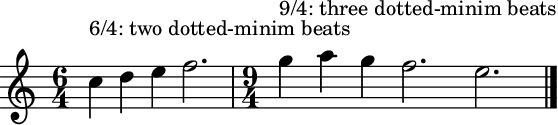

6/4 has a particular flavour worth knowing, because it is easily confused with 3/2. Both bars hold six crotchets. In 3/2 they fall in three pairs, ONE-two, THREE-four, FIVE-six; in 6/4 they fall in two threes, ONE-two-three, FOUR-five-six. Beaming, and the choice of dotted minims rather than minims for full beats, tells the reader which is meant. It is exactly the 3/4 against 6/8 argument, one level up.
Grouping in the new times
The golden rule has not changed and never will: group so that the beats are visible. Apply it beat by beat and every one of these signatures behaves.
- In simple time, beam the divisions of each beat together. In 4/8, whose beat is a quaver, that means beaming semiquavers in pairs; quavers, being whole beats, are beamed in twos so the half-bar is visible.
- In compound time, beam the three divisions of each beat as one group. In 6/16, semiquavers beam 3 + 3; in 9/16, three groups of three; in 12/16, four groups. 6/4 and 9/4 use crotchets, which carry no beams, so the grouping shows instead in the note values chosen: a full beat is written as one dotted minim, not as a minim tied to a crotchet.
- Never let a beam run through the middle of a beat, and in quadruple time never let one run through the middle of the bar. A 4/8 bar beamed as four continuous quavers hides both.
Rests follow the same logic. Each beat's silence is written so that the beat can still be counted, and a rest is never allowed to blur a beat boundary the way a note may with a tie.
- A silent beat in 6/8 takes a dotted crotchet rest; in 6/16, a dotted quaver rest; in 6/4, 9/4 and 12/4, a dotted minim rest. That dotted minim rest is the one genuinely new rest of the grade, and it stands for exactly one beat in any compound time whose beat is a dotted minim. What it must never do is turn up in simple time, or swallow two beats of 6/8.
- A silent bar takes a semibreve rest, whatever the signature.
- Within a beat, build the silence from the divisions, and keep the start of each beat visible.
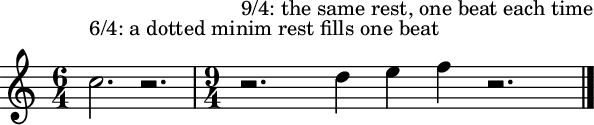
Two habits will carry you through any grouping question. Work out the beat first and write it at the top of the page. Then take the bar one beat at a time, and refuse to let any note, beam or rest cross a beat boundary unless a tie makes it obvious what is happening.
(Metres of five and seven beats, which fit none of these patterns, arrive at Grade 5.)
Duplets
Grade 3's triplet pushed three notes into the time of two. The duplet does the opposite: two notes in the time of three, marked with a small figure 2. Its home is compound time. In 6/8 a beat is a dotted crotchet holding three quavers, and a duplet of two quavers spreads evenly across that beat, each one lasting as long as an ordinary dotted quaver, which is to say one and a half of the beat's normal quavers.
The same thing happens wherever a beat divides into three, and the note value of the duplet always matches the division it is replacing. In 6/4 the beat is a dotted minim holding three crotchets, so the duplet is two crotchets in the time of three. In 6/16 the beat is a dotted quaver holding three semiquavers, so the duplet is two semiquavers in the time of three. Find the beat's ordinary division, write two of them under the figure 2, and the arithmetic takes care of itself.

Triplets and duplets belong to the wider family of irregular note-groups, all marked by a small figure: quadruplets, quintuplets and beyond work the same way, the number telling you how many notes squeeze into the normal space. At this grade, triplets and duplets are the two you must write fluently.
6. Keys to five sharps and five flats
The new majors
| Key | Signature | In order |
|---|---|---|
| B major | 5 sharps | F♯, C♯, G♯, D♯, A♯ |
| D♭ major | 5 flats | B♭, E♭, A♭, D♭, G♭ |
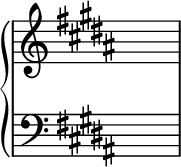
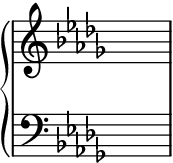
B major: B, C♯, D♯, E, F♯, G♯, A♯, B D♭ major: D♭, E♭, F, G♭, A♭, B♭, C, D♭
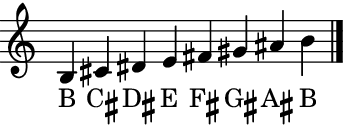
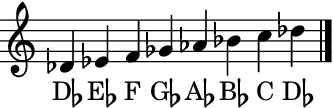
The recognition tricks still hold. Five sharps: last sharp A♯, a semitone up is B. Five flats: second-to-last flat is D♭.
The new minors
| Minor key | Signature | Relative major | Raised 7th (harmonic) |
|---|---|---|---|
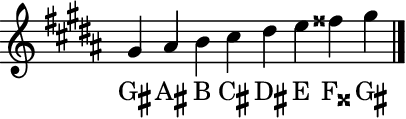
| G♯ minor | 5 sharps | B major | F𝄪 |
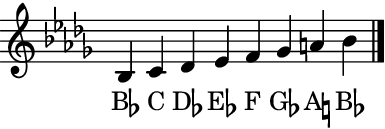
| B♭ minor | 5 flats | D♭ major | A♮ |
G♯ minor is where the double sharp earns its keep. Its seventh degree, from the key signature, is already F♯. The harmonic minor raises the seventh a semitone while keeping the letter, and a semitone above F♯, spelled with an F, is F𝄪. It sounds like G, but G is the tonic's letter and is already spoken for.
G♯ harmonic minor: G♯, A♯, B, C♯, D♯, E, F𝄪, G♯ B♭ harmonic minor: B♭, C, D♭, E♭, F, G♭, A♮, B♭
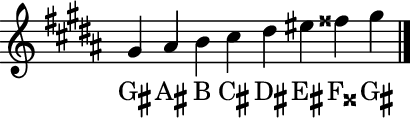
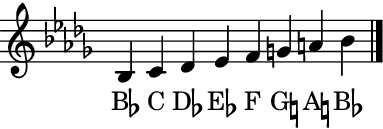
The melodic forms follow the usual rule (raise 6 and 7 ascending, restore descending):
G♯ melodic minor ascending: G♯, A♯, B, C♯, D♯, E♯, F𝄪, G♯ B♭ melodic minor ascending: B♭, C, D♭, E♭, F, G♮, A♮, B♭
Your complete key inventory now runs to five accidentals each way: majors C, G, D, A, E, B and F, B♭, E♭, A♭, D♭; minors A, E, B, F♯, C♯, G♯ and D, G, C, F, B♭.
Tonic triads
| Key | Tonic triad |
|---|---|
| B major | B, D♯, F♯ |
| D♭ major | D♭, F, A♭ |
| G♯ minor | G♯, B, D♯ |
| B♭ minor | B♭, D♭, F |
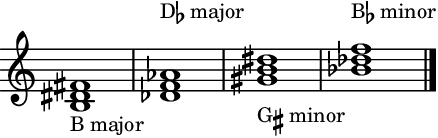
The tonic triad is no longer the only one you owe the examiner. Chapter 10 adds the triads on the subdominant and dominant of every key in the list above.
7. The chromatic scale
A chromatic scale climbs (or descends) entirely in semitones, touching all twelve pitches within the octave before arriving back at the starting letter. It has no tonic-centred pattern of tones and semitones and so no key colour of its own; it is simply the complete ladder.
Because most pitches have two possible names, writing a chromatic scale is a spelling exercise. The conventions:
- Ascending, prefer sharps to raise notes.
- Descending, prefer flats to lower them.
- Use each letter name for at most two consecutive notes, and never skip a letter entirely.
Ascending from C:
C, C♯, D, D♯, E, F, F♯, G, G♯, A, A♯, B, C

Descending from C, the same pitches spell themselves flat-wise:
C, B, B♭, A, A♭, G, G♭, F, E, E♭, D, D♭, C

Ascending from G:
G, G♯, A, A♯, B, C, C♯, D, D♯, E, F, F♯, G

Count the notes when you finish: a full chromatic octave contains thirteen written notes (twelve different pitches plus the repeated keynote). If you have fewer, a semitone has gone missing, usually at E to F or B to C, the two places with no black key in between.
8. Technical names of the scale degrees
Until now the scale degrees have been numbers. From Grade 4 they have names, and the names are the working vocabulary of harmony from here to Grade 8 and beyond. Learn them until "dominant" is as instant as "five".
| Degree | Name | Why it is called that |
|---|---|---|
| 1 | Tonic | the keynote, home |
| 2 | Supertonic | the step above the tonic (super: above) |
| 3 | Mediant | midway between tonic and dominant |
| 4 | Subdominant | a fifth below the tonic, mirroring the dominant a fifth above |
| 5 | Dominant | the most important note after the tonic |
| 6 | Submediant | midway between tonic and subdominant, counting downwards |
| 7 | Leading note | leads upward, a semitone below the tonic in major and harmonic minor |
| 8 | Tonic | home again, an octave up |

The two sub- names cause most of the errors, and the logic is worth absorbing rather than memorising blind. Stand on the tonic and look both ways. A fifth above is the dominant; a fifth below is the subdominant. A third above is the mediant; a third below is the submediant. The prefix means "the mirror image below", not "the next one down". Once that picture is in place, subdominant = 4 and submediant = 6 stop needing effort.
The names apply in every key, major and minor. In E♭ major the dominant is B♭; in C♯ minor the subdominant is F♯; in G minor the leading note (harmonic form) is F♯.
9. Intervals by quality
This is the heart of Grade 4. Up to now, "a 3rd" was a complete answer. From now on every interval has two coordinates: a number, found exactly as before, and a quality, which pins down its precise size in semitones. The five quality words:
perfect, major, minor, augmented, diminished
Step one: the number, as always
Count letter names inclusively. C to G is a 5th. So is C♯ to G, and C to G♭, and C♯ to G♭: accidentals never change the number, because the number lives in the letters alone.
Step two: the quality
The reliable method is to treat the lower note as a temporary tonic and ask: is the upper note in the lower note's major scale?
If it is, the interval is one of the "scale-perfect" defaults:
- unison, 4th, 5th, octave: perfect
- 2nd, 3rd, 6th, 7th: major
If it is not, measure how far the upper note deviates from the in-scale version:
- one semitone smaller than major: minor
- one semitone smaller than perfect, or smaller than minor: diminished
- one semitone larger than major or perfect: augmented
Two chains summarise the whole system, each step worth one semitone:
for 2nds, 3rds, 6ths, 7ths: diminished, minor, MAJOR, augmented for unisons, 4ths, 5ths, octaves: diminished, PERFECT, augmented
Notice what the chains imply: 4ths, 5ths, unisons and octaves are never called major or minor, and 2nds, 3rds, 6ths and 7ths are never called perfect. If you ever find yourself writing "major 5th", the number or the quality is wrong.
Worked examples
- C up to E. A 3rd. E is in C major, so: major 3rd.
- C up to E♭. Still a 3rd (letters C to E). E♭ is a semitone below the in-scale E: minor 3rd.
- C up to G. A 5th. G is in C major: perfect 5th.
- C up to G♭. A 5th, one semitone smaller than perfect: diminished 5th.
- C up to F♯. A 4th (C, D, E, F). F♯ is a semitone above the in-scale F: augmented 4th.
- D up to B. A 6th. D major contains B (D, E, F♯, G, A, B): major 6th.
- E up to C. A 6th. E major contains C♯, and C is a semitone smaller: minor 6th.
- B up to F. A 5th. B major contains F♯; plain F is a semitone smaller than perfect: diminished 5th.

When the lower note's major scale is awkward (try imagining D♯ major), respell both notes down a semitone, judge the interval, and the answer transfers: D♯ to A♯ has the same shape as D to A, a perfect 5th.
Any two notes, not just above the tonic
Grade 3 measured intervals only upward from the tonic. Grade 4 lifts that restriction: any two notes of the key, up to an octave apart, in either order. The method needs no adjustment, because it never mentioned the tonic in the first place. Take the lower of the two notes, make it a temporary tonic, and carry on.
The first consequence is that the key's own tonic drops out of the calculation. In A major, the interval from D up to B is judged against D major, not against A: D major contains B as its sixth degree, so the answer is a major 6th. Use the key signature to find out what the notes actually are, then forget the key entirely.
The second consequence is that qualities appear which never turned up above a tonic. The harmonic minor supplies most of them, because raising the seventh degree leaves a gap of three semitones between the sixth and seventh:
| Notes | Key | Interval |
|---|---|---|
| D up to F | C major | minor 3rd |
| F up to B | C major | augmented 4th |
| B up to F | C major | diminished 5th |
| C up to G♯ | A minor, harmonic | augmented 5th |
| F up to G♯ | A minor, harmonic | augmented 2nd |
| G♯ up to F | A minor, harmonic | diminished 7th |

That augmented 2nd from F to G♯ is the harmonic minor's fingerprint, the stretched step that makes the scale sound the way it does and the reason the melodic minor exists at all. Its partner, G♯ up to F, is the diminished 7th: the same two notes the other way round, three semitones short of a perfect octave. One more pair completes the set: G♯ up to C is a diminished 4th, because the perfect 4th above G♯ is C♯ and plain C is a semitone smaller.
You may notice that each augmented interval in the table has a diminished twin using the same two letters reversed, and that the two numbers always add up to nine. That is not a coincidence, and Grade 5 gives it a name.
The semitone table
Knowing the semitone content of each interval lets you verify any answer by brute count:
| Interval | Semitones | Interval | Semitones | |
|---|---|---|---|---|
| minor 2nd | 1 | perfect 5th | 7 | |
| major 2nd | 2 | minor 6th | 8 | |
| minor 3rd | 3 | major 6th | 9 | |
| major 3rd | 4 | minor 7th | 10 | |
| perfect 4th | 5 | major 7th | 11 | |
| augmented 4th / diminished 5th | 6 | perfect octave | 12 |
The tritone
The augmented 4th and the diminished 5th both span six semitones, the exact midpoint of the octave. This shared size is the tritone (three whole tones), the most unstable-sounding interval in the system. C to F♯ and C to G♭ strike the ear identically; only the spelling, and therefore the number, differs. Which name is correct depends on the letters: C to F♯ spans four letter names (an augmented 4th), C to G♭ spans five (a diminished 5th).
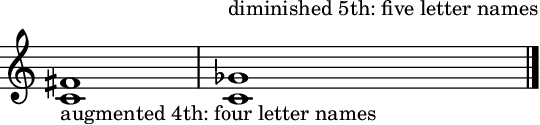
This is the general lesson of interval quality: enharmonic spellings can make identical sounds carry different names, and the written letters always win. An exam question asks about the notes on the page, not the piano key they share.
10. Triads and chords on I, IV and V
Grades 1 to 3 asked for one triad per key, the tonic. Grade 4 asks for three, and gives them their technical names: the triads on the tonic, the subdominant and the dominant, all in root position, in every key up to five sharps and five flats. This is the point where the degree names from chapter 8 and the interval quality from chapter 9 start doing real work together.
Building one
A triad is three notes: a chosen note, the note a 3rd above it, and the note a 5th above it. The chosen note is the root, and a triad standing on its root, with the root as the lowest note, is in root position.
Building a triad on a scale degree means using the notes of the key and nothing else. Take C major and build on the fourth degree, F: the 3rd above is A, the 5th above is C. Triad F, A, C. Nothing was decided; the key supplied every note.
Do that on degrees 1, 4 and 5 of C major and the three triads are:
| Degree | Technical name | Numeral | Triad in C major |
|---|---|---|---|
| 1 | tonic | I | C, E, G |
| 4 | subdominant | IV | F, A, C |
| 5 | dominant | V | G, B, D |
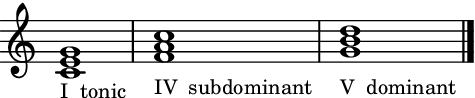
The capital Roman numerals I, IV and V are the standard labels, and they say two things at once: the numeral gives the degree the triad stands on, and in the system you will meet fully at Grade 5, a capital letter means the triad is major. All three are major in a major key. They are called the primary triads because they stand on the three primary degrees, tonic, subdominant and dominant, and between them they contain every note of the scale. That is why so much simple music needs no other chords.
Triads in a minor key
In a minor key the syllabus is explicit: use the harmonic form of the scale. That single instruction settles every question, because the harmonic minor is the form with the raised seventh, and the seventh degree is the middle note of the dominant triad.
Take E minor. The harmonic scale is E, F♯, G, A, B, C, D♯, E.
| Degree | Technical name | Numeral | Triad in E minor |
|---|---|---|---|
| 1 | tonic | i | E, G, B |
| 4 | subdominant | iv | A, C, E |
| 5 | dominant | V | B, D♯, F♯ |

Read the third row carefully, because it is the fact minor keys turn on. The dominant of a minor key is a major triad, since its middle note is the raised leading note, D♯ rather than D. Tonic and subdominant stay minor. Small letters mark the minor ones, and V keeps its capital.
The practical instruction is short: write the key signature, raise the seventh degree by hand, and then build the triads from what you see. The raised note will always need an accidental, because no minor key signature supplies it.
Triad or chord?
The syllabus asks for triads on those three degrees, and separately for chords on them. The distinction is worth being exact about.
- A triad is the bare three-note structure: root, 3rd, 5th, usually written as three notes stacked on one stave.
- A chord is that harmony as it actually appears in music: the same notes, in any octave, in any order above the bass, with any of them doubled, spread across two staves if the writing calls for it.
What makes a chord "root position" is one thing only: the lowest sounding note is the root. Everything above it may be arranged freely.
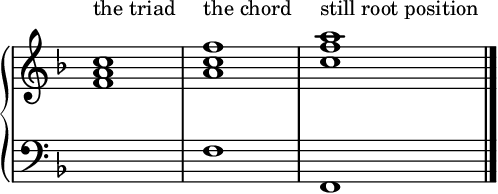
So the answer to "is this a root-position chord of IV in C major?" runs: collect the letter names, throw away duplicates, stack them in 3rds to find the root, check that root is the lowest note sounding, and check the root is the fourth degree of the key. Four steps, in that order, and the octave arrangement never enters into it.
In the keys of this grade
Nothing changes in the sharpest and flattest keys except the accidentals you are carrying. Two examples from the new keys:
| Key | I or i | IV or iv | V |
|---|---|---|---|
| B major | B, D♯, F♯ | E, G♯, B | F♯, A♯, C♯ |
| B♭ minor | B♭, D♭, F | E♭, G♭, B♭ | F, A♮, C |

B♭ minor shows the minor-key rule in action. Its key signature flattens A, so the raised leading note is A♮ and the dominant triad is F, A♮, C, a major triad. Write the natural in; leave it out and you have written a minor v, which is not what the question asked for.
A reliable way to practise: take a key, write its scale with the harmonic form if it is minor, number the degrees, and then build up from 1, 4 and 5 without looking anywhere else. Do that for all twenty-two keys of this grade and the chapter is finished.
11. Transposition at the octave and between clefs
To transpose is to rewrite music at a different pitch. Grade 4 keeps to the two gentlest cases, first on their own and then together, because the exam sets them as one operation.
At the octave
Every note moves up or down exactly one octave. Letter names, accidentals, rhythms and markings are all unchanged; only the register shifts. The usual purpose is practical: moving a melody into a comfortable range, or between instruments that sound an octave apart.

Between clefs
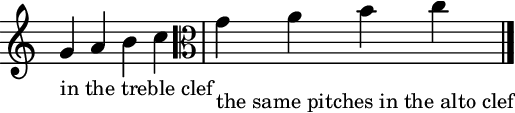
Here the sound stays identical and only the notation changes: the same pitches rewritten from, say, treble clef into alto clef. This is really a test of whether you know where each pitch lives in each clef.
A method that avoids slips:
- Identify each note's actual pitch in the old clef, taking full account of the key signature and any accidentals. Name it precisely: "the F♯ above middle C", not just "F♯".
- Find that identical pitch's position in the new clef and write it there.
- Rewrite the key signature in the new clef's own positions (chapter 1 shows where they fall in the alto clef), then copy the time signature and every accidental, dot, tie, slur and marking.
- Spot-check the first note, the last note, and any note with an accidental.
The step most often fumbled is the first: misjudging the octave of the original. Anchor yourself to middle C in both clefs before you begin.
Both at once
The syllabus sets the two together: a passage in the treble or the bass clef rewritten an octave higher or lower in the alto clef, or an alto-clef passage rewritten into one of the others. Do the two jobs one after the other rather than in one move. Work out the exact pitch of each note, shift it the octave the question asks for, and only then find its place in the new clef.
Take the four notes G, A, B, C printed in the treble clef, climbing from the G above middle C. An octave lower they are the G below middle C, then A, then B, then middle C itself. In the alto clef the G below middle C sits in the bottom space, so the phrase rises from there to middle C on the centre line and the whole of it lies on the stave with no ledger lines at all. That is usually the point of the exercise: the alto clef is chosen because it holds the register comfortably.
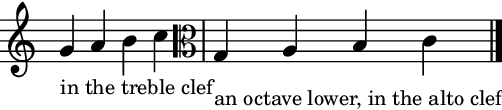
Two checks catch the usual errors. Compare the first note of your answer with the first note of the original and confirm it really is an octave away, not a unison or a 7th. Then look at how much of your answer sits off the stave: if it has piled up ledger lines where the original had none, you have moved the octave the wrong way, or written the new clef as though it were the old one.
12. Ornaments
Ornaments are the small decorations of a melodic line, marked by signs or miniature notes. At Grade 4 the task is recognition: match sign to name and know roughly what each does. (Writing out ornaments in full notation is a Grade 5 skill.)
| Ornament | Sign | What it does |
|---|---|---|
| trill (or shake) | tr, often with a wavy line | rapid alternation between the written note and the note above it |
| turn | a sideways S | a four-note figure: the note above, the note itself, the note below, the note itself |
| upper mordent | a short zig-zag | a quick note, note-above, note |
| lower mordent | a short zig-zag crossed by a vertical stroke | a quick note, note-below, note |
| appoggiatura | a small grace note without a stroke | a "leaning" note that takes a substantial share, typically half, of the main note's time, sounding on the beat |
| acciaccatura | a small grace note with a stroke through its stem | a "crushed" note, played as fast as possible, squeezed in against the main note |
| grace note(s) | one or more small-type notes printed before a main note | the general name for the small notes: a single stroked one is an acciaccatura, a single unstroked one an appoggiatura, and a group of two or more is simply called grace notes, played quickly into the main note |

The acciaccatura and the appoggiatura are the pair most often confused, and the stroke is the visual key: stroke means crushed (acciaccatura), no stroke means leaning (appoggiatura). Their musical effects differ sharply: an appoggiatura is expressive and takes real time; an acciaccatura is a flick. Once two or more small notes are printed together the question of which is which does not arise, and the answer to "name this ornament" is grace notes.
One refinement: an accidental printed above or below an ornament sign applies to the auxiliary note (the upper note of a trill or upper mordent, the lower note of a lower mordent), not to the written main note.
13. The standard orchestral instruments
Grade 4 is the first grade whose questions look past the notation to the player. A passage is printed, and you may be asked which instrument it is written for, which family that instrument belongs to, which clef it reads, or whether a given note lies within its range. Nothing technical is expected. The syllabus asks for the instruments by name and for "knowledge of clefs used and broad understanding of range and family", which is a modest requirement precisely worded.
The orchestra sorts into four families, and the sorting is by how the sound is made, not by how the instrument looks.
| Family | Sound is made by | Instruments at this grade |
|---|---|---|
| strings | a bow drawn across, or a finger plucking, a stretched string | violin, viola, cello, double bass |
| woodwind | a column of air set vibrating, by a reed or by blowing across a hole | flute, oboe, clarinet, bassoon |
| brass | the player's lips buzzing into a cup-shaped mouthpiece | trumpet, horn, trombone, tuba |
| percussion | something struck, shaken or scraped | timpani, side drum, bass drum, cymbals |
Strings
The four bowed strings are the core of the orchestra, and between them they cover almost its whole range. Each is tuned in perfect 5ths except the double bass, which is tuned in 4ths.
| Instrument | Clef | Roughly |
|---|---|---|
| violin | treble | the highest; the orchestra carries two full sections of them |
| viola | alto, and treble when the line climbs | a 5th below the violin, and the alto clef's reason for existing |
| cello | bass, and treble for high passages | an octave below the viola, with a singing upper register |
| double bass | bass | the foundation of the whole texture; its part is written an octave above where it sounds, a convention Grade 5 takes up |
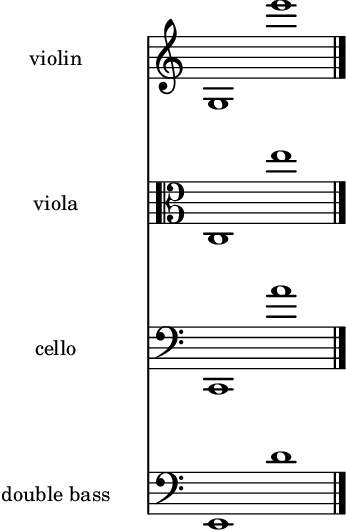
The clefs are the examinable part, and they are the point of chapter 1. A line printed in the alto clef in an orchestral score is a viola line unless something says otherwise.
Strings also carry their own performance directions, which appear over the stave rather than in the notes:
| Direction | Meaning |
|---|---|
| pizzicato (pizz.) | pluck the string with a finger instead of bowing |
| arco | resume bowing; it cancels pizz. |
| the down-bow sign, a bracket like a squared-off staple | draw the bow from heel to tip, the stronger stroke |
| the up-bow sign, a plain V | push the bow from tip to heel, the lighter stroke |
| con sordino, con sordini | with the mute fitted, giving a veiled tone |
| senza sordino, senza sordini | without the mute; take it off |
| avec sourdines / sans sourdines | the same instruction in French |
| sul G | play the passage on the G string |

A slur over a group of string notes means something specific: play them all in one bow stroke. On wind instruments the same sign means one breath, tongued only at the start. It is the same mark doing the same job, adapted to the mechanics.
Woodwind
| Instrument | Clef | Sound produced by |
|---|---|---|
| flute | treble | blowing across a hole, no reed at all |
| oboe | treble | a double reed, two blades of cane vibrating against each other |
| clarinet | treble | a single reed beating against a mouthpiece |
| bassoon | bass, and the tenor clef for high passages, which you meet at Grade 5 | a double reed, like the oboe, an octave and more below it |
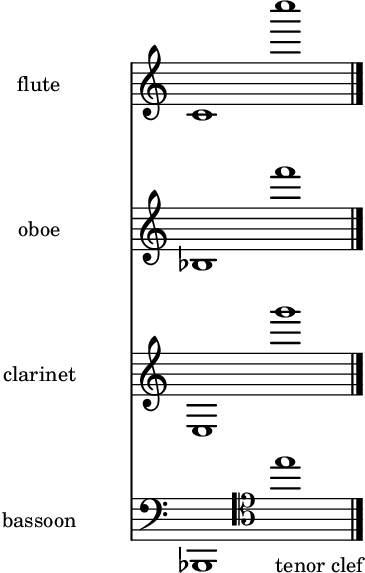
Three of the four live in the treble clef; the bassoon is the family's bass voice and reads the bass clef. The flute is the highest and the brightest, the oboe the most penetrating, the clarinet the most even across its wide range, the bassoon the darkest.
Brass
| Instrument | Clef | Roughly |
|---|---|---|
| trumpet | treble | the highest and most brilliant |
| horn | treble | the family's middle voice, rounder and more distant in tone |
| trombone | bass, and the tenor clef for high passages, which you meet at Grade 5 | the only orchestral brass instrument with a slide instead of valves |
| tuba | bass | the bass of the family, usually one per orchestra |
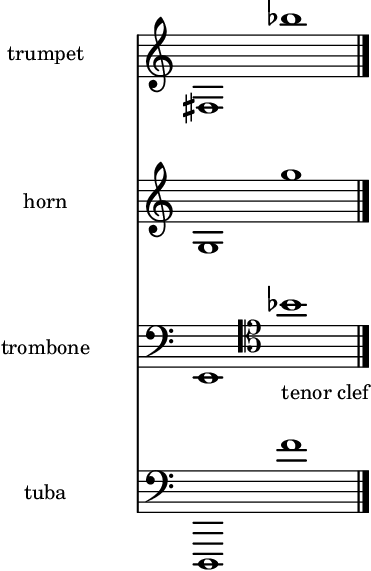
All brass tone starts the same way: the lips buzz, the tube amplifies. Length of tubing sets the pitch, and valves or a slide change the length. (Some brass instruments are written at a pitch different from the one they sound. That is Grade 5's business; at this grade take the printed note at face value.)
Percussion
| Instrument | Notated on | Note |
|---|---|---|
| timpani (kettledrums) | a bass-clef stave, at real pitches | tuned drums, traditionally set to the tonic and dominant |
| side drum (snare drum) | a single-line or ordinary stave, rhythm only | a bright, dry rattle from the snares beneath the head |
| bass drum | a single-line stave, rhythm only | the deepest, most indefinite sound in the orchestra |
| cymbals | a single-line stave, rhythm only | crashed in pairs, or one suspended and struck |
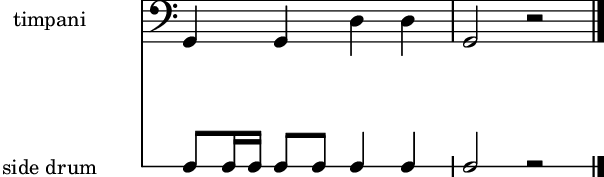
The timpani are the one percussion instrument here that plays actual notes, so they are the one that needs a clef and a key. The rest are written for rhythm alone, which is why their staves often shrink to a single line.
Answering the questions
Exam questions on the passage tend to be short and factual. Which family does the instrument belong to? Which clef is the extract printed in, and which instrument normally reads it? Is the lowest note within that instrument's range? Which of these four instruments could play this passage?
Two habits cover most of them. Read the clef first, because it narrows the field at once: an alto clef means viola, a bass clef in a wind part means bassoon, trombone or tuba. Then check the extreme notes of the passage against the ranges above. You are not expected to know exact limits, only to spot a passage that is plainly too low for a flute or too high for a tuba.
14. Terms and signs at Grade 4
Every term and sign from Grades 1 to 3 stays examinable, and this grade adds a batch of Italian words, the first signs of articulation beyond plain staccato, and the first terms in a second language.
Italian
| Term | Meaning |
|---|---|
| affettuoso | tenderly, with affection |
| alla breve | in two, with the minim as the beat |
| amabile | amiably, pleasantly |
| appassionato | with passion |
| assai | very (allegro assai, very fast) |
| come prima | as at first |
| comodo, tempo comodo | at a comfortable speed |
| con brio | with vigour, with spirit |
| deciso | decisively |
| larghetto | slow, but not as slow as largo |
| mesto | sad |
| misterioso | mysteriously |
| ritmico | rhythmically |
| rubato, tempo rubato | with give and take in the speed |
| stringendo | pressing on, getting faster |
Two of those repay a second look. Rubato means "robbed": time taken from one note is paid back to another, so the pulse bends without the music actually slowing down. And larghetto is a reminder of how Italian diminutives work: the -etto ending softens the word, so larghetto is a less extreme largo, just as allegretto is a less extreme allegro.
Signs
| Sign | Name | Meaning |
|---|---|---|
| a chevron, the ordinary accent turned on its side to point upwards | strong accent (marcato) | attack the note harder than an ordinary accent asks |
| a small pointed wedge, like a dot drawn out to a spike | staccatissimo | shorter and drier than staccato |
| a short horizontal line | tenuto | hold the note for its full value, with a slight weight |
| dots under a slur | semi-staccato | detached, but gently: separated without being clipped |

The four sit on a scale of attack and length. Tenuto is the longest and smoothest, semi-staccato slightly detached, staccato short, staccatissimo shortest. The strong accent concerns loudness at the start of the note rather than its length, and it asks for more force than the ordinary accent > that you already know.
French
From Grade 4 the vocabulary reaches beyond Italian, because composers write directions in their own languages. The first six French words:
| Term | Meaning |
|---|---|
| lent | slow |
| modéré | at a moderate speed |
| vite | fast |
| animé | animated, lively |
| douce | sweet, soft |
| retenu | held back |
A practical tip: group each new word against the Italian you already know rather than learning it as an isolated fact. Lent joins lento and largo; vite and animé join vivace and animato; retenu joins ritenuto; modéré is simply moderato. Pairs stick where lists slide off. (German terms join the glossary at Grade 5.)
15. Common mistakes at Grade 4
- Reading alto clef as if it were treble clef one position out. Learn its own landmarks; middle C is the centre line.
- Writing G for F𝄪, or otherwise "simplifying" a spelling the structure demands. The letter is part of the answer.
- Treating the second dot as another half of the note. It adds half of the first dot's value: a quarter of the note.
- Calling a 4th or 5th major or minor, or a 3rd perfect. Each number owns one chain of qualities only.
- Forgetting that the interval number comes from letters alone. C to G♭ is some kind of 5th before you even think about quality.
- Confusing the two sub- degrees: subdominant is 4 (a 5th below the tonic), submediant is 6 (a 3rd below).
- Writing a chromatic scale with three notes on one letter, or twelve written notes instead of thirteen.
- Reading 6/4 as three minim beats. Top numbers of 6, 9 and 12 are compound, whatever the bottom number: 6/4 is two dotted-minim beats.
- Beaming a bar of 12/16 in fours, or a bar of 4/8 straight through the middle. Beam by beat, always.
- Using a dotted minim rest in simple time, or letting one stand for two beats of 6/8. It fills one beat in the compound times whose beat is a dotted minim: 6/4, 9/4 and 12/4.
- Reaching for a breve rest to empty a bar. In an exam answer a whole silent bar takes a semibreve rest in every time signature.
- Building the dominant triad of a minor key from the key signature alone. The harmonic form raises the seventh, so V is major and its middle note needs an accidental.
- Deciding a chord is in root position because the root appears somewhere in it, or because it is written in the order root, 3rd, 5th. Only the lowest sounding note settles the question.
- Swapping the mordents: the vertical stroke through the zig-zag means the lower mordent.
- Muddling the grace notes: the stroke through the stem marks the acciaccatura, the crushed one.
- Naming an instrument from its range alone when the clef has already answered the question. Alto clef means viola.
- In clef transposition, landing every note a neat octave wrong. Anchor the first note's exact pitch, octave included, before copying anything.
16. Practice questions
Answers follow in the next section.
- On the alto stave, which note is on the middle line, and which is in the bottom space?
- What is a double-dotted minim worth, in crotchet beats?
- Why does G♯ minor's harmonic scale need a double sharp, and on which degree?
- Write the chromatic scale ascending from G, one octave.
- Give the technical names of the 4th and 6th degrees, and explain the sub- logic that distinguishes them.
- Describe fully, by number and quality: (a) D up to F, (b) E up to B, (c) F up to B, (d) A up to E♭.
- A duplet plays how many notes in the time of how many, and in which kind of time signature is it at home?
- What distinguishes an appoggiatura from an acciaccatura, in sign and in effect?
- Name the major key with five flats and write out its scale.
- How many beats are there in a bar of 6/4, and what note value is one beat? Answer the same for 9/16 and for 4/8.
- Which rest fills one whole beat in 9/4, and in which other time signatures does it do the same job?
- B up to F: give the interval's full name, then respell the F as E♯ and name the new interval. Why do the answers differ when the sound does not?
- How many demisemiquavers fill one minim?
- The note D𝄪 needs to become D♯. What do you write before the note?
- Give an enharmonic equivalent of each: (a) A♯, (b) G♭, (c) B, (d) E.
- Write the notes of the tonic, subdominant and dominant triads of E♭ major, and name each with its Roman numeral.
- Write the notes of the same three triads in C♯ minor, and say which one is major and why.
- A chord is written, from the bottom up, as C, G, E, C. Which degree of C major is it built on, is it in root position, and what is its Roman numeral?
- Name the four families of the orchestra and one instrument from each.
- Which instrument normally reads the alto clef, and which family does it belong to?
- What does pizz. instruct a string player to do, and which word cancels it?
- Two notes of A minor's harmonic scale, F and G♯, are sounded together. Name the interval fully, and name it again with the notes the other way round.
- What does stringendo mean? And mesto? And the French vite?
- A note carries a short horizontal line above it. What is the sign called, and what does it ask for?
17. Answers
- The middle line is middle C (the alto clef points at it). The bottom space is G.
- 3½ beats: the minim (2) plus half of it (1) plus half of the first dot (½).
- Its seventh degree is F♯ in the key signature, and the harmonic minor raises the seventh a semitone while keeping the letter F. One semitone above F♯, still spelled F, is F𝄪. The degree is the leading note (degree 7).
- G, G♯, A, A♯, B, C, C♯, D, D♯, E, F, F♯, G. Thirteen written notes, sharps used on the way up.
- Degree 4 is the subdominant; degree 6 is the submediant. The dominant lies a 5th above the tonic and the subdominant mirrors it a 5th below; the mediant lies a 3rd above and the submediant mirrors it a 3rd below.
- (a) Minor 3rd: D major contains F♯, and F is a semitone smaller. (b) Perfect 5th: B is in E major. (c) Augmented 4th: F major contains B♭, and B♮ is a semitone larger; this is the tritone. (d) Diminished 5th: A major contains E, and E♭ is a semitone smaller than perfect.
- Two notes in the time of three. Its home is compound time, where it spreads two equal notes across a dotted-note beat that normally holds three.
- The appoggiatura is written as a small note without a stroke; it sounds on the beat and takes a substantial share, usually half, of the main note's value. The acciaccatura has a stroke through its stem; it is crushed in as fast as possible, barely stealing any time.
- D♭ major: D♭, E♭, F, G♭, A♭, B♭, C, D♭.
- 6/4: two beats, each a dotted minim. 9/16: three beats, each a dotted quaver. 4/8: four beats, each a quaver.
- The dotted minim rest. It fills one beat in the compound times whose beat is a dotted minim: 6/4, 9/4 and 12/4.
- B up to F is a diminished 5th (five letter names, one semitone smaller than the perfect 5th of B major, which contains F♯). B up to E♯ is an augmented 4th (four letter names, one semitone larger than the perfect 4th B to E). The sound is the same six semitones; the names differ because interval numbers are counted from the written letters, and the two spellings use different letters.
- Sixteen. A minim is two crotchets, each crotchet is eight demisemiquavers.
- A single sharp sign. Writing ♯ before the note resets it from double sharp to sharp. (A natural sign would cancel both sharps and give plain D.)
- (a) B♭. (b) F♯. (c) C♭. (d) F♭.
- E♭ major runs E♭, F, G, A♭, B♭, C, D. Tonic I: E♭, G, B♭. Subdominant IV: A♭, C, E♭. Dominant V: B♭, D, F.
- C♯ harmonic minor runs C♯, D♯, E, F♯, G♯, A, B♯. Tonic i: C♯, E, G♯. Subdominant iv: F♯, A, C♯. Dominant V: G♯, B♯, D♯, and it is the major one, because its middle note is the raised leading note B♯ rather than B.
- The letter names are C, E and G, which stack as the tonic triad, so it is built on degree 1. The lowest note is C, the root, so it is in root position; the extra C at the top is the root doubled and changes nothing. The numeral is I.
- Strings (violin, viola, cello, double bass), woodwind (flute, oboe, clarinet, bassoon), brass (trumpet, horn, trombone, tuba), percussion (timpani, side drum, bass drum, cymbals). Any one from each family is enough.
- The viola, of the string family.
- Pluck the string with a finger instead of using the bow. Arco cancels it and returns the player to the bow.
- F up to G♯ is an augmented 2nd: a major 2nd above F is G, and G♯ is a semitone larger. G♯ up to F is a diminished 7th: a minor 7th above G♯ is F♯, and F♮ is a semitone smaller.
- Stringendo: pressing on, getting faster. Mesto: sad. Vite: fast.
- Tenuto. Hold the note for its full written length, with a little weight on it.
Next step: Grade 5 completes the system: the tenor clef, all keys to six sharps and flats, the tonic, supertonic, subdominant and dominant chords in root position and in both inversions, cadences and the choice of chords for a melody, transposing instruments, the types of voice and the scores they are printed in, the rest of the orchestra, the metres of five and seven beats, irregular divisions of the beat, and ornaments matched to the notes they stand for. Interval quality and the three chords of chapter 10 are the tools the whole grade leans on, so carry them forward sharp.