A complete, self-contained course for the fifth grade of the ABRSM Music Theory syllabus: the tenor clef and the four-clef family, all keys to six sharps and flats, intervals simple, chromatic and compound, the tonic, supertonic, subdominant and dominant chords in all three positions, cadences and chord choice, transposition and transposing instruments, voices and score types, the orchestra and the way it makes its sound, written-out ornaments and the signs that replace them, irregular time signatures and irregular divisions of the beat, and the full three-language vocabulary.
Introduction
Grade 5 is the gateway grade, and it earns the position honestly. A pass unlocks the higher practical exams, but the better reason to take it seriously is that this is where theory becomes harmony: chords with names and functions, cadences that end phrases the way punctuation ends sentences, and the first real answers to why music sounds finished or unfinished.
Several long arcs complete at once here. The key system runs out to six sharps and six flats, the clef family gains its fourth working member, and the interval training of Grade 4 pays out in triads, inversions and Roman numerals. What was learned as separate facts starts behaving like one connected subject, which is exactly what the harder questions test.
Work the harmony chapters patiently and aloud. Cadence recognition and chord choice are skills of the ear as much as of the page: play every example, transpose the cadences into other keys, and harmonise real tunes beyond the ones printed here. Ten minutes of playing progressions teaches more than an hour of staring at them.
After this grade the reference shelf takes over. Musical Harmony and Roman Numeral Analysis continue the harmony story to full depth, Technical Names and Roman Numerals tabulates everything this grade makes you derive, and Piano Chords, Musical Modes and Music Notation stand ready for the music beyond the syllabus.
About this guide and the exam
Grade 5 is the milestone. A pass here (or in Grade 5 Practical Musicianship, or a Grade 5 jazz subject) is ABRSM's prerequisite for the Grade 6, 7 and 8 practical exams, which is why so many musicians sit this paper and why it deserves unhurried preparation. The exam is online and multiple choice, like the earlier grades, and it is marked out of 75: 50 marks to pass, 60 for a Merit and 65 for a Distinction. The syllabus is fully cumulative, so anything from Grades 1 to 4 can appear.
The paper runs to seven sections. Section 3 carries 15 marks and the other six carry 10 each, which is worth knowing when you plan your time: no single section is worth abandoning, and none is worth an hour. The marking criteria name the seven areas the Grade 4 and 5 papers assess, and the chapters of this guide line up with them:
| Assessed area | Where it is covered here |
|---|---|
| rhythm | chapters 12 and 13, on top of the time signatures of Grades 1 to 4 |
| pitch and transposition | chapters 1 and 8 |
| keys and scales | chapter 2 |
| intervals | chapter 3 |
| triads and chords | chapters 4, 5, 6 and 7 |
| terms, signs and instruments | chapters 9, 10, 11 and 14 |
| music in context | chapter 15 |
What makes Grade 5 different is its centre of gravity. The earlier grades taught you to read and measure music; this one asks you to understand how it is put together. Chords, inversions, cadences and the harmonisation of melodies are the new spine, and the interval-quality system from Grade 4 is the tool they all depend on. Around that spine sit the practical musician's topics: transposing instruments, choral scores, and the layout of the orchestra.
The syllabus statement for the grade is short enough to quote in full. On top of everything from Grades 1 to 4, Grade 5 adds:
- "Irregular time signatures of 5/4, 7/4, 5/8 and 7/8, and the grouping of notes and rests within these times. Irregular divisions of simple time values."
- "Tenor clef (C clef centred on 4th line). The identification of notes in the four clefs in any of the keys set for this grade, and the transposition at the octave of a simple melody from any clef to another. Transposition to concert pitch of a short melody notated for an instrument in B♭, A or F, and vice versa (the interval of transposition up or down will be given)."
- "Scales and key signatures of all major and minor keys up to and including six sharps and flats. All simple and compound intervals from any note."
- "The root position (a), 1st inversion (b) and 2nd inversion (c) forms of the tonic, supertonic, subdominant and dominant chords in any of the keys set for this grade. The choice of suitable chords at cadential points of a simple melody in the major key of C, G, D or F. Perfect, plagal and imperfect cadences in the major keys of C, G, D or F."
- "More terms and signs. The recognition of ornaments, including the replacement of written-out ornamentation with the appropriate signs, but not vice versa. Questions on the types of voice and names of instruments, the clefs they use, instrument family groups and the basic way by which they produce sound, as well as points of general musical observation designed to test the candidate's ability to apply theoretical knowledge to actual music."
Read that twice, because three phrases in it decide how you revise. The keys stop at six sharps and flats, not seven. The cadence and chord-choice questions are set in C, G, D or F major and nowhere else. And ornaments run one way only: you are shown the notes a composer wrote out in full and asked which sign would replace them, never the reverse.
What Grade 5 asks of you
By the end of this grade you should be able to:
- read and write in the tenor clef, and name a note in any of the four clefs
- rewrite a melody an octave higher or lower in any of the four clefs
- write scales and key signatures for every major and minor key to six sharps and six flats, both forms of the minor included
- describe any interval, simple, chromatic or compound, from any note
- build triads on any degree, and write the tonic, supertonic, subdominant and dominant chords in root position, first inversion and second inversion
- recognise perfect, plagal and imperfect cadences, and choose suitable chords at the cadence points of a melody in C, G, D or F major
- transpose a melody to and from concert pitch for an instrument in B♭, A or F, given the interval
- name the six standard voice types, their clefs and ranges
- know the instruments of the orchestra, their families, clefs, transpositions and the way each produces its sound
- recognise ornamentation written out in full and give the sign that replaces it
- group notes and rests in 5/4, 7/4, 5/8 and 7/8
- read and write irregular divisions of the beat: triplets, quintuplets and sextuplets in simple time, and duplets in compound time
- answer general questions of observation on a short piece of real music
- command a wide vocabulary of Italian, French and German terms
1. The tenor clef and the four clefs
Grade 4 introduced the C clef seated on the middle line (the alto clef). Move the same clef up so it points at the fourth line, and it becomes the tenor clef. That fourth line is now middle C.
| Bottom to top | |
|---|---|
| Lines | D, F, A, C, E |
| Spaces | E, G, B, D |
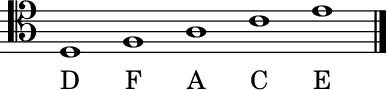
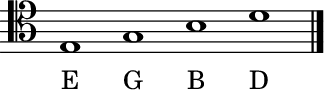
The tenor clef serves the upper registers of instruments that normally live in the bass clef: cello, bassoon, trombone, sometimes double bass. When their parts climb, the bass clef would demand a thicket of ledger lines; the tenor clef catches those notes on the stave.
Keep the two C clefs firmly apart in your mind. Alto: middle C on the third (middle) line. Tenor: middle C on the fourth line. Both are read the same way, outwards from wherever the clef points. As with the alto clef, resist translation tricks and learn the landmarks: middle C on line four, A on the middle line, G in the second space, top line E.
Naming notes in all four clefs
With the tenor clef in place the family is complete, and the paper can put a note on any of the four staves and ask for its name, in any key set for this grade. Middle C is the anchor that ties the four together:
| Clef | Middle C sits | Everyday users |
|---|---|---|
| treble (G clef) | on the first ledger line below the stave | violin, flute, oboe, clarinet, trumpet, horn, right hand of the piano |
| alto (C clef on the third line) | on the middle line | viola, occasionally trombone |
| tenor (C clef on the fourth line) | on the fourth line | high writing for cello, bassoon, trombone, double bass |
| bass (F clef) | on the first ledger line above the stave | cello, bassoon, trombone, tuba, left hand of the piano |

Notice what the four readings have in common: the same three sounds, four different placings. A clef is nothing more than a statement of where one named pitch lives, and every other note follows from it in alphabetical order, upwards through lines and spaces.
Key signatures move with the clef, and in the C clefs they look unfamiliar. Each accidental is placed so that it stays on the stave, so one signature takes four different shapes. Follow the F♯ of D major through them: it sits on the top line in the treble clef, in the fourth space in the alto clef, on the second line in the tenor clef, and on the fourth line in the bass clef.
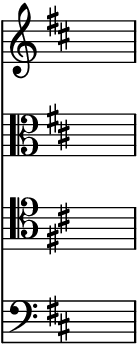
Copy a signature into a C clef by note name, never by shape. Trace the pattern of the treble clef's sharps onto an alto stave and you will have written a different key.
Moving a melody an octave between clefs
Grade 3 moved music an octave between the treble and bass clefs; Grade 4 added the alto. Grade 5 completes the grid: any of the four clefs to any other, at the octave. The point of the exercise is practical. A cello line that runs high in the bass clef is a hedge of ledger lines; put it in the tenor clef and it sits on the stave, note for note the same music.
The routine is short:
- Name every note of the given melody in its own clef, and write the letters down if that steadies you.
- Settle the direction. The new clef usually decides it: a treble-clef tune rewritten in the tenor or bass clef drops an octave, a bass-clef tune rewritten in the treble or alto clef rises one.
- Place each note in the new clef, keeping its letter name and moving it exactly one octave.
- Carry across the key signature (at the new clef's heights), the time signature, every accidental, and all the rests, ties and slurs.
- Check the first note, the last note and the shape of the line. Contour is the giveaway: the rewritten melody must rise and fall by the same steps and leaps.
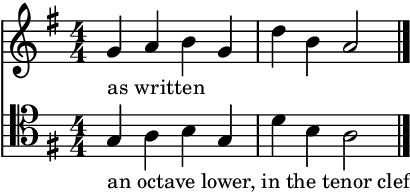
Only the octave changes. The key is the same key, the accidentals are the same accidentals, and no note gains or loses a sharp or flat. That is what separates this task from the transposition of chapter 8, where the key does change.
2. The complete key system
Every key to six sharps and flats
Grade 5 carries the key signatures out to six sharps and six flats: thirteen major keys and their thirteen relative minors, which between them cover every signature in ordinary repertoire. Seven sharps and seven flats exist as well, and Grade 6 sets them; they are not examined here.
| Sharps | Major | Relative minor | Flats | Major | Relative minor | |
|---|---|---|---|---|---|---|
| 0 | C | A minor | 0 | C | A minor | |
| 1 | G | E minor | 1 | F | D minor | |
| 2 | D | B minor | 2 | B♭ | G minor | |
| 3 | A | F♯ minor | 3 | E♭ | C minor | |
| 4 | E | C♯ minor | 4 | A♭ | F minor | |
| 5 | B | G♯ minor | 5 | D♭ | B♭ minor | |
| 6 | F♯ | D♯ minor | 6 | G♭ | E♭ minor |
The old machinery runs the whole table. Sharps accumulate in the fixed order F, C, G, D, A, E, B; flats in the reverse order B, E, A, D, G, C, F. The last sharp is the leading note (a semitone below the major tonic); the second-to-last flat names the flat major key. Every relative minor sits three semitones below its major.
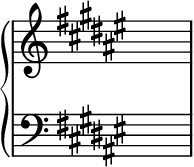
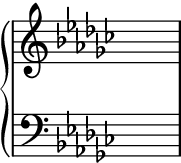
Write those two out by hand until the order comes without thinking. The six-accidental keys are where marks go astray, and a signature one flat short of six is not an approximation of G♭ major, it is D♭ major.
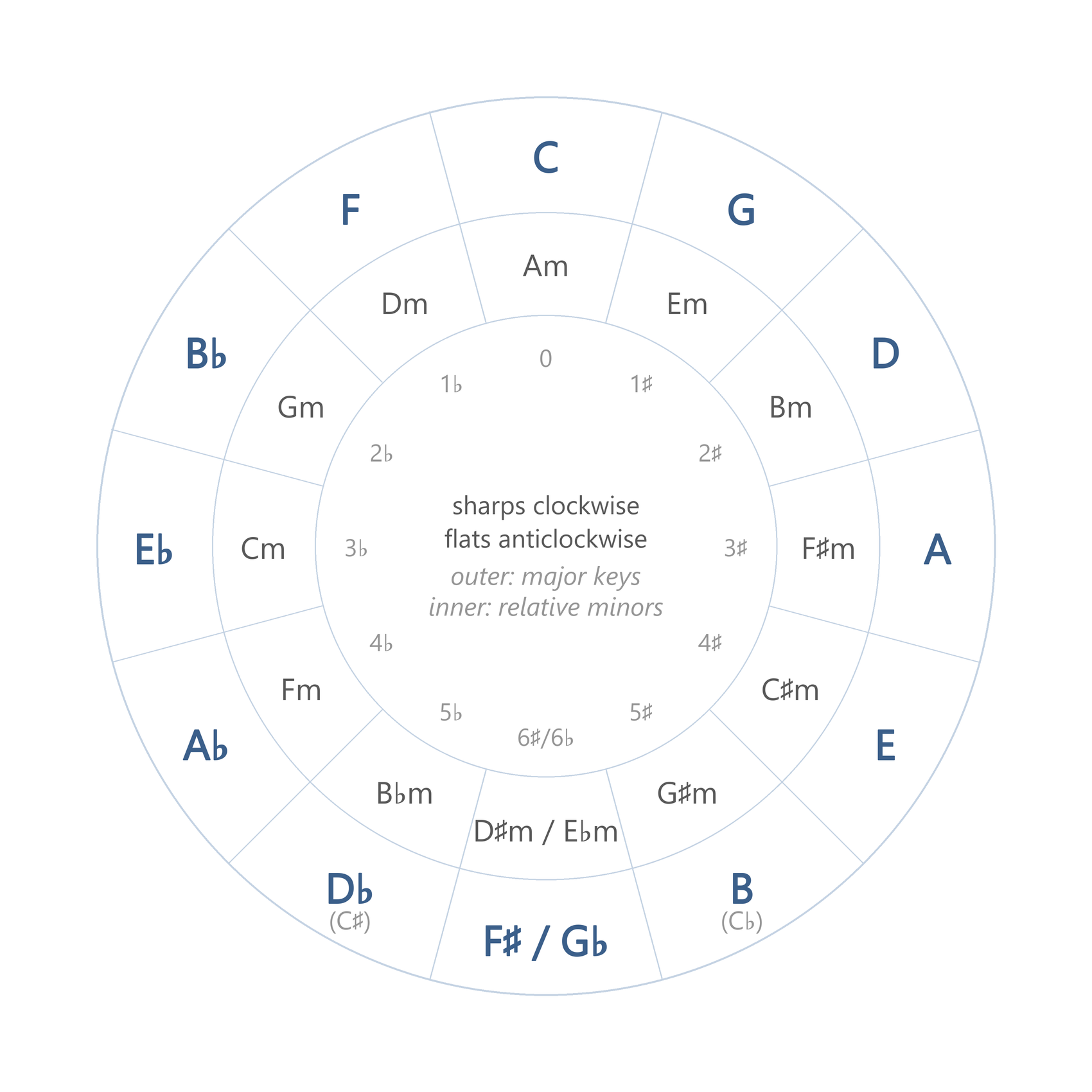
This is also the circle of fifths in table form: each step to a sharper key rises a perfect 5th (C, G, D, A...), and each step to a flatter key falls a perfect 5th (C, F, B♭, E♭...). Arrange the keys around a clock face with C at the top and the pattern closes into a circle, sharps clockwise, flats anticlockwise, meeting at the bottom.
Using the circle in the exam
The circle answers key-signature questions by position alone. The running count of sharps or flats is printed in the centre of the diagram, so asked which major key has four sharps, count four places clockwise from the top and land on E. Asked for the signature of A♭ major, find it four places anticlockwise and read off four flats.
The inner ring saves the three-semitone count. Directly inside each major key sits its relative minor with the same signature: inside E♭ is C minor, inside A is F♯ minor. Minor-key questions run the same lookup in reverse. Find the minor on the inner ring, read outwards for its major, and take the count from the centre. F♯ minor has three sharps at a glance, no arithmetic required.
The bottom of the circle is its only complication. The sharp and flat sides meet there, and the position at six o'clock carries two names, F♯ major and G♭ major, with D♯ minor and E♭ minor inside it. The bracketed C♯ and C♭ on the diagram are the seven-sharp and seven-flat spellings of the two positions beside it; they belong to Grade 6, and you can pass this one without them. When a question offers a key you were not expecting, check this seam first: the answer may be the position you found, under its other name.
None of this replaces the working rules above: the sharp and flat orders, the last-sharp and second-to-last-flat tests, and the three-semitone drop to the relative minor still do the actual naming. What the circle adds is the whole key system in one picture, small enough to redraw from memory in under a minute. Practise sketching it until that is true, and every question in this chapter starts from a diagram you already own.
Enharmonic keys
At the bottom of the circle, spellings overlap. Inside this grade one pair of major keys names an identical sound, and one pair of minors does the same:
- F♯ major (6 sharps) = G♭ major (6 flats)
- D♯ minor (6 sharps) = E♭ minor (6 flats)
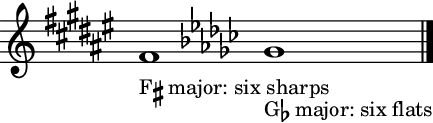
A piano plays each pair with the same keys; only the notation differs. Composers choose whichever spelling reads more easily on the page, which is why one piece sits in D♯ minor while its neighbour in the same volume sits in E♭ minor. Exam questions may ask you to rename a key or a note enharmonically, and the double sharps and double flats of Grade 4 are the tools for it.
Two further pairs exist further round the seam, where five accidentals meet seven: B major with C♭ major, and D♭ major with C♯ major. Recognise them if you meet them in music you play, but they belong to Grade 6, not to this paper.
Writing the scales
Every key in the table can be asked for as a scale, ascending or descending, and every minor in both its forms. Nothing new is being constructed; only the spelling is unfamiliar.
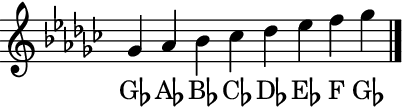
G♭ major runs G♭, A♭, B♭, C♭, D♭, E♭, F, G♭: the plain major pattern of T, T, S, T, T, T, S, with a C♭ where the ear expects a B. Write the seven letters in order first, G, A, B, C, D, E, F, then apply the signature. The C♭ appears because the signature contains it, not because anything unusual is going on.
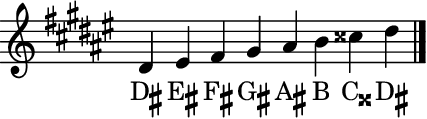
At the sharp end the harmonic minors need double sharps for their raised sevenths. D♯ minor takes six sharps, and raising its seventh degree, C♯, produces C double sharp.
The melodic form raises the sixth and seventh degrees on the way up and restores both on the way down, so at the flat end it puts naturals inside a signature full of flats. E♭ minor ascending is E♭, F, G♭, A♭, B♭, C, D, E♭, its C and D natural against six flats; descending it is E♭, D♭, C♭, B♭, A♭, G♭, F, E♭, every note back inside the signature.

One rule saves most of the marks here: a raised note keeps its letter. The sixth degree of E♭ minor is a C in both directions, C♮ climbing and C♭ falling. Write B♮ for that rising note and the scale ends up with two Bs and no C at all, which is never a scale.
3. Intervals from any note
Measuring from a note that is not the tonic
Grade 3 measured intervals above the tonic of a stated key; Grade 4 allowed any two diatonic notes of a key. Grade 5 lifts the last restriction, and the syllabus is blunt about it: "all simple and compound intervals from any note". Either note of the pair may be chromatic, neither has to belong to the key, and the chromatic and compound intervals themselves arrive with it.
The method from Grade 4 still does the whole job, in two steps.
- Number. Count letter names inclusively, the lower note counting as 1. D up to A is D, E, F, G, A, a 5th. Accidentals never change the number.
- Quality. Treat the lower note as the tonic of a major scale and ask where the upper note falls in it. If it is in that scale, the interval is perfect (unisons, 4ths, 5ths, octaves) or major (2nds, 3rds, 6ths, 7ths). A semitone smaller makes a major interval minor and a perfect interval diminished; a semitone larger than perfect or major makes it augmented; a semitone smaller than minor makes it diminished.
Step 2 is where candidates hesitate, because it can call for a scale nobody plays. D♯ up to A: imagine D♯ major, whose fifth degree is A♯. The written A is a semitone below that, so the interval is a diminished 5th. The scale does not have to be practical, only regular, and the letter pattern is regular in every key.
An interval is harmonic when the two notes sound together and melodic when they follow one another. The name is identical either way; only the look on the page changes.
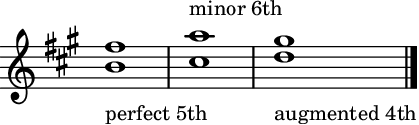
Chromatic intervals
Some intervals cannot be found between two notes of any one major or minor scale. These are the chromatic intervals, and Grade 5 is the grade that names them. Nothing new is needed to work them out; the two-step method handles them unchanged.
| Interval | Example | How it is built |
|---|---|---|
| augmented 3rd | C up to E♯ | a major 3rd stretched a semitone |
| diminished 3rd | C♯ up to E♭ | a minor 3rd squeezed a semitone |
| augmented 6th | C up to A♯ | a major 6th stretched a semitone |
| diminished 6th | C♯ up to A♭ | a minor 6th squeezed a semitone |
| augmented 7th | C up to B♯ | a major 7th stretched a semitone |
| augmented octave | C up to the C♯ above | a perfect octave stretched a semitone |
| diminished octave | C up to the C♭ above | a perfect octave squeezed a semitone |

Several of these sound like something plainer. An augmented 6th, C up to A♯, covers ten semitones, and so does a minor 7th, C up to B♭; on a keyboard they are the same two keys. The spelling decides the answer, and the number is settled by the letters before quality is considered at all. Count C, D, E, F, G, A and you have a 6th, whatever it sounds like.
Compound intervals
An interval wider than an octave is compound. It can be named with its full number or, more usefully, as an octave plus a simple interval:
| Compound | Octave plus | Simple equivalent |
|---|---|---|
| 9th | octave + 2nd | 2nd |
| 10th | octave + 3rd | 3rd |
| 11th | octave + 4th | 4th |
| 12th | octave + 5th | 5th |
| 13th | octave + 6th | 6th |
| 14th | octave + 7th | 7th |
| 15th | octave + octave | octave |
The quality carries over untouched: a major 10th is a major 3rd plus an octave; a perfect 12th is a perfect 5th plus an octave. Working method: subtract 7 from the big number to find the simple interval, judge its quality by the two steps above, then restore the octave. C up to the E an octave and a third higher (a 10th): E is in C major, so major 3rd, so major 10th.
Both names are acceptable in answers unless a question specifies: "compound major 3rd" and "major 10th" describe the same interval. The 15th, two octaves, is the widest the grade asks for, and it is the one that catches people out with its number, since two octaves stacked come to 15 and not 16. Counting inclusively explains it: the middle note is the eighth step of the first octave and the first step of the second, so it is counted once and not twice.

Inverting intervals
To invert an interval, flip its notes: move the lower note up an octave (or the upper note down) so the bottom becomes the top. C up to E (a 3rd) inverts to E up to C (a 6th).
Two rules capture everything:
- The numbers of an interval and its inversion always add up to 9. So 2nds invert to 7ths, 3rds to 6ths, 4ths to 5ths, unisons to octaves, and each pair the other way round.
- The quality flips, with one exception: major becomes minor and minor becomes major; augmented becomes diminished and diminished becomes augmented; perfect stays perfect.
So a major 3rd inverts to a minor 6th, a perfect 5th to a perfect 4th, an augmented 4th to a diminished 5th, a minor 2nd to a major 7th.
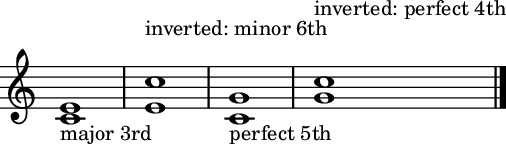
Inversion doubles as a checking device. Unsure whether E up to C is a minor or major 6th? Invert it: C up to E is certainly a major 3rd, and a major 3rd's inversion must be a minor 6th. When a wide interval is hard to judge, its narrow inversion rarely is.
4. Triads on every degree
Triad qualities
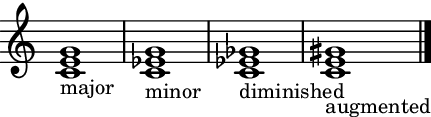
A triad is two 3rds stacked: root, third, fifth. The sizes of the two 3rds fix the triad's quality:
| Quality | Lower 3rd | Upper 3rd | Root to fifth |
|---|---|---|---|
| major | major 3rd | minor 3rd | perfect 5th |
| minor | minor 3rd | major 3rd | perfect 5th |
| diminished | minor 3rd | minor 3rd | diminished 5th |
| augmented | major 3rd | major 3rd | augmented 5th |
Major and minor triads are the everyday consonances. The diminished triad, with its shrunken fifth, sounds tense and unstable; the augmented triad, with its stretched fifth, sounds strange and unresolved. All four appear naturally once you build triads on every degree of a scale.
The diatonic triads of a major key
Build a triad on each degree of C major, using only the scale's own notes, and a fixed pattern of qualities emerges. The same pattern holds in every major key.
| Degree | Numeral | Triad in C | Quality |
|---|---|---|---|
| 1 tonic | I | C, E, G | major |
| 2 supertonic | ii | D, F, A | minor |
| 3 mediant | iii | E, G, B | minor |
| 4 subdominant | IV | F, A, C | major |
| 5 dominant | V | G, B, D | major |
| 6 submediant | vi | A, C, E | minor |
| 7 leading note | vii° | B, D, F | diminished |
The Roman numeral system encodes quality in its casing: upper case for major (I, IV, V), lower case for minor (ii, iii, vi), lower case with a small circle for diminished (vii°). The numeral itself names the degree the chord is built on.

The primary triads, and the supertonic
Three of the seven, I, IV and V, are major, and they are called the primary triads. Between them, their nine notes cover every degree of the scale (I holds degrees 1, 3, 5; IV holds 4, 6, 1; V holds 5, 7, 2). That coverage is why simple tunes can be harmonised with these three chords alone.
Grade 5 adds a fourth: the supertonic, ii, the minor triad on the second degree. These four, tonic, supertonic, subdominant and dominant, are the chords the syllabus names, and the questions in the next three chapters use them and nothing else. The supertonic earns its place by where it goes. Its root stands a 5th above the dominant's, so ii falls to V as readily as V falls to I, and ii before V is the everyday approach to a cadence. In a minor key the same chord comes out diminished (ii° in the table below), which changes its colour but not its errand.
The other three triads, iii, vi and vii°, are worth knowing as part of the pattern, and Grade 6 puts them to work. They are not required in this paper's chord questions.
The diatonic triads of a minor key
Minor-key triads are reckoned with the harmonic minor, raised seventh included, and the raised note changes the qualities markedly. In A minor:
| Degree | Numeral | Triad | Quality |
|---|---|---|---|
| 1 | i | A, C, E | minor |
| 2 | ii° | B, D, F | diminished |
| 3 | III+ | C, E, G♯ | augmented |
| 4 | iv | D, F, A | minor |
| 5 | V | E, G♯, B | major |
| 6 | VI | F, A, C | major |
| 7 | vii° | G♯, B, D | diminished |
The entry that matters most: V is major in a minor key, because the raised seventh (here G♯) is its middle note. That major dominant, leaning hard on the leading note, is what gives minor-key phrase endings their pull toward home. Without the raised seventh, V would be minor and the ending would sag. Wherever cadences are discussed below, this is the fact doing the work.

5. Inversions and how chords are labelled
Three positions
Any triad can stand on any of its three notes. What matters is which note is lowest, in the bass:
| Position | Bass note | ABRSM label |
|---|---|---|
| root position | the root | a |
| first inversion | the third | b |
| second inversion | the fifth | c |
The letters attach to the Roman numeral: Ia, Ib, Ic; Va, Vb, Vc. So in C major, the dominant chord G, B, D with B in the bass is Vb; with D in the bass it is Vc.
Only the bass note defines the inversion. The upper notes may sit in any octave and any order: G, B, D with B at the bottom is Vb whether the G and D above are close or scattered. When you identify a chord from notation, therefore, do it in this order: name the three note-letters, stack them as thirds to find the root, judge the quality, then look at the bass note alone to fix the inversion.
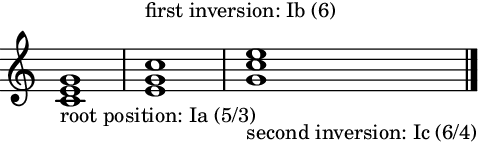
The four chords in their three positions
The syllabus asks for "the root position (a), 1st inversion (b) and 2nd inversion (c) forms of the tonic, supertonic, subdominant and dominant chords" in any key set for the grade. Twelve labels per key, and the quickest way to own them is to write the set out in a different key each day until no counting is needed. Here they are in G major.
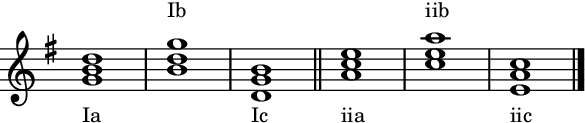
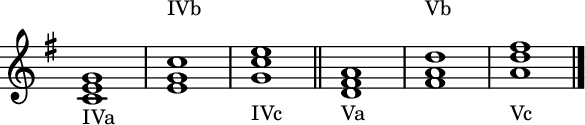
The whole set in one table, with the bass note of each position spelt out:
| Chord | Notes in G major | a: root in the bass | b: 3rd in the bass | c: 5th in the bass |
|---|---|---|---|---|
| I | G, B, D | G | B | D |
| ii | A, C, E | A | C | E |
| IV | C, E, G | C | E | G |
| V | D, F♯, A | D | F♯ | A |
Identifying a chord on the page runs the table backwards. Gather the note names, discard octave duplicates, stack them in 3rds to find the root, name the degree that root occupies, and only then look at the bass note to settle the letter. Doing it in that order stops the commonest error of all, which is reading the inversion off the top note.
In a minor key the same four chords are taken from the harmonic form, so the dominant keeps its raised leading note and the supertonic comes out diminished. In E minor: i is E, G, B; ii° is F♯, A, C; iv is A, C, E; V is B, D♯, F♯. The letters a, b and c work on them unchanged.
The labels that come next
The letters a, b and c are this grade's system, and every chord answer on this paper uses them. There is an older one. Figured bass comes from the Baroque, where keyboard players read a bass line with small numbers printed beneath it and improvised the harmony above. The numbers count intervals up from the bass note, so they record exactly the fact the letters record:
- no figure, or 5/3: a root-position triad (a 3rd and a 5th above the bass)
- 6, short for 6/3: first inversion (a 3rd and a 6th above the bass)
- 6/4: second inversion (a 4th and a 6th above the bass)
Grade 6 introduces the figures and expects them in answers. This paper does not, and a Grade 5 answer written V6/4 instead of Vc is answering a question nobody asked. The figures are set out here so that the numbers under a Baroque bass line mean something when you meet them at the keyboard, and so that the two systems are already one idea before the next grade puts them to work.
6. Cadences
A cadence is the two-chord formula that closes a musical phrase, the punctuation mark of harmony. Grade 5 sets three of them, and sets them in the major keys of C, G, D and F:
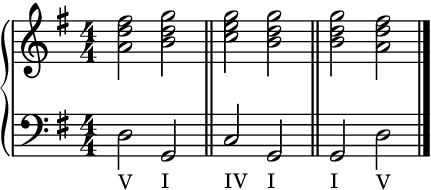
| Cadence | Chords | Effect |
|---|---|---|
| perfect | V then I | a full stop; the music sounds finished |
| plagal | IV then I | also conclusive, but softer; the "Amen" of hymn endings |
| imperfect | something then V (commonly I to V, ii to V, IV to V) | a comma; the phrase hangs, expecting more |
Hear the family resemblances. Both conclusive cadences end on I; what differs is the approach, dominant or subdominant. The imperfect cadence ends on V, borrowing the dominant's forward lean to leave the phrase open.
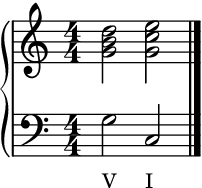
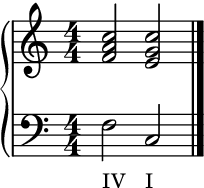
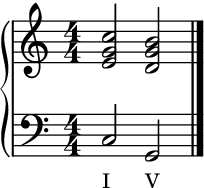
Those three are in C major, the simplest of the four keys the paper uses. Here they are again in G major, where a key signature is in play and the dominant chord carries an F♯:
Since the questions stay inside C, G, D and F major, the chords to have by heart are a short list:
| Key | I | ii | IV | V |
|---|---|---|---|---|
| C major | C, E, G | D, F, A | F, A, C | G, B, D |
| G major | G, B, D | A, C, E | C, E, G | D, F♯, A |
| D major | D, F♯, A | E, G, B | G, B, D | A, C♯, E |
| F major | F, A, C | G, B♭, D | B♭, D, F | C, E, G |
The same three cadences work identically in minor keys, taking the harmonic-minor qualities, so a perfect cadence there is V to i: a major dominant closing onto a minor tonic. This paper sets its cadence questions in major keys, but the formulas do not change when you meet them elsewhere.
Identifying a cadence in notation
- Establish the key from the key signature and the final bass note, checking for minor-key accidentals (a raised seventh in the closing bars is the giveaway that the minor reading is right).
- Take the last two chords of the phrase. For each, gather its notes across both staves, stack them in thirds, and name root and numeral.
- Match the pair to the table. Ends on V: imperfect. V then I: perfect. IV then I: plagal.
The bass line alone gets you most of the way: dominant-to-tonic bass (so, scale degrees 5 to 1) at a phrase end is almost always a perfect cadence; 4 to 1 plagal; anything landing on 5, imperfect. Check the upper parts before committing, because an inversion can put a different note in the bass, but on the evidence of two chords the bass is the fastest clue there is.
The cadence that comes next
Music has a fourth standard formula, the interrupted cadence: V followed by vi, or by VI in a minor key. It sets a perfect cadence up and swerves at the last moment onto the submediant, leaving unfinished business and usually a repeat of the phrase to come.
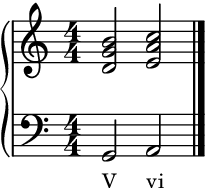
Grade 6 examines it. This paper does not, and no Grade 5 answer needs it. It appears here so that you can hear the swerve for what it is when a piece you are playing does it, and so that the family of four is complete in your head before you need it.
7. Choosing chords for a melody
A standard Grade 5 question shows a simple melody in C, G, D or F major and asks which chords fit at marked points, which are the cadences. The palette is the four chords of chapter 4: I, ii, IV and V. The method is mechanical enough to trust under exam pressure:
- Fix the key from the signature and the melody's close.
- At each marked point, list which of the four chords contain the melody note.
- Choose the pair that forms a sensible cadence for the position. A final phrase ending on degree 1 wants V then I (perfect) or IV then I (plagal). A mid-point pause wants an imperfect cadence arriving on V, approached from I, ii or IV.
- Sanity-check the leading note. If degree 7 appears in the melody over your chosen chord, that chord had better be V, and the note should step up to the tonic afterwards.
Step 2 runs off a single table, and the table is the same in every key:
| Melody note | Chords that contain it |
|---|---|
| degree 1 | I (as its root), IV (as its 5th) |
| degree 2 | ii (as its root), V (as its 5th) |
| degree 3 | I (as its 3rd) |
| degree 4 | IV (as its root), ii (as its 3rd) |
| degree 5 | V (as its root), I (as its 5th) |
| degree 6 | IV (as its 3rd), ii (as its 5th) |
| degree 7 | V (as its 3rd) |
Degree 3 and degree 7 each admit only one chord, which makes them the notes to look for first: a marked melody note on the mediant must be I, and one on the leading note must be V.
Here is a four-bar melody in G major with both cadence points harmonised, and the chords written out beneath so that you can hear what the choice does:
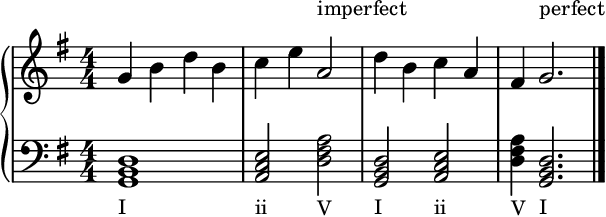
Reading the choices: bar 2 pauses on A, degree 2, which the table sends to ii or V. A pause in the middle of a melody wants an imperfect cadence, so the answer is V, approached from ii on the C at the start of the bar. Bar 4 closes on G, degree 1, approached from F♯, degree 7, and degree 7 belongs to V alone. That gives V then I, a perfect cadence.
A shorter worked case, of the kind the paper phrases in words. A melody in G major ends its final phrase with the notes A then G, over a bass that falls D to G. The A fits D, F♯, A and the G fits G, B, D; the bass moves from degree 5 to degree 1. That is V to I, a perfect cadence, labelled Va then Ia, or V then I with both in root position.
Two habits keep the answers clean. Say the degree number out loud before you look at chords, because the mapping table works on degrees and not on letter names. And read the position of the cadence in the melody before choosing between perfect and plagal: a plagal close is possible on degree 1, but the paper marks the cadence it has actually written, and the note before the last one usually settles which chord came first.
8. Transposition and transposing instruments
Grade 5 sets two kinds of transposition, and they behave quite differently. The first, moving a melody an octave from one clef to another, was chapter 1: nothing changes but the octave and the look of the page. The second changes key. You are given a short melody written for an instrument in B♭, A or F and asked for its sounding pitch, or given the sounding pitch and asked for the written part. The paper states the interval and the direction every time, so the arithmetic is never guesswork; what it tests is whether you can carry a melody across accurately.
Transposing to a new key
Moving a melody by any interval other than an octave lands it in a new key. The routine:
- Transpose the tonic by the required interval to find the new key, and write the new key signature.
- Move every note by the same interval number: for a major 2nd upward, every note climbs one letter step; for a perfect 5th, four letter steps. The new key signature handles most of the accidental bookkeeping automatically.
- Deal with accidentals in the original individually. An accidental that raised a note one semitone above its key-signature version must do exactly the same in the new key. Check each one; this is where marks are lost. A raised fourth degree stays a raised fourth degree, whatever sign that requires in the new key.
- Check the first and last notes and the contour: the shape of the line must be identical, only higher or lower.

When there is no key signature
The syllabus sets these questions "with or without key signature", and the second case changes the bookkeeping rather than the method. With no signature on the stave there is nothing to write at step 1, so every alteration in the original arrives as an accidental and every alteration in your answer has to be written as one. Step 3 does the whole job.
Work from scale degrees, as always: name the degree, transpose it, then ask what accidental that degree needs in the new key. The note that catches people is the one that carried no accidental in the original. A phrase in D major printed without a signature shows its F♯ as an accidental and leaves the D, G, A and E bare. Move it up a major 2nd into E major and the F♯ becomes G♯, an accidental again; the bare E becomes F♯ and now needs a sharp of its own; the G rises to A and still needs nothing.

An accidental holds for the rest of its bar, so a repeated note within one bar takes the sign once and the later notes inherit it. Across a barline it lapses, and a new bar needs the sign written again.
Transposing instruments
Some instruments sound at a different pitch from what their player reads. These are the transposing instruments, and the naming convention unlocks all of them:
An instrument "in X" sounds the pitch X when its player reads a written C.
So a clarinet in B♭ reading a written C sounds a B♭, a major 2nd lower than written. A horn in F reading C sounds the F below, a perfect 5th lower. From the sounding interval, everything else follows by reversal: to make a B♭ instrument sound a given concert pitch, write the part a major 2nd higher.
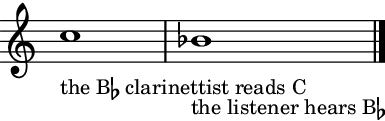
The three transpositions this grade examines, and the two octave conventions that go with the instrument list:
| Instrument | Sounds, relative to written | To notate a concert pitch, write |
|---|---|---|
| clarinet in B♭, trumpet in B♭ | a major 2nd lower | a major 2nd higher |
| clarinet in A | a minor 3rd lower | a minor 3rd higher |
| horn in F, cor anglais | a perfect 5th lower | a perfect 5th higher |
| piccolo | an octave higher | an octave lower |
| double bass, guitar | an octave lower | an octave higher |
The transposition questions are set on the first three rows, the instruments in B♭, A and F. The octave transposers (piccolo, double bass, guitar) exist only for convenience, keeping their parts on the stave; their players read ordinary notation and the octave shift is built into the convention.
Key signatures transpose with the parts: a B♭ clarinet part for a piece in concert E♭ major is written in F major, a major 2nd higher. Exam questions run in both directions, written to sounding and sounding to written; read carefully which way the question points, because reversing it is the classic error.
The question in exam form
Here is the task as the paper sets it. A melody is printed for clarinet in B♭, and you are asked to write it at concert pitch, the interval given as a major 2nd downwards. The written part is in D major, so the sounding music is in C major, two places anticlockwise round the circle. Every note drops one letter step, the key signature loses its two sharps, and the shape of the line is untouched.

Reverse the question and the same picture is read from right to left: given the concert-pitch melody in C major and asked for the clarinet part, transpose up a major 2nd into D major. Note the written C♯ in the last bar of the clarinet part. It is the leading note of D major, and it answers to the B of the concert-pitch version, which is the leading note of C major. Degrees transpose; the accidentals follow from them.
One check catches most mistakes. Compare the first note of your answer with the first note you were given, and count the interval between them. If it is not the interval the question stated, in the direction the question stated, nothing else in your answer can be right.
9. Voices and score types
The six standard voice types
The syllabus asks about "the types of voice", and there are six standard names, three above and three below:
| Voice | Approximate range |
|---|---|
| soprano | middle C to the A above the treble stave |
| mezzo-soprano | the A below middle C to the F at the top of the treble stave |
| alto (contralto) | the F below middle C to the D at the top of the treble stave |
| tenor | the C an octave below middle C to the A above middle C |
| baritone | the A an octave and a third below middle C to the F above middle C |
| bass | the E an octave and a sixth below middle C to middle C |

Two things to notice. The ranges overlap heavily, by a 6th in places, so a high note alone never identifies a voice type; what the name really describes is where the voice is comfortable and where its tone is characteristic. And the three middle names, mezzo-soprano, alto and baritone, exist because most singers are not at the extremes. A choir asks only for four parts, and the middle types sing whichever of them suits their register.
The word "alto" carries a warning. Used of a voice it means the lower female or higher male range; used in an orchestral score it is the French name for the viola; and used of a clef it means the C clef on the middle line. Three meanings, one word, and papers make use of all three.
SATB
Choral music divides into four standard voices, highest to lowest: soprano, alto, tenor, bass, abbreviated SATB.
| Voice | Clef in modern scores | Approximate range |
|---|---|---|
| soprano | treble | middle C up to the A a 13th above |
| alto | treble | the G below middle C up to the D at the top of the treble stave, a tone narrower at the bottom than the solo contralto range above |
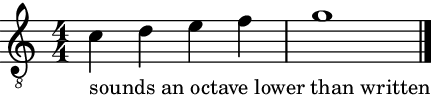
| tenor | treble with a small 8 beneath (sounding an octave lower); older scores use the tenor clef | the C an octave below middle C, up to the G or A above middle C |
| bass | bass | low E up to middle C or D |
The tenor's clef repays attention: that small 8 under a treble clef means everything sounds an octave lower than written. It is the standard modern solution to the tenor's awkward range, and it is also the notation guitar music uses.
Open score and short score
Four voices can be laid out two ways:
- Open score (sometimes called choral layout): each voice on its own stave, four staves braced together, soprano at the top. Singers prefer it; each part reads cleanly.
- Short score (close score): all four voices compressed onto a piano-style pair of staves. Soprano and alto share the treble stave, with soprano stems always up and alto stems always down. Tenor and bass share the bass stave, tenor stems up, bass stems down.
The stem convention is what keeps four voices legible on two staves: stems, not vertical position, identify the voice. Two voices may even sing the same pitch, written as one note-head with stems both up and down.
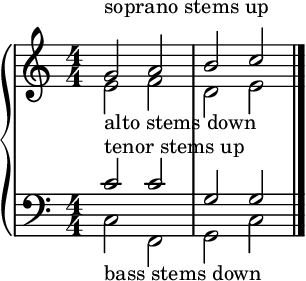
Converting a passage from one layout to the other is score-reading work, and Grade 6 is where it is set. What this paper asks is that you can read either layout: pick the four voices out of a short score by their stems, and know what the tenor's clef is doing in each. In open score the tenor reads a treble clef with a small 8 beneath and sounds an octave lower than written; in short score the same line sits in the bass clef and sounds where it is printed.
10. The orchestra
You need the standard instruments, their four families, their clefs, their broad ranges, which of them transpose, the way each produces its sound, and the order they occupy in a full score. The syllabus asks about all of it, and the sound-production question is the one candidates prepare least.
The ranges in the tables below are given as the bottom of each instrument's working compass and the direction it runs from there. That is the level the paper works at: it asks whether a melody would sit comfortably on a given instrument, not for the exact top note a virtuoso can reach. Where a transposing instrument is listed, the range given is the written one, which is what you would be reading on the page.
How each family makes its sound
The families are not a filing system. They are four different ways of setting air moving.
Strings. A stretched string is made to vibrate by drawing a bow across it (arco) or plucking it (pizzicato); the wooden body amplifies a sound the string alone could barely make. Pitch depends on the length of string left free to vibrate, and the left hand shortens it by stopping the string against the fingerboard. The harp is plucked throughout and has no bow.
Woodwind. Every woodwind instrument sounds a column of air inside a tube. What differs is how the column is set going:
- edge-blown: the player directs a stream of air across the edge of a hole, and the stream itself splits and flutters. The flute and piccolo work this way, which is why they carry no reed.
- single reed: one flat cane reed beats against a mouthpiece. The clarinets work this way.
- double reed: two cane reeds beat against each other. The oboe, cor anglais and bassoon work this way, and their narrow, reedy tone comes from it.
Pitch changes as the player opens and closes holes along the tube, lengthening or shortening the vibrating column.
Brass. The player's own lips buzz against a cup-shaped or funnel-shaped mouthpiece, and the tube amplifies the buzz and selects a pitch from the harmonic series. Valves (horn, trumpet, tuba) or a slide (trombone) change the length of tubing and so the notes available.
Percussion. The instrument is struck, shaken or scraped, and the vibrating body is a membrane, a bar, a plate or a tube rather than a string or an air column.
Strings
| Instrument | Clefs | Broad range | How it is sounded | Notes |
|---|---|---|---|---|
| violin | treble | from the G below middle C upwards | bowed or plucked | the highest of the strings; two full sections in an orchestra |
| viola | alto, treble for high passages | from the C an octave below middle C upwards | bowed or plucked | the alto clef's home |
| cello | bass, tenor and treble when high | from the C two octaves below middle C upwards | bowed or plucked | |
| double bass | bass | written from the E below the bass stave upwards | bowed or plucked | sounds an octave lower than written |
| harp | treble and bass, braced | close to seven octaves, the widest in the orchestra | plucked | pedals reset whole letter names to flat, natural or sharp |
Woodwind
| Instrument | Clef | Broad range | How it is sounded | Transposing? |
|---|---|---|---|---|
| piccolo | treble | written from the D above middle C upwards | edge-blown | sounds an octave higher |
| flute | treble | from middle C upwards, about three octaves | edge-blown | no |
| oboe | treble | from the B♭ below middle C upwards | double reed | no |
| cor anglais | treble | written from the B below middle C upwards | double reed | in F, sounds a perfect 5th lower |
| clarinet | treble | written from the E below middle C upwards, over three octaves | single reed | in B♭ or A |
| bassoon | bass, tenor when high | from the B♭ two octaves and a tone below middle C upwards | double reed | no |
The bass clarinet and the saxophones are common enough in scores, and both are reed instruments (single reed, like the clarinet), but neither is on this grade's instrument list and no question will ask about them.
Brass
| Instrument | Clef | Broad range | How it is sounded | Transposing? |
|---|---|---|---|---|
| horn (French horn) | treble | written from the C an octave below middle C upwards | lip-buzzed, valves | in F, sounds a perfect 5th lower |
| trumpet | treble | written from the F♯ below middle C upwards | lip-buzzed, valves | usually in B♭, sounds a major 2nd lower |
| trombone | bass, tenor when high | from the E below the bass stave upwards | lip-buzzed, slide | no |
| tuba | bass | the deepest of the brass, reaching well below the bass stave | lip-buzzed, valves | no |
Percussion
Percussion is sorted by whether an instrument sounds a note you could name. Those of definite pitch play written notes on a stave; those of indefinite pitch are written on a single line or a rhythm stave, because there is no pitch to write.
| Definite pitch | Indefinite pitch |
|---|---|
| timpani, glockenspiel, xylophone, marimba, vibraphone, celesta, tubular bells | side drum (snare drum), bass drum, cymbals, triangle, tambourine, castanets, tam-tam |
The timpani, or kettledrums, are the orchestral standard: a set of large drums, each tuned to a specific note by tightening its skin, traditionally the tonic and dominant of the piece. The xylophone, marimba and glockenspiel are sets of tuned bars struck with beaters (wooden bars for the first two, metal for the glockenspiel); the vibraphone adds metal resonating tubes and a motor; the celesta is a keyboard whose hammers strike metal bars.
Transposing and non-transposing
The last division cuts across the families. A non-transposing instrument sounds the notes its player reads. A transposing instrument does not, and its part is written at whatever distance the convention demands.
- Non-transposing: violin, viola, cello, harp, piano, flute, oboe, bassoon, trombone, tuba, timpani and the tuned percussion.
- Transposing: clarinet in B♭ or A, trumpet in B♭, horn in F, cor anglais in F, and the two octave transposers, piccolo (an octave higher than written) and double bass (an octave lower).
When a score question asks what an instrument is actually sounding, this list is the first thing to check. Everything on the first line can be read straight off the page; everything on the second needs chapter 8.
Score order
A full score stacks the families in a fixed order, top to bottom:
woodwind, brass, percussion, harp and keyboard, strings
Within each family, higher instruments sit above lower ones: flutes above oboes above clarinets above bassoons; violins above violas above cellos above basses. Knowing the order lets you find any part in seconds and answer layout questions without hesitation.
11. Ornaments and the signs that replace them
Grade 4 asked you to name the ornament signs. Grade 5 turns the question round, and the syllabus is precise about which way it points: "the recognition of ornaments, including the replacement of written-out ornamentation with the appropriate signs, but not vice versa". You are shown notes that a composer wrote out in full, and you say which sign would have said the same thing. The paper does not ask you to travel in the other direction.
Knowing what each sign means is still the tool for the job. You simply use it backwards, so learn the realisations first and then practise recognising them on the page:
- Trill (tr): rapid, even alternation between the written note and the note above it, filling the note's full value. The upper note obeys the key signature unless the sign carries its own accidental. How many alternations there are depends on tempo and note length, so a written-out trill may show any even number of them. (In music of Bach's era the trill conventionally begins on the upper note; later music begins on the written note. Questions specify when it matters.)
- Turn (the sideways S): four notes fitted into the written note's time: the note above, the written note, the note below, the written note again.
- Upper mordent: a fast three-note snap at the start of the note: the written note, the note above, the written note, the remainder held.
- Lower mordent (the zig-zag with a stroke): the same with the note below: note, below, note.
- Grace note: any small-printed note that borrows its time from the note it leans on. The two below are the grace notes with names of their own.
- Appoggiatura: the leaning grace note takes half the main note's value, sounding on the beat, and the main note takes the other half. Against a dotted main note, the appoggiatura takes two-thirds and the main note the final third. So an appoggiatura against a dotted crotchet sounds as a crotchet (the grace note's pitch) followed by a quaver (the main pitch).
- Acciaccatura: played as fast as possible, on or just before the beat, stealing almost nothing from the main note. In a realisation it is shown as the shortest practical value tucked against the main note.
An accidental attached above or below any ornament sign alters the auxiliary note, the added upper or lower neighbour, not the written note.

The turn has a mirrored form, the inverted or lower turn, which runs below, note, above, note. Grade 6 examines it; recognise it if you meet it, but this paper keeps to the list above.
Reading a written-out ornament back to its sign
This is the Grade 5 task. A phrase appears with an ornament spelt out in ordinary notes, and you choose the sign that replaces it. Work from the shape of the little group:
| What is written out | The sign that replaces it |
|---|---|
| main note, note above, main note, the rest of the value held | upper mordent |
| main note, note below, main note, the rest of the value held | lower mordent |
| note above, main note, note below, main note | turn |
| a rapid, even alternation of main note and note above, filling the whole value | trill |
| a note one step above or below taking half the main note's value (two-thirds of a dotted one), then the main note | appoggiatura |
| a note one step above or below crushed against the main note, taking almost nothing from it | acciaccatura |

Three checks settle nearly every question of this kind:
- Where does the group start? On the main note itself: a mordent, or a trill in music after Bach's era. A step above: a turn, or an appoggiatura from above. A step below: an appoggiatura from below.
- How many notes, and how long? Three notes and a held remainder means a mordent. Four notes filling the value means a turn. A long even alternation means a trill. Two notes sharing the value between them means an appoggiatura, and the sign carries the value the small note is to take.
- Is the auxiliary note altered? If the note above or below is written with an accidental that the key signature does not supply, the sign takes that accidental printed above it (for the upper auxiliary) or below it (for the lower).
The commonest error is answering with a realisation instead of a sign. The question wants the symbol, so write tr, or the turn's sideways S, or the mordent's zig-zag, above the main note, and give the main note its full original value.
12. Irregular time signatures
Every time signature so far has divided its bar into equal beats: two, three or four of them, each splitting into two in simple time or three in compound. Irregular time signatures give that up. Their bars hold a number of units that will not divide evenly, so the bar is built from a mixture of twos and threes instead, and where the boundaries fall is part of what the music is. Grade 5 sets four: 5/4, 7/4, 5/8 and 7/8.
The crotchet-beat pair: 5/4 and 7/4
- 5/4: five crotchets in a bar, grouped 3 + 2 or 2 + 3.
- 7/4: seven crotchets, grouped 4 + 3 or 3 + 4, and sometimes 2 + 2 + 3.
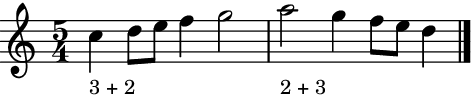

The grouping is not decoration. A 5/4 bar grouped 3 + 2 stresses its first and fourth crotchets; the same five crotchets grouped 2 + 3 stress the first and third, and the bar sounds like a different piece of music. Composers show which they mean by how they write the bar out, and occasionally by printing the signature as 3+2/4.
The quaver-beat pair: 5/8 and 7/8
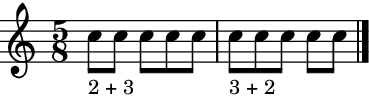
- 5/8: five quavers per bar, grouped 2 + 3 or 3 + 2.
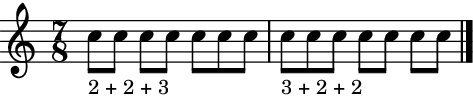
- 7/8: seven quavers, grouped in twos and threes: 2 + 2 + 3, 3 + 2 + 2 or 2 + 3 + 2.
The beaming declares the grouping: a 7/8 bar beamed 2 + 2 + 3 stresses the first, third and fifth quavers. These metres are staples of Balkan dance music and of twentieth-century scores, and what makes them move is the unequal group lengths, a quick-quick-slow limp that regular metres cannot produce. Bartók and Stravinsky both use them constantly, and Holst's Mars is built on 5/4 almost throughout.
Grouping notes and rests
The syllabus asks for "the grouping of notes and rests within these times", and rests obey the same law as notes. A rest may fill a whole group, or part of one, but it may never run across the boundary between two groups. A dotted crotchet rest is exactly right for a complete group of three quavers in 7/8 and wrong anywhere else in the bar; a minim rest fits the 2 of a 5/4 bar grouped 3 + 2 and must never straddle its third and fourth crotchets.

Four working rules cover every question of this kind:
- Read the grouping from the beams of the printed bar before you write anything.
- Make each group's contents add up to that group's length.
- Beam within a group and never across the boundary between groups.
- Let a rest fill a group, or sit inside one, but never cross a boundary. A rest that fills a whole group takes that group's own value: in 5/8 and 7/8, a crotchet rest for a group of two quavers and a dotted crotchet rest for a group of three; in 5/4 and 7/4, a crotchet rest for one silent beat and a minim rest for a complete group of two. Where you are unsure of a boundary, split the silence into the beat's own rests rather than reach for one longer sign, because the long sign is the one that can straddle.
13. Irregular divisions of the beat
A time signature settles how many beats a bar holds. A division settles how many notes fit inside one of them. In simple time a beat divides naturally into two, four or eight; in compound time into three, six or nine. An irregular division puts some other number into that same space, and a small figure printed over or under the group says how many notes are in it.
The syllabus adds these at Grade 5 under the heading "irregular divisions of simple time values", and the family is small:
| Group | Notes written | In the time of | Where it belongs |
|---|---|---|---|
| duplet | 2 | 3 of the same value | compound time |
| triplet | 3 | 2 of the same value | simple time |
| quintuplet | 5 | 4 of the same value | simple time |
| sextuplet | 6 | 4 of the same value | simple time |
The triplet has been with you since Grade 2 and the duplet since Grade 4. The quintuplet and the sextuplet are new here, and they behave exactly like the triplet: crowd more notes into a space than it was built for, and mark the group with its number.

Choosing the note value
The figure tells the reader how many notes there are. The note value you write tells them how much room the group takes, and it is chosen by one rule: write the value that the nearest regular division of that space would use.
- Three notes in a crotchet: a crotchet divides regularly into two quavers, so write three quavers and mark them 3.
- Five or six notes in a crotchet: the next regular division down is four semiquavers, so write five or six semiquavers and mark them 5 or 6.
- Three notes in a minim: write three crotchets and mark them 3.
- Five notes in a minim: write five quavers and mark them 5.
Beam the group as one unit wherever the values allow it and print the figure on the beam side. When the notes cannot be beamed together, a bracket takes the beam's place and the figure sits on the bracket.
The duplet, which runs the other way
The duplet is the odd member of the family, because it divides a compound beat rather than a simple one. A dotted crotchet in 6/8 is already three quavers; write two notes there and mark them 2, and each of them lasts a dotted quaver's worth. The effect is the reverse of a triplet's: instead of hurrying, the beat broadens for a moment.

Points that catch people out
A rest inside an irregular group is a full member of it. Two notes and a quaver rest under a figure 3 make a triplet just as three notes do, and the figure still says 3.
The notes of an irregular group need not be equal. A triplet may be written as a crotchet and a quaver under the bracket, so long as the group's total is right, and the same is true of quintuplets, which frequently mix values.
Adding up a bar containing them is the one calculation to be careful with. An irregular group is worth exactly the space it replaces, whatever it contains, so a bar of 4/4 holding a quintuplet of semiquavers, a triplet of quavers and a minim adds up to four crotchets: one, one and two. Count the space, never the notes.
Chopin's nocturnes are full of long irregular groups floating over a steady left hand, and it is worth looking at one to see how ordinary the device is in practice; the figures over the right-hand groups are doing nothing more than what this chapter describes.
Rewriting a passage in different note values
Two related tasks turn up among the observation questions: rewrite a bar in notes of twice or half the value, and rewrite a passage from compound time into simple time or the other way. Neither of them changes what the music sounds like. Both change how it is written down, and the mark is for getting the whole bar consistent, signature included.
Doubling and halving. Give every note and rest the value one step longer (doubling) or one step shorter (halving). The time signature moves with them. Its lower figure names the beat value, so it halves when the notes double and doubles when the notes halve; its upper figure never changes, because the bar still holds the same number of beats.
| Original | In notes of twice the value | In notes of half the value |
|---|---|---|
| 2/4 | 2/2 | 2/8 |
| 3/4 | 3/2 | 3/8 |
| 4/4 | 4/2 | 4/8 |
| 6/8 | 6/4 | 6/16 |
Dots survive the change: a dotted crotchet doubled is a dotted minim, halved a dotted quaver. Ties, slurs, rests and irregular groups all travel with their notes, and the beaming is redrawn to suit the new values, so a bar of quavers beamed in pairs comes out as a bar of crotchets with no beams at all.

Compound to simple, and back. The arithmetic here is different, because a compound beat divides into three and a simple beat into two. What carries across is the number of beats in the bar:
| Compound | Simple | Beats in the bar |
|---|---|---|
| 6/8 | 2/4 | 2 |
| 9/8 | 3/4 | 3 |
| 12/8 | 4/4 | 4 |
| 6/4 | 2/2 | 2 |
Each dotted crotchet beat of 6/8 becomes a plain crotchet beat of 2/4. Three quavers will fill a compound beat but not a simple one, so they arrive in 2/4 as a triplet marked 3. Read the conversion backwards and the triplets go away: a triplet in simple time becomes three ordinary quavers of compound time, and a plain pair of quavers, which filled a simple beat exactly, has to become a duplet to fill a compound one. The pitches, the ties and the articulation come across untouched.

One check finishes either task. Add the new bar up against its new time signature. If the total is wrong, something in it was converted at a different rate from the rest.
14. Terms and signs at Grade 5
Every term from Grades 1 to 4, in all three languages, remains examinable, and the Grade 5 paper draws on the full accumulated glossary. These are the additions at this level.
Italian
| Term | Meaning |
|---|---|
| a niente | to nothing: fading away to silence |
| ad libitum, ad lib. | at will; the passage or its speed is left to the performer |
| attacca | go straight on to the next movement without a break |
| cantando | singing |
| con dolore | with grief |
| con spirito | with spirit |
| doloroso | sorrowful |
| largamente | broadly |
| morendo | dying away |
| perdendosi | dying away, fading to nothing |
| quasi | as if, almost (quasi recitativo, almost like a recitative) |
| rinforzando (rf, rfz, rinf.) | reinforcing: a sudden emphasis, usually over a short group of notes |
| smorzando (smorz.) | dying away in tone, and often in speed |
| sonoro | sonorous, full in tone |
| sotto voce | in an undertone, hushed |
Four of those mean something close to "fade out", and the shades between them are worth having straight. Morendo and perdendosi say the sound dies; smorzando adds a slackening of speed; a niente insists on arriving at silence rather than merely getting quiet. Keep rinforzando apart from sforzando too: sf strikes one note, rf leans on a short phrase.
German
Grade 4 brought in the first French terms. Grade 5 brings in the first German, and they are the plain mood and tempo words that German composers reach for constantly:
| Term | Meaning |
|---|---|
| langsam | slow |
| lebhaft | lively |
| mässig | moderate, at a moderate speed |
| ruhig | calm, peaceful |
| schnell | fast |
| traurig | sad |
Signs new at this grade
| Sign | Meaning |
|---|---|
| alla breve (a C with a vertical stroke through it) | the same as 2/2: two minim beats in the bar |
| multiple-bar rest (a thick horizontal block with a figure above it) | that many whole bars of silence |
| volta brackets (marked 1. and 2. over the ends of a repeated passage) | take the first ending the first time through and the second on the repeat |
| arpeggiation (a wavy vertical line before a chord) | spread the chord from the bottom upwards; an arrow head reverses the direction |

Terms from earlier grades worth keeping bright
The paper draws on everything already learned. These come up most often:
| Term | Language | Meaning |
|---|---|---|
| stringendo | Italian | pressing on, getting faster |
| allargando | Italian | broadening: slower and fuller |
| sforzando (sf, sfz) | Italian | a sudden strong accent on one note |
| fortepiano (fp) | Italian | loud, then immediately quiet |
| rubato | Italian | with some freedom of time |
| come prima | Italian | as at first |
| alla breve | Italian | in 2/2, with a minim beat |
| una corda / tre corde | Italian | use the piano's soft pedal / release it |
| mano sinistra (m.s.) / mano destra (m.d.) | Italian | left hand / right hand |
| pizzicato (pizz.) / arco | Italian | pluck the strings / resume the bow |
| con sordino / senza sordino | Italian | with the mute / without the mute |
| lent | French | slow |
| vite | French | quick |
| modéré | French | moderate |
| animé | French | animated |
| retenu | French | held back |
| doux (douce) | French | soft, sweet |
Vocabulary remains the most reliable source of marks on the paper. A workable revision scheme: gather the full three-language glossary into families by meaning (all the "slow" words, all the "dying away" words, all the mute and pedal instructions), and drill a family a day. The families reinforce each other in a way alphabetical lists never do.
15. Music in context
The last item on the syllabus is the least tidy and the most rewarding: "points of general musical observation designed to test the candidate's ability to apply theoretical knowledge to actual music". A short piece or extract is printed, and a run of questions follows that can draw on any chapter of this book at once. Nothing new is being tested. What is being tested is whether the knowledge survives contact with real notation.

The question types recur, and each has a shape of answer that earns the mark:
- Pitch and clef. "Name the note marked X." Read the clef before the note, every time, and remember that a key signature or an earlier accidental in the bar may alter it.
- Key and scale. "Name the key." Signature, then the note the music ends on, then a check for the raised leading note that would mean the minor.
- Intervals. "Name the interval between the two marked notes." Number from the letters, quality from the lower note's major scale.
- Time and rhythm. "How many crotchet beats are in a bar?" "Rewrite bar 3 in notes of twice the value." "Add the missing rest."
- Chords and cadences. "Name the chord marked A" or "name the cadence at bars 5 and 6", with the numeral and position letter if the rubric asks for them.
- Terms and signs. Any word or symbol from any grade so far, including the performance directions.
- Instruments and voices. "Name a suitable instrument for this melody, the family it belongs to, and how it makes its sound."
- General observation. "Give two features which show the music is in D major." "Name a bar in which an earlier idea returns at a different pitch."
Worked on the melody above:
- The key is D major. The signature has two sharps, the melody starts and ends on D, and the C♯ in bar 5 behaves as the leading note, rising to the tonic in bar 6.
- Bar 3 restates bar 1 a step higher, D, F♯, A becoming E, G, B. That is a sequence, and naming the bar numbers is part of the answer.
- The interval from the first note of bar 1 to the third is a perfect 5th, D up to A.
- The bar holds three crotchet beats, so the time signature is 3/4 and the beat is a crotchet.
- Bars 1 and 2 are slurred and the first three notes of bar 5 are staccato: a deliberate change of articulation at the point where the line turns for home.
- The dynamics move from p through a crescendo across bars 3 and 4 to pp at the close, so the loudest point is the end of bar 4, where the crescendo closes on the minim G. The highest note, the B, comes earlier, in bar 3.
- A violin would suit it: a string instrument, sounded by drawing a bow across a stretched string, or by plucking it.
Three habits raise the marks on this section. Answer in the terms the question uses, so that a question about a chord gets a chord and a question about a feature gets a feature. Quote a bar number whenever you name something, because "the melody repeats" is worth less than "bar 3 repeats bar 1 a step higher". And give one precise observation rather than two vague ones; a single thing you can point to in the printed music is what the mark is for.
16. Common mistakes at Grade 5
- Confusing the two C clefs. The tenor clef's middle C is on the fourth line, not the third.
- Adding a seventh sharp or flat. The keys set for this grade stop at six of each, and an answer of C♯ major or C♭ major is outside the syllabus as well as outside the question.
- Changing pitch as well as octave when moving a melody between clefs. Every letter name stays; only the octave and the clef move.
- Identifying a chord's inversion from an upper voice instead of the bass. Only the lowest sounding note counts.
- Reaching for vi, or for the interrupted cadence, in a chord question. The palette here is I, ii, IV and V, and the cadences are perfect, plagal and imperfect.
- Labelling minor-key chords with major-key qualities, especially writing v instead of V. The harmonic minor's raised seventh makes the dominant major.
- Calling any ending-on-V cadence "perfect because it ends on a chord". Imperfect cadences end on V; perfect cadences move V to I.
- Naming a chromatic interval from how it sounds rather than how it is spelt. C to A♯ and C to B♭ sound alike; only one of them is a 6th.
- Transposing a part the wrong direction for a transposing instrument. Fix the rule first: "in B♭" means written C sounds B♭ (lower), so parts are written higher than they sound.
- Forgetting to transpose the key signature along with the notes, or to re-derive each accidental in the new key.
- In short score, letting stem directions wander. Soprano and tenor stems up, alto and bass stems down, without exception.
- Answering an ornament question with a realisation. The question runs written-out notes to sign, so the answer is a symbol above the main note, with the main note restored to its full value.
- Splitting an appoggiatura half and half against a dotted main note. Dotted main notes give the appoggiatura two-thirds.
- Writing a compound interval's quality from scratch instead of reducing to the simple interval. Subtract 7, judge, restore the octave.
- Misgrouping 5/4, 7/4, 5/8 and 7/8 bars into even pairs. The groups are twos and threes, and the beaming must say which.
- Letting a rest cross a group boundary in an irregular bar. A rest may fill a group or sit inside one; it may never straddle two.
- Counting the notes of an irregular group when adding a bar up. A quintuplet of semiquavers is worth one crotchet, not five semiquavers' worth of anything else. Count the space it fills.
17. Practice questions
Answers follow in the next section.
- On the tenor clef, which note sits on the fourth line up? And on the top line?
- Name the note on the middle line of the alto clef, and the note on the middle line of the tenor clef.
- A melody in the treble clef is rewritten an octave lower in the bass clef. What changes, and what must not?
- Give the key signatures of F♯ major and G♭ major, naming the accidentals in order, and name the relative minor of each.
- Write out E♭ melodic minor ascending. Which two notes differ from the descending form?
- Name the interval from E up to the C a 13th above, using inversion to check the quality of its simple form.
- Name the interval C up to A♯, and the interval C♯ up to A♭.
- What is a compound major 3rd also called, and how many semitones does it span? What is the widest interval this grade asks for?
- In D major, name the notes of chords ii, IV and V and state each chord's quality.
- The chord G, B, D appears in C major with D in the bass. Give its label. In G major, which note is in the bass of IVb?
- A phrase in F major ends with the chords C, E, G followed by F, A, C. Name the cadence and give the Roman numerals.
- Which three cadences does this grade set, and in which four keys are they examined?
- A melody in C major pauses at its midpoint on D and ends on C approached from B. Name a suitable chord at each of those three notes.
- A clarinet in B♭ must sound concert G. What written note does the player read? A horn in F plays a written D above middle C: what does the listener hear?
- In short score, which two voices share the treble stave, and how are their stems drawn?
- Name the six standard voice types from highest to lowest.
- Which orchestral string instrument routinely reads the alto clef, and why?
- How does an oboe produce its sound, and how does a flute? Name two percussion instruments of definite pitch and two of indefinite pitch.
- Inside the value of one note a composer writes out the note above, the main note, the note below and the main note again. Which sign replaces the group? And which sign replaces the main note, the note above, the main note, with the rest of the value held?
- A bar of 7/8 is grouped 2 + 2 + 3. Describe the beaming and where the stresses fall. How many crotchets are there in a bar of 5/4, and what are its two usual groupings?
- What is a quintuplet, and which note value fills a crotchet beat with one? What is a duplet, where does it belong, and how long does each of its notes last?
- Give the meanings of: a niente, rinforzando, largamente, schnell, ruhig, traurig. What do volta brackets tell the player?
- Name the enharmonically equivalent pairs of keys that fall inside this grade.
- In E minor, name the notes of ii° and V, and say why V comes out major.
18. Answers
- The fourth line is middle C (the clef points at it). The top line is E.
- The alto clef's middle line is middle C. The tenor clef's middle line is the A below middle C.
- Only the octave and the clef change. Every note keeps its letter name and moves exactly one octave; the key signature, the time signature, every accidental, and all the rests, ties and slurs are carried across untouched, and the contour of the line must be identical.
- F♯ major: six sharps, F♯, C♯, G♯, D♯, A♯, E♯; its relative minor is D♯ minor. G♭ major: six flats, B♭, E♭, A♭, D♭, G♭, C♭; its relative minor is E♭ minor.
- E♭, F, G♭, A♭, B♭, C, D, E♭. The sixth and seventh degrees are the two that differ: the C and D of the ascending form become C♭ and D♭ coming down.
- Subtract 7 and the simple form is E up to C, a 6th. Invert it: C up to E is certainly a major 3rd, and a major 3rd inverts to a minor 6th, so E up to C is a minor 6th. Restore the octave and the answer is a minor 13th, also called a compound minor 6th.
- C up to A♯ is an augmented 6th: the letters give a 6th, and A♯ is a semitone above the A that would make it major. C♯ up to A♭ is a diminished 6th: A♯ would be major, A♮ minor, so A♭ is a semitone smaller again.
- A major 10th. It spans an octave plus a major 3rd: 12 + 4 = 16 semitones. The widest asked for is the 15th, two octaves.
- In D major, ii is E, G, B, a minor triad; IV is G, B, D, major; V is A, C♯, E, major.
- Vc: the dominant chord of C major in second inversion, its 5th in the bass. (Grade 6 writes the same chord V6/4.) In G major, IVb is C, E, G with E in the bass.
- C, E, G is V in F major and F, A, C is I: a perfect cadence, V to I.
- Perfect, plagal and imperfect, examined in the major keys of C, G, D and F.
- D is degree 2, and a mid-point pause wants an imperfect cadence, so V. B is degree 7, which belongs to V alone. C is degree 1, so I. The melody therefore closes V to I, a perfect cadence.
- The clarinet reads a written A: the instrument sounds a major 2nd below what it reads, so the part is written a major 2nd above the concert pitch. The horn sounds a perfect 5th lower than written, so its written D above middle C is heard as the G below middle C.
- Soprano and alto share the treble stave: soprano stems up, alto stems down.
- Soprano, mezzo-soprano, alto (contralto), tenor, baritone, bass.
- The viola. Its range sits between violin and cello, and the alto clef keeps most of its notes on the stave, avoiding constant ledger lines.
- The oboe is sounded by two cane reeds beating against each other, a double reed; the flute by a stream of air directed across the edge of a hole, with no reed at all. Both belong to the woodwind. Definite pitch: timpani and xylophone (glockenspiel, marimba, vibraphone, celesta and tubular bells also qualify). Indefinite pitch: side drum and cymbals (bass drum, triangle, tambourine, castanets and tam-tam also qualify).
- Above, main, below, main is a turn. Main note, note above, main note, with the remainder held, is an upper mordent.
- The quavers are beamed in three groups: two, two, then three. Stresses fall at the start of each group, on the first, third and fifth quavers. A bar of 5/4 holds five crotchets, grouped 3 + 2 or 2 + 3.
- A quintuplet is five notes in the time of four, and semiquavers are the value that fills a crotchet beat with one. A duplet is two notes in the time of three and belongs to compound time; in 6/8 each of its notes lasts a dotted quaver's worth, the pair together filling a dotted crotchet beat.
- A niente: fading away to nothing. Rinforzando: reinforcing, a sudden emphasis usually over a short group of notes. Largamente: broadly. Schnell: fast. Ruhig: calm. Traurig: sad. Volta brackets mark alternative endings: take the passage under bracket 1 the first time through and the passage under bracket 2 on the repeat.
- F♯ major and G♭ major, both with six accidentals, and their relative minors D♯ minor and E♭ minor.
- ii° is F♯, A, C, a diminished triad, and V is B, D♯, F♯, a major one. The harmonic minor raises the seventh degree from D to D♯, and that D♯ is the middle note of V. A major 3rd below and a minor 3rd above make the chord major, and the leading note it contains is what pulls the cadence home.
This completes the arc that began at Grade 1. A Grade 5 pass opens the door to the ABRSM practical exams at Grades 6 to 8, and to the Grade 6 theory syllabus for those continuing. More importantly, everything here, keys, chords, cadences, scores and all, is working knowledge for any musician: theory understood, rather than memorised, makes a better performer.