A complete, self-contained course for the sixth grade of the ABRSM Music Theory syllabus: four-part writing for voices and keyboard, chords on every degree of the major and minor scales, figured bass, the dominant and supertonic sevenths, cadences realised in full, melodic decoration, modulation to related keys, and the score-reading, composition and vocabulary demands of the first written paper.
Introduction
Grade 6 changes the rules of the game. The first five grades asked you to identify things: name this interval, spot that cadence, tick the right chord. This grade asks you to write music, and to write it under constraints that composers from Purcell to Brahms accepted as second nature. You will realise a figured bass in four parts, harmonise a melody, compose a line of your own for a real instrument, and read scores up to full orchestral size.
The exam format changes to match. Grades 1 to 5 are online and multiple choice; Grades 6 to 8 are written papers, sat with manuscript paper and a pen over three hours. Nobody offers you four answers to choose from. You put notes on staves, and an examiner reads what you wrote the way they would read a score. That is a different discipline, and it rewards a different kind of preparation: writing out exercises by hand, week after week, until the grammar of four parts sits in your fingers.
The good news is that the harmonic vocabulary is small and the rules are few. Triads on any degree in root position, first or second inversion; the dominant seventh in every position; the supertonic seventh in two of them. Everything in the paper is built from that short list. What Grade 6 really examines is control: can you move four voices from one chord to the next without breaking the handful of conventions that keep the texture clean?
Each convention exists for an audible reason, and this guide spends its time on those reasons. Consecutive fifths are not forbidden because a rulebook says so; they are avoided because two voices locked in parallel perfect intervals stop sounding like two voices. The second-inversion chord is not rationed out of meanness; its fourth above the bass is a genuine instability that the classical style treats as needing resolution. Learn the mechanism and the rule remembers itself.
Everything from Grades 1 to 5 remains live: all four clefs, intervals simple and compound, transposing instruments, the orchestra, ornaments, and the accumulated vocabulary in three languages. The keys now extend to all the majors and minors, seven sharps and flats included; Grade 5 stopped at six. The two signatures it adds are worth fixing in the eye now, since they can turn up in a score question without warning.
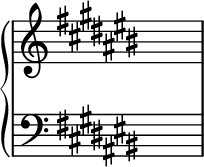
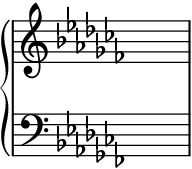
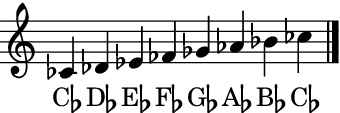 Where an earlier grade covered a topic, this guide recaps it in a sentence and moves on. If a recap feels thin, the Grade 5 volume has the full story.
About this guide and the exam
The Grade 6 exam is a written paper of five questions, marked out of 100: you need 66 to pass, 80 for a Merit and 90 for a Distinction. The time allowed is 3 hours, which is generous if you know the material and unforgiving if you plan to work things out from first principles at the desk. The five questions carry fixed marks:
| Question | Task | Marks |
|---|---|---|
| 1 | Realise a figured bass, for SATB or for keyboard, above a given bass of about four bars | 15 |
| 2 | Indicate chords for a diatonic melody of about eight bars, or add a bass with figures to it | 15 |
| 3 | Compose a melody for a specified instrument from a given opening; modulation may be required | 20 |
| 4 | Questions on a short extract: piano, voice and piano, string or vocal quartet, or a non-transposing solo sonata | 25 |
| 5 | Questions on a full score (orchestra, large ensemble, or chorus with orchestra) of up to ten sounding staves | 25 |
Questions 1 and 2 each offer a choice of format, and the choice is yours on the day: four voices or keyboard style in Question 1, chord symbols or a figured bass line in Question 2. Question 3 offers a choice of instrument. Questions 4 and 5 are answered in words and short notation on the paper itself.
Three hours for a hundred marks suggests a budget of well under two minutes per mark, and the harmony questions repay slow, careful work far more than the score-reading ones. A sensible plan: rough out Question 3 early while your ear is fresh, work Questions 1 and 2 with full checking, then take Questions 4 and 5 methodically, leaving time to return to anything parked. Candidates may leave after 40 minutes; almost nobody who does well leaves early.
The syllabus statement for the grade is short enough to quote in full. The harmonic vocabulary is "the use of 5/3, 6/3 and 6/4 chords on any degree of the major or minor (harmonic and melodic) scale; the recognition of the dominant seventh chord in root position, first, second and third inversions, in any major or minor key; the recognition of the supertonic seventh chord in root position and first inversion, in any major or minor key; the figuring for all the above chords." Beyond that, "an understanding of the principles of modulation and a knowledge of cadences, ornamentation and melodic decoration (which might include passing notes, auxiliary notes, appoggiaturas, changing notes and notes of anticipation) will also be expected."
What Grade 6 asks of you
By the end of this grade you should be able to:
- write for four voices within their ranges, with correct spacing, doubling and stem conventions
- build 5/3, 6/3 and 6/4 chords on any degree of any major or minor scale, both scale forms included
- read and write the figures: blank, 6, 6/4, accidentals alone and beside figures, and the 6/4 to 5/3 progression
- recognise and label the dominant seventh in all four positions (V7a, V7b, V7c, V7d) and know the figures 7, 6/5, 4/3 and 4/2
- recognise and label the supertonic seventh in root position and first inversion (ii7a, ii7b)
- realise the four cadences in four parts and use the cadential 6/4 correctly
- name and write the notes of melodic decoration: passing notes, auxiliary notes, appoggiaturas, changing notes, anticipations
- modulate to the dominant, subdominant, relative major or relative minor, and trace a modulation in a score
- compose a shapely eight to ten bar melody for an instrument, in the style of a given opening
- read piano scores, quartet scores and full orchestral scores, transposing instruments included
- realise the standard ornaments in context
- command the Grade 6 vocabulary in Italian, French and German, on top of everything from Grades 1 to 5
1. Writing in four parts
Four-part vocal writing, SATB, is the laboratory in which Western harmony was worked out, and it is the default format for Question 1. The four voices and their working ranges:
| Voice | Clef in short score | Working range |
|---|---|---|
| soprano | treble, stems up | middle C to the G at the top of the treble stave |
| alto | treble, stems down | the G below middle C to the D at the top of the stave |
| tenor | bass, stems up | the C an octave below middle C to the G above middle C |
| bass | bass, stems down | the E an octave and a sixth below middle C to the C or D above the bass stave |
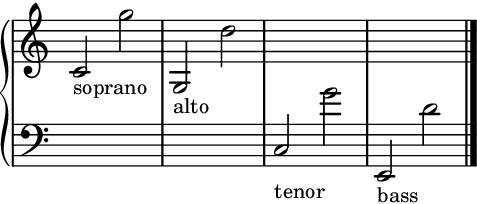
A note or two beyond these limits will not sink an answer, but a soprano camped above the stave or a tenor growling below C will. Aim for the comfortable middle of each range; extremes are for special effects, and Question 1 does not ask for special effects.
Grade 5 introduced short score: soprano and alto share the treble stave, tenor and bass share the bass stave, and stems identify the voice, upper voices up, lower voices down, even when two voices sing the same pitch. That convention carries over unchanged, and every four-part example in this guide uses it.
Spacing
Keep each pair of adjacent upper voices, soprano to alto and alto to tenor, within an octave of each other. The tenor to bass gap may be wider, up to a 12th or so, because the ear tolerates space at the bottom of a texture far better than a hole in the middle. A chord with a gaping octave-and-a-bit between alto and tenor sounds like two duets rather than one choir.
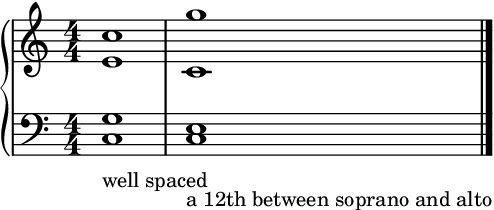
Voices must not cross (alto above soprano, tenor above alto), and should avoid overlapping, where one voice moves past the note an adjacent voice has just left. Both faults confuse the ear about which line is which.
Doubling
A triad has three notes and you have four voices, so one note appears twice. The order of preference:
- Double the root. This is the default and it is nearly always available.
- Doubling the fifth is unproblematic; doubling the third is acceptable in minor triads and positively good in the chord of vi at an interrupted cadence.
- Never double the leading note. It has a fixed destination, the tonic, and two copies must either move there in octaves (forbidden, as the next section explains) or one copy must abandon its duty, which the ear notices at once.
Second inversions have their own rule: double the bass note, which is the chord's fifth. The reason appears in chapter 2.
Consecutive fifths and octaves
Take any two voices in the texture. If they stand a perfect 5th apart and move to another perfect 5th, they have made consecutive fifths; the same motion at the octave or unison makes consecutive octaves. Both are avoided in this style, and it is worth being clear about why. Two voices a perfect interval apart blend so completely that they fuse into a single reinforced sound. Move them in parallel and they stay fused: for that moment your four-part texture has only three real parts, and the drop in richness is audible. Octaves are the worse offence because the fusion is total.
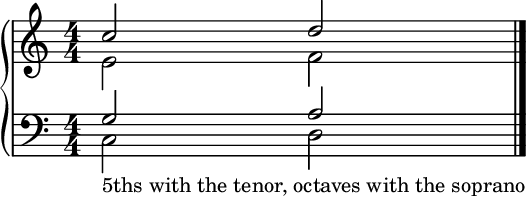
The classic trap is two root-position chords a step apart, such as I to ii, with every voice moving in parallel: the bass and whichever voice holds the fifth make fifths, the bass and the voice with the octave make octaves. The standard cure is contrary motion: when the bass steps up, move the upper three voices down to the nearest available chord notes.
Two adjacent chords sharing a note offer an easier path: keep the shared note in the same voice and move the others by step where possible. Smooth part-writing is not just a virtue in itself; it is the cheapest insurance against consecutives, because voices that barely move rarely collide.
Consecutives by contrary motion (a 5th moving outwards to a 12th) count as a fault too, and so, between soprano and bass, do exposed octaves and fifths: both outer voices leaping in the same direction onto a perfect interval. Approach outer-voice perfect intervals with at least one voice stepping and the problem never arises.
Keyboard style
Question 1 lets you write for keyboard instead of voices. The layout: three notes in the right hand on the treble stave, close enough together to be played by one hand, and the bass alone in the left. The part-writing rules are identical, the ranges are simply the pianist's reach, and the three right-hand parts plus bass behave exactly like SATB with the tenor lifted into the right hand.
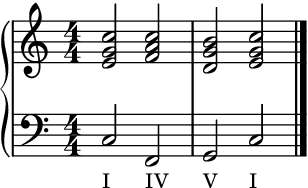
Choose whichever format you write more fluently. Keyboard style is quicker to notate and easier to check by playing; SATB makes the individual lines easier to hear and is the format most textbooks and model answers use. The marks are the same.
The five checks
Every chord you write, in either format, passes the same inspection, and running it in a fixed order turns the rules of this chapter into a habit:
- Right notes: does the chord contain exactly what the figure or numeral demands, accidentals included?
- Ranges: is every voice inside its compass?
- Spacing: soprano to alto and alto to tenor each within an octave, no crossing, no overlap?
- Doubling: root preferred, bass note in a 6/4, leading note never?
- Consecutives: against the previous chord, do any of the six voice pairs move in parallel 5ths or octaves?
Five questions per chord sounds laborious; in practice the first four are settled as you write and only the fifth needs a deliberate sweep at the end.
2. Chords on every degree
The full palette
Grade 5 confined chord work to I, ii, IV and V. Grade 6 opens the whole scale: a triad on any degree, in root position (5/3), first inversion (6/3) or second inversion (6/4), in any major or minor key. The Roman numeral and lettering system carries over unchanged: chord, then position letter, so iib is the supertonic triad in first inversion, and the figures 5/3, 6 and 6/4 say the same thing in figured-bass language.
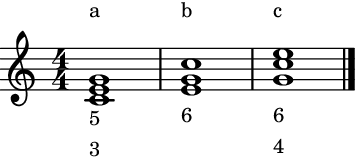
The qualities in a major key were tabulated at Grade 5: major on I, IV and V; minor on ii, iii and vi; diminished on vii. First inversions make every one of them more usable. The diminished triad on vii, unusable in root position for most purposes, is a workhorse in first inversion, where the offending diminished 5th sits between upper voices rather than against the bass: viib routinely harmonises the second degree of a descending scale, standing in for V.
Choosing between the positions is mostly a matter of what you want the bass to do. Root position is the strong form: it plants the chord's identity in the bass and suits beginnings, cadences and points of arrival. First inversion lightens the same harmony and, more usefully, lets the bass sing: a bass line that walks by step under changing chords is nearly always a chain of root positions and first inversions taking turns. Second inversion, as the next section explains, is not freely available at all. When Question 2 asks you to choose chords, think of it as composing a bass line first and labelling it second; the inversions fall out of the line.
Minor keys: two scales, one pool of chords
The syllabus wording matters here: chords "on any degree of the major or minor (harmonic and melodic) scale". In a minor key the sixth and seventh degrees each come in two forms, so the pool of available chords is larger than in major, and you choose from it by voice-leading logic. In A minor:
| Degree | With the harmonic form | With the melodic form |
|---|---|---|
| ii | ii° (B, D, F), diminished | ii (B, D, F♯), minor |
| IV | iv (D, F, A), minor | IV (D, F♯, A), major |
| V | V (E, G♯, B), major | v (E, G, B), minor, from the descending form |
| VI | VI (F, A, C), major | vi° (F♯, A, C), diminished |
| VII | vii° (G♯, B, D), diminished | VII (G, B, D), major, from the descending form |
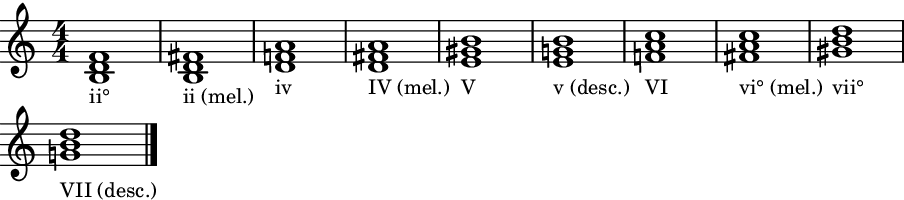
In practice the harmonic-minor set does most of the work, because cadences need the raised leading note: V and vii° almost always carry G♯, not G. The melodic sixth degree earns its keep when a line rises from dominant to tonic (F♯ and G♯ smooth the path in A minor), and the flattened seventh appears when a line falls. The rule of thumb: raised notes in rising lines, flattened notes in falling ones, and a raised seventh at any cadence.
The 6/4: why it needs care
Root-position and first-inversion chords may be used freely. The second inversion may not, and the reason is in the interval stack. Above a 6/4 chord's bass note sit a 6th and a 4th, and in this style the 4th against the bass counts as a dissonance: the ear hears the two upper notes not as a stable chord but as a pair of suspended notes leaning on the bass, wanting to fall by step. A 6/4 treated as a free-standing chord sounds oddly weightless, which is why the style rations it to a few formulas where that leaning quality is exactly the point.
The formula Grade 6 examines is the cadential 6/4: the progression 6/4 to 5/3 over a dominant bass note, written Ic to V (or ic to V in minor). The tonic chord's notes appear over the dominant's bass note on a strong beat, and then do what the dissonance analysis predicts: the 6th falls to a 5th, the 4th falls to a 3rd, the bass stays put, and the chord has melted into plain V just in time for the cadence. Despite the label Ic, the passage is best heard as a decorated dominant: the bass note is the dominant throughout, and everything above it is delay.
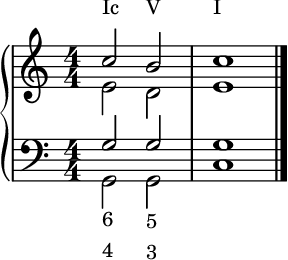
The care instructions follow from the mechanism. Place the 6/4 on a stronger beat than the V it resolves to, so the lean is felt; double the bass note, since it is the one stable thing in the chord; and let the 6th and 4th fall by step. You may also meet the passing 6/4, where the bass walks through the fifth of a chord on a weak beat (I, Vc, Ib with bass 1, 2, 3), worth recognising in analysis, though the cadential form is the one to write.
3. Figured bass at Grade 6
What the figures are
Figured bass is the Baroque shorthand: a bass line with small numbers beneath, each number naming an interval to be sounded above the bass note. The player supplied the missing upper parts on sight. Question 1 hands you exactly such a bass, so the figures must be automatic.
The Grade 6 figures:
| Figure | Meaning | Chord position |
|---|---|---|
| no figure | a 5th and a 3rd above the bass | root position |
| 6 | a 6th and a 3rd (the 3 is understood) | first inversion |
| 6/4 | a 6th and a 4th | second inversion |
| ♯, ♭ or ♮ alone | the 3rd above the bass takes that accidental | usually a root-position chord with altered 3rd |
| ♯, ♭ or ♮ beside a figure | that interval takes the accidental (6♯, 6♭ and so on) | as the figure says |
| 6/4 then 5/3 on one bass note | the cadential formula: 6th falls to 5th, 4th to 3rd | Ic to V |
The lone accidental is the one that trips candidates. A sharp standing under a bass note with no number means: raise the 3rd above this bass. In minor keys it appears under the dominant at almost every cadence, because the chord's 3rd is the leading note and the key signature does not supply it. In A minor, a bass E with ♯ beneath it means E, G♯, B.
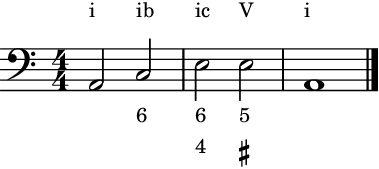
The figures name intervals, not voices: 6 above a bass C means an A somewhere above it, in any octave and any voice. Nor do figures dictate spacing or doubling; those remain your responsibility under the chapter 1 rules.
Reading a figured bass
The reliable routine, chord by chord:
- Name the key from the signature and the final bass note, and keep the leading note in mind.
- Under each bass note, read the figure and spell the chord: no figure, stack a 3rd and 5th; 6, treat the bass as the chord's 3rd; 6/4, treat it as the 5th.
- Apply every accidental the figures demand, and only those.
- Translate to a Roman numeral if it helps you hear the progression, but translate inside the key you are in, never by pattern-matching. A bass E carrying a 6 is a different chord in every key: in G major it spells E, G, C, the subdominant in first inversion (IVb); in C major the same figure over the same note spells the tonic in first inversion (Ib). Spell the intervals, then name what you have spelt.
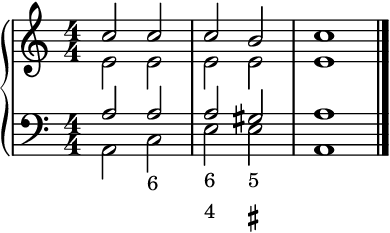
Here is a two-bar figured bass in A minor and one correct realisation. The bass runs A, C, E, E, A with figures blank, 6, 6/4, 5♯, blank: chord i, then ib, then the cadential 6/4 resolving to V with raised 3rd, then home to i.
Writing figures yourself
The Question 2 alternative reverses the trade: you write a bass line under a given melody and add the figures that name your harmonies. The conventions are the mirror of the reading rules. Mark nothing under a root-position chord; write 6 under a first inversion; 6/4 and then 5/3 under a cadential formula; and give any chromatic note in the chord its accidental in the figures, with a lone accidental serving for an altered 3rd. Do not figure melodic decoration in the upper part; figures describe the harmony, not the passing notes over it.
The seventh-chord figures
The chords of the next two chapters bring four more figures: 7, 6/5, 4/3 and 4/2. The syllabus requires "the figuring for all the above chords", so learn them as part of the chord. The specification's own table keeps the figures listed above as the core for Grade 6 realisation, with the seventh figurings needed for the dominant and supertonic sevenths; the richer figure language (9 to 8, 7 to 6, 4 to 3 suspensions) waits for Grade 7.
4. The dominant seventh in all positions
The chord
Add a minor 7th above the root of V and the result is the dominant seventh: in C major, G, B, D, F. Grade 5 met it in passing; Grade 6 requires it in every position, in every key, with its figures. Being a four-note chord it has three inversions, and the ABRSM letters run a to d:
| Position | Bass note | Label | Figure | In C major, bass |
|---|---|---|---|---|
| root position | root | V7a | 7 | G |
| first inversion | 3rd (the leading note) | V7b | 6/5 | B |
| second inversion | 5th | V7c | 4/3 | D |
| third inversion | 7th | V7d | 4/2 | F |
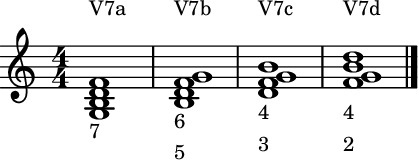
The full figures would be 7/5/3, 6/5/3, 6/4/3 and 6/4/2; the standard abbreviations keep only the numbers that distinguish each position. Read them as a descending pattern: 7, 6/5, 4/3, 4/2 as the bass climbs through the chord.
The chord's character comes from the tritone between its 3rd and 7th, B against F in C major: the leading note straining upwards and the 7th leaning downwards, a diminished 5th that wants to close inwards onto C and E. That built-in instability is why the dominant seventh drives cadences harder than plain V, and why its two tendency notes come with obligations.
Preparation and resolution
Two habits make every V7 sound right:
- The 7th falls by step. F, in C major, resolves to E, the 3rd of the tonic chord. Approach the 7th smoothly too: by step, or by keeping it as a note held over from the previous chord. A 7th that arrives by a wild leap and then fails to fall is the most common seventh-chord fault in exam scripts.
- The leading note rises to the tonic when it sits in an outer voice. In an inner voice it may fall to the 5th of the tonic chord to complete the harmony, a licence the ear forgives because the line is buried.
Follow both rules with a complete V7a and something has to give in the tonic chord: root, 3rd doubled or trebled, and often no 5th. That is normal. A complete V7 resolving to a complete I is not possible without breaking a resolution rule, so classical practice either omits the 5th from V7 (doubling the root) or lets the tonic chord arrive without its 5th.
The inversions resolve along the same lines: V7b to I (bass, the leading note, rises a semitone); V7c to I or Ib; V7d to Ib, and only to Ib, because the bass is the 7th and must fall by step to the 3rd of the tonic. A 4/2 figure therefore predicts the next bass note: one step down.
Recognising the chord in a score is quickest through its two marked notes. Find a four-note chord containing a tritone and you almost certainly have a dominant seventh; the tritone's upper spelling (the leading note) points at the key, and the bass note then names the position. This works in any texture, because the tritone survives however the chord is spread or arpeggiated.
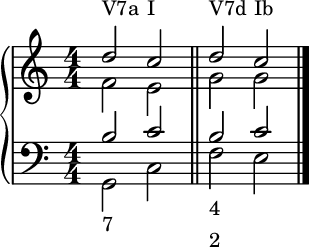
In minor keys everything transfers with the raised leading note in place: in A minor, V7 is E, G♯, B, D, and the figures carry the accidental the leading note needs. V7a is figured 7 with a ♯ beside it for the raised 3rd, while V7b needs no accidental in its figures at all, because the sharpened note is the bass itself. Spell the chord first, then figure what you see.
5. The supertonic seventh
The chord and its two positions
Build a seventh chord on the second degree and you have the supertonic seventh: in C major, D, F, A, C, a minor triad plus minor 7th. In minor keys the triad underneath is diminished (in A minor: B, D, F, A), which gives the chord a darker colour but changes none of its behaviour. Grade 6 examines two positions:
| Position | Bass note | Label | Figure | In C major, bass |
|---|---|---|---|---|
| root position | root | ii7a | 7 | D |
| first inversion | 3rd | ii7b | 6/5 | F |
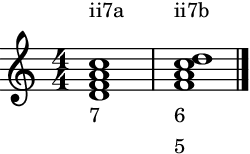
Its route to V
The supertonic seventh has one destination worth knowing at this grade: the dominant. ii7 stands to V exactly as V7 stands to I, a 5th above, pulling downwards onto it, which is why the progression ii7 to V to I is the backbone of so many cadences. The chord's 7th, C in the key of C, obeys the usual law: prepare it smoothly, then let it fall by step, to B, which is conveniently the 3rd of V.
First inversion is the form to reach for. ii7b puts the subdominant degree in the bass, so the bass line walks 4, 5, 1 into the cadence, the strongest approach there is, and the chord sits more consonantly than its root-position form because the triad above the bass is now major. Paired with a cadential 6/4 it gives the full formula ii7b, Ic, V, I that closes uncountably many classical phrases.
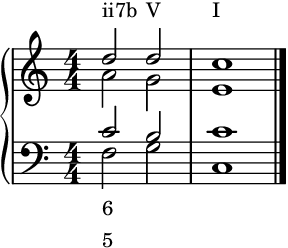
In figured-bass terms, ii7b appears as a 6/5 on the subdominant bass note, and distinguishing it from the dominant's 6/5 is a matter of scale degree: 6/5 on the leading note is V7b; 6/5 on the subdominant is ii7b. The figure tells you the shape; the bass note tells you the chord.
6. Cadences in four parts
Grade 5 asked you to recognise perfect, plagal and imperfect cadences; Grade 6 adds the interrupted cadence and asks you to write all four, which means voicing each formula so that the part-writing rules and the tendency notes all come out right. The formulas, with their standard four-part habits:
Perfect (V to I, or V7 to I). Bass falls a 5th or rises a 4th. Leading note rises to the tonic in an outer voice; any 7th falls by step; keep the common note (the dominant degree) in one voice where you can. This is the full stop, and Question 1 basses end with one almost without exception.
Imperfect (something to V). Any reasonable chord, most often I, ii, ii7b or IV, moving to a root-position V. The phrase pauses on the dominant: a comma. Approach V with contrary motion between bass and soprano and the consecutives look after themselves.
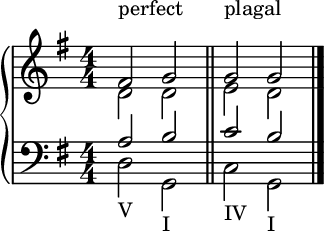
Plagal (IV to I). Bass falls a 4th. The subdominant chord's notes move the minimum distance: keep the tonic degree where it is, let the other voices settle by step.
Interrupted (V to vi, V to VI in minor). The bass rises a step instead of falling a 5th; the leading note still rises to the tonic; and the third of vi is doubled, which is both the smoothest outcome and the standard exception to root doubling. In minor the deception lands on a major chord (VI), which makes the surprise brighter.
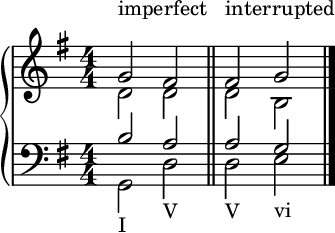
The formulas in summary:
| Cadence | Chords | Bass motion | The notes with duties |
|---|---|---|---|
| perfect | V (or V7) to I | falls a 5th or rises a 4th | leading note up, any 7th down |
| imperfect | I, ii, ii7b or IV to V | varies; ends on the dominant | approach V smoothly, contrary motion helps |
| plagal | IV to I | falls a 4th | keep the tonic degree in one voice |
| interrupted | V to vi (VI in minor) | rises a step | leading note up, double the 3rd of vi |
Dress any perfect or imperfect cadence with the cadential 6/4 and the formulas extend naturally: ii7b, Ic, V7, I is the fullest version, and every segment of it has appeared in the last three chapters. When you plan a Question 1 realisation, find the cadences first; they are the fixed points, and the rest of the bass is the road between them.
7. Melodic decoration
Chords move slowly; melodies move fast. The difference is made of non-harmony notes, pitches that do not belong to the chord of the moment and therefore carry a small, expressive tension against it. Grade 6 expects you to name five kinds in analysis, and to use the first two in your own writing. Each is defined by how it arrives and how it leaves.
Unaccented passing note. Fills the gap between two chord notes a 3rd apart, moving by step on a weak part of the beat: C to D to E while the harmony holds C major. Two can run in a row when the chord notes are a 4th apart. This is the everyday decoration, and the one your Question 2 melody will be full of.
Auxiliary note (upper or lower). Steps away from a chord note and back again: C, D, C or C, B, C. The auxiliary is a decoration of a stationary note, where the passing note decorates a moving line. At Grade 6 the diatonic forms are for use; chromatic auxiliaries are for recognition.

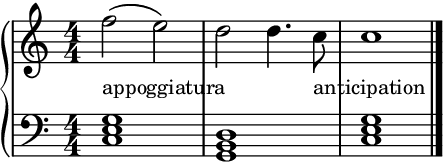
Appoggiatura. A leaning note: it arrives on the beat, usually by leap, sounds against the chord, and resolves by step, most often downwards, onto the real harmony note. Where a passing note slips between beats, the appoggiatura takes the beat for itself and makes the harmony note late. That on-the-beat dissonance resolving by step is the single most expressive device in the classical melodic style, and its written-out form here is the same event the Grade 5 grace-note ornament notated in miniature.
Anticipation. The opposite habit: a note of the next chord arriving early, on the tail of the current one. Classically it is the tonic sneaking in at the end of the dominant chord's beat, just before the cadence lands: a small rhythmic impatience.
Changing notes. The upper and lower auxiliaries taken as a pair before the main note returns: C, D, B, C. The related échappée, or escape note, steps away from a chord note and then leaps back the other way: E steps up to F, then falls a 3rd to D. Both are recognition material; you will meet them in Question 4 extracts and should name them without hesitation.
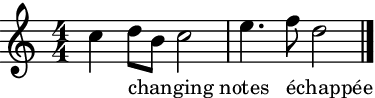
The accented passing note, which takes the beat like an appoggiatura but arrives by step, is also recognition material at this grade. When a Question 4 rubric asks you to "name the melodic decoration" at a starred note, the method is mechanical: identify the chord, confirm the starred note is foreign to it, then classify by approach and exit. Step in, step on in the same direction: passing. Step out and back: auxiliary. Leap in, step out on the beat: appoggiatura. Early arrival of the next chord: anticipation.
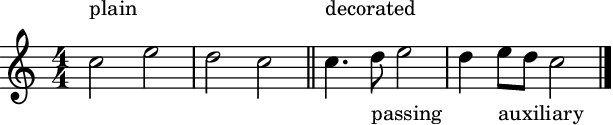
Decoration is also a compositional tool, and Question 3 rewards it. Here is a plain two-bar line and one decorated version of it, using nothing beyond Grade 6 usage: passing notes and auxiliaries.
8. Modulation to related keys
The mechanism
A piece modulates when it changes key: not a passing accidental, but a genuine shift of tonal centre, confirmed by a cadence in the new key. Grade 6 examines modulation to the four related keys: the dominant, the subdominant, the relative major and the relative minor. Each shares all but one note, or every note, with the home key, which is precisely what makes the move smooth.
Two worked sets show the pattern. The related keys of D major are A major (dominant), G major (subdominant) and B minor (relative minor); the relative major does not apply, since D major is already major. From a minor key the same logic runs: the related keys of B minor are F♯ minor (dominant), E minor (subdominant) and D major (relative major). Grade 6 questions confine themselves to these four named targets.
| Home key | Dominant | Subdominant | Relative |
|---|---|---|---|
| D major | A major | G major | B minor |
| B minor | F♯ minor | E minor | D major |
| E♭ major | B♭ major | A♭ major | C minor |
| G minor | D minor | C minor | B♭ major |
Notice the signature arithmetic: the dominant key adds one sharp (or removes one flat), the subdominant adds one flat (or removes one sharp), and the relative keeps the signature unchanged. One accidental of difference at most, which is why these four are the smooth destinations.
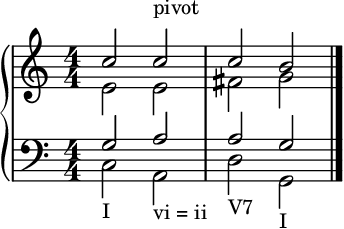
The standard vehicle is the pivot chord: a chord that belongs to both keys at once. The music approaches it meaning one thing, leaves it meaning another. A minor's chord is vi in C major and ii in G major; a phrase can arrive on it as C major's submediant and depart from it as G major's supertonic, heading into D7 and a cadence in G. By the time the listener hears the new leading note, F♯, the ground has already shifted.
How to see it in a score
Accidentals are the fingerprints. Each related key differs from the tonic by at most one signature note, so one recurring accidental usually names the destination:
| From a major key | The tell-tale accidental |
|---|---|
| to the dominant | the raised 4th degree (the new leading note): F♯ when C major moves to G |
| to the subdominant | the flattened 7th degree: B♭ when C major moves to F |
| to the relative minor | the raised 5th degree (the new leading note): G♯ when C major moves to A minor |
From a minor key, the relative major needs no new accidental at all; the old raised leading note simply stops appearing. That absence is itself the clue: a D minor passage whose C♯s give way to C naturals, with cadences landing on F, has moved to the relative major.

To confirm a modulation rather than a decoration, look for a cadence: an accidental plus a V to I close in the new key settles it. In Question 4 extracts, the phrase "in which key does the music end?" is answered exactly this way: find the last cadence, read its chords, name their key. And in Question 3, where the paper may require you to modulate, the same machinery runs in reverse: plant the new leading note in your melody, then cadence in the new key. Chapter 11 works through it.
Hearing it
Modulation to the dominant brightens and lifts; the subdominant relaxes and darkens slightly; the relative minor shades the same notes with a new centre of gravity; the relative major opens the curtains. These are impressions, not rules, but they are consistent enough that checking an analysis against your ear is worthwhile: if the analysis says "modulates to the subdominant" and the passage sounds like a lift in tension, look again.
9. Question 1 in practice: realising a figured bass
Fifteen marks for about four bars: roughly a mark a chord. The examiners' criteria reward correct chords, clean part-writing and a shapely soprano, in that order. Here is the complete method, worked on a specimen bass.
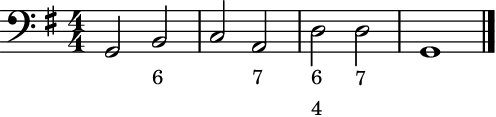
Step 1: survey. Key: G major (one sharp, bass ends G, D, G). Read every figure before writing anything: bar 1, no figure then 6; bar 2, no figure then 7; bar 3, 6/4 then 7 on a repeated D; bar 4, no figure. Translate: I, Ib, IV, ii7a, Ic, V7, I. The cadence is perfect, dressed with a cadential 6/4; the 7 on A is the supertonic seventh, its 7th (G) ready to be prepared in the IV chord before it.
Step 2: plan the soprano. A good soprano moves mostly by step, peaks once, and moves in contrary motion with the bass where convenient. Sketch it before filling anything in. The realisation below uses G, G, E, E, D, C, B: a repeated note to open, then a stepwise descent through the cadence, ending on the 3rd of the tonic chord. Nothing in it leaps, and every note belongs to its chord. Plain is fine: examiners reward correctness over ambition.
Step 3: fill alto and tenor. Complete each chord with its missing notes, obeying spacing and doubling. Keep common notes in the same voice: the G that is the 7th of ii7a is already there in the IV chord's alto; hold it over and the preparation rule is satisfied without thought.
Step 4: police the tendency notes. Over the stationary bass D, the 6/4 must melt into the chord that follows: the 6th above the bass (B, in the tenor) falls to A, the 4th (G, in the alto) falls to F♯, and the soprano's octave D falls to C, the very note that turns plain V into V7. That C then falls to B as the leading note F♯ rises to G, and the cadence is done.
Step 5: sweep for consecutives. Check all six voice pairs across every chord change: S to A, S to T, S to B, A to T, A to B, T to B. It takes two minutes and catches the errors that cost the most marks. Look especially at any two chords whose basses move by step.
Step 6: play it, or hear it. Sing the soprano; sing the bass. If any voice makes an awkward leap (an augmented 2nd or 4th, a 7th), re-voice it now.
The finished realisation:
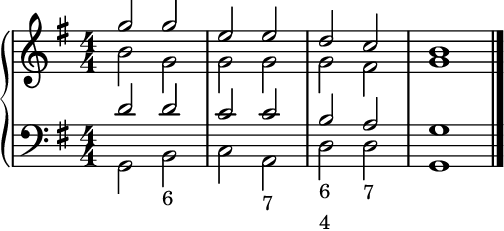
And a keyboard-style answer to the same bass: the same chords, drawn into close position so that the three upper parts sit under one hand:
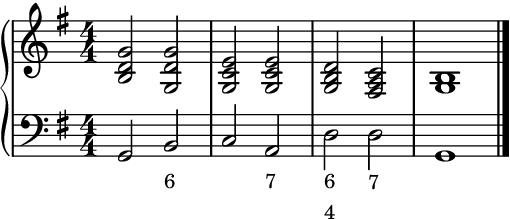
One detail of the keyboard version repays a look. In the final chord the right hand shows only two noteheads, because two of its three voices have converged on a unison G: the leading note F♯ rises to it while the A above falls onto the same note. The hand still holds three parts; two of them simply share a key.
Common causes of lost marks, in rough order of frequency: consecutive 5ths and octaves between bass and an inner voice; a doubled leading note at the cadence; the 7th of V7 leaping away instead of falling; a 6/4 whose 6th and 4th fail to fall; spacing wider than an octave between upper voices; and chords mis-spelt because a lone accidental in the figures was overlooked.
10. Question 2 in practice: chords for a melody
Question 2 presents an eight-bar diatonic melody and offers two formats for the answer: indicate suitable chords "using any recognised method of notation", which in practice means Roman numerals with position letters (or note-names with figures) written under the stave, or, at your choice, write an actual bass line beneath the melody and add figures to show the harmonies. The first format is quicker; the second earns its keep if figured bass is second nature to you. Either way the underlying task is identical: choose the harmony.
The method. First, fix the key and find the phrase ends; an eight-bar melody almost always divides four plus four. Decide the cadences before anything else: a mid-point pause on the dominant wants an imperfect cadence; a final close on the tonic wants a perfect one. Then harmonise bar by bar at a steady rate, one or two chords per bar, treating stepwise quavers as passing notes rather than forcing a chord onto every note.
Chord choice at this grade is wider than Grade 5's primary-triad diet, but the old skeleton still serves: I, IV and V do the heavy lifting; ii (and ii7b) approaches cadences; vi follows V for colour or harmonises the sixth degree; iii is rarely needed. Root position and first inversion are freely available; save 6/4 for the cadential formula. Prefer bass movement by 4th, 5th or step, and avoid V moving to IV, which reverses the current of the style.
Here is a specimen melody in D major with one good set of chords indicated beneath:
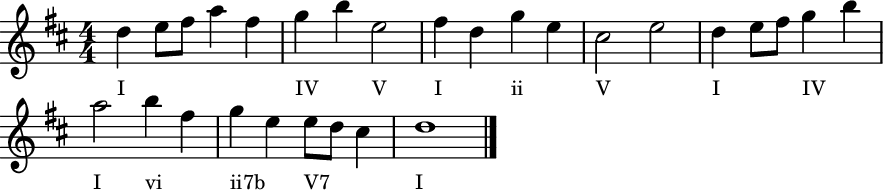
Reading the choices: bars 1 and 5 open with plain tonic harmony under a rising figure whose E is a passing note. The first phrase moves through IV to V and back to I, then approaches its imperfect cadence through ii in bar 3, whose root falls a 5th to the dominant. The second phrase revisits the opening, colours bar 6 with vi under the melody's B and F♯, and closes with the full formula: ii7b in bar 7 (the melody's G and E both belong to it), V7 with the melody's D as a passing note between E and C♯, then the tonic.
The bass-plus-figures alternative writes the same decisions as notes:
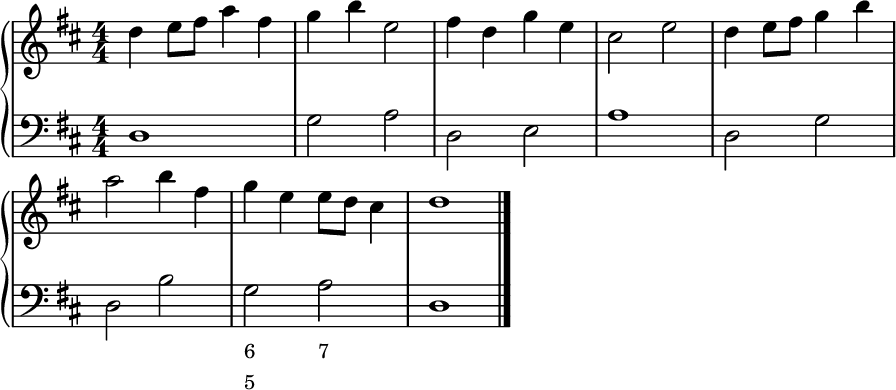
The figures mark only what the convention requires: nothing under root-position chords, 6/5 under the ii7b, 7 under the dominant seventh. If you choose this format, your bass line is itself marked as a line: give it steps and 4ths and 5ths, not a series of octave lurches, and check it against the melody for consecutives, because those two voices are the outer pair and errors between them are the most audible of all.
One warning applies to both formats: harmonise the melody you are given, not the one you wish you had. A melody note that clashes with your chosen chord is not a detail; it is the question telling you the chord is wrong. Check every chord against every simultaneous melody note, counting stepwise weak-beat notes as decoration.
11. Question 3 in practice: composing a melody
Twenty marks for eight to ten bars of melody, continuing a given opening, for one instrument chosen from the two or three offered. The examiners' published criteria say what they reward: "an excellent overall sense of shape and direction", unity of "style and character" with the opening, and idiomatic writing for the chosen instrument. Modulation "to the dominant, subdominant, relative major or relative minor may be required", and when it is, the rubric says so plainly.
Choosing the instrument. Pick the one whose sound you know, not the one that looks impressive. The practical checks: keep violin, oboe, flute or clarinet parts inside their comfortable compass (roughly two octaves from their usual low register), give a wind player somewhere to breathe, and use each instrument's natural articulation: slurred steps for wind, a mix of slurs and detached crotchets for strings. Nothing in the marking rewards extremes of range.
Reading the opening. The given bars fix your materials: key, metre, tempo word, a rhythmic cell or two, and a melodic character. The single most reliable route to a good answer is to reuse the opening's rhythm in most of your bars, vary its melodic shapes (invert a figure, sequence it a step higher or lower), and place one climax, usually the highest note, about two-thirds of the way through. A melody that introduces three new rhythms in eight bars sounds like three melodies.
A modern opening. The syllabus says the melodies may be "tonal and in more modern styles", so the given bars are not guaranteed to be a Classical tune: an opening may carry no key signature, move in an irregular metre, or turn on intervals no eighteenth-century melody would use. The method does not change. Continue in the idiom of the opening, reuse its rhythms and shapes, and place one climax, exactly as before; where conventional key and cadence do not apply, let the line settle on the note the opening has taught the ear to treat as home.
Planning the modulation. When a modulation is required, engineer it in the second half. The machinery is chapter 8's in reverse: steer the line towards the new key's notes, plant the new leading note as an accidental, and close with a clear cadence-shaped ending in the new key, usually a 2 to 1 or 7 to 1 melodic close over an implied V to I.
Here is a specimen: an Andante opening in G major, 3/4, for violin, with the requirement "modulate to the dominant".
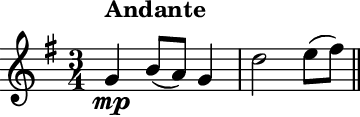
And one completed answer:
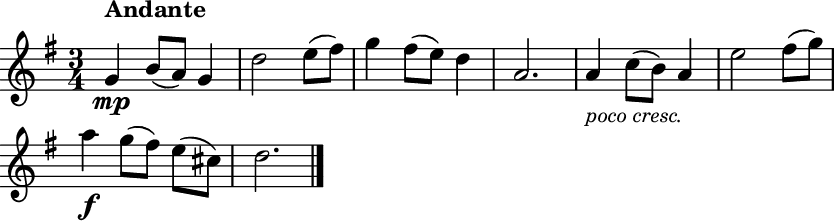
What the continuation does, and why: bars 3 and 4 answer the opening with its own rhythm, sinking to an implied imperfect cadence at bar 4 so that the eight bars fall into two balanced phrases. Bars 5 and 6 replay the opening pair one step higher, a sequence that gives the whole melody an audible plan and quietly steers it towards the new key. Bar 7 is the climax: the peak note A arrives, and the line turns down through C♯, D major's leading note, to close 7 to 1 onto D, the melodic shape of a perfect cadence in the dominant. Dynamics and phrasing are added because the question asks for a melody a violinist could perform: tempo, bowing-friendly slurs and dynamics are part of the answer, not decoration.
Before you leave the question, run the examiner's checklist against your own answer: does every bar's rhythm belong to the same piece as the opening? Is there one peak, not three? Does the required key actually arrive, accidental and cadence and all? Could the named instrument play it comfortably? Four yeses is a strong script.
12. Questions 4 and 5 in practice: reading scores
Half the paper, fifty marks, is score-reading: Question 4 on a short extract for piano, voice and piano, string or vocal quartet, or a sonata movement for a non-transposing solo instrument, and Question 5 on a full score of up to ten sounding staves: an orchestra, a large ensemble, or a chorus with orchestra. Neither asks anything you have not met; both ask it about real music at speed. The question types recur so reliably that each is worth rehearsing.
Keys, chords and cadences. Expect "name the key at bar X", "describe the chord marked A" (answer with note names, or a Roman numeral and position, or a figure, as the rubric asks), and "name the cadence at bar Y". The chord questions are chapter 2 to 5 material applied to a printed page: gather the notes sounding at the marked moment across every stave, reduce octave duplicates, stack in 3rds, read the bass note for position. In piano music remember that the sounding chord may be spread as an arpeggio or split between the hands.
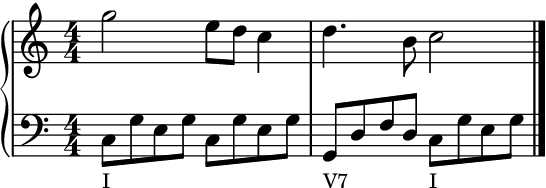
Melodic and rhythmic features. The syllabus lists what you must spot: melodic and harmonic sequences, imitation and canon, melodic and rhythmic motifs, syncopation, pedal points (tonic and dominant), and the melodic decorations of chapter 7. A sequence is a figure restated straight away at a different pitch level: the chapter 11 specimen does it melodically when bars 5 and 6 replay the opening a step higher, and the sequence is harmonic when whole chords shift level the same way. Imitation is one voice restating a figure another voice has just sounded, entering a beat or a bar behind; keep the copying exact and continuous and it becomes a canon. A pedal point is a note, almost always tonic or dominant, held or repeated in one voice while the harmony changes above or around it; name it by degree ("dominant pedal") and voice.
Ornament realisation. Grade 5's ornament chapter remains the reference: trill, turn between notes or on a note, upper and lower mordents, acciaccatura, appoggiatura. Grade 6 adds the inverted (lower) turn and asks for realisation in context: write out, in real note values, what the sign means at that spot in that tempo. At the cadence of a Baroque movement, expect the trill to begin on the upper note.

Phrase structure. A standard task marks phrase ends with letters and asks for the structure of the whole extract, or asks you to bracket the phrases yourself. Phrases at this level are mostly four bars; find the cadences and the breathing points, and say what repeats and what answers what (AABA, or "two four-bar phrases, the second beginning as a sequence of the first").
General observation. Both questions also ask for features rather than names: "name one feature which shows the change of mood at bar X", "what makes bar Y the climax of the extract?", "how is the opening melody varied when it returns?". Answer with one concrete thing you can point to in the score: a dynamic marking, a change of texture or register, a change of scoring such as the melody passing to a solo instrument, a shift of harmony, or a melodic variation named by bar. One precise, visible observation earns the mark.
Voices and instruments. Question 4's quartet extracts use the standard string quartet (two violins, viola, cello) or SATB voices; know the clefs each uses and the ranges of the standard voice types. The six voice types, highest to lowest, with working ranges rounded to the nearest useful landmark:
| Voice | Approximate range |
|---|---|
| soprano | middle C to the A above the treble stave |
| mezzo-soprano | the A below middle C to the F at the top of the stave |
| alto (contralto) | the F below middle C to the D at the top of the stave |
| tenor | the C an octave below middle C to the A above middle C |
| baritone | the A an octave and a third below middle C to the F above middle C |
| bass | the E an octave and a sixth below middle C to middle C |
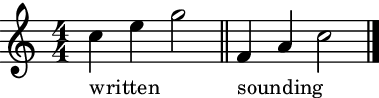
Question 5's orchestra draws on the Grade 5 instrument list, and its transposing instruments at this grade are confined to instruments in F, B♭ and A (horn, cor anglais, clarinet, trumpet), plus the octave transposers, piccolo and double bass. Bass clarinet and double bassoon are not asked about at this grade. The perennial questions: "write this phrase at sounding pitch" (transpose the written part by the instrument's interval, chapter 8 of Grade 5), "name the interval between these two instruments as it sounds" (convert both to concert pitch first), and "which instruments are silent in these bars?".
Interval questions admit one name that is new at this grade: the chromatic semitone, also called the augmented unison, in which the two notes share a letter name, C to C♯. The diatonic semitone covers the same distance across two letter names, C to D♭. The two are identical on the keyboard; the spelling on the page decides which you name, so read the letters before you answer.
Score furniture. The layout signs of an orchestral page are examinable, and most of them exist because two players often share one stave:
| Sign | Meaning |
|---|---|
| a2 | both players of the pair play the written line |
| I, II | first player only, second player only |
| div. | the section divides, sharing out the written notes |
| unis. | the divided section reunites on one line |
| tutti | everyone, after a solo or reduced passage |
| tremolo (strokes through a stem) | rapid repetition of the note, or rapid alternation between two |
| glissando (gliss.) | slide continuously between the written notes |
| muta in... | change crook, instrument or tuning (horns, timpani) |
Con sordino and senza sordino, pizzicato and arco carry over from Grade 5.
Composer and period. The paper offers three composers or periods, "all from the Baroque period onwards, each from a different period", and asks you to underline the likely one, sometimes naming a reason. The reasoning is stylistic, and broad brushstrokes suffice: figured textures, continuo bass and ornament-laden lines say Baroque; balanced four-bar phrases, Alberti figuration and modest orchestras say Classical; thick chromatic harmony, wide dynamics and a large orchestra say Romantic; no key signature, irregular metres and unresolved dissonance say the twentieth century. Tie your reason to something visible in the score ("the continuo-style figured bass suggests the Baroque"), not to a feeling.
A note on tactics for both questions: read the rubric before the score, because it tells you where to look; answer in the form asked (note names, numeral or figure as specified); and when a question offers a mark for a reason, give one concrete observation, not two vague ones.
13. Terms and signs at Grade 6
The whole vocabulary of Grades 1 to 5 remains examinable, and Question 4 and 5 rubrics use it freely. The Grade 6 additions:
Italian
| Term | Meaning |
|---|---|
| a piacere | at the performer's pleasure, freely |
| adagietto | rather slow, though less slow than adagio |
| affrettando | hurrying |
| amore | love (con amore, with love, warmly) |
| calando | dying away, quieter and gradually slower |
| delicato | delicate |
| dolciss. (dolcissimo) | as sweetly as possible |
| dolente | sad, mournful |
| giusto | exact, strict (tempo giusto, in strict time) |
| marziale | in a military style |
| mezza voce | at half voice, restrained |
| possibile | possible (presto possibile, as fast as possible) |
| prestissimo | as fast as possible |
| seconda, secondo | second (seconda volta, second time) |
| soave | gentle, smooth |
| spiritoso | spirited |
| strepitoso | noisy, boisterous |
| tanto | so much (non tanto, not too much) |
| teneramente | tenderly |
| tenerezza | tenderness (con tenerezza) |
| tenuto | held for the full value |
| volta | time (prima volta, first time) |
French
| Term | Meaning |
|---|---|
| à | to, at |
| avec | with |
| doux | sweet, soft |
| encore | again, still |
| et | and |
| non | not |
| peu | little (un peu, a little) |
| plus | more |
| sans | without |
| très | very |
| un, une | one, a |
German
| Term | Meaning |
|---|---|
| Ausdruck | expression (ausdrucksvoll, expressively) |
| ein | one, a |
| etwas | somewhat, rather |
| geschwind | quick |
| langsamer | slower |
| mit | with |
| nicht | not |
| ohne | without |
| rasch | quick |
| sehr | very |
| und | and |
| ziemlich | rather, fairly |
| zu | to, too (as in zu schnell, too fast) |
The little words are the point of this grade's lists. Composers write nicht zu rasch, un peu plus lent, sempre più tranquillo e teneramente: instructions assembled from exactly these building blocks. Practise reading whole instructions, not single words; the papers quote them whole.
Instrument names in four languages
Question 5 scores may name their instruments in English, Italian, French or German, and the syllabus expects the commonly used names:
| English | Italian | French | German |
|---|---|---|---|
| piccolo | ottavino | petite flûte | kleine Flöte |
| flute | flauto | flûte | Flöte |
| oboe | oboe | hautbois | Oboe |
| cor anglais | corno inglese | cor anglais | Englischhorn |
| clarinet | clarinetto | clarinette | Klarinette |
| bassoon | fagotto | basson | Fagott |
| horn | corno | cor | Horn |
| trumpet | tromba | trompette | Trompete |
| trombone | trombone | trombone | Posaune |
| timpani | timpani | timbales | Pauken |
| violin | violino | violon | Violine (Geige) |
| viola | viola | alto | Bratsche |
| cello | violoncello | violoncelle | Violoncello |
| double bass | contrabbasso | contrebasse | Kontrabass |
Two of these are famous traps: the French alto is the viola, not a voice, and the German Bratsche is also the viola. Timpani appear as timbales in French scores and Pauken in German ones. Cor anglais is itself the French name, borrowed whole into English; the Italian corno inglese and the German Englischhorn translate it.
14. Common mistakes at Grade 6
- Consecutive fifths or octaves between the bass and an inner voice, usually where two root-position chords stand a step apart. Sweep all six voice pairs; the outer pair is not the only place they hide.
- Doubling the leading note, most often in Vb or at a cadence. One leading note per chord, always.
- Letting the 7th of V7 or ii7 leap away or rise. Sevenths fall by step, every time.
- Writing a 6/4 chord as if it were freely available. At this grade a second inversion is the cadential formula or it is a mistake; and its bass note, not its root, takes the doubling.
- Forgetting the lone accidental in a figured bass. A bare ♯ under a dominant bass note in a minor key is the leading note asking to be raised; miss it and every chord after sounds a semitone adrift of the style.
- Spacing faults: more than an octave between soprano and alto or between alto and tenor. The wide gap belongs at the bottom, between tenor and bass, if anywhere.
- Harmonising Question 2 against the melody: a chord that clashes with a strong-beat melody note is wrong even if the progression looks elegant on paper.
- Using V to IV. The style's current runs I towards IV towards ii towards V towards I; swimming upstream at a cadence point costs marks.
- In Question 3, inventing new rhythms instead of developing the opening's, or modulating without a confirming cadence, or writing a fine melody for the wrong instrument's range.
- Leaving Question 3 bare of performance detail. A melody without a tempo word, dynamics and phrasing is an unfinished answer, whatever its notes.
- In Questions 4 and 5, transposing the wrong way. Re-derive the rule each time: an instrument in F sounds a perfect 5th lower than written, so its written part sits a perfect 5th above concert pitch.
- Identifying a chord from an arpeggiated piano texture by grabbing only the notes under the marked beat's downbeat. Gather the whole harmony of the moment, including the notes the pattern has just spread out.
15. Practice questions
Answers follow in the next section. Questions 1 to 3 are exam-shaped; the rest drill the knowledge the paper assumes.
1. Realise the following figured bass in four parts (SATB) or in keyboard style:
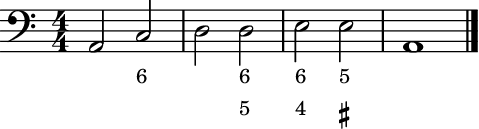
2. Indicate suitable chords for the following melody, using Roman numerals or any recognised notation. Mark the cadences at bars 4 and 8.

3. Continue the following opening for oboe to make a complete melody of eight bars, modulating to the relative major. Add tempo, dynamics and phrasing:
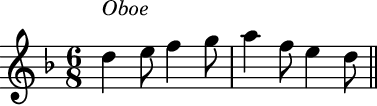
4. Write out the figures for the four positions of the dominant seventh, and name the bass note of each in E major.
5. Spell the supertonic seventh of G minor, and give the label and figure of its first inversion.
6. In a cadential 6/4, which note of the chord is doubled, and where do the 6th and the 4th go?
7. A horn in F plays a written G at the top of the treble stave. Name its sounding pitch. A clarinet in A reads a written C an octave above middle C; name its sounding pitch.
8. Give the meanings of: giusto, mezza voce, strepitoso, geschwind, sans, ziemlich.
9. A Question 3 rubric asks a melody in B minor to modulate to the relative major. Name the key, and name the accidental whose disappearance will mark the change.
10. Name the melodic decoration in each case: (a) a weak-beat quaver moving by step between two chord notes a 3rd apart; (b) a note leapt to on the beat, foreign to the chord, resolving down by step; (c) a chord note repeated early, at the end of the previous chord's beat; (d) the figure C, D, B, C over C major harmony.
11. In four-part writing, which note must never be doubled, and why exactly?
12. An orchestral score shows a horn stave marked a2, and later unis. after div. in the violas. What do the three signs mean?
13. In an orchestral score, a horn in F has a written C in the third space of the treble stave, while the double bass has a written F on the fourth line of the bass stave. Name the interval between the two notes as they sound.
14. In a Question 4 extract in G major, the cello repeats the note G for four bars while the harmony above it moves from I through IV and V7 and back to I. Name the device as precisely as you can.
15. In A♭ major, spell the dominant seventh chord, then give the label, the figure and the bass note of its second inversion.
16. Answers
1. One correct realisation (others are possible; check yours chord by chord against the figures, then sweep for consecutives):
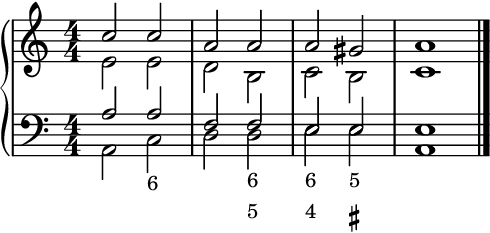
The bass carries i, ib, iv, ii7b, then the cadential 6/4 resolving to V with raised 3rd, then i. In the printed answer the tenor holds E through the last three chords, the alto's C falls to B as the 6th resolves to the 5th, and the soprano's A falls to G♯, the 4th resolving to the leading note, which duly rises to A.
2. One good scheme, by bar: 1: I. 2: IV, then V. 3: I, then V. 4: V, an imperfect cadence. 5: I. 6: vi, then IV. 7: ii (the G and B♭ belong to it), then V, with V7 equally good if your notation shows it. 8: I, a perfect cadence. Any answer is acceptable whose chords contain the strong-beat melody notes, whose cadences are imperfect at bar 4 and perfect at bar 8, and whose 6/4 chords, if any, are cadential.
3. A specimen continuation:
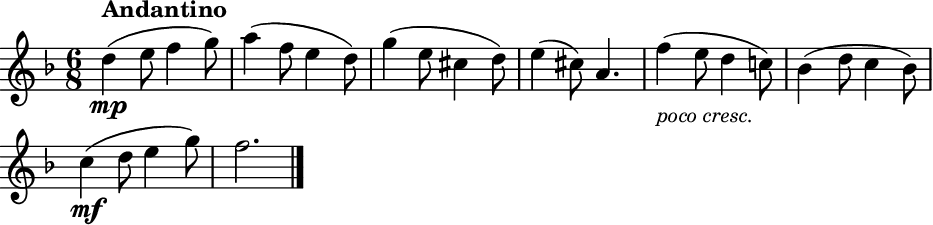
The model keeps the opening's lilting crotchet and quaver rhythm throughout, answers the first phrase with an imperfect close on A (the C♯ marking D minor's dominant), then lets the C♯ lapse to C♮ as the line turns towards F major, cadencing there with a 2 to 1 close. Your version need not match; it should share the rhythm of the opening, peak once, reach F major convincingly, and carry tempo, dynamics and slurs an oboist could use, with somewhere to breathe.
4. Root position: 7, bass B. First inversion: 6/5, bass D♯. Second inversion: 4/3, bass F♯. Third inversion: 4/2, bass A.
5. A, C, E♭, G: the supertonic seventh of G minor (a diminished triad plus a minor 7th). First inversion: ii7b, figured 6/5, bass C.
6. The bass note (the chord's 5th) is doubled. Over the stationary bass, the 6th falls to the 5th and the 4th falls to the 3rd, turning the 6/4 into the plain dominant 5/3.
7. The horn sounds a perfect 5th lower: written G at the top of the stave sounds the C a 5th below it. The clarinet in A sounds a minor 3rd lower: written C an octave above middle C sounds the A a minor 3rd below it.
8. Giusto: exact, strict. Mezza voce: at half voice, restrained. Strepitoso: noisy, boisterous. Geschwind: quick. Sans: without. Ziemlich: rather, fairly.
9. The relative major of B minor is D major. B minor's raised leading note, A♯, stops appearing; its absence, with cadences forming on D, marks the modulation.
10. (a) An unaccented passing note. (b) An appoggiatura. (c) An anticipation. (d) Changing notes: the upper and lower auxiliaries paired before the main note returns.
11. The leading note. It must rise to the tonic; two copies rising together make consecutive octaves, and a copy that resolves elsewhere abandons the pull that defines the note. Either way the texture is damaged, so the note is simply never doubled.
12. a2: both players of the pair play the same written line. div.: the section divides, half taking each note of the double stops or chords. unis.: the divided section returns to playing one line in unison.
13. The horn sounds a perfect 5th lower than written: its C in the third space sounds the F above middle C. The double bass sounds an octave lower than written: its F on the fourth line sounds the F an octave below that. The sounding interval is two octaves.
14. A tonic pedal (a pedal point on the tonic) in the bass. The tonic is held or repeated through changing harmony above it.
15. The dominant seventh of A♭ major is E♭, G, B♭, D♭. Its second inversion is V7c, figured 4/3, with B♭ in the bass.
A Grade 6 pass completes the step from reading music to writing it. The tools here, four-part grammar, the figured-bass shorthand, the seventh chords and the discipline of a working melody, are the foundation on which Grade 7 builds its chromatic vocabulary and Grade 8 its trio sonatas and keyboard reconstructions. They are also, quite simply, how the repertoire from Purcell to Brahms was made.