How pieces are built, and how to take them apart
The standard forms of Western music, from a single motif to a complete sonata: what each form is, how its key plan works, where it is found in the repertoire, and a repeatable method for analysing any piece, finished with a complete worked analysis of an engraved miniature.
Introduction
Ask what a piece of music is about and you will get answers about its tune, its harmony, perhaps its mood. Ask how it holds together over three minutes, or thirty, and most listeners have no answer at all, though their ears know. They feel the return of an opening tune as homecoming. They feel a double bar as a border crossed. They know, without being told, that a movement has ended rather than merely stopped. Form is the name for what their ears are doing.
Form is not a mould that composers pour music into. It is closer to grammar: a set of shared habits about statement, contrast and return that lets a listener follow a long stretch of music the way a reader follows an argument. The habits are few. Nearly every piece in the Western repertoire before 1900, and a great deal after, is built from a dozen or so designs: two-part and three-part shapes, the rondo's circling refrain, the variation set, the sonata's key argument, the fugue's staged entries. Learn those designs and whole libraries of music open up at once.
This guide covers each design in turn. Every form gets the same treatment: what its sections are, what its key plan is and why that plan works on the ear, where the form lives in the repertoire, and how to recognise it from the printed page. The examples are original miniatures engraved for this guide, so every feature described can be seen in the notation beside the description. Real works and their composers are named throughout so you know where to hear each form at full scale.
The second subject of this guide is analysis itself. Naming a form is the least of it. A real analysis maps the phrases, finds the cadences, traces the keys and shows how a little material goes a long way. Chapter 11 turns that into a method you can apply to any piece, then walks through a complete analysis of a 20-bar minuet written for the purpose, bar by bar, so you can see the method earn its keep.
None of this needs advanced harmony. If you can recognise the four cadence types and follow a modulation to the dominant, everything here is within reach; where a topic leans on harmonic detail, the companion volumes are cited rather than repeated. Take the forms to real pieces as you read. Analysis learned on one minuet transfers to every minuet you will ever play.
How to use this guide
Chapter 1 builds the small units: motif, phrase, sentence, period, and the cadences that punctuate them. Chapters 2 to 10 are the forms themselves, from binary to the multi-movement plans. Chapter 11 is the analysis method and the worked example, and it is the chapter to come back to. Chapter 12 relates all of this to the ABRSM theory grades. Chapter 13 compresses every form into a one-line map, and chapter 14 is practice.
If you have a piece in front of you and want to know its form, start at chapter 11 and use chapter 13 as the identification table. If you are working towards a theory exam, read chapters 1 to 3 closely, then chapter 12.
Companion documents cover neighbouring ground. Musical Harmony explains the cadences, keys and modulations this guide takes as known. Roman Numeral Analysis covers labelling the chords inside a passage. Counterpoint covers the working of fugue in detail; chapter 8 here gives only the formal outline. Rhythm and Metre covers metre and the rhythmic characters of the dances, and the Musical Terms Dictionary defines the Italian terms the scores use. The ABRSM grade volumes, especially Grades 6 to 8, apply phrase structure and form to exam questions, and Music Notation covers the signs, including repeats and da capo instructions, that the forms rely on.
A note on terms and notation
Naming follows British convention throughout: stave and bar for the page furniture, semibreve, minim, crotchet, quaver and semiquaver for the note lengths, leading note for the seventh degree, and sharpened or flattened where a note is raised or lowered. Cadences are perfect, imperfect, plagal and interrupted. Chord progressions are joined with hyphens: ii-V-I. Bar ranges are written "bars 1 to 4". Upper-case letters name sections (A, B), and a dash after a letter, as in A', marks a varied return.
Sections quoted from the engraved examples are original music written for this guide in the style under discussion. Named works by real composers are described in prose only.
1. The building blocks
1.1 Motif and figure
The smallest unit of form is the motif: a short melodic or rhythmic idea, usually under a bar long, distinctive enough to be recognised when it comes back. The opening four notes of Beethoven's Fifth Symphony are the textbook case: three quavers and a longer note, memorable at once, and the seed of most of the movement.
To find a piece's motif, take its opening phrase and strip away what is decorative: the passing notes, the accompaniment, the doubling. What is left, the shape a listener could whistle back after one hearing, is usually the motif, and the test of the identification is whether the rest of the piece keeps using it.
A figure is a pattern too, but a servant rather than a subject: a broken-chord accompaniment, a scale run, an oscillating left-hand shape. The difference is one of function, not size. A motif carries identity and is developed; a figure fills texture and is merely continued. The Alberti bass that runs under so many Classical melodies is a figure: nobody whistles it, and no development section works it out.
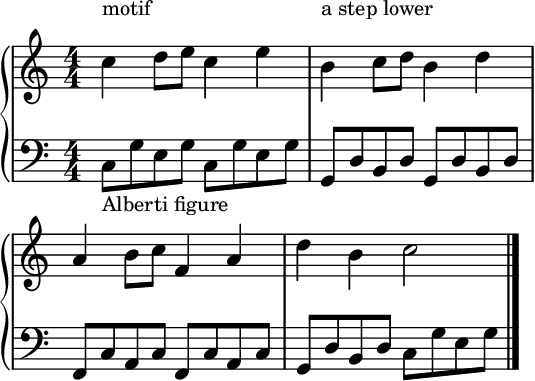
In the example the right hand states a one-bar motif and immediately repeats it a step lower, a sequence, which is the most common way of spinning a motif into a phrase. The left hand plays an Alberti figure throughout. The motif is the speaker; the figure is the hum of the room.
1.2 Developing a motif
A motif earns its keep by coming back changed. Composers work with a small toolkit of standard transformations, and analysis names them constantly, because "bar 9 is the opening motif inverted" says in six words what a paragraph of vague description cannot.
| Device | What happens to the motif |
|---|---|
| repetition | said again at the same pitch |
| sequence | repeated a step (or another fixed interval) higher or lower |
| inversion | turned upside down: each rising interval falls, each falling interval rises |
| augmentation | note values lengthened, usually doubled |
| diminution | note values shortened, usually halved |
| retrograde | played backwards, last note first |
| fragmentation | only a piece of the motif used, usually its head or its tail |
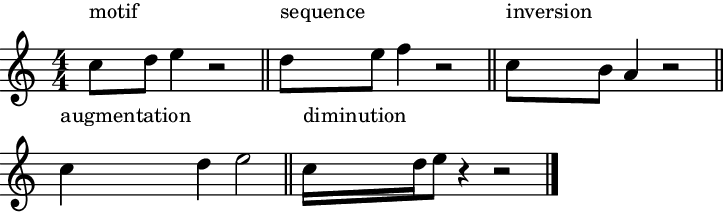
The engraving shows a short motif and its four commonest transformations. Sequence and fragmentation do the everyday work: sequences spin motifs into phrases, and development sections and fugue episodes run on fragments. Inversion, augmentation and diminution are rarer and so more noticeable; when one appears it is nearly always worth a line in the analysis. Retrograde is rarer still, and hard to hear even when the page confirms it.
The exam wording for all of this is "describe the relationship between bar 1 and bar 9", and the expected answer names the device, the interval where there is one ("a sequence, one step lower"), and any change of key. Chapter 12 returns to that question type.
1.3 The phrase
A phrase is the shortest span of music that makes a complete gesture: it moves away from a point of rest and arrives at another, marked by a cadence. Four bars is the norm in most dance-based and Classical music, so much so that the ear budgets for it, and two-bar and eight-bar phrases are heard as halvings and doublings of that norm. Within a four-bar phrase there are usually two two-bar sub-phrases, a rise and an answering fall.
Phrase lengths are not fixed. Composers stretch a phrase by extension (repeating or prolonging its cadence bars) and compress the seam between two phrases by elision, where the final bar of one phrase is simultaneously the first bar of the next. Spotting a five-bar phrase and explaining which bar was added is a standard analysis task, and a favourite of examiners.
Each device has a recognisable mechanism. The commonest extension is the dodged cadence: the phrase drives to bar 4, the dominant resolves to vi instead of I (an interrupted cadence), and the music must spend two more bars earning the close it just refused, making 4 into 6. Another is the echo, where the cadence bars are simply said twice. Elision runs the other way: listen for a bar that is unmistakably a beginning, a new theme, a new texture, yet lands on the resolution chord of the previous phrase. Count it once, not twice, and note in the analysis that the seam is elided. Bars themselves also group into strong and weak, usually alternating, so a four-bar phrase carries a larger two-beat rhythm across it; when a composer disturbs that alternation, by elision or by a three-bar phrase, the jolt is part of the expressive effect and worth a sentence in any write-up.
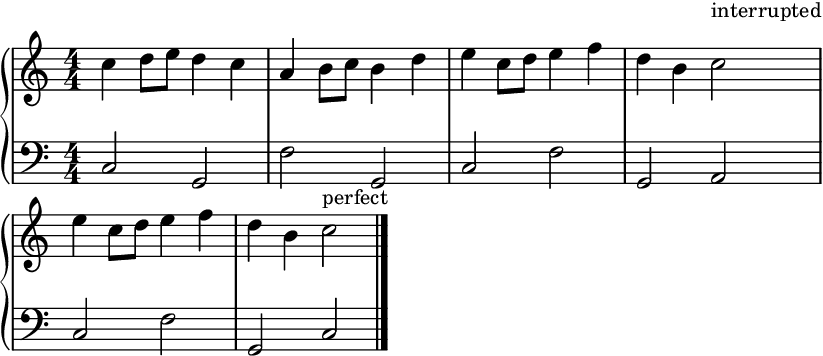
The engraving shows the commonest extension in action. Bars 1 to 3 behave like any four-bar phrase. At bar 4 the dominant resolves to vi instead of I, and the two added bars replay the approach of bars 3 and 4; this time the bass consents to close on to the tonic. Heard aloud, the effect is of a full stop withheld and then granted, and the phrase is the stronger for the delay.
1.4 Cadences: the punctuation
Form depends on cadences the way prose depends on full stops and commas, and this guide assumes the four types throughout. As a one-paragraph reminder: a perfect cadence (V-I) closes a phrase fully, a full stop; an imperfect cadence (ending on V) leaves it open, a comma; an interrupted cadence (V to vi, usually) promises a close and swerves, a dash of surprise; a plagal cadence (IV-I) closes softly, the "Amen" ending. How each is built, voiced and approached is the business of Musical Harmony, and labelling them with figures is covered in Roman Numeral Analysis.
For analysis, cadences are the survey pegs. Find every cadence and you have found every phrase ending; name each one and the tonal shape of the piece, its pattern of open and closed punctuation, is already drawn.
| Cadence | Progression | Effect | Punctuation |
|---|---|---|---|
| perfect | V-I | full close | full stop |
| imperfect | any approach, ending on V | open, more expected | comma |
| interrupted | V-vi (V-VI in minor) | promised close diverted | dash of surprise |
| plagal | IV-I | soft close | the "Amen" |
Two practical notes. First, cadences in most Classical music fall at two-bar or four-bar intervals, so once one cadence is found the others can be predicted and checked rather than hunted blind. Second, the strength of a perfect cadence varies with its voicing: both chords in root position with the tonic in the top voice makes the firmest close, and composers save that strongest form for the ends of sections. A phrase can end perfectly yet lightly, which is how a piece keeps moving through a dozen full stops without stalling.
1.5 The sentence
Two standard designs assemble phrases into a theme. The first is the sentence, an eight-bar plan in three moves: a two-bar basic idea; the same idea repeated at once, often over different harmony; then a four-bar continuation that breaks the idea into fragments, quickens the pace and drives to a cadence. The proportions are 2+2+4. The effect is of a speaker stating a point, restating it, then pressing on to the conclusion.
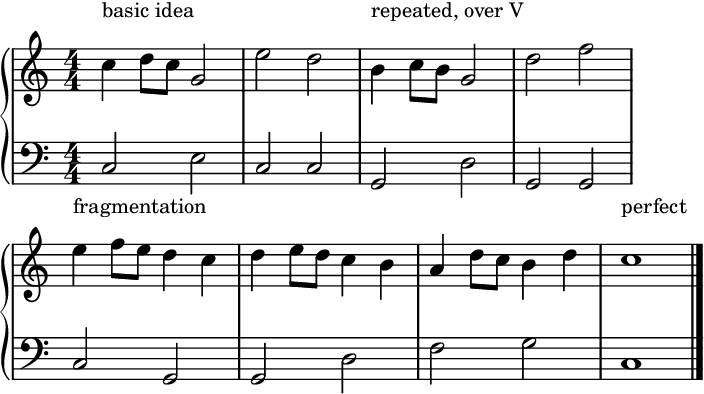
In the example the basic idea occupies bars 1 to 2, returns over dominant harmony in bars 3 to 4, and bars 5 to 8 fragment it into one-bar units that fall by step into a perfect cadence. The opening of Beethoven's Piano Sonata in F minor, Op. 2 No. 1, is a famous sentence; so is the first theme of Mozart's Symphony No. 40.
1.6 The period
The second design is the period: two phrases in a question-and-answer pair. The antecedent ends with an open cadence, normally imperfect; the consequent begins like the antecedent, then steers to a perfect cadence. The proportions are 4+4, and the parallel openings are what make the pair sound like matched halves rather than two unrelated phrases.
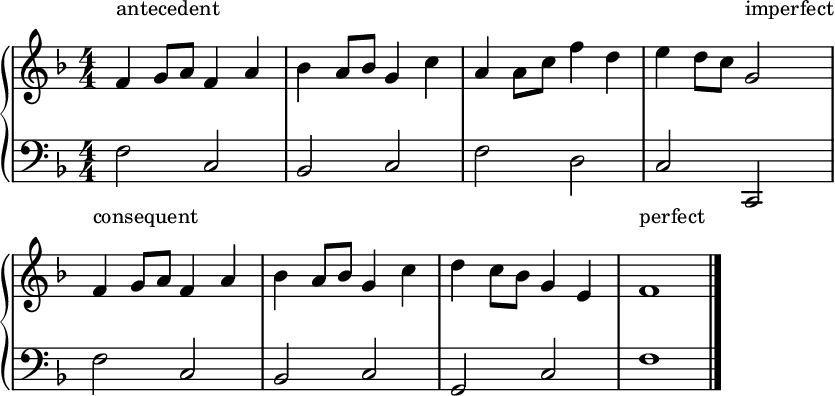
Sentence and period are worth telling apart because they behave differently under pressure. A sentence has forward drive built in, which suits openings that must launch a movement; a period is balanced and closed, which suits themes that will be varied, as in a theme and variations, or left to stand alone, as in a hymn or folk song.
| Sentence | Period | |
|---|---|---|
| proportions | 2+2+4 | 4+4 |
| engine | repetition, then fragmentation and drive | question and matched answer |
| cadence plan | one cadence, at the end | open cadence, then closed |
| suits | launching a movement | themes to be varied or sung |
1.7 From theme to form
Everything larger in this guide is these units at greater scale. A binary dance is roughly two phrase-pairs with a key plan; a sonata exposition is a chain of themes with a tonal argument between them. Keep the small units in mind as the forms grow: when an analysis stalls, the way out is nearly always to drop back down to phrases and cadences and rebuild from there.
2. Binary form
2.1 Two strains and a double bar
Binary form is music in two halves, each usually repeated, written with a double bar and repeat marks between them:
||: A :||: B :||
The two strains balance each other but the first does not close: A sets out from the tonic and cadences somewhere else, and B makes the return trip. That open first half is the defining feature. A piece whose first section ends with a perfect cadence in the tonic is not binary but ternary in miniature, however the repeats are printed.
2.2 The key plan
The route is standardised, and it is worth memorising because sonata form later inherits it:
| Home key | A ends in | B returns via |
|---|---|---|
| major | the dominant (V) | related keys, back to I |
| minor | the relative major (III), sometimes the dominant minor (v) | related keys, back to i |
The mechanism is simple. Ending A away from home creates a debt; B's job is to pay it, usually passing through a sequence or a related key or two before the closing cadence in the tonic. The listener does not need to name the keys to feel the pattern: away, then home.
Why the dominant? Because it is the nearest key. One accidental separates it from home, so the music can slip across without ceremony, and the dominant's pull back to the tonic is the strongest pull tonal harmony has. Minor-key movements prefer the relative major for the same nearness, no new accidentals at all, with brighter colour as the bonus.
2.3 Simple binary
In simple binary the B strain answers A without restating A's opening in the tonic. The two strains share figuration and character, and often B begins with A's material transposed, but there is no moment of return.
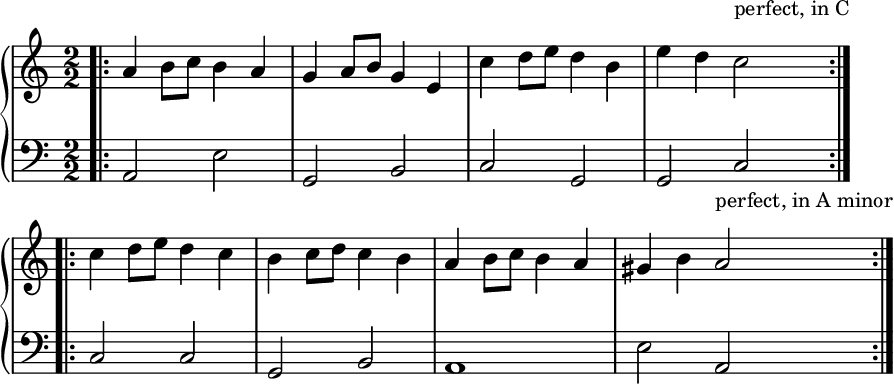
The example is a quick dance in 2/2, in A minor. The first strain cadences in C major, the relative major, at its double bar. The second strain sets the opening figure sequencing downwards and cadences perfectly in A minor. Nothing in the second strain replays the opening in the home key; the two halves are siblings, not a departure and a homecoming.
The repeat marks are part of the form, not decoration: each strain heard twice doubles the listener's exposure to the key plan, and in Baroque practice the second pass was the invitation to ornament. In an analysis, count the bars without the repeats but say that they are there.
2.4 Rounded binary
In rounded binary the opening material does come back, in the tonic, partway through the second strain:
||: A :||: B + A' :||
The return is usually shortened, often just the first phrase of A steered to close in the tonic. The moment of return is unmistakable to the ear and it is the feature to hunt for on the page: the opening bars recopied after the double bar, now ending with a perfect cadence at home.
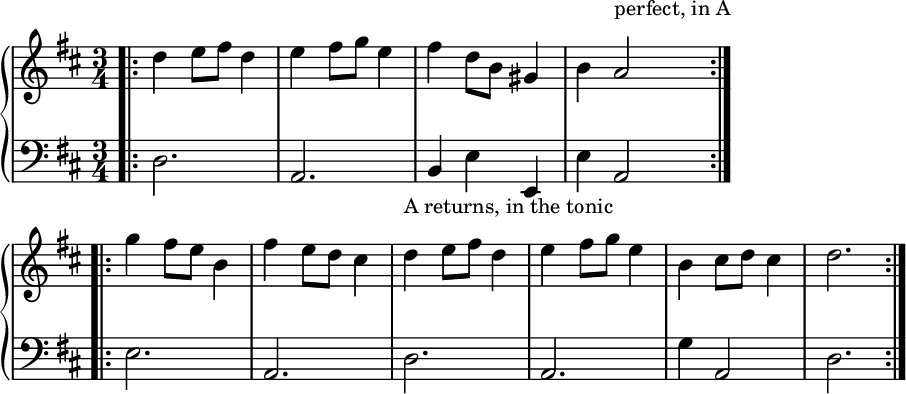
The example is in D major. Its first strain is a single four-bar phrase cadencing in A major, the dominant, with a sharpened G to prove it. After the double bar, two bars of sequence work the opening figure's rhythm back round towards home; the opening then returns note for note for two bars, and its second pair of bars is rewritten to cadence in D. That rewritten tail is typical. A literal return could only cadence in the dominant again, so the join between recall and close is exactly where the composer must intervene.
2.5 Balanced binary
A third variety rounds off both strains with the same closing material instead of the same opening. In balanced binary the final bars of A, first heard in the away key, return as the final bars of B transposed to the tonic. Nothing of the opening comes home, so the form is not rounded; what rhymes is the cadence material.
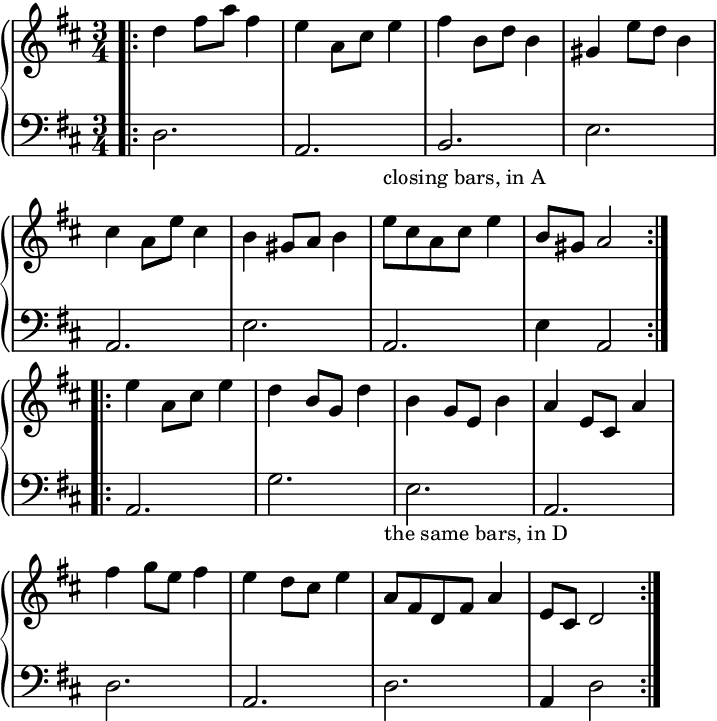
In the engraving the first strain ends with a two-bar closing figure in the dominant, and the second strain, after its excursion, ends with the same two bars moved into the home key. The ear catches the rhyme even when it has not consciously registered the transposition. Domenico Scarlatti's sonatas use the device constantly, and it survives inside sonata form itself, whose closing themes return transposed in the recapitulation to make the same effect at larger scale.
2.6 Where binary lives
Binary is the workhorse of the Baroque dance suite: allemandes, courantes, sarabandes, gigues, minuets, bourrees and gavottes are almost all binary, simple or rounded. Bach's keyboard suites supply hundreds of examples. Early Classical sonatina movements are often rounded binary grown slightly larger, and chapter 6 shows how sonata form itself is rounded binary writ large: the exposition is the A strain, the development and recapitulation are B and the return. Analyse enough minuets and sonata form arrives half-learned.
2.7 The dance suite's binary family
Since the suite is where binary analysis is usually practised, it helps to know the dances by sight; Rhythm and Metre treats their metres and rhythms in full. The core four appear in nearly every Bach suite, in this order, with optional galanteries (minuet, bourree, gavotte and others) inserted before the gigue:
| Dance | Metre | Character | Marks of identification |
|---|---|---|---|
| allemande | 4/4 | moderate, flowing | semiquaver motion, short upbeat, even texture |
| courante | 3/2 or 3/4 | moderate, rhythmically supple | French type shifts accents between 3/2 and 6/4; Italian corrente is quick running triple time |
| sarabande | 3/4 | slow, grave | weight on the second beat, chordal texture |
| gigue | 6/8, 12/8 or similar | quick, leaping | compound time, often imitative openings; second strain may invert the subject |
| minuet | 3/4 | moderate dance | plain crotchet movement, four-bar phrases |
| bourree | 2/2 | quick | single crotchet upbeat |
| gavotte | 2/2 | moderate | half-bar upbeat, phrases begin and end mid-bar |
Every one of these is a two-strain form with the chapter's key plan; the differences are surface. That is worth a moment's reflection: metre, tempo and figuration make seven dances out of one form, which is a measure of how separable form is from character.
2.8 Reading a binary movement from the page
A checklist that settles most binary questions quickly:
- Find the double bar with repeat marks: it divides A from B.
- Read the last two bars of A. Name the cadence and its key. Away from the tonic confirms binary; in the tonic points to ternary thinking instead.
- Read the opening of B. Transposed A material suggests simple binary; watch instead for A's opening returning later, in the tonic, which makes it rounded.
- Compare the ends of both strains. The same bars in different keys make it balanced.
- Note proportions. B is usually the longer strain, since it has further to travel; an unusually long B with a strong return is a step towards sonata thinking.
3. Ternary form
3.1 Statement, contrast, restatement
Ternary form is three sections, A B A: a self-contained statement, a contrast, and the statement again. The word self-contained is the load-bearing one. In true ternary, A ends with a perfect cadence in its own tonic before B begins; B then contrasts in key, material or both; A returns complete, either note for note or lightly varied (A').
The return may be literal enough that the composer does not write it out: the instruction da capo (or D.C. al Fine) sends the performer back to the beginning, to stop at Fine at the end of A. A written-out return, by contrast, is engraved in full, which frees the composer to vary it, decorate the melody, or reharmonise. Handel's and Bach's arias use the da capo; Chopin's nocturnes usually write the return out and ornament it.
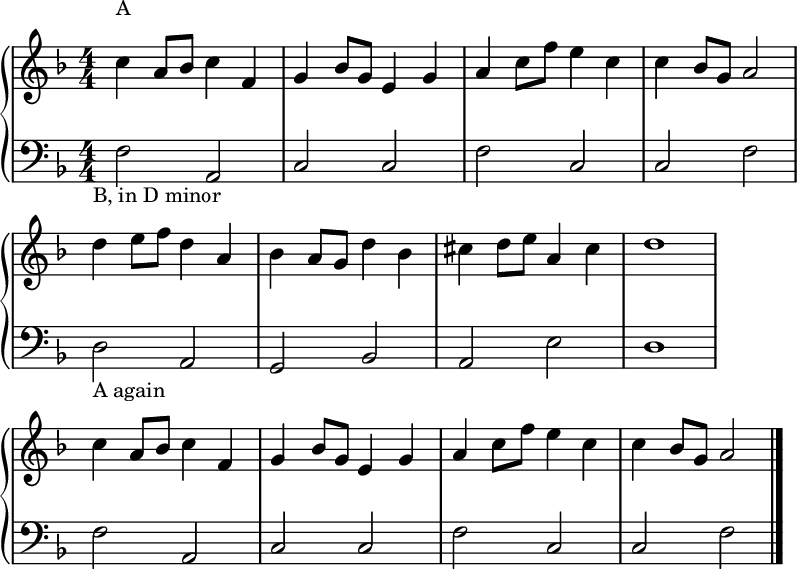
In the example, A is a four-bar phrase in F major closing with its own perfect cadence; B moves to D minor, the relative minor, and cadences there; A then returns unchanged. Compare the rounded binary example in chapter 2: there the opening section ended away from home, so the music made one continuous trip away and back. Here each section stands on its own feet.
3.2 Rounded binary or ternary?
The two shapes both end with the opening material in the tonic, and telling them apart is a classic exam point. Ask two questions of the first section: does it end with a perfect cadence in the home key (ternary) or away from home (binary)? And ask one of the middle: is it a self-contained section with its own key and cadence (ternary), or a connective passage, often sequential and unstable, that exists to prepare the return (binary)? Repeat marks are a hint but not proof: many minuets print ||: :|| around both halves of what is otherwise a clean three-part design.
3.3 Minuet and trio
The minuet and trio is ternary built out of ternary. The minuet is itself a small binary or rounded binary movement; the trio is a second, contrasting minuet, often in a different but related key, historically lighter in texture (the name recalls trios scored for three instruments); then the minuet returns, this time played without its internal repeats. The instruction at the end of the trio is Menuetto da capo.
%%{init: {'theme':'neutral'}}%%
flowchart LR
  M1["Minuet<br/>binary, repeats"] --> T["Trio<br/>new key or colour<br/>binary, repeats"] --> M2["Minuet again<br/>no repeats<br/>da capo"]
  classDef home fill:#dce8f5,stroke:#3b5f8a,stroke-width:2px
  class M1,M2 home
Each large letter of the A B A hides a complete two-strain form inside it, which is why the design is called compound ternary. It supplied the third movement of nearly every Classical symphony, quartet and sonata.
The trio's key does much of the colour work: the subdominant relaxes, the tonic minor darkens, and a remote third-related key makes the trio a separate world. Whatever the choice, the returning minuet resets the frame, which is why the design can absorb so much contrast in its middle panel.
3.4 The scherzo
The scherzo ("joke") is the minuet's faster descendant: the same compound ternary plan, still usually in triple time, but quicker, with one beat to the bar rather than three and a taste for rhythmic surprise, offbeat accents and sudden dynamic changes. Beethoven made the swap standard; his scherzos sometimes run the cycle twice (scherzo, trio, scherzo, trio, scherzo). The form is identical; only the temperament changed. Cut loose from the symphony, the scherzo also became a piece in its own right: Chopin's four scherzos keep the metre and the temper but build far larger structures on them.
3.5 The written-out return
When a composer engraves the return rather than writing da capo, expect the reprise to differ, and treat the differences as the section's main analytical interest. The usual changes: the melody decorated with runs and ornaments (Chopin's nocturnes make an art of this); the accompaniment enriched; the scoring changed; the section shortened, since the listener no longer needs the internal repeats; and a coda appended, growing out of A's final cadence. Between B and the return there is often a retransition, a short passage, frequently over a dominant pedal, whose whole purpose is to make the return land as an arrival. In an analysis, list what changed at the reprise in one or two lines; a return marked A' with no comment is a question left unanswered.
Ternary at large scale carries much of the slow-movement repertoire: the nocturnes and the songs without words, most Classical slow movements not in variation or sonatina form, and countless character pieces of the nineteenth century, where the plan is often song-like enough to be heard as verse, contrast, verse.
3.6 Reading a ternary movement from the page
- Find the end of the first section: a perfect cadence in the home key with a clear break in texture. A da capo or Fine marking gives the plan away at once.
- Name B's key and its relation to home. The relative minor, the subdominant, the dominant and the tonic minor are the usual choices.
- Decide whether B is closed (its own tune, its own cadence: true ternary) or open and unstable (a preparation for the return: think rounded binary instead).
- At the return, list what changed: decoration, scoring, length, an added coda. If nothing changed, say so; an exact da capo is itself a fact worth recording.
- Check the seams: is there a retransition into the return, and does a coda follow the final section?
4. Rondo
4.1 The refrain principle
A rondo keeps returning to one theme. The refrain (A) is a complete, closed tune in the tonic; between its returns come contrasting episodes in other keys. The listener's contract is simple: however far an episode wanders, the refrain will come back, and it will come back in the tonic.
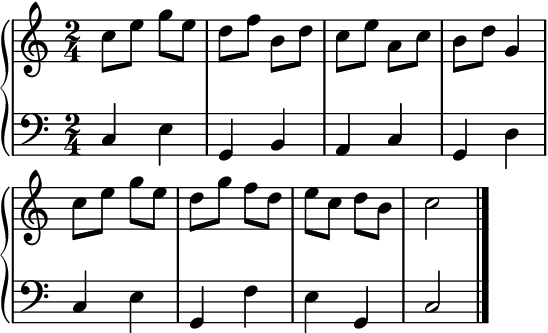
A refrain has to survive several hearings, so rondo themes are typically short, catchy and rhythmically clean. Episodes contrast with it in key first of all, and usually in texture and figuration too.
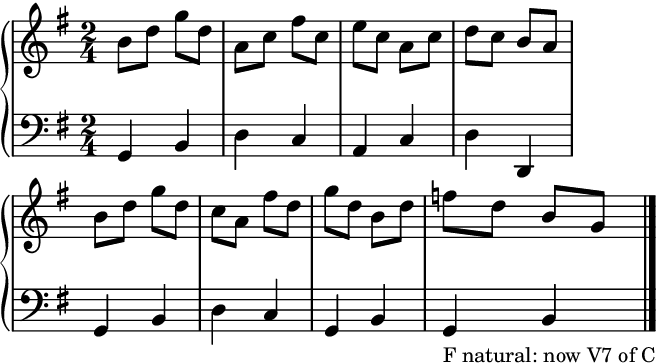
The episode above sits in the dominant and, in its final bar, flattens its own seventh so that its tonic chord turns back into a dominant seventh of the home key. That pivot at the episode's edge is the standard joint in a rondo: episodes do not simply stop, they lean back towards A.
A rondo needs its joins looked after. Before each return there is usually a moment of dominant preparation, even a single chord, so that the refrain lands on its feet; after the last return a coda is common, because a tune heard four times needs a fuller stop than its own final cadence. And when a return sounds premature or sideways, check for the joke of the false return, a favourite of Haydn's: the tune starts in the wrong key, breaks off, and then starts again properly.
4.2 Five-part and seven-part rondo
The two common sizes:
| Plan | Sections | Typical keys |
|---|---|---|
| five-part rondo | A B A C A | A in I throughout; B in V or vi; C in another related key |
| seven-part rondo | A B A C A B' A | as above, but B returns transposed to the tonic |
The five-part rondo simply alternates. The seven-part rondo does something cleverer: its second episode B returns near the end transposed into the tonic, resolving the one section that had been heard only away from home. A coda often follows the last refrain.
Later returns of the refrain are routinely trimmed to a single phrase, and one is often decorated. The trimming is a courtesy to the listener, who no longer needs the whole tune to recognise it; the decoration keeps a familiar object interesting. Both habits are worth a line in an analysis.
4.3 Sonata-rondo
That transposed return of B is the germ of the sonata-rondo, the hybrid that powers many Classical finales. Read A B A as an exposition (first subject, second subject in the dominant, first subject again), C as a development or a central episode, and A B' A as a recapitulation with B now in the tonic. The form satisfies both descriptions at once: a listener hears a rondo's returning refrain, an analyst also finds sonata form's key argument. Mozart's and Beethoven's concerto finales are the natural habitat; the finale of Beethoven's Pathetique sonata is a clear worked example in the repertoire.
The practical test is twofold. Did the first episode behave like a second subject, settling the dominant with a proper cadence? And does the refrain return in the tonic immediately after it, where sonata form alone would press on into the development? Both answers yes makes the movement sonata-rondo; either answer no leaves it plain rondo or plain sonata.
4.4 Where rondo lives
Rondo is above all a finale form: quick, tuneful and secure, since the audience always knows where home is. Slow movements occasionally use the five-part plan. The French Baroque kept an earlier version, the rondeau, in which a refrain alternates with couplets and the refrain itself never modulates; Couperin's harpsichord pieces supply examples.
4.5 Analysing a rondo
Number the refrains first: their count settles the plan (three refrains make five-part, four make seven-part). Then, for each return of A, note whether it comes back complete, shortened, or varied; later returns are often trimmed to their first phrase, and one is sometimes decorated. Next name the key of every episode and how each finds its way back, since the retransitions, those turning passages at episode ends, are where the composer's craft is most visible. Finally check the second B in a seven-part plan: if it returns in the tonic, say so, and consider whether the movement reads better as sonata-rondo.
A worked sketch of the shape, with the sample keys most often met in a major-key movement:
| Section | A | B | A | C | A | B' | A + coda |
|---|---|---|---|---|---|---|---|
| key | I | V | I | vi or IV | I | I | I |
| size | full | full | often shortened | often the longest | full or varied | transposed | full, then coda |
The C episode deserves a look of its own. It is frequently the movement's centre of gravity: longer, in a minor or subdominant key, sometimes developmental, occasionally a self-contained tune that never returns. Describing C's character is usually the most individual sentence in a rondo analysis.
5. Variation forms
5.1 Ground bass
The oldest variation principle repeats not a theme but a bass line. A ground bass is a short bass phrase, typically two to eight bars, repeated over and over while the upper parts change on every pass. The ground itself never varies; everything above it does, and the art lies in building longer arcs of melody across the relentless bass loop, often by phrasing the upper part so that it overlaps the ground's seams.
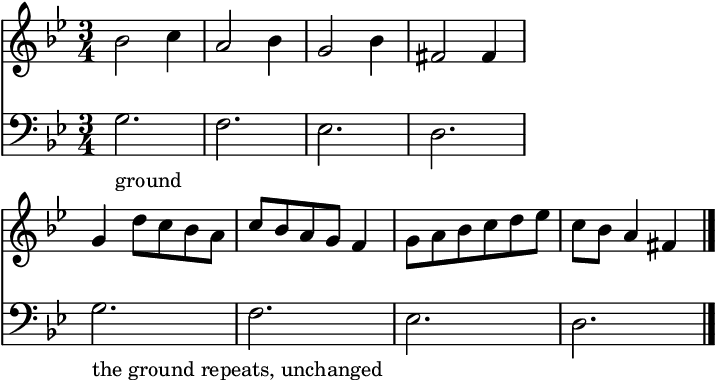
The example's ground is the descending line G, F, E flat, D, a shape so common in the seventeenth century that it had a nickname, the lament bass. Purcell's "When I am laid in earth" from Dido and Aeneas is built on a chromatic relative of it; Pachelbel's Canon rides an eight-note ground for its whole length.
Analysing a ground bass piece is mostly a matter of counting. Number every statement of the ground first, then describe the long arc of the upper parts against that numbering: where the motion quickens, where the texture thickens, where a phrase is carried across the ground's seam so that the loop does not chop the music into equal lengths. The numbered statements turn a piece that sounds like one unbroken span into an easily mapped one.
5.2 Chaconne and passacaglia
Two grander Baroque forms grow from the same idea. A passacaglia keeps the repeating idea mostly in the bass, as an extended ground, though the theme may occasionally migrate to upper voices; Bach's organ Passacaglia in C minor is the monument. A chaconne repeats a harmonic pattern, a progression rather than a fixed bass line, leaving the bass free to change register and figuration on each pass; Bach's Chaconne for solo violin varies a four-bar progression for a quarter of an hour.
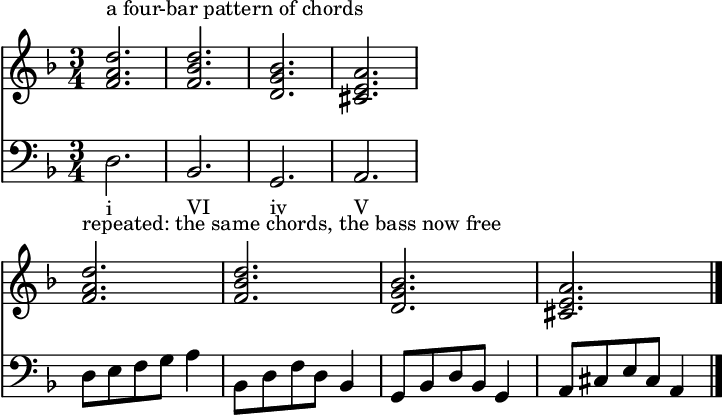
In the engraving the same four chords, i-VI-iv-V in D minor, are stated twice. The first statement lays them out plainly over root-position bass notes; the second keeps every chord but sets the bass moving in quavers, changing register and figuration. Repeat that process a few dozen times with rising invention and the result is a chaconne.
Both forms move by convention in a slow triple metre, and both build by accumulation: each pass adds motion, register or weight, with an occasional clearing of the texture partway through so the growth can begin again. Be aware that historical usage is looser than the definitions above: composers of the period used the two words inconsistently, and some pieces answer to either. In an analysis, describe the mechanism you actually find, then attach the label.
5.3 Theme and variations
The Classical theme and variations takes a complete, closed theme, most often a small binary tune of 8 to 32 bars, and restates it whole a number of times, each restatement transformed. The theme's proportions and phrase structure persist underneath: variation 4 has the same bar count, the same cadence points and usually the same harmonic skeleton as the theme. That skeleton is what lets the ear keep hold of wildly different surfaces.
The form lives in three habitats: as an independent work, often on a borrowed tune; as the slow movement of a sonata, quartet or symphony, where Haydn's Emperor quartet variations are a famous case; and occasionally as a finale asked to carry an ending's full weight, as in Beethoven's Eroica Symphony and, returning the form to its Baroque roots, the passacaglia finale of Brahms's Fourth.
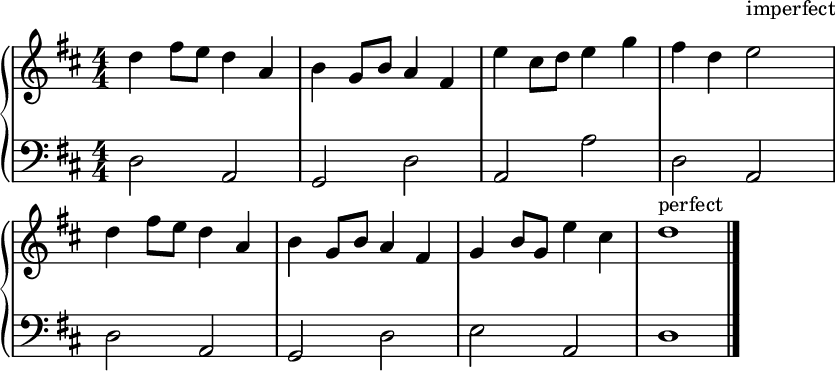
The engraved theme's skeleton, the property every variation will keep, can be tabulated in a line per bar:
| Bar | 1 | 2 | 3 | 4 | 5 | 6 | 7 | 8 |
|---|---|---|---|---|---|---|---|---|
| harmony | D | G, D | A7 | D, A | D | G, D | Em, A | D |
| cadence | imperfect | perfect |
Eight bars, two matched phrases, open then closed: a period, exactly the shape section 1.6 predicted would suit a variation theme. When composers borrow a theme for variations, from a song, a hymn, another composer, they choose or trim it into this kind of closed, evenly phrased shape first.
5.4 The variation techniques
Each variation typically commits to one main transformation. The standard catalogue:
| Technique | What changes | What stays |
|---|---|---|
| melodic decoration | the tune gains passing notes, runs, ornaments | harmony, bass, phrase plan |
| rhythmic variation | note values recast, new metre or motion (e.g. continuous quavers) | harmony, melody outline |
| change of mode | major becomes minor or the reverse (the minore / maggiore) | melody outline, phrase plan |
| harmonic variation | chords reharmonised, chromatic substitutions | melody, bar count |
| textural variation | new figuration: broken chords, imitation, melody in the bass | harmony, phrase plan |
| character variation | the theme recast as a march, siciliano, waltz | phrase plan, some outline |
| canonic or fugal variation | the theme treated in imitation | its head motif |
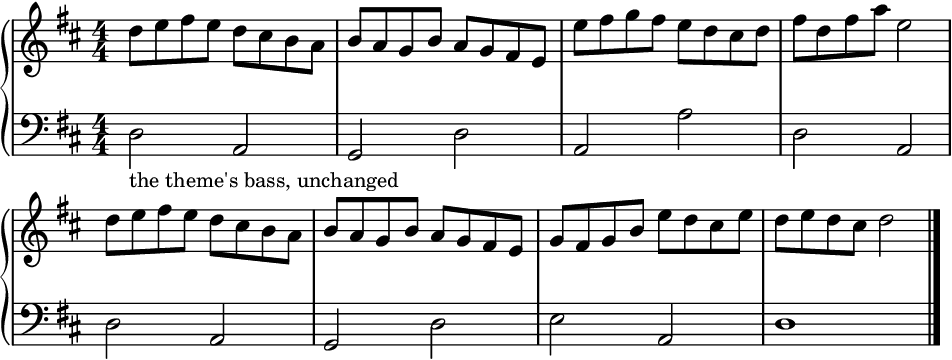
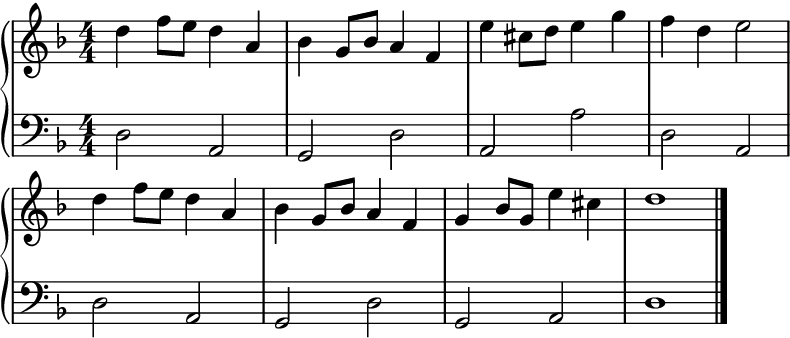
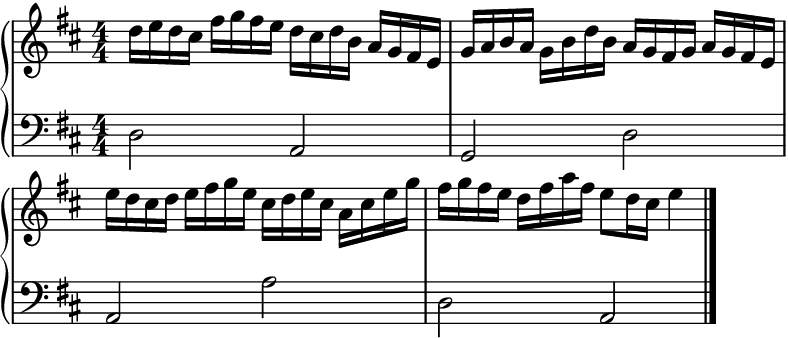
The third variation shows the rhythmic route: the theme's first phrase dissolved into continuous semiquavers. Nothing else has moved. The bass is the theme's bass, the chords change where the theme's chords changed, and the semiquavers touch the old melody notes often enough for the outline to show through the figuration.
Sets usually order the techniques for cumulative effect: figuration quickening across the early variations, a minore or a slow decorated variation near the two-thirds mark, and a finale variation, often fugal or in a quicker metre, to close. Mozart's variation sets, Beethoven's Diabelli Variations and Brahms's Variations on a Theme of Haydn show the plan at three scales.
Haydn's slow movements sometimes run a double variation set instead: two themes in alternation, one major and one minor, each varied in turn. And some late sets outgrow the frame altogether. Once a variation changes the theme's length and harmony at once, as the last of the Diabelli Variations do, the skeleton has become a springboard, and the analysis should say so rather than force the tally to balance.
5.5 Analysing a variation set
The productive question about any variation is: which elements of the theme survive, and which have been replaced? Answer it in one line per variation and the whole set is mapped. A table keeps the answers honest, one row per variation; for the set engraved above it would begin:
| Variation | Main technique | What survives |
|---|---|---|
| theme | (the reference) | everything |
| 1 | melodic decoration in quavers | bass, harmony, phrase plan |
| 2 | minore | melodic outline, phrase plan |
| 3 | continuous semiquavers | bass, harmony, cadence points |
Two whole-set checks finish the job. First the ordering: look for the quickening figuration, the placed minore, the finale variation, and say whether the set follows or resists that convention. Second the bar counts: any variation longer than the theme contains an extension, nearly always at a cadence, and finding the added bars is the same task section 1.3 practised on phrases.
6. Sonata form
6.1 The key argument
Sonata form is the large first-movement design of the Classical period, and it is best understood as a drama of keys rather than a sequence of tunes. In one sentence: the exposition states home material, then commits the crime of cadencing and settling in the wrong key; the development aggravates the instability; the recapitulation replays the exposition with the crime corrected, everything now in the tonic. The tunes are the cast; the plot is tonal.
A note on names. British usage says first subject and second subject; much modern writing says first and second group, acknowledging that each may contain several themes. This guide keeps the British terms and adds "group" where the plurality matters. Older textbook names for the same sections (bridge for transition, closing group for codetta) still appear in print and mean what they say.
The form descends directly from rounded binary. Expand the A strain until its departure from the tonic carries two distinct themes; expand the connective passage after the double bar into a full development; make the return carry the whole of A rather than a phrase of it, and sonata form appears. Early editions even print exposition repeat marks exactly where binary's first ||: :|| stood.
%%{init: {'theme':'neutral'}}%%
flowchart LR
  subgraph EXPO["Exposition"]
    FS["first subject<br/>tonic"] --> TR["transition<br/>modulates"] --> SS["second subject<br/>dominant or relative major"] --> CT["codetta"]
  end
  subgraph DEVREC["Then"]
    DEV["Development<br/>keys unstable,<br/>motifs worked"] --> REC["Recapitulation<br/>both subjects in tonic"] --> CODA["coda"]
  end
  EXPO ~~~ DEVREC
  CT --> DEV
  classDef tonic fill:#dce8f5,stroke:#3b5f8a,stroke-width:2px
  class FS,REC,CODA tonic
6.2 The exposition
The first subject (or first subject group; there may be more than one theme) establishes the tonic and the movement's character, and is often the more rhythmic and assertive idea.
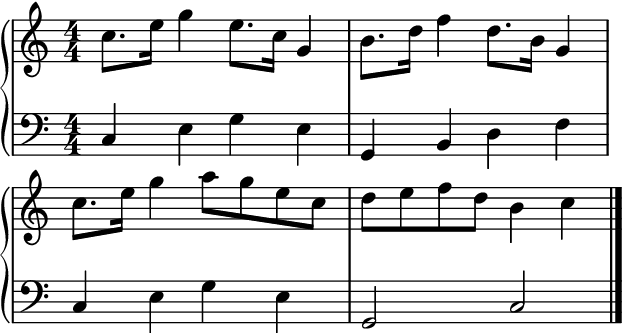
The transition (or bridge) carries the modulation. It typically works first-subject material into a sequence, gathers energy, and halts on the dominant of the new key, a gap of silence or a held chord that presents the second subject like a speaker given the floor.
The second subject (group) then settles the new key: the dominant if the movement is major, normally the relative major if it is minor. Convention makes it more lyrical than the first subject, though the contrast of key matters more than the contrast of character; Haydn sometimes builds the second subject from the same theme as the first, and the form works exactly the same way.
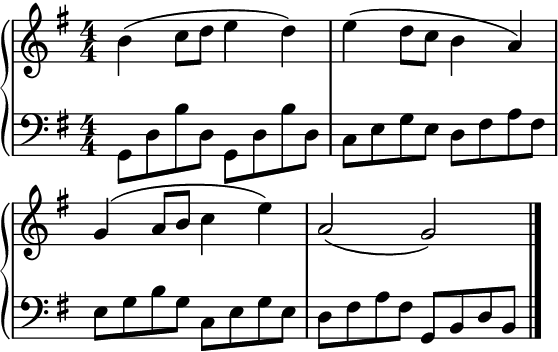
A codetta of cadential figures seals the new key, often over repeated perfect cadences, and the exposition is conventionally repeated.
6.3 The development
The development takes the exposition's material somewhere less stable. Standard equipment: fragments of the subjects worked in sequence; rapid movement through related keys; counterpoint between motifs that were previously separate; and, near the end, a dominant preparation, a stretch on the home dominant, often over a dominant pedal, that makes the recapitulation arrive as a resolution rather than a restart.
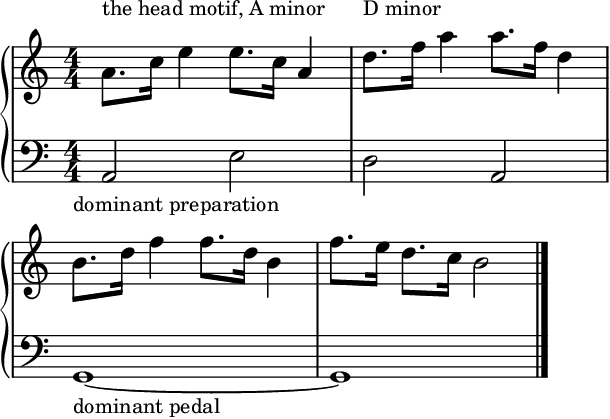
Developments vary more than any other section; some are storms, some are three bars of retransition. What defines the section is tonal: it is the span where no key is allowed to feel like home.
When analysing a development, keep a key ledger: each key the music settles in, however briefly, with its bars and the material being worked there. Three or four entries are typical. The ledger usually reveals a shape, often a drive flatwards or a chain of falling fifths, and it shows exactly where the dominant preparation begins, which is the one boundary every development has.
6.4 The recapitulation
The recapitulation replays the exposition with the key argument resolved: first subject in the tonic as before, transition rewritten so that it no longer modulates, second subject now in the tonic, codetta in the tonic. That transposed second subject is the point of the whole form, the material heard away from home finally heard at home. Minor-movement recapitulations must choose whether the second subject returns in the tonic minor or the tonic major; both are common.
Look closely at recapitulated transitions when analysing: since the modulation must be removed, this is where composers most often recompose, and the small differences from the exposition are usually the most interesting bars in the section.
6.5 Introductions and codas
Many movements open with a slow introduction: a paragraph in a slower tempo, often harmonically searching, that ends poised on the dominant. It stands outside the form proper and rarely returns, though Beethoven sometimes recalls it mid-movement.
The coda ("tail") follows the recapitulation's final cadence. Short codas are a few extra cadential bars; long ones, especially Beethoven's, behave like second developments before settling. However long, a coda's tonal job is single: confirm the tonic beyond argument.
6.6 Sonatina form
Sonatina form is sonata form with the development shrunk to a brief link or removed entirely: exposition, short retransition, recapitulation. It is the plan of most movements actually titled sonatina (Clementi's Op. 36 set is the classroom staple) and of many overtures and slow movements, where a full development would overload the design. The key plan is untouched; only the middle is light.
6.7 Departures worth knowing
Four common departures from the textbook plan, none of which breaks it:
- A monothematic exposition, Haydn's habit: the second subject group opens with the first subject's theme transposed to the new key. The key argument is unchanged; only the cast list is doubled up.
- The false recapitulation: the first subject returns mid-development in the wrong key, breaks off, and the true return arrives later, the stronger for the feint.
- A subdominant recapitulation starts the return in IV, which lets the exposition's transition come back almost unaltered and still deliver the second subject in the tonic. Schubert liked the shortcut.
- In minor-key movements the recapitulated second subject often returns in the tonic major, warming the ending without leaving home.
6.8 Reading a sonata movement from the page
- Find the end of the exposition: a firm perfect cadence away from home, in earlier works followed by a repeat mark.
- Inside the exposition, find the transition's halt on the new key's dominant, often a rest or a held chord, with the second subject starting beyond it.
- In the development, find the arrival on the home dominant, frequently a pedal: everything after it is preparation for the return.
- Find the recapitulation, the first subject back in the tonic, then compare it bar against bar with the exposition and circle every difference. The rewritten transition is where most of them live.
- Ask what follows the recapitulation's final cadence: nothing, a few cadential bars, or a coda with ideas of its own.
6.9 Hearing the form
For listening and for exams alike, the two questions that unlock any sonata movement are: where does the exposition leave the tonic, and where in the recapitulation does the second subject return transposed? Find those two joints and every other section can be measured from them.
7. Ritornello and concerto forms
7.1 The ritornello principle
The Baroque's large instrumental form is built on the ritornello ("little return"): an orchestral theme that opens the movement, then returns, in whole or in part and in a series of related keys, between passages for the soloist. The alternation is the form:
%%{init: {'theme':'neutral'}}%%
flowchart LR
  R1["ritornello<br/>tutti, tonic"] --> E1["episode<br/>solo, modulating"] --> R2["ritornello<br/>dominant"] --> E2["episode<br/>solo"] --> R3["ritornello<br/>relative or other key"] --> E3["episode<br/>solo"] --> R4["ritornello<br/>tonic, complete"]
  classDef tutti fill:#dce8f5,stroke:#3b5f8a,stroke-width:2px
  class R1,R2,R3,R4 tutti
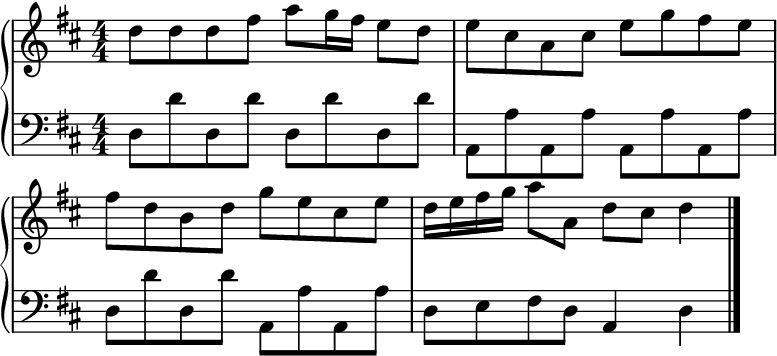
The middle returns are usually partial, a head or a tail of the theme rather than all of it, and each confirms the key the episode has just reached. The final return is in the tonic and normally complete. Ritornello differs from rondo in exactly this: a rondo refrain returns in the tonic every time, a ritornello returns in a new key each time until the last.
7.2 The Baroque concerto
Vivaldi standardised the concerto as three movements, quick, slow, quick, with the outer movements in ritornello form and the middle one a song-like aria for the soloist, sometimes laid over a ground bass or a simple repeating accompaniment. Bach's concertos, and the concerto-shaped choruses of his cantatas, work the same machinery. In a concerto grosso (Corelli, Handel, the Brandenburg Concertos) the soloist is a small group, the concertino, set against the full ensemble, the ripieno; the form is unchanged.
7.3 The Classical concerto
The Classical concerto first movement merges ritornello with sonata form. The orchestra opens with a ritornello presenting the themes in the tonic; the soloist then leads a full sonata exposition that modulates properly; development and recapitulation follow with the orchestra's interjections keeping the ritornello idea alive. This is often described as a double exposition. Near the end, the orchestra halts on a six-four chord and the soloist plays a cadenza, historically improvised, before the final ritornello closes the movement. Mozart's piano concertos are the reference set for the whole design.
7.4 Analysing a ritornello movement
The ritornello theme is usually a chain of two or three short, separable ideas, and composers exploit the joints: a middle return may use only the head idea, or only the tail. So the first job is to split the opening tutti into its members and label them. After that the analysis is a table: where each return falls, which members it uses, which key it confirms. A sketch of a typical movement:
| Return | Members used | Key |
|---|---|---|
| opening tutti | all | tonic |
| second | head only | dominant |
| third | head and tail | relative minor |
| final | all | tonic |
The solo episodes between the returns carry the figuration and, in a concerto, the give and take between soloist and tutti that is the movement's real drama. But the skeleton is the returns, and listing them takes most of the mystery out of a long Baroque movement.
8. Fugue as a form
8.1 A procedure with a customary shape
A fugue is strictly a texture and a procedure, imitative counterpoint on a single subject, rather than a fixed form; no two fugues share an identical plan. But the procedure has a customary shape, and that outline is what this chapter gives. The mechanics of writing the counterpoint, invertible counterpoint, answer construction, stretto technique, live in the companion Counterpoint volume; here the concern is the map.
A fugue announces itself on the page before a note is analysed: the piece opens with a single unaccompanied line, a second voice enters with the same material at a different pitch while the first carries on, and the texture stacks up voice by voice. Staggered identical openings are the fingerprint; nothing else in the repertoire begins quite that way.
8.2 Subject, answer, countersubject
The subject is the fugue's theme, stated alone by the first voice. The second voice enters with the answer, the subject transposed to the dominant; while it does, the first voice continues with the countersubject, a counter-melody designed to combine with the subject wherever it appears. An answer is real if it is an exact transposition and tonal if its first notes are adjusted, most often the subject's opening tonic-to-dominant motion answered by dominant-to-tonic, so the music does not lurch out of key at the second entry.
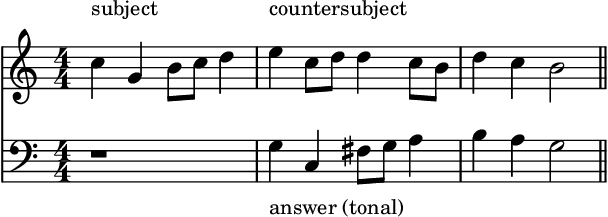
In the example the subject opens by falling from tonic to dominant; the answer, entering a bar later in the lower stave, falls from dominant to tonic, the tonal adjustment, then continues the transposition exactly while the upper voice supplies the countersubject.
8.3 The outline
| Stage | What happens | Keys |
|---|---|---|
| exposition | each voice enters in turn with subject or answer; countersubject accompanies | tonic and dominant alternating |
| episode | a passage without a complete subject entry, usually sequential, built from fragments | modulating |
| middle entries | the subject in related keys, singly or in pairs, separated by further episodes | relative, subdominant, others |
| stretto (if used) | entries overlap, each voice starting before the last has finished | often near the end |
| final entry | the subject back in the tonic, often over a dominant pedal then a tonic pedal | tonic |
After the exposition, a fugue is an alternation: entries confirm keys, episodes travel between them. The closing pages typically raise the intensity with stretto, pedal points, or both. Analysing a fugue is therefore mostly an entry-hunt: number every complete subject entry, name its key and voice, and mark the episodes between; the resulting table is the analysis. Bach's Well-Tempered Clavier offers 48 test pieces, and the C major and C minor fugues of Book 1 are the classic first analyses.
8.4 The entry table
Because a fugue analysis is an entry-hunt, its natural write-up is a table. Here is one for an imagined three-voice fugue of the kind Bach's simpler keyboard fugues resemble:
| Bars | Event | Voice | Key |
|---|---|---|---|
| 1 to 2 | subject | alto | tonic |
| 3 to 4 | answer, tonal | soprano | dominant |
| 5 to 6 | subject | bass | tonic |
| 7 to 10 | episode: head fragment in sequence | all three | modulating |
| 11 to 12 | middle entry | soprano | relative minor |
| 13 to 15 | episode | upper two | modulating |
| 16 to 17 | middle entry | bass | subdominant |
| 18 to 20 | final entry over dominant, then tonic pedal | alto | tonic |
A table like this, plus a sentence on the countersubject and one on any stretto, is a complete formal analysis of a fugue. One warning: count only complete entries. Fugues are full of head fragments inside episodes, and mistaking a fragment for an entry is the standard error. Measure every candidate against the subject's full length before it earns a row.
9. Vocal and song forms
9.1 Strophic form
A song is strophic when every verse of text is sung to the same music. The form is the natural home of hymns, folk songs and most popular song, and its strength and weakness are the same fact: the music must fit every verse, so it can illustrate none of them too specifically.
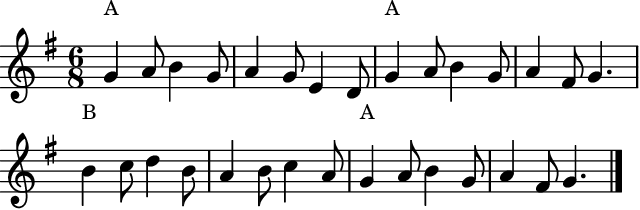
A typical verse melody has its own small internal form; the example runs four two-bar lines, the first, second and last nearly identical, giving A A B A in miniature. Modified strophic form keeps the verse structure but varies the music of some verses, a favourite Schubert compromise.
9.2 Through-composed
A through-composed song writes new music continuously, following the text wherever it goes, with no verse-level repetition scheme. Narrative and dramatic poems demand it: Schubert's "Erlkonig" changes music with every speaker of the poem. The analytical approach changes accordingly: with no letter scheme to find, the analysis maps the song by its key areas, its recurring motifs and the poem's own structure.
Whatever the shape, song analysis starts from the poem: number its stanzas, mark its refrain lines, then map the music against that grid. Letter the vocal sections and note their keys, and treat the piano's prelude, interludes and postlude as structural members rather than filler; in Schubert they often carry half the argument.
9.3 The da capo aria
The Baroque opera and oratorio aria standardised ternary at large scale. Section A sets the main text and closes in the tonic; B sets contrasting text, in related keys, usually quieter in scoring; then the score writes da capo, and A repeats, the singer now expected to ornament it.
%%{init: {'theme':'neutral'}}%%
flowchart LR
  A1["A<br/>main text, tonic<br/>closed"] --> B["B<br/>new text<br/>related keys"] --> A2["A repeated<br/>da capo<br/>sung ornamented"]
  classDef home fill:#dce8f5,stroke:#3b5f8a,stroke-width:2px
  class A1,A2 home
Handel's operas and Bach's Passions are full of the design. Its dramatic cost, the action freezing while A returns, is what later opera reformers, Gluck first, campaigned against.
Inside each big letter the orchestra frames the singing: instrumental ritornellos open and close A, and shorter ones punctuate B, so the aria is a ritornello structure and a ternary one at the same time. The frame is worth marking in an analysis, because the voice's paragraphs and the orchestra's do not always coincide.
9.4 Art-song and popular shapes
Three other schemes recur constantly. Bar form, A A B, two matched Stollen and a longer Abgesang, organises the German song tradition from the Minnesingers to the chorales Bach harmonised. Verse and refrain alternates changing verses with a fixed refrain, the ancestor of most folk and popular practice. And the 32-bar song form, A A B A in eight-bar units, the B section called the middle eight or bridge, carried the bulk of twentieth-century popular song and remains the jazz standard's default frame. The units are small, but analysis treats them exactly as it treats a minuet: phrases, cadences, letters.
| Bars | Section | What happens |
|---|---|---|
| 1 to 8 | A | the tune, closing in the tonic |
| 9 to 16 | A | the tune again |
| 17 to 24 | B | the middle eight: new material, away from the tonic, ending poised on V |
| 25 to 32 | A | the tune once more |
The middle eight earns its contrast cheaply: it starts somewhere else, the subdominant and the relative minor are the favourites, and its final bars lean on the home dominant so that the last A lands as a return rather than as one more repetition. That is binary-form thinking in an eight-bar space, and it is why the shape wears so well.
10. Larger designs
10.1 Multi-movement plans
Complete works are themselves formed. The standard plans:
| Genre | Movements | Typical forms |
|---|---|---|
| sonata, symphony, quartet | 4 | sonata form; slow (ternary, variations or sonatina); minuet or scherzo; finale (rondo, sonata or sonata-rondo) |
| Classical concerto | 3 | sonata with double exposition; slow song form; rondo or sonata-rondo |
| Baroque suite | 4 or more | binary dances: allemande, courante, sarabande, gigue, plus galanteries |
| Baroque concerto | 3 | ritornello; aria-like slow; ritornello or gigue-like finale |
The logic of the four-movement plan is contrast of tempo and weight around a shared tonic: the outer movements in the home key, the inner two providing lyric relief and dance, the slow movement most often in the subdominant, dominant or relative key. Two-movement and three-movement sonatas are common; the four-movement scheme is the reference against which those read as compressions.
The slow movement's key is the most telling single choice in the plan. The subdominant sits a shade lower and calmer than home, the dominant brighter, the relative minor darker; a remote key, and Beethoven grew fond of the flattened submediant, makes the movement an island. Minuets and scherzos usually stay in or beside the tonic, with the trio supplying the colour change.
10.2 Cyclic form
A work is cyclic when material returns across movements: a theme from the first movement resurfacing, transformed, in the finale. The recall can be a quotation (the finale of Beethoven's Ninth reviews themes from the earlier movements before rejecting them) or a structural motto that seeds every movement, as in Franck's Symphony in D minor and Berlioz's Symphonie fantastique, whose idee fixe melody returns in each movement transformed to fit its scene.

The engraving shows the mechanism at its smallest: a motto stated in long, stately values, then the same pitches recast in quick triple time. Rhythm, metre and character change; identity survives in the pitch contour. That is thematic transformation, the standard tool of cyclic writing and of Liszt's symphonic poems.
10.3 Programme music
Programme music lets a story or image, stated in a title or printed programme, shape the form. The symphonic poem (Liszt's term; Strauss preferred tone poem) compresses several movements' worth of contrast into one continuous span, its sections following the programme's episodes while usually leaning on sonata or rondo logic underneath. Wagner's operas extend the same principle by leitmotif: short motifs attached to characters and ideas, recombined continuously, so that form becomes a woven fabric of recognitions. Analysing programme music means running two maps at once, the narrative and the tonal, and noting where they pull against each other. The practical format is a two-column table, the story's episodes on one side and the musical sections with their keys on the other; the piece's craft shows in how the columns line up, and its most expressive moments are often where they refuse to.
11. How to analyse a piece
11.1 The method
Analysis fails when it starts with a label and hunts for evidence. Work the other way: gather the small facts first and let the label emerge. The method, in order:
- Play or hear the whole piece once without writing anything. Note where your ear feels arrivals and returns.
- Find every cadence. Mark each phrase ending and name the cadence: perfect, imperfect, plagal, interrupted. This gives the phrase map.
- Name the key at each cadence. Watch for new accidentals: a consistently sharpened note is usually a new leading note, announcing a modulation. Track the keys against the home key.
- Letter the material. Give each distinct theme or section a letter; mark returns, exact or varied (A'). Note what each section's final cadence is and where the double bars and repeats fall.
- Name the form by matching the letter scheme and key plan against the maps in this guide (chapter 13 collects them). If nothing matches cleanly, say what actually happens; an accurate description outranks a forced label.
- Go below the phrase. Find the motifs, the sequences, the extensions and elisions. This is where the piece's individuality lives.
- Write it up briefly: form, key plan, phrase structure, then the two or three most interesting details.
%%{init: {'theme':'neutral'}}%%
flowchart TD
  S1["1. hear the whole"] --> S2["2. find the cadences"] --> S3["3. name the keys"] --> S4["4. letter the sections"]
  S4 --> S5["5. name the form"] --> S6["6. find the motifs"] --> S7["7. write it up"]
  classDef core fill:#dce8f5,stroke:#3b5f8a,stroke-width:2px
  class S2,S4 core
Work on the score itself, in pencil: cadence marks at every phrase ending, key names in the margin, letters over the sections. The marked-up page is the analysis; the prose write-up only reports what the page already shows.
11.2 A worked analysis: Minuet in G
The subject is a 20-bar minuet written for this chapter. Here it is in its three sections.
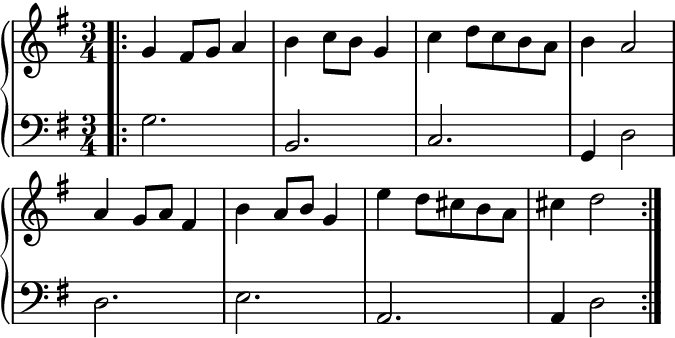
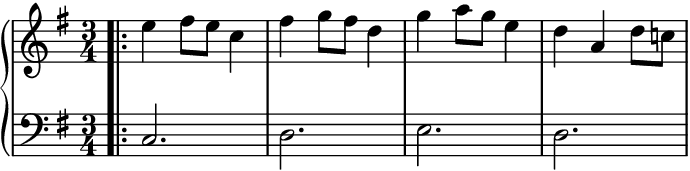
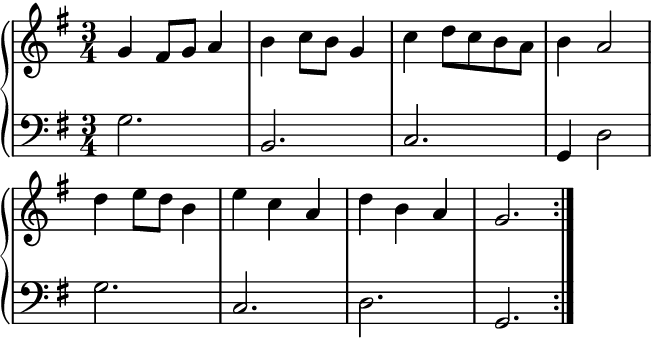
Step 2, cadences. Phrase endings fall every four bars, so the piece is five four-bar phrases. Bar 4 ends on a D chord approached from the tonic: imperfect. Bar 8 closes on to D major with C sharp in the melody just before: perfect, but not in G. Bar 12 halts on D with C natural sounding above it, a dominant seventh left hanging. Bar 16 is imperfect, as bar 4 was. Bar 20 is perfect: the bass falls D to G under the melody's step down on to G.
Step 3, keys. The C sharps in bars 7 and 8 are the giveaway: C sharp is the leading note of D, so bars 5 to 8 modulate to the dominant and cadence there. Bar 12's C natural cancels the modulation, turning D major back into V7 of G. Everything from bar 13 is diatonic G major. Key plan: G to D, then back, exactly the binary norm of chapter 2.
Step 4, letters. Bars 1 to 8 are the first strain, A. Bars 9 to 12 are new in behaviour though not in material: the bar-2 figure climbing in sequence. Bars 13 to 20 restate bars 1 to 4 note for note, then continue differently to close in G. So: A, then a connective B, then A'.
Step 5, the form. First strain ends away from home (perfect cadence in D, bar 8), so this is binary, not ternary. The opening returns in the tonic at bar 13, so it is rounded binary: ||: A :||: B + A' :||, with A' expanded from four bars of recall to a full eight-bar phrase pair.
Step 6, below the phrase. Almost everything grows from the bar-1 motif: crotchet, two quavers, crotchet. Bars 2, 5, 6, 9, 10, 11, 13, 14 and 17 all carry its rhythm, and bars 3, 7 and 15 state its head then run on in quavers. The B section is that figure in a rising sequence, on C major, D major and E minor roots in turn (IV, V, vi), a textbook use of sequence as connective tissue. Bar 12 compresses the rhythm (crotchet, crotchet, two quavers) to hurry the seventh, C natural, into place: the one bar whose job is purely tonal. In the final phrase, bar 18's A minor chord in first inversion (iib) and bar 19's 6-5 motion over the bass D, two voices standing in for Ic-V, make the standard approach iib-Ic-V march into the closing perfect cadence; Musical Harmony covers that cadential formula in detail.
Step 7, the write-up. Rounded binary minuet in G major, 20 bars: ||: 8 :||: 4 + 8 :||. First strain a matched pair of four-bar phrases, imperfect then perfect-in-D, modulating to the dominant. Middle: the principal motif in rising sequence over IV-V-vi, settling on V7. Return restates the opening phrase exactly, then substitutes a new consequent, iib-Ic-V-I, to end at home. One motif supplies fourteen of the twenty bars: the piece is a study in how far one bar of material stretches.
That paragraph is a complete analysis at the scale most exams and most practical purposes require. The same seven steps, applied patiently, scale up to a symphony movement; only the bar counts grow.
11.3 Common pitfalls
Five errors account for most weak analyses:
- Label first, evidence later. The cure is the method's order: cadences and keys before any form name.
- Counting an elided bar twice, which throws every later bar number out by one.
- Calling a rounded binary ternary because the opening returns. The test is the first section's final cadence, not the fact of return.
- Treating every accidental as a modulation. A sharpened note that never reaches a cadence is decoration; a modulation is confirmed only by a cadence in the new key.
- Writing history instead of analysis. A paragraph on the composer's life earns nothing; a named cadence with a bar number always counts.
12. Form at the ABRSM grades
12.1 Where form enters the syllabus
Form is examined lightly and indirectly at the lower grades and directly from Grade 6. Earlier grades establish the raw materials: phrases and cadence recognition, keys and their signatures, and the Italian terms (da capo, fine, dal segno) that the forms depend on, all defined in the Musical Terms Dictionary. From Grade 6 the papers assume those materials and ask questions that are really form questions, even when the word form never appears.
| Grade | Where form appears |
|---|---|
| 1 to 5 | the raw materials: repeat signs, da capo and fine, phrase marks, and at Grade 5 the chords at marked cadence points |
| 6 | melody continuation from a given opening; naming cadences in score extracts; describing how one passage relates to another |
| 7 | the same tasks with chromatic harmony at the cadences and longer extracts; sequence and imitation spotting |
| 8 | full score questions ranging across a movement, with the standard forms assumed as background knowledge |
12.2 Phrase structure in melody writing
The Grade 6 to 8 composition question asks for a melody continuation of a given opening, and the mark scheme rewards phrase logic above all: balanced phrase lengths, a clear cadence shape at the end, and motivic economy, reusing the given opening's material rather than inventing new ideas every two bars. In this guide's terms, examiners are asking for a sentence or a period with an audible full stop. The engraved question-and-answer chapters of the companion Grade 6 to 8 volumes work through the technique; chapter 1 here explains why those particular shapes satisfy the ear.
What the mark scheme rewards, translated into this guide's terms:
- A phrase plan the ear can parse: 4+4, or 2+2+4.
- The given opening's motif reused rather than abandoned; sequence and fragmentation are the everyday tools.
- A single climax, usually near the three-quarter mark, rather than several competing ones.
- An ending the reader could name as a cadence, perfect for a full close.
- Nothing in the added bars that quarrels with the key, metre or style of the given opening.
12.3 Cadence and phrase questions in score extracts
Score questions at Grades 6 to 8 regularly ask candidates to name the cadence at a marked point, locate a modulation, or describe how one passage relates to another (an exact repeat, a sequence, a transposition, an inversion). These are steps 2 to 4 of chapter 11's method, applied to someone else's music under exam conditions.
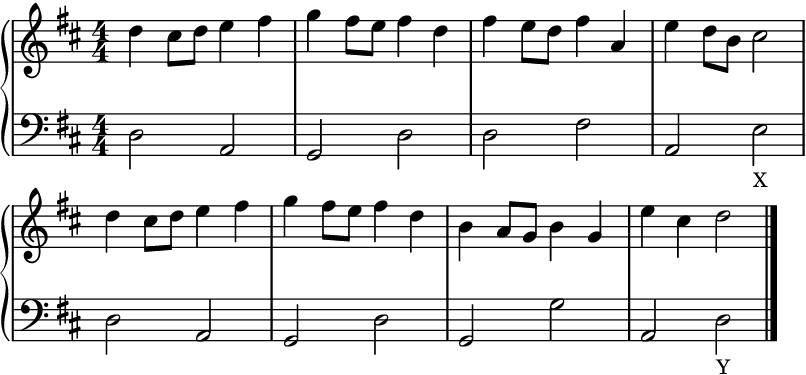
Worked answer, by the method: the extract is two four-bar phrases, parallel in their openings. At X the phrase settles on the dominant chord, approached from the tonic side: imperfect cadence. At Y the melody's C sharp, the leading note, rises to D over a falling-fifth bass: perfect cadence. The phrase pair is therefore a period, antecedent and consequent, and naming that earns the "describe the relationship" marks in one word.
12.4 Practical exams and general musicianship
Instrumental exams touch form too: aural tests ask for features of a piece just heard, and a candidate who can say "binary, with both halves repeated" or "a rondo, the opening tune came back twice" is answering at a different level from one who mentions only the dynamics. The quick reference in chapter 13 is deliberately compact enough to serve as revision for exactly that.
For revision, the exam tasks map onto this guide's chapters directly:
| Exam task | Where it is taught here |
|---|---|
| continue a melody from a given opening | chapter 1 (sentence, period, cadence shape) |
| name the cadence at a marked point | sections 1.4 and 11.1 |
| describe the relationship between two passages | section 1.2 |
| locate a modulation | sections 2.2 and 11.1 |
| name the form of an extract | chapters 2 and 3, checked against chapter 13 |
13. Quick reference
Three questions sort almost any piece into the right family before the detailed maps are needed:
| Question | A yes points to |
|---|---|
| Does the opening section close with a perfect cadence at home before any contrast arrives? | the ternary family; a no points to the binary family, sonata form included |
| Does one closed tune keep returning in the tonic with contrasts between? | the rondo family |
| Is the whole piece one short unit, a theme, a bass line or a progression, restated over and over? | the variation family |
Then every form in this guide as a one-line map. Letters are sections; keys in brackets; ||: :|| marks repeated strains.
| Form | Map |
|---|---|
| simple binary | ||: A (I to V, or i to III) :||: B (back to I) :|| |
| rounded binary | ||: A (I to V) :||: B + return of A opening (I) :|| |
| balanced binary | ||: A, closing theme in V :||: B, same closing theme in I :|| |
| small ternary | A (closed, I) B (related key) A or A' (I) |
| minuet and trio | Minuet (binary) Trio (binary, new key or colour) Minuet da capo |
| scherzo and trio | as minuet and trio, faster, one beat to the bar |
| five-part rondo | A (I) B (V or vi) A (I) C (related) A (I) |
| seven-part rondo | A B A C A B' (now in I) A, often plus coda |
| sonata-rondo | A B A as exposition, C as development, A B' A in tonic |
| sonata form | exposition: first subject (I), transition, second subject (V or III), codetta; development (unstable); recapitulation (all in I); coda |
| sonatina form | exposition, brief link, recapitulation; no real development |
| Classical concerto, first movement | orchestral ritornello, solo exposition, development, recapitulation, cadenza on Ic, final ritornello |
| ritornello form | R (I) episode R (V) episode R (related) episode R (I, complete) |
| ground bass | short bass phrase repeated; upper parts renewed each pass |
| passacaglia | ground bass at full scale, theme mostly in the bass |
| chaconne | repeating harmonic pattern, bass free to vary |
| theme and variations | closed theme, then whole-theme restatements each transformed |
| fugue | exposition of entries (tonic/dominant), episodes and middle entries in related keys, final entry in tonic, pedal |
| strophic song | same music every verse |
| modified strophic | verse structure kept, some verses varied |
| through-composed | continuous new music, no verse scheme |
| da capo aria | A (closed, I) B (related keys) A da capo, ornamented |
| bar form | A A B |
| 32-bar song form | A A B A in eight-bar units; B is the middle eight |
| cyclic work | movements linked by a returning, transformed theme |
| symphonic poem | one span, sections follow a programme over sonata or rondo logic |
14. Exercises
Answers follow at the end. For the two engraved exercises, apply chapter 11's method before reaching for a label.
- Define motif and figure, and give one reason the distinction matters in analysis.
- An eight-bar theme runs: two-bar idea, the same idea repeated, then four bars of quickening fragments into a perfect cadence. Sentence or period, and why?
- A binary movement is in E minor. Name the two keys its first strain is most likely to cadence in, in order of likelihood.
- What single question about the first section most reliably separates ternary form from rounded binary?
- Write out the letter scheme of the seven-part rondo, and state the one key event that separates it from a five-part rondo heard twice.
- A Baroque movement repeats a four-bar unit throughout. What would make you call it a chaconne rather than a ground bass piece?
- Name four variation techniques, and for each state one element of the theme that survives it.
- In a sonata-form movement in C major, where is the second subject in the exposition, where is it in the recapitulation, and why is the change the point of the form?
- A rondo refrain and a ritornello both keep returning. State the tonal difference between their returns.
- In a fugue, what is the difference between a real and a tonal answer, and during which stage of the fugue does the answer first appear?
- Which two song forms would you consider first for a poem of six identical verses, and what trade-off decides between them?
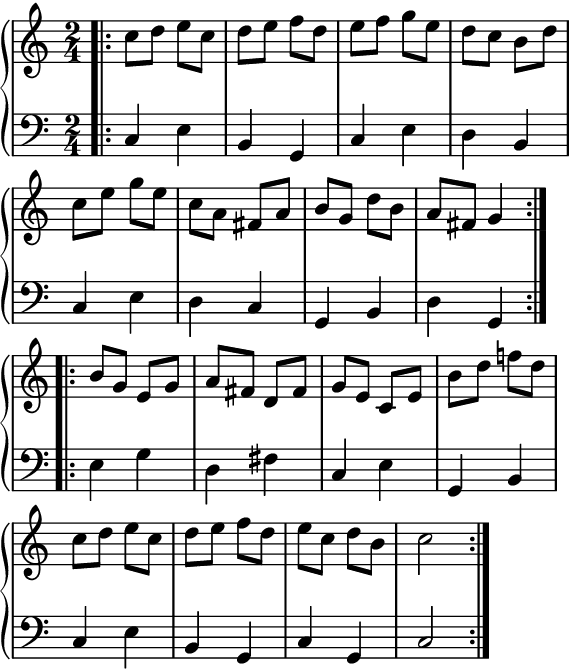
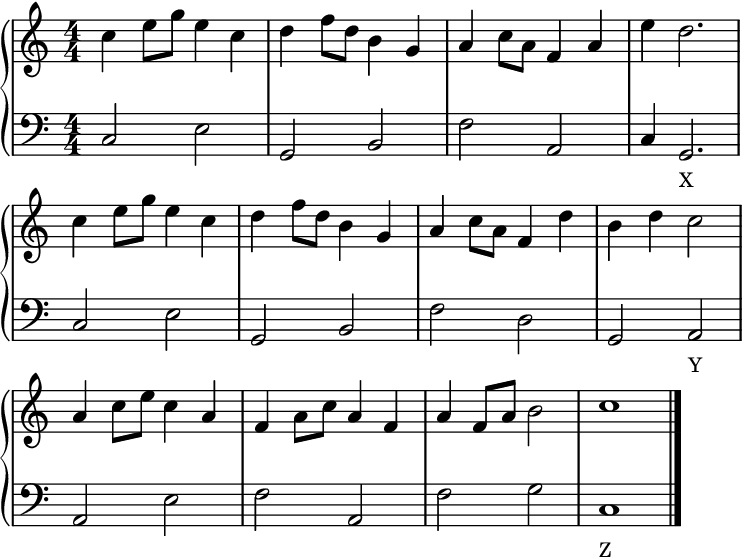
- Name the form of the engraved extract below, and give the two pieces of evidence that decide it.
- Name the cadences at X, Y and Z in the extract below.
- A minuet's first strain ends with a perfect cadence in its home key of D major, and its middle section is eight self-contained bars in B minor ending with a perfect cadence there. What is the form, and which detail settled it?
- Bar 1 of a piece states a motif; bar 9 states it upside down in doubled note values. Name the two devices at work.
- A phrase sets out in bar 1 and reaches its close in bar 6 rather than bar 4. Name the two extension mechanisms from chapter 1 that most often explain the added bars, and say how you would tell them apart on the page.
- In a binary movement, the two bars before the first double bar reappear as the movement's final two bars, transposed from the dominant into the tonic, and the opening material never returns. Which variety of binary is this, and why is it not rounded?
- Set out the column headings of a fugue entry table, and state what does and does not earn a row.
- In the recapitulation of a sonata-form movement, which section is usually the most rewritten, and why must it be?
- A song sets a six-verse poem: verses 1, 2, 5 and 6 share one music, verses 3 and 4 are set to new music in the tonic minor. Name the form as precisely as you can.
- In the worked minuet of chapter 11, bar 12 contains a C natural. Say in one sentence each what that note undoes and what it prepares.
Answers
- A motif is a short, recognisable melodic or rhythmic idea that carries identity and is developed; a figure is a pattern of accompaniment or passage-work that fills texture without being a subject in its own right. The distinction matters because analysis traces motifs, not figures: development sections, fugue subjects and cyclic returns are all built from motifs.
- A sentence. The proportions 2+2+4 with immediate repetition of the idea and a fragmenting continuation are the sentence's definition; a period would instead pair a four-bar antecedent (open cadence) with a four-bar consequent (closed).
- G major, the relative major, first; B minor, the dominant minor, second.
- Does the first section end with a perfect cadence in the home key? Yes: ternary. No, it cadences away from home: binary (rounded, if the opening later returns in the tonic).
- A B A C A B' A. The second appearance of B is transposed into the tonic, resolving the section that had only been heard away from home; in a doubled five-part rondo B would simply return in its original foreign key.
- If what repeats is the harmonic progression while the bass changes register and figuration between statements, it is a chaconne; a ground bass keeps the same bass melody in the bass throughout.
- Any four of: melodic decoration (harmony and bass survive); rhythmic variation (harmonic skeleton and melodic outline survive); change of mode, the minore (melodic outline and phrase plan survive); harmonic variation (melody and bar count survive); textural variation (harmony and phrase plan survive); character variation (phrase plan and outline survive); canonic variation (the head motif survives).
- Exposition: in the dominant, G major. Recapitulation: in the tonic, C major. The transposition resolves the exposition's departure from the tonic; the whole form exists so that material first heard away from home is finally heard at home.
- A rondo refrain returns in the tonic every time. A ritornello returns in a different related key at each middle appearance, confirming the key just reached, and only its final return is in the tonic.
- A real answer transposes the subject exactly into the dominant; a tonal answer adjusts its opening notes, most often answering the subject's tonic-to-dominant step with dominant-to-tonic, to keep the music anchored while the second voice enters. The answer first appears in the exposition, as the second entry.
- Strophic and modified strophic. Pure strophic gains memorability and unity but must fit every verse equally; modified strophic keeps the verse frame while varying the music where a verse's meaning demands it.
- Rounded binary. Evidence: the first strain ends away from the tonic, on the dominant (so not ternary), and the opening bars return in the tonic partway through the second strain, steered to a perfect cadence at home (so rounded rather than simple).
- X: imperfect (the phrase halts on the dominant chord, approached from the tonic). Y: interrupted (the dominant resolves not to C but to A minor, chord vi, under a melody note that fits vi). Z: perfect (V-I with the melody closing on to the tonic).
- Ternary (small ternary). The first section's perfect cadence in the home key makes it self-contained, and the middle's own closed cadence in B minor confirms three independent sections rather than two strains of a binary design.
- Inversion (upside down) and augmentation (doubled note values), applied together.
- The dodged cadence and the echo. If the dominant at the expected cadence resolves to vi and the close is then re-earned, it is the dodged cadence; if the added bars simply restate the closing bars, it is the echo.
- Balanced binary. Rounded binary requires the opening material back in the tonic; here only the closing bars rhyme, and the opening never returns.
- Bars, event, voice, key. Every complete subject or answer entry earns a row, as does every episode; head fragments inside episodes do not, however prominent they sound.
- The transition. In the exposition it carried the music from the tonic into the new key; in the recapitulation both subjects stay at home, so the transition must be recomposed to keep its energy while going nowhere.
- Modified strophic form: the strophic frame stands for four of the six verses, and the music of verses 3 and 4 varies it, here by the change of mode, without abandoning the verse structure.
- It undoes the modulation to D major by cancelling the C sharp that had served as the new leading note; and, sounding as a seventh above the D bass, it turns D from a tonic into V7 of G, preparing the return of the opening at bar 13.