A Complete and In-Depth Documentation of the Subject
From the physics of vibrating strings to the pitch-class sets of the twentieth century — a comprehensive reference covering the acoustic foundations of harmony, the vocabulary of chords, the grammar of tonal and chromatic harmony, voice-leading and part-writing, modal, jazz, blues, popular and post-tonal harmony, the major analytical methods, and the history of it all.
Introduction
Why does a perfect cadence sound finished? Why do some pairs of notes purr together while others grind? Why did the same twelve notes serve Monteverdi, Wagner and Ellington so differently? These are harmony questions, and this guide is a map of the whole territory: the physics underneath, the chords and their names, the grammar that connects them in a key, the chromatic colours that stretch it, and the modal, jazz and post-tonal systems that reorganise the rules altogether.
A reference of this size is not meant to be swallowed whole. The foundations and the tonal core, Parts I to III, repay a slow first reading in order, because everything later leans on them. The rest works best raided: a chapter at a time, when a piece, a progression or an argument sends you there. The glossary and reference tables at the back are the quick way back to anything half-remembered.
No prose teaches harmony by itself, this guide's included. The ideas become knowledge at the moment you find them in real music: a hymn's cadences, a song's turnaround, the bar where a modulation actually happens. Read with scores nearby and a keyboard within reach, and treat every example as an invitation to play it.
Within this collection, this is the deep reference. The graded ABRSM guides build the groundwork step by step, Roman Numeral Analysis drills the labelling system in analytical detail, and Piano Chords, Musical Modes and Music Notation serve the practical questions. This volume is where their threads join.
How to Use This Guide
This is a standalone, comprehensive reference on musical harmony — the study of how simultaneously-sounding pitches combine, how chords are built and connected, and how those combinations create tension, motion, colour and repose. It is organised into six parts and twenty-two chapters, moving from first principles to the most advanced techniques:
- Part I — Foundations: the acoustic and interval basis of harmony.
- Part II — The Vocabulary of Chords: triads, sevenths, extended/altered chords, and the systems used to notate them.
- Part III — Tonal (Functional) Harmony: diatonic harmony, function and progression, cadences, non-chord tones, and voice-leading/part-writing.
- Part IV — Chromatic Harmony: secondary dominants, modulation, mixture, augmented sixths, and advanced chromaticism.
- Part V — Beyond Common-Practice Tonality: modal, jazz, blues/popular, and twentieth-century/post-tonal harmony.
- Part VI — Analysis, History & Reference: the analytical methods, a history of harmony, a practical analysis method, glossary, reference tables and exercises.
It is designed to be read in order but also to serve as a look-up reference; the Glossary and Reference Tables at the end consolidate the essentials. Two companion documents in this collection go deeper on narrower topics: an ABRSM Grades 1–5 guide covers the elementary groundwork, and a Roman Numeral Analysis guide expands the functional-labelling system of Parts III–IV. This document is self-contained, but cross-references them where useful.
Assumed background: you can read the treble and bass clefs, know major and minor scales and key signatures, and can identify basic intervals and triads. Everything beyond that is built up here.
A note on notation in this document
Because this is a text document, sound examples are given by note name and chord symbol, and analysed with Roman numerals, figured-bass figures and chord-scale labels written on one line. Accidentals use ♯ (sharp), ♭ (flat), ♮ (natural), 𝄪 (double sharp) and 𝄫 (double flat); diminished is °, half-diminished ø, augmented +. Where a five-line stave would help, write the example out yourself — hearing and notating harmony is how it is truly learned.
What Is Harmony?
Harmony is the aspect of music concerned with simultaneity — pitches sounding together — and with the succession of those simultaneous combinations through time. If melody is the horizontal dimension of music (one note after another) and rhythm is its temporal dimension, harmony is primarily the vertical dimension (notes stacked at one instant) plus the logic that governs how those verticals move from one to the next.
Two complementary viewpoints run through the whole subject and it is worth naming them at the outset:
- The vertical (chordal) view treats each simultaneity as a chord — an object with a root, quality and function. This is the viewpoint of Roman numeral analysis and chord symbols.
- The horizontal (contrapuntal) view treats the music as several independent melodic lines (voices) whose momentary coincidences produce the chords. This is the viewpoint of counterpoint and voice-leading.
Neither view is complete alone. A chord progression that looks correct vertically can be ruined by bad voice-leading; a set of beautiful independent lines will, at every moment, still form recognisable harmonies. Mature harmonic understanding holds both views at once — chords governed by function, realised through good voice-leading — and this guide develops them side by side.
Harmony as a field therefore spans an enormous range: the acoustics that make some combinations sound stable and others tense; the vocabulary of chords from simple triads to dense jazz voicings; the syntax of tonal music that makes progressions sound purposeful; the chromatic techniques that colour and extend that syntax; the modal, jazz and popular systems that reorganise it; the post-tonal languages that replace it; and the analytical methods by which we make sense of all of the above. Each is a chapter that follows.
The dimensions of a harmony, summarised
| Question | What it concerns | Chapters |
|---|---|---|
| Why do chords sound consonant or dissonant? | Acoustics, the overtone series, tuning | 1–2 |
| What chords exist and how are they built? | Triads, sevenths, extensions, notation | 3–6 |
| How do chords function and connect in a key? | Tonal function, progression, cadence, voice-leading | 7–11 |
| How is that language coloured and extended? | Chromatic harmony | 12–15 |
| What other harmonic systems exist? | Modal, jazz, blues/pop, post-tonal | 16–19 |
| How do we analyse and situate harmony? | Analytical methods, history, practice | 20–22 |
1. The Acoustic Basis of Harmony
Harmony is not an arbitrary set of rules; it grows out of how sound itself behaves. Understanding the acoustics explains why an octave sounds like "the same note higher," why a major triad sounds stable, why the dominant seventh strains toward resolution, and why keyboards are tuned the slightly "wrong" way on purpose.
1.1 Sound, Frequency and Pitch
A musical sound is a periodic vibration of the air. The frequency of that vibration (cycles per second, measured in hertz, Hz) is heard as pitch: faster vibration → higher pitch. The amplitude is heard as loudness, and the shape of the wave is heard as timbre (tone colour). Standard tuning fixes the note A above middle C at 440 Hz.
Crucially, when two frequencies are in a simple whole-number ratio, the ear fuses them into a stable, "consonant" blend. This single fact is the seed of all harmony.
1.2 The Harmonic (Overtone) Series
A vibrating string or air column does not vibrate only as a whole. It simultaneously vibrates in halves, thirds, quarters and so on, producing a fundamental frequency plus a series of overtones (partials) at integer multiples of the fundamental. This harmonic series is the acoustic bedrock of harmony.
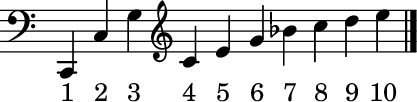
Built on a low C, the first sixteen partials are (approximately):
| Partial | Note | Interval above fundamental | Ratio to fundamental |
|---|---|---|---|
| 1 | C | (fundamental) | 1:1 |
| 2 | C | octave | 2:1 |
| 3 | G | octave + perfect 5th | 3:1 |
| 4 | C | two octaves | 4:1 |
| 5 | E | two octaves + major 3rd | 5:1 |
| 6 | G | two octaves + perfect 5th | 6:1 |
| 7 | B♭ (flat) | two octaves + minor 7th | 7:1 |
| 8 | C | three octaves | 8:1 |
| 9 | D | + major 2nd | 9:1 |
| 10 | E | + major 3rd | 10:1 |
| 11 | F♯ (very flat) | + tritone-ish | 11:1 |
| 12 | G | + perfect 5th | 12:1 |
| 13 | A (flat) | + major 6th-ish | 13:1 |
| 14 | B♭ (flat) | + minor 7th | 14:1 |
| 15 | B | + major 7th | 15:1 |
| 16 | C | four octaves | 16:1 |
Read what the series gives us, in order of appearance:
- The octave (partials 1→2) comes first — which is why two notes an octave apart share a name and sound "equivalent."
- The perfect fifth (2→3) comes next — the most consonant interval after the octave, and the backbone of the circle of fifths.
- The major third (4→5) appears higher up — consonant, but less fundamental than the fifth, which is why medieval music treated the fifth as stable and the third as only later "sweet."
- Partials 4:5:6 spell a major triad (C–E–G). The major triad is literally written into the overtone series — the most acoustically natural chord there is.
- Partials 4:5:6:7 add the (flat) minor seventh (C–E–G–B♭), the raw acoustic form of the dominant seventh chord — which is why the dominant seventh feels so natural yet so charged.
- The higher partials (9, 11, 13) supply the extensions (ninth, eleventh, thirteenth) that jazz harmony makes explicit.
Two consequences pervade the whole subject: octave equivalence (notes an octave apart are functionally "the same") and the acoustic priority of fifths and thirds as the building intervals of chords.
1.3 Consonance and Dissonance
Consonance is the sense of stability, blend and repose; dissonance is the sense of tension, roughness and the need to resolve. There are two layers to it:
- Sensory (psychoacoustic) consonance depends on frequency ratios. The simpler the ratio, the more consonant the interval, because the partials of the two tones align rather than clash. When partials fall close but not identical in frequency, they beat (a throbbing) and, within the ear's critical band, produce roughness — the physical sensation of dissonance.
- Musical (contextual) dissonance depends on style and function. A major seventh chord is a stable point of rest in jazz but a dissonance requiring resolution in Palestrina. Consonance is thus partly acoustic fact and partly stylistic agreement.
Frequency ratios of the common intervals (in just intonation), simplest first:
| Interval | Ratio | Character |
|---|---|---|
| Unison | 1:1 | perfect consonance |
| Octave | 2:1 | perfect consonance |
| Perfect 5th | 3:2 | perfect consonance |
| Perfect 4th | 4:3 | (perfect) consonance* |
| Major 6th | 5:3 | imperfect consonance |
| Major 3rd | 5:4 | imperfect consonance |
| Minor 3rd | 6:5 | imperfect consonance |
| Minor 6th | 8:5 | imperfect consonance |
| Minor 7th | 16:9 (or 9:5) | dissonance |
| Major 2nd | 9:8 | dissonance |
| Major 7th | 15:8 | dissonance |
| Minor 2nd | 16:15 | dissonance |
| Tritone | 45:32 (≈7:5) | dissonance |
*The perfect fourth is acoustically consonant, yet in tonal counterpoint a fourth above the bass is treated as a dissonance — one of the most important style-dependent quirks in all of harmony (see Chapter 2).
1.4 Timbre, Register and Combination Tones
Because every instrument emphasises different partials, the "same" chord has a different colour on strings, brass or a piano — timbre is the relative strength of the overtones. This is why voicing and register matter harmonically: a chord spaced with wide gaps low in the register sounds muddy (its low partials clash within the critical band), while the same chord spaced like the overtone series — wider at the bottom, closer at the top — sounds clear. Good voice-leading and spacing are, at root, an accommodation to acoustics.
When two loud tones sound together, the ear also generates faint combination tones (Tartini tones), notably a difference tone at the frequency difference of the two. Barbershop singers and string players exploit these; they are a reminder that harmony is partly created inside the listener.
1.5 Tuning and Temperament
Here lies a deep problem. If we tune by pure ratios (just intonation), individual chords sound gorgeous — but the system will not close. Stack twelve pure fifths (3:2) and you overshoot seven octaves by the Pythagorean comma (about 23.5 cents, nearly a quarter of a semitone). Likewise four pure fifths produce a major third (81:64) noticeably sharper than the pure 5:4 third — a discrepancy called the syntonic comma (about 21.5 cents). You cannot have pure fifths and pure thirds and a closed circle of twelve keys at once. Every tuning system is a compromise among these.
The historical solutions ("temperaments"):
| System | Idea | Strength | Weakness |
|---|---|---|---|
| Pythagorean | Pure 3:2 fifths stacked | Pure fifths, bright | Very sharp ("wolf") thirds |
| Just intonation | Pure ratios for a home key | Purest chords in one key | Unusable in remote keys; commas |
| Meantone | Temper fifths flat to purify thirds | Sweet thirds in near keys | A "wolf" fifth; limited keys |
| Well temperament | Unequal but all keys usable | Each key a distinct colour | Keys not identical |
| Equal temperament (12-TET) | Divide the octave into 12 identical semitones | All keys equal; free modulation | No interval except the octave is pure |
Equal temperament makes every semitone exactly the twelfth root of two (≈ 1.0595), so the octave is the only pure interval; the fifth is 2 cents flat and, more audibly, the major third is about 14 cents sharp. We accept these small impurities because ET lets us play in any key and modulate freely on a fixed-pitch instrument — the very freedom that made the elaborate key schemes of common-practice and later harmony possible. Measured in cents (100 cents = one ET semitone, 1200 = octave), the just fifth is 702 cents versus ET's 700, and the just major third is 386 versus ET's 400.
The lesson for harmony: the chords we analyse are idealised. On a piano they are slightly tempered approximations of the pure ratios that the overtone series suggests — a standing compromise between acoustic purity and harmonic freedom.
2. Intervals as Harmonic Units
Chords are built from intervals, and the way intervals are classified as consonant or dissonant is the grammar underneath voice-leading and chord construction. This chapter treats the interval specifically as a harmonic object.
2.1 Harmonic vs Melodic Intervals
The same interval can be sounded two ways:
- a melodic interval — the two notes played in succession (the horizontal dimension);
- a harmonic interval — the two notes played together (the vertical dimension).
Harmony is chiefly concerned with harmonic intervals, but the two interact constantly: a melodic leap outlines a harmony, and a vertical interval is approached and left by melodic motion in each voice. (Interval number and quality — 2nds, 3rds, perfect vs major/minor/augmented/diminished — are assumed here; the Roman Numeral and ABRSM companion guides drill them.)
2.2 The Consonance/Dissonance Classification
Tonal theory sorts harmonic intervals into three classes. This classification is the foundation of counterpoint and of every voice-leading rule that follows.
| Class | Intervals | Behaviour |
|---|---|---|
| Perfect consonances | unison, octave, perfect 5th (and P4 between upper voices) | Stable; but bare and "open" — approach with care (parallels forbidden) |
| Imperfect consonances | major & minor 3rds and 6ths | Stable and warm — the harmonic "filling"; may be used freely, even in parallel |
| Dissonances | all 2nds and 7ths, the tritone, and the P4 above the bass | Unstable; must be prepared and/or resolved by step |
Three points repay attention:
- Thirds and sixths are the workhorses of tonal harmony. They are consonant enough to rest on but rich enough to give warmth — which is why parallel thirds and sixths sound sweet, and why triads (stacks of thirds) became the basic chord.
- The octave and fifth are "perfect" but exposed. Their purity means two voices moving in parallel octaves or fifths momentarily fuse into one, destroying independence — hence the strict ban on parallel fifths and octaves (Chapter 11).
- Dissonances are not "bad" — they are the engine of motion. Controlled dissonance (a suspension, a seventh, a passing tone) creates the tension whose resolution gives tonal music its sense of purpose.
2.3 The Curious Case of the Perfect Fourth
The perfect fourth is the textbook paradox of harmony. Acoustically it is a consonance (ratio 4:3, low and simple). Yet in tonal counterpoint a fourth formed above the bass is treated as a dissonance requiring resolution, while a fourth between two upper voices is consonant. The reason is contextual: over a bass, a bare fourth implies a second-inversion triad, which the common-practice ear hears as unstable (recall the cadential 6/4, whose fourth leans down to a third). So the fourth is:
- consonant as a melodic interval and between upper voices;
- dissonant above the bass, where it behaves like a suspension seeking the third below it.
This single exception explains the special handling of all 6/4 chords and is a favourite exam trap.
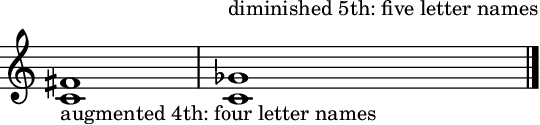
2.4 The Tritone
The tritone — the augmented fourth (e.g. F–B) or its enharmonic equal the diminished fifth (B–F) — spans three whole tones and is the most unstable interval in the diatonic scale (ratio ≈ 45:32). It is the defining dissonance of the dominant seventh: in G7 (G–B–D–F) the tritone B–F wants to resolve inward to C–E (or the diminished fifth F–B outward), pulling the whole chord onto the tonic. The tritone's built-in instability is thus the mainspring of tonal cadence; later, its symmetry (it divides the octave exactly in half) makes it central to tritone substitution in jazz and to the symmetrical scales of post-tonal music.
2.5 Inversion, Compound Intervals and the "Root" of an Interval
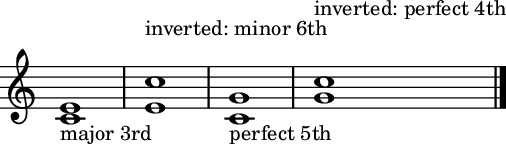
- Inversion: move the lower note up an octave (or the upper down) and an interval inverts — the numbers sum to 9 (a 3rd inverts to a 6th, a 2nd to a 7th, a 4th to a 5th) and the quality flips (major↔minor, augmented↔diminished; perfect stays perfect). Consonances invert to consonances (a 3rd to a 6th), and the tritone inverts to a tritone — its self-inversion is a sign of its symmetry.
- Compound intervals exceed the octave (a 9th, 10th, 11th…). They keep the quality of their simple form; harmonically a 10th behaves like a 3rd, but the wider spacing sounds more open and consonant, which is why low chords are voiced with tenths rather than thirds.
- The interval's root: in any interval the lower note of the stronger partial-alignment tends to sound like a "root." For a fifth C–G the root is C; for a fourth C–F the root is F (the upper note) — one more reason the fourth-above-the-bass feels unstable, since its acoustic root contradicts the bass. This idea (developed by Hindemith) foreshadows how chords acquire roots.

2.6 From Intervals to Chords
Stack intervals and you get chords. Stack thirds and you get the tertian harmony that dominates Western music — triads, sevenths and extensions (Chapters 3–5). Stack fourths and you get the quartal harmony of the twentieth century (Chapter 19). Stack fifths and you get open quintal sonorities. The choice of building interval defines the whole harmonic idiom. Because the overtone series privileges the third and fifth, tertian harmony became the default — but it is a choice, not a law, and Part V shows what happens when composers choose otherwise.
3. Triads
The triad is the basic chord of Western harmony: three notes stacked in thirds. Because thirds and fifths sit low in the overtone series (Chapter 1), the triad is the most acoustically natural chord, and tertian (third-based) harmony became the default idiom.
3.1 Construction and the Four Qualities
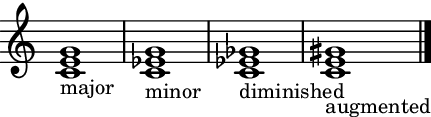
A triad has three members: the root (the note it is built on), the third (a third above the root), and the fifth (a fifth above the root). The sizes of the two stacked thirds determine the quality:
| Quality | Lower 3rd | Upper 3rd | Root–5th | Symbol | Example |
|---|---|---|---|---|---|
| Major | major | minor | perfect 5th | C, "maj" | C–E–G |
| Minor | minor | major | perfect 5th | Cm, "min", – | C–E♭–G |
| Diminished | minor | minor | diminished 5th | C°, "dim" | C–E♭–G♭ |
| Augmented | major | major | augmented 5th | C+, "aug" | C–E–G♯ |
The major and minor triads are consonant (a perfect fifth framing a third) and are the pillars of tonal music. The diminished and augmented triads are dissonant (their outer interval is a tritone or an augmented fifth) and are used for tension and colour; the augmented triad, dividing the octave into three equal major thirds, is symmetrical and harmonically ambiguous.
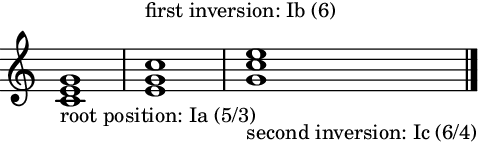
3.2 Position and Inversion
The bass note (lowest sounding note) sets the inversion:
- Root position — root in the bass; the most stable.
- First inversion — third in the bass (figure 6); lighter, mobile, good for smooth bass lines.
- Second inversion — fifth in the bass (figure 6/4); unstable, used only as a passing, pedal or cadential embellishment (Chapters 2 and 9).
Inversion does not change which chord is present (same three note-names), only its stability and colour. Roman numerals and figured bass encode the inversion; see the companion Roman Numeral Analysis guide for exhaustive detail.
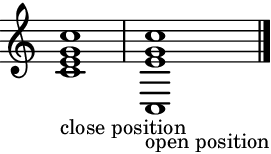
3.3 Spacing: Close and Open Position
The same triad can be spaced in countless ways across the register, and spacing is a genuinely harmonic decision, not mere layout:
- Close position — the upper three voices are packed within an octave. Compact, blended.
- Open position — the upper voices are spread beyond an octave. Resonant, clearer.
- Doubling — with more voices than chord tones (e.g. four-part SATB on a three-note triad), one note is doubled. In root-position triads the root is usually doubled; the leading tone is never doubled (two leading tones would create parallel octaves when both resolve to the tonic).
The overtone series is the guide: chords voiced wide at the bottom and close at the top (like the partials) sound clear, while thirds placed low in the bass sound muddy because their overtones clash within the ear's critical band. This is why arrangers avoid low thirds and why a well-voiced chord "rings."
3.4 Why the Triad?
A triad answers three demands at once: it is consonant (framed by a perfect fifth), complete (the third tells major from minor, giving it emotional colour), and efficient (three notes suffice to imply a key's function). Stacking a further third turns it into a seventh chord — the next chapter — and continuing the stack produces the extended chords of Chapter 5. Everything in tertian harmony is a triad with more thirds piled on top.
4. Seventh Chords
Add one more third above a triad and you get a seventh chord — a four-note chord (root, third, fifth, seventh). The added dissonant seventh gives the chord drive: it wants to resolve, and that wanting powers tonal progression.
4.1 The Qualities of Seventh Chords
A seventh chord's quality is described by its triad plus its seventh. The seven types you will meet:
| Name | Triad + 7th | Symbol | Example on C |
|---|---|---|---|
| Major seventh | major triad + major 7th | maj7, Δ7 | C–E–G–B |
| Dominant seventh | major triad + minor 7th | 7 | C–E–G–B♭ |
| Minor seventh | minor triad + minor 7th | m7, –7 | C–E♭–G–B♭ |
| Half-diminished seventh | diminished triad + minor 7th | ø7, m7♭5 | C–E♭–G♭–B♭ |
| Fully-diminished seventh | diminished triad + diminished 7th | °7 | C–E♭–G♭–B♭♭(A) |
| Minor-major seventh | minor triad + major 7th | m(maj7), –Δ7 | C–E♭–G–B |
| Augmented-major seventh | augmented triad + major 7th | +maj7, +Δ7 | C–E–G♯–B |
The first five are common; the dominant seventh is the most important chord in tonal music (its tritone drives the cadence), the major and minor sevenths are the staples of jazz, and the fully-diminished seventh — a symmetrical stack of three minor thirds — is the great pivot chord of chromatic harmony (Chapter 15). The last two are rarer colour chords (the minor-major seventh haunts film noir and the "James Bond" chord).

4.2 Inversions and Figured Bass
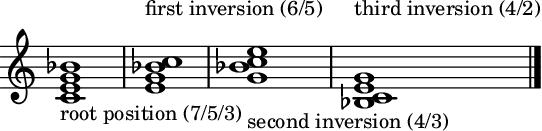
Four notes give a root position and three inversions, shown by figures counting intervals above the bass:
| Position | Bass note | Figure |
|---|---|---|
| Root position | root | 7 |
| First inversion | third | 6/5 |
| Second inversion | fifth | 4/3 |
| Third inversion | seventh | 4/2 (or 2) |
Remember the sequence 7 · 6/5 · 4/3 · 4/2 as the bass climbs from root to seventh.
4.3 The Behaviour of the Seventh
The defining voice-leading fact: the chordal seventh is a dissonance and normally resolves down by step. In G7→C the seventh F falls to E; in a chain of sevenths each seventh falls to the third of the next chord. Likewise, when the chord is a dominant, its third is the leading tone and rises to the tonic. These two "tendency tones" (seventh down, leading tone up) resolving the tritone are the microscopic mechanism of the cadence — and knowing them lets you predict and voice resolutions correctly (Chapter 11).
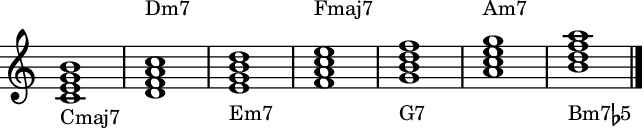
4.4 Diatonic Seventh Chords
Building a seventh on every scale degree yields the diatonic sevenths of a key. In a major key: IMaj7, ii7, iii7, IVMaj7, V7, vi7, viiø7. In a minor key (harmonic): i(7), iiø7, IIIMaj7(+), iv7, V7, VIMaj7, vii°7. The two dissonant leading-tone sevenths — viiø7 in major and the fully-diminished vii°7 in minor — are especially potent dominant substitutes. These are catalogued in full, with resolutions, in the Roman Numeral Analysis guide; Part III here places them in their functional context.
5. Extended, Added-Note and Altered Chords
Keep stacking thirds above a seventh chord, or add colour tones to a triad, and the harmonic palette expands from the four notes of a seventh chord to the lush sonorities of late-Romantic and jazz music.
5.1 Extended Chords (9ths, 11ths, 13ths)
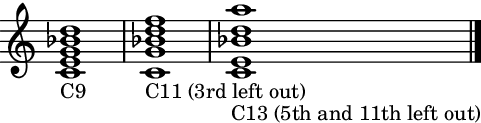
Continuing the tertian stack past the seventh produces extensions, drawn from the upper partials of the overtone series:
| Chord | Thirds stacked | Notes on C | Common use |
|---|---|---|---|
| Ninth | up to the 9th | C–E–G–B♭–D | dominant 9 (C9), major 9 (Cmaj9), minor 9 (Cm9) |
| Eleventh | up to the 11th | C–E–G–B♭–D–F | often the 3rd is omitted (it clashes with the 11th); minor 11 is common |
| Thirteenth | up to the 13th | C–E–G–B♭–D–F–A | the fullest tertian chord; the 11th is usually omitted |
In practice not every note is played. With only four voices you omit the weakest tones — typically the fifth, and (in an 11th or 13th) the notes that clash — keeping the root, third, seventh and the characteristic extension. The chord is named for its highest extension, so a "C13" implies the 7th and 9th are available even if not all sound.
5.2 Added-Note Chords
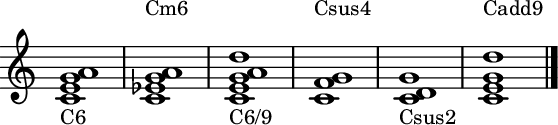
Distinct from extensions: an added-note chord adds a colour tone to a triad without a seventh, so the stack is not continuous.
- Add9 / add2 — a triad plus the 9th (= 2nd), e.g. Cadd9 = C–E–G–D. Bright, open; ubiquitous in pop and film music.
- Sixth chords — a triad plus a major sixth: C6 = C–E–G–A (major 6th) and Cm6 = C–E♭–G–A (minor 6th). A stable, sweet substitute for the tonic in jazz.
- Six-nine (6/9) — triad plus 6th and 9th: C6/9 = C–E–G–A–D. A favourite final chord in jazz, richer than a bare triad but more restful than a major 7th.
5.3 Suspended Chords
A suspended chord replaces the third with a fourth (sus4) or a second (sus2), removing the major/minor colour and creating a floating, unresolved sound:
- Csus4 = C–F–G; Csus2 = C–D–G.
- Classically the suspended fourth resolves down to the third (the sus4→3 suspension of Chapter 10), but in pop and modal music the sus chord is often a stable colour that never resolves.
5.4 Altered Chords
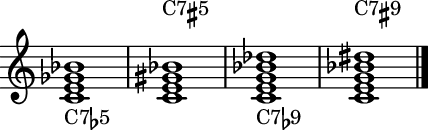
Alteration chromatically raises or lowers a chord tone — most often the fifth or the extensions of a dominant chord, to intensify its pull:
- ♭5 / ♯5 — flattened or raised fifth (C7♯5 contains an augmented triad).
- ♭9 / ♯9 — flattened or raised ninth (the ♯9 gives the gritty "Hendrix chord," C7♯9).
- ♯11 — the raised eleventh (a bright, "lydian" dominant colour).
- ♭13 — the flattened thirteenth (= ♯5 enharmonically).
- The altered dominant ("alt") stacks several of these (♭9, ♯9, ♯11, ♭13) over the root, third and seventh — the maximally tense dominant of bebop. Note its kinship with the augmented-sixth chords of Chapter 14: the German sixth is enharmonically a dominant-seventh-type sonority, and an altered dominant is an augmented sixth's jazz cousin.
5.5 Polychords and Slash Chords
- A slash chord writes a chord over a specified bass note: C/E is a C triad with E in the bass (a first inversion), and C/G puts G in the bass. When the bass note is not a chord tone (e.g. F/G, an F triad over a G bass), the slash chord becomes a compact way to notate a dense, extended, or suspended sonority.
- A polychord stacks two independent chords, notated one over the other (e.g. a D major triad over a C major triad). Polychords are a gateway to the polytonality of the twentieth century (Chapter 19) and to jazz upper-structure voicings (Chapter 17), where an upper triad supplies a dominant's alterations.
5.6 Beyond Tertian Stacking
Extensions and alterations are still tertian (third-based). Abandon the third as the building interval and you enter quartal/quintal harmony (chords built in fourths or fifths), clusters (chords built in seconds), and polychordal combinations — the vocabulary of Impressionism, jazz modal playing and modernism, gathered in Chapter 19. The point of this chapter is that even the richest common-practice and jazz chords are, at heart, a triad with more thirds and colours piled on.
6. How Harmony Is Written Down: Notation Systems
Harmony has been notated by four main systems, each reflecting a different era and viewpoint. Fluency means being able to read and translate all four.
6.1 Figured Bass (Thoroughbass)
Born in the Baroque basso continuo, figured bass writes only the bass line plus numbers showing the intervals to be played above it. A keyboardist "realises" the harmony in real time. It is the ancestor of the inversion figures in Roman numeral analysis.
| Figure | Means (above the bass) | Chord |
|---|---|---|
| (none) or 5/3 | 5th and 3rd | root-position triad |
| 6 (6/3) | 6th and 3rd | first-inversion triad |
| 6/4 | 6th and 4th | second-inversion triad |
| 7 | 7th, 5th, 3rd | root-position seventh |
| 6/5, 4/3, 4/2 | — | seventh-chord inversions |
| ♯ / ♭ / ♮ alone | alters the third above the bass | (e.g. a raised leading tone) |
| accidental beside a figure | alters that interval | |
| slash or + through a figure | raises that note a semitone | |
| horizontal line | hold the previous note over |
Figured bass captures vertical intervals and voice-leading but says nothing about function — it tells you what to play, not what the chord means.
6.2 Roman Numerals
Roman numerals label each chord by the scale degree of its root and its quality/function (I, ii, V7, viiø7, V/V, N6…), combining a functional label with figured-bass inversion figures. This is the analyst's system for tonal music; the Roman Numeral Analysis companion guide is devoted to it.
6.3 Lead-Sheet Chord Symbols
Popular and jazz music uses absolute chord symbols: a root letter, a quality, any extensions/alterations, and an optional slash bass. Reading them is essential for modern harmony.
| Symbol | Meaning |
|---|---|
| C | C major triad |
| Cm, C– | C minor triad |
| C7 | C dominant seventh |
| Cmaj7, CΔ7 | C major seventh |
| Cm7 | C minor seventh |
| C°7, Cdim7 | C fully-diminished seventh |
| Cø7, Cm7♭5 | C half-diminished seventh |
| C9 / C11 / C13 | dominant chord with that extension |
| Cadd9 | triad plus 9th (no 7th) |
| C6 / Cm6 / C6/9 | added-sixth chords |
| Csus4 / Csus2 | suspended chords |
| C7♯9, C7♭9, C7alt | altered dominants |
| C/E | C triad with E in the bass (inversion) |
| F/G | F triad over a G bass (a slash voicing) |
6.4 Function Symbols and the Nashville Number System
- Function symbols (from Hugo Riemann): T, S, D for Tonic, Subdominant and Dominant function, with modifiers. Common in German-language theory, they foreground function over scale-degree (Chapter 8).
- The Nashville Number System writes chords as Arabic numerals 1–7 relative to the key (
1 – 6m – 4 – 5), so a chart transposes instantly. It is Roman-numeral thinking for working session musicians.
6.5 Choosing and Translating Between Systems
| System | Shows | Best for |
|---|---|---|
| Figured bass | intervals above a bass | Baroque continuo; voice-leading |
| Roman numerals | scale-degree + function | analysing tonal music |
| Function symbols (T/S/D) | functional role | functional analysis |
| Chord symbols | absolute root + quality | performing jazz/pop |
| Nashville numbers | key-relative shorthand | session work, transposing |
The systems are inter-translatable: a Baroque bass figured 6/5 on the leading tone, a chord symbol G7/B, and a Roman numeral V6/5 can all describe the same chord — each viewing it through a different lens (voice-leading, absolute pitch, function). A complete harmonic education means being able to move freely among them.
7. Keys, Scales and Diatonic Harmony
Tonal harmony is organised around a single central pitch — the tonic — to which all other notes and chords relate. This chapter sets out the raw materials: the scales that supply the notes, and the diatonic chords built from them.
7.1 Tonality and the Tonic
Tonality is the sense that one note is "home." Everything in tonal harmony is heard in relation to the tonic: some chords feel stable (at rest on or near the tonic), others feel tense (needing to move toward it). The major and minor scales are the source-sets from which a key's notes — and therefore its chords — are drawn. A key signature fixes those notes; the circle of fifths organises the twenty-four keys so that neighbours differ by one sharp or flat (shown below).
The circle of fifths in harmony
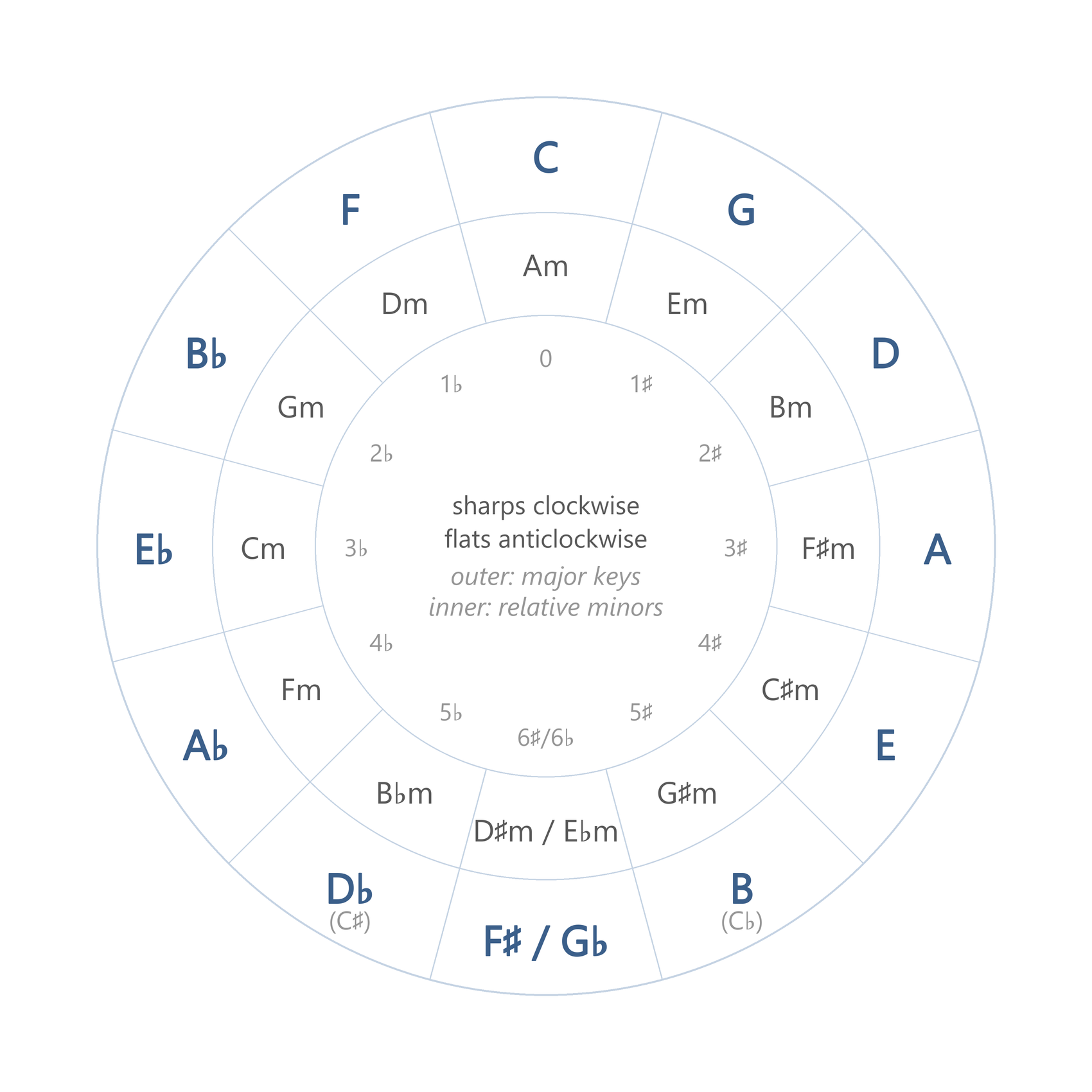
The diagram places the major keys on twelve positions around the outer ring, rising a fifth with each clockwise step from C at the top; each key's relative minor sits inside it, and the tally of sharps or flats is given in the centre. At the foot of the circle, where the sharp and flat sides meet, three pairs of keys are enharmonic equivalents: B and C flat, F sharp and G flat, D flat and C sharp. Most musicians meet the circle first as a map of key signatures. In harmony it earns its keep a second time, as a map of motion between chords and between keys.
The strongest root motion in tonal harmony is a fall of a perfect fifth, and on the circle that is one anticlockwise step. V to I is the model: G falls to C, tension gives way to rest. The same step can be chained. In a progression such as vi, ii, V, I (in C major: A minor, D minor, G, C) each chord stands a fifth above the next and hands its tension on, so the line pulls home with gathering force. This is why so many sequences and turnarounds trace an arc of the circle rather than wandering among unrelated chords.
The everyday ii-V-I is simply the last two links of that chain: from the supertonic chord, two anticlockwise steps land on the tonic. Jazz treats the pair as its basic cadential unit, but the same two steps are the skeleton of the classical cadence, in which ii prepares V and V resolves home.
A secondary dominant is a one-step detour in the other direction. To throw weight behind a chord other than the tonic, borrow the chord one clockwise step beyond it and let it fall: in C major, D7 resolving to G is V7 of V, a brief visit to G's neighbourhood before the music continues round the circle to C. A chain of applied dominants merely begins the detour further back and falls, fifth by fifth, all the way home.
The circle also shows the distance of a modulation. The five closely-related keys all sit within one step of the tonic, counting both rings: from C major they are G, F, A minor, E minor and D minor, none of them more than one accidental away from home, so shared chords are plentiful and the ear follows the move easily. Keys across the circle are another matter. C major and F sharp major have only two notes in common, and reaching so remote a key usually takes chromatic or enharmonic machinery, the kind of respelling that lives at the enharmonic seam at the foot of the diagram. Root motion is formalised in Chapter 8, applied dominants in Chapter 12, and the techniques of modulation in Chapter 13.
7.2 The Diatonic Chords
Using only the notes of the scale, build a triad (or seventh) on each degree, and you get the diatonic harmony of the key — the home vocabulary before any chromaticism. In a major key the qualities are fixed:
| Degree | 1 | 2 | 3 | 4 | 5 | 6 | 7 |
|---|---|---|---|---|---|---|---|
| Triad | I | ii | iii | IV | V | vi | vii° |
| Quality | major | minor | minor | major | major | minor | dim. |
The three major triads (I, IV, V — the primary triads) are the load-bearing chords; between them they contain all seven scale degrees, so any diatonic melody can be harmonised with them alone. The minor triads (ii, iii, vi) and the diminished vii° add variety and are often substitutes for the primary triads they resemble.

7.3 The Minor-Key Complication
Minor keys are richer and more variable because the 6th and 7th degrees change across the natural, harmonic and melodic forms. In practice composers raise the 7th (the leading tone) to get a major dominant (V) that can cadence strongly, while the 6th flexes for melodic smoothness. The upshot is that a minor key offers more chords than a major one: alongside i, ii°, III, iv, V, VI and vii°, the natural-minor forms add a minor v, a major VII (subtonic) and a plain major III, and the raised mediant yields an augmented III+. Reading the accidentals tells you which form — and therefore which chord — is present.

7.4 Scale-Degree Tendencies
Each degree has a characteristic harmonic tendency, and these tendencies are what make progressions feel directed:
| Degree | Name | Tendency |
|---|---|---|
| 1 | Tonic | Rest; the goal of motion |
| 2 | Supertonic | Mild; often falls to 1 or supports pre-dominant chords |
| 3 | Mediant | Colours major/minor; part of the tonic triad |
| 4 | Subdominant | Pulls down to 3; the "pre-dominant" pole |
| 5 | Dominant | Strong; the axis of tension opposite the tonic |
| 6 | Submediant | Falls to 5 or rises; the "deceptive" goal |
| 7 | Leading tone | Pulls up to 1 — the sharpest tendency of all |
The two most active degrees, 4 and 7, form the tritone of the dominant seventh and resolve inward onto the tonic third — the engine described in Chapter 2 and formalised next.
7.5 Relative, Parallel and Closely-Related Keys
- Relative keys share a signature (C major / A minor); their tonics lie a minor third apart.
- Parallel keys share a tonic (C major / C minor); borrowing between them is modal mixture (Chapter 14).
- Closely-related keys differ by at most one sharp/flat and are the usual goals of modulation (Chapter 13).
These relationships map the terrain a piece can travel through, and recognising them is the first step in analysing any tonal harmony.
8. Harmonic Function and Progression
Diatonic chords are not interchangeable; they play roles. The theory of harmonic function explains why some successions sound purposeful and others aimless, and it is the deepest idea in tonal harmony.
8.1 The Three Functions
Following Hugo Riemann, nearly every tonal chord serves one of three functions:
| Function | Symbol | Chords (major key) | Role |
|---|---|---|---|
| Tonic | T | I, vi, iii | Stability, home, arrival |
| Subdominant / Pre-dominant | S / PD | IV, ii, vi | Departure; prepares the dominant |
| Dominant | D | V, vii°, V7 | Tension demanding resolution to T |
Chords within a function can substitute for one another because they share notes: vi can stand in for I (a "tonic substitute," the basis of the deceptive cadence), and ii can stand in for IV (both pre-dominants). Hearing chords as functions, not just letters, is what turns a chord list into a coherent progression.
8.2 The Syntax of Tonal Harmony
Functions succeed one another in a characteristic order — the grammar of tonal music:
T → (T) → PD → D → T
The tonic may move anywhere; the pre-dominant leads to the dominant; the dominant resolves to the tonic. Motions with this flow (e.g. ii→V, IV→V, V→I) sound convincing; motions against it (a "retrogression" such as V→IV) sound weak or archaic in classical style — though V→IV is idiomatic in blues and rock, a reminder that syntax is style-specific.
8.3 Root Motion
The strength of a chord change owes much to how the roots move:
| Root motion | Strength | Examples |
|---|---|---|
| Down a 5th (up a 4th) | Strongest, most goal-directed | ii→V, V→I, vi→ii |
| Down a 3rd | Smooth, shares two notes | I→vi, IV→ii |
| Up a 2nd (step) | Energetic, shares no notes | IV→V, V→vi |
| Up a 5th / down a 2nd | Weaker, "retrogressive" | V→IV (rare in classical) |
Chaining descending-fifth motions produces the circle-of-fifths sequence (I–IV–vii°–iii–vi–ii–V–I), the most powerful engine of forward motion in tonal music and the harmonic skeleton of countless pieces.
8.4 Harmonic Rhythm and Prolongation
- Harmonic rhythm is the rate at which chords change. Slow harmonic rhythm (a chord per bar) feels broad and stable; fast harmonic rhythm (several per bar) feels urgent, especially toward a cadence, where it typically accelerates. Harmonic rhythm is a structural force as real as melody or metre.
- Prolongation is the idea that a single harmony or function can be extended over time by embellishing chords that do not change the underlying function. A passage
I – V6/4 – I6 – IV6/4 – Iis really one prolonged tonic, decorated by passing and pedal 6/4 chords. Distinguishing structural harmonies from prolonging ones is the key insight of Schenkerian analysis (Chapter 20) and the reason good analysis reads through the surface to the harmonic frame beneath.
8.5 From Progression to Cadence
A progression's purpose is realised at its cadence — the point where the functional cycle T→PD→D→T completes (or is deliberately interrupted). Cadences punctuate harmony into phrases and give tonal music its sense of breathing and closure, and they are the subject of the next chapter.
9. Cadences and Phrase Structure
A cadence is a harmonic formula that ends a phrase — the punctuation of tonal music. Cadences define where music breathes and concludes, and their relative strength shapes musical form.
9.1 The Cadence Types
| Cadence | Harmony | Strength / effect |
|---|---|---|
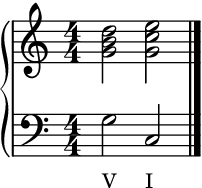
| Perfect Authentic (PAC) | V(7)–I, both root position, soprano on 1 | Strongest close — a full stop |
| Imperfect Authentic (IAC) | V–I weakened (inversion, soprano on 3/5, or vii°–I) | A softer close |
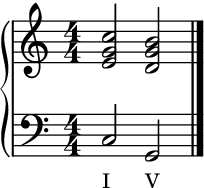
| Half Cadence (HC) | ends on V | Unfinished — a question |
| Phrygian Half Cadence | iv6–V in minor | Expressive Baroque HC |
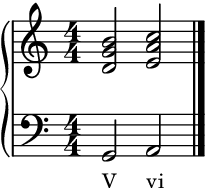
| Deceptive (DC) | V–vi (V–VI in minor) | Thwarted resolution; extends the phrase |
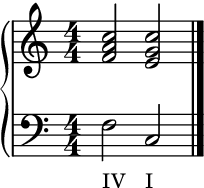
| Plagal (PC) | IV–I | The "Amen"; a post-cadential tag |
The grading of the authentic cadence (PAC vs IAC) matters because it signals how conclusive a phrase-ending is: only a PAC — root-position V–I with the tonic in the top voice — closes with full finality, which is why it is reserved for the ends of themes and movements. (Full detail and voice-leading of each cadence are in the Roman Numeral Analysis guide.)
9.2 The Cadential Six-Four
The single most important cadential embellishment is the cadential 6/4: a tonic chord in second inversion falling to V at a cadence (I6/4 – V – I). Because its fourth and sixth lean down onto the fifth and third of the dominant, it is heard not as a stable tonic but as a dominant embellishment — hence its functional label V6/4–5/3. Recognising it prevents the classic error of reading a decorative 6/4 as a structural tonic.
9.3 Phrase, Period and Sentence
Cadences assemble into phrase structures:
- A phrase is the basic unit of musical "sentence," typically ending in a cadence.
- A period pairs two phrases: an antecedent ending in a weaker cadence (usually a HC or IAC) and a consequent answering it with a stronger cadence (usually a PAC). The effect is question-and-answer.
- A sentence (in the Schoenbergian sense) begins with a short idea, repeats/varies it, then continues to a cadence — a presentation-plus-continuation shape rather than a balanced pair.
Mapping the cadences of a passage reveals its phrase rhythm and thus its form; harmony and form are inseparable at this level.
9.4 Evaded, Elided and Expanded Cadences
Composers play with cadential expectation:
- A deceptive cadence substitutes vi for the expected I, delaying closure and often launching a phrase extension.
- An evaded cadence sidesteps the expected resolution (e.g. the bass leaps away instead of falling to the tonic), forcing the phrase to "try again."
- An elided cadence overlaps the arrival tonic of one phrase with the start of the next, so the cadence and the new beginning coincide, driving the music forward without a seam.
These devices show that cadence is not merely an ending formula but a dramatic resource — the manipulation of arrival and denial is central to how tonal music generates momentum and shape.
10. Non-Chord Tones
Real harmony is decorated by notes that are not part of the underlying chord. These non-chord tones (NCTs) give melodies fluency and create the passing dissonances that make consonance meaningful. Before assigning any chord you must separate harmony from decoration.
10.1 The Catalogue
Each NCT is classified by how it is approached and how it is left:
| NCT | Approached by | Left by | Note |
|---|---|---|---|
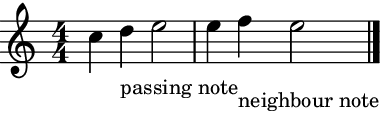
| Passing tone (P) | step | step, same direction | Fills a third between chord tones |
| Neighbour tone (N) | step | step, back | Decorates one chord tone |
| Suspension (S) | same note (held) | step down | Prepared dissonance; 4–3, 7–6, 9–8, 2–3 |
| Retardation | held | step up | Upward-resolving suspension (7–8) |
| Appoggiatura (App) | leap | step | Accented "leaning" dissonance |
| Escape tone (Esc) | step | leap, opposite | The appoggiatura's mirror |
| Anticipation (Ant) | step/leap | same note | Next chord tone sounded early |
| Pedal point (Ped) | sustained | sustained | Held note under changing chords |
The accented NCTs (falling on the beat — chiefly suspensions and appoggiaturas) create the strongest dissonance and expressive "sigh"; the unaccented ones (passing and neighbour tones, anticipations) smooth the melodic surface.
10.2 Suspensions in Detail
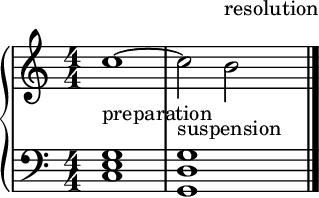
The suspension is the richest NCT and the historical root of much dissonance treatment. Its three phases are always preparation → suspension → resolution: a consonant note is prepared, held (or repeated) so that it becomes a dissonance against the new chord, then resolved down by step. Suspensions are named by the intervals above the bass — 4–3, 7–6, 9–8 (upper-voice) and 2–3 (bass suspension). A chain of suspensions ("suspension chain") propels many a Baroque sequence.
10.3 Why NCTs Matter to Harmony
Non-chord tones are not merely ornamental; they are where new chords come from. Historically, a passing or suspended dissonance that recurred often enough became absorbed as a chord tone — this is literally how the dominant seventh, the ninth chord, and eventually the whole apparatus of extended harmony entered the language: yesterday's non-chord tone is today's chord tone. In analysis, the practical rule is to test a strange note as an NCT before inventing a harmony for it: if it is a passing tone, suspension or appoggiatura, it does not change the chord. Distinguishing decoration from harmony is the difference between a mechanical reading and a musical one — and it keeps a florid surface from generating a nonsensical chord-by-chord analysis.
11. Voice Leading and Part-Writing
A correct chord progression can still sound clumsy if the individual voices move badly. Voice leading (part-writing) is the craft of connecting chords so that each voice forms a smooth, independent melodic line. It is where the vertical (chordal) and horizontal (contrapuntal) views of harmony meet, and mastering it is what separates real command of harmony from mere chord-spelling.
11.1 The Four-Voice (SATB) Model
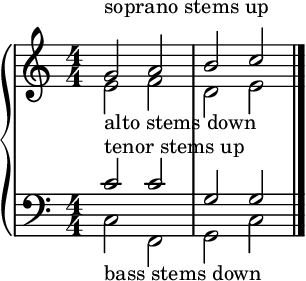
Part-writing is studied in four voices — Soprano, Alto, Tenor, Bass — because four parts are the minimum needed to state a seventh chord fully while illustrating every voice-leading principle. The vocal ranges keep the exercise realistic:
| Voice | Approx. range |
|---|---|
| Soprano | middle C → G/A above |
| Alto | G below middle C → D above |
| Tenor | C an octave below middle C → G above |
| Bass | low E/F → middle C |
The upper three voices (S, A, T) usually move within comfortable reach of one another; the bass carries the harmonic foundation and moves more freely.
11.2 The Four Types of Motion
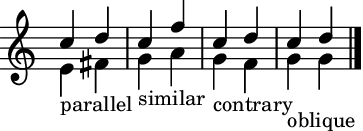
Between any two voices, motion is classified as:
| Motion | Definition |
|---|---|
| Contrary | The two voices move in opposite directions |
| Oblique | One voice holds, the other moves |
| Similar | Both move the same direction, by different intervals |
| Parallel | Both move the same direction, by the same interval |
Contrary and oblique motion preserve voice independence and are preferred; similar and parallel motion must be handled with care, because they can fuse voices together.
11.3 The Cardinal Prohibitions
Three rules protect the independence of the voices — the whole point of good part-writing:
- No parallel perfect fifths or octaves (or unisons). When two voices move in parallel perfect consonances, their purity makes them momentarily fuse into one voice, destroying independence. This is the strictest rule in tonal part-writing. (Parallel thirds and sixths are fine — even beautiful — because imperfect consonances keep their separateness.)
- Avoid direct (hidden) fifths and octaves. Reaching a perfect fifth or octave by similar motion in the outer voices is forbidden unless the upper voice moves by step. The ear "fills in" the leap and hears a lurking parallel.
- No voice crossing or overlapping (except deliberately). Voices should keep their order (S above A above T above B), and a voice should not leap past the previous note of its neighbour.
11.4 Spacing and Doubling
Spacing:
- Keep no more than an octave between soprano–alto and between alto–tenor. The tenor–bass gap may be larger.
- Avoid very low thirds (they sound muddy, per the acoustics of Chapter 1); space chords wider at the bottom, closer at the top, mirroring the overtone series.
Doubling (which note to duplicate when there are more voices than chord tones):
| Chord type | Double | Never double |
|---|---|---|
| Root-position triad | the root (usually) | the leading tone |
| First-inversion triad | root or fifth (flexible) | leading tone |
| First-inversion diminished (vii°6, ii°6) | the third (the bass note) | the diminished fifth / leading tone |
| Second-inversion (6/4) | the bass (the fifth of the chord) | — |
| Seventh chords | (all four tones present; if one is dropped, drop the fifth) | the seventh; the leading tone |
The leading tone and the chordal seventh must never be doubled, because both are tendency tones that must resolve in a fixed direction — doubling them forces parallel octaves when both copies resolve the same way.
11.5 Tendency Tones and Their Resolution
Certain tones must move a particular way, and respecting them is most of good voice-leading:
- The leading tone (scale-degree 7) resolves up to the tonic, especially in an outer voice. (In an inner voice it may occasionally fall to the fifth to complete a triad — a permitted concession.)
- The chordal seventh resolves down by step — the seventh of V7 (scale-degree 4) falls to 3.
- Chromatically altered notes resolve in the direction of their alteration — a raised note rises, a lowered note falls.
Together, the leading tone rising and the seventh falling resolve the dominant's tritone inward onto the tonic, which is the microscopic mechanism of the perfect cadence.
11.6 Connecting Chords: The Method
To join two chords smoothly:
- Keep common tones in the same voice where possible (they act as an oblique "pivot").
- Move the other upper voices to the nearest chord tone — the "law of the shortest way."
- Move the upper voices in contrary motion to the bass wherever you can, which automatically avoids most parallels.
- Resolve tendency tones as above.
Two worked resolutions illustrate the whole craft:
- V(7) → I. The leading tone rises to the tonic; the seventh falls to the third; common tones (the fifth of V = the root of... ) are held. To avoid parallels the tonic chord may end up with a tripled root and no fifth — this is normal and preferred over breaking a rule.
- V → vi (deceptive). The bass rises a step (5→6). To avoid parallel octaves/fifths, move the three upper voices contrary to the bass (down), resolve the leading tone up to the tonic, and consequently double the third of vi (the tonic degree). This is the textbook exception where you double the third rather than the root.
11.7 Melodic Quality of Each Voice
Each voice should be a good melody in its own right:
- Favour conjunct (stepwise) motion; use leaps sparingly and recover a large leap by step in the opposite direction.
- Avoid augmented intervals melodically (e.g. the augmented second between scale-degrees 6 and 7 of the harmonic minor — a classic trap; smooth it with the melodic minor).
- Give the soprano a clear shape and the bass a strong harmonic tread; keep the inner voices smooth and unobtrusive.
11.8 Harmony and Counterpoint: Two Views of One Thing
All of the above reveals that harmony and counterpoint are two views of the same music. Counterpoint is the art of combining independent melodic lines; the chords it produces are, in a sense, by-products of good lines. Harmony starts from the chords and asks how to voice them; good voice-leading is simply harmonically-informed counterpoint.
The classic training in line-combination is species counterpoint (codified by Fux), which builds fluency in stages:
| Species | Texture | Teaches |
|---|---|---|
| First | note against note | consonance and motion types |
| Second | two notes against one | the passing dissonance |
| Third | four notes against one | figuration and neighbour tones |
| Fourth | syncopated | the suspension |
| Fifth | florid (mixed) | free, melodic combination |
Whether you conceive a passage as "chords well voiced" or "lines well combined," the constraints are the same — smooth motion, controlled dissonance, independent voices — and the greatest tonal music satisfies both views at once. Keeping the contrapuntal ear alive while thinking harmonically (and vice versa) is the mark of a complete musician.
12. Secondary Dominants and Tonicisation
Diatonic harmony uses only the notes of the key. Chromatic harmony introduces notes from outside it, and the first and most fundamental chromatic technique is the secondary dominant.
12.1 Tonicisation
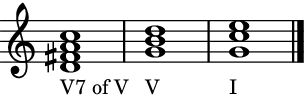
Any major or minor chord in a key can be made to sound, briefly, like a temporary tonic by preceding it with its own dominant. This is tonicisation — lending a chord the spotlight without truly changing key. The borrowed dominant is a secondary (applied) dominant, written with a slash: V/V ("five of five"), V7/ii, V/vi, and so on.
In C major, the dominant of the dominant (of G) is D major (D–F♯–A). The chromatic F♯ — the temporary leading tone of G — is the audible signal of tonicisation. The applied chord resolves down a fifth to its target, which then continues to function normally in the home key.
12.2 The Secondary Chords
Two families supply applied function:
- Secondary dominants — a major triad or dominant seventh built a perfect fifth above the target:
V/ii, V/iii, V/IV, V/V, V/vi(and their sevenths). There is no V/vii°, since the diminished leading-tone triad cannot be a stable tonic. - Secondary leading-tone chords — a diminished (or diminished/half-diminished seventh) built on the leading tone of the target:
vii°/V, vii°7/V, viiø7/V. These resolve up by semitone into the target and are prized for their smooth chromatic voice-leading.
12.3 Recognising and Using Applied Chords
The tell-tales of a secondary function: a chromatic accidental that behaves like a leading tone (rising by semitone) into the root of the following chord, and a chord quality (major/dominant/diminished-seventh) just before a chord that is not the tonic. Ask "dominant of what?" — the answer names the target, and you label the chord V/target. Applied chords can chain around the circle of fifths (V7/vi – vi – V7/ii – … – V7 – I), a favourite device of development sections and jazz turnarounds. (Exhaustive tables and resolutions are in the Roman Numeral Analysis guide.)
Because the tonicisation is brief and not confirmed by a cadence, you remain in the home key throughout. When a new tonic is confirmed by its own cadence, tonicisation has become modulation.
13. Modulation
Modulation is a genuine change of key, established and confirmed by a cadence in the new key — as opposed to the passing spotlight of tonicisation. Tracking modulation is essential to analysing anything longer than a phrase, and the large-scale plan of keys is the backbone of tonal form.
13.1 Where Music Modulates
Music most often moves to a closely-related key — one differing by no more than one sharp or flat. From C major these are G (V), F (IV), A minor (vi), E minor (iii) and D minor (ii). The overwhelmingly common destinations are the dominant (from a major key) and the relative major (from a minor key); larger works then venture to more remote keys before returning home.
13.2 Techniques of Modulation
| Technique | How it works |
|---|---|
| Pivot-chord (common-chord) | A chord diatonic to both keys is reinterpreted — heard first in the old key, then in the new. The smoothest method. |
| Direct / phrase modulation | The new key simply begins, often at a new phrase, with no preparation. |
| Chromatic modulation | A chromatically altered chord (often an applied dominant) links the keys. |
| Common-tone modulation | A single sustained note is reinterpreted into the new key. |
| Enharmonic modulation | A chord is respelled to swing to a remote key — classically the °7 (which can resolve four ways) or the German sixth ≈ dominant seventh equivalence. |
| Sequential modulation | A sequence carries the music to a new key by pattern. |
13.3 The Pivot Chord
The pivot is the hinge of common-chord modulation: locate the last chord that still makes diatonic sense in the old key which is also diatonic in the new key; the chord after it usually introduces the first accidental of the new key. In analysis the pivot is shown with both interpretations stacked (old key's numeral above, new key's below). For example, modulating C → G, an A-minor chord serves as vi in C and ii in G; the analysis "hands over" there, and the arrival of F♯ plus a PAC in G confirms the new key. (The Roman Numeral Analysis guide details the notation.)
13.4 Tonicisation vs Modulation — the Judgement
The boundary is genuinely fuzzy, and analysts sometimes disagree. Guidelines:
- A brief accidental resolving locally, with no cadence in the new key → tonicisation (stay in the old key).
- A new key confirmed by its own cadence and sustained for a phrase or more → modulation.
- The longer and more cadentially confirmed the new tonic, the more it merits being called a modulation.
At the largest scale, recognising the tonal plan — how a movement departs from and returns to its tonic (e.g. I → V → … → I, or a sonata's tonic–dominant polarity and resolution) — is the ultimate goal of harmonic analysis, for it reveals the architecture that individual chords serve.
14. Modal Mixture, the Neapolitan and Augmented Sixths
Beyond applied chords, the common-practice palette holds a set of chromatic colour chords, each with a standard label and resolution. (The Roman Numeral Analysis guide drills them; here they are placed in the harmonic landscape.)
14.1 Modal Mixture (Borrowed Chords)
Modal mixture imports chords from the parallel key — most often a major key borrowing from its parallel minor, using the lowered 3rd, 6th and 7th degrees. The staples (in C major):
| Borrowed chord | Notes | Effect |
|---|---|---|
| iv (minor subdominant) | F–A♭–C | The classic darkening, superb before I or V |
| iiø7 / ii° | D–F–A♭ | A poignant pre-dominant |
| ♭VI | A♭–C–E♭ | Rich; common in deceptive motion |
| ♭III | E♭–G–B♭ | Lowered mediant colour |
| ♭VII | B♭–D–F | Lowered subtonic |
The reverse borrowing gives the Picardy third — a minor-key piece ending on a major tonic (I for i). Mixture does not change the key; it recolours chords within it, and its expressive power comes from the sudden shadow (or light) of the parallel mode.
14.2 The Neapolitan Sixth (♭II6)
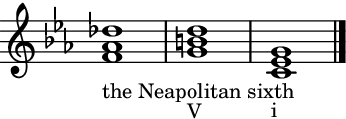
The Neapolitan is a major triad on the lowered second degree (♭2), almost always in first inversion — hence "sixth." In C: D♭–F–A♭ with F in the bass. It is a chromatic pre-dominant (an intensified subdominant), moving to V, often through a cadential 6/4: N6 – V – I or N6 – I6/4 – V – I. Its flavour of the lowered 2nd is most poignant in minor keys.
14.3 Augmented Sixth Chords
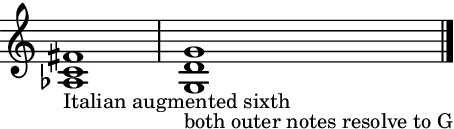
The augmented sixths are the most vivid pre-dominants of all, built around the interval of an augmented sixth between the lowered 6th degree (♭6, in the bass) and the raised 4th (♯4) — an interval that expands outward by semitone to the octave on the dominant. Three types differ by their inner note(s); in C:
| Type | Notes | Distinctive tone |
|---|---|---|
| Italian (It+6) | A♭–C–F♯ | tonic only (doubled) |
| French (Fr+6) | A♭–C–D–F♯ | scale-degree 2 (D) |
| German (Ger+6) | A♭–C–E♭–F♯ | scale-degree ♭3 (E♭) |
All resolve to V. The German sixth sounds enharmonically like a dominant seventh (A♭–C–E♭–F♯ ≈ A♭7), so it usually resolves to V through a cadential 6/4 to avoid parallel fifths — a fact that also makes it a superb enharmonic pivot (Chapter 15).
15. Advanced Chromaticism and the Stretching of Tonality
The techniques of Chapters 12–14 remain functional — chromatic chords still serve tonic, pre-dominant and dominant roles. Nineteenth-century composers pushed chromaticism until function itself began to dissolve. This chapter surveys those advanced resources and the road they opened toward atonality.
15.1 Enharmonic Reinterpretation
Two symmetrical/ambiguous chords are the great enharmonic pivots, able to swing the music to remote keys:
- The fully-diminished seventh (°7). Being a stack of equal minor thirds, it is symmetrical: any of its four notes can be heard as the leading tone, so a single °7 can resolve into four different keys (a major/minor pair from each). Respelling it is the classic route to a distant key.
- The German sixth ≈ dominant seventh. Because Ger+6 and a dominant seventh are enharmonically identical (A♭–C–E♭–F♯ = A♭–C–E♭–G♭), a chord introduced as an augmented sixth in one key can resolve as a dominant seventh in another (and vice-versa), pivoting between keys a tritone or semitone apart.
These reinterpretations exploit the fact that equal temperament makes enharmonic notes identical in pitch (Chapter 1) — the tuning compromise becomes a compositional resource.
15.2 Chromatic Mediants
A chromatic mediant relationship links two triads of the same quality (both major, or both minor) whose roots lie a third apart and which share only one common tone, with chromatic clashes on the others. In C major these include a sudden E major, A♭ major, E♭ major or A major chord. Because they share a tone but contradict the key, chromatic mediants sound at once connected and startling — the shimmering "third relations" of Schubert, the mythic gleam of Wagner and Bruckner, and the harmonic language of film music. They typically function colouristically rather than by classical syntax, prolonging or decorating a harmony by luminous side-step rather than by fifth-motion. (A doubly-chromatic mediant, sharing no common tone, is even more remote.)
15.3 Common-Tone Chords and the Omnibus
- Common-tone diminished seventh (CT°7) and common-tone augmented sixth are chromatic chords that hold a common tone with the chord they embellish (often I or V), the other voices moving outward by semitone and back. They are embellishing, not functional.
- The omnibus progression is a famous chromatic sequence in which the outer voices spread apart chromatically (a bass descending by semitone against a rising upper line), harmonised by a chain of dominant sevenths and augmented sixths. It can prolong a single dominant across a remarkable stretch of chromatic motion, and it showcases voice-leading, not function, as the organising force.
15.4 Chromatic Sequences
Sequences need not be diatonic. The chromatic circle-of-fifths sequence sends roots down by fifth while each chord is a secondary dominant of the next; the descending chromatic bass (a "lament bass") harmonises a semitone-by-semitone descent with shifting chords. In such passages the pattern and the voice-leading carry the music; the individual chords may be non-functional links in a chromatic chain.
15.5 Extended Tonality and the Dissolution of Function
By the later nineteenth century, chromaticism had grown so pervasive that the tonic could be implied but continually withheld, dominant function prolonged without resolving, and chords valued for colour and voice-leading over syntactic role. This is extended (or "chromatic") tonality: still tonal in aspiration, but with the functional pull stretched to breaking point.
Its emblem is the Tristan chord — the opening sonority of Wagner's Tristan und Isolde (F–B–D♯–G♯). Enharmonically a half-diminished seventh (or a French-sixth-like altered chord), it resolves not to a stable harmony but to a dominant seventh whose own resolution is evaded, launching a chain of longing that never quite lands. Its very analytical ambiguity — is it an augmented sixth? an appoggiatura chord? a half-diminished seventh? — is the point: it is a chord poised between functions, and generations of theorists have debated it precisely because tonal function no longer gives a single answer.
From here the path is short. When chords no longer need to resolve, when every note may be chromatically inflected, when the tonic is a memory rather than a presence, tonality has been stretched until it dissolves — and the twentieth century's search for new harmonic systems (Part V) becomes inevitable.
16. Modal Harmony
Tonal harmony is built on just two scales — major and minor. Modal harmony draws on the seven diatonic modes, an older and broader palette that Renaissance composers used, that Debussy and jazz revived, and that pervades folk and rock. Its logic is different from functional tonality: there is a tonal centre but no dominant-driven cadence.
16.1 The Seven Diatonic Modes
Each mode is a rotation of the major scale, beginning on a different degree. Playing only the white notes but treating a different note as "home" gives:
| Mode | Built on (white-note) | Quality | Characteristic tone(s) |
|---|---|---|---|
| Ionian | C | major | (= the major scale) |
| Dorian | D | minor | ♮6 (a raised 6th vs natural minor) |
| Phrygian | E | minor | ♭2 (a lowered 2nd) |
| Lydian | F | major | ♯4 (a raised 4th) |
| Mixolydian | G | major | ♭7 (a lowered 7th) |
| Aeolian | A | minor | (= the natural minor scale) |
| Locrian | B | diminished | ♭2 and ♭5 (rarely a stable centre) |
Ordered from brightest to darkest, each mode lowers one more degree: Lydian → Ionian → Mixolydian → Dorian → Aeolian → Phrygian → Locrian. The characteristic tone is the note that distinguishes a mode from the plain major or minor scale — and harmonising that note is the secret to sounding genuinely modal.
16.2 Why Modal Harmony Is Different
Functional tonality is powered by the leading-tone → tonic semitone and the dominant's tritone resolving to the tonic. Most modes lack a leading tone (Mixolydian, Dorian, Aeolian and Phrygian all have a ♭7, a whole tone below the tonic), so they have no dominant pull. Worse, if you naïvely use the "diatonic" chords of a mode, the ear tends to re-hear the music in the relative major/minor (D Dorian collapses into C major).
Modal harmony therefore works by assertion, not resolution: it establishes the centre by pedals, drones and repetition (vamps), and by foregrounding the characteristic tone and the chords that contain it, while avoiding the V–i cadence that would betray the mode.
16.3 Characteristic Chords and Modal Cadences
Each mode has signature chords — those built on or containing its characteristic tone — and its own cadential gestures:
| Mode | Signature chord(s) | Typical modal cadence |
|---|---|---|
| Dorian (minor) | IV major (holds the ♮6), ♭VII, ii | i – IV vamp; ♭VII – i |
| Phrygian (minor) | ♭II major (holds the ♭2), ♭vii | ♭II – i (the flamenco cadence) |
| Lydian (major) | II major (holds the ♯4), vii | II – I; float on I with ♯4 |
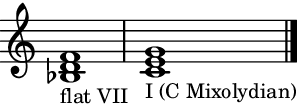
| Mixolydian (major) | ♭VII major (holds the ♭7), v minor | ♭VII – I (the rock/folk cadence) |
| Aeolian (minor) | ♭VI, ♭VII | ♭VI – ♭VII – i; ♭VII – i |
The recurring device is the subtonic ♭VII replacing the dominant: ♭VII–I in Mixolydian and ♭VII–i in Dorian/Aeolian are the modal world's answer to V–I. The Phrygian ♭II–i and the Lydian ♯4 are the most instantly recognisable modal colours.
16.4 Modality in History and Practice
- Renaissance modality (Palestrina, Lassus) is the original home of the modes, governed by rules of counterpoint rather than chord function; cadences were formed by clausulae (stepwise voice-leading formulas), and "musica ficta" added leading tones at cadence points, quietly pulling the modes toward major/minor.
- The common-practice era absorbed the modes into just two (Ionian → major, Aeolian → minor), and modality receded for two centuries.
- The modal revival — Debussy and Ravel (modal scales for colour), Vaughan Williams and folk-song collectors, and above all modal jazz (Chapter 17) and modal rock (Chapter 18) — restored the modes as a living resource. Miles Davis's Kind of Blue built entire pieces on one or two modes held for many bars, trading functional progression for static modal colour.
Modal harmony proves that the dominant-tonic engine of common-practice tonality is one option, not a necessity — a theme that the rest of Part V develops.
17. Jazz Harmony
Jazz took the chromatic harmony of late-Romantic music, added the blues, and built a performer's harmonic system in which chords are dense by default, every dominant can be substituted, and each chord implies a scale for improvisation. This chapter surveys its core.
17.1 Extensions as the Default
Where classical harmony treats the triad as basic and the seventh as a dissonance, jazz treats the seventh chord as the minimum and freely adds 9ths, 11ths and 13ths as consonant colour. A "C" in a jazz chart is usually voiced as C6, Cmaj7 or C6/9; a dominant is C9 or C13, not a bare triad. The 3rd and 7th ("guide tones") define a chord's quality and voice-lead by half-step from chord to chord; the root is often left to the bass, and the 5th is expendable.
17.2 Chord-Scale Theory
Jazz pairs each chord with a scale (mode) that supplies its available notes for melody and voicing — the improviser's map. Over a major-key ii–V–I:
| Chord | Scale/mode | Notes (in C) |
|---|---|---|
| IMaj7 | Ionian (or Lydian for a ♯11 colour) | C D E F G A B |
| ii7 | Dorian | D E F G A B C |
| iii7 | Phrygian | E F G A B C D |
| IVMaj7 | Lydian | F G A B C D E |
| V7 | Mixolydian | G A B C D E F |
| vi7 | Aeolian | A B C D E F G |
| viiø7 | Locrian | B C D E F G A |
| V7alt | Altered scale (7th mode of melodic minor) | supplies ♭9 ♯9 ♯11 ♭13 |
| V7♭9 (to minor) | Half-whole diminished, or Phrygian-dominant |
Chord-scale theory turns harmony into a melodic resource: to "play the changes" is to move through the sequence of scales the chords imply.
17.3 The ii–V–I and Its Transformations
The ii7–V7–IMaj7 progression is the fundamental cadential unit of jazz — a pre-dominant, dominant and tonic with the strongest possible root motion (descending fifths) and smooth guide-tone voice-leading. Nearly all standard-tune harmony is a string of ii–V–I's in various keys. Its key transformations:
- Tritone substitution (subV7). Replace a dominant with the dominant seventh a tritone away — it shares the same tritone (the two chords' 3rds and 7ths are swapped), so it resolves just as strongly but gives a chromatic bass descent. In C,
Dm7 – D♭7 – Cmaj7substitutes D♭7 for G7 (both contain the tritone B/F). - Backdoor ii–V. Borrowing from the parallel minor,
iv7 – ♭VII7 – I(in C,Fm7 – B♭7 – Cmaj7) approaches the tonic "through the back door." - Turnarounds. A short progression that cycles back to the top of a form, e.g.
I – vi – ii – V, often energised with secondary dominants:I – VI7 – II7 – V7(every chord a dominant). - Coltrane changes. Root motion by major thirds dividing the octave into three, each approached by its own ii–V (as in Giant Steps) — a symmetrical reharmonisation that sidesteps the ordinary circle of fifths.
17.4 Voicings
How a jazz chord is spaced is as important as which chord it is:
| Voicing | Notes used | Character |
|---|---|---|
| Shell | root, 3rd, 7th | Lean; the essential guide tones |
| Rootless (Bill Evans) | 3–5–7–9 or 7–9–3–5 | Full colour, bass covers the root |
| Quartal | stacked fourths | Open, modern, ambiguous — the "So What" chord |
| Upper-structure triad | a triad over a dominant shell | Supplies alterations (e.g. a D triad over C7 = 9, ♯11, 13) |
| Drop-2 | close voicing with the 2nd-from-top dropped an octave | The workhorse of guitar and big-band writing |
Guide-tone voice-leading ties it together: across a ii–V–I the 3rds and 7ths of each chord move to the nearest tone of the next (the 7th of ii becomes the 3rd of V, and so on), producing the smooth inner lines that make jazz changes flow.
17.5 Reharmonisation
Jazz musicians routinely replace the given chords with richer or fresher ones while preserving the melody. The standard techniques:
- Diatonic substitution — swap a chord for another of the same function (iii or vi for I; ii for IV).
- Add a ii before any V — turn every dominant into a ii–V.
- Secondary dominants and tritone subs — chromaticise the approach to any chord.
- Modal interchange — borrow chords from the parallel minor/modes (iv, ♭VI, ♭VII).
- Chromatic approach and passing chords — slot diminished or dominant chords a half-step away.
Reharmonisation is functional harmony used creatively in reverse: knowing what each chord does lets you find another chord that does the same job with more colour.
17.6 Modal Jazz and the Blues
Two currents complete the picture:
- Modal jazz (Miles Davis, Herbie Hancock) reacts against dense ii–V harmony by holding a single mode for many bars (Chapter 16), voiced in quartal stacks, so improvisation floats on colour rather than chasing changes.
- The jazz blues overlays the 12-bar blues (Chapter 18) with jazz's apparatus — adding ii–V's, tritone subs and passing diminished chords — so that a form born of the simplest dominant harmony becomes a vehicle for the most sophisticated. From Ellington to Parker to Coltrane, the blues remained jazz's harmonic heart even as its chords grew ever richer.
18. The Blues and Popular-Music Harmony
Popular music — blues, rock, soul, pop — runs on harmony that is tonal but not classically functional. Its cadences are often plagal or modal, its dominants may never resolve, and its chords frequently loop rather than progress. Understanding it means loosening the common-practice rulebook.
18.1 The Twelve-Bar Blues
The 12-bar blues is the most influential harmonic form of the last century. Its basic scheme uses only the three primary chords, in a fixed 12-bar pattern:
| Bars 1–4 | I – I – I – I |
|---|---|
| Bars 5–8 | IV – IV – I – I |
| Bars 9–12 | V – IV – I – (V) |
Its defining harmonic peculiarity: all three chords are usually dominant sevenths — I7, IV7 and V7. In classical terms this is impossible (the tonic is a consonance, not a dominant seventh), and it is precisely this non-functional use of dominant-quality tonics that gives the blues its idiom. Common variants add a "quick change" to IV in bar 2 and a turnaround (V, or ii–V) in bar 12.
18.2 Blues Tonality and the Blue Notes
The blues does not sit in major or minor but in a blues tonality that superimposes them. Melodies draw on the blues scale — the minor pentatonic plus a ♭5: 1 – ♭3 – 4 – ♭5 – 5 – ♭7 — sung over major-quality (dominant) harmony. The friction of a minor third and ♭7 in the tune against a major third in the chord produces the "blue notes": bent, expressive pitches that live in the cracks between major and minor. This major/minor ambiguity is the harmonic soul of the blues and the source of much of what followed in jazz, R&B and rock.
18.3 Pop and Rock Progressions
A handful of diatonic loops underlie an enormous amount of popular music:
| Progression | Nickname / use |
|---|---|
| I – V – vi – IV | The "four-chord song" (the Axis progression) and its rotations (vi–IV–I–V, etc.) |
| I – vi – IV – V | The 1950s "doo-wop" progression |
| I – IV – V | Three-chord rock and folk |
| 12-bar blues | Blues, rockabilly, early rock 'n' roll |
| vi – IV – V / i – ♭VI – ♭VII | Minor-key anthems |
The crucial difference from classical harmony is that these are frequently loops — repeating cycles with no cadential hierarchy, where harmony functions as a groove and colour rather than a goal-directed syntax. There is often no structural dominant and no leading-tone resolution at all.
18.4 Modal Rock and the ♭VII Chord
Much rock is modal rather than major/minor (Chapter 16). The flag is the ♭VII major chord — a subtonic borrowed from Mixolydian or Aeolian — used where classical harmony would put V:
- Mixolydian rock:
I – ♭VII – IV(major tonic, flat-seventh chord) — the sound of countless rock anthems. - Dorian rock: a minor i with a major IV (the raised 6th of Dorian).
- Aeolian rock:
i – ♭VI – ♭VIIand♭VII – i— the natural-minor cadence without a leading tone.
The ♭VII–I and IV–I (plagal) cadences largely replace the classical V–I, because the modal and pentatonic materials of rock have no leading tone to drive an authentic cadence.
18.5 Power Chords
Rock's signature sonority, the power chord, is a bare root-and-fifth (often with the octave), omitting the third. Two reasons, both acoustic: with distortion, added overtones make a full triad sound muddy and dissonant (thirds generate rough intermodulation products), whereas the pure fifth stays clean and powerful; and omitting the third leaves the chord modally neutral — neither major nor minor — which suits rock's modal/pentatonic language. The power chord is harmony stripped to the most consonant interval above the octave, chosen for how it behaves through an amplifier.
18.6 Chromatic Colour in Pop
Popular harmony is not only diatonic loops. Borrowed chords (the minor iv in a major key — the "Beatles" cadence; ♭VI and ♭III), secondary dominants (a II7 pushing to V), and chromatic bass lines (descending "line-cliché" tonic prolongations, as in Stairway to Heaven) are common. But even these are typically deployed for colour and voice-leading rather than to build the long-range tonal architecture of classical form. Popular harmony thus confirms Part V's theme once more: the dominant–tonic engine is one dialect of tonal harmony, not its whole grammar.
19. Twentieth-Century and Post-Tonal Harmony
When the chromatic saturation of late Romanticism dissolved functional tonality (Chapter 15), composers invented new ways to organise pitch. This chapter surveys the principal twentieth-century harmonic languages and the analytical tools built to understand them.
19.1 Impressionism: Harmony as Colour
Debussy and Ravel loosened function without abandoning triads, treating chords as colours rather than syntactic agents:
- Non-functional extended chords — 7ths, 9ths and 11ths used as stable sonorities, not dissonances needing resolution.
- Parallelism ("planing") — moving a chord shape in parallel up or down (parallel 9th chords, parallel triads), flatly forbidden in classical voice-leading, now embraced for its sheen.
- The whole-tone scale (six notes, all whole steps: C D E F♯ G♯ A♯) — having no semitone and no perfect fifth, it is rootless and weightless; every triad built on it is augmented.
- The pentatonic scale and modal materials — gapped, consonant, non-directional.
The result is harmony that shimmers and floats, organised by timbre, register and colour rather than by tension and resolution.
19.2 New Ways to Stack Chords
- Quartal and quintal harmony — chords built in fourths or fifths instead of thirds (Chapter 2). Open and modern, they lack the third that colours a chord major or minor. Scriabin's "mystic chord" (C–F♯–B♭–E–A–D) is a famous quartal sonority; jazz's quartal voicings (Chapter 17) are the same idea.
- Polychords and polytonality — two triads or two keys sounded at once. Stravinsky's Petrushka chord superimposes C major and F♯ major triads (a tritone apart); polytonality stacks whole keys.
- Tone clusters — chords built in seconds, dense bands of adjacent notes (Cowell, Ives).
- Pandiatonicism — using the diatonic notes freely, with no functional syntax and no need to resolve, so that a familiar C-major collection sounds fresh and non-directional (Stravinsky's neoclassicism, Copland).
19.3 Symmetrical and Synthetic Scales
Composers exploited scales that divide the octave evenly, which are transpositionally symmetrical (they map onto themselves) and so undermine any single tonic:
| Scale | Construction | Property |
|---|---|---|
| Whole-tone | all whole steps (6 notes) | only augmented triads; no leading tone |
| Octatonic (diminished) | alternating half/whole steps (8 notes) | rich in tritones, dim. and dom.7 chords |
| Hexatonic (augmented) | alternating half-step/minor-3rd (6 notes) | augmented triads and major/minor triads a M3 apart |
| Acoustic (Lydian-♭7) | mirrors the overtone series | "natural" dominant colour |
These scales are central to Debussy, Bartók, Messiaen (his "modes of limited transposition"), Stravinsky and much film and video-game music.
19.4 Pitch-Class Set Theory
For atonal music — where no scale or tonic governs — analysts use pitch-class set theory, a systematic way to describe and compare any collection of notes. Its apparatus:
- Pitch classes — the twelve notes, numbered 0–11 (C = 0, C♯ = 1, … B = 11), with octave and enharmonic equivalence (a C and a B♯ in any octave are all pc 0).
- Interval class (ic) — the shortest distance between two pcs, 1 to 6 (since intervals larger than 6 are counted by their inversion). There are only six interval classes.
- Pitch-class set — an unordered collection of pcs, e.g. {0, 4, 7} (a C major triad).
- Normal form — the most compact ordering of the set (smallest span, packed to the left).
- Prime form — the normal form transposed to begin on 0 and compared with its inversion, choosing the most left-packed; written like (0 3 7). All sets related by transposition or inversion share one prime form and belong to one set class (often labelled by a Forte number, e.g. 3-11).
- Interval-class vector — a six-digit tally of how many of each interval class a set contains, e.g. the major/minor triad (0 3 7) has the vector ⟨0 0 1 1 1 0⟩.
A few landmark set classes: the major/minor triad is 3-11 (0 3 7); the diminished triad 3-10 (0 3 6); the augmented triad 3-12 (0 4 8); the whole-tone scale 6-35; the octatonic scale 8-28. Set theory lets us say precisely how two atonal chords are related even when no key exists to name them.
19.5 Twelve-Tone (Serial) Harmony
Schoenberg's twelve-tone method organises music around a tone row — a fixed ordering of all twelve pitch classes, in which no note repeats until all have sounded, so no pitch is privileged as a tonic. The row generates the whole piece through four operations, each available at twelve transpositions (48 forms in all):
| Form | Operation |
|---|---|
| Prime (P) | the row as stated |
| Inversion (I) | intervals turned upside-down |
| Retrograde (R) | the row backwards |
| Retrograde-Inversion (RI) | backwards and upside-down |
A 12×12 matrix conveniently displays all forms. Harmony in serial music is derived from the row — vertical chords are formed from row segments — so that melody and harmony spring from the same source. Webern pursued this with crystalline concision, Berg with lingering tonal echoes.
19.6 Neo-Riemannian Theory
For the chromatic but still triadic music where function has evaporated (Wagner, Liszt, and the chromatic mediants of Chapter 15, as well as much film music), neo-Riemannian theory analyses motion between major and minor triads by parsimonious voice-leading — transformations that keep two common tones and move one voice by a step:
| Transformation | Effect | Example |
|---|---|---|
| P (Parallel) | major ↔ parallel minor | C major ↔ C minor |
| L (Leading-tone exchange) | major ↔ minor a 3rd above | C major ↔ E minor |
| R (Relative) | major ↔ relative minor | C major ↔ A minor |
Chaining P, L and R navigates remote triadic relationships without any key, and the Tonnetz (a lattice of thirds and fifths) maps the journeys geometrically. Neo-Riemannian theory gives a functional-free grammar for exactly the chromatic-mediant harmony that classical Roman numerals struggle to explain.
19.7 The Wider Twentieth Century and Beyond
The harmonic imagination kept expanding: microtonality (dividing the octave into more than twelve parts — quarter tones, just-intonation revivals); spectralism (Grisey, Murail), which builds harmony directly from the overtone spectrum analysed by computer, closing the circle back to Chapter 1; minimalism (Reich, Glass), with its static, slowly-shifting diatonic harmony; cluster and texture music (Ligeti, Penderecki), where dense masses replace chords; and the free harmonic collage of much recent concert, film and popular art music.
What unites this variety is the recognition that harmony is a designed system, not a natural law. Common-practice tonality was one supremely successful design — grounded in the overtone series, powered by the dominant–tonic engine — but the twentieth century proved that pitch can be organised by symmetry, by set-relations, by rows, by spectra, by colour or by process, and that each choice makes a different music possible.
20. Analytical Methods
Different repertoires need different analytical tools. This chapter surveys the major methods for analysing harmony, what each reveals, and where each applies. A complete analyst chooses the tool to fit the music.
20.1 Roman Numeral (Functional) Analysis
The default method for common-practice tonal music. Each chord is labelled by the scale degree of its root, its quality and its inversion (I, ii6, V7, viiø7, V/V, N6…), revealing the function (T, PD, D) and the syntax of the progression. Its strengths are clarity and universality; its limits appear where function breaks down — dense chromaticism, non-functional colour chords, modal and post-tonal music — for which other tools serve better. (The Roman Numeral Analysis companion guide covers this method exhaustively.)
20.2 Figured-Bass and Thoroughbass Analysis
Analysing from the bass up, using figured-bass numbers to track intervals and voice-leading rather than roots and functions. It is the natural lens for Baroque continuo music and, more broadly, for foregrounding linear/contrapuntal motion — how the voices move — which the chord-labelling of Roman numerals can obscure.
20.3 Functional Theory (Riemann and the T/S/D Model)
The German tradition following Hugo Riemann labels chords by function symbols — T (tonic), S (subdominant) and D (dominant), with modifiers for substitutes and applied functions. It emphasises the three functional poles over precise scale-degree spelling, and is illuminating for showing how varied chords perform the same three roles. Many modern "function-based" pedagogies descend from it.
20.4 Schenkerian Analysis
Heinrich Schenker's method is the most ambitious theory of tonal coherence. Its central claim: a tonal masterwork is the elaborate "composing-out" (prolongation) of a simple background structure, the Ursatz (fundamental structure), which consists of:
- a fundamental line (Urlinie) — a stepwise descent in an upper voice, 3̂–2̂–1̂ (or from 5̂ or 8̂) to the tonic; over
- a bass arpeggiation (Bassbrechung) — the bass motion I–V–I.
Analysis proceeds through three levels:
| Level | German | What it shows |
|---|---|---|
| Background | Hintergrund | the bare Ursatz (the piece's structural skeleton) |
| Middleground | Mittelgrund | intermediate prolongations and linear progressions |
| Foreground | Vordergrund | the actual notes, reduced by layered graphs |
Using specialised graphic notation (slurs, beams, stemmed and unstemmed notes), the analyst strips away decoration to reveal how surface chords prolong a few structural harmonies. Schenkerian analysis is unmatched at showing hierarchy and long-range coherence — which chords are structural and which merely embellish (recall prolongation, Chapter 8) — though it applies chiefly to common-practice tonal music and downplays rhythm, timbre and form.
20.5 Jazz and Chord-Scale Analysis
For jazz and popular music, analysis pairs chord symbols with the scales/modes they imply (Chapter 17), tracks guide-tone lines (3rds and 7ths), and identifies ii–V–I units, substitutions and reharmonisations. Roman numerals are still used (often loosely) to show key-relative function, but the emphasis shifts to chord-scale relationships and voicing — the improviser's and arranger's concerns.
20.6 Neo-Riemannian and Transformational Analysis
For chromatic triadic music where keys and functions dissolve (late Wagner, Liszt, film music), neo-Riemannian theory describes motion between triads by parsimonious transformations (P, L, R; Chapter 19) mapped on the Tonnetz. More generally, transformational theory (David Lewin) analyses music by the operations that connect its objects rather than the objects themselves — a powerful lens for symmetrical and chromatic harmony.
20.7 Pitch-Class Set Analysis
For atonal music, set theory (Chapter 19) describes chords as pitch-class sets, comparing them by normal form, prime form, set class and interval-class vector. It reveals the relationships among sonorities in music that has neither key nor triads, and underpins the analysis of Schoenberg, Webern, Bartók and their successors.
20.8 Choosing the Right Tool
| Repertoire | Primary method(s) |
|---|---|
| Baroque continuo | figured bass; Roman numerals |
| Classical / Romantic tonal | Roman numerals; functional; Schenkerian |
| Late-Romantic chromatic | neo-Riemannian; extended Roman numerals |
| Modal (early & modern) | modal analysis; characteristic tones |
| Jazz / popular | chord-scale; chord symbols; loose Roman numerals |
| Atonal / serial | pitch-class set theory; row analysis |
The methods are complementary, not rival: a Romantic piece may reward a Roman-numeral reading of its progressions, a Schenkerian view of its structure, and a neo-Riemannian account of its chromatic turns. Fluency in several — and judgement about which fits the passage in hand — is the mark of a mature harmonic analyst.
21. A Brief History of Harmony
Harmony was not handed down complete; it grew over a thousand years, each era expanding what combinations were possible and what they meant. This short history threads the innovations together.
21.1 From Monophony to Polyphony
Western music began as monophony — a single line, as in Gregorian chant — with no harmony at all, though the ancient Greeks had already discovered (via Pythagoras) that consonant intervals correspond to simple ratios (Chapter 1). Harmony proper begins around the 9th century with organum: a chant doubled by a second voice. Early parallel organum moved the voices in lockstep perfect fourths, fifths and octaves — the only intervals then considered consonant. Over the next centuries the added voice grew more independent (oblique and free organum), and by the 12th–13th centuries the Notre Dame school (Léonin, Pérotin) produced florid, rhythmically organised polyphony in two to four voices. Thirds were still classed as mild dissonances.
21.2 The Rise of the Third: Ars Nova and the Renaissance
The 14th-century Ars Nova (Machaut) brought greater rhythmic and harmonic independence, and the third and sixth began their rise toward consonance — encouraged by the sweeter English style (Dunstaple's "contenance angloise"). By the Renaissance (15th–16th centuries), triadic sonority ruled: thirds and sixths were fully consonant, and composers (Josquin, Palestrina, Lassus) wrote rich modal counterpoint governed by careful dissonance treatment — prepared suspensions, passing tones — and cadences formed by stepwise clausulae. Toward 1600, intense chromaticism (Gesualdo) strained the modal system to its limits.
21.3 The Birth of Tonality: the Baroque
Around 1600 the decisive shift occurred: the many modes collapsed into just two, major and minor, and functional tonality was born. The basso continuo (thoroughbass) made the bass-plus-figures the practical foundation of harmony, and Jean-Philippe Rameau's Treatise on Harmony (1722) supplied the theory — the idea of the chord root and the fundamental bass, explaining chords and their inversions as one entity. The dominant–tonic axis, the leading tone, and cadential syntax became the grammar of music; the spread of well/equal temperament (celebrated in Bach's Well-Tempered Clavier) made all keys and free modulation possible.
21.4 Clarity and Drama: the Classical Era
The Classical period (1750–1820) distilled tonal harmony to clarity: primary triads, slower harmonic rhythm, transparent cadences and balanced phrase structure. Harmony now articulated large-scale form — the tonic–dominant polarity of sonata form is a drama of keys, departing to the dominant and resolving home. Haydn, Mozart and early Beethoven made functional harmony a vehicle of wit, proportion and narrative.
21.5 Colour and Chromaticism: the Romantic Era
The Romantic 19th century enriched the palette relentlessly: modal mixture, Neapolitan and augmented-sixth chords, enharmonic modulation and chromatic mediants moved from rare effects to everyday vocabulary, and the harmonic rhythm of keys grew adventurous. Chromaticism intensified until function itself weakened — the emblem is Wagner's Tristan chord (1859) and its endlessly deferred resolution (Chapter 15). Simultaneously, nationalist composers reintroduced modal and folk materials, loosening major/minor from another direction.
21.6 Dissolution and Pluralism: the Twentieth Century
By 1900, Debussy's Impressionism treated harmony as colour — whole-tone and modal scales, parallel planing, unresolved extended chords. From there tonality fractured into a plurality of systems (Chapter 19): atonality and twelve-tone serialism (Schoenberg, Webern, Berg); neoclassical pandiatonicism and polytonality (Stravinsky); synthetic-scale harmony (Bartók, Messiaen); and, from an entirely different root, the blues and jazz, which grew their own sophisticated harmonic language across ragtime, swing, bebop, modal jazz and free jazz. Later came microtonality, spectralism, minimalism and beyond.
21.7 The Present
Today no single system reigns. Popular music runs on modal loops and blues-derived harmony (Chapter 18); film and video-game scores blend late-Romantic chromaticism, modal colour and minimalist stasis; jazz continues to evolve; concert composers draw on spectralism, just intonation, set-theoretic construction and free eclecticism; and global traditions cross-pollinate ceaselessly. The long arc — from a single chant line, to parallel fifths, to triadic tonality, to its chromatic dissolution, to a pluralism of designed systems — shows harmony to be a living, expanding art, not a fixed set of rules.
The story in one table
| Era | Dates (approx.) | Harmonic innovation |
|---|---|---|
| Chant (monophony) | –900 | single line; interval ratios known |
| Organum | 900–1200 | first polyphony; parallel 4ths/5ths/8ves |
| Notre Dame / Ars Nova | 1150–1400 | rhythmic polyphony; thirds emerging |
| Renaissance | 1400–1600 | triadic/modal harmony; consonant 3rds & 6ths; suspensions |
| Baroque | 1600–1750 | tonality; continuo; functional harmony; Rameau |
| Classical | 1750–1820 | clear function; form-defining key drama |
| Romantic | 1820–1900 | pervasive chromaticism; weakening function |
| Impressionism | 1890–1920 | harmony as colour; whole-tone/modal |
| 20th c. onward | 1900– | atonality, serialism, jazz, modal, spectral, pluralism |
22. How to Analyse Harmony in Practice
Analysis is a skill, not a lookup. This chapter gives a general procedure that works across idioms, then demonstrates it on a tonal and a jazz example.
22.1 First, Identify the Idiom
Before labelling a single chord, ask what kind of harmony this is — because the right tool depends on the answer:
| If the music… | …the idiom is | …use |
|---|---|---|
| has a clear key and dominant-driven cadences | functional tonal | Roman numerals + functional analysis |
| centres on a mode, avoids leading-tone cadences | modal | characteristic tones + modal cadences |
| uses dense 7th/extended chords, ii–V–I's | jazz | chord symbols + chord-scale |
| loops a few chords, blues or ♭VII colour | popular/blues | chord symbols + loose Roman numerals |
| is saturated with non-functional chromaticism | extended-tonal | neo-Riemannian + extended RN |
| has no key or triads | atonal | pitch-class set theory |
Misjudging the idiom is the commonest analytical error — forcing Roman numerals onto modal or atonal music yields nonsense.
22.2 The Tonal Analysis Procedure
For functional tonal music, work through these steps (developed fully in the Roman Numeral Analysis guide):
- Establish the key — signature, plus the first/last bass notes and cadences.
- Find the harmonic rhythm — where do chords actually change?
- Stack each sonority into thirds to find the root and quality.
- Screen out non-chord tones (Chapter 10) — do not harmonise a passing tone or suspension.
- Assign the Roman numeral — degree, quality (case), inversion figure.
- Check function and chromatics — fit to T–PD–D; spot secondary dominants, mixture, N6, +6.
- Mark cadences and modulations — pivot chords where the key changes.
- Step back to the structure — which chords are structural and which merely prolong? What is the phrase's tonal arc?
22.3 Worked Example — a Tonal Phrase (G major)
One chord per beat, with a 4–3 suspension over the dominant:
| Beat | Chord | Analysis |
|---|---|---|
| 1 | G–B–D | I |
| 2 | E–G–B | vi |
| 3 | A–C–E (bass C) | ii6 |
| 4 | G–B–D (bass D) | I6/4 (cadential) |
| 5 | D–F♯–A–C, with C→B suspension | V7 (4–3 susp.) |
| 6 | G–B–D | I |
Reading: I – vi – ii6 – I6/4 – V7 – I. The functions are T – T – PD – D – D – T: the vi is a tonic substitute, ii6 is the pre-dominant, and beats 4–5 are a cadential six-four resolving to V7 (so a functional analyst writes V6/4–5/3). The C on beat 5 is a suspension resolving down to B — decoration, not a chord change. The phrase ends in a PAC.
Structural view: strip the decoration and the whole phrase prolongs the tonic, travelling out to the pre-dominant and back through the cadential dominant. If the soprano descends B–A–G (3̂–2̂–1̂) over the bass G…D–G (I–V–I), that is the Ursatz (Chapter 20) — the six surface chords elaborating a three-note fundamental structure.
22.4 Worked Example — a Jazz ii–V–I (C major)
The chords Dm7 – G7 – Cmaj7:
| Chord | Roman numeral | Chord-scale | Guide tones (3 & 7) |
|---|---|---|---|
| Dm7 | ii7 | D Dorian | F, C |
| G7 | V7 | G Mixolydian | B, F |
| Cmaj7 | IMaj7 | C Ionian | E, B |
Reading: the strongest cadential unit in jazz — pre-dominant, dominant, tonic by descending fifths. Note the guide-tone voice-leading: the 7th of Dm7 (C) falls to the 3rd of G7 (B), and the 7th of G7 (F) falls to the 3rd of Cmaj7 (E) — smooth half-step lines inside the changes. Apply a tritone substitution and G7 becomes D♭7, giving the chromatic bass D – D♭ – C while the same tritone (B/F) resolves. This is functional harmony viewed through the jazz lens — the same T/PD/D logic, richer chords, a scale for every chord.
22.5 The Meta-Skill: Reading Through the Surface
Every method in Chapter 20 shares one aim: to see past the note-by-note surface to the harmonic logic beneath. Whether that logic is functional syntax, a prolonged Ursatz, a chord-scale flow, a set-class network or a chain of neo-Riemannian transformations, good analysis separates structure from decoration and names the forces at work. Do it often, on real music, and harmony stops being a wall of chords and becomes a legible language — which is the whole purpose of this guide.
Reference Tables
A consolidated cheat-sheet for the whole subject. Return to it often.
Appendix A — Chord Quality Reference
Triads:
| Quality | Thirds | 5th | Symbol |
|---|---|---|---|
| Major | major + minor | perfect | C |
| Minor | minor + major | perfect | Cm, C– |
| Diminished | minor + minor | diminished | C° |
| Augmented | major + major | augmented | C+ |
Sevenths:
| Quality | Triad + 7th | Symbol | On C |
|---|---|---|---|
| Major 7th | major + M7 | maj7, Δ7 | C E G B |
| Dominant 7th | major + m7 | 7 | C E G B♭ |
| Minor 7th | minor + m7 | m7, –7 | C E♭ G B♭ |
| Half-diminished 7th | dim + m7 | ø7, m7♭5 | C E♭ G♭ B♭ |
| Fully-diminished 7th | dim + d7 | °7 | C E♭ G♭ A |
| Minor-major 7th | minor + M7 | m(maj7) | C E♭ G B |
| Augmented-major 7th | aug + M7 | +maj7 | C E G♯ B |
Extensions & alterations: 9 / 11 / 13 (stacked thirds); add9, 6, 6/9 (added notes, no 7th); sus4, sus2 (no 3rd); ♭5 ♯5 ♭9 ♯9 ♯11 ♭13 (alterations); slash chords (C/E); polychords (D/C).
Inversion figures: triad — root / 6 / 6/4; seventh — 7 / 6/5 / 4/3 / 4/2.
Appendix B — Scale and Mode Reference
| Scale / mode | Steps (from tonic) | Character |
|---|---|---|
| Major (Ionian) | W W H W W W H | bright, functional |
| Natural minor (Aeolian) | W H W W H W W | dark, minor |
| Harmonic minor | W H W W H W+H H | raised 7th; leading tone |
| Melodic minor (asc.) | W H W W W W H | raised 6 & 7 ascending |
| Dorian | W H W W W H W | minor + ♮6 |
| Phrygian | H W W W H W W | minor + ♭2 |
| Lydian | W W W H W W H | major + ♯4 |
| Mixolydian | W W H W W H W | major + ♭7 |
| Locrian | H W W H W W W | diminished (♭2, ♭5) |
| Whole-tone | W W W W W W | symmetrical; augmented triads |
| Octatonic | H W H W H W H W | symmetrical; dim & dom7 |
| Blues | 1 ♭3 4 ♭5 5 ♭7 | blue notes |
Appendix C — Interval and Consonance Reference
| Interval | Semitones | Ratio (just) | Class |
|---|---|---|---|
| Unison | 0 | 1:1 | perfect consonance |
| Minor 2nd | 1 | 16:15 | dissonance |
| Major 2nd | 2 | 9:8 | dissonance |
| Minor 3rd | 3 | 6:5 | imperfect consonance |
| Major 3rd | 4 | 5:4 | imperfect consonance |
| Perfect 4th | 5 | 4:3 | consonance* |
| Tritone | 6 | 45:32 | dissonance |
| Perfect 5th | 7 | 3:2 | perfect consonance |
| Minor 6th | 8 | 8:5 | imperfect consonance |
| Major 6th | 9 | 5:3 | imperfect consonance |
| Minor 7th | 10 | 16:9 | dissonance |
| Major 7th | 11 | 15:8 | dissonance |
| Octave | 12 | 2:1 | perfect consonance |
*The perfect fourth is dissonant when formed above the bass. Inversion: numbers sum to 9; quality flips (perfect stays perfect).
Appendix D — Diatonic Chords
Major key: I · ii · iii · IV · V · vi · vii° (major · minor · minor · major · major · minor · dim). Primary triads = I, IV, V.
Minor key (harmonic): i · ii° · III(+) · iv · V · VI · vii° (minor · dim · major/aug · minor · major · major · dim). Natural-minor variants: v, ♭VII, III.
Appendix E — Cadences
| Cadence | Chords | Effect |
|---|---|---|
| Perfect authentic (PAC) | V(7)–I, root pos., soprano on 1 | strongest close |
| Imperfect authentic (IAC) | V–I weakened | softer close |
| Half (HC) | …–V | unfinished |
| Phrygian half | iv6–V (minor) | expressive |
| Deceptive | V–vi (VI) | thwarted |
| Plagal | IV–I | "Amen" |
| Modal | ♭VII–I, ♭II–i | non-functional |
Appendix F — Chromatic Chords
| Chord | Formula (in C) | Function |
|---|---|---|
| Secondary dominant | V(7)/x, e.g. D–F♯–A–C = V7/V | tonicises x |
| Secondary leading-tone | vii°7/x | tonicises x |
| Borrowed iv | F–A♭–C | pre-dominant (mixture) |
| ♭VI / ♭III / ♭VII | A♭–C–E♭ / E♭–G–B♭ / B♭–D–F | mixture |
| Neapolitan (♭II6) | D♭–F–A♭ (bass F) | pre-dominant → V |
| Italian +6 | A♭–C–F♯ | pre-dominant → V |
| French +6 | A♭–C–D–F♯ | pre-dominant → V |
| German +6 | A♭–C–E♭–F♯ | pre-dominant → (I6/4) → V |
| Chromatic mediant | e.g. E major or A♭ major in C | colour |
Appendix G — Chord-Scale Quick Reference (Jazz)
| Chord | Scale |
|---|---|
| Imaj7 | Ionian / Lydian |
| ii7 (m7) | Dorian |
| iii7 | Phrygian |
| IVmaj7 | Lydian |
| V7 | Mixolydian |
| V7alt | Altered (mel. minor 7th mode) |
| V7♭9 | Half-whole diminished |
| vi7 | Aeolian |
| viiø7 | Locrian |
Appendix H — Pitch-Class Set Basics
- Pitch classes: C=0, C♯=1, D=2, D♯=3, E=4, F=5, F♯=6, G=7, G♯=8, A=9, A♯=10, B=11.
- Interval classes: 1–6 (shortest distance between two pcs).
- Prime form: most compact, transposed to 0; identifies the set class.
| Sonority | Prime form | Forte no. |
|---|---|---|
| Major/minor triad | (0 3 7) | 3-11 |
| Diminished triad | (0 3 6) | 3-10 |
| Augmented triad | (0 4 8) | 3-12 |
| Dominant/half-dim 7th | (0 3 6 8) / (0 2 5 8) | 4-27 |
| Fully-dim 7th | (0 3 6 9) | 4-28 |
| Whole-tone scale | (0 2 4 6 8 10) | 6-35 |
| Octatonic scale | (0 1 3 4 6 7 9 10) | 8-28 |
Glossary of Harmony Terms
| Term | Definition |
|---|---|
| Added-note chord | A triad with an extra tone (6th, 9th) but no seventh (e.g. add9, 6/9). |
| Altered chord | A chord with a chromatically raised/lowered tone, usually a dominant (♭9, ♯5, etc.). |
| Anticipation | A non-chord tone that sounds the next chord's note early. |
| Appoggiatura | An accented non-chord tone approached by leap and left by step ("leaning"). |
| Atonality | Music organised without a tonic or key. |
| Augmented sixth chord | A chromatic pre-dominant framed by ♭6 and ♯4 (Italian, French, German), resolving to V. |
| Cadence | A harmonic formula ending a phrase (perfect, imperfect, half, plagal, deceptive). |
| Cadential 6/4 | A tonic second-inversion chord embellishing the dominant at a cadence (= V6/4–5/3). |
| Chord-scale theory | The jazz practice of pairing each chord with a scale/mode for improvising and voicing. |
| Chromatic | Using notes outside the prevailing key/scale. |
| Chromatic mediant | Two same-quality triads a third apart sharing one common tone; a colouristic relation. |
| Circle of fifths | The arrangement of keys by fifths; the engine of the strongest root motion. |
| Consonance | A stable, restful interval or chord (simple frequency ratios). |
| Continuo (basso continuo) | The Baroque bass-plus-figures foundation, realised by a keyboard/lute + bass instrument. |
| Counterpoint | The combination of independent melodic lines; the horizontal view of harmony. |
| Deceptive cadence | V resolving to vi (VI) instead of the expected tonic. |
| Diatonic | Belonging to the notes of the prevailing key/scale. |
| Dissonance | An unstable interval/chord that tends to resolve (complex ratios; roughness). |
| Dominant | Scale-degree 5 and its chord (V); the pole of tension resolving to the tonic. |
| Doubling | Which chord tone is duplicated when voices exceed chord tones; never the leading tone. |
| Enharmonic | Two spellings of the same pitch (C♯ = D♭), identical in equal temperament. |
| Extended chord | A tertian chord past the seventh: 9th, 11th, 13th. |
| Figured bass | Notation of a bass line with numbers showing the intervals to be played above it. |
| Function | A chord's role — tonic (T), pre-dominant/subdominant (S/PD) or dominant (D). |
| Guide tones | The 3rd and 7th of a chord, which define its quality and voice-lead smoothly (jazz). |
| Harmonic rhythm | The rate at which the harmony changes. |
| Harmonic (overtone) series | The integer-multiple partials over a fundamental; the acoustic basis of harmony. |
| Interval class (ic) | The shortest distance (1–6) between two pitch classes; a set-theory unit. |
| Inversion (chord) | Arrangement with a non-root chord tone in the bass (first = 3rd, second = 5th, etc.). |
| Leading tone | Scale-degree 7, a semitone below the tonic, pulling up to it. |
| Modal mixture | Borrowing chords from the parallel major/minor key. |
| Mode | A scale defined by its pattern of steps and characteristic tone (Dorian, Phrygian, etc.). |
| Modulation | A change of key confirmed by a cadence in the new key. |
| Neapolitan sixth (♭II6) | A major triad on ♭2, usually first inversion, a chromatic pre-dominant. |
| Neo-Riemannian theory | Analysis of triadic motion by parsimonious transformations (P, L, R) on the Tonnetz. |
| Non-chord tone (NCT) | A melodic note not belonging to the underlying chord (passing, neighbour, suspension…). |
| Octatonic scale | An eight-note symmetrical scale of alternating half and whole steps. |
| Parallel fifths/octaves | Two voices moving in parallel perfect 5ths/8ves; forbidden in tonal part-writing. |
| Parallel keys | Keys sharing a tonic (C major / C minor). |
| Passing tone | A non-chord tone filling a third between chord tones by step. |
| Pedal point | A sustained note (usually tonic or dominant) under changing harmonies. |
| Pentatonic scale | A five-note gapped scale; consonant and non-directional. |
| Picardy third | A major tonic ending a minor-key piece. |
| Pitch class | A note-name regardless of octave (twelve in all; C = 0 … B = 11). |
| Plagal cadence | IV resolving to I (the "Amen" cadence). |
| Polychord / polytonality | Two chords, or two keys, sounded simultaneously. |
| Power chord | A root-and-fifth (no third) chord, standard in amplified rock. |
| Primary triads | I, IV and V — the three major triads that harmonise any diatonic melody. |
| Prime form | The most compact, zero-based representation of a pitch-class set; names its set class. |
| Prolongation | The extension of a single harmony/function over time by embellishing chords. |
| Quartal harmony | Chords built in fourths rather than thirds. |
| Relative keys | A major and minor key sharing a key signature (C major / A minor). |
| Retrogression | A progression against normal functional syntax (e.g. V–IV in classical style). |
| Roman numeral analysis | Labelling chords by scale-degree root, quality and inversion within a key. |
| Root | The note a chord is built on; the foundation of its identity and function. |
| Secondary dominant | An applied dominant (V/x) tonicising a chord other than the tonic. |
| Sequence | A pattern repeated at successively higher/lower pitch levels. |
| Set class | The family of pitch-class sets related by transposition/inversion (a Forte number). |
| Seventh chord | A four-note chord: a triad plus a seventh. |
| Slash chord | A chord over a specified bass note (C/E); an inversion or added-bass voicing. |
| Subdominant | Scale-degree 4 and its chord (IV); a pre-dominant. |
| Submediant | Scale-degree 6 and its chord (vi); a tonic substitute. |
| Supertonic | Scale-degree 2 and its chord (ii); a pre-dominant. |
| Suspension | A chord tone held into the next chord as a dissonance, resolving down by step. |
| Temperament | A tuning that adjusts pure intervals to allow more keys; equal temperament divides the octave into 12 equal semitones. |
| Tendency tone | A note that must resolve a fixed way (leading tone up; chordal 7th down). |
| Tertian | Built in thirds (the default chord construction of Western harmony). |
| Tonality | The organisation of music around a central tonic. |
| Tonic | Scale-degree 1 and its chord (I); the harmonic "home." |
| Tonicisation | Temporarily treating a non-tonic chord as a tonic via its own dominant. |
| Tritone | The augmented 4th / diminished 5th; three whole tones, symmetrical and unstable. |
| Tritone substitution | Replacing a dominant with the dominant a tritone away (shared tritone). |
| Twelve-tone (serial) | Composition ordering all twelve pitch classes into a row and its transformations. |
| Ursatz | Schenker's fundamental structure: a descending upper line over a I–V–I bass. |
| Voice leading | The art of connecting chords smoothly through independent melodic voices. |
| Whole-tone scale | A six-note symmetrical scale of all whole steps; only augmented triads. |
Exercises
These range across the whole subject. Check the answer key that follows.
Part I — Foundations
- Which chord is spelled by partials 4 : 5 : 6 of the harmonic series?
- Why is equal temperament used for keyboards even though no interval except the octave is perfectly in tune?
- Classify each as perfect consonance, imperfect consonance or dissonance: (a) perfect 5th, (b) major 3rd, (c) minor 7th, (d) a perfect 4th above the bass.
- Which interval divides the octave exactly in half, and why is it harmonically unstable?
Part II — Chords
- Spell, on the root C: Cmaj7, C7, Cm7, Cø7, C°7.
- What distinguishes an extended chord from an added-note chord?
- A bass note carries the figures 6/5. What type and inversion of chord is it?
- Translate the chord symbol G7/B into a Roman numeral in C major.
Part III — Tonal Harmony
- Name the three harmonic functions and give one chord of each in C major.
- Which root motion produces the strongest progression?
- Why are parallel perfect fifths forbidden while parallel thirds are idiomatic?
- In V7 → I, how do the leading tone and the chordal seventh each resolve?
- Identify the cadence formula I6/4 – V – I.
Part IV — Chromatic Harmony
- In C major, identify D–F♯–A–C and state its resolution.
- Spell the German augmented sixth in C and say where it resolves.
- Give the notes of the Neapolitan sixth in A minor.
- Name two enharmonic pivot chords used to reach remote keys.
Part V — Beyond Common-Practice Tonality
- What is the characteristic tone of Dorian? Of Mixolydian?
- Which modal cadence replaces V–I in Mixolydian rock?
- Spell a jazz ii–V–I in C with sevenths, then give the tritone substitution for the dominant.
- What are the notes of a power chord on E, and why is the third omitted?
- Give the prime form and Forte number of the major/minor triad.
- Name the four forms of a twelve-tone row.
- What does each neo-Riemannian transformation — P, L, R — do?
Part VI — Analysis
- Which analytical method best suits (a) atonal music, (b) Baroque continuo, (c) chromatic triadic music where function has dissolved?
Answers
Part I
- A major triad (e.g. C–E–G).
- Because equal temperament makes every key equally usable, permitting free modulation on a fixed-pitch instrument; the small impurities (a slightly narrow 5th, a sharp major 3rd) are the price of that freedom.
- (a) perfect consonance; (b) imperfect consonance; (c) dissonance; (d) dissonance (the fourth above the bass is treated as a dissonance in tonal harmony).
- The tritone; it is unstable because it is symmetrical (it divides the octave evenly) and gives no clear root, and its complex ratio sounds rough.
Part II
- Cmaj7 = C E G B; C7 = C E G B♭; Cm7 = C E♭ G B♭; Cø7 = C E♭ G♭ B♭; C°7 = C E♭ G♭ A (B♭♭).
- An extended chord continues the tertian stack and includes the seventh (9th, 11th, 13th); an added-note chord adds a tone (6th, 9th) to a triad with no seventh.
- A first-inversion seventh chord (the 6/5 figure).
- V6/5 (G7 in first inversion, with the third B in the bass).
Part III
- Tonic (I), Pre-dominant/Subdominant (IV or ii), Dominant (V).
- Descending a fifth (root down a 5th / up a 4th) — e.g. ii→V, V→I.
- Parallel perfect fifths/octaves are so pure that the two voices fuse into one, destroying independence; thirds and sixths are imperfect consonances that keep the voices distinct, so parallels of them are fine.
- The leading tone rises by step to the tonic; the chordal seventh falls by step (in C: B→C and F→E).
- A cadential six-four resolving into a perfect authentic cadence (the I6/4 is a dominant embellishment = V6/4–5/3).
Part IV
- V7/V (the secondary dominant of the dominant); it resolves to V (G).
- A♭–C–E♭–F♯; it resolves to V (G), usually through a cadential I6/4 to avoid parallel fifths.
- B♭–D–F (a B♭ major triad on ♭2), normally in first inversion (F in the bass).
- The fully-diminished seventh (resolvable to four keys) and the German sixth ≈ dominant seventh equivalence.
Part V
- Dorian: ♮6 (raised 6th); Mixolydian: ♭7 (lowered 7th).
- ♭VII – I (the subtonic replacing the dominant).
- Dm7 – G7 – Cmaj7; the tritone substitution for G7 is D♭7 (→ Dm7 – D♭7 – Cmaj7).
- E – B (plus the octave E); the third is omitted so the chord stays clean under distortion and modally neutral (neither major nor minor).
- Prime form (0 3 7), Forte number 3-11.
- Prime (P), Inversion (I), Retrograde (R), Retrograde-Inversion (RI).
- P (Parallel): major ↔ parallel minor; L (Leading-tone exchange): major ↔ minor a third above (C major ↔ E minor); R (Relative): major ↔ relative minor (C major ↔ A minor).
Part VI
- (a) Pitch-class set theory; (b) figured-bass / thoroughbass analysis; (c) neo-Riemannian (transformational) analysis.
End of the guide. Harmony is vast because it is alive — grounded in the physics of sound, grown through a thousand years of practice, and still expanding. Use this document as a map, but learn harmony where it truly lives: in the analysis of real music and in the writing of your own.