The seven diatonic modes and their relatives
Every mode in common use: the seven diatonic modes in depth, the seven modes of the melodic minor, the seven modes of the harmonic minor, and the five modes of the pentatonic scale. How each one is built, what it sounds like, how to spell it on any tonic, how to harmonise it, and how to identify a mode from the notes in front of you.
Introduction
Play the white notes from C to C and you get the major scale. Play the same white notes from D to D and something odd happens: not one note has changed, yet the music no longer sounds major. It does not sound like any minor scale either. It has a colour of its own, at once minor and strangely bright, and that colour has had a name for around a thousand years: Dorian.
That experiment is the whole subject of this guide. A mode is what you get when a familiar set of notes is made to revolve around a new centre. Seven different white-note centres give seven different modes, and only two of them, the major scale and the natural minor, get much attention in ordinary theory teaching. The other five are not exotic curiosities. They are the sound of English and Celtic folk song, of plainsong, of flamenco, of film scores, of modal jazz and of a very large slice of rock and pop. A musician who knows the modes hears all of that music more precisely, and has five new colours to write with.
This guide covers the ground comprehensively. The seven diatonic modes each get a chapter, with the mode spelled on every usable tonic, its chords, its cadences and its repertoire. Three further chapters cover the mode families beyond the diatonic set: the seven modes of the melodic minor, which are the working vocabulary of jazz improvisation, the seven modes of the harmonic minor, and the five modes of the pentatonic scale. Chapter 16 gives a step-by-step method for identifying a mode from a melody, a scale or a handful of notes, and chapter 17 collects every formula in one place.
Every scale spelling in this guide was generated and checked by machine rather than typed by hand, because 21 heptatonic modes across 15 tonics is exactly the territory where hand-typed accidentals drift. What is printed is what the derivation gives.
You need no jazz background for chapters 1 to 11, and no classical background for chapters 12 and 13. If you can read note names and count semitones, chapter 1 will carry you from there.
How to use this guide
Chapters 1 to 4 build the ideas: what a mode is, where the modes came from, how to derive any mode from scales you already know, and why the modes sit in a natural order from bright to dark. Chapters 5 to 11 take the seven diatonic modes one at a time. Chapters 12 to 14 cover the other mode families. Chapters 15 and 16 are practical: writing modally and identifying modes. Chapter 17 is the quick reference and chapter 18 is practice.
If you want to look up one mode, go straight to its chapter; each one stands alone. If you have a melody in front of you and want to know its mode, go to chapter 16. If you only want the tables, go to chapter 17.
Companion documents cover neighbouring ground. Musical Harmony covers modal harmony inside a broader harmony course, including modal interchange. Technical Names and Roman Numerals covers the degrees of the major and minor keys, which this guide takes as its reference points. Piano Chords covers the chords themselves.
A note on terms and notation
Naming follows British convention throughout: tone and semitone for the two step sizes, stave and bar for the page furniture, leading note for a seventh degree a semitone below the tonic, and subtonic for a seventh degree a whole tone below it. That last distinction is not pedantry here: the difference between a leading note and a subtonic is one of the main things that separates the modes from the major and minor keys, and the two words do a lot of work in this guide. Where a note is raised or lowered it is sharpened or flattened.
Step patterns are written with T for a tone and S for a semitone. One scale family also needs A2 for an augmented 2nd, a leap of three semitones. Degrees are numbered 1 to 7 and compared against the major scale on the same tonic, so ♭3 means the third degree a semitone lower than the major scale's third. Accidentals use the printed symbols ♯, ♭, ♮, 𝄪 and ♭♭. Notes of a scale are separated by commas. Chord progressions are joined with hyphens: i-♭VII-i.
The diagrams are written in Mermaid. In the Word version they are pictures; in the markdown version the diagram source sits in a fenced block, which most markdown viewers render on sight.
1. What a mode is
1.1 Scale, key and mode
A scale is an ordered set of notes within an octave. A key is the gravitational system built on a scale: a tonic that the music treats as home, and a hierarchy of pulls towards it. A mode, in the sense this guide uses, is a scale defined by two things at once: a pattern of tones and semitones, and a choice of which note is home.
The major scale is itself a mode, the one called Ionian. So is the natural minor, the one called Aeolian. Nothing about the idea of a mode is unusual; what is unusual is only that European music spent about two centuries using two of the seven and neglecting the rest.
1.2 The white-note picture
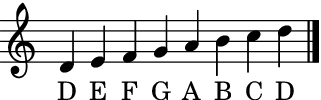
The clearest way to meet all seven diatonic modes is on the white notes of a keyboard. The white notes contain two semitones, E to F and B to C, and five tones. Start an octave scale on each of the seven letters in turn and the two semitones land in a different place each time. Seven starting notes, seven step patterns, seven modes:
| Mode | White-note octave | Degrees against the parallel major | Step pattern | Characteristic note |
|---|---|---|---|---|
| Ionian | C to C | 1 2 3 4 5 6 7 | T T S T T T S | none (the reference) |
| Dorian | D to D | 1 2 ♭3 4 5 6 ♭7 | T S T T T S T | ♮6 |
| Phrygian | E to E | 1 ♭2 ♭3 4 5 ♭6 ♭7 | S T T T S T T | ♭2 |
| Lydian | F to F | 1 2 3 ♯4 5 6 7 | T T T S T T S | ♯4 |
| Mixolydian | G to G | 1 2 3 4 5 6 ♭7 | T T S T T S T | ♭7 |
| Aeolian | A to A | 1 2 ♭3 4 5 ♭6 ♭7 | T S T T S T T | ♭6 |
| Locrian | B to B | 1 ♭2 ♭3 4 ♭5 ♭6 ♭7 | S T T S T T T | ♭5 |
The white-note octave in the second column is only the easiest example of each mode, not its definition. Like the major scale, every mode can be transposed to begin on any tonic, and chapters 5 to 11 spell all seven on every usable tonic.
1.3 What makes the tonic the tonic
On paper, D Dorian and C major contain identical notes, so what makes one D Dorian and the other C major? The music itself. A mode exists only when the music treats its tonic as home: beginning and ending phrases there, returning there after excursions, sitting on it as a drone or a bass anchor. Play the white notes aimlessly and you are in no mode at all; keep coming to rest on D and the Dorian colour appears.
This matters practically. Modal music has to work harder than tonal music to establish its centre, because most modes lack the sharpened leading note and the dominant chord that drag the ear home in a major or minor key. How modal music solves that problem, mainly with drones, ostinati and a small set of characteristic cadences, is a running theme of chapters 5 to 11 and the subject of chapter 15.
1.4 The mode families
The seven diatonic modes are rotations of one parent, the major scale. The same rotation trick works on any parent scale, and two other parents matter enough to have their modes named: the melodic minor (chapter 12), whose modes are everyday vocabulary in jazz, and the harmonic minor (chapter 13), whose fifth mode in particular is a fixture of flamenco, klezmer and Middle Eastern-flavoured writing. The five-note pentatonic scale rotates into five modes of its own (chapter 14).
That gives 21 heptatonic modes and 5 pentatonic modes, and that is the complete set this guide covers in depth. Scales that are not modes of anything covered here, such as the whole-tone and octatonic scales, get a short section at the end of chapter 14 so you can tell the neighbours from the family.
2. Where the modes came from
2.1 Plainsong and the eight church modes
The modal system entered European theory as a way of classifying plainsong, the unaccompanied liturgical chant of the medieval church. From around the 9th century, theorists sorted chants into eight church modes, defined by their final (the note the chant ends on) and their range. The finals were D, E, F and G. Each final carried a pair of modes: an authentic mode, ranging roughly an octave up from the final, and a plagal mode, ranging around it, distinguished by the prefix hypo-. The authentic modes on D, E, F and G correspond to what are now called Dorian, Phrygian, Lydian and Mixolydian.
Two cautions about history. First, the Greek names are borrowed ornaments: medieval theorists took them from ancient Greek writings, but the Greek originals described different structures, and the medieval application of the names does not match ancient practice. Second, sung practice was looser than the theory: singers routinely flattened B to avoid the tritone with F, which quietly turned Lydian into something very like the major scale, and much notated Dorian towards natural minor.
2.2 Twelve modes, and the odd one out
In 1547 the Swiss theorist Heinrich Glarean published the Dodecachordon, arguing that the system needed four more modes: authentic and plagal modes on A, which he named Aeolian, and on C, which he named Ionian. His expansion recognised what music was already doing, since so much of it gravitated to the scales on A and C. The mode on B never earned a working place in the system. Its tonic chord is diminished, and a diminished chord will not serve as a stable home. It was named by analogy, Locrian, and it remains the theoretical member of the family, discussed in chapter 11.
2.3 Two survivors
Through the 17th century the modal system collapsed into two members. Ionian became the major key, Aeolian, with its sixth and seventh degrees freely raised and lowered, became the minor key, and functional harmony, the engine of chords pulling to other chords described in Musical Harmony, was built on that pair. For roughly two hundred years, from Purcell to Brahms, the other modes survive mainly at the edges of art music: in archaic-flavoured church writing, and continuously in folk song, which had never asked theory's permission in the first place.
2.4 The revival
The modes returned to art music by several doors at once around the turn of the 20th century. Folk-song collectors, Vaughan Williams and Bartók among them, found the tunes they notated were very often Dorian, Mixolydian or Aeolian, and their own music absorbed those colours. Debussy and Ravel reached for modes as a way out of functional harmony's gravitational pull. Jazz arrived by its own route: in the late 1950s, players wanting relief from fast-moving chord progressions built pieces on one or two modes held for bars at a time, a practice named modal jazz and fixed in the repertoire by Miles Davis's Kind of Blue (1959). Rock and pop then made two of the modes, Mixolydian and Aeolian, close to default settings for guitar-driven music.
%%{init: {'theme':'neutral'}}%%
flowchart TD
  A["Plainsong<br/>8 church modes<br/>finals D, E, F, G"] --> B["Glarean, 1547<br/>12 modes<br/>adds A and C"]
  B --> C["Common practice, c. 1700 on<br/>2 survive<br/>major and minor keys"]
  C --> D["c. 1900 revival<br/>folk collection, Debussy,<br/>Vaughan Williams, Bartok"]
  D --> E["1959 on<br/>modal jazz, rock, film"]
  classDef era fill:#dce8f5,stroke:#3b5f8a,stroke-width:2px
  class A,C,E era
3. Deriving any mode
There are two ways to work out the notes of any mode, and fluent musicians use both, choosing whichever is quicker for the task in hand.
3.1 The relative method: rotate a parent scale
Every diatonic mode is a rotation of some major scale. To spell a mode by the relative method, find the parent major scale, then start it from the right degree:
- Dorian starts on degree 2 of its parent
- Phrygian on degree 3
- Lydian on degree 4
- Mixolydian on degree 5
- Aeolian on degree 6
- Locrian on degree 7
So E Dorian is the scale of D major begun on its second note: E, F♯, G, A, B, C♯, D. The relative method is quick when you know your key signatures well, and it explains why a mode's notes never need new accidentals: they are all inherited from the parent key.
%%{init: {'theme':'neutral'}}%%
flowchart TD
  C["One parent scale<br/>C major: C, D, E, F, G, A, B"] --> R{"begin it on<br/>degree..."}
  R -- "1" --> M1["C Ionian"]
  R -- "2" --> M2["D Dorian"]
  R -- "3" --> M3["E Phrygian"]
  R -- "4" --> M4["F Lydian"]
  R -- "5" --> M5["G Mixolydian"]
  R -- "6" --> M6["A Aeolian"]
  R -- "7" --> M7["B Locrian"]
  classDef parent fill:#dce8f5,stroke:#3b5f8a,stroke-width:2px
  class C parent
3.2 The parallel method: alter the major scale
The other route keeps the tonic fixed and alters degrees of the major scale on that same tonic. Each mode has a fixed degree formula against its parallel major:
| Mode | Degrees against the parallel major | To derive it from the major scale |
|---|---|---|
| Lydian | 1 2 3 ♯4 5 6 7 | sharpen the 4th |
| Ionian | 1 2 3 4 5 6 7 | no change |
| Mixolydian | 1 2 3 4 5 6 ♭7 | flatten the 7th |
| Dorian | 1 2 ♭3 4 5 6 ♭7 | flatten the 3rd and 7th |
| Aeolian | 1 2 ♭3 4 5 ♭6 ♭7 | flatten the 3rd and 6th and 7th |
| Phrygian | 1 ♭2 ♭3 4 5 ♭6 ♭7 | flatten the 2nd and 3rd and 6th and 7th |
| Locrian | 1 ♭2 ♭3 4 ♭5 ♭6 ♭7 | flatten the 2nd and 3rd and 5th and 6th and 7th |
So to spell C Mixolydian, take C major and flatten the 7th: C, D, E, F, G, A, B♭. The parallel method is quicker when you are thinking in one tonic, and it makes each mode's colour explicit, because the formula names exactly the notes that differ from major.
3.3 Choosing a method
Use the relative method to read and to transpose: a tune in E Dorian sits in the key signature of D major, and knowing that answers most notation questions at once. Use the parallel method to hear and to write: "minor with a raised 6th" describes the Dorian sound far better than "major scale started on its second note" does. Chapter 16's identification method leans on the parallel view, because what the ear notices about a mode is its differences from plain major or minor.
4. Bright to dark: the order of the modes
4.1 The brightness ladder
Arrange the seven modes so that each differs from the next by a single flattened note and a striking order appears, running from the brightest sound to the darkest:
%%{init: {'theme':'neutral'}}%%
flowchart TD
  L["Lydian<br/>1 2 3 ♯4 5 6 7"] -- "restore ♮4" --> I["Ionian, the major scale<br/>1 2 3 4 5 6 7"]
  I -- "flatten the 7th" --> M["Mixolydian<br/>1 2 3 4 5 6 ♭7"]
  M -- "flatten the 3rd" --> D["Dorian<br/>1 2 ♭3 4 5 6 ♭7"]
  D -- "flatten the 6th" --> A["Aeolian, the natural minor<br/>1 2 ♭3 4 5 ♭6 ♭7"]
  A -- "flatten the 2nd" --> P["Phrygian<br/>1 ♭2 ♭3 4 5 ♭6 ♭7"]
  P -- "flatten the 5th" --> Lo["Locrian<br/>1 ♭2 ♭3 4 ♭5 ♭6 ♭7"]
  classDef majorside fill:#dce8f5,stroke:#3b5f8a,stroke-width:2px
  classDef minorside fill:#efe6d8,stroke:#8a6d3b,stroke-width:2px
  class L,I,M majorside
  class D,A,P,Lo minorside
The top three modes have a major 3rd and sound like varieties of major; the bottom four have a minor 3rd and sound like varieties of minor. Each step down the ladder flattens one more degree, and each flattened degree darkens the sound a little further. The ladder is worth memorising: it organises all seven modes around the two scales you already know, one alteration at a time.
4.2 Characteristic notes
Each mode owes its identity mainly to one degree, the characteristic note, the note that most clearly separates it from plain major or plain minor on the same tonic:
- Lydian: the ♯4, a tritone above the tonic, floating and bright
- Mixolydian: the ♭7, a subtonic in a major-third scale
- Dorian: the ♮6, a major 6th inside a minor-third scale
- Phrygian: the ♭2, a semitone crowding the tonic from above
- Aeolian: the ♭6, which together with ♭7 gives the unraised minor sound
- Locrian: the ♭5, which destroys the perfect 5th and with it any stable tonic
Ionian has no characteristic note; it is the reference the others are measured against. The characteristic note is the practical heart of modal writing: melody and harmony that dwell on it project the mode strongly, while music that avoids it slides back towards sounding like ordinary major or minor. The same note answers most identification questions, which is why chapter 16 keeps returning to it.
4.3 The collapse problem
Modal music has a standing enemy: the ear's habit of reinterpreting everything as major. Play D Dorian carelessly and a listener may simply hear C major with an obsession about D. The music holds its mode by insisting on the tonic (drones, pedal points, phrase endings) and by keeping the characteristic note in play. This is the single most useful practical fact about writing modally, and chapter 15 turns it into a set of working techniques.
5. Ionian: the major scale as a mode
5.1 Character and formula
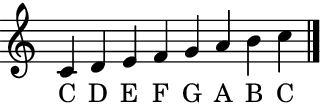
Ionian is the major scale under its modal name: T T S T T T S, degrees 1 to 7 unaltered. Everything about its behaviour as a key, its harmony and its repertoire is the subject of the rest of tonal theory and of the companion guides, so this chapter is short and exists to place the scale inside the modal family.
What is worth saying here is what Ionian has that its siblings lack: a leading note a semitone below the tonic, and with it the V-I perfect cadence and the entire machinery of functional harmony. Every other mode gives up some part of that machinery, which is exactly why each of them sounds the way it does.
5.2 Triads on every degree
Built on C, using only the mode's own notes:
| Degree | Chord | Notes | Quality |
|---|---|---|---|
| I | C | C, E, G | major |
| ii | Dm | D, F, A | minor |
| iii | Em | E, G, B | minor |
| IV | F | F, A, C | major |
| V | G | G, B, D | major |
| vi | Am | A, C, E | minor |
| vii° | Bdim | B, D, F | diminished |
5.3 Ionian in use
In modal repertoire, plain Ionian turns up in folk tunes and hymnody that never leave the seven notes and never lean on chromatic decoration. In a modal jazz context, "Ionian" usually names the scale played over a major-7th tonic chord. When a piece treats the major scale as a colour, one static sound among others rather than a key with functional pull, it is being used modally, and the name Ionian earns its keep.
5.4 Ionian on every tonic
| Tonic | Notes | Parent major | Key signature |
|---|---|---|---|
| C | C, D, E, F, G, A, B | C major | no sharps or flats |
| G | G, A, B, C, D, E, F♯ | G major | 1 sharp |
| D | D, E, F♯, G, A, B, C♯ | D major | 2 sharps |
| A | A, B, C♯, D, E, F♯, G♯ | A major | 3 sharps |
| E | E, F♯, G♯, A, B, C♯, D♯ | E major | 4 sharps |
| B | B, C♯, D♯, E, F♯, G♯, A♯ | B major | 5 sharps |
| F♯ | F♯, G♯, A♯, B, C♯, D♯, E♯ | F♯ major | 6 sharps |
| C♯ | C♯, D♯, E♯, F♯, G♯, A♯, B♯ | C♯ major | 7 sharps |
| F | F, G, A, B♭, C, D, E | F major | 1 flat |
| B♭ | B♭, C, D, E♭, F, G, A | B♭ major | 2 flats |
| E♭ | E♭, F, G, A♭, B♭, C, D | E♭ major | 3 flats |
| A♭ | A♭, B♭, C, D♭, E♭, F, G | A♭ major | 4 flats |
| D♭ | D♭, E♭, F, G♭, A♭, B♭, C | D♭ major | 5 flats |
| G♭ | G♭, A♭, B♭, C♭, D♭, E♭, F | G♭ major | 6 flats |
| C♭ | C♭, D♭, E♭, F♭, G♭, A♭, B♭ | C♭ major | 7 flats |
6. Dorian: the folk minor
6.1 Character and formula
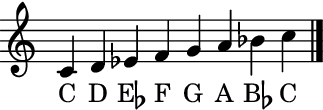
Dorian is the white-note mode from D to D: T S T T T S T, degrees 1 2 ♭3 4 5 ♮6 ♭7. It is a minor-third mode, but where the natural minor droops onto its flattened 6th, Dorian lifts onto a major 6th, and that single note changes the whole temperament of the scale. Dorian sounds like a minor that refuses to be sad: sturdy, modal, slightly bright, very old and at the same time very much at home in a jazz club.
The characteristic note is the ♮6. Against a D tonic, that note is B natural, and any tune that keeps landing on it while circling a D minor chord is announcing Dorian.
6.2 Harmony
Built on C, using only the mode's own notes:
| Degree | Chord | Notes | Quality |
|---|---|---|---|
| i | Cm | C, E♭, G | minor |
| ii | Dm | D, F, A | minor |
| ♭III | E♭ | E♭, G, B♭ | major |
| IV | F | F, A, C | major |
| v | Gm | G, B♭, D | minor |
| vi° | Adim | A, C, E♭ | diminished |
| ♭VII | B♭ | B♭, D, F | major |
The prize chord is IV: a major chord built on the 4th degree of a minor-third mode, containing the characteristic ♮6. The vamp i-IV, Cm to F in C Dorian, is probably the most instantly recognisable Dorian sound in existence, and it powers a large share of modal jazz. The minor v and the major ♭VII supply the cadences: ♭VII-i is the standard modal close, and v-i, with its unsharpened leading note, marks the music as modal rather than tonal minor at every cadence.
6.3 Dorian in use
Dorian saturates the English and Celtic folk repertoires: "Scarborough Fair" and "What Shall We Do with the Drunken Sailor" are both Dorian tunes, and collectors found the mode everywhere in traditional song. In jazz, Miles Davis's "So What" holds a single Dorian mode for sixteen bars at a stretch, and the m7 chord in any ii-V-I invites a Dorian scale over it. Rock reaches for Dorian when it wants minor without gloom: a minor riff over which the major IV chord keeps appearing is the usual signature.
6.4 Dorian on every tonic
| Tonic | Notes | Parent major | Key signature |
|---|---|---|---|
| D | D, E, F, G, A, B, C | C major | no sharps or flats |
| A | A, B, C, D, E, F♯, G | G major | 1 sharp |
| E | E, F♯, G, A, B, C♯, D | D major | 2 sharps |
| B | B, C♯, D, E, F♯, G♯, A | A major | 3 sharps |
| F♯ | F♯, G♯, A, B, C♯, D♯, E | E major | 4 sharps |
| C♯ | C♯, D♯, E, F♯, G♯, A♯, B | B major | 5 sharps |
| G♯ | G♯, A♯, B, C♯, D♯, E♯, F♯ | F♯ major | 6 sharps |
| D♯ | D♯, E♯, F♯, G♯, A♯, B♯, C♯ | C♯ major | 7 sharps |
| G | G, A, B♭, C, D, E, F | F major | 1 flat |
| C | C, D, E♭, F, G, A, B♭ | B♭ major | 2 flats |
| F | F, G, A♭, B♭, C, D, E♭ | E♭ major | 3 flats |
| B♭ | B♭, C, D♭, E♭, F, G, A♭ | A♭ major | 4 flats |
| E♭ | E♭, F, G♭, A♭, B♭, C, D♭ | D♭ major | 5 flats |
| A♭ | A♭, B♭, C♭, D♭, E♭, F, G♭ | G♭ major | 6 flats |
| D♭ | D♭, E♭, F♭, G♭, A♭, B♭, C♭ | C♭ major | 7 flats |
7. Phrygian: the dark second
7.1 Character and formula
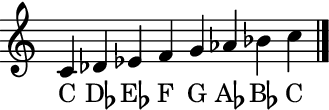
Phrygian is the white-note mode from E to E: S T T T S T T, degrees 1 ♭2 ♭3 4 5 ♭6 ♭7. It is the darkest of the modes with a stable tonic, and its darkness comes from the very first step: a semitone sitting immediately above the tonic. That ♭2 is the characteristic note, and it colours everything, pressing down on the tonic from above where a leading note would push up from below.
7.2 Harmony
Built on C, using only the mode's own notes:
| Degree | Chord | Notes | Quality |
|---|---|---|---|
| i | Cm | C, E♭, G | minor |
| ♭II | D♭ | D♭, F, A♭ | major |
| ♭III | E♭ | E♭, G, B♭ | major |
| iv | Fm | F, A♭, C | minor |
| v° | Gdim | G, B♭, D♭ | diminished |
| ♭VI | A♭ | A♭, C, E♭ | major |
| ♭vii | B♭m | B♭, D♭, F | minor |
The defining move is ♭II-i, a major chord a semitone above the tonic falling onto the tonic minor: D♭ to Cm in C Phrygian. That cadence, with the bass falling by semitone, is the sound of flamenco, where it usually extends to the Andalusian cadence iv-♭III-♭II-i (in A Phrygian: Dm-C-B♭-A). The related Phrygian cadence of Baroque music, iv6-V in minor with the bass falling ♭6 to 5, borrows the same semitone descent, and is covered in Roman Numeral Analysis.
7.3 Phrygian in use
Phrygian's home territories are Spanish music, where flamenco treats the mode (often with a sharpened 3rd, for which see Phrygian dominant in chapter 13) as its fundamental sound, and heavy metal, where riffs built on the tonic and ♭2 supply an aggression that plain minor cannot. Film and game scores use Phrygian as shorthand for menace or the exotic. In jazz it appears over sus♭9 chords and in Spanish-tinged writing such as Davis's Sketches of Spain.
7.4 Phrygian on every tonic
| Tonic | Notes | Parent major | Key signature |
|---|---|---|---|
| E | E, F, G, A, B, C, D | C major | no sharps or flats |
| B | B, C, D, E, F♯, G, A | G major | 1 sharp |
| F♯ | F♯, G, A, B, C♯, D, E | D major | 2 sharps |
| C♯ | C♯, D, E, F♯, G♯, A, B | A major | 3 sharps |
| G♯ | G♯, A, B, C♯, D♯, E, F♯ | E major | 4 sharps |
| D♯ | D♯, E, F♯, G♯, A♯, B, C♯ | B major | 5 sharps |
| A♯ | A♯, B, C♯, D♯, E♯, F♯, G♯ | F♯ major | 6 sharps |
| E♯ | E♯, F♯, G♯, A♯, B♯, C♯, D♯ | C♯ major | 7 sharps |
| A | A, B♭, C, D, E, F, G | F major | 1 flat |
| D | D, E♭, F, G, A, B♭, C | B♭ major | 2 flats |
| G | G, A♭, B♭, C, D, E♭, F | E♭ major | 3 flats |
| C | C, D♭, E♭, F, G, A♭, B♭ | A♭ major | 4 flats |
| F | F, G♭, A♭, B♭, C, D♭, E♭ | D♭ major | 5 flats |
| B♭ | B♭, C♭, D♭, E♭, F, G♭, A♭ | G♭ major | 6 flats |
| E♭ | E♭, F♭, G♭, A♭, B♭, C♭, D♭ | C♭ major | 7 flats |
8. Lydian: the raised fourth
8.1 Character and formula
Lydian is the white-note mode from F to F: T T T S T T S, degrees 1 2 3 ♯4 5 6 7. It is the brightest member of the family, the only mode that sharpens a degree of the major scale rather than flattening one. The characteristic ♯4 removes the one semitone pull that the major scale's 4th has towards the 3rd, and the result is a scale that seems to float: nothing in it wants to fall.
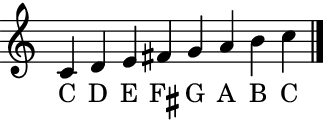
8.2 Harmony
Built on C, using only the mode's own notes:
| Degree | Chord | Notes | Quality |
|---|---|---|---|
| I | C | C, E, G | major |
| II | D | D, F♯, A | major |
| iii | Em | E, G, B | minor |
| ♯iv° | F♯dim | F♯, A, C | diminished |
| V | G | G, B, D | major |
| vi | Am | A, C, E | minor |
| vii | Bm | B, D, F♯ | minor |
The tell-tale chord is II: a major triad on the 2nd degree, D major against a C tonic, carrying the ♯4. The progression I-II, rocking between the tonic and the major supertonic, is the plainest Lydian gesture in harmony, and film composers lean on it for wonder and weightlessness. Note also what Lydian lacks: with the 4th sharpened there is no subdominant chord, and IV-I plagal motion is off the menu.
8.3 Lydian in use
Lydian is the film-score mode of flight, childhood and awe; the openings of many John Williams cues float on I-II Lydian harmony. Danny Elfman's theme for The Simpsons opens with a sung Lydian phrase, ♯4 prominent. Jazz theory, following George Russell's Lydian Chromatic Concept, treats Lydian as the natural scale over a major 7th chord, since the ♯11 avoids the clash the ♮11 makes with the chord's 3rd. Pop reaches Lydian more rarely, usually as a bridge colour rather than a home.
8.4 Lydian on every tonic
| Tonic | Notes | Parent major | Key signature |
|---|---|---|---|
| F | F, G, A, B, C, D, E | C major | no sharps or flats |
| C | C, D, E, F♯, G, A, B | G major | 1 sharp |
| G | G, A, B, C♯, D, E, F♯ | D major | 2 sharps |
| D | D, E, F♯, G♯, A, B, C♯ | A major | 3 sharps |
| A | A, B, C♯, D♯, E, F♯, G♯ | E major | 4 sharps |
| E | E, F♯, G♯, A♯, B, C♯, D♯ | B major | 5 sharps |
| B | B, C♯, D♯, E♯, F♯, G♯, A♯ | F♯ major | 6 sharps |
| F♯ | F♯, G♯, A♯, B♯, C♯, D♯, E♯ | C♯ major | 7 sharps |
| B♭ | B♭, C, D, E, F, G, A | F major | 1 flat |
| E♭ | E♭, F, G, A, B♭, C, D | B♭ major | 2 flats |
| A♭ | A♭, B♭, C, D, E♭, F, G | E♭ major | 3 flats |
| D♭ | D♭, E♭, F, G, A♭, B♭, C | A♭ major | 4 flats |
| G♭ | G♭, A♭, B♭, C, D♭, E♭, F | D♭ major | 5 flats |
| C♭ | C♭, D♭, E♭, F, G♭, A♭, B♭ | G♭ major | 6 flats |
| F♭ | F♭, G♭, A♭, B♭, C♭, D♭, E♭ | C♭ major | 7 flats |
9. Mixolydian: the flattened seventh
9.1 Character and formula
Mixolydian is the white-note mode from G to G: T T S T T S T, degrees 1 2 3 4 5 6 ♭7. Take the major scale and trade its leading note for a subtonic, a 7th a whole tone below the tonic, and the scale relaxes. The pull of ti towards do disappears, and with it goes the urgency of the perfect cadence. What remains is major in colour but easy-going in behaviour: the sound of folk fiddle tunes, bagpipes and a great deal of rock.
The characteristic note is the ♭7, and its harmonic embodiment is the ♭VII chord.
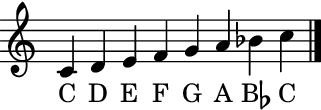
9.2 Harmony
Built on C, using only the mode's own notes:
| Degree | Chord | Notes | Quality |
|---|---|---|---|
| I | C | C, E, G | major |
| ii | Dm | D, F, A | minor |
| iii° | Edim | E, G, B♭ | diminished |
| IV | F | F, A, C | major |
| v | Gm | G, B♭, D | minor |
| vi | Am | A, C, E | minor |
| ♭VII | B♭ | B♭, D, F | major |
The signature cadence is ♭VII-I: B♭ to C in C Mixolydian, two major chords a tone apart rising onto the tonic. The loop I-♭VII-IV-I is one of the most common progressions in rock. The dominant chord of the mode is minor (v), so a Mixolydian piece that wants a strong close uses ♭VII-I or IV-I instead; if a composer sharpens the 7th to force a real V-I, the music has left the mode and gone tonal, which is a legitimate move but a different sound.
9.3 Mixolydian in use
Mixolydian owns a large share of the guitar repertoire: "Sweet Home Alabama" cycles I-♭VII-IV throughout, and The Beatles' "Norwegian Wood" is a Mixolydian melody over a drone. Bagpipe music is heavily Mixolydian because the instrument's scale is built that way. In the fiddle traditions of Scotland and Ireland the mode is everywhere. In jazz, Mixolydian is the plain-vanilla scale over an unaltered dominant 7th chord, the V7 of any ii-V-I.
9.4 Mixolydian on every tonic
| Tonic | Notes | Parent major | Key signature |
|---|---|---|---|
| G | G, A, B, C, D, E, F | C major | no sharps or flats |
| D | D, E, F♯, G, A, B, C | G major | 1 sharp |
| A | A, B, C♯, D, E, F♯, G | D major | 2 sharps |
| E | E, F♯, G♯, A, B, C♯, D | A major | 3 sharps |
| B | B, C♯, D♯, E, F♯, G♯, A | E major | 4 sharps |
| F♯ | F♯, G♯, A♯, B, C♯, D♯, E | B major | 5 sharps |
| C♯ | C♯, D♯, E♯, F♯, G♯, A♯, B | F♯ major | 6 sharps |
| G♯ | G♯, A♯, B♯, C♯, D♯, E♯, F♯ | C♯ major | 7 sharps |
| C | C, D, E, F, G, A, B♭ | F major | 1 flat |
| F | F, G, A, B♭, C, D, E♭ | B♭ major | 2 flats |
| B♭ | B♭, C, D, E♭, F, G, A♭ | E♭ major | 3 flats |
| E♭ | E♭, F, G, A♭, B♭, C, D♭ | A♭ major | 4 flats |
| A♭ | A♭, B♭, C, D♭, E♭, F, G♭ | D♭ major | 5 flats |
| D♭ | D♭, E♭, F, G♭, A♭, B♭, C♭ | G♭ major | 6 flats |
| G♭ | G♭, A♭, B♭, C♭, D♭, E♭, F♭ | C♭ major | 7 flats |
10. Aeolian: the natural minor as a mode
10.1 Character and formula
Aeolian is the white-note mode from A to A: T S T T S T T, degrees 1 2 ♭3 4 5 ♭6 ♭7, identical to the natural minor scale. As with Ionian, the scale itself is familiar; what the modal name adds is a way of using it. Music in a minor key habitually sharpens the 7th (and often the 6th) to manufacture a leading note and a major dominant chord. Music in the Aeolian mode declines to do so, and lives with the subtonic.
Against Dorian, the characteristic note is the ♭6; against the minor key, the characteristic feature is the unsharpened ♭7 and everything that follows from it.
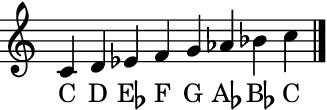
10.2 Harmony
Built on C, using only the mode's own notes:
| Degree | Chord | Notes | Quality |
|---|---|---|---|
| i | Cm | C, E♭, G | minor |
| ii° | Ddim | D, F, A♭ | diminished |
| ♭III | E♭ | E♭, G, B♭ | major |
| iv | Fm | F, A♭, C | minor |
| v | Gm | G, B♭, D | minor |
| ♭VI | A♭ | A♭, C, E♭ | major |
| ♭VII | B♭ | B♭, D, F | major |
Aeolian's harmony runs on three major chords that the tonal minor treats as visitors: ♭III, ♭VI and ♭VII. The loops i-♭VI-♭VII and i-♭VII-♭VI are the backbone of Aeolian rock, and ♭VII-i is its standard cadence. The dominant is minor (v), and the ear accepts v-i as a close far more readily here than in a tonal context, because the whole texture has given up leading-note pull.
10.3 Aeolian in use
Aeolian is the default minor of rock, pop and film music since the 1960s: whenever a song sits on a minor chord and moves through ♭VI and ♭VII without any sharpened leading note, it is Aeolian rather than "in a minor key" in the classical sense. Folk repertoires use it alongside Dorian as one of the two standard minors. Classical composers touch pure Aeolian when they want archaic or folk colour without Dorian's brightness.
10.4 Aeolian on every tonic
| Tonic | Notes | Parent major | Key signature |
|---|---|---|---|
| A | A, B, C, D, E, F, G | C major | no sharps or flats |
| E | E, F♯, G, A, B, C, D | G major | 1 sharp |
| B | B, C♯, D, E, F♯, G, A | D major | 2 sharps |
| F♯ | F♯, G♯, A, B, C♯, D, E | A major | 3 sharps |
| C♯ | C♯, D♯, E, F♯, G♯, A, B | E major | 4 sharps |
| G♯ | G♯, A♯, B, C♯, D♯, E, F♯ | B major | 5 sharps |
| D♯ | D♯, E♯, F♯, G♯, A♯, B, C♯ | F♯ major | 6 sharps |
| A♯ | A♯, B♯, C♯, D♯, E♯, F♯, G♯ | C♯ major | 7 sharps |
| D | D, E, F, G, A, B♭, C | F major | 1 flat |
| G | G, A, B♭, C, D, E♭, F | B♭ major | 2 flats |
| C | C, D, E♭, F, G, A♭, B♭ | E♭ major | 3 flats |
| F | F, G, A♭, B♭, C, D♭, E♭ | A♭ major | 4 flats |
| B♭ | B♭, C, D♭, E♭, F, G♭, A♭ | D♭ major | 5 flats |
| E♭ | E♭, F, G♭, A♭, B♭, C♭, D♭ | G♭ major | 6 flats |
| A♭ | A♭, B♭, C♭, D♭, E♭, F♭, G♭ | C♭ major | 7 flats |
11. Locrian: the theoretical mode
11.1 Character and formula
Locrian is the white-note mode from B to B: S T T S T T T, degrees 1 ♭2 ♭3 4 ♭5 ♭6 ♭7. It is the odd one out, and the reason sits on its 5th degree. Every other mode has a perfect 5th above the tonic, which lets a stable tonic triad form. Locrian's ♭5 makes the tonic triad diminished, and a dissonant chord cannot serve as a point of rest. The mode is not unusable, but it resists being a home.
The characteristic note is the ♭5, with the ♭2 close behind; together they give Locrian its unstable, closed-in character.
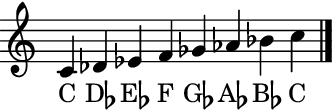
11.2 Harmony
Built on C, using only the mode's own notes:
| Degree | Chord | Notes | Quality |
|---|---|---|---|
| i° | Cdim | C, E♭, G♭ | diminished |
| ♭II | D♭ | D♭, F, A♭ | major |
| ♭iii | E♭m | E♭, G♭, B♭ | minor |
| iv | Fm | F, A♭, C | minor |
| ♭V | G♭ | G♭, B♭, D♭ | major |
| ♭VI | A♭ | A♭, C, E♭ | major |
| ♭vii | B♭m | B♭, D♭, F | minor |
There is no stable i to cadence onto, so functional progressions in Locrian barely exist. What survives in practice: riffs that hammer the tonic, ♭2 and ♭5 as a melodic cell over a bass pedal, common in metal; and the scale as a melodic resource over the half-diminished chord, since Locrian fits iiø7 in a minor-key ii-V-i (though jazz players often prefer Locrian ♮2 from chapter 12 for that job, which sweetens the 2nd degree).
11.3 Locrian in use
Stable pieces genuinely in Locrian are rare enough to be collectors' items, and the mode mostly appears in fragments: a riff, a scale run, a colour over one chord. That rarity is itself the lesson: comparing Locrian with Phrygian shows exactly how much work the perfect 5th does in every other mode.
11.4 Locrian on every tonic
| Tonic | Notes | Parent major | Key signature |
|---|---|---|---|
| B | B, C, D, E, F, G, A | C major | no sharps or flats |
| F♯ | F♯, G, A, B, C, D, E | G major | 1 sharp |
| C♯ | C♯, D, E, F♯, G, A, B | D major | 2 sharps |
| G♯ | G♯, A, B, C♯, D, E, F♯ | A major | 3 sharps |
| D♯ | D♯, E, F♯, G♯, A, B, C♯ | E major | 4 sharps |
| A♯ | A♯, B, C♯, D♯, E, F♯, G♯ | B major | 5 sharps |
| E♯ | E♯, F♯, G♯, A♯, B, C♯, D♯ | F♯ major | 6 sharps |
| B♯ | B♯, C♯, D♯, E♯, F♯, G♯, A♯ | C♯ major | 7 sharps |
| E | E, F, G, A, B♭, C, D | F major | 1 flat |
| A | A, B♭, C, D, E♭, F, G | B♭ major | 2 flats |
| D | D, E♭, F, G, A♭, B♭, C | E♭ major | 3 flats |
| G | G, A♭, B♭, C, D♭, E♭, F | A♭ major | 4 flats |
| C | C, D♭, E♭, F, G♭, A♭, B♭ | D♭ major | 5 flats |
| F | F, G♭, A♭, B♭, C♭, D♭, E♭ | G♭ major | 6 flats |
| B♭ | B♭, C♭, D♭, E♭, F♭, G♭, A♭ | C♭ major | 7 flats |
12. The modes of the melodic minor
12.1 A second parent scale
Sharpen the 6th and 7th of the natural minor, keep them sharpened whether rising or falling, and you have the melodic minor as jazz uses it (classical practice, which reverts to the natural form descending, is covered in the grade guides). The result is a fresh parent: T S T T T T S, degrees 1 2 ♭3 4 5 6 7, a scale one note different from major, with all the smoothness that implies but a minor 3rd at its heart.
Rotate it, exactly as the major scale was rotated in chapter 3, and seven new modes appear. These are not medieval survivals; they are creatures of jazz theory, named descriptively after the diatonic modes they most resemble, and they earn their keep as the standard scales over the more colourful chords: altered dominants, m(maj7), 7♯11 and half-diminished chords. Each is given here spelled on C, with its degree formula, step pattern and parent, so all seven can be compared directly.
%%{init: {'theme':'neutral'}}%%
flowchart TD
  N["Natural minor<br/>1 2 ♭3 4 5 ♭6 ♭7"] -- "sharpen the 6th and 7th" --> P["Melodic minor<br/>1 2 ♭3 4 5 6 7"]
  P -- "rotation, as in chapter 3" --> Q["seven modes"]
  Q --> A["1. Melodic minor itself"]
  A --> B["2. Dorian ♭2"]
  B --> C2["3. Lydian augmented"]
  C2 --> D["4. Lydian dominant"]
  D --> E["5. Mixolydian ♭6"]
  E --> F["6. Locrian ♮2"]
  F --> G["7. Altered scale"]
  classDef parent fill:#dce8f5,stroke:#3b5f8a,stroke-width:2px
  class N,P parent
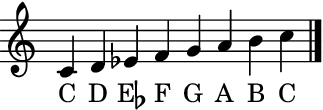
12.2 Melodic minor (jazz minor): the first mode
The parent itself, played over a minor chord with a major 7th, m(maj7). Minor, but with none of natural minor's droop: the top half of the scale is pure major.
| Spelt on C | C, D, E♭, F, G, A, B |
| Degrees against C major | 1 2 ♭3 4 5 6 7 |
| Step pattern | T S T T T T S |
| Parent scale | 1st mode of C melodic minor |
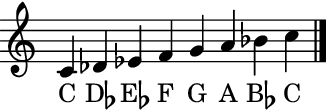
12.3 Dorian ♭2: the second mode
Dorian with its 2nd flattened, at home over a m7 chord when a ♭9 colour is wanted, and over sus♭9 chords. A darker, more Phrygian-leaning Dorian.
| Spelt on C | C, D♭, E♭, F, G, A, B♭ |
| Degrees against C major | 1 ♭2 ♭3 4 5 6 ♭7 |
| Step pattern | S T T T T S T |
| Parent scale | 2nd mode of B♭ melodic minor |
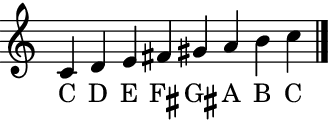
12.4 Lydian augmented: the third mode
Lydian with its 5th sharpened as well: ♯4 and ♯5 together. The standard scale over the maj7♯5 chord, and the brightest scale in common use.
| Spelt on C | C, D, E, F♯, G♯, A, B |
| Degrees against C major | 1 2 3 ♯4 ♯5 6 7 |
| Step pattern | T T T T S T S |
| Parent scale | 3rd mode of A melodic minor |
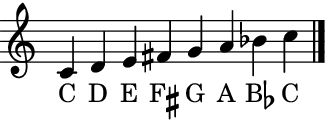
12.5 Lydian dominant: the fourth mode
Lydian's ♯4 combined with Mixolydian's ♭7. The scale of the 7♯11 chord, and the default sound over a dominant chord that is not going to resolve, such as a ♭VII7 or a tritone substitute. Also called the acoustic scale, since its notes approximate the lower overtone series.
| Spelt on C | C, D, E, F♯, G, A, B♭ |
| Degrees against C major | 1 2 3 ♯4 5 6 ♭7 |
| Step pattern | T T T S T S T |
| Parent scale | 4th mode of G melodic minor |
12.6 Mixolydian ♭6: the fifth mode
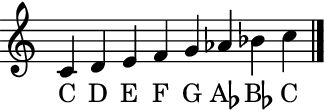
Mixolydian with a flattened 6th: major below, minor above. Fits a dominant chord resolving to a minor tonic, where the ♭6 anticipates the darkness to come. Sometimes called the melodic major scale.
| Spelt on C | C, D, E, F, G, A♭, B♭ |
| Degrees against C major | 1 2 3 4 5 ♭6 ♭7 |
| Step pattern | T T S T S T T |
| Parent scale | 5th mode of F melodic minor |
12.7 Locrian ♮2: the sixth mode
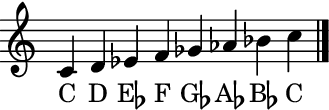
Locrian with its 2nd restored to natural, which removes the ♭2 crowding of the tonic while keeping the ♭5. The preferred jazz scale over the half-diminished (m7♭5) chord, precisely because the ♮2 is available as a melody note where plain Locrian's ♭2 clashes.
| Spelt on C | C, D, E♭, F, G♭, A♭, B♭ |
| Degrees against C major | 1 2 ♭3 4 ♭5 ♭6 ♭7 |
| Step pattern | T S T S T T T |
| Parent scale | 6th mode of E♭ melodic minor |
12.8 The altered scale: the seventh mode
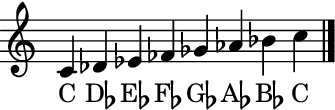
Every degree that can be altered, is: ♭2 (=♭9), ♭3 (=♯9), ♭4 (enharmonically the major 3rd), ♭5, ♭6, ♭7. This is the altered scale, played over the V7alt chord, the dominant carrying ♭9, ♯9, ♯11 or ♭13. It contains the 3rd and ♭7 that define a dominant chord plus every standard alteration, which is why it is the first scale a jazz student learns for tense dominants. Also called super Locrian.
| Spelt on C | C, D♭, E♭, F♭, G♭, A♭, B♭ |
| Degrees against C major | 1 ♭2 ♭3 ♭4 ♭5 ♭6 ♭7 |
| Step pattern | S T S T T T T |
| Parent scale | 7th mode of D♭ melodic minor |
13. The modes of the harmonic minor
13.1 A third parent scale
The harmonic minor, natural minor with only the 7th sharpened, carries an augmented 2nd between its 6th and 7th degrees: T S T T S A2 S, degrees 1 2 ♭3 4 5 ♭6 7. That three-semitone leap gives every one of its modes an audible exotic streak that the melodic minor modes lack. Jazz uses this family more selectively, but its fifth mode is one of the most widely used scales in the world.
13.2 Harmonic minor: the first mode
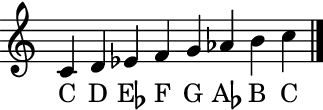
The parent scale: the sound of minor-key art music at cadences, and a melodic colour from Bach to metal. Over a m(maj7) chord it offers a darker alternative to the melodic minor, with the ♭6 kept.
| Spelt on C | C, D, E♭, F, G, A♭, B |
| Degrees against C major | 1 2 ♭3 4 5 ♭6 7 |
| Step pattern | T S T T S A2 S |
| Parent scale | 1st mode of C harmonic minor |
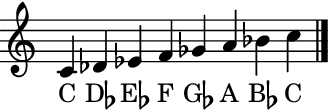
13.3 Locrian ♮6: the second mode
Locrian with its 6th raised to natural. A scale for the half-diminished chord when an A2 sparkle suits the line.
| Spelt on C | C, D♭, E♭, F, G♭, A, B♭ |
| Degrees against C major | 1 ♭2 ♭3 4 ♭5 6 ♭7 |
| Step pattern | S T T S A2 S T |
| Parent scale | 2nd mode of B♭ harmonic minor |
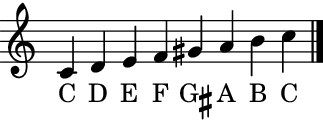
13.4 Ionian ♯5: the third mode
The major scale with an augmented 5th: the scale of the maj7♯5 chord when a darker tinge than Lydian augmented is wanted.
| Spelt on C | C, D, E, F, G♯, A, B |
| Degrees against C major | 1 2 3 4 ♯5 6 7 |
| Step pattern | T T S A2 S T S |
| Parent scale | 3rd mode of A harmonic minor |
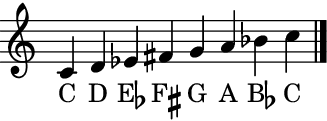
13.5 Dorian ♯4: the fourth mode
Dorian with a sharpened 4th, also called Ukrainian Dorian or the Romanian minor. Prominent in klezmer and Eastern European fiddle music, where the A2 between degrees 3 and 4 is a beloved feature, not a flaw.
| Spelt on C | C, D, E♭, F♯, G, A, B♭ |
| Degrees against C major | 1 2 ♭3 ♯4 5 6 ♭7 |
| Step pattern | T S A2 S T S T |
| Parent scale | 4th mode of G harmonic minor |
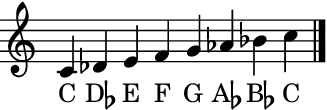
13.6 Phrygian dominant: the fifth mode
Phrygian with a major 3rd: ♭2 below, major triad on the tonic. This is the celebrated fifth mode of harmonic minor, the scale a minor key's dominant chord actually draws its notes from, and an independent modal home across flamenco (where it deepens the Phrygian tradition of chapter 7), klezmer (as the freygish scale), and Arabic and Turkish practice (as a close cousin of maqam Hijaz). "Hava Nagila" is the standard first example. The tension between the major 3rd and the ♭2 gives the mode its simultaneous brightness and darkness.
| Spelt on C | C, D♭, E, F, G, A♭, B♭ |
| Degrees against C major | 1 ♭2 3 4 5 ♭6 ♭7 |
| Step pattern | S A2 S T S T T |
| Parent scale | 5th mode of F harmonic minor |
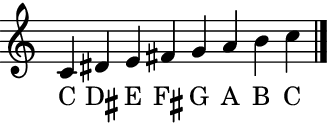
13.7 Lydian ♯2: the sixth mode
Lydian with a sharpened 2nd as well as its ♯4: an A2 right at the bottom of the scale. A rare colour, occasionally chosen over a maj7 chord for maximum brightness with an exotic opening step.
| Spelt on C | C, D♯, E, F♯, G, A, B |
| Degrees against C major | 1 ♯2 3 ♯4 5 6 7 |
| Step pattern | A2 S T S T T S |
| Parent scale | 6th mode of E harmonic minor |
13.8 Altered diminished: the seventh mode
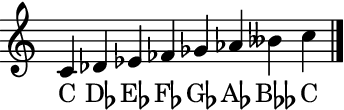
The darkest spelling in this guide, with a double-flattened 7th, and in pitch content a diminished-7th arpeggio filled in with semitones. It appears over the vii°7 chord of a minor key. Also called super Locrian ♭♭7.
| Spelt on C | C, D♭, E♭, F♭, G♭, A♭, B♭♭ |
| Degrees against C major | 1 ♭2 ♭3 ♭4 ♭5 ♭6 ♭♭7 |
| Step pattern | S T S T T S A2 |
| Parent scale | 7th mode of D♭ harmonic minor |
14. Pentatonic modes and the near relatives
14.1 The five pentatonic modes
The five-note major pentatonic scale, degrees 1 2 3 5 6 of the major scale, rotates into five modes just as the seven-note scales do. Two of the five dominate practice:
| Mode | White-note example | Common name |
|---|---|---|
| 1 | C, D, E, G, A | Major pentatonic |
| 2 | D, E, G, A, C | Second mode |
| 3 | E, G, A, C, D | Third mode |
| 4 | G, A, C, D, E | Fourth mode |
| 5 | A, C, D, E, G | Minor pentatonic |

The first mode is the major pentatonic, the melody scale of an enormous share of the world's folk music. The fifth is the minor pentatonic, the backbone of blues, rock and gospel melody. The two are relatives in exactly the way C major and A minor are: the same five notes, revolving around different homes. The middle three modes have no settled English names and are met mainly in East Asian repertoires and in modern composition; naming them by number, as the table does, is standard practice.
With only five notes, pentatonic modes have no semitones at all, which is why they are so forgiving melodically: there is no note a semitone away from a chord note to clash with. That same absence means a pentatonic melody projects its mode weakly, and accompanying harmony usually decides whether music built on C, D, E, G, A sounds major, minor or modal.
14.2 Near relatives that are not modes of anything here
Three scale families often mentioned alongside the modes do not belong to any parent in this guide, and are listed so the boundary is clear:
- The whole-tone scale, six notes all a tone apart. Every rotation gives the same step pattern, so it has no distinct modes at all.
- The octatonic (diminished) scale, alternating tones and semitones. It has exactly two forms, tone-first and semitone-first, rather than a family of seven.
- The chromatic scale, all twelve semitones, which has no modes for the same reason as the whole-tone scale.
The harmonic major scale (major with a ♭6) does generate seven modes of its own on the same rotation principle, but they are rare enough in practice that listing them adds bulk rather than use; the derivation method of chapter 3 applies unchanged if you ever need them.
15. Modes in practice
15.1 Notating a modal piece
Two honest conventions exist, and editions differ:
- Parent signature. Write the key signature of the parent major scale, so E Dorian carries D major's two sharps and no accidentals appear in the body. This is the older convention and remains standard in folk music editions. Its cost: the signature no longer announces the tonic, and a reader who assumes "two sharps means D major or B minor" starts in the wrong place.
- Parallel signature plus accidentals. Write the signature of the parallel major or minor and add the mode's alterations as accidentals in the body, so E Dorian carries E minor's one sharp and every C♯ is marked. This tells the reader the tonic at the cost of recurring accidentals.
Neither is wrong. For a piece that stays in one mode throughout, the parent signature is cleaner; for music that shifts between modes on one tonic, the parallel convention keeps the tonic visible. Say which you are doing if there is room for doubt, and be consistent.
15.2 Keeping the modal colour
Chapter 4 named the enemy: collapse into the relative major, or into ordinary tonal minor. The working defences, in rough order of power:
- Anchor the tonic physically. A drone, a bass pedal, an ostinato or simply beginning and ending every phrase on the tonic. Modal repertoires from bagpipe music to modal jazz all do this, because nothing else establishes a centre so cheaply.
- Keep the characteristic note sounding. Melodically, let phrases peak on it or circle it; harmonically, prefer the chords that contain it (IV in Dorian, ♭VII in Mixolydian, ♭II in Phrygian, II in Lydian).
- Refuse the tonal cadence. No sharpened leading note, no V-I. Use the mode's own closes: ♭VII-i, ♭VII-I, ♭II-i, v-i, IV-I.
- Move diatonically and sparingly. Two or three chords looping serve a mode better than a wandering progression, which is why so much modal music is vamp-based.
15.3 Borrowing from the modes
Even firmly tonal music raids the modal cupboard. A major-key song that pulls in ♭VII from Mixolydian, or iv and ♭VI from Aeolian, is practising modal interchange, borrowing chords from a parallel mode while keeping its tonal centre. The technique sits at the boundary between this guide and Musical Harmony, which treats it fully; what belongs here is the observation that every borrowed chord carries its home mode's flavour with it, which is exactly why composers borrow.
16. Identifying a mode
16.1 The method
Given a melody, a scale or a handful of notes, four steps settle the mode:
- Find the tonal centre. Trust the music, not the key signature: the note phrases end on, the bass drone, the note the tune keeps gravitating to. In a scale exercise, the centre is simply the given tonic.
- Sort the third. Is the 3rd above the centre major or minor? That halves the field: major 3rd means Ionian, Lydian or Mixolydian; minor 3rd means Dorian, Aeolian, Phrygian or Locrian.
- Find the characteristic note. On the major side: a ♯4 means Lydian, a ♭7 means Mixolydian, neither means Ionian. On the minor side: a ♮6 means Dorian, a ♭2 with a ♭5 means Locrian, a ♭2 alone means Phrygian, and none of those means Aeolian.
- Check for a second parent. A minor 3rd with a major 7th points to the melodic or harmonic minor families; an augmented 2nd anywhere in the scale points to the harmonic minor family; a major 3rd with a ♭2 is Phrygian dominant. Then chapter 12 or 13 identifies the exact member by its degree formula.
%%{init: {'theme':'neutral'}}%%
flowchart TD
  A["Find the tonal centre"] --> B{"3rd above it:<br/>major or minor?"}
  B -- major --> C{"4th and 7th?"}
  C -- "♯4" --> L["Lydian"]
  C -- "♭7" --> M["Mixolydian"]
  C -- "♮4 and ♮7" --> I["Ionian"]
  B -- minor --> D{"6th and 2nd?"}
  D -- "♮6" --> Do["Dorian"]
  D -- "♭2 and ♭5" --> Lo["Locrian"]
  D -- "♭2, ♮5" --> P["Phrygian"]
  D -- "♭6, ♮2" --> Ae["Aeolian"]
  classDef result fill:#dce8f5,stroke:#3b5f8a,stroke-width:2px
  class L,M,I,Do,Lo,P,Ae result
16.2 Worked examples
A scale: G, A, B♭, C, D, E, F, G. The centre is given: G. The 3rd above G is B♭, minor, so the mode is on the ladder's minor side. The 6th above G is E natural, a major 6th. A minor 3rd with a ♮6 is Dorian: this is G Dorian, parent F major.
A fiddle tune ending on A, one sharp in the signature. One sharp is the signature of G major, so the notes are G major's; a tune from that set ending and centring on A is A Dorian (A, B, C, D, E, F♯, G). Check with the characteristic note: the F♯ is the ♮6 above A, and Dorian is confirmed. Had the tune centred on E with the same notes, it would have been E Aeolian; on D, D Mixolydian.
A scale: C, D♭, E, F, G, A♭, B♭, C. The 3rd above C is E natural, major, but there is a D♭, a ♭2, which no diatonic major-third mode contains. Step 4 applies: a major 3rd with ♭2 and ♭6 is the degree formula 1 ♭2 3 4 5 ♭6 ♭7, Phrygian dominant, the fifth mode of F harmonic minor.
16.3 Modes that share notes, and modes that share tonics
Any confusion between modes is one of two kinds, and they are resolved oppositely. Modes that share their notes (D Dorian and C major) are told apart only by the tonal centre: listen for home. Modes that share their tonic (D Dorian and D Aeolian) are told apart only by their notes: look for the characteristic degree. The identification method handles both because it starts by fixing the centre and ends by examining the degrees.
17. Quick reference
17.1 The seven diatonic modes
| Mode | White-note octave | Degrees against the parallel major | Step pattern | Characteristic note |
|---|---|---|---|---|
| Ionian | C to C | 1 2 3 4 5 6 7 | T T S T T T S | none (the reference) |
| Dorian | D to D | 1 2 ♭3 4 5 6 ♭7 | T S T T T S T | ♮6 |
| Phrygian | E to E | 1 ♭2 ♭3 4 5 ♭6 ♭7 | S T T T S T T | ♭2 |
| Lydian | F to F | 1 2 3 ♯4 5 6 7 | T T T S T T S | ♯4 |
| Mixolydian | G to G | 1 2 3 4 5 6 ♭7 | T T S T T S T | ♭7 |
| Aeolian | A to A | 1 2 ♭3 4 5 ♭6 ♭7 | T S T T S T T | ♭6 |
| Locrian | B to B | 1 ♭2 ♭3 4 ♭5 ♭6 ♭7 | S T T S T T T | ♭5 |
17.2 All 21 heptatonic modes on C
| Mode | Family | Spelt on C | Degrees against C major |
|---|---|---|---|
| Ionian | major scale | C, D, E, F, G, A, B | 1 2 3 4 5 6 7 |
| Dorian | major scale | C, D, E♭, F, G, A, B♭ | 1 2 ♭3 4 5 6 ♭7 |
| Phrygian | major scale | C, D♭, E♭, F, G, A♭, B♭ | 1 ♭2 ♭3 4 5 ♭6 ♭7 |
| Lydian | major scale | C, D, E, F♯, G, A, B | 1 2 3 ♯4 5 6 7 |
| Mixolydian | major scale | C, D, E, F, G, A, B♭ | 1 2 3 4 5 6 ♭7 |
| Aeolian | major scale | C, D, E♭, F, G, A♭, B♭ | 1 2 ♭3 4 5 ♭6 ♭7 |
| Locrian | major scale | C, D♭, E♭, F, G♭, A♭, B♭ | 1 ♭2 ♭3 4 ♭5 ♭6 ♭7 |
| Melodic minor | melodic minor | C, D, E♭, F, G, A, B | 1 2 ♭3 4 5 6 7 |
| Dorian flat 2 | melodic minor | C, D♭, E♭, F, G, A, B♭ | 1 ♭2 ♭3 4 5 6 ♭7 |
| Lydian augmented | melodic minor | C, D, E, F♯, G♯, A, B | 1 2 3 ♯4 ♯5 6 7 |
| Lydian dominant | melodic minor | C, D, E, F♯, G, A, B♭ | 1 2 3 ♯4 5 6 ♭7 |
| Mixolydian flat 6 | melodic minor | C, D, E, F, G, A♭, B♭ | 1 2 3 4 5 ♭6 ♭7 |
| Locrian natural 2 | melodic minor | C, D, E♭, F, G♭, A♭, B♭ | 1 2 ♭3 4 ♭5 ♭6 ♭7 |
| Altered scale | melodic minor | C, D♭, E♭, F♭, G♭, A♭, B♭ | 1 ♭2 ♭3 ♭4 ♭5 ♭6 ♭7 |
| Harmonic minor | harmonic minor | C, D, E♭, F, G, A♭, B | 1 2 ♭3 4 5 ♭6 7 |
| Locrian natural 6 | harmonic minor | C, D♭, E♭, F, G♭, A, B♭ | 1 ♭2 ♭3 4 ♭5 6 ♭7 |
| Ionian sharp 5 | harmonic minor | C, D, E, F, G♯, A, B | 1 2 3 4 ♯5 6 7 |
| Dorian sharp 4 | harmonic minor | C, D, E♭, F♯, G, A, B♭ | 1 2 ♭3 ♯4 5 6 ♭7 |
| Phrygian dominant | harmonic minor | C, D♭, E, F, G, A♭, B♭ | 1 ♭2 3 4 5 ♭6 ♭7 |
| Lydian sharp 2 | harmonic minor | C, D♯, E, F♯, G, A, B | 1 ♯2 3 ♯4 5 6 7 |
| Altered diminished | harmonic minor | C, D♭, E♭, F♭, G♭, A♭, B♭♭ | 1 ♭2 ♭3 ♭4 ♭5 ♭6 ♭♭7 |
17.3 Cadences and signature chords
| Mode | Signature chord | Standard cadence |
|---|---|---|
| Ionian | V | V-I |
| Dorian | IV (major, with ♮6) | ♭VII-i or v-i |
| Phrygian | ♭II | ♭II-i |
| Lydian | II (major, with ♯4) | II-I |
| Mixolydian | ♭VII | ♭VII-I |
| Aeolian | ♭VI, ♭VII | ♭VII-i or ♭VI-♭VII-i |
| Locrian | none stable | none |
17.4 Where each mode starts in its parent major scale
| Degree of parent | Mode |
|---|---|
| 1 | Ionian |
| 2 | Dorian |
| 3 | Phrygian |
| 4 | Lydian |
| 5 | Mixolydian |
| 6 | Aeolian |
| 7 | Locrian |
18. Exercises
Answers follow at the end. Work with an instrument nearby: modes are learned by ear at least as much as by spelling.
- The white notes from G to G form which mode?
- Spell E♭ Dorian, and name its parent major scale.
- What is the characteristic note of Mixolydian, and what chord does it produce in place of the dominant?
- A scale runs 1 2 3 ♯4 5 6 ♭7 against its tonic's major scale. Name it, and name the chord it usually accompanies.
- A melody uses only white notes and keeps coming to rest on A. One passage would sound different if F were F♯. Which two modes does that single note choose between?
- Which diatonic mode cannot form a perfect 5th above its tonic, and what quality is its tonic triad?
- Spell B Phrygian, and name its parent major scale.
- Which two modes did Glarean's Dodecachordon add to the medieval eight, and what did each become in later tonal music?
- A rock song loops I-♭VII-IV in a major-third mode. Which mode is it in?
- F Lydian dominant is the fourth mode of which melodic minor scale? Spell the mode.
- The cadence ♭II-i, bass falling by semitone onto a minor tonic, belongs to which mode and which musical tradition above all?
- Give the two honest ways to notate a piece in E Dorian, naming the key signature each would use.
Answers
- Mixolydian: the white-note octave on G, with F natural as its ♭7.
- E♭, F, G♭, A♭, B♭, C, D♭. Parent: D♭ major (E♭ is its 2nd degree).
- The ♭7 (subtonic). It produces the major ♭VII chord, whose ♭VII-I motion replaces V-I.
- Lydian dominant, the fourth mode of the melodic minor. It is the standard scale over a 7♯11 chord.
- F natural makes the melody A Aeolian; F♯ would make it A Dorian. The 6th degree is the deciding note.
- Locrian. Its ♭5 makes the tonic triad diminished, which is why the mode rarely serves as a stable home.
- B, C, D, E, F♯, G, A. Parent: G major (B is its 3rd degree).
- Aeolian (on A) and Ionian (on C). Ionian became the major key; Aeolian became the minor key.
- Mixolydian: major 3rd plus the ♭VII chord is its signature combination.
- C melodic minor. F Lydian dominant: F, G, A, B, C, D, E♭.
- Phrygian, and above all flamenco, where it extends into the Andalusian cadence iv-♭III-♭II-i.
- Parent signature: D major's two sharps with no accidentals in the body. Parallel signature: E minor's one sharp, with every C♯ marked as an accidental.