Every ABRSM term and sign in Italian, French and German
A complete dictionary of the musical terms and signs met in ABRSM Music Theory, Grades 1 to 8: every word from the official lists in Italian, French and German with its meaning and its grade, every notational sign with an engraved example, the whole vocabulary regrouped by grade and by meaning, and a chapter on the pairs that trip candidates up.
Introduction
Open almost any album of printed music and the notes come surrounded by words. A Beethoven sonata movement is headed Allegro con brio; a Schumann song says Langsam, mit Ausdruck; a Debussy prelude asks the player to cédez un peu. The notes themselves record only pitch and duration. Everything else a composer wants, the speed, the weight, the mood, the touch, arrives as words, and for historical reasons those words come in three languages.
Italian got there first. Opera, the sonata and the concerto grew up in seventeenth-century Italy, Italian musicians carried them across Europe, and the vocabulary travelled with the music. By 1700 a composer in London or Leipzig wrote allegro and piano as a matter of course, whatever language he spoke at home. The convention held for two centuries, which is why the bulk of any musical word list is Italian. In the nineteenth century composers began writing directions in their own languages instead: Schumann and Mahler in German, Debussy and Ravel in French. A musician today reads all three side by side, often within one concert programme.
ABRSM examines exactly this vocabulary. Each theory grade adds a list of terms, Italian from Grade 1, French from Grade 4, German from Grade 5, and the lists are cumulative: everything learnt stays examinable to Grade 8. This dictionary contains every term and every sign from those lists, transcribed from the qualification specification rather than from memory, together with the standard extras a player meets in real scores, from tacet to col legno. Entries from the official lists carry the grade at which ABRSM first lists them; the extras are marked "beyond the lists".
The heart of the book is chapter 3, an alphabetical dictionary of around 280 entries, one table per letter, each entry giving the term, its language, a tight meaning and its grade. Around it sit five working chapters. Chapter 4 covers the signs, hairpins to harmonics, each with an engraved example. Chapter 5 regroups the words grade by grade, matching the official lists, for revision before a paper. Chapter 6 regroups them by meaning, tempo words from slowest to fastest, dynamics from softest to loudest, mood words in families, because families are how vocabulary actually sticks. Chapter 7 deals with the confusables: ritenuto against ritardando, assai against assez, dolce against dolente.
Terms are the cheapest marks on any theory paper. There is nothing to work out and nothing to construct; you either know the word or you do not. But the words repay learning for a better reason than marks: they are instructions, not decorations, and a player who reads sotto voce or incalzando correctly plays differently from one who skips past it. Little and often is the way in. Ten minutes with one family of words a day covers the whole book long before an exam does.
How to use this guide
To look up a word, go straight to chapter 3; to identify a sign, chapter 4. Chapter 5 is for revision: one checklist per grade, matching the official lists. Chapter 6 is for learning the vocabulary in meaning families, and chapter 7 for keeping similar words apart. Chapter 8 tests all of it, with answers.
Companion volumes cover neighbouring ground. The eight grade volumes, ABRSM Music Theory Grade 1 to Grade 8, teach each grade's terms inside the rest of that grade's theory, with practice questions. Music Notation covers the notation the signs live in: staves, clefs, note values and the rest. Musical Form and Analysis covers words such as scherzo, coda and stretto in their structural sense, where here they appear only as performance directions. Instrument names in four languages are a Grade 6 topic and are tabled in the Grade 6 volume; they are not repeated here.
A note on terms and notation
Naming follows British convention throughout: stave and bar, semibreve, minim, crotchet and quaver for the note values, leading note for the seventh degree, and sharpened or flattened where a note is raised or lowered. Cadences, where mentioned, are perfect, imperfect, plagal and interrupted.
Foreign terms are printed in italics, with standard abbreviations in parentheses: accelerando (accel.). Accidentals use the printed symbols ♯, ♭ and ♮. Note ranges are written "1 to 5". Grades appear as plain numerals, and "beyond the lists" marks a term that ABRSM does not list but real scores use.
1. How to use this dictionary
1.1 What an entry contains
Every entry in chapter 3 has four parts: the term with any standard abbreviation, its language, its meaning, and a grade. A typical row:
| Term | Language | Meaning | Grade |
|---|---|---|---|
| stringendo | Italian | pressing on, getting gradually faster | 4 |
The grade is the point at which the ABRSM qualification specification first lists the word. The lists are cumulative, so a Grade 4 word can appear on any paper from Grade 4 to Grade 8. A handful of words appear in the specification twice; the entry gives the first listing. Terms marked "beyond the lists" are not in the specification at all, but they turn up in real scores often enough that a working musician needs them, and this dictionary would be incomplete without them.
Note one small honesty in the language column: a few "Italian" list words, ad libitum, tacet, bis, are actually Latin, and the column says so.
1.2 Finding a phrase
Phrases are alphabetised under their first word as the lists print them: a tempo under A, con brio under C, sotto voce under S. Two conventions to know. First, fine, al fine sits under F, because fine is the headword and al fine its common companion. Second, the French 1er mouvt. is spelt out and filed as premier mouvement under P, with the abbreviation beside it. Accents and umlauts are ignored for ordering, so très sits with the plain T words and mässig with the M words. German nouns keep their capital letters (Ausdruck, Empfindung); that is German spelling, not emphasis.
1.3 Reading a compound instruction
Composers rarely write one word at a time. The lists include a set of small connecting words, molto, poco, più, meno, sempre, ma, non, and their French and German counterparts, precisely because real directions are built from them. The skill is to parse the instruction word by word, and it is worth doing slowly once. Take sempre più tranquillo e poco a poco morendo:
| Word | Meaning |
|---|---|
| sempre | always |
| più | more |
| tranquillo | calm |
| e | and |
| poco a poco | little by little |
| morendo | dying away |
Assembled: "always more calm, and little by little dying away", that is, keep growing calmer, and let the sound fade gradually to nothing. Every long instruction in the repertoire yields to the same treatment: find the head words (tranquillo, morendo), then let the small words tell you how much, how fast and for how long. Chapter 6.6 collects the small words of all three languages in one table for exactly this purpose.
2. A note on the three languages and pronunciation
2.1 Why three languages
The short history from the introduction, drawn as a line:
%%{init: {'theme':'neutral'}}%%
flowchart LR
  A["c. 1600<br/>Italian opera and sonata<br/>spread across Europe"] --> B["1700s<br/>Italian terms are<br/>the default everywhere"]
  B --> C["1800s<br/>Schumann and Debussy write<br/>German and French directions"]
  C --> D["1900s on<br/>three languages side by side<br/>in the repertoire"]
The practical consequence: Italian supplies the core vocabulary and nearly all the abbreviations (cresc., rit., D.C.), while French and German words cluster in the music of their own composers. When a French or German word is examined, it is usually either a tempo word (lent, langsam) or a small connecting word (très, sehr), and it nearly always has an Italian relative you already know. Learning the three languages as parallel columns, not three separate lists, is the efficient route, and chapter 6 is built that way.
2.2 How the words behave
A little grammar multiplies your vocabulary at no cost, because the lists are full of words that are other words with a suffix.
Endings that grade the meaning. Italian -issimo is a superlative: fortissimo is as loud as forte can reasonably go, prestissimo as fast as presto, dolcissimo as sweet as dolce, pianissimo as quiet as piano, legatissimo as smooth as legato, pochissimo as little as poco. Italian -etto and -ino are diminutives, "a smaller version of": allegretto is a milder allegro, larghetto a less extreme largo, adagietto a less extreme adagio, pochettino a smaller poco. The one treacherous member is andantino, discussed in chapter 7. German makes comparatives with -er, exactly like English: langsamer slower, schneller faster, lebhafter livelier, ruhiger calmer.
Agreement. Italian and French adjectives change ending with gender: primo and prima are the same word "first", un and une the same word "a", doux and douce the same word "sweet". The lists print both forms; the meaning never changes with the ending.
Fusion. Italian squeezes prepositions and articles together: con + il gives col (col legno, with the wood), a + la gives alla (alla marcia, in the style of a march), da + il gives dal (dal segno, from the sign). When an unfamiliar compound appears, split it at the fused article and the parts are usually words you know.
2.3 Italian pronunciation
Italian spelling is regular; a few consonant rules cover nearly everything. Every vowel is sounded, including finals, and doubled consonants are held slightly longer (the two l's of allegro). Approximate English respellings below are a guide, not phonetics.
| Spelling | Sound | Examples from the lists |
|---|---|---|
| c before e or i | "ch" as in church | dolce (DOL-cheh), veloce (veh-LOH-cheh) |
| ch | "k" | pochettino (po-ket-TEE-noh) |
| sc before e or i | "sh" | crescendo (creh-SHEN-doh) |
| sch | "sk" | scherzando (skair-TSAN-doh) |
| g before e or i | "j" as in jam | leggiero (led-JAIR-oh), giocoso (jo-KOH-zoh) |
| gh | hard "g" | larghetto (lar-GET-toh) |
| gn | "ny" as in canyon | segno (SEN-yoh) |
| z | "ts" or "dz" | sforzando (sfor-TSAN-doh), mezzo (MED-zoh) |
2.4 French pronunciation
French is the least phonetic of the three for an English speaker. The rules that matter for the lists: final consonants are usually silent (lent ends on a nasal "ahn", retenu on "-ny(oo)"), except that final c, r, f and l are usually sounded (avec, vif). An acute é sounds "ay" (cédez, say-DAY; modéré, mo-day-RAY). Ou is "oo" (doux, doo). Vowels before n or m are nasal, made through the nose with the n itself unsounded: en dehors (ahn duh-OR), non (nohn), sans (sahn).
2.5 German pronunciation
German is regular once a few letter values are relearnt. W sounds like English v (bewegt, buh-VAYKT; wieder, VEE-der), v like f (voll, fol), z like "ts" (zart, tsart; ziemlich, TSEEM-likh). Sch is "sh" (schnell, shnel; geschwind, guh-SHVINT). Ei says "eye" (ein, einfach: EYN-fakh) and ie says "ee" (leise, LY-zeh has ei first; wieder, VEE-der shows ie). The umlauts round the vowel: mässig (MEH-sikh), fröhlich (FRUR-likh), süss (zewss). Ch after a, o or u is the throaty sound of Scottish "loch" (doch, einfach); after e or i it is a soft hiss (nicht, leicht).
3. The master dictionary
Alphabetical, one table per letter. Accents are ignored for ordering. The grade column gives the grade at which the ABRSM specification first lists the term, or "beyond the lists" for standard extras. No syllabus terms begin with J, K, X or Y.
A
| Term | Language | Meaning | Grade |
|---|---|---|---|
| à | French | to, at | 6 |
| a due (a 2) | Italian | both players play the one written part | 6 |
| a niente | Italian | to nothing: fade the sound to silence | 5 |
| a piacere | Italian | at the performer's pleasure, freely | 6 |
| a tempo | Italian | back to the original speed | 1 |
| aber | German | but | 7 |
| accelerando (accel.) | Italian | gradually getting faster | 1 |
| acciaccatura | Italian | crushed grace note, played as fast as possible | 4 |
| ad libitum (ad lib.) | Latin | at choice, freely | 5 |
| adagietto | Italian | rather slow, though less slow than adagio | 6 |
| adagio | Italian | slow | 1 |
| affettuoso | Italian | tender, affectionate | 4 |
| affrettando (affrettare) | Italian | hurrying, pressing on | 6 |
| agitato | Italian | agitated, restless | 3 |
| al, alla | Italian | to the, in the manner of | 2 |
| alla breve | Italian | with a minim beat: two beats in a bar of 2/2 | 4 |
| alla marcia | Italian | in the style of a march | 2 |
| allargando | Italian | broadening: slower and fuller in tone | 2 |
| allegretto | Italian | fairly quick, not as fast as allegro | 1 |
| allegro | Italian | fast, lively | 1 |
| amabile | Italian | amiable, pleasant | 4 |
| amore | Italian | love (con amore: with love, warmly) | 6 |
| ancora | Italian | again, still (ancora più forte: still louder) | 8 |
| andante | Italian | at a medium walking pace | 1 |
| andantino | Italian | slightly faster than andante (for some composers, slightly slower) | 3 |
| animato | Italian | animated, lively | 3 |
| animé | French | animated, lively | 4 |
| appassionato | Italian | with passion | 4 |
| appoggiatura | Italian | leaning grace note, taking part of the main note's value | 4 |
| arco | Italian | resume bowing (cancels pizzicato) | 5 |
| arpeggio | Italian | the notes of a chord sounded one after another | 5 |
| assai | Italian | very (allegro assai: very fast) | 4 |
| assez | French | enough, fairly | 7 |
| attacca | Italian | go straight on to the next section without a break | 5 |
| au mouvement (au mouvt.) | French | in time, back to the main speed | 7 |
| Ausdruck | German | expression (ausdrucksvoll: expressively) | 6 |
| avec | French | with | 6 |
| avec sourdines | French | with mutes | 5 |
B
| Term | Language | Meaning | Grade |
|---|---|---|---|
| B | German | the note B flat (B natural is H) | 8 |
| ben | Italian | well (ben marcato: well marked) | 3 |
| bewegt | German | with movement, agitated | 8 |
| bis | Latin | twice: repeat the marked passage | beyond the lists |
| bouché | French | stopped: the horn hand closes the bell | 8 |
| breit | German | broad | 8 |
| brillante | Italian | brilliant, sparkling | 7 |
| brioso | Italian | vigorous, spirited | 8 |
C
| Term | Language | Meaning | Grade |
|---|---|---|---|
| calando | Italian | dying away: quieter, and usually slower too | 6 |
| calma, calmato | Italian | calm; calmed | 8 |
| cantabile | Italian | in a singing style | 1 |
| cantando | Italian | singing | 5 |
| cédez | French | yield: ease the speed back | 7 |
| chiuso | Italian | stopped (horn), closed | 8 |
| coda | Italian | tail: a closing section (al coda: go to the coda) | beyond the lists |
| col legno | Italian | strike the strings with the wood of the bow | beyond the lists |
| colla parte | Italian | follow the solo part: the accompaniment yields to the soloist | 7 |
| come prima | Italian | as before | 4 |
| comodo, tempo comodo | Italian | at a comfortable, convenient speed | 4 |
| con, col | Italian | with | 2 |
| con brio | Italian | with vigour and spirit | 4 |
| con dolore | Italian | with grief, sorrowfully | 5 |
| con forza | Italian | with force | 3 |
| con moto | Italian | with movement | 2 |
| con pedale | Italian | with the sustaining pedal | 5 |
| con sordino, con sordini | Italian | with the mute, with mutes | 5 |
| con spirito | Italian | with spirit | 5 |
| crescendo (cresc.) | Italian | gradually getting louder | 1 |
| cuivré | French | brassy: a forced, ringing horn tone | 8 |
D
| Term | Language | Meaning | Grade |
|---|---|---|---|
| da capo (D.C.) | Italian | repeat from the beginning | 1 |
| dal segno (D.S.) | Italian | repeat from the sign 𝄋 | 2 |
| deciso | Italian | with determination | 4 |
| decrescendo (decresc.) | Italian | gradually getting quieter | 1 |
| delicato | Italian | delicate | 6 |
| diminuendo (dim.) | Italian | gradually getting quieter | 1 |
| divisi (div.) | Italian | divided: the section splits to cover multiple parts | 6 |
| doch | German | yet, still | 7 |
| dolce | Italian | sweet, gentle | 1 |
| dolcissimo (dolciss.) | Italian | as sweetly as possible | 6 |
| dolente | Italian | sad, mournful | 6 |
| doloroso | Italian | sorrowful | 5 |
| doppio movimento | Italian | twice as fast as the preceding music | 8 |
| douce | French | sweet, soft (feminine form of doux) | 4 |
| doux | French | sweet, soft | 6 |
E
| Term | Language | Meaning | Grade |
|---|---|---|---|
| e, ed | Italian | and | 2 |
| ein, eine | German | one, a | 6 |
| einfach | German | simple | 8 |
| Empfindung | German | feeling (mit Empfindung: with feeling) | 7 |
| en animant | French | becoming more lively | 7 |
| en dehors | French | brought out, prominent | 8 |
| en serrant | French | tightening: pressing on, getting quicker | 7 |
| encore | French | again, still | 6 |
| energico | Italian | energetic, vigorous | 3 |
| espressivo (espress.) | Italian | expressively | 2 |
| estinto | Italian | as quiet as possible, barely audible | 8 |
| et | French | and | 6 |
| etwas | German | somewhat, rather | 6 |
F
| Term | Language | Meaning | Grade |
|---|---|---|---|
| facile | Italian | easy, fluent | 7 |
| fine, al fine | Italian | the end; to the end | 1 |
| Flatterzunge (flz.) | German | flutter tonguing | 8 |
| forte (f) | Italian | loud | 1 |
| fortepiano (fp) | Italian | loud, then at once quiet | 2 |
| fortissimo (ff) | Italian | very loud | 1 |
| fröhlich | German | cheerful, joyful | 7 |
| frullato | Italian | flutter tonguing | 8 |
| fuoco | Italian | fire (con fuoco: with fire) | 7 |
G
| Term | Language | Meaning | Grade |
|---|---|---|---|
| Generalpause (G.P.) | German | a rest for the whole ensemble at once | beyond the lists |
| gesangvoll | German | songlike, singing | 7 |
| geschwind | German | quick | 6 |
| gesprochen | German | spoken | 8 |
| giocoso | Italian | playful, merry | 3 |
| giusto | Italian | exact, strict (tempo giusto: in strict time) | 6 |
| glissando | Italian | sliding continuously from one note to another | 6 |
| grave | Italian | very slow, solemn | 2 |
| grazioso | Italian | graceful | 2 |
H
| Term | Language | Meaning | Grade |
|---|---|---|---|
| H | German | the note B natural (B flat is B) | 8 |
I
| Term | Language | Meaning | Grade |
|---|---|---|---|
| immer | German | always (immer leiser: quieter and quieter) | 8 |
| incalzando | Italian | pressing forward, getting quicker | 8 |
L
| Term | Language | Meaning | Grade |
|---|---|---|---|
| l'istesso | Italian | the same (l'istesso tempo: at the same speed) | 7 |
| lacrimoso | Italian | tearful, mournful | 8 |
| langsam | German | slow | 5 |
| langsamer | German | slower | 6 |
| langsamer als | German | slower than | 7 |
| largamente | Italian | broadly | 5 |
| larghetto | Italian | rather slow, not as slow as largo | 4 |
| largo | Italian | slow and broad | 2 |
| lebhaft | German | lively | 5 |
| lebhafter | German | livelier | 8 |
| legatissimo | Italian | as smoothly as possible | 8 |
| legato | Italian | smooth, the notes joined | 1 |
| légèrement | French | lightly | 8 |
| leggiero (legg.) | Italian | light, nimble | 3 |
| leicht | German | light | 8 |
| leise | German | soft, quiet | 8 |
| lent | French | slow | 4 |
| lento | Italian | slow | 2 |
| loco | Italian | at normal pitch: cancels an octave sign | 8 |
| lunga, lunga pausa | Italian | long; a long pause | 7 |
| lusingando | Italian | coaxing, caressing in style | 8 |
M
| Term | Language | Meaning | Grade |
|---|---|---|---|
| ma | Italian | but | 2 |
| maestoso | Italian | majestic, stately | 3 |
| main droite, main gauche (m.d., m.g.) | French | right hand, left hand | beyond the lists |
| mais | French | but | 7 |
| mancando | Italian | dying away, failing | 8 |
| mano destra (m.d.) | Italian | right hand | 5 |
| mano sinistra (m.s.) | Italian | left hand | 5 |
| marcato (marc.) | Italian | marked, accented | 3 |
| marziale | Italian | in a military style | 6 |
| mässig | German | at a moderate speed | 5 |
| meno | Italian | less | 2 |
| meno mosso | Italian | less movement: slower | 2 |
| mesto | Italian | sad, mournful | 4 |
| mezza voce | Italian | at half voice, restrained | 6 |
| mezzo, mezza | Italian | half | 1 |
| mezzo forte (mf) | Italian | moderately loud | 1 |
| mezzo piano (mp) | Italian | moderately quiet | 1 |
| misterioso | Italian | mysterious | 4 |
| misura | Italian | strict time (senza misura: unmeasured, in free time) | 8 |
| mit | German | with | 6 |
| moderato | Italian | at a moderate speed | 1 |
| modéré | French | at a moderate speed | 4 |
| modérément | French | moderately | 8 |
| moins | French | less | 7 |
| molto | Italian | very, much | 2 |
| morendo | Italian | dying away | 5 |
| mosso | Italian | moved, with motion (see meno mosso, più mosso) | 2 |
| moto | Italian | movement (con moto: with movement) | 2 |
| muta | Italian | change: switch instrument, crook or tuning (muta G in A) | 6 |
N
| Term | Language | Meaning | Grade |
|---|---|---|---|
| nicht | German | not | 6 |
| nobilmente | Italian | nobly | 8 |
| non | French | not | 6 |
| non troppo | Italian | not too much (allegro non troppo) | 2 |
O
| Term | Language | Meaning | Grade |
|---|---|---|---|
| ohne | German | without | 6 |
| ossia | Italian | or, alternatively: marks an alternative version of a passage | 7 |
| ottava (8va, 8vb) | Italian | octave: play an octave higher (8va) or lower (8vb, 8va bassa) | 3 |
P
| Term | Language | Meaning | Grade |
|---|---|---|---|
| parlando | Italian | in a speaking manner | 8 |
| perdendosi | Italian | dying away, losing itself to nothing | 5 |
| pesante | Italian | heavy, weighty | 3 |
| peu | French | little (un peu: a little) | 6 |
| peu à peu | French | little by little | 8 |
| piacevole | Italian | pleasant, agreeable | 7 |
| piangevole | Italian | plaintive, as if weeping | 8 |
| pianissimo (pp) | Italian | very quiet | 1 |
| piano (p) | Italian | quiet | 1 |
| più | Italian | more | 2 |
| più mosso | Italian | more movement: quicker | 2 |
| pizzicato (pizz.) | Italian | pluck the strings | 5 |
| plus | French | more | 6 |
| pochettino (poch.) | Italian | a very little | 7 |
| pochissimo (pochiss.) | Italian | very, very little | 7 |
| poco | Italian | a little | 2 |
| poco a poco | Italian | little by little | 2 |
| portamento | Italian | a smooth carrying slide between two notes, chiefly in singing and strings | beyond the lists |
| possibile | Italian | possible (presto possibile: as fast as possible) | 6 |
| precipitando | Italian | rushing headlong | 8 |
| premier mouvement (1er mouvt.) | French | at the first speed | 7 |
| presser, pressez | French | hurry, press on | 8 |
| prestissimo | Italian | as fast as possible | 3 |
| presto | Italian | very fast | 2 |
| prima, primo | Italian | first (prima volta: first time) | 3 |
Q
| Term | Language | Meaning | Grade |
|---|---|---|---|
| quasi | Italian | as if, almost, in the manner of | 5 |
R
| Term | Language | Meaning | Grade |
|---|---|---|---|
| ralentir | French | slow down | 7 |
| rallentando (rall.) | Italian | gradually getting slower | 1 |
| rasch | German | quick | 6 |
| retenu | French | held back | 4 |
| rinforzando (rf, rfz, rinf.) | Italian | reinforced: a sudden stress on a note or short phrase | 5 |
| risoluto | Italian | bold, resolute | 3 |
| ritardando (ritard., rit.) | Italian | gradually getting slower | 1 |
| ritenuto (riten., rit.) | Italian | held back: slower at once, not gradually | 2 |
| ritmico | Italian | rhythmically | 4 |
| rubato, tempo rubato | Italian | robbed time: with some freedom of tempo | 4 |
| ruhig | German | calm, peaceful | 5 |
| ruhiger | German | calmer | 8 |
S
| Term | Language | Meaning | Grade |
|---|---|---|---|
| sans | French | without | 6 |
| sans sourdines | French | without mutes | 5 |
| scherzando | Italian | playfully, jokingly | 3 |
| scherzo, scherzoso | Italian | a joke; playful | 8 |
| schleppend | German | dragging (nicht schleppend: do not drag) | 8 |
| schnell | German | fast | 5 |
| schneller | German | faster | 8 |
| seconda, secondo | Italian | second (seconda volta: second time) | 6 |
| segno | Italian | the sign 𝄋 that dal segno returns to | 2 |
| segue | Italian | go straight on; or continue in the same manner | 7 |
| sehr | German | very | 6 |
| semplice | Italian | simple, plain | 3 |
| sempre | Italian | always | 3 |
| senza | Italian | without | 2 |
| senza pedale | Italian | without the sustaining pedal | 5 |
| senza sordino | Italian | without the mute | 5 |
| sforzando, sforzato (sf, sfz) | Italian | forced: a sudden strong accent | 3 |
| simile (sim.) | Italian | continue in the same manner | 3 |
| smorzando (smorz.) | Italian | dying away, smothered | 5 |
| soave | Italian | gentle, smooth | 6 |
| solo, soli | Italian | alone: for one player; soli for a group | beyond the lists |
| sonore | French | sonorous, full-toned | 7 |
| sonoro | Italian | sonorous, full-toned | 5 |
| sopra | Italian | above (come sopra: as above) | 7 |
| sordino, sordini | Italian | mute, mutes | 5 |
| sostenuto (sost.) | Italian | sustained | 3 |
| sotto voce | Italian | in an undertone, hushed | 5 |
| sourdine | French | mute | 5 |
| spiritoso | Italian | spirited | 6 |
| staccato (stacc.) | Italian | short, detached | 1 |
| strepitoso | Italian | noisy, boisterous | 6 |
| stretto | Italian | quickening; in a fugue, entries overlapping closer together | 8 |
| stringendo | Italian | pressing on, getting gradually faster | 4 |
| subito (sub.) | Italian | suddenly (subito piano: suddenly quiet) | 3 |
| sul, sulla | Italian | on the (sul G: on the G string) | 5 |
| sul ponticello | Italian | bow close to the bridge, for a thin glassy tone | beyond the lists |
| sul tasto | Italian | bow over the fingerboard, for a soft veiled tone | 8 |
| süss | German | sweet | 7 |
T
| Term | Language | Meaning | Grade |
|---|---|---|---|
| tacet | Latin | is silent: the player has nothing in this movement | beyond the lists |
| tanto | Italian | so much (non tanto: not too much) | 6 |
| tempo | Italian | time, speed (a tempo: back in time) | 1 |
| tempo primo (Tempo I) | Italian | return to the opening speed | beyond the lists |
| teneramente | Italian | tenderly | 6 |
| tenerezza | Italian | tenderness (con tenerezza) | 6 |
| tenuto (ten.) | Italian | held for the note's full value, slightly stressed | 3 |
| tosto | Italian | swift, rapid (più tosto: rather) | 8 |
| tranquillo | Italian | calm | 3 |
| traurig | German | sad | 5 |
| tre corde | Italian | three strings: release the piano's soft pedal | 5 |
| tremolo | Italian | a rapid trembling repetition of a note or alternation of two | 6 |
| très | French | very | 6 |
| triste, tristamente | Italian | sad, sadly | 3 |
| troppo | Italian | too much (non troppo: not too much) | 2 |
| tutti | Italian | everyone: the whole ensemble plays | 6 |
U
| Term | Language | Meaning | Grade |
|---|---|---|---|
| un, une | French | one, a | 6 |
| una corda | Italian | one string: press the piano's soft (left) pedal | 5 |
| und | German | and | 6 |
| unisono (unis.) | Italian | in unison: a divided section rejoins on one part | 6 |
V
| Term | Language | Meaning | Grade |
|---|---|---|---|
| veloce | Italian | swift, rapid | 7 |
| vibrato | Italian | a controlled wavering of pitch that warms the tone | beyond the lists |
| vif | French | lively, quick | 7 |
| vite | French | quick, fast | 4 |
| vivace, vivo | Italian | lively, quick | 2 |
| voce | Italian | voice (sotto voce, mezza voce) | 5 |
| volante | Italian | flying: light and very fast | 8 |
| voll | German | full | 7 |
| volta | Italian | time (prima volta, seconda volta: first time, second time) | 6 |
| volti subito (V.S.) | Italian | turn the page at once | beyond the lists |
W
| Term | Language | Meaning | Grade |
|---|---|---|---|
| wenig | German | a little | 8 |
| wieder | German | again | 8 |
Z
| Term | Language | Meaning | Grade |
|---|---|---|---|
| zart | German | tender, delicate | 7 |
| ziemlich | German | rather, fairly | 6 |
| zu | German | to, too (zu schnell: too fast) | 6 |
4. Signs and symbols
The syllabus pairs its word lists with a set of notational signs, and papers ask for both directions: name the sign, or draw or describe the sign for a name. This chapter takes the signs in families. Each engraving is the sign in context; the grade given is the point where the specification first lists it.
4.1 Dynamic marks
The six standard marks are abbreviations of Italian words, and the ladder runs in strict order from very quiet to very loud: pp, p, mp, mf, f, ff. The mechanism behind the ladder is two words and a modifier: piano (quiet) and forte (loud), each doubled by -issimo into its extreme, with mezzo (half) marking the middle ground. All six are Grade 1 knowledge. Beyond the exam lists, composers extend the ladder outwards, ppp, fff and further, on the same logic.

Gradual change is drawn as a hairpin: a pair of lines opening outwards for crescendo, closing inwards for diminuendo. The wide end is always the loud end, so the picture literally draws the volume. The words cresc. and dim. mean the same and are used where the change lasts too long for a hairpin to stay legible (Grade 1). Three further marks make a sudden change on a single note: fp strikes loud and drops at once to quiet (Grade 2), sfz forces one strong accent (Grade 3), and rf (rinforzando) stresses a note or a short phrase (Grade 5).

4.2 Articulation marks
Articulation signs sit above or below the note head, on the opposite side from the stem, and each one answers the same question: how much of the written length does the note get, and how hard does it start? The staccato dot shortens (Grade 1). The staccatissimo wedge shortens further (Grade 3). Semi-staccato, a dot under a slur or a line with a dot, also called portato, detaches the notes only slightly (Grade 3). The tenuto line holds the note for its full value with a slight stress (Grade 3). The accent attacks more strongly (Grade 1), and the strong accent, an upright wedge, more strongly still (Grade 3).

Do not confuse the staccato dot with the duration dot: after the note head it lengthens the note by half, above or below the head it shortens it. Position is everything.
4.3 Slur and tie
Both are curved lines, and telling them apart is a Grade 1 skill with one clean rule: a tie joins two notes of the same pitch into one unbroken sound, a slur joins different pitches and means play them smoothly, legato. A curve between two identical adjacent notes is a tie; anything else is a slur.

4.4 The pause
The pause sign, an arc with a dot, holds a note or rest beyond its written value for as long as the performer judges right (Grade 1). It works on rests exactly as on notes. Its Italian name, fermata, is common in scores and books; the syllabus word is simply "pause". Lunga pausa over a pause sign asks for a long one (Grade 7). The related breath mark, a comma above the stave, marks where a singer or wind player should breathe, taking the time from the note before it.

4.5 Repeats and navigation
A repeat passage sits between a start repeat barline (thick, thin, two dots) and an end repeat (the mirror image). Volta brackets, "1." and "2." boxes over the final bars, give the passage two endings: play the bars under "1." the first time, jump to the bars under "2." on the repeat (repeat marks Grade 2, volta brackets Grade 5, and the words prima volta and seconda volta Grade 6).

The word-based navigation signs move the player around the page. D.C. (da capo, Grade 1) sends the player back to the very beginning; D.S. (dal segno, Grade 2) sends the player back to the sign 𝄋. Either instruction may be qualified al fine, "to the end": play until the word Fine, which marks the true stopping place. The engraving shows the standard round trip: play to D.S. al Fine, return to the segno, stop at Fine.

4.6 Octave signs
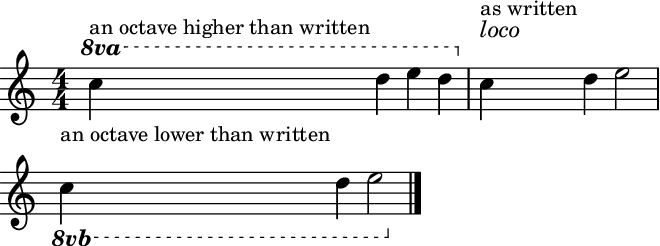
8va above the stave, with a dotted line marking its reach, means play an octave higher than written; the same sign below the stave, often written 8vb or 8va bassa, means an octave lower (Grade 3). The sign exists to rescue legibility: a passage that would sit on six ledger lines is written an octave nearer the stave and displaced by the sign instead. Loco, "in place", cancels the sign and returns the music to written pitch, though the end of the dotted line does the same job.
4.7 Common time and alla breve
Two time signatures wear symbols instead of numbers, both inherited from medieval notation. The broken circle C stands for 4/4, called common time (Grade 2). The same sign with a vertical stroke stands for 2/2, called alla breve or cut common time (Grade 4): the stroke halves the count and doubles the counting unit, so the bar is felt in two minim beats rather than four crotchets. The music inside the bar is identical either way; what changes is the pulse the player feels and the speed the beats imply.

4.8 Metronome marks and multiple-bar rests
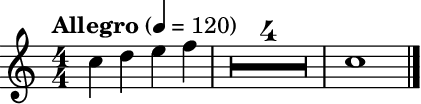
A metronome indication fixes tempo exactly: crotchet = 120 means 120 crotchet beats per minute, a rate a metronome can sound (Grade 2). It often follows a tempo word, the word giving the character and the number the precise rate. A multiple-bar rest condenses consecutive silent bars into one symbol with a count above it, so an orchestral part says "rest for 4 bars" in one bar's width (Grade 5). The player counts the printed number of bars and comes in.
4.9 Ornament signs
Grade 4 introduces the ornament signs; Grade 5 adds recognising them written out in full, and Grades 6 to 8 expect realisations in context. The six standard signs: the trill (tr), a rapid alternation of the written note with the note above; the turn, a four-note figure circling the written note (above, note, below, note); the upper mordent, a single rapid alternation with the note above; the lower mordent, the same zigzag sign with a vertical stroke, alternating with the note below; the acciaccatura, a small note with a stroke through its stem, crushed in as fast as possible; and the appoggiatura, a small note without a stroke, which leans on the beat and takes a substantial share, usually half, of the main note's value.

The realisation of each sign, with worked examples in context, is covered in the Grade 4 to Grade 8 volumes; the sign vocabulary above is what this dictionary owes you.
4.10 String players' signs
The Grade 5 syllabus lists the common string directions. The down bow sign (a squared bracket) and up bow sign (a V) mark bow direction. A small circle above a note means an open string or a natural harmonic. Pizz. switches from bowing to plucking; arco cancels it. Sul G keeps the passage on the G string for its darker colour, and the mute words (con sordino, senza sordino, French avec sourdines, sans sourdines) fit and remove the mute. At Grades 7 and 8 the vocabulary extends to double stopping, artificial harmonics (diamond note heads), sul tasto, sul ponticello and col legno.

4.11 Pianists' signs
The keyboard directions are Grade 5 material. A wavy vertical line before a chord spreads it, sounding the notes rapidly from the bottom up, an arpeggiated chord. Ped. marks where the sustaining pedal goes down and the flower-like asterisk where it comes up (modern scores often use a bracket line instead). Una corda calls for the soft (left) pedal, and tre corde releases it; the names were literal on the early piano, whose mechanism shifted the hammers to strike one string rather than three; the modern action strikes two of the three. M.d. (mano destra) and m.s. (mano sinistra) assign a passage to the right or left hand; French scores write m.d. and m.g. (main gauche).

4.12 Tremolo and glissando
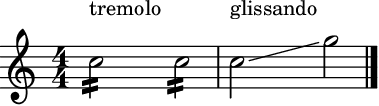
Both belong to the Grade 6 instrumental vocabulary. Tremolo, drawn as strokes through or beside a note's stem, is a rapid trembling: either one note reiterated as fast as possible, or two notes alternated. The strokes borrow beaming logic, each stroke standing for one level of subdivision. A glissando, a straight or wavy line between two note heads, slides continuously from the first pitch to the second, catching every pitch in between: a harpist's sweep, a trombone's slide, a pianist's dragged thumb.
4.13 Signs at Grades 7 and 8
The last two grades add signs read in orchestral scores rather than drawn by candidates. Grade 7: the harmonic circle and diamond note heads, reiteration slashes and the abbreviation conventions of string writing, and the layout words a 2, div., unis., tutti and muta met at Grade 6. Grade 8: the plus sign for a stopped horn note, with the circle sometimes cancelling it, flz. or frullato for flutter tonguing, and the foreign pitch names that function as signs in timpani tunings and horn crooks, German H for B natural and B for B flat, French and Italian sib and la♯. These are covered in full, with score extracts, in the Grade 7 and Grade 8 volumes.
5. Terms by grade
One checklist per grade, matching the official ABRSM lists. The lists are cumulative: everything below a grade's own list stays examinable at that grade. Grades 1 to 3 are Italian only; French joins at Grade 4 and German at Grade 5. A sign line at the end of each grade lists the notational signs the specification pairs with that grade. Where the printed lists repeat a word (the specification lists prestissimo at Grades 3 and 6, and tenuto appears among both the signs and the Grade 6 words), the repetition is kept here so each checklist matches its list.
5.1 Grade 1
| Term | Meaning |
|---|---|
| a tempo | back to the original speed |
| accelerando (accel.) | gradually getting faster |
| adagio | slow |
| allegretto | fairly quick |
| allegro | fast, lively |
| andante | at a medium walking pace |
| cantabile | in a singing style |
| crescendo (cresc.) | gradually getting louder |
| da capo (D.C.) | repeat from the beginning |
| decrescendo (decresc.) | gradually getting quieter |
| diminuendo (dim.) | gradually getting quieter |
| dolce | sweet, gentle |
| f (forte) | loud |
| ff (fortissimo) | very loud |
| fine, al fine | the end; to the end |
| legato | smooth |
| mf (mezzo forte) | moderately loud |
| moderato | at a moderate speed |
| mp (mezzo piano) | moderately quiet |
| p (piano) | quiet |
| pp (pianissimo) | very quiet |
| rallentando (rall.) | gradually getting slower |
| ritardando (ritard., rit.) | gradually getting slower |
| staccato (stacc.) | short, detached |
Signs at Grade 1: the crescendo and diminuendo hairpins, the slur, the tie, the staccato dot, the accent, and the pause.
5.2 Grade 2
| Term | Meaning |
|---|---|
| alla marcia | in the style of a march |
| allargando | broadening |
| con moto | with movement |
| con, col | with |
| dal segno (D.S.) | repeat from the sign |
| e, ed | and |
| espressivo (espress.) | expressively |
| fp (fortepiano) | loud, then at once quiet |
| grave | very slow, solemn |
| grazioso | graceful |
| largo | slow and broad |
| lento | slow |
| ma | but |
| meno | less |
| meno mosso | slower |
| molto | very, much |
| non troppo | not too much |
| più | more |
| più mosso | quicker |
| poco, poco a poco | a little; little by little |
| presto | very fast |
| ritenuto (riten., rit.) | held back at once |
| senza | without |
| vivace, vivo | lively, quick |
Signs at Grade 2: metronome indications, repeat marks, and the common time symbol.
5.3 Grade 3
| Term | Meaning |
|---|---|
| agitato | agitated |
| andantino | slightly faster than andante |
| animato | animated, lively |
| ben | well |
| con forza | with force |
| energico | energetic |
| giocoso | playful, merry |
| leggiero | light, nimble |
| maestoso | majestic |
| marcato (marc.) | marked, accented |
| pesante | heavy |
| prestissimo | as fast as possible |
| prima, primo | first |
| risoluto | bold, resolute |
| scherzando | playfully |
| semplice | simple |
| sempre | always |
| sforzando, sforzato (sfz, sf) | a sudden strong accent |
| simile (sim.) | continue in the same manner |
| sostenuto (sost.) | sustained |
| subito (sub.) | suddenly |
| tranquillo | calm |
| triste, tristamente | sad, sadly |
Signs at Grade 3: the strong accent, semi-staccato, staccatissimo, the tenuto line, and the 8va octave sign.
5.4 Grade 4
Italian
| Term | Meaning |
|---|---|
| affettuoso | tender |
| alla breve | two minim beats in a bar |
| amabile | pleasant |
| appassionato | with passion |
| assai | very |
| come prima | as before |
| comodo, tempo comodo | at a comfortable speed |
| con brio | with vigour |
| deciso | with determination |
| larghetto | rather slow, not as slow as largo |
| mesto | sad, mournful |
| misterioso | mysterious |
| ritmico | rhythmically |
| rubato, tempo rubato | with some freedom of time |
| stringendo | pressing on, getting faster |
French
| Term | Meaning |
|---|---|
| animé | animated, lively |
| douce | sweet, soft |
| lent | slow |
| modéré | at a moderate speed |
| retenu | held back |
| vite | quick |
Signs at Grade 4: the alla breve symbol, and the ornament signs (trill, turn, upper mordent, lower mordent, acciaccatura, grace notes, appoggiatura).
5.5 Grade 5
Italian
| Term | Meaning |
|---|---|
| a niente | to nothing |
| ad libitum (ad lib.) | at choice, freely |
| attacca | go straight on |
| cantando | singing |
| con dolore | with grief |
| con spirito | with spirit |
| doloroso | sorrowful |
| largamente | broadly |
| morendo | dying away |
| perdendosi | dying away to nothing |
| quasi | as if, almost |
| rinforzando (rf, rfz, rinf.) | a sudden stress |
| smorzando (smorz.) | dying away |
| sonoro | full-toned |
| sotto voce | in an undertone |
German
| Term | Meaning |
|---|---|
| langsam | slow |
| lebhaft | lively |
| mässig | at a moderate speed |
| ruhig | calm |
| schnell | fast |
| traurig | sad |
Signs at Grade 5: multiple-bar rests and volta brackets, plus the instrumental directions the specification sets here: pizzicato and arco, the up bow and down bow signs, con and senza sordino (sordini), avec and sans sourdines, sul G, una corda and tre corde, pedalling signs, con and senza pedale, mano sinistra (m.s.) and mano destra (m.d.), and arpeggiation.
5.6 Grade 6
Italian
| Term | Meaning |
|---|---|
| a piacere | at the performer's pleasure |
| adagietto | rather slow, less slow than adagio |
| affrettando | hurrying |
| amore | love |
| calando | dying away, quieter and slower |
| delicato | delicate |
| dolciss. (dolcissimo) | as sweetly as possible |
| dolente | sad, mournful |
| giusto | exact, strict |
| marziale | in a military style |
| mezza voce | at half voice |
| possibile | possible |
| prestissimo | as fast as possible (also listed at Grade 3) |
| seconda, secondo | second |
| soave | gentle, smooth |
| spiritoso | spirited |
| strepitoso | noisy, boisterous |
| tanto | so much |
| teneramente | tenderly |
| tenerezza | tenderness |
| tenuto | held for the full value (the sign appears among the Grade 3 signs) |
| volta | time (prima volta, seconda volta) |
French
| Term | Meaning |
|---|---|
| à | to, at |
| avec | with |
| doux | sweet, soft |
| encore | again, still |
| et | and |
| non | not |
| peu | little |
| plus | more |
| sans | without |
| très | very |
| un, une | one, a |
German
| Term | Meaning |
|---|---|
| Ausdruck, ausdrucksvoll | expression, expressively |
| ein | one, a |
| etwas | somewhat, rather |
| geschwind | quick |
| langsamer | slower |
| mit | with |
| nicht | not |
| ohne | without |
| rasch | quick |
| sehr | very |
| und | and |
| ziemlich | rather, fairly |
| zu | to, too |
Signs at Grade 6: the score-layout and technique signs a 2, I/II, div., unis., tutti, muta, tremolo and glissando.
5.7 Grade 7
Italian
| Term | Meaning |
|---|---|
| brillante | brilliant, sparkling |
| colla parte | follow the solo part |
| facile | easy, fluent |
| fuoco | fire |
| legg. (leggiero) | light, nimble (first listed at Grade 3; the abbreviation is new here) |
| l'istesso | the same |
| lunga, lunga pausa | long; a long pause |
| marc. (marcato) | marked (first listed at Grade 3; the abbreviation is new here) |
| ossia | an alternative version |
| piacevole | pleasant |
| pochettino (poch.) | a very little |
| pochiss. (pochissimo) | very, very little |
| segue | go straight on; continue likewise |
| sopra | above |
| veloce | swift |
French
| Term | Meaning |
|---|---|
| 1er mouvt. (premier mouvement) | at the first speed |
| assez | enough, fairly |
| au mouvt. (au mouvement) | back to the main speed |
| cédez | yield, hold back |
| en animant | becoming more lively |
| en serrant | pressing on |
| mais | but |
| moins | less |
| ralentir | slow down |
| sonore | full-toned |
| vif | lively, quick |
German
| Term | Meaning |
|---|---|
| aber | but |
| doch | yet, still |
| Empfindung | feeling |
| fröhlich | cheerful |
| gesangvoll | songlike |
| langsamer als | slower than |
| süss | sweet |
| voll | full |
| zart | tender, delicate |
Signs at Grade 7: harmonics (the circle and diamond note heads), open strings and double stopping, muting, and the reiteration and repeated-pattern signs.
5.8 Grade 8
Italian
| Term | Meaning |
|---|---|
| affrettare (affrettando) | hurrying (listed at Grade 6 as affrettando) |
| ancora | again, still |
| brioso | vigorous, spirited |
| calma | calm |
| calmato | calmed |
| doppio movimento | twice as fast |
| estinto | barely audible |
| incalzando | pressing forward |
| lacrimoso | tearful |
| legatissimo | as smoothly as possible |
| loco | at normal pitch |
| lusingando | coaxing |
| mancando | dying away |
| misura | strict time |
| nobilmente | nobly |
| parlando | in a speaking manner |
| piangevole | plaintive |
| precipitando | rushing headlong |
| scherzo, scherzoso | a joke; playful |
| stretto | quickening |
| tosto | swift (più tosto: rather) |
| volante | flying, very fast |
French
| Term | Meaning |
|---|---|
| en dehors | brought out |
| légèrement | lightly |
| modérément | moderately |
| peu à peu | little by little |
| presser, pressez | hurry, press on |
German
| Term | Meaning |
|---|---|
| bewegt | with movement, agitated |
| breit | broad |
| einfach | simple |
| gesprochen | spoken |
| immer | always |
| lebhafter | livelier |
| leicht | light |
| leise | soft |
| ruhiger | calmer |
| schleppend | dragging |
| schneller | faster |
| wenig | a little |
| wieder | again |
Signs at Grade 8: the stopped horn plus sign and its cancelling circle, flutter tonguing (flz., frullato), playing on the fingerboard (sul tasto), the advanced horn colours (bouché, cuivré, chiuso), and the foreign pitch names (H, B, sib, la♯) as they appear in tunings and crook changes.
6. Terms by meaning
Alphabetical order is for looking up; meaning order is for learning. This chapter regroups the whole vocabulary into working families. Within each family the three languages sit side by side, because lent, langsam and lento are one fact, not three.
6.1 Tempo, slowest to fastest
The Italian ladder, top to bottom. The rungs are conventional rather than precise, and neighbouring rungs overlap in practice; what the ladder fixes is the order.
| Rank | Term | Meaning | Grade |
|---|---|---|---|
| slowest | grave | very slow, solemn | 2 |
| largo | slow and broad | 2 | |
| lento | slow | 2 | |
| adagio | slow | 1 | |
| larghetto | rather slow | 4 | |
| adagietto | rather slow, less slow than adagio | 6 | |
| andante | at a medium walking pace | 1 | |
| andantino | a shade faster than andante (usually) | 3 | |
| moderato | at a moderate speed | 1 | |
| allegretto | fairly quick | 1 | |
| allegro | fast, lively | 1 | |
| vivace, vivo | lively, quick | 2 | |
| presto | very fast | 2 | |
| fastest | prestissimo | as fast as possible | 3 |
The French and German tempo words map onto the same ladder:
| Speed | French | German |
|---|---|---|
| slow | lent (4) | langsam (5) |
| moderate | modéré (4), modérément (8) | mässig (5) |
| lively | animé (4), vif (7) | lebhaft (5), bewegt (8) |
| quick | vite (4) | schnell (5), geschwind (6), rasch (6) |
6.2 Changing the tempo
| Change | Terms |
|---|---|
| slower, gradually | rallentando (1), ritardando (1), allargando (2, with fuller tone), calando (6, with fading tone), cédez (7), ralentir (7) |
| slower, at once | ritenuto (2), meno mosso (2), retenu (4), langsamer (6) |
| faster, gradually | accelerando (1), stringendo (4), affrettando (6), en serrant (7), en animant (7), incalzando (8), precipitando (8), presser (8), schneller (8) |
| faster, at once | più mosso (2), doppio movimento (8, exactly double), lebhafter (8) |
| back to speed | a tempo (1), come prima (4), au mouvement (7), premier mouvement (7), l'istesso tempo (7), tempo primo (beyond the lists) |
| free time | rubato (4), ad libitum (5), a piacere (6), senza misura (8) |
| strict time | tempo giusto (6), misura (8), ritmico (4) |
| warnings | non troppo (2), nicht schleppend (8: do not drag) |
The gradual words all describe processes, and composers place them where the process starts; the ear should notice the change beginning there, not a sudden gear shift. The instant words (ritenuto, più mosso) take effect on the note they mark. That single distinction, gradual against immediate, separates the most-confused pair in the book, ritardando and ritenuto, and chapter 7 returns to it.
6.3 Dynamics, softest to loudest
| Rank | Mark or term | Meaning | Grade |
|---|---|---|---|
| softest | estinto | barely audible | 8 |
| a niente | to nothing (the end point of a fade) | 5 | |
| pp | very quiet | 1 | |
| p | quiet | 1 | |
| mp | moderately quiet | 1 | |
| mf | moderately loud | 1 | |
| f | loud | 1 | |
| loudest | ff | very loud | 1 |
Around the ladder sit the hushed colours, sotto voce (5), mezza voce (6) and German leise (8); the full colours, sonoro (5), sonore (7) and voll (7); the fading family, morendo, perdendosi, smorzando (all 5), calando (6) and mancando (8); and the sudden strokes, fp (2), sforzando (3) and rinforzando (5). German dynamics build from leise and laut with the modifiers: immer leiser, quieter and quieter (8).
6.4 Mood and character
| Family | Terms |
|---|---|
| happy, playful | giocoso (3), scherzando (3), scherzoso (8), brioso (8), fröhlich (7) |
| sad, mournful | triste (3), mesto (4), doloroso (5), con dolore (5), traurig (5), dolente (6), lacrimoso (8), piangevole (8) |
| sweet, tender | dolce (1), douce (4), affettuoso (4), amabile (4), doux (6), soave (6), teneramente (6), con tenerezza (6), dolcissimo (6), süss (7), zart (7), lusingando (8) |
| majestic, bold | maestoso (3), risoluto (3), energico (3), con forza (3), deciso (4), con brio (4), marziale (6), nobilmente (8) |
| calm, simple | tranquillo (3), semplice (3), comodo (4), ruhig (5), soave (6), calma (8), einfach (8), ruhiger (8) |
| agitated, fiery | agitato (3), appassionato (4), con fuoco (7), bewegt (8), strepitoso (6), precipitando (8) |
| mysterious, dark | misterioso (4), sotto voce (5), mezza voce (6), estinto (8) |
| singing, speaking | cantabile (1), cantando (5), gesangvoll (7), parlando (8), gesprochen (8) |
6.5 Articulation and touch
| Touch | Terms and signs |
|---|---|
| joined | legato (1, and the slur), legatissimo (8), sostenuto (3), tenuto (3) |
| detached | staccato (1), staccatissimo (3), semi-staccato (3) |
| accented | accent (1), strong accent (3), marcato (3), sforzando (3), rinforzando (5) |
| light | leggiero (3), delicato (6), leicht (8), légèrement (8), volante (8) |
| heavy | pesante (3), breit (8) |
6.6 The small words
These attach to everything else, and the three languages run in parallel columns. Learn this table and whole families of compound instructions unlock at once.
| English | Italian | French | German |
|---|---|---|---|
| very | molto (2), assai (4) | très (6) | sehr (6) |
| a little | poco (2), pochettino (7) | peu (6), un peu (6) | etwas (6), wenig (8) |
| little by little | poco a poco (2) | peu à peu (8) | |
| more | più (2) | plus (6) | |
| less | meno (2) | moins (7) | |
| much, so much | molto (2), tanto (6) | ||
| always | sempre (3) | immer (8) | |
| again | ancora (8) | encore (6) | wieder (8) |
| and | e, ed (2) | et (6) | und (6) |
| but | ma (2) | mais (7) | aber (7), doch (7) |
| not | non (2) | non (6) | nicht (6) |
| too (much) | troppo (2) | zu (6) | |
| with | con, col (2) | avec (6) | mit (6) |
| without | senza (2) | sans (6) | ohne (6) |
| one, a | un, une (6) | ein (6) | |
| to, at | a (1, in a tempo) | à (6) | zu (6) |
| well | ben (3) | ||
| as if, almost | quasi (5) | ||
| enough, fairly | assez (7) | ziemlich (6) | |
| than | als (7, in langsamer als) |
6.7 Instructions about how and when to play
| Purpose | Terms |
|---|---|
| navigation | da capo (1), dal segno (2), fine, al fine (1), volta (6), volti subito (beyond the lists), al coda (beyond the lists) |
| continuity | attacca (5), segue (7), simile (3), come prima (4), come sopra (7) |
| alternatives | ossia (7), sopra (7) |
| ensemble | a due (6), divisi (6), unisono (6), tutti (6), solo, soli (beyond the lists), colla parte (7), tacet (beyond the lists), Generalpause (beyond the lists) |
| strings | pizzicato, arco, sul G, the mute words (all 5), sul tasto (8), sul ponticello, col legno (beyond the lists) |
| keyboard | una corda, tre corde, con and senza pedale, mano destra, mano sinistra (all 5), main gauche (beyond the lists) |
| voice and wind | sotto voce (5), mezza voce (6), parlando (8), gesprochen (8), Flatterzunge, frullato (8) |
7. False friends and confusables
Vocabulary marks are lost less often to ignorance than to confusion: two words half-known blur into one wrong answer. This chapter lists the pairs and families that examiners can rely on to catch the unwary, with the distinction stated as sharply as the words allow.
7.1 The classic pairs
| Pair | The difference |
|---|---|
| ritardando / ritenuto | both slow the music, but ritardando slows gradually and ritenuto holds back at once. The trap is the shared abbreviation rit.; when the abbreviation appears, the context (a hairpin-like process or a sudden marking) decides. |
| largo / larghetto | the -etto diminutive softens the word: larghetto is less slow than largo. |
| adagio / adagietto | same logic: adagietto is less slow than adagio. |
| andante / andantino | the treacherous one. By the usual convention andantino is slightly faster than andante (a "little walk" moves more lightly), but some composers meant slightly slower. State the usual reading first. |
| tenuto / sostenuto | tenuto is local, one note held for its full value; sostenuto is a manner, a passage played sustained throughout. |
| dolce / dolente | four letters apart and a world of difference: dolce is sweet, dolente is sad. Doloroso (sorrowful) belongs with dolente, from Italian dolore, grief. |
| assai / assez | Italian assai means very (allegro assai, very fast); French assez means enough, fairly (assez vite, fairly quick). The same Latin root drifted to different strengths in the two languages. |
| più / peu | near-identical on paper, opposite in force: Italian più is more, French peu is little. Un peu plus (a little more) uses both French words in one phrase. |
| presto / tosto | presto is the tempo word (very fast); tosto means swift but appears mostly in più tosto (rather), where speed is not the point at all. |
| stringendo / stretto | both from "tightening". Stringendo is a process, pressing the tempo forward; stretto is a state, and in fugue a technical device of overlapped entries. |
| scherzando / scherzo | scherzando is a manner, playfully; scherzo is a movement title (a joke). Scherzoso rejoins the manner side. |
| misterioso / misura | nothing in common but the opening letters: mysterious against strict time. |
| simile / segue | both continue something. Simile continues a manner just shown (keep the staccato going); segue continues into the next thing without a break, or continues an accompaniment pattern. |
| volta / volante / volti | three different words from turning and flying: volta is time (prima volta), volante is flying (light and fast), volti is turn the page (volti subito). |
| leise / leicht | German leise is soft (a dynamic); leicht is light (a touch). |
| doch / doux | German doch, yet; French doux, sweet. Sound-alikes across languages with nothing shared. |
| B / H | in German usage B is B flat and H is B natural. Reading a German B as B natural miscopies every timpani tuning it appears in. |
7.2 The dying-away family
Seven Italian words end the same way, in silence, and papers love them. The shades of meaning:
| Term | Shade |
|---|---|
| diminuendo | simply quieter; the neutral, mechanical word |
| morendo | dying: quieter, and usually slower, to the point of expiry |
| perdendosi | losing itself: the sound recedes into the distance |
| smorzando | smothered: damped, extinguished |
| calando | lowering: volume falls and the tempo usually eases with it |
| mancando | failing: the sound gives out |
| estinto | extinct: not a process but the destination, barely audible |
For exam purposes "dying away" earns the mark for any of the middle five; the distinctions above are for musicians rather than examiners. A niente, to nothing, names the end point and often follows a hairpin: dim. a niente.
7.3 The sudden-stroke family
fp, sfz and rf all interrupt the prevailing dynamic for a moment, and each does it differently. Fortepiano (fp) is two dynamics fused: the note starts loud and drops at once to quiet, with the drop as important as the strike. Sforzando (sfz, sf) forces a single strong accent; what follows carries on as before. Rinforzando (rf, rfz) reinforces, and can stretch over a short phrase rather than one note. The ordinary accent sign is the mildest of the four. None of them changes the underlying dynamic level: after the stroke, the music returns to whatever mark was in force.
7.4 One word, two jobs
A few list words carry two meanings, and the question "what does X mean?" needs the right one for the context. Rit. abbreviates both ritardando and ritenuto (see above). Segue means either "go straight on to the next movement" or "continue in the same style". Sostenuto names a manner, but on piano music sostenuto pedal names the middle pedal. Loco means "at normal pitch" after an octave sign, but appears in older scores meaning "in place" more generally. Volta is "time" in prima volta but survives in English usage in "volta brackets". And tempo itself means both speed in general (a tempo) and a movement's speed in particular (tempo primo, l'istesso tempo).
8. Test yourself
Fourteen questions, covering every chapter. Answers follow; attempt everything first.
- Translate the direction Langsam, mit Ausdruck, and name the language and the grades of its words.
- Translate cédez un peu, and explain what a player actually does.
- Arrange from slowest to fastest: presto, andante, largo, allegretto, prestissimo, moderato.
- Which is the quicker of each pair: largo or larghetto? adagio or adagietto? And what is awkward about andantino?
- State the difference between ritardando and ritenuto, and explain why the abbreviation rit. needs care.
- Parse sempre più forte e stringendo poco a poco word by word, then give the whole meaning.
- Give the Italian, French and German for "slow", and for "with".
- What do fp, sfz and rf have in common, and how does each differ from a plain accent?
- What does 8va below a group of bass notes mean? What cancels it? Which end of a hairpin is the loud end?
- A piece of 8 bars has Fine at the end of bar 4 and D.C. al Fine at the end of bar 8. Give the playing order and total bars sounded.
- False friends: what does assai mean, what does assez mean, and which languages do they belong to? Do the same for più and peu.
- In an orchestral horn part, what do a 2 and div. each tell the two players sharing the stave?
- What does senza misura ask for, and which two-word direction from the lists asks for the opposite?
- A movement marked crotchet = 60 reaches doppio movimento. What is the new speed, and what would l'istesso tempo have meant instead if the time signature changed from 4/4 to 2/2?
Answers
- German: "slow, with expression". Langsam is a Grade 5 word; mit and Ausdruck are Grade 6 words.
- French: "yield a little". The player eases the tempo back slightly, a gentle momentary relaxation rather than a full rallentando. Cédez is Grade 7, un and peu Grade 6.
- Largo, andante, moderato, allegretto, presto, prestissimo.
- Larghetto is quicker than largo; adagietto is quicker than adagio; the -etto diminutive always pulls the extreme back towards the middle. Andantino is awkward because convention says slightly faster than andante but some composers used it to mean slightly slower; the usual reading is faster.
- Ritardando slows gradually, as a process; ritenuto holds the tempo back at once, from the note it marks. Rit. abbreviates both, so the reader must judge from context which is meant.
- Sempre always, più more, forte loud, e and, stringendo pressing on, poco a poco little by little: "always louder, and pressing forward little by little". The two processes, growing louder and getting faster, run together.
- Slow: lento (also adagio, largo), lent, langsam. With: con (or col), avec, mit.
- All three are sudden, momentary dynamic strokes that leave the prevailing dynamic unchanged afterwards. Fp strikes loud and drops instantly to quiet; sfz forces one strong accent, stronger than the plain accent sign; rf reinforces a note or a short phrase, spreading its stress rather than striking once. The plain accent is the mildest single-note stress.
- 8va below bass notes means play an octave lower than written. Loco, or simply the end of the dotted line, cancels it. The wide end of a hairpin is the loud end.
- Bars 1 to 8, then bars 1 to 4 again, stopping at Fine: 12 bars sounded in all.
- Assai is Italian for "very"; assez is French for "enough, fairly". Più is Italian for "more"; peu is French for "little". Each pair looks related and is not interchangeable.
- A 2 tells both players to play the single written line together. Div. tells them to divide: one takes the upper notes, the other the lower.
- Senza misura asks for free, unmeasured time, with no strict beat. The opposite from the lists is tempo giusto, in strict time.
- Doppio movimento doubles the speed: the new rate is crotchet = 120. L'istesso tempo would have meant that the beat stays the same through the change: the minim of the new 2/2 takes the time the crotchet had, so the pulse continues unbroken even though the note values are relabelled.