Every instrument of the orchestra: how it works, what it plays, and how to read it
A working reference to the instruments of the orchestra and the conventions of the orchestral page: the four families and how each instrument makes its sound, the range of every standard instrument engraved on the stave, the transposing instruments and a step-by-step method for converting between written and sounding pitch, the voices and choral scoring, instrument names in four languages, and the skills of reading a full score from a string quartet to twenty-four staves.
Introduction
Open a full score for the first time and the page seems designed to repel you. Thirty lines of music run down the sheet, half of them in clefs you rarely read, several of them lying about their pitch, one of them in a language you may not speak. A clarinet part with two sharps sits above a horn part with none, and both are playing in the same key as the violins with their one flat. Nothing here is arbitrary. Every one of these conventions exists for the player's convenience, and each has a mechanical reason that can be learned once and applied everywhere.
This guide is about those reasons. An orchestral score is not a wall of information but a stack of small, regular systems: instruments appear in a fixed order, each family has its habits of clef and notation, and every transposing instrument obeys one rule so simple it can be stated in a sentence. A reader who knows what a horn in F actually does to a written note, and why, never again needs to memorise which way the transposition goes. A reader who knows why the viola uses the alto clef, or why the double bassoon is written an octave above its sound, reads those staves without translation.
The instruments themselves come first, family by family. Each one is described by its mechanism, because the mechanism explains the character: a reed explains the oboe's cut, a conical bore explains the horn's blend, a struck bar explains why the xylophone's notes die at once. Each instrument's range is engraved on the stave, written and sounding where the two differ, and the ranges are gathered again in a single sequence near the end for quick comparison. Alongside the ranges sit the techniques a score reader meets: double stopping and harmonics, mutes and stopped notes, divisi, tremolo, glissando, and the little Italian instructions that govern them.
The middle of the guide is practical. A transposition workshop works through every transposing instrument step by step, from written pitch to sounding pitch and back again, including the quiet cases that catch people out: the piccolo and the double bass, which transpose at the octave while claiming to be in C. A chapter on score reading then puts the families back together, from the four staves of a quartet to the twenty-four of a late Romantic full score, taking in rehearsal marks, cues, scores in C and scores written without key signatures.
The final chapters are for looking things up and for practice: the complete table of instrument names in English, Italian, French and German, every range chart on one page sequence, and a set of exercises in the style of ABRSM Grade 6 to 8 score questions, with full answers. Everything in the guide can be checked against a real score, and the best way to use it is with one open beside you.
How to use this guide
Chapters 1 to 7 are the instruments: the orchestra as a whole, then strings, woodwind, brass, percussion, the harp and keyboards, and the voices. Chapter 8 is the transposition workshop, and it is the chapter to work through with a pencil. Chapter 9 applies everything to the reading of full scores. Chapters 10 and 11 are pure reference, names and ranges, and chapter 12 is practice.
If you have a score open and a part you cannot place, go straight to the family chapter, or to chapter 10 if the instrument is named in German. If a transposing part is the problem, chapter 8 gives the method and chapter 11 the intervals. Exam candidates preparing the score questions of Grades 6 to 8 should read chapters 8 and 9 closely; they cover the instrument knowledge those questions assume.
Companion documents cover neighbouring ground. Music Notation explains the signs themselves, including the instrument-specific marks, bowing, pedalling and percussion noteheads, in its chapter 16. ABRSM Music Theory Grade 6, Grade 7 and Grade 8 apply this material to specific exam questions, grade by grade. Musical Harmony covers what the notes are doing while the instruments play them. Music Notation also covers the clefs in full; this guide assumes you can read treble, bass, alto and tenor clefs, and says which instruments use which.
A note on terms and notation
Naming follows British convention throughout: stave and bar for the page furniture, semibreve, minim, crotchet, quaver and semiquaver for the note lengths, leading note for the seventh degree, and sharpened and flattened for raised and lowered notes. Cadences are perfect, imperfect, plagal and interrupted. Pitches are described against middle C in the prose ("the F below middle C") and engraved exactly on the stave, so the pictures carry the precision and the words carry the sense. Intervals of transposition are named in full: a major 2nd, a perfect 5th, an octave.
Ranges given here are practical orchestral ranges, the compass a composer can write for a professional section without special arrangement. Almost every instrument can exceed them at the edges, upward more often than downward, and solo writing regularly does. Where an extreme matters, the text says so.
1. The orchestra
1.1 The four families
The symphony orchestra sorts its instruments by how they make sound, and the four resulting families behave differently enough that each needs its own chapter.
| Family | Sound source | Standard members |
|---|---|---|
| strings | a bowed or plucked string | violins I and II, violas, cellos, double basses |
| woodwind | air blown across an edge or through a reed | flutes and piccolo, oboes and cor anglais, clarinets and bass clarinet, bassoons and double bassoon |
| brass | the player's buzzing lips in a cup mouthpiece | horns, trumpets, trombones, tuba |
| percussion | a struck, shaken or scraped surface | timpani, plus definite and indefinite pitch instruments |
The harp, the piano and the celesta sit slightly apart: plucked or struck strings under keyboard or hand control, grouped on the page between the percussion and the strings. Voices, when an orchestral work uses them, sit just above the strings.
Each family also has a characteristic internal balance. The strings are the orchestra's foundation because they can sustain indefinitely, play at every dynamic, and divide into as many parts as the composer wants. The woodwind are soloists by nature: one player to a part, each with a distinct colour. The brass are the loudest family and the slowest to speak at low dynamics. The percussion are the only family whose core member, the timpani, was present from the orchestra's beginnings; the rest of the section is a later arrival.
1.2 The orchestra through history
The orchestra grew by accretion, and knowing the stages helps date any score at sight.
| Period | Typical forces | Marks of the period |
|---|---|---|
| Baroque, c. 1700 | strings and continuo, often 2 oboes, bassoon, sometimes 2 trumpets or horns and timpani | harpsichord continuo, figured bass, trumpet parts without valves |
| Classical, c. 1780 | 2 flutes, 2 oboes, 2 clarinets, 2 bassoons, 2 horns, 2 trumpets, timpani, strings | paired woodwind, horns and trumpets on natural instruments, timpani on tonic and dominant |
| Early Romantic, c. 1810 | the Classical pairs plus piccolo, double bassoon and 3 trombones | Beethoven's Fifth Symphony adds all three in its finale |
| Late Romantic, c. 1890 | woodwind in threes or fours, 4 to 8 horns, harps, large percussion | cor anglais, bass clarinet and tuba are regulars; Mahler and Strauss push past 100 players |
| Twentieth century onward | anything from chamber forces to the giant orchestra | percussion sections grow largest of all; scores often dispense with key signatures |
A few landmarks put flesh on the table. Haydn's London symphonies use the full Classical pairs. Berlioz's Symphonie fantastique of 1830 asks for two harps, a cor anglais, an E flat clarinet and two ophicleides, the tuba's predecessor. Wagner added a quartet of tubas of his own design to the Ring. Stravinsky's Rite of Spring wants woodwind in fives, including two double bassoons. None of these choices was decoration; each new instrument extended the orchestra's range outward, downward or louder.
1.3 Score order
A full score stacks the families in a fixed vertical order, high to low within each family. Once learned, the order lets you find any instrument on an unfamiliar page in seconds.
%%{init: {'theme':'neutral'}}%%
flowchart TD
  W["Woodwind<br/>piccolo, flutes, oboes, cor anglais,<br/>clarinets, bass clarinet, bassoons, double bassoon"]
  B["Brass<br/>horns, trumpets, trombones, tuba"]
  P["Percussion<br/>timpani first, then the rest"]
  H["Harp, celesta, piano"]
  V["Soloists and voices"]
  S["Strings<br/>violins I and II, violas, cellos, double basses"]
  W --> B --> P --> H --> V --> S
  classDef family fill:#dce8f5,stroke:#3b5f8a,stroke-width:2px
  class W,B,P,H,V,S family
Two details of the order are worth committing to memory. The horns sit at the top of the brass, above the trumpets, although the trumpets play higher; the horns' blending role with the woodwind earned them the position. And the timpani head the percussion whatever else the section contains. Within the strings, the double basses sit at the bottom of the page, usually bracketed with the cellos whose line they often double an octave down.
Each family is joined by a square bracket at the left margin, and instruments that share a stave in pairs are joined by braces where the layout needs them. Bar lines run through each family's block but break between families, which is what makes the blocks visible at a glance.
1.4 The conventions of the orchestral page
Orchestral parts double up on staves, and a handful of Italian and French instructions govern who plays what.
| Marking | Meaning |
|---|---|
| a2 | both players on this stave play the written line in unison |
| I. or 1. | first player only; the second rests |
| II. or 2. | second player only |
| solo | one player carries a featured line |
| tutti | everyone returns after a solo or a reduced passage |
| div. (divisi) | a string section splits: where two or more notes are printed, players divide them rather than double stopping |
| unis. (unisono) | the divided section rejoins on one line |
| muta in... | change: re-tune, change crook, or pick up a different instrument |
The muta instruction repays a moment's care, because it appears in three unrelated situations that share one word. A timpani part reading muta G in A tells the player to re-tune the G drum to A during the rest. A Classical horn part reading muta in E tells the player to change crook (chapter 4.2). A flute part reading muta in flauto piccolo tells the player to put down the flute and take up the piccolo, which is why piccolo and third flute are so often the same person. In each case the instruction sits in the empty bars before it takes effect, giving the player time to make the change.
One further habit of the page: when an instrument has nothing to play for a whole movement, many scores omit its stave entirely and reinstate it when it returns. The first page of a movement lists the full complement; after that, trust the margin labels.
1.5 Numbers and seating
A full symphonic string section runs to about 60 players against perhaps 20 wind and brass, and the imbalance is deliberate: one oboe balances sixteen first violins because a reed concentrates its energy where massed strings spread theirs. String players sit in pairs at desks sharing a stand, and instructions like div. are executed by desk or by player within the desk. The standard modern seating puts first violins at the conductor's left, cellos or second violins at the right depending on the layout, woodwind in two rows facing the conductor, brass and percussion behind, basses along the back or side.
| Section | Typical symphonic strength |
|---|---|
| first violins | 16 |
| second violins | 14 |
| violas | 12 |
| cellos | 10 |
| double basses | 8 |
The wind sit in a fixed formation of their own: flutes and oboes in the front row, clarinets and bassoons behind them, each principal on the inside where the four can hear one another. Knowing the seating is not merely concert lore; it explains why scores mark 1. Pult (first desk) in divided string passages, and why antiphonal effects between first and second violins appear in scores from eras when the two sections faced each other across the platform.
2. Strings
2.1 How the family works
A string instrument is a wooden box amplifying four stretched strings. The pitch of a string depends on its length, its tension and its mass: shorten it under a finger and the pitch rises. The four strings are tuned a 5th apart on violin, viola and cello, and a 4th apart on the double bass, whose player's hand cannot stretch the wider spacing at that string length.
The bow is the family's engine. A bowed string can sustain a note indefinitely, swell and fade within it, and restart it in either direction, which is why the strings can imitate breathing without needing breath. Plucking (pizzicato) trades that sustain for a percussive attack that dies quickly. Everything else in string technique, from harmonics to playing near the bridge, is a way of changing which vibrations of the string reach the box.
The section divides into five parts: first violins, second violins, violas, cellos and double basses. A full professional section runs to about 16 first violins down to 8 double basses; the notation for one player and for sixteen is identical, which is one of the quiet conveniences of the family.
2.2 The violin
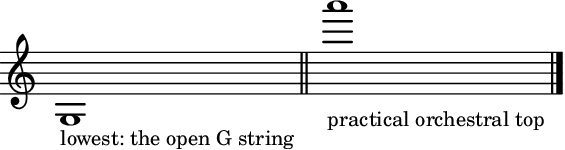
The violin is the orchestra's treble voice and its largest single body of players. Its strings are tuned G, D, A, E: the G below middle C, then the D and A above it, then the E an octave and a third above middle C. It reads the treble clef only.
The practical range runs from that open G, which is the instrument's floor, to the A two octaves above the open A, and solo writing goes higher still. The lowest string cannot be shortened, so nothing below the open G is possible; the top has no hard limit beyond control and taste.
2.3 The viola
The viola is tuned a perfect 5th below the violin, C, G, D, A: the C an octave below middle C upward. Its body is slightly too small for its tuning, a compromise that keeps it playable on the arm, and the resulting veiled, nasal warmth is the sound composers seek from it.
The viola is the home of the alto clef, with middle C on the third line; without it the part would live on ledger lines. High passages change to the treble clef rather than pile ledger lines above the alto stave. The practical range runs from the open C to the C two octaves above middle C, with solo writing reaching higher.

2.4 The cello
The cello is tuned an octave below the viola, C, G, D, A: the C two octaves below middle C upward. It reads the bass clef for most of its work, changes to the tenor clef, middle C on the fourth line, for its upper-middle register, and to the treble clef for real heights. The three clefs are not decoration; a cello line that stayed in the bass clef would spend half its life above the stave.
The practical orchestral range runs from the open C to the A above middle C, and solo writing regularly exceeds that by an octave. The cello section carries the orchestra's bass line in partnership with the double basses, and its tenor register, sonorous and vocal, is one of the most borrowed solo colours in the repertoire.

2.5 The double bass
The double bass is the orchestra's true bass and its one habitual octave transposer among the strings. Its strings are tuned in 4ths, E, A, D, G, and it sounds an octave lower than written: the part is notated in the bass clef an octave above the sound to keep it on the stave. A written bottom E sounds the E two octaves and a sixth below middle C.
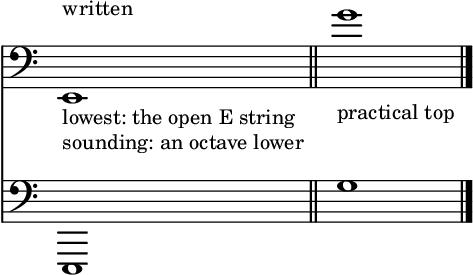
Many instruments carry a low C extension or a fifth string taking the compass down to sounding C, a 3rd below the standard floor; scores that want those notes say so. When the basses double the cellos, the standard Classical texture, the two sections read the same written line and sound in octaves. That is why the low string parts of Haydn and Mozart are printed on one shared stave marked Violoncello e Basso.
2.6 Open strings and double stopping
The sixteen open strings of the four string instruments are worth engraving in one place, because so much string technique refers back to them.

An open string rings freer and louder than a stopped note and cannot be varied with vibrato. Composers exploit both facts: sul G, "on the G string", asks the violinist to keep a melody on one string for its darker weight, and a score marking an open string deliberately (the sign is a small circle, shared with the harmonic sign) wants its ringing quality.
Double stopping is the playing of two strings at once with one bow; three and four strings extend the idea into chords. The mechanics set the rules. Two adjacent strings can sound together and sustain together. Three and four cannot, because the bridge is curved, so chords of three and four notes are spread, usually bottom up, the bow settling on the top two notes. For a chord to be possible at all, each note must be playable on its own string with the hand in one position: pairs involving an open string come almost free, fingered pairs are comfortable from a 3rd to an octave, and anything past a 10th is out of reach without an open string. When a passage in double stops is beyond the section, or simply needs to be cleaner, the composer writes div. instead (chapter 2.10).

2.7 Harmonics
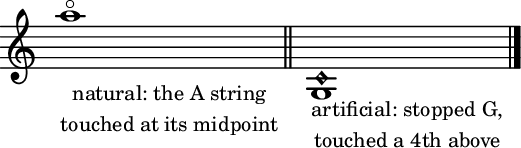
Touch a string lightly at its midpoint, without pressing it to the fingerboard, and it sounds an octave above its open pitch with a pure, flute-like tone. The light touch splits the string's vibration into halves. Touching at a third of the length gives a 12th above the open string, at a quarter two octaves. These are natural harmonics, marked with a small circle over the note or with a diamond notehead at the touching point.
Artificial harmonics apply the same trick to a stopped note: the first finger stops the string firmly and the fourth finger touches lightly a perfect 4th above, printed as a diamond. The sound is two octaves above the stopped note. The notation shows both fingers, normal notehead below, diamond above, and the sounding pitch is left to the reader, which is exactly the kind of conversion exam score questions like to ask about.
2.8 Pizzicato, arco and the bow strokes
Pizz. instructs the player to pluck; arco cancels it and returns to the bow. Both are written under the stave at the moment of change, and the pizzicato lasts until cancelled, a rule that catches out readers who forget an arco twenty bars back. Left-hand pizzicato, marked +, appears in solo writing.
Bowing signs are covered in Music Notation chapter 16; the ones a score reader must recognise are the down-bow and up-bow signs, slurs binding notes into one bow, the dots and dashes of detached and carried strokes, and tremolo, the rapid repetition of one note shown by slashes through the stem. Unmeasured tremolo is an effect; measured tremolo, with a stated number of slashes, means exact repeated demisemiquavers or faster.
Glissando, a slide between two written notes along the string, is marked with a straight line and the abbreviation gliss.; the related portamento is the singer's and string player's expressive slide into a note, implied or marked port. rather than fully notated. Both are effects of the fingerboard, and both survive transposition questions untouched, since the printed endpoints obey the part's ordinary rules.
2.9 Mutes and bow position
Con sordino (or con sord.) instructs the string player to fit the mute, a small clamp on the bridge that absorbs the higher partials and turns the tone silvery and distant; senza sordino removes it. The change takes a second or two, and considerate composers leave a rest for it. French scores write avec sourdines and sans sourdines.
Where the bow meets the string changes the tone without any mute. Sul ponticello, bowing close to the bridge, produces a glassy, metallic sound rich in high partials; sul tasto, bowing over the fingerboard, produces a flutey softness with the partials suppressed. Naturale or ord. cancels either. Col legno, "with the wood", strikes or draws the bow stick itself against the string, a dry rattle much loved by composers of the macabre; Berlioz uses it in the witches' sabbath finale of the Symphonie fantastique, and Holst builds the opening of Mars on it.
2.10 Divisi
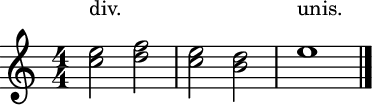
When a string part carries two or more simultaneous notes, the section either double stops them or divides. Div. settles it: the players split, typically by desk, half taking the upper note and half the lower. Unis. rejoins them. For divisions into more than two, scores write div. a 3 or give each part its own stave. Divisi thins the tone as it thickens the harmony, since fewer players carry each line, and composers choose between div. and double stops with exactly that trade in mind.
3. Woodwind
3.1 How the family works
Every woodwind instrument is a tube in which a column of air vibrates; the player shortens the effective tube by opening holes, and overblows the column into its higher modes to reach upper registers. What varies is how the vibration starts, and that difference is the family's map:
- the flute and piccolo are edge-blown: the breath splits on the far edge of the mouth hole, and there is no reed at all;
- the oboe, cor anglais, bassoon and double bassoon use a double reed, two shaved cane blades bound face to face that beat against each other;
- the clarinet family uses a single reed, one cane blade beating against a solid mouthpiece.
Reed type shapes tone: the double reed gives a concentrated, slightly nasal sound that carries through any texture, the single reed a rounder, hollower one. All the winds articulate with the tongue, and all can flutter tongue, rolling an R into the airstream for a buzzing tremolo, notated with tremolo slashes plus the instruction flatterzunge (Flz.), frullato or simply flutter; the technique is a Grade 7 score-reading item and appears in brass parts as readily as in flutes. Bore shape matters just as much. The clarinet's cylindrical bore suppresses the even-numbered harmonics in its low register, which is why it overblows at the 12th rather than the octave and why its bottom register, the chalumeau, sounds so unlike any other woodwind. The conical bores of oboe and bassoon overblow at the octave.
Woodwind players sit one to a part, and scores number them: Flute 1, Flute 2. The auxiliary instruments, piccolo, cor anglais, bass clarinet, double bassoon, are usually taken by the second or third player of the parent instrument, switching on a muta instruction.
3.2 Flute and piccolo
The flute is a non-transposing treble instrument reading the treble clef. Its practical range runs from middle C to the C three octaves above, with the D above that available; instruments with a B foot joint reach the B below middle C. The bottom octave is weak and breathy but uniquely warm, the top octave brilliant and penetrating, and a scorer who buries the flute's low register under full strings has wasted a player.
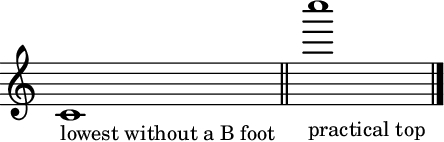
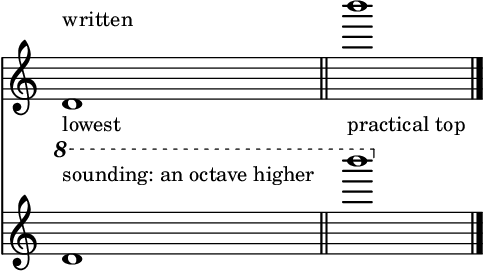
The piccolo is half the flute's size and sounds an octave higher than written; its part is written an octave low, in C, to spare the copyist endless ledger lines. Written like the flute from the D above middle C, it sounds from the D an octave higher and tops the orchestra's entire compass. Its lowest written octave is quiet and dry; its top sounding octave rides over a full orchestral tutti.
3.3 Oboe and cor anglais
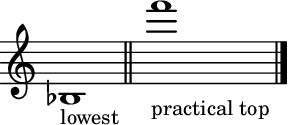
The oboe is the double-reed treble, non-transposing, treble clef. Its practical range runs from the B flat below middle C to the F two and a half octaves above it, with higher notes possible and rarely lovely. The tone is focused and expressive, made for the singing line; it is also stable in pitch, which is why the orchestra tunes to the oboe's A.
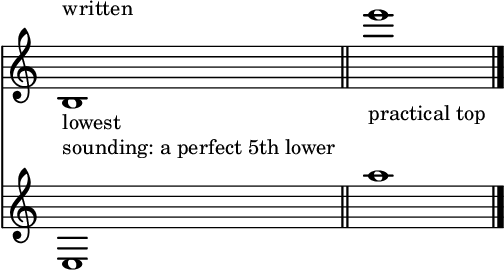
The cor anglais is the alto oboe, a 5th deeper, with a bulbous bell and a darker, more covered tone. It is a transposing instrument in F, sounding a perfect 5th lower than written, reading the treble clef. Its written range mirrors the oboe's fingering, from the B below middle C to the E two octaves and a fourth above; the sound falls a 5th below all of it. The famous solos, Dvořák's New World Symphony among them, sit in its rich written middle register.
3.4 The clarinet family
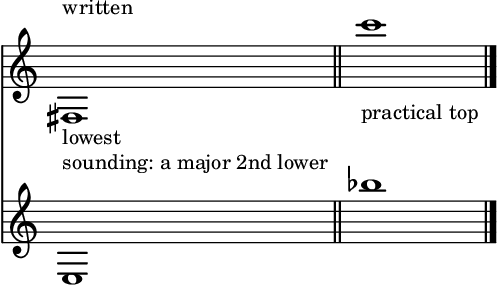
The clarinet in B flat is the standard orchestral clarinet, a transposing instrument sounding a major 2nd lower than written, treble clef. Its written range runs from the E below middle C up to the G three octaves and a third above (higher is possible), and every note of it sounds a tone lower. The register break between the chalumeau and the upper (clarino) register falls at the top of the throat notes, around the written B flat above middle C: the instrument overblows at the 12th, so the clarino register begins a 12th above the bottom E. The instrument's uniquely wide dynamic range, down to a real pianissimo no other wind matches, makes it the family's chameleon.
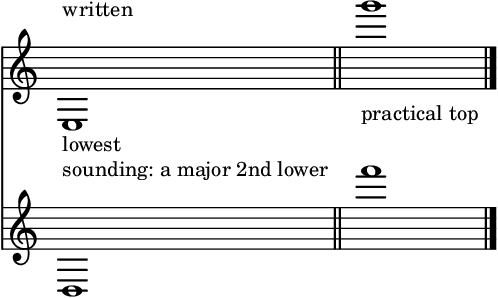
The clarinet in A, identical to look at, sounds a minor 3rd lower than written. Composers choose between the pair by key: sharp keys sit better on the A instrument, flat keys on the B flat, because each subtracts its transposition from the written key signature (chapter 8.5). Beethoven, Brahms and Mahler switch between them constantly, and muta in A in a clarinet part means exactly that switch.
The small clarinet in E flat sounds a minor 3rd higher than written: bright, hard and slightly shrill, the family's piccolo. Berlioz gives it the distorted love theme in the finale of the Symphonie fantastique.
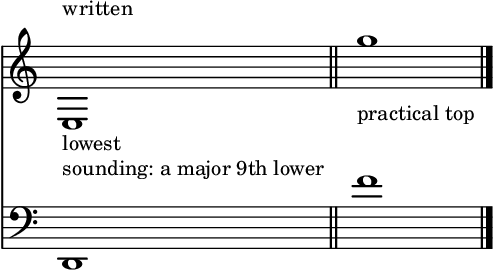
The bass clarinet, in B flat an octave below the standard instrument, is normally written in the treble clef sounding a major 9th lower, an octave plus the familiar tone. (Some German-tradition scores write it in the bass clef a major 2nd above the sound; the treble-clef convention is the one ABRSM sets.) Its written range matches the ordinary clarinet's fingerings from written E upward; the sounding result reaches the D two octaves below middle C. The tone is soft-edged, deep and slightly sinister, and it walks through the low register of Wagner and Mahler.
3.5 Bassoon and double bassoon
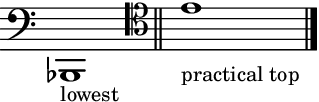
The bassoon is the double-reed bass, non-transposing, reading the bass clef and changing to the tenor clef for its upper register. The practical range runs from the B flat two octaves and a tone below middle C to the E above middle C, and solo writing goes higher: Stravinsky opens the Rite of Spring on the bassoon's extreme top, precisely because it sounds strained there. The instrument's dry staccato and its plaintive tenor register are its two most-used colours.
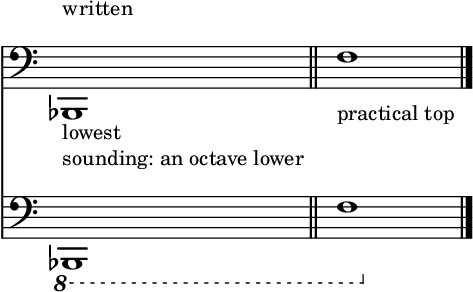
The double bassoon (contrabassoon) doubles the bassoon an octave down and is written like the double bass: bass clef, sounding an octave lower than written. Its written range occupies the bassoon's lower register; its sound extends to the very bottom of the orchestra, below the double basses. It speaks slowly and is happiest reinforcing a bass line rather than carrying one alone.
3.6 The woodwind transpositions in one table
| Instrument | Written clef | Sounds |
|---|---|---|
| piccolo | treble | an octave higher |
| flute | treble | as written |
| oboe | treble | as written |
| cor anglais | treble | a perfect 5th lower |
| clarinet in E flat | treble | a minor 3rd higher |
| clarinet in B flat | treble | a major 2nd lower |
| clarinet in A | treble | a minor 3rd lower |
| bass clarinet in B flat | treble | a major 9th lower |
| bassoon | bass, tenor | as written |
| double bassoon | bass | an octave lower |
4. Brass
4.1 The harmonic series, the family's raw material
A brass instrument is a long tube that the player's buzzing lips can set vibrating at any of its natural modes. Those modes form the harmonic series: on a tube in C, the available notes rise from the fundamental through the octave, the 12th, the double octave, and onward, crowding closer together as they climb.

Two facts about the series drive everything in brass writing. First, the low modes lie far apart, so a natural (valveless) instrument can play only arpeggio notes down low and stepwise music only near the top; that is why Baroque trumpet parts sit so high. Second, the seventh and eleventh notes of the series fall between the cracks of notation, audibly flat and sharp respectively, so even the natural instrument's scale had holes in it.
Valves, arriving in the 1820s, solved both problems by adding lengths of tubing that lower the whole series by a semitone, a tone or a minor 3rd; combinations fill in the chromatic scale. The trombone had solved the problem centuries earlier with its slide, which changes the tube length continuously. Every modern brass part assumes a fully chromatic instrument; every transposition convention in brass parts is a fossil of the valveless era.
4.2 The horn and its crooks
The horn (often called the French horn) is the mellowest of the brass, its conical bore and backward-facing bell blending it with woodwind and strings alike. It reads the treble clef, with bass clef for its lowest reaches, and the modern instrument is in F, sounding a perfect 5th lower than written. The practical written range runs from the C an octave below middle C to the C two octaves above middle C, sounding a 5th lower throughout.
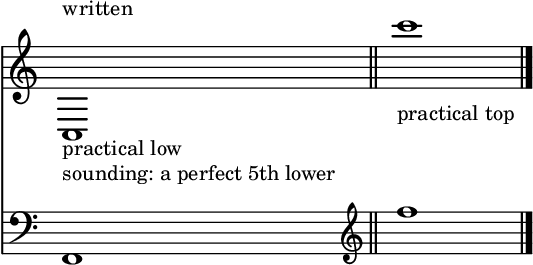
Before valves, a horn player carried crooks, interchangeable loops of tubing that put the instrument's harmonic series into the key of the movement. A Classical or early Romantic part is headed Corno in E flat, in D, in G as the work requires, and the part is then written in C, mostly without a key signature, leaving the crook to supply the actual key. Each crook has its own transposition, and reading Classical horn parts means knowing them:
| Crook | Written C sounds | Interval down from written |
|---|---|---|
| horn in G | G below | a perfect 4th |
| horn in F | F below | a perfect 5th |
| horn in E | E below | a minor 6th |
| horn in E flat | E flat below | a major 6th |
| horn in D | D below | a minor 7th |
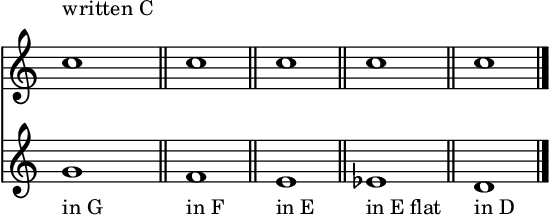
The crook system explains a habit that survives today: horn parts are still usually written without key signatures, accidentals supplied as needed. It also explains muta in E in a horn part, an instruction to change crook that lingered into the valve era as an instruction to transpose.
Old scores add one more trap: in the bass clef, horn parts were traditionally written an octave lower than the treble-clef convention, so an old-notation bass-clef horn note sounds a perfect 4th higher than written. Modern editions usually print new notation and say so; when a low horn note looks impossibly deep, suspect old notation.
4.3 Stopped notes and mutes
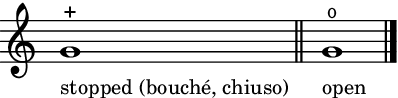
The horn player's right hand lives in the bell, shading pitch and tone. Pushed fully in, it stops the instrument: the sound turns tight, brassy and metallic, and carries astonishingly. The sign is + over the note, cancelled by o for open; the Italian is chiuso, the French bouché. Cuivré, "brassy", asks for the metallic edge at any dynamic, with or without full stopping. These three terms are Grade 8 vocabulary and they cluster in French scores, Debussy and Ravel especially.
All brass can also be muted with an object in the bell. The straight mute, a truncated cone, is the orchestral default, giving a pinched, distant tone; con sordino and senza sordino apply and remove it, and unmarked "mute" means straight. The harmon mute, a hollow metal shell sealing the bell with an adjustable central stem, gives the buzzing, wa-wa colour of jazz trumpet sections; removed-stem harmon is the Miles Davis sound. Cup, plunger and bucket mutes fill out the jazz and theatre palette. Mutes take a hand from the player and a second or two of rest, which is why sord. markings sit early in a rest bar.
4.4 The trumpet
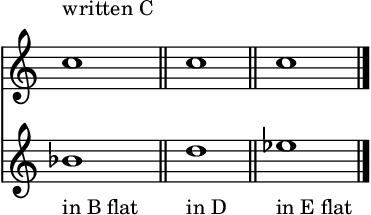
The trumpet is the brass treble, cylindrical-bored and brilliant. The standard orchestral instrument is in B flat, sounding a major 2nd lower than written, treble clef; its practical written range runs from the F sharp below middle C to the C two octaves above, the top reachable by professionals and hazarded by everyone else.
Like the horn, the valveless trumpet came in crooks, and parts survive in many keys; ABRSM's Grade 7 syllabus names the trumpet in D and in E flat alongside the B flat instrument. The trumpet in D sounds a major 2nd higher than written, the trumpet in E flat a minor 3rd higher: small, bright instruments pitched above C rather than below it. The modern trumpet in C, common in American and French orchestras, sounds as written.
| Trumpet | Written C sounds |
|---|---|
| in B flat | B flat below: a major 2nd lower |
| in C | C: as written |
| in D | D above: a major 2nd higher |
| in E flat | E flat above: a minor 3rd higher |
4.5 The trombones
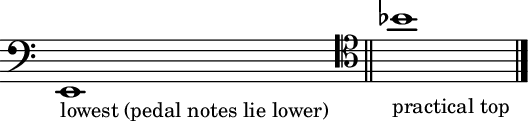
The trombone replaces valves with a slide and has therefore always been chromatic; it is also, mercifully, non-transposing: what is written is what sounds. The tenor trombone reads the bass clef, moving to the tenor clef (occasionally the alto) when the line climbs. Its practical range runs from the E an octave and a sixth below middle C to the B flat above middle C, plus a detached set of pedal notes, the fundamentals of each slide position, from the B flat two octaves and a tone below middle C downward.
The bass trombone, with a wider bore and valve attachments, extends the compass downward toward the pedal register and thickens the section's bottom. The classical section is two tenors and a bass, written on two staves or three. The alto trombone, reading the alto clef, appears in Classical and early Romantic scores, Beethoven's Fifth among them, taking the top of the section.
Trombones entered the symphony late, through the church and the opera pit: Beethoven's Fifth introduced them to the symphony in 1808, and their long association with the sacred and the supernatural, Mozart's Requiem, the Commendatore in Don Giovanni, still colours how composers deploy them.
4.6 The tuba
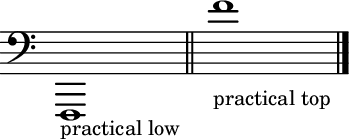
The tuba anchors the brass, one player in the standard orchestra, reading the bass clef and sounding as written. Builders make tubas in several sizes (instruments in E flat, F, C and B flat are all common), but unlike the trumpet the orchestral tuba part is always written at concert pitch; the player, not the copyist, handles the instrument's own fingering. The practical range runs from the F two octaves and a fifth below middle C to the F above middle C, with both extremes extensible by good players. Its tone is round and enveloping rather than brazen; it blends with the horn family as readily as with the trombones, and Wagner, Bruckner and Mahler write for it as a singing bass voice, not a foghorn.
5. Percussion
5.1 Definite and indefinite pitch
The percussion section divides cleanly in two. Instruments of definite pitch produce identifiable notes and read real staves: timpani, xylophone, marimba, glockenspiel, vibraphone, celesta, tubular bells, and others. Instruments of indefinite pitch produce unpitched sounds, read a percussion clef with lines assigned by legend, and include the side drum, bass drum, cymbals, triangle, tambourine, castanets and tam-tam. The distinction is the first thing ABRSM asks about the section, and it is occasionally blurred in practice: a tam-tam has a pitch of a sort, but no one writes it a melody.
| Definite pitch | Indefinite pitch |
|---|---|
| timpani | side drum (snare) |
| xylophone | bass drum |
| glockenspiel | cymbals (clash and suspended) |
| vibraphone | triangle |
| marimba | tambourine |
| celesta | castanets |
| tubular bells | tam-tam (gong) |
One player covers many instruments; a percussion part is a job description, not an instrument. Timpani are the exception, a dedicated player and a dedicated stave, listed first in the section by right of seniority.
5.2 Timpani
The timpani (kettledrums) are bowls of stretched membrane tuned to precise pitches, the only drums of the Classical orchestra. A Classical pair was tuned to tonic and dominant and retuned between movements by hand screws; the modern orchestra uses four or more pedal-tuned drums that can change pitch mid-phrase, even glissando. The part reads the bass clef at sounding pitch, traditionally without a key signature, the tuning declared at the start (Timpani in G, d) or changed in rests by muta G in A.
Each drum size covers roughly a 5th, and the standard set of four covers the octave and a half from the D almost two octaves below middle C to the A below middle C:
| Drum | Usual compass |
|---|---|
| 32 inch | D up to A, the bottom of the set |
| 29 inch | F up to the C above |
| 26 inch | B flat up to the F above |
| 23 inch | D up to A, an octave above the largest drum |

Rolls are written as tremolo slashes or trills and sustain the sound of an instrument that otherwise decays quickly. Beethoven made the timpani a motivic voice (the drum solo that opens the Violin Concerto); Berlioz asked for chords from multiple players; the instrument has never since been mere punctuation.
5.3 The tuned mallet instruments and their octave transpositions
Three of the tuned percussion are written below their sound, exactly as the piccolo is, to keep ledger lines in check; the syllabus names them for "occasional transposition" questions at Grade 7 and more frequent ones at Grade 8.
| Instrument | Material | Sounds | Character |
|---|---|---|---|
| glockenspiel | steel bars | two octaves higher than written | bright, bell-like, long ring |
| xylophone | wooden bars | an octave higher than written | dry, hard, instant decay |
| celesta | steel bars struck via a keyboard | an octave higher than written | soft, glassy, touch-controlled |
| marimba | wooden bars over resonators | as written | mellow, round, darker than xylophone |
| vibraphone | metal bars with motorised resonators | as written | sustained, pulsing when the motor runs |
| tubular bells | hanging metal tubes | as written | church-bell clang |
The mechanism behind the difference is size: small high bars produce sounds so far above the stave that honest notation would be unreadable, so the copyist drops the written part an octave or two and the reader is trusted to remember. The marimba and vibraphone sit low enough to be written honestly. Repertoire fixed each colour early: Saint-Saëns's Danse macabre made the xylophone the orchestra's rattling skeleton, and the glockenspiel glitters through Dukas's The Sorcerer's Apprentice.
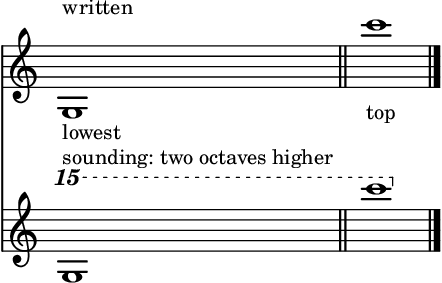
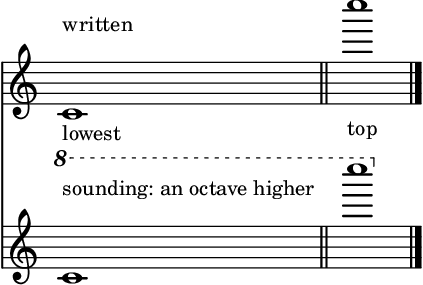
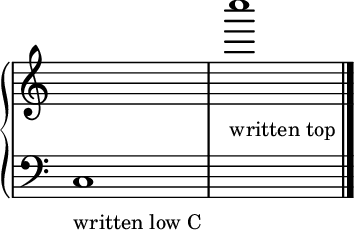
The celesta looks like a small upright piano and is played by a keyboardist, usually listed with the keyboards on the page but belonging acoustically here: hammers strike steel bars over resonators. It reads two staves like a piano and sounds an octave above the written notes. Tchaikovsky introduced it to the wide public in the Sugar Plum Fairy's dance in the Nutcracker.

5.4 The indefinite pitch instruments
The unpitched instruments need less theory and more vocabulary. The side drum (snare drum) carries wires across its lower head that rattle against it, giving the crisp military crackle; rolls are its natural speech. The bass drum supplies weight and dread at the bottom of the section. Cymbals come as a clashed pair or as a single suspended cymbal rolled with soft sticks, two different instruments in effect. The triangle cuts through any tutti; the tambourine adds jingles to a shaken or struck frame; castanets click in pairs, Spain on demand; the tam-tam is the flat-faced gong whose crash and long bloom mark catastrophes and ends of worlds.
On the page these instruments occupy single lines or a shared percussion stave with a legend, and their parts are rhythm, dynamics and stick instructions. Music Notation chapter 16 covers the notehead conventions.
5.5 The percussion section on the page
Percussion sits below the timpani and above the harp in the score. Common layouts give each instrument its own line, or group the unpitched instruments onto one or two staves with a written legend at the first entry. Parts name the player, not the instrument (Percussion 1, 2, 3), and a single player's line may change instrument every few bars, with muta-style warnings and the instrument named at each entry. Tuned percussion read normal clefs; remember which three transpose (glockenspiel, xylophone, celesta) and the section holds no further reading traps.
6. Harp, piano and other keyboards
6.1 The harp: mechanism first
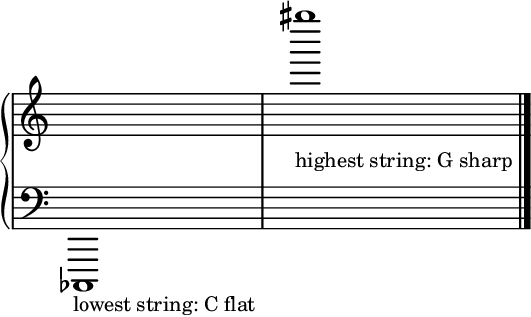
The orchestral harp has 47 strings, one per diatonic note across six and a half octaves, from the C flat three octaves below middle C to the G sharp three octaves and a fifth above it. There are no strings for chromatic notes; instead, seven pedals, one per letter name, each with three notches, retune every string of that letter at once. Left foot D, C, B; right foot E, F, G, A. Pedal up gives the flat, the middle notch the natural, pedal down the sharp. The instrument's home scale with all pedals up is therefore C flat major.
Everything idiomatic about harp writing follows from the pedal mechanism:
- The harp is a diatonic instrument that can be set to any scale, not a freely chromatic one. Rapid chromatic passages force pedal changes at speed and eventually become impossible; composers list pedal settings at the start and mark changes in rests.
- Glissando is the signature effect: a sweep across the strings sounds whatever scale the pedals currently spell. Because enharmonic doublings are available (C flat is the same sound as B natural), the pedals can tune the whole instrument to a seven-string set containing only the notes of, say, a dominant seventh chord, and the glissando becomes an arpeggio wash.
- Chords of more than four notes per hand are impossible (the little finger is not used); wide spreads are normal, and près de la table, playing near the soundboard, gives a guitar-like colour. Harmonics, marked with the circle, sound an octave above the written note.
The harp reads two staves like a piano, sounds as written, and sits between percussion and strings in the score. Berlioz asked for two; Mahler and Strauss made the pair standard.
6.2 The piano as an orchestral instrument
Inside the orchestra the piano is a percussion-adjacent colour, not a soloist. Twentieth-century scores use its attack to edge string basses (Petrushka gives it a starring section role), its bass register for bell effects, its extreme treble for glitter. It reads its usual two staves and sounds as written, and its 88 keys run from the A three octaves and a third below middle C to the C four octaves above, the widest standard compass in the orchestra. In scores it sits with the harp and celesta. The organ, where a work includes it (the Saint-Saens Third Symphony, the Also sprach Zarathustra sunrise), brings its own staves, its pedal line and a range extended by stops far beyond its written notes.
6.3 Which keyboard is which
| Instrument | Staves | Sounds | Orchestral role |
|---|---|---|---|
| piano | 2 | as written | percussion colour, rhythmic edge |
| celesta | 2 | an octave higher | glassy sweetness (chapter 5.3) |
| organ | 3 | as written (stops add octaves) | mass and grandeur |
| harpsichord | 2 | as written | continuo in Baroque scoring |
7. Voices
7.1 The six voice types
Choral and orchestral vocal writing recognises six standard types, three female and three male, each with a practical range about a 13th wide. The ranges below are the working choral compasses; trained soloists extend them at both ends.
| Voice | Practical range |
|---|---|
| soprano | middle C to the A above the treble stave |
| mezzo-soprano | the A below middle C to the F at the top of the treble stave |
| alto (contralto) | the F below middle C to the D on the fourth line of the treble stave |
| tenor | the C an octave below middle C to the A above middle C |
| baritone | the A an octave and a third below middle C to the F above middle C |
| bass | the E an octave and a sixth below middle C to middle C |
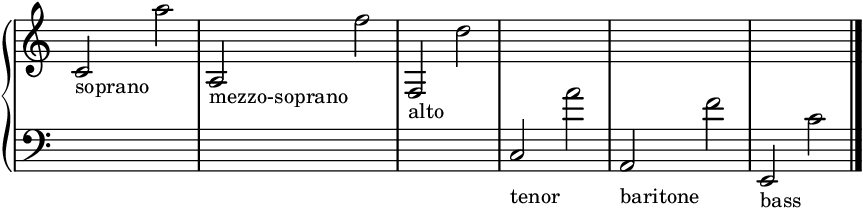
The three female voices read the treble clef at pitch. The tenor reads the treble clef with a small 8 below it, sounding an octave lower than printed, one more octave transposer to add to the list; the baritone and bass read the bass clef at pitch. In older scores the soprano, alto and tenor C clefs appear instead, and Grade 8 candidates meet them in early music extracts.
7.2 Choral scoring: open score and short score
Choral music is printed two ways, and ABRSM expects fluency in both. Open score gives each voice its own stave: soprano and alto in the treble clef, tenor in the octave treble clef, bass in the bass clef. Short score compresses the four parts onto two staves, soprano and alto sharing the treble stave with stems up and down, tenor and bass sharing the bass stave the same way; the tenor is now written at sounding pitch in the bass clef, so its octave transposition disappears in the compression.
The same two bars in both layouts make the differences plain:
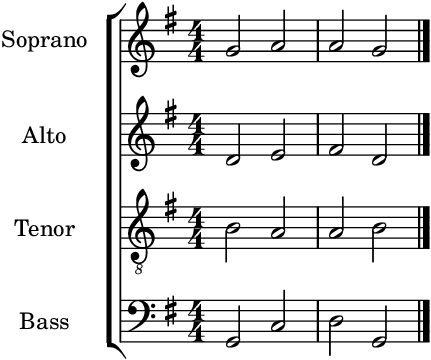
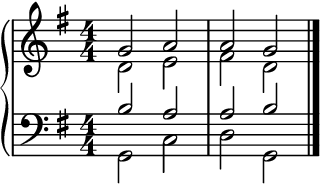
Converting between the layouts is a standard exam task, and the tenor is the whole difficulty: moving from open to short score, the tenor's printed notes drop an octave into the bass clef; moving from short to open score, they rise an octave into the octave treble clef. The other three voices copy across unchanged.
8. The transposition workshop
8.1 One rule
A transposing instrument is one whose written C produces some other note. Name that note and you have named the transposition: an instrument in X sounds X when it plays a written C, and every other written note moves by the same interval in the same direction. The whole subject is the consistent application of that rule, plus a memory of which direction each instrument goes.
Direction follows size. Instruments pitched below C sound lower than written: the clarinet in B flat (a major 2nd down), the clarinet in A (a minor 3rd down), the cor anglais and horn in F (a perfect 5th down). Small instruments pitched above C sound higher: the E flat clarinet and trumpet in E flat (a minor 3rd up), the trumpet in D (a major 2nd up). The octave transposers sound where their families need them: piccolo, xylophone and celesta up an octave, glockenspiel up two, double bass, double bassoon and tenor voice down one.
%%{init: {'theme':'neutral'}}%%
flowchart TD
  A["The part is for an instrument in X"] --> B["Written C sounds X"]
  B --> C{"Which X?"}
  C -- "X below C: B flat, A, F..." --> D["every note sounds lower<br/>by the interval C down to X"]
  C -- "X above C: D, E flat..." --> E["every note sounds higher<br/>by the interval C up to X"]
  C -- "in C but octave-transposing" --> F["piccolo up an octave<br/>double bass down an octave"]
  classDef rule fill:#dce8f5,stroke:#3b5f8a,stroke-width:2px
  class B,D,E,F rule
Two directions of working cover every task:
- written to sounding: transpose the printed notes by the instrument's interval, in the instrument's direction;
- sounding to written: transpose the intended sound by the same interval in the opposite direction.
The second direction is the one composers and arrangers use, and the one exam questions phrase as "write this passage as it would appear in the part".
8.2 Worked example: clarinet in B flat, written to sounding
The passage below is written for clarinet in B flat, in D major. The instrument sounds a major 2nd lower than written.
Step by step:
- Name the interval and direction: a major 2nd, downward.
- Move the key signature the same way: D major down a major 2nd is C major, so the sounding version has no sharps or flats.
- Move every note down a major 2nd, keeping the interval's quality: F sharp falls to E, A falls to G, D falls to C.
- Check a spot pitch: the written final D should sound C, and it does.
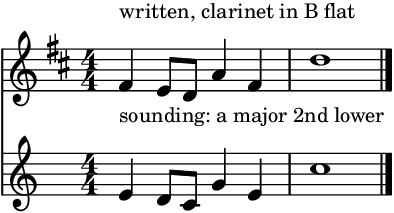
The quality check in step 3 matters. A major 2nd below F sharp is E, not E flat; count two letter names and two semitones, not just two piano keys. Transposition errors are almost always quality errors.
8.3 Worked example: horn in F, sounding to written
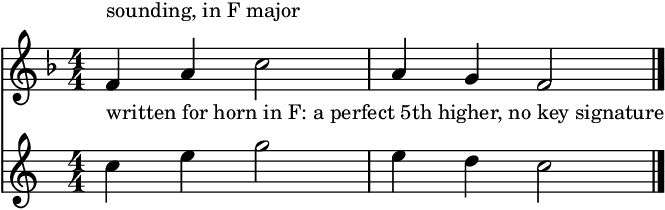
Now the other direction. A composer wants the horn to sound the phrase below, and must write the part. The horn in F sounds a perfect 5th lower than written, so the part must be written a perfect 5th higher than the intended sound.
- Interval and direction for the part: a perfect 5th, upward.
- Key: the sounding phrase is in F major; a perfect 5th up is C major. Horn parts are conventionally written without a key signature anyway, so no signature is printed and any accidentals are written in.
- Move each note up a perfect 5th: sounding F rises to written C, sounding A to written E, sounding C to written G.
- Spot check downward: written C sounds the F a 5th below. Correct.
8.4 The octave transposers in C
Three orchestral regulars are described as being "in C" yet do not sound where they are written: the piccolo sounds an octave higher, the double bass and double bassoon an octave lower. ABRSM introduces the piccolo and double bass cases at Grade 6, and they are the easiest transpositions to execute and the easiest to forget, precisely because the letter names do not change. An interval between a piccolo note and a double bass note as printed misstates the true gap by two octaves.
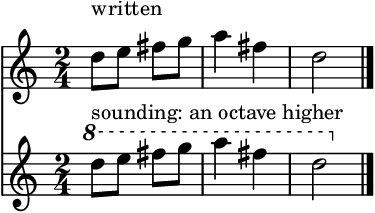
The same octave logic covers the guitar and the tenor voice, both written in the octave treble clef sounding an octave lower, and the three transposing percussion (chapter 5.3).
8.5 Why key signatures move with the instrument
The written key always sits the transposition interval away from the sounding key, in the opposite direction to the sound. The mechanism: the player of a B flat clarinet fingers written C and the room hears B flat, so for the room to hear C major music, the player must read D major. Written key = sounding key shifted up a major 2nd; two sharps appear in the part while the strings play none. This is why a full score in concert C major shows the B flat clarinets with two sharps, the A clarinets with three flats, and the cor anglais and horns (when they carry signatures at all) with one sharp.
The rule also drives instrument choice. A symphony in E major hands the B flat clarinet a written key of F sharp major, six sharps; the A clarinet reads G major, one sharp. The composer specifies the A instrument, and the player thanks them.
8.6 The complete transposition table
| Instrument | Sounds relative to written |
|---|---|
| piccolo | an octave higher |
| glockenspiel | two octaves higher |
| xylophone | an octave higher |
| celesta | an octave higher |
| clarinet in E flat | a minor 3rd higher |
| trumpet in E flat | a minor 3rd higher |
| trumpet in D | a major 2nd higher |
| flute, oboe, bassoon | as written |
| trumpet in C, trombones, tuba, timpani | as written |
| marimba, vibraphone, tubular bells, harp, piano | as written |
| clarinet in B flat | a major 2nd lower |
| trumpet in B flat | a major 2nd lower |
| clarinet in A | a minor 3rd lower |
| horn in G | a perfect 4th lower |
| cor anglais | a perfect 5th lower |
| horn in F | a perfect 5th lower |
| horn in E | a minor 6th lower |
| horn in E flat | a major 6th lower |
| horn in D | a minor 7th lower |
| double bass | an octave lower |
| double bassoon | an octave lower |
| tenor voice, guitar | an octave lower |
| bass clarinet in B flat | a major 9th lower |
8.7 Ten-second drills
Transposition becomes reliable only when single conversions are instant. Cover the right-hand column and work down the table; every answer follows from the one rule.
| Instrument | Written note | Sounding note |
|---|---|---|
| clarinet in B flat | G | F, a major 2nd lower |
| clarinet in A | C | A, a minor 3rd lower |
| clarinet in E flat | C | E flat, a minor 3rd higher |
| cor anglais | A | D, a perfect 5th lower |
| horn in F | E | A, a perfect 5th lower |
| horn in D | C | D, a minor 7th lower |
| trumpet in D | C | D, a major 2nd higher |
| bass clarinet | C | B flat, a major 9th lower |
| piccolo | C | C, an octave higher |
| double bass | F | F, an octave lower |
| glockenspiel | B | B, two octaves higher |
9. Reading a full score
9.1 From four staves to twenty-four
Score reading scales. The habits that manage a string quartet's four staves are the same ones that manage Mahler; a big score simply repeats the families' patterns at greater height. ABRSM builds the skill in exactly this order: quartets, accompanied solos and full scores of up to ten sounding staves at Grade 6, transposing solo instruments and 14-stave scores at Grade 7, up to 24 sounding staves at Grade 8.
A four-stave quartet score already contains most of the machinery: a bracket joining the family, instrument names in the margin of the first system and abbreviations after, the viola's alto clef, and a rehearsal mark.
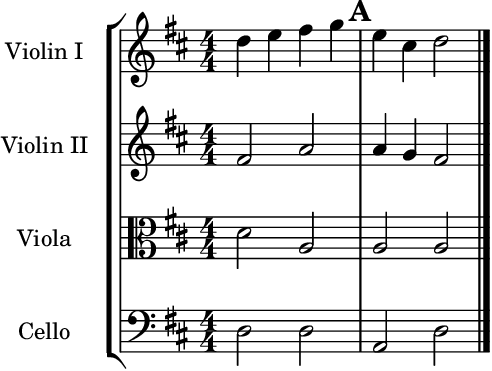
The reading order for any score page, four staves or twenty-four:
- Read the margin: name every instrument, note each one's clef and transposition. On a big score this minute of work is the whole battle.
- Find the key: the signature of the non-transposing instruments (strings are the most reliable) plus the final bass note of the extract.
- Find the metre and the tempo word, and only then read music.
- When a question asks about a specific stave, convert its notes to sounding pitch before doing anything else with them.
9.2 Rehearsal marks, bar numbers and cues
Rehearsal marks, boxed letters or numbers at structural points, let a conductor say "from letter D" instead of counting bars aloud; scores carry either these, bar numbers every system or every five or ten bars, or both. In parts, long rests are compressed into multi-bar rest signs with a count, and cue notes, small notes from another instrument's line printed in the resting part, warn the player of the entry: after 40 silent bars, four small notes of the oboe's tune are worth more than a conductor's glance. Cues are labelled with the source instrument and are not played.
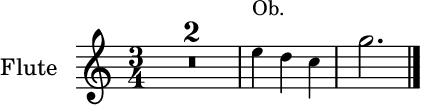
Scores and parts also compress repetition itself. The reiteration and tremolo signs are Grade 7 vocabulary; simile and the octave signs arrive much earlier in the syllabus:
| Sign | Meaning |
|---|---|
| slashes through a stem | repeat the note in quavers, semiquavers or demisemiquavers to the note's value |
| slashes between two notes | alternate the pair, a two-note tremolo |
| a bar filled with one thick slash and dots | repeat the previous bar |
| simile (sim.) | continue the established pattern of articulation or figuration |
| 8va, 8vb | play an octave higher or lower than printed |
The repeated-bar sign and the tremolo slashes exist for the same reason multi-bar rests do: an orchestral accompaniment may repeat one figure for forty bars, and writing each out would bury the page. Reading them aloud into real rhythm is a routine exam task.
9.3 Transposing score and score in C
Most published scores are transposing scores: each part is printed exactly as its player reads it, clarinets in their written keys, horns a 5th above their sound. The alternative, a score in C (sounding score), prints every line at concert pitch, octave transpositions usually excepted, and declares itself with in C or sounding score on the first page. Twentieth-century composers, Prokofiev among them, often preferred it; conductors read either.
The practical consequence runs one way: in a transposing score, you do the arithmetic of chapter 8 whenever you compare staves; in a score in C, the arithmetic is done, and only the octave transposers still lie. Before comparing any two staves, establish which kind of page you are reading. The instrument headings settle it: Clarinetti in B over a part with a different key signature from the strings means a transposing score.
9.4 Scores without key signatures
Many post-1900 scores print no key signatures at all, marking every accidental as it comes. The habit began where key itself loosened, and it spread as a courtesy: in heavily chromatic music, a signature contradicted as often as obeyed is worse than none. Horn and trumpet parts had used the convention for a century already, and timpani parts likewise. Reading such a score, identify tonal centres from the music itself, the bass line above all, exactly as chapter 16 of Musical Modes identifies a centre from notes rather than signatures. ABRSM flags "modern scores without key signatures" at Grade 6; the skill it actually tests is naming a chord or key from accidentals alone.
9.5 Worked example: naming a chord across transposing staves
The commonest Grade 8 trap is a chord question spread across instruments in different keys. Suppose a score shows, all sounding together: cellos on the D below middle C, violas on the A above it, first violins on the F sharp above middle C, a clarinet in B flat on a written E at the bottom of the treble stave, and a horn in F on a written A in the second space. Name the chord.
- Convert every transposing part first. The clarinet in B flat sounds a major 2nd lower: its written E becomes the sounding D above middle C. The horn in F sounds a perfect 5th lower: its written A becomes the same sounding D.
- Collect the sounding pitches, bass upward: D, A, D, D, F sharp.
- Stack the distinct notes in thirds from the bass: D, F sharp, A. The chord is a root position D major triad, its root tripled and its 5th supplied by the violas.
- Answer in the terms the question uses: as a symbol, D major; as a Roman numeral, I in D major or V in G major, the extract's context deciding which.
The procedure never varies: sounding pitches first, then the stack, then the label. Two kinds of slip cost most of the marks lost on these questions: converting the interval but not thinking about the octave, and identifying a chord from written pitches because two of the five staves happened to agree. When one converted note refuses to fit the stack, re-check the conversion and the clef before believing in exotic harmony.
9.6 What the examiner asks
The score questions of Grades 6 to 8 draw on everything in this guide, and they recur in stable forms: name the family and the transposition of a given part; write a given passage at sounding pitch; name the interval between two notes in different transposing parts (convert both to concert pitch first); explain a2, div., muta, a harmonic sign or a stopped-note sign; say which instrument carries the tune at a given bar, and how you know. The last one rewards rhythm-matching between staves, which survives transposition unchanged, before pitch-matching, which does not.
9.7 Scores to learn from
Score reading is learned from scores, and these six repay study in this order. Each is widely available in cheap or free editions.
| Score | What to notice |
|---|---|
| Haydn, Symphony No. 104 | the Classical pairs complete; natural horns and trumpets in D; timpani on tonic and dominant |
| Beethoven, Symphony No. 5 | trombones, piccolo and double bassoon held back until the finale; clarinets in B flat and C |
| Berlioz, Symphonie fantastique | cor anglais, E flat clarinet, two harps, four timpanists, col legno strings |
| Dvořák, Symphony No. 9 | the cor anglais solo; horns in E; a compact Romantic score to practise transposition on |
| Stravinsky, The Rite of Spring | woodwind in fives, alto flute, trumpet in D; the modern percussion section |
| Britten, The Young Person's Guide to the Orchestra | every instrument introduced family by family, a full score tour by design |
10. Instrument names in English, Italian, French and German
Scores name instruments in the composer's language, and the reader is expected to cope. The tables below give the standard forms; plurals are usually regular, and abbreviations in brackets are the ones margins actually print.
10.1 Woodwind
| English | Italian | French | German |
|---|---|---|---|
| piccolo | ottavino, flauto piccolo | petite flûte | kleine Flöte |
| flute | flauto (Fl.) | flûte (Fl.) | Flöte (Fl.) |
| oboe | oboe (Ob.) | hautbois (Hb.) | Oboe (Ob.) |
| cor anglais | corno inglese | cor anglais | Englischhorn |
| clarinet | clarinetto (Cl.) | clarinette (Cl.) | Klarinette (Kl.) |
| bass clarinet | clarinetto basso | clarinette basse | Bassklarinette |
| bassoon | fagotto (Fg.) | basson (Bn.) | Fagott (Fg.) |
| double bassoon | controfagotto | contrebasson | Kontrafagott |
10.2 Brass
| English | Italian | French | German |
|---|---|---|---|
| horn | corno (Cor.) | cor | Horn (Hr.) |
| trumpet | tromba (Tr.) | trompette | Trompete (Trp.) |
| trombone | trombone (Trb.) | trombone | Posaune (Pos.) |
| tuba | tuba | tuba | Tuba, Basstuba |
Posaune is the one that catches everyone: nothing about the German word suggests "trombone". Old Italian scores may also write clarino for a high trumpet part.
10.3 Percussion, harp and keyboards
| English | Italian | French | German |
|---|---|---|---|
| timpani (kettledrums) | timpani (Timp.) | timbales | Pauken (Pk.) |
| side drum (snare) | tamburo militare | caisse claire | kleine Trommel |
| bass drum | gran cassa | grosse caisse | grosse Trommel |
| cymbals | piatti | cymbales | Becken |
| triangle | triangolo | triangle | Triangel |
| tambourine | tamburino | tambour de basque | Schellentrommel |
| castanets | castagnette | castagnettes | Kastagnetten |
| tam-tam | tam-tam | tam-tam | Tamtam |
| glockenspiel | campanelli | jeu de timbres | Glockenspiel |
| xylophone | silofono | xylophone | Xylophon |
| tubular bells | campane | cloches | Glocken |
| celesta | celesta | célesta | Celesta |
| harp | arpa | harpe | Harfe |
| piano | pianoforte (Pf.) | piano | Klavier |
Beware the false friends in this table. Italian timpani looks like "tambourine" to the unwary and means kettledrums; French timbales means the same kettledrums, not the Latin dance drums; German Glocken are the tubular bells, while the Glockenspiel keeps its own name in every language.
10.4 Strings and voices
| English | Italian | French | German |
|---|---|---|---|
| violin | violino (Vl.) | violon | Violine, Geige |
| viola | viola (Vla.) | alto | Bratsche, Viola |
| cello | violoncello (Vc.) | violoncelle | Violoncello (Vc.) |
| double bass | contrabbasso (Cb.) | contrebasse | Kontrabass (Kb.) |
| strings (the section) | archi | cordes | Streicher |
| voice | voce | voix | Stimme, Singstimme |
The French alto for viola and the German Bratsche are the traps: alto looks like a voice type, and Bratsche looks like nothing in particular (it descends from braccio, "arm", the viola da braccio). Note also Violine against Violone, an old term for a bass instrument.
10.5 Pitch names inside instrument names
German and Italian scores name the transposition inside the instrument heading: Klarinette in B, Corno in Mi bemolle. Two systems are in play. German uses letter names with one alteration worth memorising: H is B natural and B is B flat, so Klarinette in B is the B flat clarinet, and Horn in E in a German score means E natural (Es is E flat). Italian and French use solfège names: do (ut), re, mi, fa, sol, la, si, with bemolle/bémol for flat and diesis/dièse for sharp, so Corno in Mi bemolle is the horn in E flat and Trompette en Si bémol the B flat trumpet. Grade 7 expects these pitch names read at sight in headings; the full foreign term lists live in the Grade 6 to 8 companion volumes.
11. Ranges at a glance
The engraved ranges from the family chapters, gathered for comparison. Written ranges are shown for the transposing instruments together with their sounding transposition; the summary table beneath adds the clefs and restates every transposition in score order.
11.1 Strings
11.2 Woodwind
11.3 Brass
11.4 Percussion, harp and voices
11.5 Summary table
Reading down the table is reading down the orchestra, top of the woodwind to the bottom of the strings.
| Instrument | Clefs | Transposition |
|---|---|---|
| piccolo | treble | sounds an octave higher |
| flute | treble | at pitch |
| oboe | treble | at pitch |
| cor anglais | treble | a perfect 5th lower |
| clarinet in B flat / A | treble | a major 2nd / minor 3rd lower |
| bass clarinet | treble | a major 9th lower |
| bassoon | bass, tenor | at pitch |
| double bassoon | bass | an octave lower |
| horn in F | treble, bass | a perfect 5th lower |
| trumpet in B flat | treble | a major 2nd lower |
| tenor trombone | bass, tenor | at pitch |
| tuba | bass | at pitch |
| timpani | bass | at pitch |
| glockenspiel | treble | two octaves higher |
| xylophone | treble | an octave higher |
| celesta | treble and bass | an octave higher |
| harp | treble and bass | at pitch |
| violin | treble | at pitch |
| viola | alto, treble | at pitch |
| cello | bass, tenor, treble | at pitch |
| double bass | bass | an octave lower |
12. Exercises
Answers follow at the end. Work with the range charts of chapter 11 covered, then check against them; the point of a range chart is to stop needing it.
1. Name the four instruments of the standard woodwind section that use a double reed, and the one standard member of the family that uses no reed at all. (Count auxiliaries with their parents.)
2. Why does the horn section appear above the trumpets in a full score, although the trumpets play higher?
3. A first oboe stave in a full score carries the marking a2 at bar 12 and 1. at bar 20. Who plays at each point?
4. A timpani part reads muta G in A during a long rest. What must the player do, and why is the instruction placed in the rest?
5. A violin part contains the chord G, D, B, G spanning all four strings. Describe how it is actually performed, and why the bow cannot sustain all four notes.
6. What does sul ponticello ask of a string player, and what is the audible result? Name the instruction that cancels it.
7. A cello line climbs high enough that the copyist wants to avoid ledger lines above the bass stave. Which clef comes next by convention, and which clef follows if the line keeps climbing?
8. The written note E at the bottom of the treble stave appears in a clarinet in B flat part, a clarinet in A part, and an E flat clarinet part. Give the three sounding pitches.
9. A horn in E flat (Classical crook) plays a written G at the top of the treble stave. Name the sounding pitch and the interval of transposition.
10. Write out the steps: a passage in A major, sounding pitch, must be written for trumpet in B flat. What key signature does the part carry, and which way do the notes move?
11. In a full score, the glockenspiel and the double bass both have a written C: the glockenspiel's in the third space of the treble stave, the double bass's in the second space of the bass stave. State each sounding pitch, and the number of octaves between the two sounding notes.
12. A score page shows the clarinets with two flats while the strings have four flats. Is this a transposing score or a score in C, and which clarinet is in use?
13. Which three tuned percussion instruments are regularly written below their sounding pitch, and by how much does each transpose?
14. Name the voice type for each range: (a) the A below middle C to the F at the top of the treble stave; (b) the C an octave below middle C to the A above middle C; (c) the E an octave and a sixth below middle C to middle C.
15. In converting a hymn from short score to open score, which voice's notes change their printed octave, in which direction, and into which clef?
16. A German score lists Pauken, Bratsche and Klarinette in B. Give the English for all three, including the clarinet's exact pitch.
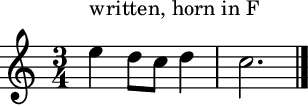
17. The passage below is written for horn in F. Write it at sounding pitch (clef, key and notes), then check your answer against the engraved version.
18. Explain why the harp can play a glissando that contains only the notes of a dominant seventh chord, when its strings are tuned to a seven-note scale.
19. A bass clarinet part (treble clef, standard notation) shows a written G above middle C. Give the sounding pitch and describe its position relative to middle C.
20. A flute part carries tremolo slashes on a note together with the marking Flz. What is the player being asked to do, and what does the same marking mean in a trumpet part?
21. Why could a Classical trumpet or horn play stepwise melodies only in its high register? Name the physical series that dictates this.
22. A passage for first violins shows two-note chords with the instruction div., then unis. four bars later. Describe exactly who plays what in each passage, and name the sign the composer would use instead if all players were to take both notes at once.
Answers
1. Double reeds: oboe, cor anglais, bassoon, double bassoon. No reed: the flute (with the piccolo), which is edge-blown.
2. Convention, inherited from the horns' role as partners of the woodwind: the horns blend with the wind chords above them as often as with the heavy brass below, and the score order fixed itself before the modern brass section settled.
3. At a2, both oboists play the printed line in unison. At 1., only the first oboist plays; the second rests.
4. Re-tune the G drum to A (on a pedal instrument, a foot movement; on a hand-tuned drum, adjusting the screws). The instruction sits in the rest because re-tuning takes time and must be finished before the drum is next struck.
5. The chord is spread, strings sounding from the bottom pair upward, with the bow coming to rest sustaining the top two notes. The bridge is curved, so the bow can touch at most two adjacent strings at once.
6. Bowing close to the bridge; a thin, glassy, metallic tone rich in upper partials. Naturale (or ord.) cancels it.
7. The tenor clef first, then the treble clef.
8. Clarinet in B flat: D (a major 2nd lower). Clarinet in A: C sharp (a minor 3rd lower). E flat clarinet: G (a minor 3rd higher).
9. The horn in E flat sounds a major 6th lower than written: the written G at the top of the stave sounds the B flat above middle C. Interval: a major 6th, downward.
10. The trumpet in B flat sounds a major 2nd lower than written, so the part is written a major 2nd higher than the sound. A major 2nd above A major is B major: the part carries five sharps, and every note moves up a major 2nd (sounding A becomes written B, sounding C sharp becomes written D sharp).
11. The glockenspiel sounds two octaves above its written C; the double bass sounds an octave below its written C. Their written notes are two octaves apart, so the sounding notes are two octaves plus two octaves plus one octave: five octaves apart.
12. A transposing score: the clarinet stave carries a different key signature from the strings. Four flats sounding (A flat major) against two flats written (B flat major) means the part is written a major 2nd above the sound: the clarinet in B flat.
13. Glockenspiel, sounding two octaves higher than written; xylophone, an octave higher; celesta, an octave higher.
14. (a) mezzo-soprano; (b) tenor; (c) bass.
15. The tenor's. Its notes rise an octave from their short-score position in the bass clef into the octave treble clef (treble clef with an 8 beneath), where they are printed an octave above their sound.
16. Pauken: timpani. Bratsche: viola. Klarinette in B: the clarinet in B flat (German B is B flat; B natural would be H).
17. The horn in F sounds a perfect 5th lower than written. Every note moves down a perfect 5th; the sounding version is engraved below. Written E at the top of the stave sounds the A above middle C, written C sounds F, and the phrase ends on the F above middle C.
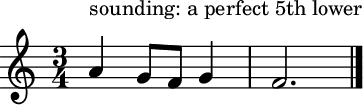
18. The pedals allow enharmonic doubling: each of the seven strings per octave can be set to flat, natural or sharp, and two different letters can then sound the same pitch. Set the pedals to C flat, D natural, E natural, F flat, G sharp, A flat, B natural and count what the strings actually sound: C flat is B, F flat is E, A flat doubles G sharp. The seven strings between them produce only E, G sharp, B and D, the notes of E7, and the sweep is a pure dominant seventh. Not every chord can be reached this way, which is part of the craft of writing for the instrument.
19. The bass clarinet sounds a major 9th lower than written: an octave plus a major 2nd. A major 9th below the written G above middle C is the F below middle C (down an octave to G, then a tone further to F).
20. Flutter tonguing: rolling an R into the airstream while playing, producing a buzzing tremolo. In a trumpet part it means exactly the same technique; flutter tonguing belongs to all the wind and brass.
21. A valveless brass instrument can sound only the notes of its harmonic series, and the series' notes lie far apart at the bottom (octave, 5th, 4th) and close together at the top, where they finally run stepwise. Only up there could a natural instrument play a scale.
22. Under div., the section splits: half the players (usually the outer player at each desk) take the upper notes, half the lower. At unis. all players return to the single printed line. If every player were to take both notes, the composer would write non div. or rely on the chord being an ordinary double stop.