Pulse, time signatures, grouping and every rhythmic device in common use
A complete reference for rhythm and metre: what a beat is and how tempo is fixed, every time signature and its grouping rules, the full rulebook for beaming notes and placing rests, dots, ties and tuplets, and the devices built on top of the system: syncopation, hemiola, cross-rhythm, polyrhythm, swing, metric modulation and the anacrusis, with a chapter tracing rhythmic practice from the Renaissance tactus to the changing metres of the twentieth century.
Introduction
Rhythm is the half of notation that everyone thinks they know. Pitch gets the attention: clefs, keys and accidentals fill the early years of theory teaching, while rhythm is absorbed almost by imitation. Yet ask a room of competent players why a bar of 6/8 must never be beamed in three pairs, or when a minim rest is forbidden, or what exactly a septuplet is worth, and the confident answers thin out. The rules exist, they are consistent, and nearly every one of them follows from a single idea: notation must let a reader see the beat.
That idea is the spine of this guide. A time signature is a promise about where the accents fall; beaming, rest placement and the choice between a dot and a tie all exist to keep that promise visible on the page. Once the mechanism is understood, the rules stop being a list to memorise and become predictions you can make yourself. You will know why 3/4 and 6/8 hold identical contents and remain different metres, why a crotchet rest may begin a compound beat but never sit in the middle of one, and why engravers write a syncopated minim in the middle of a 4/4 bar when the strict rule says they should not.
The first half of the guide builds the system: pulse and tempo, the complete table of time signatures, the irregular metres, and the grouping, beaming and rest rules for every metre class, each rule shown as an engraved right and wrong pair. The second half covers what music does with the system: dots, ties and tuplets in full, then syncopation, hemiola, cross-rhythm, polyrhythm and polymetre, the swing convention, metric modulation, and the anacrusis. Chapter 14 walks the whole history in one pass, from the barless world of the Renaissance to Stravinsky's shifting signatures. The last two chapters are a quick reference and a set of exercises with complete answers.
Every musical example is engraved afresh for this guide. Where a rule has a right and a wrong version, both are printed, because the wrong version is what a copyist actually writes when the rule is unknown, and seeing the error teaches faster than reading the prohibition.
No instrument is required, but a table top and two hands help enormously. Rhythm lives in the body before it lives on the page, and tapping the examples while reading them fixes the patterns in a way silent study cannot.
How to use this guide
Chapters 1 to 3 establish pulse, tempo and the full set of metres, regular and irregular. Chapters 4 and 5 are the rulebook chapters on beaming and rests, and they are the ones to keep within reach when writing music out. Chapters 6 and 7 complete the vocabulary with dots, ties and tuplets. Chapters 8 to 13 each take one rhythmic device. Chapter 14 is the historical tour, chapter 15 the quick reference, chapter 16 the exercises.
Companion documents cover neighbouring ground. Music Notation introduces the symbols themselves: note shapes, rest shapes, barlines and performance directions; this guide assumes those symbols and concentrates on how metre governs their use. ABRSM Music Theory Grade 1 to Grade 5 teach the examined core of this material step by step, and this guide agrees with their rulings while going further. Musical Harmony covers the suspension, whose rhythm reappears here in chapter 8. Musical Form and Analysis covers phrase structure, which chapter 13 touches from the rhythmic side. The Musical Terms Dictionary holds the full Italian, French and German vocabulary of terms, the tempo words of chapter 1 included.
A note on terms and notation
Naming follows British convention throughout: stave and bar for the page furniture, semibreve, minim, crotchet, quaver, semiquaver, demisemiquaver for the note values, metre for the pattern of beats. Cadences, where they arise, are perfect, imperfect, plagal and interrupted. Where a note is raised or lowered it is sharpened or flattened.
Time signatures are written with a slash in prose: 6/8, 3/4. Groupings within a bar are written with plus signs: 3 + 2. Metronome marks use the note symbol: ♩ = 60 means sixty crotchets to the minute, ♩. = 60 sixty dotted crotchets. Note ranges are written "1 to 5". Tuplet ratios use a colon: 3:2 means three in the time of two.
The diagrams are written in Mermaid. In the Word version they are pictures; in the markdown version the diagram source sits in a fenced block, which most markdown viewers render on sight.
1. Pulse, beat and tempo
1.1 Pulse and beat
Put a record on and let your foot start moving. What the foot finds is the pulse: a chain of evenly spaced instants that the music keeps returning to. Pulse is not something printed on the page. It is an inference the ear draws, so automatic that suppressing it is harder than finding it.
The beat is the pulse as notation adopts it: the counting unit that a time signature names and a metronome mark prices. The distinction matters because the same music can be felt at more than one level. A quick waltz can be counted three beats to a bar or felt as one sway per bar; a slow 4/4 can be counted in four or in eight. The composer chooses which level the notation treats as the beat, and everything else in the bar is defined relative to that choice: divisions below it, and the bar above it.
Beats are not all alike. In any metre some beats are strong and some weak, in a repeating cycle, and this cycle of accent is what turns a mere pulse into a metre. In 4/4 the first beat is strongest, the third carries a lesser stress, and the second and fourth are weak. In 3/4 the first beat is strong and the other two weak. The accents need not be played loudly; they are felt positions, and most of the devices in chapters 8 to 10 work by contradicting them.

1.2 Metronome marks
A note value fixes duration only relative to the beat. To fix absolute speed, notation prices the beat in beats per minute: ♩ = 60 means one crotchet per second, ♩ = 120 two per second. The device that made this practical was patented by Johann Nepomuk Maelzel in 1815, which is why older scores write M.M. before the figure: Maelzel's Metronome. Beethoven took it up at once and issued marks for his symphonies.
The note symbol in the mark is always the real beat of the metre, so compound time is priced by the dotted note: a jig might carry ♩. = 112, never a bare quaver figure. A mark may also be given as a narrow range, ♩ = 108 to 116, or qualified with c. (circa) when the composer wants the region rather than the point.
Two cautions. First, a metronome mark is a statement about the beat, not about difficulty: semiquavers at ♩ = 60 move exactly as fast as quavers at ♩ = 120. Second, composers' own marks are historical evidence, not always practical advice; Beethoven's have been argued over for two centuries.
1.3 Tempo terms in brief
Before the metronome, and alongside it ever since, tempo has been named in words, mostly Italian. The words are characters as much as speeds, which is why no committee has ever fixed their boundaries. The table gives the working order, slowest first, with rough modern equivalents:
| Term | Meaning | Rough region |
|---|---|---|
| grave | very slow, solemn | ♩ = 40 and below |
| largo | broad | ♩ = 40 to 60 |
| lento | slow | ♩ = 45 to 60 |
| adagio | slow, at ease | ♩ = 66 to 76 |
| andante | at a walking pace | ♩ = 76 to 108 |
| moderato | moderate | ♩ = 108 to 120 |
| allegretto | fairly quick | ♩ = 112 to 120 |
| allegro | quick, lively | ♩ = 120 to 156 |
| vivace | lively | ♩ = 156 to 176 |
| presto | very fast | ♩ = 168 to 200 |
| prestissimo | as fast as possible | ♩ = 200 and above |
The modifiers molto (very), assai (very), meno (less), più (more), poco (a little) and non troppo (not too much) scale any of these. Tempo changes gradually with accelerando and stringendo (speeding up) or rallentando and ritardando (slowing down); ritenuto is an immediate holding back; a tempo restores the previous speed, tempo primo the opening one. Rubato, the expressive bending of tempo within a phrase, and l'istesso tempo, which keeps the beat's speed across a change of metre, both return later: rubato in chapter 14, l'istesso tempo in chapter 12. The full multilingual vocabulary belongs to the Musical Terms Dictionary, to Music Notation and to the grade volumes; this guide needs only the working core above.
1.4 Counting and conducting
Players externalise the beat cycle in words and conductors in gesture, and both systems are worth knowing because both are diagnostic: if you cannot count a bar aloud, you have not yet understood its metre.
The standard counting syllables give every attack a name. Beats take their numbers. In simple time the half-beat is "and", and the quarter-beats are "e" and "a": a beat of four semiquavers is counted "one e and a". In compound time the three divisions are counted "one and a, two and a", the same syllables doing different work. Say the words in rhythm while tapping the beat and any figure in this guide becomes concrete:
| Figure | Count |
|---|---|
| four crotchets in 4/4 | 1, 2, 3, 4 |
| quavers in 2/4 | 1 and 2 and |
| semiquavers in 2/4 | 1 e and a, 2 e and a |
| quavers in 6/8 | 1 and a, 2 and a |
| dotted quaver, semiquaver | 1 (e and) a |
| syncopated quaver, crotchet, quaver | 1 and (2) and |
Bracketed syllables are felt, not sounded. That is the whole discipline of rhythmic counting: the grid keeps running through the silences and the long notes, and the attacks hang on named points of it.
Conducting patterns trace the same cycles in space. Two beats: down, up. Three: down, out, up. Four: down, in, out, up. The downbeat is always the strong first beat, physically the lowest point, which is why "downbeat" and "upbeat" are the words for the strong beat and the lead-in to it. In slow music conductors subdivide the pattern; in fast triple time they collapse it to one sweep per bar. The gesture, like the count, states the metre's level: choosing whether to beat a quick 6/8 in six or in two is choosing what the beat really is.
1.5 Levels of the grid
Rhythm runs on a hierarchy of nested levels, and having names for them saves a great deal of circumlocution later:
| Level | What it is | In 4/4 | In 6/8 |
|---|---|---|---|
| bar | one full accent cycle | four crotchets | six quavers |
| beat | the counting unit | crotchet | dotted crotchet |
| division | the beat's first split | two quavers | three quavers |
| subdivision | the next split down | four semiquavers | six semiquavers |
Every level is a steady pulse in its own right, and the levels lock together like gears: each bar holds a whole number of beats, each beat a whole number of divisions. The metre's class is simply the gear ratio between beat and division, two for simple and three for compound. The devices of chapters 8 to 10 all work by setting one level against another: syncopation attacks between beats, hemiola regroups divisions into false beats, polymetre runs two bar-level cycles at once. Keep the four level names in mind and every later chapter can say precisely which gears are engaged.
2. Metre and time signatures
2.1 What a metre is
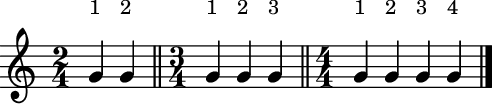
A metre is a repeating cycle of strong and weak beats. A time signature is the notation of that cycle: two numbers at the start of the music, restated only when the cycle changes. The signature makes two promises at once: how many beats each bar holds, and what note value carries one beat. Every barline thereafter is a milestone in the cycle, placed immediately before the strongest beat.
The lower number names the beat value as a division of the semibreve: 2 means a minim, 4 a crotchet, 8 a quaver, 16 a semiquaver. The upper number counts. But what it counts depends on the class of the metre, and this is the first place the system genuinely forks.
2.2 Simple and compound
Every metre in common use divides its beat into two or into three, and notation handles the two cases differently.
In simple time the beat is a plain note and divides into two. The upper number counts beats directly: 2/4 is two crotchet beats, 3/2 three minim beats, 4/8 four quaver beats.
In compound time the beat divides into three, and only a dotted note divides into three equal parts, so the beat is a dotted note. Here the signature counts the divisions rather than the beats: 6/8 means six quavers, which group in threes into two dotted-crotchet beats. Divide the upper number by three to find the beats. The upper numbers 6, 9 and 12 always mean compound time; 2, 3 and 4 always mean simple.
The other axis of classification counts the beats themselves: duple metres have two per bar, triple three, quadruple four. The two axes are independent, and crossing them gives the complete standard table:
| Duple | Triple | Quadruple | |
|---|---|---|---|
| Simple (beat divides in 2) | 2/2, 2/4, 2/8 | 3/2, 3/4, 3/8 | 4/2, 4/4, 4/8 |
| Compound (beat divides in 3) | 6/4, 6/8, 6/16 | 9/4, 9/8, 9/16 | 12/4, 12/8, 12/16 |
| Signature | Class | Beats per bar | One beat is |
|---|---|---|---|
| 2/4 | simple duple | 2 | crotchet |
| 3/4 | simple triple | 3 | crotchet |
| 4/4 | simple quadruple | 4 | crotchet |
| 2/2 | simple duple | 2 | minim |
| 3/2 | simple triple | 3 | minim |
| 3/8 | simple triple | 3 | quaver |
| 6/8 | compound duple | 2 | dotted crotchet |
| 9/8 | compound triple | 3 | dotted crotchet |
| 12/8 | compound quadruple | 4 | dotted crotchet |
| 6/4 | compound duple | 2 | dotted minim |
| 9/16 | compound triple | 3 | dotted quaver |
| 12/16 | compound quadruple | 4 | dotted quaver |
%%{init: {'theme':'neutral'}}%%
flowchart TD
  M["metre"] --> S["simple<br/>beat divides in 2<br/>top number counts beats"]
  M --> K["compound<br/>beat divides in 3<br/>top number counts divisions"]
  S --> SD["duple: 2/2, 2/4"]
  S --> ST["triple: 3/2, 3/4, 3/8"]
  S --> SQ["quadruple: 4/2, 4/4"]
  K --> KD["duple: 6/8, 6/4"]
  K --> KT["triple: 9/8, 9/16"]
  K --> KQ["quadruple: 12/8, 12/16"]
  classDef axis fill:#dce8f5,stroke:#3b5f8a,stroke-width:2px
  class S,K axis

2.3 The two symbol signatures
Two signatures are written as symbols rather than numbers. C means 4/4 and 𝄵, C with a vertical stroke, means 2/2, also called alla breve or cut common time. The C is not an abbreviation of "common": it survives from medieval mensural notation, where a full circle meant triple ("perfect") time and a broken circle duple ("imperfect") time. The broken circle outlived the system that named it.
The practical difference between 4/4 and 2/2 is entirely one of feel. A bar of either holds four crotchets, but 2/2 promises two minim beats, so the music strides in two rather than walking in four. Quick marches and Classical finales are written alla breve precisely to tell the player not to count four.
2.4 The same music in 3/4 and 6/8
The sharpest test of the whole system is the pair 3/4 and 6/8. Each bar holds six quavers' worth of music. The difference is entirely in the grouping: 3/4 is three crotchet beats, its quavers paired 2 + 2 + 2; 6/8 is two dotted-crotchet beats, its quavers grouped 3 + 3. Same contents, different accent cycle: ONE and TWO and THREE and, against ONE and a TWO and a.
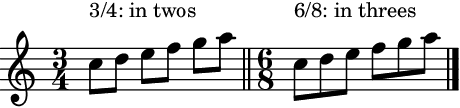
Renotating music from one to the other changes no duration; it moves the accents. The quavers keep their value and simply re-beam. Notes that fitted 3/4's beats may now cross 6/8's, needing ties (chapter 6 returns to this, and exercise 4 makes you do it). Bernstein's "America" from West Side Story alternates the two bar by bar, which is why its six quick notes keep changing stride; the same alternation inside a single metre is the hemiola, chapter 9's subject.
2.5 3/2 and 6/4: the same trap one level up
The 3/4 and 6/8 relationship repeats at every level of the value family, and the minim-level pair catches even experienced readers. A bar of 3/2 and a bar of 6/4 each hold six crotchets. 3/2 is simple triple: three minim beats, crotchets paired 2 + 2 + 2. 6/4 is compound duple: two dotted-minim beats, crotchets grouped 3 + 3. The courante's deliberate play between them (chapter 14) works because the two metres share their contents exactly and disagree only about accent, and the notation must take sides through its grouping even when the music refuses to.
One level further down, 3/8 and 6/16 stand in the same relationship. The general rule: any simple triple signature and the compound duple signature with the same bar length form a hemiola pair, and chapter 9 is about what happens when music exploits that.
2.6 Hearing a metre
Identifying the metre of music you can hear but not see is a skill with a method:
- Find the pulse and tap it: the steady rate your foot chooses unprompted.
- Find the strong beats: listen for the recurring weight of harmony changes, bass notes and phrase starts, and count how many pulses fall between them. Two, three or four gives duple, triple or quadruple.
- Listen to the space between pulses: if the fast notes run in pairs and fours the metre is simple; if they run in threes, with the lilt of a jig or a slow rocking, it is compound.
- Check for a limp: if the strong beats will not settle into equal lengths, count the quick units in each group and you are in irregular metre.
The answer is a metre class, not a signature: the ear cannot tell 2/4 from 2/2, because the choice of beat value is notation, not sound. Writing music down from hearing, you choose the signature; hearing music with the score, the signature tells you which level the composer heard as the beat.
2.7 Choosing a signature
Nothing about a melody forces one signature. A composer writing a quick triple dance may choose 3/8, 3/4 or 3/2; the sound can be identical, and the choice is about legibility and feel. Small lower numbers look slow and heavy on the page; large ones look busy. Convention has settled comfortable homes: hymns in 4/4 and 3/4, jigs in 6/8, siciliennes in 12/8, Viennese waltzes in 3/4 felt in one. The signature is the composer's first performance direction, and reading it as such, rather than as arithmetic alone, is a mark of a practised musician.
2.8 The common metres one by one
Each metre in regular use has a settled character, part acoustics and part two centuries of habit. These sketches are generalisations with plentiful exceptions, but they are the associations a reader brings to each signature, and a writer ignores them knowingly or not at all.
2/4 is the step metre: marches, polkas, and fast movement pairs of every kind. Its bars are small and its downbeats close together, so it reads as crisp and grounded.
3/4 carries the waltz, the minuet, the sarabande and the mazurka, four dances distinguished not by the signature but by where inside the bar each puts its weight: the waltz on 1, the sarabande on 2, the mazurka often on 2 or 3. Hymn books use it for flowing, unhurried tunes.
4/4 is the default metre of common practice and of nearly all popular music, roomy enough for interior structure (the half-bar) and even enough to disappear behind the music. Its very neutrality is the point: 4/4 is the metre a listener assumes until told otherwise.
2/2 is 4/4 told to stride: the same bar contents felt in two. Quick Classical finales, fast church music and much Renaissance-derived writing use it, and the difference from 4/4 is entirely in the felt level of the beat.
3/8 and its quick triple relatives are one-in-a-bar metres in practice: scherzos and fast Baroque movements where the notated three quavers fuse into a single felt beat, the true cycle being the bar itself.
6/8 is the compound workhorse: jigs, tarantellas, barcarolles, marches-in-two with a lilt, and a large share of folk song. Two swinging beats, each of three.
9/8 is rarer and more deliberate, three compound beats to the bar; slow movements use its breadth, and fast ones (Bach's gigues among them) its rolling drive.
12/8 stretches compound time across four beats: siciliennes, pastorales, slow blues and doo-wop ballads, where it is effectively 4/4 with the shuffle written in (chapter 11).
3/2 and 6/4 carry the broad triple and compound-duple strides of earlier style: Purcell's grounds, Handel's larger arias, and any music wanting weight without slowness. Their crotchets move at ordinary speed; only the beat above is large.
2.9 Changing signature mid-piece
A new signature may appear at any barline, printed once and holding until replaced. The mechanics carry three conventions.
First, when the change falls at a line break, a cautionary signature is printed at the end of the old line, after the final barline, warning the reader before the page turns the corner. Second, unless the score says otherwise, the smallest shared note value keeps its speed across the change: a quaver before equals a quaver after, which is why a change between 4/4 and 6/8 alters the felt beat (chapter 12 prices this exactly). Where the composer intends something else, an equation over the barline says so. Third, a change of signature needs only a plain barline, though editors often use a double barline where the change coincides with a structural seam.
Pieces that alternate two signatures bar by bar can print them together at the start, a dual signature: 6/8 and 3/4 side by side means the bars rotate between the two, and Bernstein's "America" is the famous case. Twentieth-century music that changes metre almost every bar (chapter 14) simply prints each new signature as it comes, and players learn to read the signature as part of the bar, not as an event between bars.
3. Irregular metres
3.1 Beyond two and three
Regular metres keep every beat the same length. Irregular metres mix beats of two divisions with beats of three, so the accent cycle limps. The Turkish name for the effect, aksak, means exactly that: limping. The limp is not a defect; it is the point. A 7/8 dance drives precisely because one beat in each bar is half as long again as the others.
The common irregular signatures fall into two families, exactly parallel to 5/4 versus 5/8: crotchet-level metres, where the odd count is felt as unequal groups of crotchets, and quaver-level metres, where quick quavers bundle into twos and threes.
3.2 5/4 and 7/4
5/4 holds five crotchet beats, almost always felt as 3 + 2 or 2 + 3. The secondary accent falls where the second group begins, on beat four in 3 + 2, on beat three in 2 + 3, and a whole piece usually commits to one shape. Holst's "Mars" hammers 5/4 in 3 + 2; the second movement of Tchaikovsky's Pathétique symphony waltzes in 5/4; Paul Desmond's "Take Five" swings it.
7/4 holds seven, normally 4 + 3 or 3 + 4, each half behaving like a small bar of its own. Pink Floyd's "Money" rides a 7/4 riff. Very long odd bars tend to be split in notation instead: a recurring 4 + 3 can equally be written as alternating bars of 4/4 and 3/4, and editors choose whichever the phrasing supports.

3.3 5/8 and 7/8
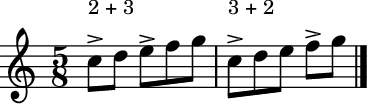
At the quaver level the groups tighten into single gestures. 5/8 bundles its quavers 2 + 3 or 3 + 2; 7/8 runs 2 + 2 + 3, 3 + 2 + 2 or 2 + 3 + 2. The two-quaver groups are felt as short beats and the three-quaver groups as long beats: quick-quick-slow in 2 + 2 + 3. These metres are the backbone of Balkan dance music and a fixture of twentieth-century scores.
The signature alone cannot say which grouping is meant. The beaming says it: a 7/8 bar beamed 2 + 2 + 3 stresses the first, third and fifth quavers, and a bar beamed 3 + 2 + 2 stresses the first, fourth and sixth. In irregular metre, beaming stops being a courtesy and becomes the metre's only visible definition. Some modern scores make the grouping explicit in the signature itself, writing (3 + 2)/8 or 2+2+3 over 8; the notation is self-explaining and increasingly common.

3.4 Additive metre
Read the groups as bricks, twos and threes laid end to end, and the idea generalises to any total. 8/8 grouped 3 + 3 + 2 is a different metre from 4/4, though the bars are the same length: 4/4 has four equal beats, 8/8 in 3 + 3 + 2 has three unequal ones, and Latin American and African-diaspora music is full of exactly this pattern (chapter 8 meets it again as the tresillo). Bartók built piano pieces on 4 + 2 + 3 and 3 + 2 + 3; his "Six Dances in Bulgarian Rhythm" from Mikrokosmos wear the groupings in their titles. Metre built this way is called additive, in contrast to the divisive regular metres, which start from a whole bar and divide it evenly.
The mechanism to hold on to: in additive metre the quaver is the only constant, the beats are compounds of it, and the notation's whole job is to show the bricklaying. That is done by beams, by explicit signatures, or by both.
3.5 Longer bars and shifting groups
The brick principle scales without limit. 11/8 lays four bricks, perhaps 2 + 2 + 3 + 2 + 2 or 3 + 3 + 3 + 2; 13/8 lays five. Past about nine quavers the bare signature tells the reader almost nothing, which is why long additive bars nearly always carry their grouping explicitly, either in the signature or in a footnote at the head of the movement.
A subtler case: the total stays fixed while the grouping shifts from bar to bar. A run of 7/8 bars might alternate 2 + 2 + 3 with 3 + 2 + 2, and the signature, printed once, cannot say so. The beams take over completely, restating the grouping in every bar, and the player reads the beams as continuously as the notes. Composing in these metres, the practical discipline is the reverse: decide the grouping first, from the accents the music wants, and let it drive both the beaming and any explicit signature. A grouping chosen after the notes are written shows, the way a key signature chosen after the accidentals shows.
One more relative deserves naming: metres whose top number is regular but whose grouping is not, such as 9/8 grouped 2 + 2 + 2 + 3 instead of the compound 3 + 3 + 3. Bartók uses exactly this in the Bulgarian dances, and the only visible difference from ordinary 9/8 is the beaming, which is one more reason chapter 4's rules carry real weight.
3.6 Performing irregular metre
Irregular metres are conducted and counted by their bricks, not their quavers. A 5/8 bar is beaten in two unequal gestures, one short and one long, in whichever order the grouping declares; 7/8 takes three gestures with one of them stretched. The player's count matches: "1 and 2 and a" for 2 + 3, the "and a" marking the long brick's extra quaver. Trying to count all the quavers individually works only at slow tempo; at speed the bricks are the beats, unequal but felt as single units, and the limp becomes as natural as a regular metre's swing. Dancers to Balkan music do not count seven; they know the steps as quick-quick-slow.
4. The grouping and beaming rulebook
4.1 Why beaming is metre made visible
Beams join the tails of quavers and shorter notes into groups. The durations do not change; what the beam adds is information about where beats begin. A reader confronted with fourteen mixed note values recovers the metre from the beam groups, and from almost nothing else. That gives the copyist one golden rule, from which nearly everything in this chapter follows:
Beam so that each group occupies exactly one beat, starting on the beat.
Everything else is either a refinement of that rule, a permitted enlargement of it, or one of a small set of traditional exceptions listed at the end.
4.2 Simple time
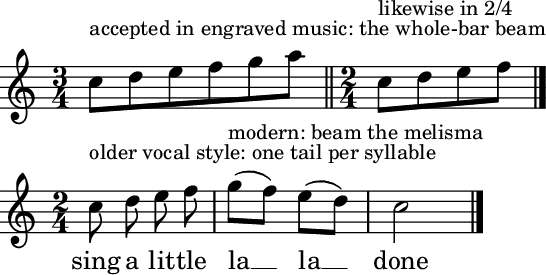
In 2/4, 3/4 and 4/4 the beat is a crotchet, so quavers beam in pairs, one pair per beat. Semiquavers beam in fours, one four per beat, and mixed quaver-semiquaver figures beam as whole beats: a quaver plus two semiquavers is one group, a dotted quaver plus semiquaver is one group. The beat boundary is sacred: a beam that starts halfway through one beat and ends inside the next hides both.

Two enlargements are standard. In 4/4, quavers may beam in fours across beats 1 and 2, or across beats 3 and 4, because each half of the bar is itself a clean metrical unit. What they must never do is beam across the middle: the join of beats 2 and 3 is the bar's structural seam, and a beam across it makes the bar unreadable at speed. The same halves rule gives 2/2 its beaming: the beat is a minim, so quavers beam in fours per beat.
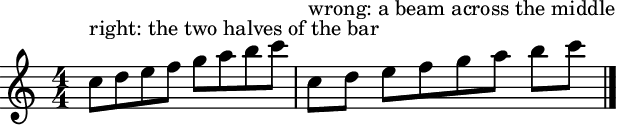
In 3/4 the strict grouping is 2 + 2 + 2. A full bar of six quavers is often beamed as one group in engraved music, a licence noted in section 4.5, but 3 + 3 is always wrong, because 3 + 3 is the definition of 6/8 and the reader will take the bar for compound time. Small quaver metres beam whole bars as a matter of course: a bar of 3/8 is one group of three.

The mixed figures that fill exactly one crotchet beat form a small standard vocabulary, met so often that fluent readers recognise them as shapes rather than spelling them out:
| Figure | Contents | Count |
|---|---|---|
| two quavers | 1/2 + 1/2 | 1 and |
| quaver, two semiquavers | 1/2 + 1/4 + 1/4 | 1 and a |
| two semiquavers, quaver | 1/4 + 1/4 + 1/2 | 1 e and |
| four semiquavers | four quarters | 1 e and a |
| dotted quaver, semiquaver | 3/4 + 1/4 | 1 (e and) a |
| semiquaver, dotted quaver | 1/4 + 3/4 | 1 e |
| semiquaver, quaver, semiquaver | 1/4 + 1/2 + 1/4 | 1 e (and) a |
Each beams as one group, and the last of them is the one-beat syncopation, short-long-short in miniature. Recognising these seven at sight is most of practical rhythm reading in simple time.
4.3 Compound time
In compound time the beat is a dotted note holding three divisions, and the beam groups are threes: 6/8 beams 3 + 3, 9/8 beams 3 + 3 + 3, 12/8 beams four threes. Never 2 + 2 + 2 in 6/8, which is 3/4's grouping and instantly misleads. Semiquavers beam in sixes per beat, or in threes when the figure divides that way; mixed figures again beam as whole beats: quaver plus crotchet cannot beam, but quaver-quaver-quaver with the middle one split into semiquavers is still one group.

4.4 Irregular metre
Beam the bricks. A 5/8 bar beams 2 + 3 or 3 + 2; a 7/8 bar beams its declared grouping and nothing else. Since the beaming is the metre's definition here (section 3.3), a beaming error in irregular metre is not poor style but a wrong note: it changes which metre the bar states.
4.5 Where convention overrides the rule
Engraving practice keeps a short list of licensed departures, each earned by generations of legibility:
- The whole-bar beam. A complete bar of quavers in 2/4 or 3/4 may be beamed as one group where no compound-time confusion is possible. Engravers use it freely; the ABRSM grades teach the strict per-beat form, and in an exam the strict form is the safe answer.
- Vocal beaming, old style. Vocal music once beamed notes only where several fell on one syllable, tailing syllabic notes separately so the text aligned. Modern vocal engraving has largely gone over to instrumental beaming with slurs marking the melismas, but a century and a half of printed song uses the old convention, and singers still read both.
- Beaming over rests. Modern practice allows a beam to span a short rest inside the beat, keeping the beat picture whole where separate tails would shatter it. Older engraving broke the beam at every rest.
- Recognised syncopation figures. A small family of syncopated shapes is written whole against the strict letter of the beat rule; they are catalogued in chapters 6 and 8.
4.6 A worked example
Task: notate this rhythm in 4/4, attacks lasting, in quavers, 1, 1, 2, 1, 1, 2 (a quaver pair, a crotchet, a quaver pair, a crotchet).
- Lay the durations against the beat grid. The bar holds eight quaver slots; the attacks fall on slots 1, 2, 3, 5, 6, 7. Slots 3 and 7 hold the crotchets.
- Mark the beat boundaries: slots 1, 3, 5, 7 begin beats. Every duration here starts on a slot inside one beat and ends without crossing into the next beat's interior: the crotchets sit exactly on beats 2 and 4. No ties needed.
- Beam by beats: the quavers on slots 1 and 2 fill beat 1, so they beam as a pair. The crotchet on beat 2 stands alone (crotchets never beam). Likewise for the second half.
- Check the halves rule: nothing crosses the middle of the bar, and each half reads as beat-pair plus beat. Done: two quavers beamed, crotchet, two quavers beamed, crotchet.
Now the same durations in 6/8, where the bar holds only six quaver slots, so take the first six values: 1, 1, 2, 1, 1. The attacks fall on slots 1, 2, 3, 5, 6. The crotchet on slots 3 and 4 now crosses the beat boundary after slot 3: in 6/8 the beats begin on slots 1 and 4. Step 2 therefore forces a split: the crotchet becomes two tied quavers, one ending beat 1, one beginning beat 2. Beaming then groups slots 1 to 3 and 4 to 6 in threes. Same durations, different metre, different notation: the whole rulebook in one small example.
5. Rest placement rules
5.1 Silence is notated by beat
Rests obey the same master rule as beams: the reader must be able to see where beats begin. A note may sail across a beat boundary and let the beat pass silently inside it; a rest may not. Silence has no attack to orient the ear, so notation compensates by chopping silence at every beat boundary and dealing it out in beat-sized or beat-completing pieces. Almost every rest rule reduces to that.
5.2 The whole-bar rest
A completely silent bar takes the semibreve rest, hung below the fourth line, whatever the time signature. In 3/4, where a semibreve note would not fit, the semibreve rest still means "silent bar". The one exception is at the top of the size range: a silent bar of 4/2 or longer takes the breve rest. Multi-bar silences in instrumental parts are compressed into the numbered multi-bar rest, covered in Music Notation.

5.3 Simple time
Within a bar, rests fill by beats:
- A silent beat takes its own rest: one crotchet rest per silent beat in crotchet metres.
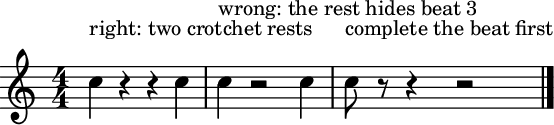
- A minim rest may stand for beats 1 and 2, or beats 3 and 4, of a 4/4 bar: the halves of the bar, exactly as with beams. It must never stand for beats 2 and 3. The middle of the bar has to stay visible, so that silence is written as two crotchet rests.
- In 3/4 the minim rest is not used at all. A two-beat silence is two crotchet rests, wherever it falls. Triple metre has no half-bar unit, so there is nothing for a minim rest to represent.
- Part-beat silences complete the current beat first, using the beat's own subdivision: after a quaver on the beat, write a quaver rest to finish that beat before any larger rest. The mirror applies before a note: rests leading up to an off-beat entry spell out the beat structure from the barline.
5.4 Compound time
Compound beats hold three divisions, and the rest conventions protect both the beat and its first division:
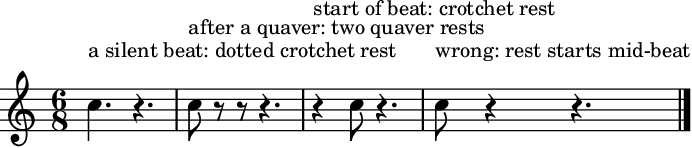
- A whole silent beat takes a dotted crotchet rest (in 6/8, 9/8 and 12/8). Writing crotchet rest plus quaver rest for a full beat is obsolete; the single dotted rest is the modern standard.
- Silence on the first two divisions of a beat, before a sounded third quaver, takes a single crotchet rest: the rest starts on the beat, so the beat stays visible.
- Silence on the last two divisions, after a sounded first quaver, takes two quaver rests. A crotchet rest here would begin in the middle of the beat, exactly what rests must not do.
- A silent pair of beats takes two dotted crotchet rests, one each; only the fully silent bar collapses to the semibreve rest.
5.5 Rests in irregular metre
Irregular metre applies the same law to its own bricks: rests group by the declared twos and threes, never across them. In 7/8 grouped 2 + 2 + 3, a silent first group takes a crotchet rest, a silent final group takes a dotted crotchet rest, and a silence spanning the second and third groups takes a crotchet rest then a dotted crotchet rest, split exactly at the group boundary. Writing a minim rest anywhere in such a bar is meaningless, because no group is a minim long. As with beaming (section 4.4), what would be a style fault in regular metre becomes a factual error here: the rests are part of how the bar states its grouping, and a wrong rest states a wrong metre.
5.6 Dotted rests in simple time
In simple time, dotted rests are confined to the inside of a beat. A dotted quaver rest before a semiquaver is normal; a dotted crotchet rest spanning a beat and a half of 4/4 is not, because its dot swallows a beat boundary, and the correct spelling is crotchet rest then quaver rest. The rule of thumb: a rest's dot must never cross a beat line. Compound time is no exception, since there the dotted crotchet rest is precisely one beat.
5.7 A worked example
Task: in 4/4, a quaver sounds on the second half of beat 1 and a crotchet on beat 4. Fill the silences.
- Mark the sounded slots: the quaver occupies the "and" of beat 1; the crotchet occupies beat 4. Everything else is silent: the first half of beat 1, all of beats 2 and 3.
- Work forwards from the barline. The silence before the quaver is half of beat 1, and rests before an off-beat entry must spell the beat's subdivision: one quaver rest.
- The silence after the quaver runs from beat 2 to beat 4. Beats 2 and 3 are whole silent beats, and in 4/4 they are the forbidden pair: no minim rest across the middle. Two crotchet rests.
- Read the bar back: quaver rest, quaver, crotchet rest, crotchet rest, crotchet. Every rest starts on a beat or completes one, and every beat of the bar can be pointed to. That test, "can I point to every beat?", is the whole chapter in one sentence.
Had the same figure sat in 2/2, the ink would not change but the reasoning would: the middle silence now straddles the join of the bar's two minim beats, so it is still chopped into two crotchet rests, one completing beat 1 and one opening beat 2. Only a silence filling a whole minim beat would earn 2/2's single minim rest. Rest spelling always argues from the metre, never from the raw durations.
6. Values, dots and ties
6.1 The family of values
The note values form one binary family, each worth half the one before: breve, semibreve, minim, crotchet, quaver, semiquaver, demisemiquaver, hemidemisemiquaver. Music Notation covers their anatomy and their rests; here the family matters as arithmetic, because rhythm notation is the art of adding these powers of two up to exact bar lengths.
| Value | Worth in crotchets |
|---|---|
| breve | 8 |
| semibreve | 4 |
| minim | 2 |
| crotchet | 1 |
| quaver | 1/2 |
| semiquaver | 1/4 |
| demisemiquaver | 1/8 |
| hemidemisemiquaver | 1/16 |
A system built purely on halving cannot write a three, a five or a seven. Three arrives with the dot, five and seven with the tie, and every other ratio with the tuplet (chapter 7). Those three devices complete the arithmetic.
6.2 The dot and the double dot
A dot after a note lengthens it by half its value: a dotted minim is three crotchets, a dotted crotchet three quavers, a dotted quaver three semiquavers. The dot is how notation writes threes, which is why compound time, whose beat is three divisions, must have a dotted beat.
A double dot adds half plus a quarter: the second dot is worth half the first. A double-dotted minim is 2 + 1 + 1/2 = 3 1/2 crotchets; a double-dotted crotchet is 1 3/4 crotchets, leaving exactly a semiquaver to complete two beats. The double-dotted figure is the engine of the French overture style (chapter 14). Triple dots exist in late Romantic scores and extend the same series: each dot is worth half the previous one.

Dots apply to rests on the terms of chapter 5: freely inside a beat, as the standard beat rest in compound time, never across a beat boundary.
6.3 The tie
A tie joins two noteheads of the same pitch into one unbroken sound. It exists because notation's units stop at two hard walls: the barline, and the beat boundary that a dot must not cross. A sound lasting from beat 4 into the next bar physically cannot be one symbol; it is written as two notes tied. Chains of ties extend a sound indefinitely. The tie is distinguished from the slur by its pitches: same pitch, tie; different pitches, slur.
Ties also write the unwritable values: five quavers is a minim tied to a quaver, seven semiquavers a dotted crotchet tied to a semiquaver, and in general any length is a sum of dotted and plain values tied together, spelled so that each piece respects the beats it covers. The full set of quaver-counted lengths shows how few tools the system needs:
| Length in quavers | Spelling (starting on a beat in 4/4) |
|---|---|
| 1 | quaver |
| 2 | crotchet |
| 3 | dotted crotchet |
| 4 | minim |
| 5 | minim tied to quaver |
| 6 | dotted minim (from beat 1; from beat 2, crotchet tied to minim) |
| 7 | double-dotted minim, or minim tied to dotted crotchet |
| 8 | semibreve |
The spellings assume the note starts on beat 1 or 3; start it elsewhere and the beat rules of section 6.4 may force further splits. That is the general pattern: length fixes the ingredients, starting position fixes how many pieces they must be cut into.
6.4 Dot or tie: the choice
Often both spellings are arithmetically correct, and the rule that picks between them is by now familiar: choose the spelling that keeps the beats visible.
- Within one beat, or from the start of one beat to a point inside the next-but-not-past-it: prefer the dot. A dotted crotchet starting on beat 1 of 4/4 is clean; splitting it into crotchet tied to quaver adds ink and says nothing new.
- Across a barline: always a tie; there is no alternative.
- Across a beat boundary mid-bar: prefer the tie, so the covered beat has a visible notehead at or before it. In 4/4, a sound from beat 2 to beat 3 is strictly two crotchets tied, keeping beat 3 findable.
That last rule has one great traditional exception. The symmetrical figure crotchet, minim, crotchet in 4/4, with the minim astride the middle of the bar, is accepted everywhere: the pattern is so common and so instantly recognised that the strict spelling would cost more than it buys. Its small cousin, quaver, crotchet, quaver spanning one half of the bar, enjoys the same licence. These are spellings to recognise and to use; chapter 8 shows why syncopated figures earned them.

6.5 A worked example: spelling an awkward length
Task: in 4/4, write a single sound lasting three and a half beats, starting on beat 2.
- Map the span: it runs from beat 2 to the middle of beat 1 in the next bar. One symbol cannot cross the barline, so at least two tied notes are required.
- Spell up to the barline: beats 2, 3 and 4 are three crotchets' worth. The one-symbol candidate, a dotted minim starting on beat 2, fails the visibility test: its dot swallows beat 3, the bar's structural seam, and it is not one of the licensed symmetrical figures. Split at the seam instead: a crotchet on beat 2 tied to a minim on beats 3 and 4. The minim is legal there because beats 3 + 4 are a permitted half of the bar.
- Cross the barline with a tie into the next bar: half a beat is a quaver on beat 1.
- Result: crotchet (beat 2) tied to minim (beats 3 and 4) tied to quaver (start of the new bar). Three symbols, two ties, every beat recoverable. Where two spellings agree on arithmetic, the beats decide between them.
6.6 Duration and articulation
One equivalence trips composers and arrangers constantly: a staccato crotchet and a quaver followed by a quaver rest can sound identical, yet they are not interchangeable on the page. The crotchet with a staccato dot says "this note belongs to the crotchet layer of the rhythm; clip it"; the quaver plus rest says "this attack is structurally short, and the silence is part of the rhythm". Players read the first as a lightness of delivery and the second as a countable event.
The practical rule: notate the duration the music means structurally, and let articulation marks govern delivery. Writing rests to fake staccato produces pages of needless symbols; writing staccato to fake rests hides rhythm the ensemble needs to count. Music Notation covers the articulation signs themselves; the point here is the division of labour between them and the values.
7. Tuplets complete
7.1 The mechanism
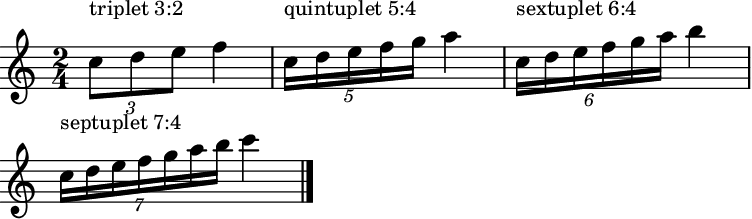
A tuplet borrows time: it plays n equal notes in the space that normally holds m of them, marked with the figure n (or the ratio n:m) over the group. The triplet, 3:2, is the everyday case: three quavers in the time of two, filling one crotchet. Tuplets are the notation's escape from binary arithmetic, buying every division the value family cannot write.
The written value inside a tuplet is chosen by a fixed rule: use the value the group would have if it held the next lower ordinary count. In simple time that means the nearest power of two below n: a triplet of quavers replaces two quavers; quintuplets, sextuplets and septuplets replace four semiquavers, so they are written as semiquavers. Nine to fifteen in a beat are written as demisemiquavers, replacing eight. The number over the group resolves what the noteheads alone cannot say.
| Tuplet | Ratio in simple time | Written as (per crotchet beat) |
|---|---|---|
| duplet | 2:3 (compound time only) | quavers (per dotted-crotchet beat) |
| triplet | 3:2 | quavers |
| quadruplet | 4:3 (compound time only) | quavers (per dotted-crotchet beat) |
| quintuplet | 5:4 | semiquavers |
| sextuplet | 6:4 | semiquavers |
| septuplet | 7:4 | semiquavers |
7.2 Tuplets in compound time
Compound time reverses the trade. Its beat already holds three, so the visitor squeezes in twos and fours: the duplet puts two notes in the time of three, the quadruplet four in the time of three, each written as quavers with the figure 2 or 4. An older alternative spells the duplet as two dotted quavers, which is arithmetically exact and needs no figure; both notations are current, and the dotted spelling is commoner in older engraving.
Larger tuplets in compound time take their ratio against the beat's own count: a quintuplet filling a dotted crotchet is 5:3 if written in quavers, 5:6 if written in semiquavers. Where any doubt exists, modern practice prints the full ratio, 5:3 or 5:6, instead of a bare 5. The bare figure is a convention; the ratio is a definition.
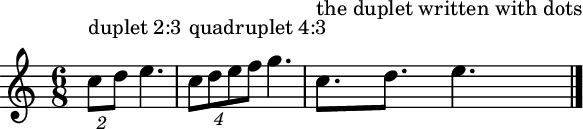
7.3 Counting and placing tuplets
A tuplet is performed by hearing its span first: the group borrows a known duration, so the player's anchor is the beat or beats it fills, never the individual notes. A triplet is counted "trip-a-let" or "1 and a" inside its beat. A quintuplet is counted as five even syllables squeezed into the beat ("hip-po-pot-a-mus" serves), the beat's edges held firm by the accompanying pulse. The failure mode is always the same: rushing the first notes and stretching the last, turning five even notes into a flourish plus a wait. The cure is the method of chapter 9 in miniature: tap the host beat with one hand while speaking the tuplet against it, and let the coincidence points discipline the middle.
7.4 Sextuplet or two triplets
Six notes in a beat can be felt 3 + 3, as two quick triplets, or 2 + 2 + 2, as a true sextuplet with one accent. Engraving distinguishes them: two figure-3 groups beamed per half beat for the first, a single figure-6 group for the second. The sounds differ, the accents differ, and careful composers choose deliberately. Where an edition prints a lazy 6 over what is plainly 3 + 3, players read the beaming, which once again outranks the figure.
7.5 Tuplets of rests, and nesting
A tuplet may contain rests anywhere: a triplet of quaver, quaver rest, quaver is three equal slots with the middle one silent. Where a beam cannot join the group, because it begins or ends with a rest or holds values too long to beam, the figure takes a bracket marking the group's true extent. The bracket is omitted only where a beam already does its job.
Tuplets nest: a tuplet may stand inside another, and each level multiplies the time scaling. In a triplet of quavers where the last quaver is itself split into a triplet of semiquavers, each small note lasts one third of one third of the beat, a ninth of it: the arithmetic compounds, and the notation simply stacks the figures. Nested tuplets are rare before the twentieth century and routine after it.
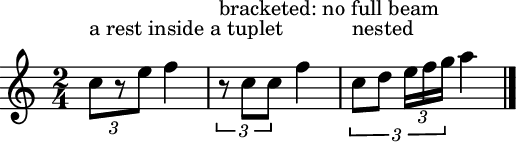
7.6 Tuplets larger than a beat
Nothing confines a tuplet to one beat; the ratio machinery works over any span. Triplet crotchets over a minim are the everyday large case: three crotchets with a bracketed 3, filling half a bar of 4/4 or a whole bar of 2/4, each note two-thirds of a beat long. Triplet minims fill a whole 4/4 bar the same way, three attacks across four beats. Since values this long cannot beam, the bracket is compulsory, and its ends mark the borrowed span exactly.
The beat rules still reach inside these groups: a large tuplet spanning half a 4/4 bar must start on beat 1 or beat 3, the halves rule wearing tuplet clothing. And the listener's experience of triplet crotchets is worth naming: they are chapter 9's three-against-two, notated from the three side. A tuplet is always a cross-rhythm frozen into one voice.
7.7 A worked example
Task: in 3/4, set five equal notes across beats 2 and 3.
- The span is two crotchet beats, a minim's worth, which normally holds four quavers. Five equal notes in the time of four: the ratio is 5:4.
- Choose the written value by the rule of section 7.1: five replaces four, and four of a minim span are quavers, so the quintuplet is written in quavers with a figure 5.
- The group cannot beam as one beat (it spans two), so bracket it from the first note to the last.
- Check the start: beats 2 and 3 of 3/4 are not a licensed half-bar, but the group starts cleanly on beat 2 and its bracket declares its full extent, which is what makes multi-beat tuplets legible. Write the figure, and the bar is done: crotchet, then five bracketed quintuplet quavers.
7.8 Placement conventions
The figure (and bracket where present) sits on the beam side of the group, follows the stem direction, and reads upright, never mirrored. Very large tuplets, the elevens and thirteens of Chopin's ornamental runs, are written as small notes with a single figure and left to the player's timing; the figure states the count, and the accompaniment states the space. Tuplet figures never modify the metre itself: however many tuplets a bar holds, its signature's arithmetic is unchanged, each complete tuplet counting as its host value.
8. Syncopation
8.1 The mechanism
Syncopation is accent placed where the metre promises none, while the metre itself continues underneath. That last clause is the whole trick. Displace every accent and the listener simply re-hears the metre in the new place; displace some, against an established cycle, and the contradiction is audible as energy. Syncopation therefore needs a felt pulse to push against, which is why it sits in this guide after metre and not before.
Notation produces syncopation in three ways: by accent marks on weak positions, by silencing strong positions so a weak attack stands out, and by starting a long note in a weak position so it holds through the following strong one. The third way is the classic, and it is written with the ties and licensed figures of chapter 6.
8.2 The standard patterns
- Off-beat quavers: attacks on the "and" of each beat, the strong halves silent or held. The rhythm of countless accompaniment figures, and of ska and reggae guitar.
- Short-long-short: quaver, crotchet, quaver, the crotchet astride the beat boundary. The half-bar version, crotchet, minim, crotchet, straddles the middle of a 4/4 bar. These are the licensed spellings of section 6.4.
- The tie across the beat or barline: a note begun on a weak quaver or weak beat and tied through the next strong point, robbing it of its attack.
- The missed downbeat: a rest on the beat, entry a division later. The listener's own expectation supplies the accent that the music withholds.
- The Scotch snap: semiquaver on the beat, dotted quaver after, the short note taking the stress. Common in Scottish song, in Purcell's word-setting, and in hip-hop vocal rhythm.
- The tresillo: quavers grouped 3 + 3 + 2 across a 4/4 bar, additive metre used as syncopation. It underlies the habanera, a large share of Latin American dance rhythm, and modern pop basslines beyond counting.
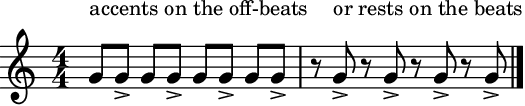
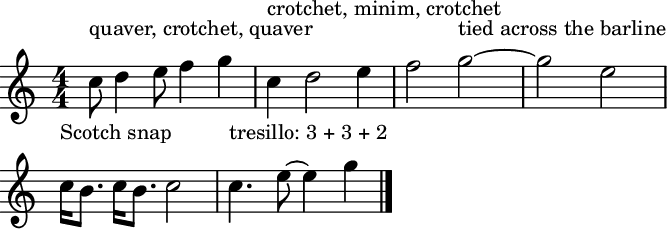
Several of these carry names worth knowing, because rhythm sections use the names as shorthand:
| Name | Pattern | Where met |
|---|---|---|
| backbeat | accents on beats 2 and 4 | rock, soul, jazz (section 8.4) |
| tresillo | quavers grouped 3 + 3 + 2 | Latin American music, pop basslines |
| habanera | quavers grouped 3 + 1 + 2 + 2 | the tango's ancestor |
| charleston | attack on 1 and the "and" of 2 | jazz comping |
| Scotch snap | semiquaver on the beat, dotted quaver after | Scottish song, Purcell, hip-hop |
| clave (son) | quavers grouped 3 + 3 + 4 then 2 + 4, over two bars | Cuban music and its descendants |
The two-bar clave deserves its footnote: it is a fixed pattern that the whole ensemble aligns to, one bar syncopated, the next nearly plain, and Cuban practice treats its direction (which bar comes first) as a structural fact of the piece. A pattern of accents can organise music as firmly as a metre does, which is the bridge to chapter 10.
8.3 The suspension tie
Harmony has owned one syncopation since the Renaissance: the suspension, in which a chord note is held by tie while the harmony changes beneath it, lands as a dissonance on the strong beat, and resolves by step after it. Rhythmically it is exactly the tie-over pattern above; the dissonance is what the tie carries. The preparation-suspension-resolution machinery belongs to Musical Harmony; what matters here is that its rhythm is syncopation, which is why suspensions animate a texture even when played gently.
8.4 The backbeat
One displacement became so standard that it stopped sounding displaced. The backbeat accents beats 2 and 4 of 4/4, the metre's two weak beats, and it is the default rhythmic floor of rock, soul and most popular music since the 1950s: snare drum on 2 and 4, handclaps in gospel, the off-beat chop of reggae one level down. By strict definition it is syncopation, a fixed contradiction of the notated hierarchy. In practice it functions as a second metre riding on the first, so stable that listeners raised on it clap on 2 and 4 by instinct.
It earns its place here as the limiting case of the chapter's mechanism: an accent pattern can be displaced so consistently that the displacement becomes the style's own grid, and further syncopation is then heard against the backbeat itself.
8.5 A worked example
Task: syncopate the plain rhythm crotchet, crotchet, minim (4/4, attacks on beats 1, 2 and 3).
- Choose an attack to displace. Move the second attack half a beat early or late; late is the classic. It now falls on the "and" of beat 2.
- Respell around the displacement. The first note shrinks to a dotted crotchet (beat 1 to the "and" of 2). The moved attack lasts until the third attack: from the "and" of beat 2 to beat 3 is half a beat plus nothing: it is a quaver, and the minim on beat 3 stays.
- Check the spelling rules. The dotted crotchet from beat 1 reaches into beat 2 but is a licensed within-half spelling; the quaver sits inside beat 2; the minim occupies the second half. Every beat is recoverable.
- Compare by counting: "1, 2, 3" has become "1, (2) and, 3". The withheld attack on 2 and the early weight on "and" are the syncopation; the surrounding attacks keep the metre alive to push against.
The same four steps syncopate anything: pick an attack, displace it, respell by chapter 6's rules, and confirm the grid survives. Skip the last check and the result is not syncopation but a new metre, which is exactly the boundary chapter 10 explores.
8.6 Reading and writing it
Two practical rules. Writing: spell syncopation with the licensed figures where they exist, and with ties elsewhere; never invent a spelling that hides a beat the reader needs. Reading: find the beats first, mark them mentally or physically, then place the attacks between them. A syncopated line read without its underlying grid is guesswork; the same line read against a tapped foot is easy, which is the practical meaning of the rule that syncopation exists only against a pulse.
9. Hemiola and cross-rhythm
9.1 Three against two
The ratio 3:2 has a name of its own, hemiola, from the Greek for "one and a half", and two distinct musical uses: successive and simultaneous.
The successive hemiola re-groups two bars of triple time as three units of two: six beats, heard not as 3 + 3 but as 2 + 2 + 2. Nothing changes in the signature; the music's own accents, harmony changes and phrase shapes do the regrouping. Baroque composers made it a cadential mannerism: in a courante or a minuet, the two bars before the cadence broaden into three minim strides, and the arrival lands with extra weight. Handel's triple-time choruses lean on it constantly; Brahms, two centuries later, built whole movements from the same device.
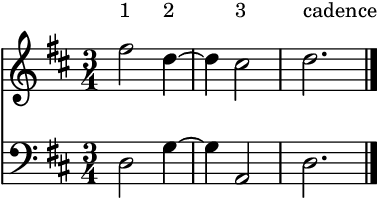
The engraved example shows the mechanism: across the two hemiola bars, the harmony changes every minim, cutting across the notated crotchet beats, and the barline between them is contradicted by a tie or by a chord held across it. On paper the metre never changes; in the ear it has, until the cadence restores it.
9.2 Simultaneous three against two
Play the three-unit and the two-unit versions at once and you have cross-rhythm: one voice divides the span into three, another divides the same span into two. The composite pattern repeats every six subdivisions, and lining it up on a grid shows exactly where the attacks fall:
| Subdivision | 1 | 2 | 3 | 4 | 5 | 6 |
|---|---|---|---|---|---|---|
| The two-voice | x | x | ||||
| The three-voice | x | x | x |
Only the first subdivision is shared. The three-voice's second note falls exactly halfway between the two-voice's attacks, and the resulting composite, long-short-short-long, is the sound every pianist knows from Brahms and from Chopin's accompaniments. Learning to play it means learning the composite first, then relaxing back into two independent streams.
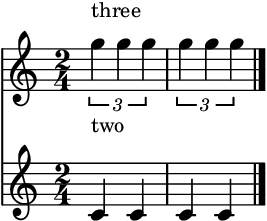
9.3 Learning three against two
The polyrhythm is learned composite-first. Write out the six-subdivision grid of section 9.2 and read off the combined attacks: subdivisions 1, 3, 4 and 5. Tap that composite pattern with one hand until it is a single remembered shape, a long note then three quick ones. Then split it: left hand takes subdivisions 1 and 4 (the two), right hand takes 1, 3 and 5 (the three). Because the composite is already automatic, the hands are not competing but sharing out a known rhythm. Finally detach: speed it up until each hand hears its own even stream and the composite dissolves into two tempos. Every polyrhythm in the next chapter yields to the same three stages: composite, split, detach.
9.4 Period practice
The hemiola is older than the barline. Renaissance triple-time music treats the 3:2 regrouping as a normal resource of mensural rhythm, and the Baroque dance repertoire inherits it: the courante trades on deliberate ambiguity between 3/2 and 6/4, which are the hemiola pair one level up. Bernstein's "America", met in chapter 2, is the same pair one level down, 6/8 against 3/4, alternating rather than simultaneous. One ratio, four centuries of use.
10. Polyrhythm and polymetre
10.1 Definitions worth keeping apart
Usage drifts, but the distinctions are real and worth fixing:
- Polyrhythm: two or more conflicting divisions of the same span sounding together. Three against two is the smallest case; four against three the next.
- Cross-rhythm: polyrhythm sustained long enough to threaten the prevailing metre rather than decorate one beat of it.
- Polymetre: different metres genuinely running at once, each voice keeping its own accent cycle, whether or not the notation shows separate signatures.
%%{init: {'theme':'neutral'}}%%
flowchart TD
  A["one metre,<br/>accents displaced"] --> S["syncopation<br/>(ch. 8)"]
  B["one span,<br/>two divisions"] --> H["hemiola and<br/>cross-rhythm (ch. 9)"]
  C["two accent cycles<br/>at once"] --> P["polyrhythm and<br/>polymetre (ch. 10)"]
  S ~~~ H ~~~ P
  classDef dev fill:#dce8f5,stroke:#3b5f8a,stroke-width:2px
  class S,H,P dev
10.2 Four against three
The next polyrhythm up from 3:2 aligns on a grid of twelve. Four attacks every three subdivisions against three attacks every four:
| Subdivision | 1 | 2 | 3 | 4 | 5 | 6 | 7 | 8 | 9 | 10 | 11 | 12 |
|---|---|---|---|---|---|---|---|---|---|---|---|---|
| The four-voice | x | x | x | x | ||||||||
| The three-voice | x | x | x |
Again only the downbeat is shared, and the composite is a distinctive limping pattern that repeats each bar. Chopin's Fantaisie-Impromptu runs four semiquavers against triplet quavers for pages; the pianist's two hands each keep an even stream, and the shimmer between them is the piece.
The learning method of section 9.3 applies unchanged, with one addition worth knowing: the composite of 4:3 is symmetrical around the span's midpoint, attacks at subdivisions 1, 4, 5, 7, 9 and 10 of twelve, so the second half is the first half reversed. Feeling that palindrome makes the pattern loop naturally instead of restarting with a jolt each bar.
10.3 Implied polymetre
Far more common than double signatures is one metre with a repeating figure of the wrong length laid across it. A three-quaver cell repeated in 4/4 puts its accent on a different quaver of each bar, cycling back to the downbeat after three bars: the notation stays in one metre, the accents walk. Composers from Brahms to rock guitarists use this constantly, and the engraving convention is to keep the true metre's beaming and mark the cell's accents, letting the conflict show rather than renotating it away.
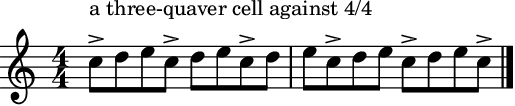
10.4 Notated polymetre
True double-signature notation, each stave carrying its own metre and its own barlines, appears where the layers are genuinely independent. The textbook example is the ballroom scene of Mozart's Don Giovanni, where three onstage bands play a minuet in 3/4, a contredanse in 2/4 and a fast dance in 3/8 simultaneously. The metres share a common small unit, and the notation aligns them so that the layers coincide at agreed points.
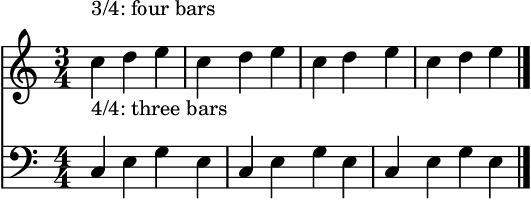
In the engraved example, four bars of 3/4 span the same time as three bars of 4/4, meeting at the double bar: twelve crotchets either way. In practice most publishers renotate polymetric passages into a single metre with accents and beams carrying the second layer, because parts with private barlines are expensive to rehearse. The composer's polymetre survives in the sound; the notation compromises towards the players.
10.5 Cross-rhythm as a system
European notation treats the devices of this chapter as special effects against a single ruling metre. Much West African drumming ensemble music inverts that assumption: a repeating bell pattern of twelve pulses anchors the texture, and the parts around it group those twelve pulses in twos, threes, fours and sixes simultaneously, none of the groupings ranking as "the" metre. Twelve divides every way at once, and the music lives in the composite. Transcribers force such textures into 12/8 or 6/8 and immediately misstate them, because a signature elects one grouping as ruler and the whole point is that no grouping rules.
The lesson transfers directly to reading and writing Western syncopated music. A funk groove or a salsa arrangement is often best understood the same way: a lattice of interlocking patterns over a shared fast pulse, with the notated metre serving as the agreed grid reference rather than the audible king. Notation says 4/4; the ear says several things at once; both are right, and chapter 1's distinction between the felt pulse and the notated beat is what keeps the two honest.
11. Swing and notational shorthand
11.1 The convention
Jazz, and everything jazz has touched, is written in a deliberate shorthand: the page shows even quavers, the performance divides each beat long-short. The long-short ratio is close to 2:1, the first quaver of each pair taking about two-thirds of the beat, like the first two notes of a quaver triplet with the first two tied. But the true ratio is elastic: gentle, nearly even at fast tempos, more sharply unequal in slow blues. That elasticity is exactly why the notation stays straight. Written-out triplets would fix one ratio and bury the line in figures; the word Swing at the head of the part fixes none and lets the style breathe.

The engraved pair shows the convention: the "written" line is what the part contains, the "played" line approximates what a competent player delivers. Where a passage must be even against a swung background, it is marked straight quavers or even quavers; the countermand is as much a part of the convention as the rule.
11.2 Shuffle and 12/8
The shuffle commits harder to the same division: an insistent long-short on every beat, the triplet feel made explicit, the skeleton of boogie-woogie and half of the blues. At its most literal it is written out in 12/8, four dotted-crotchet beats each carrying crotchet-plus-quaver, which is the swing rhythm with the shorthand removed. A slow blues in 12/8 and a swung 4/4 at the same tempo can be note-for-note identical in sound; the 12/8 spelling trades flexibility for precision.
11.3 Older shorthands
The habit of writing one rhythm and playing another is centuries older than jazz. Dance-band and theatre parts well into the twentieth century wrote dotted quaver plus semiquaver while meaning the gentler swung pair; players of the idiom read the dotting as style, not arithmetic. The French Baroque institutionalised notes inégales: stepwise quavers written even and played unequal, long-short, as a matter of national performance practice, with the degree of inequality left to taste. And the French overture's written dotted rhythms were sharpened in performance beyond their notated values, a practice called over-dotting (chapter 14).
In every case the mechanism is the same: notation states the grid, convention states the delivery, and the reader is assumed to know the style. Shorthand is not imprecision; it is trust.
11.4 Half time and double time
Popular and jazz musicians speak of a groove going into half time or double time, and the terms describe a change of level, not of speed. In half time the backbeat rate halves, the snare moving from beats 2 and 4 to beat 3 alone, so the bar feels twice as long while every written duration and the tempo mark stay put. Double time doubles the backbeat rate instead, the same bar now feeling like two. Both are chapter 1's lesson about levels made audible: the pulse hierarchy has not changed, only which level the rhythm section treats as the beat.
The notational forms are worth keeping apart. A half-time feel is written as a direction over unchanged notation. A true double-time passage, common in jazz, renotates the music in halved values so the page matches the new density. And the shuffle applied to half time, the drummer's half-time shuffle, layers swung semiquavers over a beat-3 backbeat, a texture funk and hip-hop borrowed wholesale.
11.5 When to write it out
The shorthand has limits, and knowing them is part of the craft. Write the rhythm literally when the division is structural rather than stylistic: a composed cross-rhythm against the swing, a passage where swung and straight players overlap, or any music likely to be read by players outside the idiom. Keep the shorthand when the whole ensemble shares the style and the feel should float with tempo. Between the two sits the labelled compromise, a marking such as "swung quavers" with a small printed triplet equivalence at the head of the piece: one bar of explanation buying a whole part of clean notation.
Film and theatre copyists, whose players may meet the part cold at a single rehearsal, lean towards writing things out; jazz publishers, whose readers grew up in the style, lean the other way. The question is always the same: which notation lets this reader deliver the right rhythm first time?
12. Metric modulation and tempo relationships
12.1 Proportional tempo changes
Some tempo changes are not new speeds but new relationships. The oldest is l'istesso tempo, "the same tempo": the beat keeps its speed while the metre changes around it. A song moving from 3/4 to 6/8 under l'istesso tempo keeps one steady beat, ♩ = ♩., while the beat's contents change from two quavers to three; the pulse walks on, the subdivision changes gait. Doppio movimento doubles the speed, its opposite halves it, and Baroque proportional practice, where a new section moved at a clean ratio of the old, stands behind both.
Modern scores make these relationships exact with an equation over the change: the old note value on the left, the new on the right, ♩ = ♩. or ♪ = ♪. Read it as "the thing that was worth the left symbol is now worth the right": the durations named are equal across the barline, and everything else follows arithmetically.
12.2 Metric modulation
Metric modulation turns that equation into a way of travelling between tempos. A subdivision of the old tempo is declared equal to a unit of the new: the music establishes, say, triplet crotchets, and then a marking states that the triplet crotchet has become the ordinary crotchet. The pulse the listener is already hearing continues unbroken; only its metrical meaning changes, and with it the notated tempo.
The arithmetic is exact. At ♩ = 90, triplet crotchets pass at 135 to the minute (three in the time of two, so 90 × 3/2). Declare triplet crotchet = new crotchet, and the new tempo is ♩ = 135: a precise 3:2 acceleration reached without a single moment of speeding up. Elliott Carter, whose Cello Sonata of 1948 made the device famous, chained such equations to move between remote tempos as smoothly as a harmonic modulation moves between keys, which is exactly the analogy the name asserts.
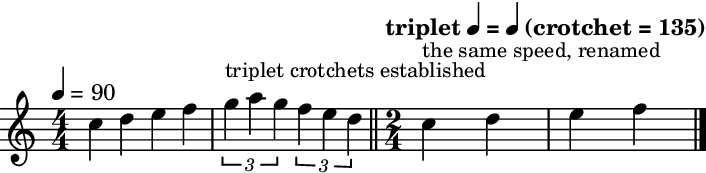
Reading one, work right to left: find the shared duration, count its speed in the old tempo, and that number is the new mark. Writing one, the discipline is to establish the pivot value audibly before the change, just as a pivot chord is established before a modulation; an equation over a pivot the listener never heard is arithmetic without an effect.
12.3 The common proportions
Each pivot value produces a fixed multiplier, and the useful ones are few enough to table. The multiplier prices the notated crotchet: old crotchet mark × multiplier = new crotchet mark, exactly as the worked example turned ♩ = 90 into ♩ = 135. Where the felt beat behaves differently from the written values, the table says so:
| Equation | Pivot | Multiplier |
|---|---|---|
| ♩ = ♩. | crotchet becomes dotted crotchet | × 3/2 (felt beat unchanged: l'istesso tempo) |
| ♩. = ♩ | dotted crotchet becomes crotchet | × 2/3 (felt beat unchanged: l'istesso tempo) |
| triplet ♩ = ♩ | triplet crotchet becomes crotchet | × 3/2 |
| ♩ = triplet ♩ | crotchet becomes triplet crotchet | × 2/3 |
| ♪ = ♪ across 4/4 to 6/8 | quaver constant, beat regroups | × 1 (felt beat slows to 2/3) |
| ♩ = 𝅗𝅥 | crotchet becomes minim | × 2 (doppio movimento) |
| 𝅗𝅥 = ♩ | minim becomes crotchet | × 1/2 |
Two of these deserve a second look. The quaver-constant change between 4/4 and 6/8 is the commonest proportional move in ordinary repertoire: the fast notes keep their speed while the beat above them regroups from two quavers to three, so the felt tempo drops by a third though nothing on the surface slows. And the pair of triplet equations are inverses: chain one after the other and the music returns to its opening tempo exactly, which is how Carter builds round trips through three or four tempos with no approximation anywhere. Proportional tempo is closed arithmetic, and that exactness is what separates metric modulation from an ordinary rallentando into a new speed.
12.4 Leaving the grid
Notation also has machinery for suspending metre altogether, and it belongs in this chapter because each device is defined by what it does to counted time.
The pause (fermata) holds one note, chord or rest beyond its written value, at the performer's discretion; counting stops and resumes after it. A pause over a barline stops time between two bars. The caesura, two slashes above the stave, is a clean break in the sound, an instant of uncounted silence. A general pause (G.P.), a marked silent bar in every part at once, is counted strictly by the conductor even though nothing sounds, which is exactly what distinguishes it from a pause: G.P. bars are inside the metre, pauses are outside it.
Beyond these local suspensions lies unmeasured notation: senza misura passages, cadenzas in small notes, and recitative, where barlines thin out or vanish and note values become relative shapes rather than counted durations. The reader's contract inverts: instead of the metre timing the notes, the performer's delivery times everything, and notation records only the order and approximate proportion. The symbols themselves are covered in Music Notation; what matters here is the boundary they mark, since every device in this guide up to now has assumed the grid, and these are the signs that switch it off.
13. The anacrusis and phrasing across the barline
13.1 The anacrusis
Many melodies begin before their first strong beat. The unstressed opening note or group is the anacrusis (the upbeat): it belongs, musically, to the bar it leans into. "Happy Birthday" begins with a two-note anacrusis; hymn books are full of tunes that start on beat 4.
Notationally the anacrusis is an incomplete first bar, containing only the closing beats of its notional bar. Convention then balances the books at the far end: the final bar is shortened by the anacrusis's value, so first and last bars together make one whole bar. A 4/4 tune opening with a crotchet anacrusis traditionally ends with a three-crotchet bar. The convention is strict in the Classical repertoire and in exam answers, looser in modern editions and popular music, where full final bars padded with rests are common.

Counting an anacrusis, use the beat numbers of its notional bar: a single crotchet anacrusis in 4/4 is counted "four", not "one". The downbeat that follows is beat 1, and the bar numbering of a piece starts there: bar 1 is the first complete bar.
13.2 Phrases against bars
The anacrusis is the smallest case of a general truth: phrases do not have to start at barlines, and much of the best melody writing pulls against the bar. A phrase that begins on a weak beat leans forward; one that ends just after a downbeat lands and releases. The classical terms for the two endings are masculine, ending on the strong beat, and feminine, ending after it on a weak one.
Whole dance genres are defined by where they sit against the bar: the gavotte begins at the half-bar, every phrase spanning the barline; the bourrée springs from a single-crotchet anacrusis; the sarabande starts squarely on the downbeat and stresses beat 2 from inside the bar. Barlines mark the metre; phrasing, shown by slurs, lyrics and the shapes of the lines themselves, is free to cross them, and the tension between the two grids is a large part of what players mean by musical rhythm. The larger machinery of phrase structure belongs to Musical Form and Analysis.
13.3 Counting in and counting through
Two performing skills hang on this chapter. Counting in: an anacrusis entry is prepared by counting the notional bar it completes, so a tune starting on beat 4 is counted "1, 2, 3" and entered on "4". Ensembles live on this convention, and the leader's count-in is, in effect, a spoken bar of rests.
Counting through: a player resting for part of a bar before an entry counts the printed rests by the beat map of chapter 5, and the rest spelling earns its keep exactly here. Rests grouped by beats can be counted at sight; rests grouped carelessly must first be decoded. The chain of custody runs from the copyist's rest placement, through the player's count, to the accuracy of the entry, which is why this guide keeps insisting that grouping rules are not etiquette. They are the interface between the silent page and a player counting under pressure.
13.4 The anacrusis at repeats
Repeat signs complicate the balancing convention. When a repeated section begins with an anacrusis, the bar before the repeat barline gives up the anacrusis's value, so that jumping back completes a whole bar with no join showing: the last bar inside the repeat is short, exactly as a final bar would be, and the anacrusis is heard again on the way round. First-time and second-time bars follow the same arithmetic, each ending short if what follows begins with an anacrusis.
Editors who neglect this leave the player a bar with too many beats on the repeat, one of the commonest engraving faults in amateur editions, and spotting it is a good test of everything this chapter has said: the notation must add up around every route the repeat signs allow, and the plain run of the bars is only one such route.
14. Rhythm through the periods
14.1 Before the bar: modal rhythm and isorhythm
Notated rhythm begins in the twelfth century, when the Notre Dame school in Paris needed to coordinate voices singing different melodies at once. Their solution was the system of rhythmic modes: six repeating long-short patterns, close cousins of poetic feet, so that a voice sang its assigned pattern over and over and the notation needed only to say which pattern and for how long. Rhythm entered Western notation not as free choice but as a small menu of loops.
The fourteenth century's Ars Nova broke the menu open, notating durations individually and admitting duple divisions beside the older triples. Its grandest game was isorhythm: a repeating rhythmic pattern, the talea, laid against a repeating melodic pattern, the color, with the two deliberately different in length so that pitch and rhythm cycled at different rates, coinciding only after several repetitions. Machaut's motets run on exactly this machinery. It is worth pausing on how modern that is: a rhythmic cell of the "wrong" length cycling against another layer is the mechanism of chapter 10's implied polymetre, six centuries early.
14.2 The Renaissance: tactus and mensuration
Renaissance music ran on the tactus: a steady beat, around 60 to 70 to the minute, kept by a hand moving down and up, and remarkably constant across pieces. There were no bar lines in the singers' part-books and no time signatures in the modern sense. Instead, mensuration signs declared how the long values divided: a full circle meant the breve divided into three semibreves ("perfect" time), a broken circle into two ("imperfect"), with a dot inside the sign governing the next level down.
The broken circle is the direct ancestor of our C (chapter 2), and the proportional habits of the system, where a sign could set three new notes in the time of two old ones, are the ancestors of the tuplet and of metric modulation alike.
Rhythm inside this system was supple. Without barlines, syncopation was simply a note held against the tactus, and the dissonance treatment built on such holds became the suspension (chapter 8). When barred notation arrived, it recorded accents the music already had; the bar did not create metre, it photographed it.
14.3 The Baroque: dance metres and dotted styles
Baroque instrumental music is organised around dance types, each a metre with a character attached:
| Dance | Usual metre | Rhythmic signature |
|---|---|---|
| allemande | 4/4 | flowing semiquavers, short anacrusis |
| courante (French) | 3/2 or 6/4 | deliberate hemiola ambiguity |
| corrente (Italian) | 3/4 or 3/8 | fast running triple |
| sarabande | 3/4 | slow, weight on beat 2 |
| minuet | 3/4 | moderate triple, hemiola cadences |
| gavotte | 2/2 | begins at the half-bar |
| bourrée | 2/2 | crotchet anacrusis, quick duple |
| gigue | 6/8 or 12/8 | compound drive, often fugal |
| siciliana | 6/8 or 12/8 | lilting dotted figure on each beat |
Two national performance practices layered rhythm on top of the notation: French notes inégales swung written-even quavers, and the French overture demanded double-dotted majesty, its written dotted rhythms sharpened further in performance (over-dotting). Chapter 11's argument that notation trusts style begins here.

14.4 The Classical period: the tyranny of the four-bar phrase
Classical style regularised. Phrases fell into balanced four-bar units, metres stayed put for whole movements, and the interest moved to what happened against the regularity: Haydn's displaced accents, the syncopated inner voices of Mozart's finales, Beethoven's sforzandi on weak beats, which are chapter 8's devices deployed at symphonic scale. The minuet quickened into the scherzo, triple metre taken in one beat to a bar so fast that the notated 3/4 is really a compound metre of whole bars, with hemiola (two-bar groups against three-bar groups) operating at the level of the phrase. Alla breve finales and the metronome's arrival at the period's end complete the picture.
14.5 The Romantic period: rubato and the two-against-three
The nineteenth century loosened time itself. Rubato, the expressive bending of tempo, became central to performance; accounts from Chopin's pupils describe an accompaniment hand keeping strict time while the melody floats free of it, the strict layer making the free one audible. On the page, the period's fingerprint is the cross-rhythm: Brahms made three-against-two a stylistic signature at every level from accompaniment figures to phrase structure, and Chopin's nocturnes set florid tuplet runs of seven, eleven and thirteen against even quaver accompaniments, tuplet notation carrying rhythms no earlier style needed.
Metres grew extreme in both directions, from one-in-a-bar waltzes to the vast slow spans of Bruckner, and the 5/4 movement of Tchaikovsky's Pathétique put irregular metre on the mainstream concert stage.
14.6 The twentieth century: metre unbound
The twentieth century attacked every assumption this guide has catalogued, using the system's own tools:
- Changing metres: Stravinsky's Rite of Spring switches signature almost every bar in its final dance, the barline demoted from cycle-marker to accent-marker. Copland, Bernstein and film music normalised the practice.
- Additive metre: Bartók's Bulgarian rhythms (chapter 3) and the aksak patterns of folk sources became concert vocabulary.
- Polymetre and layered tempo: Ives stacked marching bands, Stravinsky stacked ostinati of unequal length, and the implied-polymetre techniques of chapter 10 became structural.
- Metric modulation: Carter made tempo itself modulatory (chapter 12).
- Process rhythm: Reich's phasing set identical patterns slipping against themselves, polyrhythm generated mechanically over minutes.
- Swing: jazz built a world repertoire on the shorthand of chapter 11, and popular music carried the tresillo and the backbeat everywhere.
%%{init: {'theme':'neutral'}}%%
flowchart TD
  R["Renaissance<br/>tactus, mensuration,<br/>no barlines"] --> B["Baroque<br/>dance metres,<br/>dotted styles"]
  B --> C["Classical<br/>four-bar regularity,<br/>accent play"]
  C --> RO["Romantic<br/>rubato,<br/>cross-rhythm"]
  RO --> T["20th century<br/>changing metres, additive rhythm,<br/>metric modulation, swing"]
  classDef era fill:#dce8f5,stroke:#3b5f8a,stroke-width:2px
  class R,C,T era

14.7 The click and the grid
The story has a present tense. Recorded popular music since the 1980s is mostly made against a click track, a metronome in the performers' ears, and edited on a grid of bars and beats inside recording software, with performances nudged towards exact subdivisions by quantisation. The tactus has returned as a machine: a steady, external, unarguable pulse that every layer answers to, tighter than any Renaissance singer's hand.
And the counter-movement returned with it, as producers program deliberate displacements and players prize feel precisely because the grid makes it scarce; swing percentages in software are notes inégales with a numeric dial. The vocabulary of this guide describes a studio session as accurately as a Handel chorus, which is the reason to learn it.
The through-line of the whole story: each period's innovation became the next period's rulebook. The tactus became the barline, the dance metres became the signature table, the hemiola became the cross-rhythm, the proportion became the metric modulation. Nothing in chapters 1 to 13 was ever repealed; it was accumulated.
15. Quick reference
15.1 Time signatures
| Signature | Class | Beats per bar | One beat is | Quavers group as |
|---|---|---|---|---|
| 2/4 | simple duple | 2 | crotchet | 2 + 2 |
| 3/4 | simple triple | 3 | crotchet | 2 + 2 + 2 |
| 4/4 (C) | simple quadruple | 4 | crotchet | 2 + 2 + 2 + 2 |
| 2/2 (𝄵) | simple duple | 2 | minim | 4 + 4 |
| 3/2 | simple triple | 3 | minim | 4 + 4 + 4 |
| 3/8 | simple triple | 3 | quaver | 3 (one group) |
| 6/8 | compound duple | 2 | dotted crotchet | 3 + 3 |
| 9/8 | compound triple | 3 | dotted crotchet | 3 + 3 + 3 |
| 12/8 | compound quadruple | 4 | dotted crotchet | 3 + 3 + 3 + 3 |
| 5/4 | irregular | 3 + 2 or 2 + 3 crotchets | crotchet | by the grouping |
| 7/4 | irregular | 4 + 3 or 3 + 4 crotchets | crotchet | by the grouping |
| 5/8 | irregular | 2 + 3 or 3 + 2 quavers | the group | 2 + 3 or 3 + 2 |
| 7/8 | irregular | twos and threes | the group | 2 + 2 + 3 etc. |
15.2 Beaming rules
| Metre class | Rule |
|---|---|
| simple, crotchet beat | quavers in pairs per beat; semiquavers in fours per beat; mixed figures as whole beats |
| 4/4 enlargement | quaver fours across beats 1 + 2 or 3 + 4; never across the middle |
| simple, minim beat | quavers in fours per beat |
| 3/8 and other small bars | whole bar as one group |
| compound | threes per dotted beat; semiquavers in sixes or threes; never twos |
| irregular | beam the declared grouping; the beaming is the metre |
15.3 Rest rules
| Situation | Rule |
|---|---|
| whole silent bar | semibreve rest, any metre (breve rest in 4/2 and longer) |
| silent beat | that beat's own rest (crotchet rest in crotchet metres, dotted crotchet rest in compound) |
| 4/4, beats 1 + 2 or 3 + 4 | minim rest allowed |
| 4/4, beats 2 + 3 | two crotchet rests, never a minim rest |
| 3/4, any two beats | two crotchet rests; the minim rest is not used in triple time |
| compound, first two divisions | one crotchet rest |
| compound, last two divisions | two quaver rests |
| part-beat silence | complete the beat first, in its own subdivision |
| any dotted rest | the dot must not cross a beat boundary |
15.4 Tuplets
| Figure | Simple time | Compound time |
|---|---|---|
| 2 | 2 in the time of 3 (duplet) | |
| 3 | 3 in the time of 2 (triplet) | |
| 4 | 4 in the time of 3 (quadruplet) | |
| 5 | 5 in the time of 4 | 5:3 or 5:6, ratio printed |
| 6 | 6 in the time of 4 (sextuplet) | |
| 7 | 7 in the time of 4 | 7:6, ratio printed |
Written values: use the value of the next lower ordinary count (triplet in quavers per crotchet; 5, 6, 7 in semiquavers per crotchet). Bracket the figure whenever no beam spans the whole group.
15.5 The devices
| Device | One-line definition | Chapter |
|---|---|---|
| syncopation | accent where the metre promises none, against a continuing pulse | 8 |
| hemiola | 3:2 regrouping, successive (two bars of three as three of two) or simultaneous | 9 |
| cross-rhythm | conflicting divisions sustained against the metre | 9, 10 |
| polyrhythm | two divisions of one span at once (3:2, 4:3) | 10 |
| polymetre | two accent cycles at once, notated or implied | 10 |
| swing | written even, played long-short, ratio elastic | 11 |
| metric modulation | shared subdivision redefined to reach a new tempo exactly | 12 |
| anacrusis | unstressed opening notes belonging to the following downbeat | 13 |
15.6 Counting syllables
| Level | Simple time | Compound time |
|---|---|---|
| beats | 1, 2, 3, 4 | 1, 2 |
| divisions | 1 and 2 and | 1 and a, 2 and a |
| subdivisions | 1 e and a | (count the six, or split "and-a" further) |
| triplet in simple time | 1 and a (borrowed from compound) |
15.7 Tempo relationships
| Marking | Meaning |
|---|---|
| ♩ = 120 | 120 crotchet beats per minute |
| ♩. = 60 | 60 dotted-crotchet beats per minute (compound time) |
| l'istesso tempo | the beat keeps its speed across the change of metre |
| ♩ = ♩. | old crotchet and new dotted crotchet last the same |
| doppio movimento | twice as fast |
| a tempo | resume the previous speed |
| tempo primo | resume the opening speed |
15.8 The rulebook in ten lines
- Notation's first duty is to keep the beats visible.
- The top number counts beats in simple time and divisions in compound; 6, 9 and 12 mean compound.
- Beam one beat per group; in 4/4 the halves of the bar are also legal; never bridge the bar's middle.
- In compound time, beam and rest in threes; in irregular metre, beam and rest the declared bricks.
- A silent bar is a semibreve rest; a silent beat is that beat's own rest.
- Rests complete the current beat first, in its own subdivision, and a rest's dot never crosses a beat.
- A dot stays inside its beat's territory; across a barline, always a tie; across a hidden beat, split and tie.
- The licensed exceptions (crotchet-minim-crotchet and its half-bar cousin) are symmetrical syncopations; learn them as shapes.
- A tuplet is written in the value of the count it replaces, bracketed when no beam spans it.
- When two spellings agree on arithmetic, choose the one a stranger could count at sight.
16. Exercises
Answers follow at the end. Write your answers out on manuscript paper where the question involves notation: rhythm rules are learned through the hand as much as the eye.
For each signature, name its class and its beat: 9/16, 6/4, 3/2, 4/8, 12/8.
A bar of 6/8 and a bar of 3/4 both contain six quavers. State two notational differences and one difference of feel.
Why must a bar of 6/8 never be beamed as three pairs of quavers?
The engraved melody below is in 3/4. Rewrite it in 6/8 so that it sounds identical. What happens to the middle crotchet?
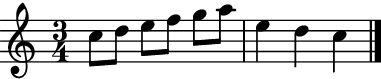
The engraved bar below contains a grouping error and a rest error. Rewrite it correctly.
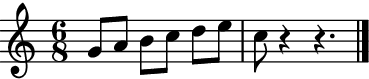
In 4/4, a melody sounds on beats 1 and 4 only. Write the rests for beats 2 and 3, and explain why a minim rest is wrong there.
In 6/8, a quaver sounds on the first division of beat 1 and a dotted crotchet fills beat 2. What rests complete beat 1, and why not a crotchet rest?
A quintuplet of semiquavers fills one beat of 2/4. State its ratio, and the total duration of the group.
What is the duration of the whole figure: a triplet of quavers in which the third quaver is itself a triplet of semiquavers?
A passage in 3/4 approaches a cadence, and for two bars the harmony changes every minim. Name the device and describe what the listener hears.
In a three-against-two bar, which attacks coincide, and where does the middle note of the three fall relative to the two?
At ♩ = 80, a passage establishes triplet crotchets, and the score then declares triplet crotchet = crotchet. What is the new tempo mark?
A 4/4 tune begins with a single crotchet anacrusis. On which beat number is it counted, and what does the traditional convention require of the final bar?
A jazz part marked Swing contains straight quavers. How are they performed, and why does the notation not write the rhythm out?
Name the period: (a) music with no barlines, governed by a steady tactus; (b) double-dotted overture rhythms sharpened further in performance; (c) signatures changing almost every bar; (d) strict-time accompaniment under a freely bent melody.
8/8 grouped 3 + 3 + 2 and 4/4 hold the same quavers. What distinguishes them as metres, and which chapter 8 pattern does the 3 + 3 + 2 grouping produce inside 4/4?
Write the counting syllables for a 6/8 bar of running quavers, and for a 2/4 bar of running semiquavers.
A bar of 3/2 and a bar of 6/4 both hold six crotchets. Which is simple and which compound, and how does each group its crotchets?
Five equal notes fill beats 2 and 3 of a 3/4 bar. State the ratio, the written note value, and why the figure needs a bracket.
On which beats does the backbeat fall, and why can further syncopation still be heard against it?
A conductor beats through a G.P. bar but stops beating at a pause. Explain the difference in one sentence each.
A drummer moves the snare from beats 2 and 4 to beat 3 only, at an unchanged tempo mark. Name the effect and state what has and has not changed.
In 7/8 grouped 2 + 2 + 3, the first group sounds and the rest of the bar is silent. Write the rests.
In a fourteenth-century isorhythmic motet, the talea is 12 notes long and the color 18 notes. After how many notes do they realign, and which twentieth-century device in this guide works the same way?
Answers
9/16: compound triple, beat = dotted quaver. 6/4: compound duple, beat = dotted minim. 3/2: simple triple, beat = minim. 4/8: simple quadruple, beat = quaver. 12/8: compound quadruple, beat = dotted crotchet.
Notation: 3/4 beams its quavers 2 + 2 + 2, 6/8 beams 3 + 3; rests are grouped by crotchet beats in 3/4 but by dotted-crotchet beats in 6/8 (a silent beat of 6/8 takes a dotted crotchet rest). Feel: 3/4 has three beats per bar, 6/8 two, so the same quavers carry different accents.
Because 2 + 2 + 2 is the grouping of 3/4: the beaming would state simple triple metre and the reader would place three crotchet-level accents where the music has two dotted-crotchet beats. In compound time the beams must show the threes.
The quavers re-beam from 2 + 2 + 2 into 3 + 3, and the three crotchets become crotchet, quaver tied to quaver, crotchet: the middle crotchet now crosses the beat boundary between the two dotted-crotchet beats, so it must be split into two tied quavers. The first and last crotchets sit inside single beats and stay whole. (See the answer engraving below.)
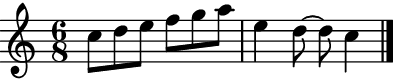
The six quavers must be beamed 3 + 3, not 2 + 2 + 2; and the silence after the quaver must complete the beat with two quaver rests before the whole silent beat takes a dotted crotchet rest. (See the answer engraving below.)
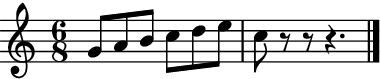
Two crotchet rests, one for beat 2 and one for beat 3. A minim rest may stand only for beats 1 + 2 or 3 + 4, the halves of the bar; across beats 2 + 3 it would swallow the bar's middle, which rests must keep visible.
Two quaver rests. A crotchet rest would begin in the middle of the beat, and a rest must not obscure the beat's interior: the crotchet rest is only allowed at the start of a compound beat.
5:4, five semiquavers in the time of four. The group lasts one crotchet.
One crotchet. The host triplet fills a crotchet regardless of how its members subdivide; the nested triplet replaces one quaver of it exactly.
Hemiola. Six crotchet beats regroup as three minim units, so the listener hears the music broaden into duple strides across the notated triple bars, and the cadence lands with added weight when the true metre returns.
Only the first attack of the span coincides. The second note of the three falls exactly halfway between the first and second notes of the two, at the midpoint of the span.
♩ = 120. Triplet crotchets at ♩ = 80 pass at 80 × 3/2 = 120 per minute, and the equation makes that stream the new crotchet.
It is counted as beat 4 of its notional bar. The final bar is traditionally shortened to three crotchets, so that the opening and closing partial bars sum to one whole bar.
Each pair of written quavers is played long-short, roughly the first two-thirds and last third of the beat, as if the beat were a triplet with the first two notes tied. The notation stays straight because the exact ratio varies with tempo and style; the word Swing delegates the division to the player.
(a) Renaissance. (b) Baroque (the French overture). (c) the twentieth century. (d) the Romantic period (rubato as described by Chopin's pupils).
4/4 has four equal crotchet beats; 8/8 in 3 + 3 + 2 has three unequal beats of 3, 3 and 2 quavers, so the accent cycle differs though the bar length matches. Inside 4/4 the same grouping is heard as the tresillo, the standard additive syncopation of chapter 8.
6/8: "1 and a, 2 and a". 2/4: "1 e and a, 2 e and a".
3/2 is simple triple: three minim beats, crotchets paired 2 + 2 + 2. 6/4 is compound duple: two dotted-minim beats, crotchets grouped 3 + 3. They are the hemiola pair one level above 3/4 and 6/8.
5:4, five in the time of four. Written as quavers, since four quavers is what the two-beat span normally holds. The bracket is required because the group spans two beats and cannot be beamed as one beat; the bracket marks its true extent.
Beats 2 and 4 of 4/4. The backbeat is so consistent that it becomes a stable grid of its own, and attacks displaced against that grid, off-beat quavers or anticipated chords, still register as syncopation against it.
A G.P. bar is counted silence inside the metre, so the beat continues and the conductor shows it. A pause suspends counted time entirely, so there is nothing to beat until the music resumes.
Half-time feel. The backbeat rate has halved and the bar feels twice as long; the tempo mark, the written durations and the underlying pulse are unchanged.
A crotchet rest for the second group (two quavers), then a dotted crotchet rest for the third (three quavers), split exactly at the group boundary.
After 36 notes, the lowest common multiple of 12 and 18, so the talea has run three times and the color twice. The mechanism, a cell repeating against a cycle of a different length, is that of implied polymetre (chapter 10), and of Reich's phasing at the century's end.