A Complete Guide to Analysing Tonal Music
From the diatonic triads to secondary dominants, borrowed chords, augmented sixths and modulation — everything you need to read, write and understand Roman numeral analysis in common-practice tonal harmony.
Introduction
Take a progression you love and move it to another key: every note changes, and nothing changes. Roman numeral analysis is the notation for the part that stays. It names each chord by its role in the key rather than by its notes, and in doing so it collapses ten thousand chord successions into a few dozen recurring patterns worth knowing by name. Learn to read it and other people's analyses become open letters; learn to write it and any piece of tonal music will explain its own workings to you, bar by bar.
That is a large promise for a system built from seven numerals and a handful of figures, and this guide keeps it methodically: what the labels mean, how the diatonic chords behave, what the chromatic vocabulary adds, how modulation is tracked, and a step-by-step method for analysing a real score without getting lost.
Analysis is a performing skill, not a spectator one. From the first chapter onwards, label real music: hymn books and chorales first, since their chords change steadily and their textures are honest, then songs and sonatas as the vocabulary grows. Expect to be wrong often and instructively; the method chapter exists precisely because first guesses need a procedure to check themselves against.
Within this collection, Musical Harmony explains the forces behind the labels, Technical Names and Roman Numerals tabulates every numeral in every key for quick reference, and the ABRSM guides supply the groundwork this guide assumes.
How to Use This Guide
Roman numeral analysis is the standard language for describing harmony in tonal (common-practice) music — the system used in ABRSM Grades 6–8, AP Music Theory, and university theory courses worldwide. It lets you label every chord by its function within a key, independent of the actual pitches, so that the same progression can be recognised in any key.
This guide assumes you already know the material in a Grade 5 theory course:
- Scale degrees and their technical names (tonic, supertonic, mediant, subdominant, dominant, submediant, leading note).
- How to build triads (root, third, fifth) and identify their quality (major, minor, diminished, augmented).
- Key signatures, major and (harmonic/melodic) minor scales, and basic cadences.
If any of that is shaky, review it first — a companion ABRSM Grades 1–5 guide covers it in full. Everything else is built up here from the ground.
The guide is progressive: diatonic harmony → function and syntax → non-chord tones → chromatic harmony → modulation → a step-by-step analysis method → worked examples → reference tables → graded exercises with answers. Work through it in order, and keep returning to the Reference Cheat-Sheet appendix.
A note on notation in this document
Because this is a text document, chords are described by their note names and analysed with Roman numerals and figured-bass figures written on one line (for example V6/5, ii°6, I6/4). In printed scores these figures are stacked vertically under the chord; the linear forms used here are the standard way to type them and mean exactly the same thing. Accidentals use the symbols ♯ (sharp), ♭ (flat) and ♮ (natural); diminished is shown by °, half-diminished by ø, and augmented by +.
What Roman Numeral Analysis Is (and Why We Use It)
A Roman numeral labels a chord by the scale degree of its root and its quality. In C major:
- The chord built on the 1st degree (C–E–G) is I.
- The chord on the 5th degree (G–B–D) is V.
- The chord on the 2nd degree (D–F–A) is ii.
Because the label refers to the degree within the key, not the literal notes, the same numeral describes the same function in every key. A V–I is a dominant-to-tonic motion whether the music is in C major (G→C), in E♭ major (B♭→E♭) or in F♯ minor (C♯→F♯). This is the whole point: Roman numerals reveal the underlying grammar of tonal music that pitch names alone conceal.
Three related labelling systems
Roman numeral analysis sits alongside two cousins; it is worth seeing how they relate.
| System | What it shows | Example (a G7 chord with B in the bass, in C major) |
|---|---|---|
| Figured bass (Baroque) | Intervals above the bass note | bass B with figures 6/5 |
| Roman numerals (analysis) | The chord's root-degree and function in the key | V6/5 |
| Lead-sheet / pop chord symbols | The chord's absolute root and quality | G7/B |
Figured bass tells a performer what to play above a given bass; a chord symbol names the chord absolutely; the Roman numeral tells an analyst what the chord does in the key. Roman numeral analysis effectively combines the figured-bass inversion figures with a functional label — which is why the two share the same numbers (6, 6/4, 6/5, 4/3, 4/2).
A very short history
The approach grew out of thoroughbass (figured bass) in the seventeenth and eighteenth centuries. Theorists including Gottfried Weber (early nineteenth century) formalised the use of Roman numerals for each scale-degree chord, and Hugo Riemann developed the idea of harmonic function (tonic, subdominant, dominant). Modern textbooks blend these traditions into the system taught today.
Prerequisites Recap: Triads on Every Degree
A triad stacks two thirds: a root, a third and a fifth. Its quality depends on the size of those thirds:
| Quality | Lower third | Upper third | Root-to-fifth | Symbol |
|---|---|---|---|---|
| Major | major 3rd | minor 3rd | perfect 5th | uppercase (I, IV, V) |
| Minor | minor 3rd | major 3rd | perfect 5th | lowercase (ii, iii, vi) |
| Diminished | minor 3rd | minor 3rd | diminished 5th | lowercase + ° (vii°) |
| Augmented | major 3rd | major 3rd | augmented 5th | uppercase + + (III+) |
Build a triad on each degree of the scale, using only the notes of the key, and you get the diatonic triads — the raw vocabulary that Roman numerals name. Those are the subject of the next chapter.
1. The Roman Numeral System
1.1 Case and Quality Conventions
The modern (North-American textbook) convention encodes a chord's quality in the numeral itself:
- UPPER-CASE numeral = major triad — I, II, III, IV, V, VI, VII.
- lower-case numeral = minor triad — i, ii, iii, iv, v, vi, vii.
- A ° after a lower-case numeral = diminished triad — vii°, ii°.
- A + after an upper-case numeral = augmented triad — III+.
So the letters tell you the degree, the case tells you major or minor, and the little symbols mark diminished/augmented. (An older convention writes every numeral in upper case and relies on added symbols for quality; you will see it in some editions, but this guide uses the case-sensitive system throughout, as it is clearer and now standard.)
Roman numerals for sevenths and inversions add figures (7, 6, 6/4, 6/5, 4/3, 4/2), covered in Chapter 2.
1.2 The Diatonic Triads in a Major Key
Building a triad on each degree of the major scale always produces the same pattern of qualities, in every major key. Using C major as the model:
| Degree | Numeral | Triad | Quality | Function name |
|---|---|---|---|---|
| 1 | I | C – E – G | major | Tonic |
| 2 | ii | D – F – A | minor | Supertonic |
| 3 | iii | E – G – B | minor | Mediant |
| 4 | IV | F – A – C | major | Subdominant |
| 5 | V | G – B – D | major | Dominant |
| 6 | vi | A – C – E | minor | Submediant |
| 7 | vii° | B – D – F | diminished | Leading-tone |
Memorise the quality pattern: I ii iii IV V vi vii° → major, minor, minor, major, major, minor, diminished. The three major triads are I, IV, V (the primary triads); the three minor triads are ii, iii, vi; the lone diminished triad is vii°.

1.3 The Diatonic Triads in a Minor Key
Minor keys are richer because the 6th and 7th degrees are variable (natural, harmonic and melodic minor forms). In common-practice harmony the leading tone is usually raised (from the harmonic minor) so that chord V is major and can pull strongly to the tonic. Using A minor (raised leading tone = G♯):
| Degree | Numeral | Triad | Quality | Notes |
|---|---|---|---|---|
| 1 | i | A – C – E | minor | Tonic |
| 2 | ii° | B – D – F | diminished | Supertonic |
| 3 | III (or III+) | C – E – G | major | Mediant (becomes III+, augmented, if G♯ used) |
| 4 | iv | D – F – A | minor | Subdominant |
| 5 | V | E – G♯ – B | major | Dominant — uses the raised leading tone |
| 6 | VI | F – A – C | major | Submediant |
| 7 | vii° | G♯ – B – D | diminished | Leading-tone — uses the raised leading tone |
The quality pattern for harmonic-minor harmony: i ii° III iv V VI vii° → minor, diminished, major, minor, major, major, diminished.
The natural-minor variants
If the 7th degree is left un-raised (natural minor), three chords change and get their own labels — you will meet these in modal, folk and Romantic contexts:
| Chord | Natural-minor form | Quality |
|---|---|---|
| v | E – G♮ – B | minor (the "minor dominant") |
| VII | G♮ – B – D | major (the "subtonic", a whole tone below the tonic) |
| III | C – E – G♮ | major (plain, not augmented) |
So a progression using ♭VII–i or a minor v is telling you the composer chose the natural 7th degree. Always let the accidentals in the score decide which form is present.

1.4 Diatonic Seventh Chords
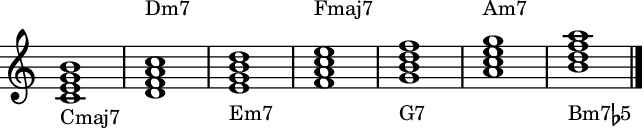
Add another third on top of a triad and you get a seventh chord (root, 3rd, 5th, 7th). Seventh chords have five common qualities:
| Seventh quality | Built from | Example |
|---|---|---|
| Major seventh (Maj7) | major triad + major 7th | C–E–G–B |
| Dominant seventh (7) | major triad + minor 7th | G–B–D–F |
| Minor seventh (m7) | minor triad + minor 7th | D–F–A–C |
| Half-diminished seventh (ø7) | diminished triad + minor 7th | B–D–F–A |
| Diminished seventh (°7) | diminished triad + diminished 7th | G♯–B–D–F |
Diatonic sevenths in a major key (C major)
| Numeral | Chord | Quality |
|---|---|---|
| IMaj7 | C–E–G–B | major 7th |
| ii7 | D–F–A–C | minor 7th |
| iii7 | E–G–B–D | minor 7th |
| IVMaj7 | F–A–C–E | major 7th |
| V7 | G–B–D–F | dominant 7th |
| vi7 | A–C–E–G | minor 7th |
| viiø7 | B–D–F–A | half-diminished 7th |
V7 — the dominant seventh — is by far the most important seventh chord in tonal music: its dissonant tritone (B–F in C major) drives powerfully to the tonic.
Diatonic sevenths in a minor key (A minor, raised leading tone)
| Numeral | Chord | Quality |
|---|---|---|
| i7 | A–C–E–G | minor 7th (natural) |
| iiø7 | B–D–F–A | half-diminished 7th |
| III+Maj7 | C–E–G♯–B | major 7th on an augmented triad |
| iv7 | D–F–A–C | minor 7th |
| V7 | E–G♯–B–D | dominant 7th |
| VIMaj7 | F–A–C–E | major 7th |
| vii°7 | G♯–B–D–F | fully-diminished 7th |
Two minor-key sevenths deserve special note: the fully-diminished leading-tone seventh (vii°7), a stack of three minor thirds that is intensely dominant in feel, and the half-diminished supertonic seventh (iiø7), a favourite pre-dominant chord.
2. Inversions and Figured-Bass Figures
Which chord member is in the bass determines the chord's inversion, and Roman numeral analysis borrows the figured-bass numbers to show it. The figures count intervals above the bass note.
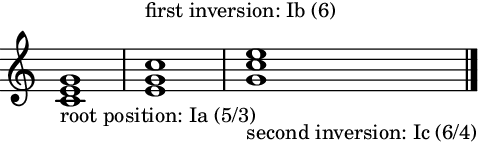
2.1 Triad Inversions
| Position | Bass note | Full figures | Short figure | Written as |
|---|---|---|---|---|
| Root position | root | 5/3 | (none) | V |
| First inversion | third | 6/3 | 6 | V6 |
| Second inversion | fifth | 6/4 | 6/4 | V6/4 |
So in C major:
- I = C–E–G with C in the bass.
- I6 = C–E–G with E in the bass (first inversion).
- I6/4 = C–E–G with G in the bass (second inversion).
The short figures come from abbreviating the full stack: a root-position triad is 5/3 (a 5th and 3rd above the bass) but the figures are so standard they are omitted; a first inversion is 6/3, abbreviated to just 6; a second inversion 6/4 keeps both numbers because it is unusual and needs flagging.
The a/b/c alternative. Some syllabuses (including ABRSM) write inversions with letters instead of figures: a = root position, b = first inversion, c = second inversion. So V6 = Vb and V6/4 = Vc. The two systems are interchangeable; this guide uses the figured-bass numbers, but recognise both.
2.2 Seventh-Chord Inversions
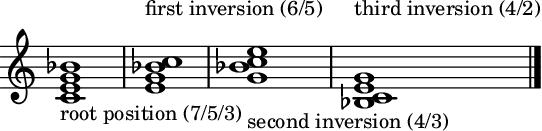
A seventh chord has four notes, so it has a root position and three inversions. The figures again show the intervals above the bass (abbreviated to the distinctive ones):
| Position | Bass note | Full figures | Short figure | Written as |
|---|---|---|---|---|
| Root position | root | 7/5/3 | 7 | V7 |
| First inversion | third | 6/5/3 | 6/5 | V6/5 |
| Second inversion | fifth | 6/4/3 | 4/3 | V4/3 |
| Third inversion | seventh | 6/4/2 | 4/2 (or 2) | V4/2 |
For the dominant seventh (G–B–D–F) in C major:
- V7 — bass G (root).
- V6/5 — bass B (the third).
- V4/3 — bass D (the fifth).
- V4/2 — bass F (the seventh). Because the chordal seventh is in the bass, it must resolve down by step (F→E), so V4/2 almost always goes to I6.
A quick way to remember the seventh-chord figures: 7 · 65 · 43 · 42, descending as the bass climbs from root to seventh.
2.3 Putting It Together
A complete Roman numeral has up to three parts:
[accidental] + numeral(case = quality) + [° or + or ø] + [inversion figure]
Examples, all read fluently once you know the parts:
| Symbol | Means |
|---|---|
| IV | subdominant, root position, major |
| ii6 | supertonic, first inversion, minor |
| V6/5 | dominant seventh, first inversion |
| vii°7 | leading-tone, root position, fully-diminished seventh |
| iiø6/5 | supertonic half-diminished seventh, first inversion |
| ♭II6 | Neapolitan sixth (Chapter 7) |
| V7/V | secondary dominant seventh of the dominant (Chapter 6) |
2.4 The Cadential Six-Four
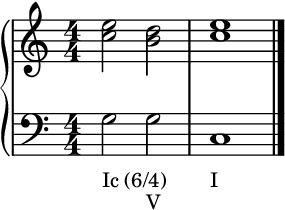
One second-inversion chord is so important it has its own name: the cadential 6/4. At a cadence you often see the tonic triad in second inversion (I6/4) fall to V, then to I:
I6/4 – V – I (in C: G-in-bass C/E/G → G/B/D → C/E/G)
Here the I6/4 is not really a stable tonic chord — it is a dominant embellishment, the 6th and 4th above the bass G leaning down onto the 5th and 3rd of the V chord. For that reason many analysts label it under the dominant, as V6/4 – 5/3 (or V(6/4–5/3)), showing that the bass G carries dominant function throughout. Both labels — Cad.6/4 and V6/4–5/3 — describe the same sound; understand the function, then use whichever your course prefers.
Other second-inversion chords are treated as embellishments too, not as independent harmonies:
- Passing 6/4 — a 6/4 chord harmonising a passing bass note between two chords (e.g.
I – V6/4 – I6). - Pedal (neighbour) 6/4 — a 6/4 over a stationary bass (e.g.
I – IV6/4 – I). - Cadential 6/4 — as above, at a cadence.
Recognising a 6/4 as passing, pedal or cadential is a standard analysis task, because it tells you the chord is a melodic/voice-leading event, not a structural harmony.
2.5 A Word on Voicing and Doubling
Roman numerals describe which chord is present, not how it is spaced. But when you write four-part harmony (SATB) to a Roman numeral, the common-practice guidelines are:
- Double the root in root-position triads (and usually the bass in general); avoid doubling the leading tone (it wants to resolve up to the tonic and doubling causes parallel octaves).
- In first-inversion triads you may double the soprano or bass note; vii°6 typically doubles the third (the bass).
- The cadential 6/4 doubles the bass (the dominant note).
- Resolve the chordal seventh down by step, and the leading tone up to the tonic (at least in outer voices).
- Avoid parallel fifths and octaves between any two voices.
These rules explain why certain inversions and doublings recur in the music you analyse.
3. Harmonic Function and Syntax
Roman numerals name chords, but the deeper insight is function — the job a chord does. In tonal music almost every chord belongs to one of three functional families, and these families flow in a characteristic order. This is the "grammar" that makes progressions sound convincing.
3.1 The Three Functions
| Function | Chords (major key) | Role |
|---|---|---|
| Tonic (T) | I, and vi, iii | Stability, rest, "home" |
| Pre-dominant / Subdominant (PD) | IV, ii, and vi | Motion away from home; prepares the dominant |
| Dominant (D) | V, vii°, and V7 | Tension that demands resolution to tonic |
The normal flow of functions is:
T → PD → D → T (tonic → pre-dominant → dominant → tonic)
The dominant resolves back to tonic; the pre-dominant leads into the dominant; the tonic can move anywhere. Chords within a family can substitute for one another (e.g. ii and IV are both pre-dominants, so IV–V and ii–V do the same job). Progressions that follow this flow sound "grammatical"; progressions that reverse it (e.g. V–IV) sound unusual and are the exception in common-practice style.
A fuller map, showing typical motion:
I → (ii / IV / vi) → (V / vii°) → I, with vi and iii acting as gentle tonic substitutes, and V often preceded by a cadential I6/4.
3.2 Root Motion
The strength of a progression owes much to how the roots move:
- Descending 5th (root down a 5th / up a 4th) — the strongest, most common motion:
ii–V,V–I,vi–ii,IV–vii°. Chains of these produce the circle-of-fifths sequence. - Descending 3rd — smooth, often functionally similar chords:
I–vi,IV–ii. - Ascending 2nd (step up) — energetic:
IV–V,V–vi(the deceptive motion). - Ascending 5th / descending 2nd — weaker or "retrogressive" in classical style (e.g.
V–IVis avoided as a functional progression, though it is idiomatic in blues and rock).
3.3 Common Progressions Worth Knowing
These recur constantly; learn to recognise them by their Roman numerals.
| Progression | Name / use |
|---|---|
| I – IV – V – I | The primary-triad backbone; the essence of tonal harmony |
| I – V – vi – IV | The ubiquitous pop progression ("four chords") |
| ii – V – I | The strongest cadential approach; the heart of jazz harmony |
| I – vi – IV – V | The "doo-wop" / 1950s progression |
| I – vi – ii – V | Circle-of-fifths turnaround |
| vi – ii – V – I | Circle-of-fifths cadential chain |
| I – V6 – vi – iii – IV – I – IV – V | Pachelbel's Canon sequence |
| I6/4 – V – I | Cadential six-four into a perfect cadence |
| V – vi | Deceptive (interrupted) resolution |
3.4 Sequences
A sequence repeats a melodic-harmonic pattern at successively higher or lower pitch levels. The most important is the descending circle-of-fifths sequence, whose roots fall by fifth each step:
I – IV – vii° – iii – vi – ii – V – I (roots: C–F–B–E–A–D–G–C)
Add sevenths and you get the endlessly useful chain I – IV7 – viiø7 – iii7 – vi7 – ii7 – V7 – I. Other common sequences include the descending-thirds sequence (I–vi–IV–ii…) and the ascending 5-6 sequence. Recognising a passage as sequential often explains chords that would look strange analysed in isolation — the pattern, not the individual function, is doing the work.
3.5 The Special Chords: V, vii° and the Tonic Substitutes
- The dominant (V / V7) is the engine of tonality. Its leading tone (scale-degree 7) pulls up to the tonic, and in V7 the chordal seventh (scale-degree 4) pulls down to 3. Together these two "tendency tones" resolve the tritone inward or outward onto the tonic triad.
- vii° (and vii°7 / viiø7) is a dominant substitute — it shares three notes with V7 and resolves the same way; think of it as "V7 without a root."
- vi is the main tonic substitute (it shares two notes with I) and the goal of the deceptive cadence
V–vi. iii is a weaker tonic/dominant-ish substitute, relatively rare.
Understanding function turns a list of numerals into a story: departure from tonic, growing tension through pre-dominant and dominant, and release back home.
4. Cadences in Roman Numerals
A cadence is the harmonic punctuation that ends a phrase. Analysis identifies cadences by their last two chords (and the melodic scale-degree in the soprano). These are more finely graded than the four cadence types taught at Grade 5.
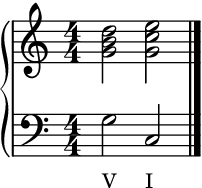
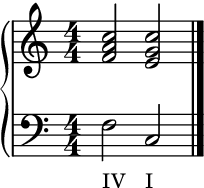
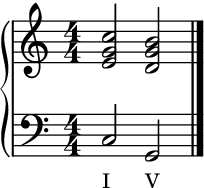
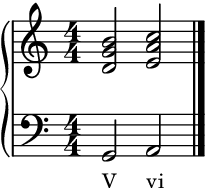
| Cadence | Roman numerals | Strength / effect |
|---|---|---|
| Perfect Authentic (PAC) | V(7) – I, both root position, soprano ends on scale-degree 1 | The strongest close — a full stop |
| Imperfect Authentic (IAC) | V – I but weakened: an inversion is used, and/or the soprano ends on 3 or 5, and/or vii°–I replaces V–I | A softer authentic close |
| Half Cadence (HC) | ends on V (approached by I, ii, IV, etc.) | An unfinished, "question" ending |
| Phrygian Half Cadence | iv6 – V in a minor key | A special, expressive HC of the Baroque |
| Deceptive / Interrupted (DC) | V – vi (V – VI in minor) | The expected tonic is "deceived" |
| Plagal (PC) | IV – I | The "Amen" cadence; often a post-cadential tag after a PAC |
4.1 Grading the Authentic Cadence
The distinction between PAC and IAC matters in analysis because it signals how conclusive a phrase-ending is:
- PAC requires all of: V (or V7) to I, both in root position, and the soprano landing on the tonic note. Only then is the cadence maximally closed — the goal of a period or a whole piece.
- IAC is any authentic cadence that misses one of those conditions. Three common sub-types:
- Root-position IAC — V–I in root position but the soprano ends on 3 or 5.
- Inverted IAC — V6–I or V–I6, etc.
- Leading-tone IAC — vii°6–I substituting for the dominant.
4.2 Half Cadences
A half cadence ends on the dominant, leaving the music suspended. What precedes the V is free: I–V, I6–V, ii6–V, IV–V and the cadential 6/4 approach I6/4–V are all half cadences (the phrase stops on that V). The Phrygian half cadence (iv6–V in minor) is named for the semitone descent in the bass (♭6→5) that recalls the Phrygian mode.
4.3 Deceptive and Plagal
- The deceptive cadence sets up a dominant that "should" resolve to I but instead moves to vi (or another tonic substitute). It typically extends a phrase, delaying the real PAC. In minor,
V–VI— note the major submediant. - The plagal cadence
IV–Imost often appears after an authentic cadence as a closing gesture (the hymn "Amen"), or colours a final tonic. A minor iv–I (borrowed subdominant, see Chapter 7) gives a especially rich plagal colour.
4.4 Why Cadence Type Matters
Cadences define the form of tonal music. A period is typically two phrases where the first ends with a weaker cadence (often HC or IAC, the "antecedent") and the second with a PAC (the "consequent"). Labelling every cadence as you analyse reveals the phrase structure and the large-scale tonal plan — analysis is not just chord-by-chord, but hearing where the music breathes and concludes.
5. Non-Chord Tones
Real music is not a series of block chords — melodies weave in notes that are not part of the underlying harmony. These non-chord tones (NCTs, also non-harmonic tones or embellishing tones) are the single most common reason a chord "looks wrong." Before you can assign a Roman numeral you must separate the chord tones from the decoration. Each NCT is classified by how it is approached and how it is left.
5.1 The Catalogue of Non-Chord Tones
| NCT | Approached by | Left by | Notes |
|---|---|---|---|
| Passing tone (P) | step | step (same direction) | Fills the gap between two different chord tones |
| Neighbour tone (N) | step | step (opposite direction) | Leaves a chord tone and returns; upper or lower |
| Suspension (S) | same note (held/tied) | step down | A chord tone held into the next chord, then resolved |
| Retardation | same note (held) | step up | Like a suspension but resolving upward (e.g. 7→8) |
| Appoggiatura (App) | leap | step | A "leaning" accented dissonance |
| Escape tone / échappée (Esc) | step | leap (opposite direction) | The mirror image of the appoggiatura |
| Anticipation (Ant) | step or leap | same note | Arrives at the next chord tone early |
| Neighbour group / double neighbour | leap then step | — | Upper and lower neighbour in succession around a note |
| Pedal point (Ped) | sustained | sustained | A held note (usually tonic or dominant) under changing chords |
5.2 The Most Important: Passing Tones, Neighbours and Suspensions
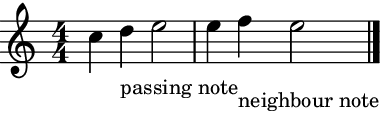
Passing tones connect two chord tones a third apart by moving through the note between them (C–D–E over a C chord: the D is a passing tone). They are usually unaccented (on a weak beat), but an accented passing tone falls on the beat and sounds momentarily like the harmony until it resolves.
Neighbour tones decorate a single chord tone by stepping away and back (C–D–C = upper neighbour; C–B–C = lower neighbour). A double neighbour / neighbour group visits both sides (C–D–B–C).
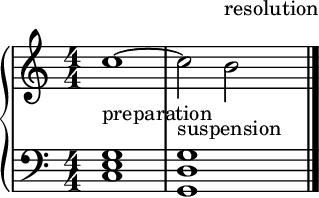
Suspensions are the richest NCT and are labelled by the intervals above the bass: the suspended note and its resolution. The three phases are always preparation → suspension → resolution:
| Suspension | Dissonance → resolution (above bass) | Comment |
|---|---|---|
| 4–3 | 4th resolves to 3rd | The commonest; over the root |
| 7–6 | 7th resolves to 6th | Often over a first-inversion bass |
| 9–8 | 9th resolves to the octave | A "melodic" suspension |
| 2–3 (bass suspension) | bass is suspended; figures 2 then 3 | The suspension is in the bass voice |
A suspension that resolves the "wrong" way (upward) is a retardation — classically the leading tone suspended and resolving up to the tonic (7–8).
5.3 Anticipations, Pedals and the Rest
- Anticipation — the next chord tone sounds before its chord arrives (very common at cadences, where the soprano reaches the tonic a beat early).
- Pedal point — a sustained bass note (occasionally an inner or top voice) held while the harmonies above it change, often clashing with them. A tonic pedal stabilises; a dominant pedal builds tension before a return. During a pedal you may bracket the whole passage and analyse the upper harmonies "over a tonic/dominant pedal."
- Escape tone and appoggiatura are opposites: the appoggiatura leaps in and steps out (accented, expressive), the escape tone steps in and leaps out (unaccented, light).
5.4 How NCTs Change Your Analysis
The practical rule: when a note does not fit the chord you expect, test whether it is an NCT before inventing a new harmony. Ask:
- Is it approached and left by step in the same direction? → passing tone.
- Step away and back? → neighbour.
- Held over from the previous chord and resolved down by step? → suspension.
- On the beat, leapt to and stepped away? → appoggiatura.
Only if a note genuinely belongs to a stackable third-based chord with the others should it change your Roman numeral. Distinguishing decoration from harmony is what separates a mechanical reading from a musical analysis — and it is what keeps a florid melody from generating a nonsensical string of chords.
6. Secondary (Applied) Dominants and Tonicisation
So far every chord has been diatonic (built only from notes of the key). Chromatic harmony introduces notes from outside the key, and the first and most important source is the secondary dominant.
6.1 The Idea of Tonicisation
Any major or minor chord in a key can be made to feel, briefly, like a temporary tonic by preceding it with its own dominant. This is tonicisation — lending a chord the spotlight without actually changing key. The borrowed dominant is a secondary (applied) dominant, notated with a slash:
V/V ("five of five") = the dominant of the dominant.
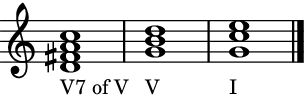
In C major, the dominant is G (chord V). The dominant of G is D major (D–F♯–A) — but D major is not diatonic to C (it needs F♯). That F♯ is the chromatic "signal" that we are tonicising G. So:
V/V – V in C major = D(F♯)A → G B D — the D major chord applies dominant tension to G, which then behaves as the real dominant.
6.2 Building a Secondary Dominant
To build V/x (or V7/x): treat chord x as a temporary tonic, and build a major triad (or dominant seventh) a perfect fifth above its root (equivalently, on its own 5th degree). The chord almost always contains a raised (chromatic) note — the temporary leading tone of x.
The secondary dominants available in a major key (each resolves to the chord after the slash):
| Applied chord | Notes (in C major) | Resolves to |
|---|---|---|
| V/ii | A – C♯ – E | ii (D minor) |
| V/iii | B – D♯ – F♯ | iii (E minor) |
| V/IV | C – E – G (= I, but with B♭ if V7/IV) | IV (F major) |
| V/V | D – F♯ – A | V (G major) |
| V/vi | E – G♯ – B | vi (A minor) |
Note V7/IV adds B♭ to the tonic chord (C–E–G–B♭), which is what distinguishes it from plain I — the chromatic seventh tips the tonic into acting as the dominant of IV. There is no V/vii°, because the diminished leading-tone triad cannot be a stable tonic to tonicise.
6.3 Secondary Leading-Tone Chords
Just as vii° substitutes for V, a secondary leading-tone chord substitutes for a secondary dominant. These are diminished (or half-diminished/fully-diminished seventh) chords built on the leading tone of the tonicised chord:
vii°/V, vii°7/V, viiø7/V … resolving to V.
In C major, vii°7/V = C♯–E–G–B♭ resolving to G (V). Secondary leading-tone sevenths are prized for their smooth, chromatic voice-leading and appear constantly in Bach, Mozart and Chopin alike. The fully-diminished form (°7) works in both major and minor targets; the half-diminished form (ø7) is used mainly when tonicising a major chord.
6.4 Recognising Applied Chords in Analysis
The tell-tale signs of a secondary function:
- A chromatic accidental appears that does not belong to the key.
- That accidental behaves like a leading tone — it rises by semitone — into the root of the following chord.
- The chord's quality is major or a dominant/diminished seventh just before a chord that is not the tonic.
When you spot this, ask "dominant of what?" — the chord it resolves to is x, and you label the applied chord V/x (or V7/x, vii°7/x). Then continue analysing x normally in the main key. Because the tonicisation is brief, you stay in the original key throughout; only if the new tonic is confirmed by a cadence does tonicisation become full modulation (Chapter 8).
6.5 Extended Tonicisation and Chains
Applied chords can chain, each tonicising the next, producing a run of secondary dominants around the circle of fifths:
V7/vi – vi – V7/ii – ... – V7/V – V7 – I
Such chains are common in development sections and in jazz ("the chord before the chord before the chord"). Analyse each link as an applied dominant resolving down a fifth to the next.
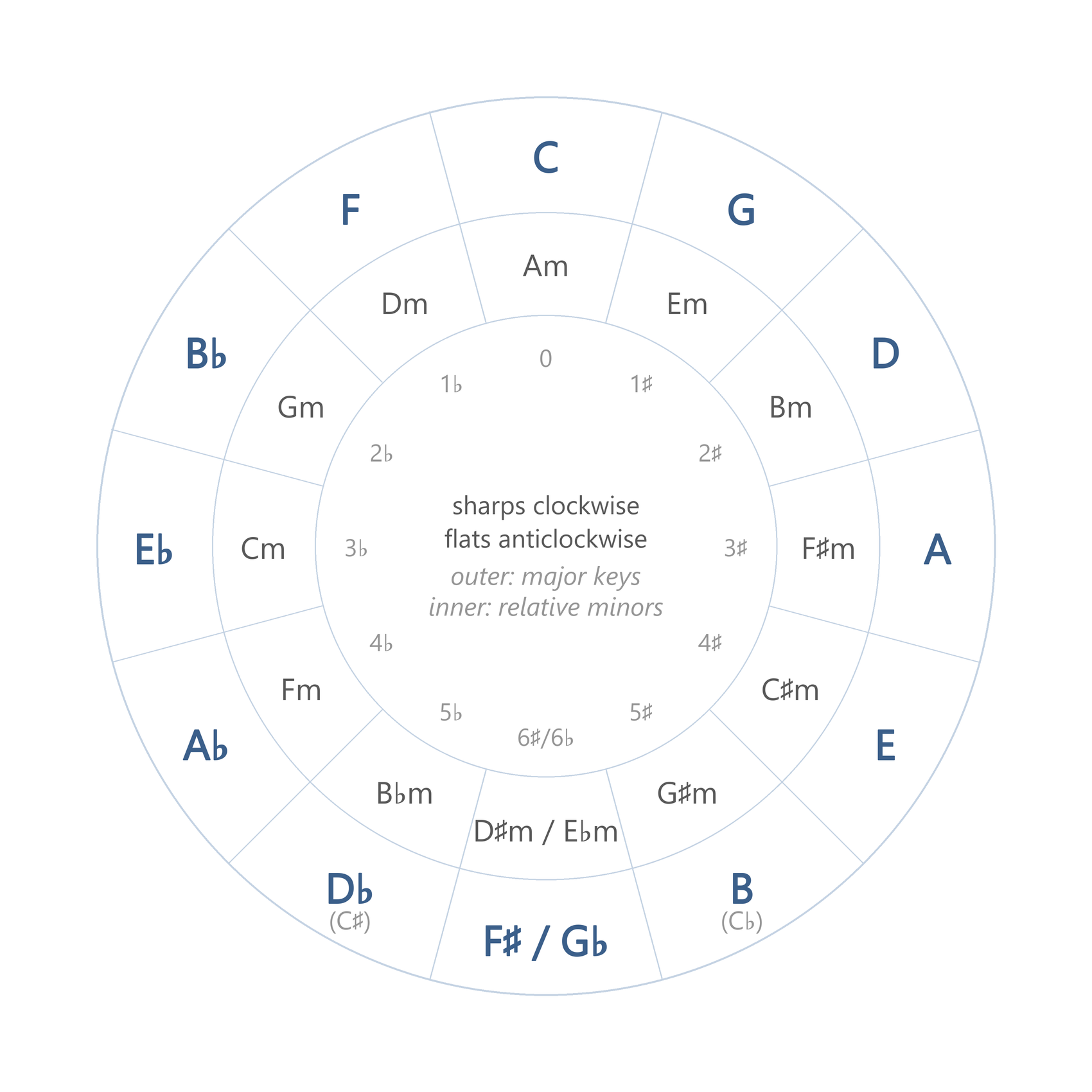
The circle of fifths maps this walk directly. Each resolution down a perfect fifth is one anticlockwise step round the circle, so the chain above starts at E (V7/vi) and steps through A, D and G before landing on C. However far out a chain begins, it walks the circle one chord per resolution until it reaches home.
7. Modal Mixture, the Neapolitan and Augmented Sixths
Beyond secondary dominants, the common-practice palette includes several colour chords. Each has a standard Roman numeral and a standard resolution.
7.1 Modal Mixture (Borrowed Chords)
Modal mixture (mode mixture, or "borrowing") imports chords from the parallel key — the major or minor key with the same tonic. Most often a major key borrows from its parallel minor, darkening the colour. The borrowed chords use the lowered 3rd, 6th and 7th scale degrees of the minor.
Common chords borrowed into a major key (shown in C major):
| Borrowed chord | Notes | Comment |
|---|---|---|
| iv | F – A♭ – C | Minor subdominant — the classic mixture, superb before I or V |
| ii° (or iiø7) | D – F – A♭ | Diminished/half-diminished supertonic |
| ♭VI | A♭ – C – E♭ | Lowered submediant; rich, often in deceptive motion |
| ♭III | E♭ – G – B♭ | Lowered mediant |
| ♭VII | B♭ – D – F | Lowered subtonic |
| i | C – E♭ – G | The minor tonic itself (e.g. via a mixture passage) |
The flat in the numeral (♭VI, ♭III, ♭VII) shows the root is the lowered degree. A special case in the other direction is the Picardy third: a piece in minor ending on a major tonic (I instead of i) — borrowing the major third from the parallel major for a bright final chord.
Mixture does not change the key; it recolours chords within it. Analyse the passage in the prevailing key and mark the borrowed chords with their flats (or naturals, in minor).
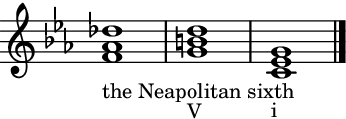
7.2 The Neapolitan Sixth (♭II6 / N6)
The Neapolitan is a major triad built on the lowered second scale degree (♭2). It almost always appears in first inversion, hence "Neapolitan sixth." In C major/minor:
♭II6 (N6) = D♭ – F – A♭, with F in the bass.
- Function: a pre-dominant — a chromatic, intensified subdominant. It typically moves to V (often through a cadential 6/4):
N6 – V – IorN6 – I6/4 – V – I. - Voice-leading: the root D♭ falls to C (the leading tone of V's resolution) or descends the characteristic diminished third D♭→B into the dominant. Double the bass (F).
- Notation: you will see both N6 and ♭II6; they mean the same chord.
The Neapolitan is at home in minor keys especially, where its flavour of the lowered 2nd is most poignant (think of the opening of Beethoven's "Moonlight" Sonata).
7.3 Augmented Sixth Chords
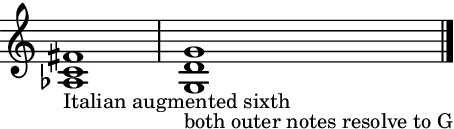
The augmented sixth chords are the most vivid pre-dominants of all. They are built around the interval of an augmented sixth between the lowered 6th degree (♭6) in the bass and the raised 4th degree (♯4) above it. That augmented sixth expands outward by semitone to an octave on the dominant (5) — a hallmark sound.
Three types, distinguished by their inner note(s). In C (♭6 = A♭, 1 = C, 2 = D, ♭3/♯2 = E♭/D♯, ♯4 = F♯):
| Type | Notes | Distinctive extra note |
|---|---|---|
| Italian (It+6) | A♭ – C – F♯ | just the tonic (C); the tonic is doubled |
| French (Fr+6) | A♭ – C – D – F♯ | scale-degree 2 (D) |
| German (Ger+6) | A♭ – C – E♭ – F♯ | scale-degree ♭3 (E♭) |
- All three resolve to V (the A♭ and F♯ moving out to G–G). The German sixth sounds enharmonically like a dominant seventh (A♭–C–E♭–F♯ ≈ A♭7), and to avoid parallel fifths it usually resolves to V through a cadential 6/4 (
Ger+6 – I6/4 – V). - Notation varies: you may see It+6 / Fr+6 / Ger+6, or the figured forms It6 / Fr4/3 / Ger6/5, or "Aug 6." Learn to recognise the ♭6-in-bass + ♯4 frame; the type is then just a matter of the middle note(s).
- Augmented sixths also appear built on other degrees (e.g. resolving to the tonic instead of the dominant), but the ♭6→♯4 pre-dominant form above is the standard one.
7.4 Chromatic Mediants and Common-Tone Diminished Sevenths
- Chromatic mediants are major or minor triads whose roots are a third apart from the tonic (or from each other) and which share only one common tone, with a chromatic clash on the others — e.g. in C major, a sudden E major or A♭ major chord. They colour Romantic harmony (Schubert, Wagner, film music) and are labelled by their altered numerals (e.g. III♯, ♭VI), often functioning colouristically rather than by classical syntax.
- The common-tone diminished seventh (CT°7) is a fully-diminished seventh that shares a common tone with the chord it decorates (frequently embellishing I or V), resolving outward by step. It is analysed as an embellishing chord (CT°7) rather than as a functional dominant.
7.5 Keeping Chromatic Chords Straight
When a chromatic chord appears, run through this short checklist:
- Does the accidental act as a leading tone up to the next root? → likely a secondary dominant / leading-tone chord (Chapter 6).
- Is it a borrowed version of a diatonic chord (lowered 3/6/7)? → modal mixture (♭VI, iv, etc.).
- Is it a major triad on ♭2 in first inversion, heading to V? → Neapolitan (N6).
- Does it frame a ♭6-in-bass augmented sixth to ♯4, heading to V? → augmented sixth (Italian / French / German).
- Otherwise, is it a colouristic chromatic mediant or an embellishing CT°7?
That sequence resolves the great majority of chromatic chords you will meet.
8. Modulation
Modulation is a genuine change of key, confirmed by a cadence in the new key — as opposed to a passing tonicisation (Chapter 6), which merely spotlights a chord without leaving home. Recognising and notating modulation is central to analysing anything longer than a phrase.
8.1 Closely Related Keys
Music most often modulates to a closely related key — one whose key signature differs by no more than one sharp or flat. For any key these are:
- the dominant (V) and the subdominant (IV);
- the relative minor/major;
- the relative minor/major of the dominant and subdominant.
From C major, the closely related keys are G major (V), F major (IV), A minor (vi), E minor (iii) and D minor (ii). The overwhelmingly common destinations are the dominant (in major-key pieces) and the relative major (in minor-key pieces).
8.2 Pivot-Chord (Common-Chord) Modulation
The smoothest modulation turns on a pivot chord — a chord that is diatonic to both keys and is heard first as belonging to the old key, then reinterpreted as belonging to the new one. After the pivot, a chromatic note and a cadence confirm the new key.
Notation: at the pivot, write both analyses, stacked, with the old key's numeral above and the new key's below, and a bracket showing the reinterpretation:
Modulating C major → G major using the pivot chord A minor:
C: I vi↘ pivotG: ii V7 I (cadence in G)
Here A minor is vi in C but ii in G; the analysis "hands over" at that chord. The arrival of F♯ (the leading tone of G) and a PAC in G confirm the modulation.
Method for finding the pivot: locate the last chord that still makes diatonic sense in the old key which is also diatonic in the new key; that chord is the pivot. The chord after it usually carries the first accidental of the new key.
8.3 Other Modulation Techniques
| Technique | How it works |
|---|---|
| Pivot-chord (common-chord) | A shared diatonic chord is reinterpreted (as above) |
| Direct / phrase modulation | The new key simply begins, often at a new phrase, with no pivot |
| Chromatic modulation | A chromatically altered chord (e.g. an applied dominant) links the keys |
| Common-tone modulation | A single sustained note is reharmonised into the new key |
| Enharmonic modulation | A chord is respelled — classically the Ger+6 ≈ V7 equivalence, or the °7 (which can resolve to four different keys) — to swing to a remote key |
| Sequential modulation | A sequence carries the music to a new key by pattern |
8.4 Analysing a Modulating Passage
- Establish the opening key and analyse diatonically.
- Watch for persistent new accidentals — an occasional accidental is tonicisation; a consistent new leading tone signals modulation.
- Find the pivot (the last chord that fits both keys) and mark the double analysis.
- Switch your Roman numerals to the new key from the pivot onward.
- Confirm the new key with its cadence; label it (e.g. "PAC in G major").
- At the end, note the large-scale tonal plan — many classical pieces move I → V (or III in minor) → … → I, and recognising that arch is the ultimate goal of analysis.
8.5 Tonicisation vs Modulation — the Judgement Call
There is a genuine grey area, and analysts sometimes disagree. Use these guidelines:
- A brief accidental resolving locally, with no cadence in the new key → tonicisation (keep the old key, label
V/x). - A new key confirmed by its own cadence and sustained for a phrase or more → modulation (switch keys with a pivot).
- The longer and more cadentially confirmed the new tonic, the more it deserves to be called a modulation. When in doubt, describe what you hear ("tonicises V" vs "modulates to V") rather than forcing a rule.
9. Extended Chords, Jazz and Pop Notation
Roman numeral analysis extends naturally into later-Romantic, jazz and popular music, where chords grow beyond the seventh and connect to the lead-sheet symbols musicians read every day.
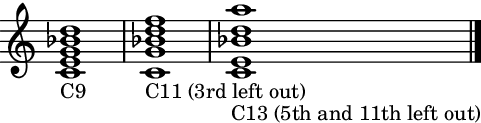
9.1 Ninth, Eleventh and Thirteenth Chords
Keep stacking thirds above a seventh chord and you get extended chords:
| Chord | Notes above root | Example on G |
|---|---|---|
| Seventh | 1–3–5–7 | G B D F |
| Ninth (9) | + 9th | G B D F A |
| Eleventh (11) | + 11th | G B D F A C |
| Thirteenth (13) | + 13th | G B D F A C E |
In Roman numerals these appear most often as a dominant with added extensions: V9, V11, V13. In four-part writing some notes are omitted (the 5th, or the 11th under a 3rd) for playability, but the label reflects the highest extension present. The dominant ninth (V9) — major or minor ninth — is the commonest, giving a lush cadential dominant.
9.2 Altered Dominants
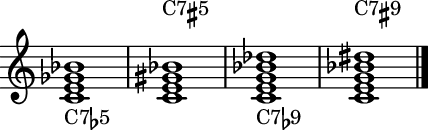
Chromatic alteration of the dominant's 5th or 9th yields altered chords prized in jazz and late-Romantic music:
- V7♭5 / V7♯5 — flattened or raised fifth (the raised-fifth form is an augmented triad plus seventh).
- V7♭9 / V7♯9 — flattened or raised ninth (the ♯9 is the famous "Hendrix chord" colour).
- Combined, these make the altered dominant (V7alt), the workhorse tension chord of bebop. Note the deep kinship with the augmented-sixth chords of Chapter 7 — the German sixth is enharmonically a V7♭5-ish sonority applied as a pre-dominant.
9.3 Lead-Sheet / Pop Chord Symbols
Popular and jazz scores label chords absolutely (root + quality), not functionally. It is worth being fluent in both, because Roman numeral analysis of pop music means translating chord symbols into numerals relative to the key.
| Symbol | Meaning | Roman numeral (in C major) |
|---|---|---|
| C | C major triad | I |
| Cm / C– | C minor triad | i (or borrowed) |
| C7 | C dominant seventh | V7/IV (or I7) |
| Cmaj7 / CΔ7 | C major seventh | IMaj7 |
| Cm7 | C minor seventh | — (i7) |
| Cdim / C° | C diminished | — |
| Cø7 / Cm7♭5 | C half-diminished seventh | viiø7/… |
| Csus4 | suspended 4th (no 3rd) | I sus |
| C/E | C chord with E in the bass | I6 |
| G7/B | G7 with B in bass | V6/5 |
The slash in a chord symbol (C/E) shows the bass note — the pop equivalent of an inversion figure. Reading G7/B as V6/5 in C is exactly the translation an analyst performs.
9.4 The Nashville Number System
Session and worship musicians use the Nashville Number System, a cousin of Roman numerals that writes chords as Arabic numbers (1–7) relative to the key, so a chart can be transposed instantly. 1 – 6m – 4 – 5 in Nashville is I – vi – IV – V in Roman numerals. The principle is identical — describe the chord by its scale-degree, not its letter name — which is the whole philosophy of Roman numeral analysis.
9.5 Why This Matters
Extended and altered chords show that Roman numeral analysis is not confined to Bach and Mozart. The same functional thinking — tonic, pre-dominant, dominant, tonicisation, mixture — explains a jazz ii–V–I with altered extensions, a pop I–V–vi–IV, or a gospel progression drenched in secondary dominants. Master the diatonic and chromatic core, and you can analyse virtually any tonal or tonally-rooted music.
10. How to Analyse a Passage — Method and Worked Examples
10.1 The Step-by-Step Method
- Establish the key. Read the key signature, then confirm with the first and last bass notes and the cadences. A signature of one sharp is G major or E minor — the music decides.
- Find the harmonic rhythm. Where do the chords actually change? Often once or twice per bar, on the strong beats. Group the notes accordingly.
- Stack each sonority into thirds. Take the notes sounding together, rearrange them into a pile of thirds, and see the triad or seventh chord. The bottom of that pile is the root.
- Screen out non-chord tones. Any note that will not join the third-stack is probably a passing tone, suspension, neighbour etc. — set it aside (Chapter 5).
- Assign the numeral. Name the root's scale degree, set the case by quality (major = capital, minor = small), add ° / + / ø as needed.
- Add the inversion figure from the bass note (6, 6/4, 7, 6/5, 4/3, 4/2).
- Check function and chromatics. Does it fit T–PD–D–T? Is there an accidental signalling a secondary dominant, mixture, Neapolitan or augmented sixth?
- Label cadences and modulations. Mark each phrase-ending cadence; where a new key is confirmed, insert a pivot and switch numerals.
- Step back. Summarise the phrase structure and tonal plan — analysis is about the shape of the whole, not only the parts.
10.2 Worked Example 1 — A Diatonic Phrase (C major)
A four-chord phrase, one chord per beat:
| Beat | Bass | Upper voices | Chord (stacked in 3rds) | Analysis |
|---|---|---|---|---|
| 1 | C | E · G · C | C–E–G | I |
| 2 | F | A · C · F | F–A–C | IV |
| 3 | G | B · D · G | G–B–D | V |
| 4 | C | C · E · G | C–E–G | I |
Reading: I – IV – V – I. Functions T – PD – D – T — a textbook grammatical phrase. The last two chords are V–I, both root position; if the soprano ends on C (scale-degree 1), this is a Perfect Authentic Cadence (PAC).
10.3 Worked Example 2 — Inversions and a Cadential 6/4 (G major)
Key of G major (F♯). One chord per beat:
| Beat | Bass | Chord | Analysis |
|---|---|---|---|
| 1 | G | G–B–D | I |
| 2 | C | A–C–E (bass C) | ii6 |
| 3 | D | G–B–D (bass D) | I6/4 |
| 4 | D | D–F♯–A–C | V7 |
| 5 | G | G–B–D | I |
Reading: I – ii6 – I6/4 – V7 – I. Note that ii6 is the pre-dominant (a first-inversion supertonic), and beats 3–4 form a cadential six-four: the I6/4 is a dominant embellishment over the bass D, so a functional analyst may write it V6/4–5/3. The close is a PAC.
10.4 Worked Example 3 — A Minor Key with Chromatic Colour (A minor)
Key of A minor (raised leading tone G♯ in the dominant):
| Beat | Bass | Chord | Analysis |
|---|---|---|---|
| 1 | A | A–C–E | i |
| 2 | F | B♭–D–F (bass F) | ♭II6 (N6) |
| 3 | E | E–G♯–B–D | V7 |
| 4 | A | A–C–E | i |
Reading: i – N6 – V7 – i. The Neapolitan sixth (B♭–D–F in first inversion) is a chromatic pre-dominant: its root B♭ falls toward the dominant, and G♯ in the V7 is the raised leading tone driving to the tonic. A plainer diatonic version would use ii°6 (B–D–F) in place of the Neapolitan — compare the two to hear what the chromaticism adds.
10.5 Worked Example 4 — A Modulation (C major → G major)
A phrase that begins in C major and modulates to the dominant, G major, via a pivot:
Chord:   C-E-G    A-C-E         A-C-E    D-F#-A-C   G-B-D
C major:   I       vi
                    └─ pivot ─┐
G major:            ii         ii         V7          I
Reading: the A-minor chord is vi in C but ii in G — the pivot. From there the analysis switches to G major; the appearance of F♯ (G's leading tone) and the closing V7–I in G confirm the new key with a PAC in G major. Had the F♯ chord been a fleeting touch with no cadence, we would instead have called it a tonicisation of V and stayed in C.
10.6 Worked Example 5 — Translating a Pop Progression
Popular music gives you chord symbols; analysis means converting them to numerals relative to the key. In C major:
| Chord symbol | C | G | Am | F |
|---|---|---|---|---|
| Roman numeral | I | V | vi | IV |
C – G – Am – F = I – V – vi – IV, the famous "four-chord song." Re-order to C – Am – F – G and you get I – vi – IV – V, the doo-wop progression. A symbol with a slash bass, say G/B, becomes V6; G7/B becomes V6/5. The functional story (tonic → dominant → tonic-substitute → pre-dominant) is identical whether the source is a hymn, a sonata or a pop song.
10.7 Common Pitfalls
- Mistaking an NCT for a chord. If a "chord" has a strange note, test it as a suspension or passing tone first.
- Forgetting the raised leading tone in minor. Chord V is major in a minor key — look for the accidental.
- Over-reading tonicisation as modulation. No cadence in the new key usually means you have not modulated.
- Ignoring inversion. The bass note is as important as the root; always add the figure.
- Analysing vertically only. Keep one eye on voice-leading (the lines) — it confirms chords and reveals NCTs.
11. Reference Cheat-Sheet
11.1 Diatonic Triads and Sevenths — Major Key
| Degree | Triad | Triad quality | Seventh | Seventh quality |
|---|---|---|---|---|
| 1 | I | major | IMaj7 | major 7th |
| 2 | ii | minor | ii7 | minor 7th |
| 3 | iii | minor | iii7 | minor 7th |
| 4 | IV | major | IVMaj7 | major 7th |
| 5 | V | major | V7 | dominant 7th |
| 6 | vi | minor | vi7 | minor 7th |
| 7 | vii° | diminished | viiø7 | half-diminished 7th |
11.2 Diatonic Triads and Sevenths — Minor Key (harmonic, raised leading tone)
| Degree | Triad | Triad quality | Seventh | Seventh quality |
|---|---|---|---|---|
| 1 | i | minor | i7 | minor 7th |
| 2 | ii° | diminished | iiø7 | half-diminished 7th |
| 3 | III (III+) | major (augmented if ♯7) | IIIMaj7 | major 7th |
| 4 | iv | minor | iv7 | minor 7th |
| 5 | V | major | V7 | dominant 7th |
| 6 | VI | major | VIMaj7 | major 7th |
| 7 | vii° | diminished | vii°7 | fully-diminished 7th |
Natural-minor variants: v (minor dominant), VII (major subtonic), plain III (major).
11.3 Inversion Figures
| Chord type | Root pos. | 1st inv. | 2nd inv. | 3rd inv. |
|---|---|---|---|---|
| Triad | (none) | 6 | 6/4 | — |
| Seventh | 7 | 6/5 | 4/3 | 4/2 (or 2) |
| Bass note is the… | root | 3rd | 5th | 7th |
| a/b/c label | a | b | c | d |
11.4 Secondary (Applied) Chords — in a Major Key
| Applied chord | Root a P5 above… | Notes in C major | Resolves to |
|---|---|---|---|
| V7/ii | ii | A–C♯–E–G | ii |
| V7/iii | iii | B–D♯–F♯–A | iii |
| V7/IV | IV | C–E–G–B♭ | IV |
| V7/V | V | D–F♯–A–C | V |
| V7/vi | vi | E–G♯–B–D | vi |
| vii°7/V | (lead. tone of V) | C♯–E–G–B♭ | V |
11.5 Chromatic Colour Chords
| Chord | Formula | Notes (C major/minor) | Function |
|---|---|---|---|
| iv (borrowed) | minor subdominant | F–A♭–C | pre-dominant |
| ♭VI | lowered submediant, major | A♭–C–E♭ | mixture / deceptive |
| ♭III | lowered mediant, major | E♭–G–B♭ | mixture |
| ♭VII | lowered subtonic, major | B♭–D–F | mixture |
| N6 (♭II6) | major triad on ♭2, 1st inv. | D♭–F–A♭ (bass F) | pre-dominant → V |
| It+6 | ♭6 – 1 – ♯4 | A♭–C–F♯ | pre-dominant → V |
| Fr+6 | ♭6 – 1 – 2 – ♯4 | A♭–C–D–F♯ | pre-dominant → V |
| Ger+6 | ♭6 – 1 – ♭3 – ♯4 | A♭–C–E♭–F♯ | pre-dominant → I6/4 → V |
| Picardy 3rd | major I ending a minor piece | C–E–G | final tonic colour |
11.6 Cadences
| Cadence | Numerals | Marker |
|---|---|---|
| Perfect authentic (PAC) | V(7)–I, root pos., soprano on 1 | strongest close |
| Imperfect authentic (IAC) | V–I weakened (inversion / soprano 3 or 5 / vii°–I) | softer close |
| Half (HC) | …–V | unfinished |
| Phrygian half | iv6–V (minor) | Baroque HC |
| Deceptive (DC) | V–vi (V–VI) | thwarted resolution |
| Plagal (PC) | IV–I | "Amen" |
11.7 Function Families
| Function | Chords (major) | Chords (minor) |
|---|---|---|
| Tonic (T) | I, vi, iii | i, VI, III |
| Pre-dominant (PD) | ii, IV, (vi); N6, +6, borrowed iv | ii°, iv; N6, +6 |
| Dominant (D) | V, V7, vii°, vii°7 | V, V7, vii°7 |
11.8 Symbol Glossary
| Symbol | Meaning |
|---|---|
| I, IV, V (upper case) | major triad on that degree |
| ii, iii, vi (lower case) | minor triad |
| ° | diminished (triad or, with 7, fully-diminished seventh) |
| ø | half-diminished seventh |
| + | augmented triad |
| 7, 6/5, 4/3, 4/2 | seventh chord in root / 1st / 2nd / 3rd inversion |
| 6, 6/4 | triad in 1st / 2nd inversion |
| ♭ / ♯ before a numeral | root is the lowered / raised scale degree (♭VI, ♯iv°) |
| V/x ("V of x") | secondary dominant resolving to chord x |
| vii°7/x | secondary leading-tone seventh resolving to x |
| N6 / ♭II6 | Neapolitan sixth |
| It+6 / Fr+6 / Ger+6 | Italian / French / German augmented sixth |
| Cad. 6/4 | cadential six-four (= V6/4–5/3) |
| CT°7 | common-tone diminished seventh |
| [ ] with two rows | pivot-chord modulation (old key above, new key below) |
12. Practice Exercises
Work through these, then check the answer key that follows. They progress from basic diatonic labelling to chromatic harmony and short analysis.
A. Diatonic triads and quality
- In D major, give the Roman numeral and quality of the chord F♯–A–C♯.
- In D major, give the notes and quality of chord IV.
- In B♭ major, give the notes and quality of chord vi.
B. Seventh chords and inversions
- In B♭ major, spell V7 and name its quality.
- A C major triad has G in the bass. Give the full Roman-numeral label (with figure).
- In C major, a G7 chord has F in the bass. Give the label, and name the chord it most likely resolves to.
- Identify B–D–F–A in C major (numeral, figure if root position, and seventh quality).
- Identify G♯–B–D–F in A minor and name its seventh quality.
C. Minor-key harmony
- In G minor, spell V7 and name the note that is raised from the key signature.
- In A minor, identify B♭–D–F in first inversion (chromatic chord name and numeral).
D. Chromatic chords
- In C major, identify the chord D–F♯–A and state what it resolves to.
- In C major/minor, identify A♭–C–E♭–F♯ by type, and say where it resolves.
- In C major, name the borrowed chord F–A♭–C and its function.
E. Cadences and function
- Name the cadence for each ending: (a) V–vi; (b) ii6–V; (c) V7–I with the soprano on scale-degree 1; (d) IV–I.
- State the function (T, PD or D) of: ii, vii°, vi, V7, IV.
F. Short analysis and translation
- Give Roman numerals for this F major progression: F – B♭ – C7 – F, and name the cadence.
- Translate to Roman numerals in G major: the chord symbols D – Em – C – G.
- A passage modulates from C major to G major. Name a chord that could serve as the pivot, and give its numeral in both keys.
G. Non-chord tones
- A note is approached by step and left by step in the same direction, over an unchanging harmony. Which NCT is it?
- A note is held over from the previous chord and then resolves down by step. Which NCT is it, and what are the three phases of its life?
Answers
A. Diatonic triads
- iii, a minor triad (F♯ is the 3rd degree/mediant of D major; F♯–A–C♯ is minor).
- IV = G–B–D, major.
- vi = G–B♭–D, minor (the 6th degree of B♭ major is G).
B. Seventh chords and inversions
- V7 = F–A–C–E♭, a dominant seventh.
- I6/4 (second inversion — the fifth, G, is in the bass).
- V4/2 (third inversion — the seventh, F, in the bass); it resolves to I6 (the bass F falls to E).
- viiø7 — B–D–F–A, root position, a half-diminished seventh.
- vii°7 — G♯–B–D–F, a fully-diminished seventh.
C. Minor-key harmony
- V7 = D–F♯–A–C; the raised note is F♯ (the raised leading tone; the key signature has F♮).
- ♭II6, the Neapolitan sixth (B♭ major triad on the lowered 2nd degree, first inversion with F in the bass).
D. Chromatic chords
- V/V (secondary dominant of the dominant — D major, with the chromatic F♯); it resolves to V (G).
- The German augmented sixth (Ger+6) — ♭6(A♭)–1(C)–♭3(E♭)–♯4(F♯); it resolves to V, usually through a cadential I6/4 to avoid parallel fifths.
- The borrowed minor subdominant, iv (from the parallel minor); its function is pre-dominant.
E. Cadences and function
- (a) Deceptive (interrupted); (b) Half cadence; (c) Perfect Authentic Cadence (PAC); (d) Plagal.
- ii = pre-dominant, vii° = dominant, vi = tonic (substitute), V7 = dominant, IV = pre-dominant.
F. Short analysis and translation
- I – IV – V7 – I (F–B♭–C7–F); the close is a PAC.
- V – vi – IV – I (in G major: D=V, Em=vi, C=IV, G=I).
- The C major chord works: it is I in C major and IV in G major. (Equally, A minor = vi in C and ii in G.)
G. Non-chord tones
- A passing tone (approached and left by step in the same direction).
- A suspension; its three phases are preparation → suspension (the dissonance) → resolution (down by step).
End of the guide. Roman numeral analysis rewards practice above all: take real music — a Bach chorale, a Clementi sonatina, a pop song — and label every chord. The symbols will soon become a second language, and with them the hidden logic of tonal music comes into view.