Four-part harmony from first principles, with the complete figured-bass table and a workbook of worked exercises
The consolidated rulebook for writing in four parts: voice ranges, doubling and spacing, every kind of motion and every forbidden consecutive shown wrong and then right, the standard connections for each root movement, inversions and six-fours, cadence formulas in major and minor, sevenths and suspensions in full, the complete table of figured-bass signs from about 1620 to 1790 with each figure realised, a repeatable method for realising a bass and for harmonising a melody, a catalogue of the twenty commonest faults, and graded exercises with complete answers.
Introduction
Four-part writing is the laboratory of tonal harmony. Nothing about it is arbitrary, though the rule lists handed out in classrooms often look that way. Four voices, each with its own range and its own line to sing, must between them spell a chord, move to the next chord, and stay independent while doing it. Almost every rule in this guide is a consequence of those three demands pulling against each other. Once you can see which demand a rule serves, you stop memorising and start predicting.
The texture is not an academic invention. It is the sound of the church choir, the hymn book and the Lutheran chorale, and the roughly 370 chorale harmonisations of J. S. Bach are the reason it became the standard training ground. Those settings are hard to improve on as models: the bass is a real melody, the inner parts are singable, and the harmony is dense with sevenths, suspensions and passing modulations while never losing its four clean lines. Every conservatoire and examination board since has used the same texture for the same reason. If you can write it, you can hear harmony from the inside.
Figured bass is the other half of the story, and it belongs in the same volume because it was the same skill. From about 1600 to 1780 a keyboard player was handed a bass line with numbers under it and expected to build the harmony on the spot, in performance, at speed. The numbers are a compressed instruction set, and reading them fluently is still the quickest way to internalise how chords sit above a bass. Chapter 8 sets out the whole system, sign by sign, with each figure engraved and realised, so that you never again have to guess what a 4/2 with a stroke through it means.
This guide is written to be self-contained. It assumes you can name a chord, spell a scale and recognise the four cadences, and it builds everything else from there. Where a topic already has a home in another volume, the cross-reference is given rather than the material repeated. What is new here is the systematic treatment: the rules with their reasons attached, one fully worked example wherever a skill is taught, and the errors printed as notation rather than described in words, because a copyist who has seen the wrong version once rarely writes it again.
Work with a pencil and a keyboard if you have one. Part-writing is a craft skill, and reading about it produces the same result as reading about swimming. Every chapter that teaches a technique ends with something to write, and chapter 14 holds a graded set with full answers.
How to use this guide
Chapters 1 to 3 set the physical conditions: who sings what, how the chord is spaced and doubled, and how the voices may move against each other. Chapter 3 is the one to know by heart, because the consecutives it forbids are what markers look for first. Chapters 4 to 7 build the working vocabulary: connecting any two chords, handling inversions and six-fours, the cadence formulas, and the sevenths. Chapter 8 is the figured-bass reference table and can be used on its own. Chapter 9 turns everything so far into a method for realising a figured bass, with two full worked realisations. Chapters 10 and 11 add suspensions and melody harmonisation. Chapter 12 is the error catalogue, chapter 13 the one-page summary, chapter 14 the workbook.
If you have an exercise in front of you and no time, read chapter 9's algorithm and chapter 13's summary, then work. If you are learning the subject properly, read straight through and write the exercises at the end of each chapter as you meet them.
Companion documents cover neighbouring ground. Musical Harmony explains what the chords are, how keys relate and how modulation works; this guide takes that knowledge as given and concentrates on writing the chords out. Roman Numeral Analysis covers labelling, including the numeral conventions used here for inversions and applied chords. Musical Form and Analysis covers phrase structure and cadence placement, which decides where the cadences of chapter 6 actually go. ABRSM Music Theory Grade 6 introduces four-part writing and figured bass in examination form, Grade 7 adds the chromatic chords and the full figuring, and Grade 8 takes the texture into free composition. This guide is deeper and more systematic than those chapters, and every example in it is new, so the two sets can be worked through side by side without repetition.
A note on terms and notation
Naming follows British convention throughout: stave and bar for the page furniture, semibreve, minim, crotchet, quaver and semiquaver for the note lengths, leading note for the seventh degree, and sharpened or flattened where a note is raised or lowered. Cadences are perfect, imperfect, plagal and interrupted.
Chords are spelled with hyphens: C-E-G. Progressions are joined the same way: ii-V-I. Roman numerals are upper case for major triads and lower case for minor, with a small circle for diminished, and inversions are shown by the figures: V7, V65, V43, V42; Ib, IIb, Ic. Voices are named soprano, alto, tenor and bass, abbreviated S, A, T and B, and an interval between two of them is written S-A, T-B and so on. Ranges are written "1 to 5". Scale degrees are written with a circumflex-free number: degree 1, degree 5.
Every musical example is engraved fresh for this guide. Where a rule has a wrong version, both versions are printed, because the wrong version is what an untrained hand writes and seeing it once teaches faster than reading a prohibition. Named works and composers are described in prose; none of their notation is reproduced.
1. The four voices
1.1 Why four parts
Three notes are enough to spell a triad, so the fourth voice is a surplus by definition, and that surplus is the whole point. It gives the writer something to place: a doubled root that thickens a cadence, a held note that becomes a suspension, an inner line that fills the gap left when the melody leaps. Four is also the smallest number of parts in which every common seventh chord can be spelled complete, one note to a voice, with nothing left over.
The practical reason is human. Choral singing sorts naturally into two women's and two men's ranges, and the four-part chorale texture is what that sorting produces. Everything in this guide follows from writing for four singers rather than for a keyboard: each part must be singable on its own, must stay inside a real voice's range, and must not be asked to leap awkwardly or hold a note nobody can pitch.
1.2 The ranges
Voices vary, and choirs vary more. The figures below are the safe working limits used in teaching and in examinations. Staying inside them guarantees that the music can be sung by an ordinary amateur choir, which is the point of the exercise.
| Voice | Working range | Comfortable core | Notes |
|---|---|---|---|
| Soprano | middle C to G above the treble stave | E above middle C to E an octave up | the top note is the one to watch; sustained high G is tiring |
| Alto | G below middle C to D on the fourth line of the treble stave | A below middle C to C an octave above | low G is weak in an amateur choir; avoid sitting there |
| Tenor | C an octave below middle C to G above middle C | E flat below middle C to E flat above | written an octave above sounding pitch in open score |
| Bass | E below the bass stave to middle C | G below the bass stave to B below middle C | the low E is available but thin, and should not be leaned on |
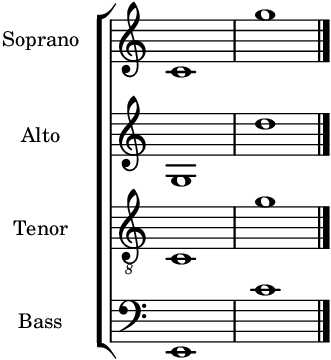
Two habits follow from the table. First, check the extremes of every part before anything else when you finish an exercise: a single note out of range is the easiest fault to spot and the easiest to avoid. Second, keep the parts near the middle of their ranges most of the time, and save the extremes for the moments that want them, usually a climax in the soprano or a cadential drop in the bass.
1.3 Open score and short score
The same four parts can be printed two ways.
Short score, sometimes called close score, puts all four voices on two staves: soprano and alto on the treble stave, tenor and bass on the bass stave. Soprano and tenor take stems up, alto and bass stems down, always, even when the stem direction looks odd, because stem direction is what tells the reader which voice is which. This is the hymn-book layout and the one used for nearly every example in this guide.
Open score gives each voice its own stave: soprano and alto in the treble clef, tenor in the treble clef with a small 8 below it (sounding an octave lower than written), bass in the bass clef. Older editions put the tenor in the tenor C clef instead. Open score is what a choir sings from and what examination questions often ask you to convert to or from.
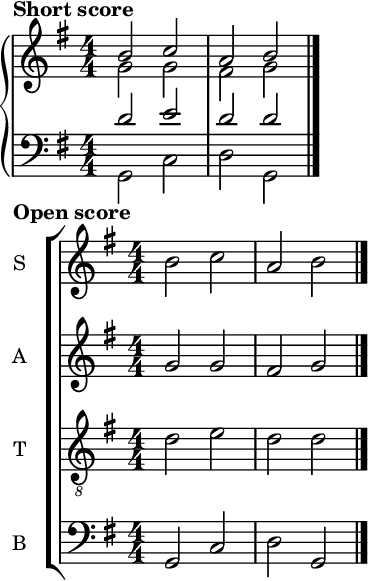
Converting between them is mechanical, and the one trap is the tenor. In short score the tenor is written where it sounds, on the bass stave. In open score with the octave-treble clef it is written an octave higher than it sounds. Copy the pitches, not the positions.
1.4 Vocal style and keyboard style
Two textures share the same harmony and differ in how the notes are distributed between the hands or voices.
Vocal style is what has been described so far: four independent lines, one note each, spread across the two staves as two plus two. Every part is singable, no part doubles another at the unison unless the harmony forces it, and the texture stays in four real voices from beginning to end.
Keyboard style puts the bass alone in the left hand and the other three parts together in the right, as a chord. The right hand keeps its three notes close, usually within an octave, so the hand can reach them. The harmonic content is identical; only the layout changes. Examination questions that say "in keyboard style" are asking for exactly this, and the marker still checks the same voice-leading rules between the four parts.
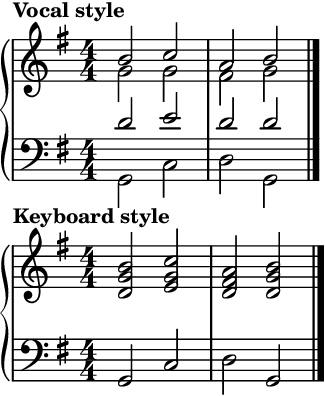
The rules of this guide apply to both, with one relaxation: in keyboard style the three right-hand parts may cross or double more freely, because they are not being sung, and the top line is the only one a listener follows as a melody. What does not relax is the bass, the outer-part relationship, and the ban on consecutives.
1.5 What a good part looks like
Before any rule about pairs of voices, there is a rule about single voices: each part must be worth singing. In practice that means four things.
Stepwise movement is the default, and leaps are the exception that needs a reason. A part that moves by step or by a third for most of a phrase will almost always be correct.
Leaps larger than a fourth should be followed by a step in the opposite direction, which fills in the gap the leap opened. Two leaps in the same direction are acceptable only when they outline a single chord, as in a bass moving C-E-G.
Augmented intervals are forbidden as melodic steps in the older style: the augmented second between degrees 6 and 7 of the harmonic minor scale is the one that catches everybody, and the augmented fourth between degrees 4 and 7 is the other. Diminished intervals are allowed if the note after them steps back inside the interval, so a leap down a diminished fifth resolving upward by step is fine.
The leading note pulls to the tonic, and in the soprano at a cadence it must go there. In an inner part it may fall to degree 5 instead, which is a licence with a purpose: chapter 4 shows why.
2. Doubling and spacing
2.1 The problem stated
A triad has three notes and there are four voices, so one note of every triad is sung twice. Choosing which one is doubling. Deciding how far apart the four voices sit is spacing. Both decisions are made chord by chord, and both have consequences two chords later, which is why they are worth doing deliberately rather than by ear alone.
2.2 Close and open position
Position describes the gap between the three upper voices, and it ignores the bass entirely.
In close position the soprano, alto and tenor are as near together as the chord allows: no chord note is skipped between them, and the S-T interval is an octave or less. In open position one chord note is skipped between adjacent upper voices, and the S-T interval is more than an octave.
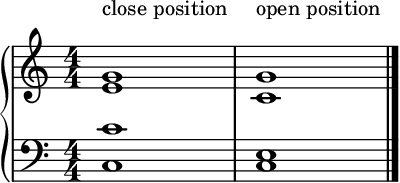
Neither is better. Close position sounds compact and works well when the soprano is low; open position sounds airy and is almost obligatory when the soprano sits high, because keeping three voices packed under a top A leaves the tenor stranded above his range. Most real writing mixes the two and changes between them freely, which is legal at any moment provided the voice leading is clean.
2.3 The spacing rules
Three rules govern the gaps, and the first two are absolute in the classical style.
Never more than an octave between soprano and alto. Never more than an octave between alto and tenor. These two intervals are the seams of the chord, and opening either beyond an octave leaves a hole in the middle of the sound that a listener hears as two separate bands rather than one chord.
The tenor and bass may be as far apart as you like. An eleventh or a twelfth between them is normal and often good, because the low register needs room: a bass and tenor a third apart down at the bottom of the stave sound muddy, and every composer from Corelli onwards spaces the lower parts wider than the upper ones. The harmonic series gives the reason. Low partials are far apart, so wide low spacing matches what the ear expects from a resonant bass note.
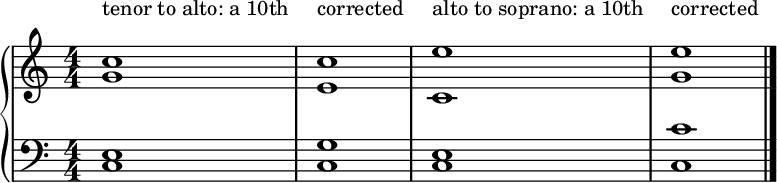
One further habit is worth acquiring: keep the changes of position gradual. Moving from a close-position chord to a wide open-position chord in one step usually forces at least one voice to leap awkwardly, and a marker who sees a tenth in the tenor knows what caused it.
2.4 Which note to double
The working rule is short: double the root in root-position triads, and everything else is an exception with a reason. Beyond that, doubling is decided by the function of the notes in the chord and by what the voice leading will allow.
| Chord | Normal doubling | Reason |
|---|---|---|
| major or minor triad, root position | root | the root is the strongest note and the doubling reinforces it |
| major or minor triad, first inversion | any note, root or fifth most often; the soprano note of the chord is a safe choice | the bass third is already prominent and does not need reinforcing |
| diminished triad, first inversion (viib, iib in minor) | the bass note, which is the third of the chord | the root and fifth form the tritone; doubling either strengthens a dissonance that wants to resolve |
| second inversion (six-four) | the bass, which is the fifth of the chord | the bass of a six-four is the stable note in an unstable chord |
| dominant triad before an interrupted cadence | root | chapter 6 shows why V-vi then needs the third of vi doubled |
| chord vi in the progression V-vi | the third of vi | the two upper voices must fall while the bass rises, and doubling the third is what avoids consecutives |
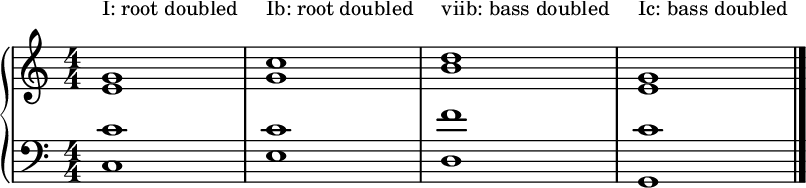
2.5 What never to double
Three categories of note are effectively barred, and each ban has the same cause: the note in question is already committed to a particular next note, and doubling it produces two voices trying to make the same move.
The leading note of the key is never doubled. It must rise to the tonic, and two leading notes rising to the tonic give consecutive octaves. This applies whenever the note is functioning as a leading note, in chord V, in chord viib, and in a secondary dominant.
The seventh of a seventh chord is never doubled. It must fall by step, so two of them give consecutive octaves again.
Any chromatically altered note is not doubled. The alteration exists to make the note lean somewhere, and the same argument follows. The sharpened sixth in a minor-key melodic passage, the flattened supertonic of the Neapolitan, the raised fourth of an applied dominant: each of these is a note with an appointment to keep.
The one systematic exception is the doubled third of a first-inversion diminished triad, which is not a barred note at all: in viib the bass third is the only note of the chord that is not part of the tritone, so it is the note that may safely be doubled.
2.6 Omitting a note
In a four-voice texture a triad has one note doubled and none missing. That is the normal case. Two departures from it are permitted.
The fifth may be omitted from a root-position triad, with the root tripled instead. This is common on a final tonic chord, where the effect is a strong, open sound, and it happens naturally when the leading note in the soprano rises to the tonic while an inner voice does the same.
The fifth may be omitted from a dominant seventh, giving root, third and seventh with the root doubled. This is the standard way of writing V7 when the alternative would break a rule, and it is treated fully in chapter 7. Nothing else may be omitted: a triad without its third has no mode, and a seventh chord without its seventh is not a seventh chord.
2.7 Exercises for chapter 2
- Write the chord C-E-G in root position with the bass on C, first in close position with the soprano on E above the treble stave's bottom line, then in open position with the same soprano note.
- A chord has bass F, tenor F, alto A and soprano F. Name the fault and correct it without changing the bass or soprano.
- Which note of the chord B-D-F would you double if the bass note is D, and why?
- In G major, chord V has been written with F sharp in both the tenor and the soprano. State the two rules broken and give the reason common to both.
3. Motion between voices
3.1 The four motions
Take any two voices and compare what they do between one chord and the next. There are exactly four possibilities.
Contrary motion: the two voices move in opposite directions. This is the most independent kind of movement and the safest, because two voices going opposite ways can never produce a consecutive anything.
Oblique motion: one voice moves, the other stays on the same note. Also safe, and the engine of the suspension.
Similar motion: both voices move in the same direction by different intervals. Legal, but the place where most faults are born, because similar motion is what carries two voices into a perfect interval together.
Parallel motion: both voices move in the same direction by the same interval, keeping the same interval between them. Parallel thirds and sixths are the sound of tonal music. Parallel perfect intervals are the thing this chapter is mostly about.

Parallel motion is a special case of similar motion, and the two words are often used loosely. Where the distinction matters in this guide, "parallel" means the interval is preserved and "similar" means it is not.
3.2 Why consecutive perfect intervals are forbidden
The rule is not superstition and it is not about ugliness. It is about the number of voices the listener hears.
Two notes an octave apart fuse. Sing a tune and have somebody double it an octave above and the ear does not report two melodies; it reports one melody with a bright timbre. The perfect fifth fuses almost as completely, which is why organ stops are built on octaves and fifths and why parallel fifths were the entire technique of early organum. When two voices move in parallel octaves or fifths for even two chords, those two voices stop being two voices and become one line with a thickened tone. A four-part texture that does this drops to three parts for a moment, and the drop is audible as a hole.
Thirds and sixths do not fuse. They are consonant enough to sound well together and impure enough that the ear keeps counting them separately, which is why you may write as many parallel thirds and sixths in a row as you like.
That is the mechanism, and every case below follows from it.
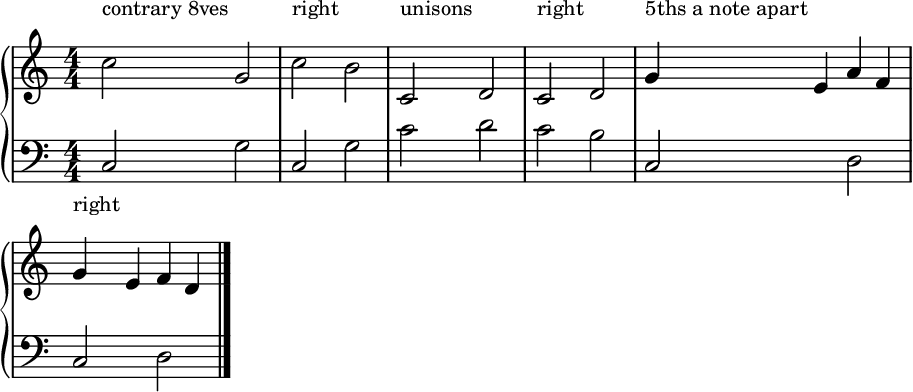
3.3 Consecutive fifths
Two voices that are a perfect fifth apart must not move to another perfect fifth. The rule applies to any pair of the four voices, not only to the outer ones, and it applies whether the fifth is simple or compound: a twelfth is a fifth for this purpose.
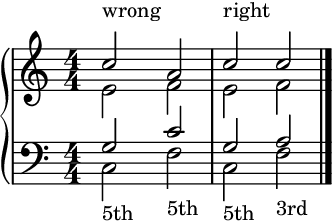
The commonest way to write them by accident is to move two root-position chords a step apart with all four voices going the same way. The commonest cure is to make one voice change direction, which usually means rewriting the tenor.
Three refinements are worth knowing.
Fifths remain fifths when an intervening note separates them. If the tenor and bass are a fifth apart on beat 1, move to something else on beat 2, and are a fifth apart again on beat 3, the ear still hears the parallel if the second fifth falls on a strong beat and the notes in between are decoration. Examiners mark these.
Fifths by contrary motion are still forbidden in the strict style, even though the voices move in opposite directions. A fifth expanding outward to a twelfth is two perfect fifths in succession and sounds like it.
Fifths between a chord and its own repetition do not exist. If the same chord is restated and the voices merely change position, nothing has moved harmonically and no rule is broken.
3.4 Consecutive octaves and unisons
Two voices an octave or a unison apart must not move to another octave or unison. This is the same rule with a stronger effect: the fusion is complete, so the texture visibly loses a voice.
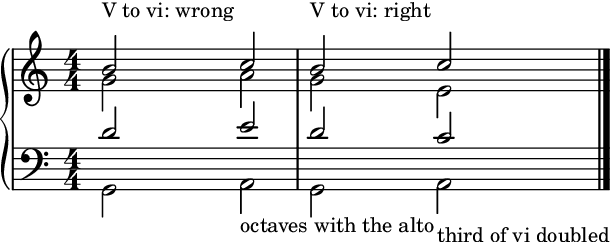
The correction shown is worth memorising on its own, because V to vi is where this fault happens most. The bass must rise a step from degree 5 to degree 6. If the upper parts rise with it, everything is parallel. The formula that fixes it is: the leading note rises to the tonic, and the other two upper voices fall to the nearest note of chord vi. The result has the third of vi doubled, which is why chapter 2's doubling table lists that exception.
Unisons are octaves for this purpose, and an octave moving to a unison, or a unison to an octave, is equally forbidden. The one place a unison appears legitimately is on a final chord where the tenor meets the bass, or momentarily in passing, and even there it thins the texture.
3.5 Unequal fifths
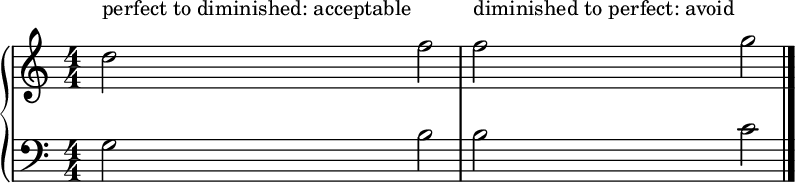
A perfect fifth followed by a diminished fifth, or the reverse, is called an unequal fifth or a false fifth. The two intervals are not the same size, so the fusion argument does not apply in full, and the rule is correspondingly softer.
Perfect fifth to diminished fifth is acceptable in all styles. The move happens constantly in the progression from a triad to a dominant seventh over the same bass, and forbidding it would forbid half of Bach.
Diminished fifth to perfect fifth is avoided where the lower of the two voices is the bass. The diminished fifth is a dissonance that wants to contract, and letting it open out into a perfect fifth both leaves the dissonance unresolved and delivers a bare fifth to the ear at the moment of arrival. Between two upper voices the same move is usually allowed, and Bach writes it.
3.6 Exposed octaves and fifths
Also called hidden octaves and hidden fifths. The interval reached is a perfect octave or fifth, the two voices arrive at it by similar motion, and the upper voice arrives by leap.
Nothing parallel has happened. What offends is the approach: the ear hears the two voices converging on a perfect interval together, and for an instant they fuse in the way an actual consecutive would. The leap is what makes it audible, because a leaping voice draws attention to where it lands.
The rule for practical purposes: between the soprano and the bass, do not arrive at a perfect octave or a perfect fifth by similar motion unless the soprano moves by step. Between inner parts, and between an inner part and the bass, the fault is much less serious and is generally tolerated.
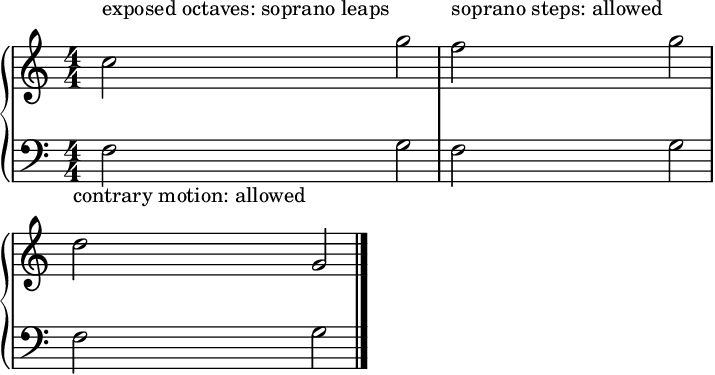
There is one systematic exemption. Arriving at the tonic octave in a perfect cadence, where the bass moves from degree 5 to degree 1 and the soprano moves from degree 2 or degree 7 to degree 1 by step, is correct by definition, because the soprano steps.
3.7 Overlapping and crossing
These two faults look similar on the page and are quite different in kind.
Overlapping is when a voice moves past the note the neighbouring voice has just left. If the alto sits on A and the soprano then moves down to G, the soprano has gone below where the alto just was, even though at no point are the two voices actually in the wrong order. The ear loses track of which line is which, because the soprano's new note is in territory the alto has just occupied. Avoid it.
Crossing is when two voices actually swap position, so the alto is above the soprano or the tenor above the alto. In vocal writing this is usually a fault, because a choir cannot hear which line it is singing. In keyboard style, and in Bach when a line demands it, brief crossing is acceptable and sometimes the only way to keep an inner part singable. Crossing that lasts one chord and unwinds immediately is a licence; crossing that persists is a mistake.
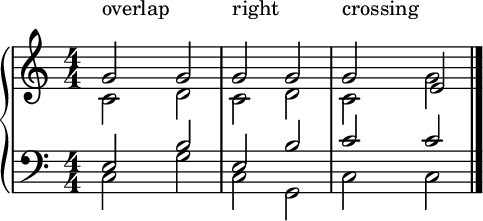
The practical test for both is the same. Cover the other voices with a finger and read one line at a time. If the line you are reading makes sense on its own and stays in its own register, the texture is sound.
3.8 Exercises for chapter 3
- Name the motion between the outer parts in each of these pairs, given as bass then soprano: (a) C up to F, G up to C; (b) C up to F, G down to E; (c) C to C, G up to A; (d) C up to D, E up to F.
- In C major, write chord IV in root position with the bass on F and the tenor a fifth above it, then move to chord V in root position. State what goes wrong if the tenor moves up by step, and give a tenor note that avoids it.
- Why is a diminished fifth followed by a perfect fifth treated more strictly than the reverse?
- Bass moves E up to G; soprano moves C above the treble stave up to G an octave higher. Name the fault and state the single change to the soprano that removes it.
- A tenor part moves from D above middle C down to F below it, while the bass, which was on G, stays put. Is this overlapping, crossing, or neither?
4. Connecting chords
4.1 The general method
Every join between two chords is solved the same way, and the method has three steps.
Write the bass first. The bass is fixed by the harmony, or given to you in a figured-bass exercise, and everything else is built above it.
Keep any common tone in the voice that already has it. If a note belongs to both chords, the voice singing it does not need to move, and a voice that does not move cannot break a rule.
Move the remaining voices to the nearest note of the new chord, by step where possible, and preferably contrary to the bass. Contrary motion is what keeps the texture free of consecutives, and the smallest available movement is what keeps each part singable.
That is the whole method. What follows is what it produces in each of the three cases, because the number of common tones depends entirely on how far the root moves.
4.2 Root movement by a fifth or a fourth
The commonest movement in tonal music: V to I, I to IV, ii to V, vi to ii. Two triads whose roots are a fifth apart share exactly one note.
The recipe. Hold the common tone. Move the other two upper voices by step to the nearest notes of the new chord. The bass leaps a fourth or a fifth, so all three upper parts moving by step gives an easy, well-behaved join.
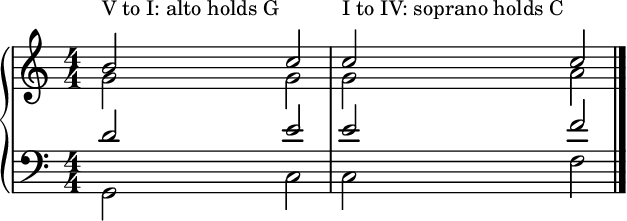
There is a second recipe for the same movement, used when the first would strand a voice or produce the wrong soprano note. Move all three upper voices in the direction opposite to the bass, each to the nearest chord note, holding nothing. In V to I this produces a complete tonic chord with the third in the soprano rather than the root, and it is the version to reach for when the melody demands degree 3 at the cadence.
The one thing neither recipe may violate is the leading note. If the leading note is in the soprano at a perfect cadence it must rise to the tonic. In an inner part it may instead fall a third to degree 5, which is what makes a complete final chord possible when the soprano also wants the tonic.
4.3 Root movement by a third
I to vi, I to iii, IV to ii, vi to IV. Two triads whose roots are a third apart share two notes.
The recipe. Hold both common tones. Move the one remaining upper voice by step. This is the smoothest join in harmony and almost impossible to get wrong: three of the four parts barely move.
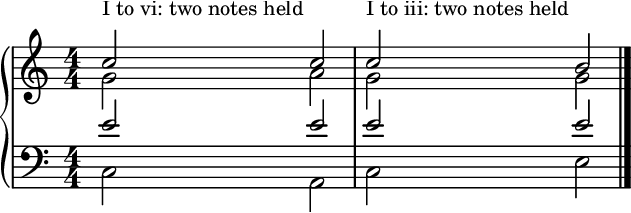
The join is so smooth that the danger is inertia rather than error. A stretch of chords all related by third produces a limp bass line and a static texture. Use the movement for colour, not as a default.
4.4 Root movement by a second
I to ii, IV to V, V to vi. Two triads a step apart share no note at all, so nothing can be held and every part must move.
The recipe. Move all three upper voices in the direction opposite to the bass, each to the nearest note of the new chord. Because there is no common tone, moving with the bass means moving everything in parallel, which is precisely how consecutive fifths and octaves are written by accident.
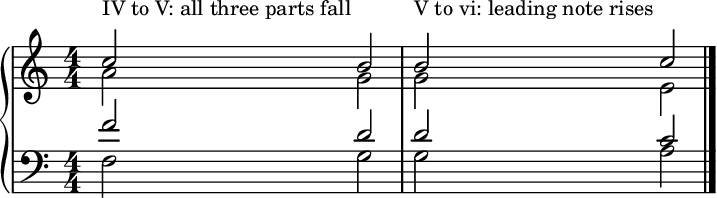
V to vi is the exception inside the exception. The leading note is in chord V and must rise, so it cannot move contrary to a rising bass. The formula, given in chapter 3 and repeated here because it is worth knowing cold, is: leading note up to the tonic, the other two upper voices down to the nearest note of vi, third of vi doubled. In the minor key the same formula gives V to VI, with the third of VI doubled, and it works for exactly the same reason.
4.5 Repeating a chord
When the same chord is restated, the voices may stay where they are, or they may redistribute themselves freely: change from close to open position, swap which voice has the root, move the soprano to a different chord note. Nothing can go wrong harmonically because nothing has changed harmonically.
Two cautions. Do not let a repeated chord produce an awkward leap for the sake of a new arrangement. And remember that a chord repeated across a barline is not repeated at all as far as the ear is concerned: the accent falls again, and a soprano that jumps at that moment sounds like a new event.
4.6 When the recipe will not work
The recipes above solve most joins, and the ones they do not solve fail for a small number of identifiable reasons.
The soprano is given. In a melody harmonisation the top line is fixed, so the recipe must be applied to the inner parts only, and sometimes a common tone has to be abandoned to let the alto reach a note the soprano has vacated.
A voice would go out of range. Follow the recipe and the tenor lands on B flat above middle C: the join must be rewritten with the upper voices redistributed, usually by moving one of them an octave.
The doubling would be illegal. The recipe delivers two leading notes, or a doubled seventh. Change one voice, accepting a leap of a third or a fourth if necessary.
Consecutives appear anyway. This happens most often between the tenor and the bass. The cure is nearly always to move the tenor in the other direction, taking a leap of a third or a fourth, which is unobjectionable in an inner part.
4.7 Exercises for chapter 4
- In F major, chord I is written as bass F, tenor A, alto C, soprano F. Connect it to chord IV using the common-tone recipe, and say which voice holds the common tone.
- In D major, connect chord V to chord vi in four parts with the leading note in the soprano. State the doubling of the vi chord and why it is required.
- Two chords a third apart share two notes. Explain in one sentence why that makes consecutive fifths between them almost impossible.
- In C major, chord ii is written as bass D, tenor A, alto D, soprano F. Move it to chord V. Which recipe applies, and what does each upper voice do?
5. First and second inversions
5.1 What an inversion changes
An inversion changes which chord note is in the bass and nothing else. The chord is the same chord, the notes are the same notes, and the Roman numeral keeps its case. What changes is the sound of the bass line and, with it, the doubling.
First inversion (b, figured 6) puts the third in the bass. The effect is lighter and less settled than root position, because the strongest interval above the bass is now a sixth rather than a fifth. First inversions are what turn a lumpy bass into a melody: a chain of them under a rising or falling scale is one of the standard textures of the period.
Second inversion (c, figured 6/4) puts the fifth in the bass. This chord is not a free-standing harmony at all in the classical style. It contains a fourth above the bass, which the older theory counts as a dissonance, and it is used only in four specific ways, all of them set out in 5.4.
5.2 Doubling in first inversion
The bass note of a first-inversion triad is the third of the chord, and it is already conspicuous by being in the bass. Doubling it as well thickens exactly the note that needs no thickening, so:
In major and minor triads in first inversion, double the root or the fifth in preference to the bass note. In practice the soprano note of the chord is the safest thing to double, because doubling a note that is already in an outer part rarely causes trouble.
In a diminished triad in first inversion, double the bass note. This looks like a contradiction and is not. In viib, the root is the leading note and the fifth is the note that forms the tritone with it, so both are committed to particular resolutions; the third, which is in the bass, is the only free note in the chord. The same applies to iib in the minor key.
Never double the leading note, whatever the inversion, and that ban is what drives the rule above.
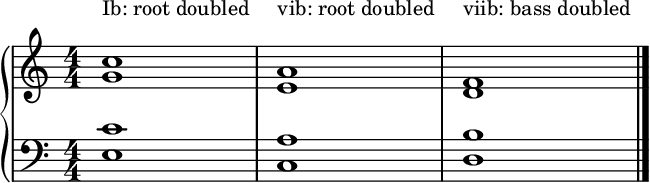
5.3 Chains of first inversions
A run of first-inversion chords under a scalic bass is a standard device, and the ordinary doubling rules cannot survive it: doubling the same chord member in every chord of the chain guarantees consecutives.
The solution is to alternate. Double the root in the first chord of the chain, the fifth in the second, the root in the third, and so on, so that the doubled note keeps changing voice. The alternation makes the offending parallel intervals into alternating sixths and octaves, which is legal. Bach does this constantly, and it is the one place where the doubling rules are followed as a pattern rather than chord by chord.
5.4 The four uses of the six-four
The second-inversion triad appears in exactly four contexts, and each has its own name, its own approach and its own resolution. Outside these four, a six-four in the classical style is a mistake.
The cadential six-four. The most important by far. Over a bass on degree 5, the tonic triad in second inversion sounds on the strong beat, then resolves on the weak beat to the dominant over the same bass: Ic to V. The two upper notes fall by step, the sixth above the bass moving to the fifth and the fourth to the third. Function is what matters here: although the chord is spelled as a tonic triad, it behaves as a decorated dominant, which is why some writers figure it V64-53 rather than Ic. It must fall on a stronger beat than its resolution.
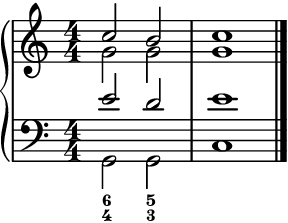
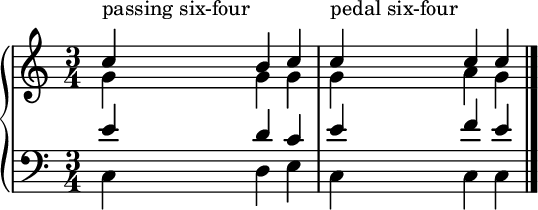
The passing six-four. The bass moves by step through three notes, the outer two being a third apart, and the middle one carries a six-four. The commonest case is I, Vc, Ib under a bass rising C-D-E, with the soprano usually moving in contrary motion. The chord is pure decoration and takes a weak beat.
The pedal or auxiliary six-four. The bass stays on one note while the upper parts move away and back: I, IVc, I over a held tonic bass, or V, Ic, V over a held dominant. Again decorative, again on a weak beat.
The arpeggiated six-four. The bass arpeggiates through the notes of one chord and happens to land on the fifth. Nothing has changed harmonically; the six-four is an accident of the bass line and needs no special handling.
5.5 The rules that cover all four
Two rules apply to every six-four and are worth stating separately because they are what markers check.
Double the bass. The bass note of a six-four is the fifth of the chord, and doubling it is standard in all four uses. The reason is the fourth above the bass: it is treated as a dissonance, so doubling it would give two dissonant notes needing the same resolution, and the third above the bass is too weak to carry a doubling in an unstable chord.
Approach and leave by step, or by staying put. In three of the four uses the bass either moves by step or does not move at all, and the upper parts move by step as well. The arpeggiated six-four is the exception, and it is the one case where the chord is not really functioning as a six-four.
5.6 Exercises for chapter 5
- In B flat major, write chord I in first inversion in four parts with the soprano on D. Which note have you doubled, and why is that the sensible choice?
- Write chord viib in G major in four parts. Name the doubled note and give the reason.
- A bass line rises C-D-E in C major and the chords are I, ? and Ib. Name the missing chord and its type of six-four.
- Why must the cadential six-four fall on a stronger beat than the chord it resolves to?
- State the doubling rule for six-four chords and give the reason behind it.
6. Cadence formulas
6.1 What has to happen at a cadence
A cadence is the harmonic punctuation at the end of a phrase, and in four-part writing it is the moment where the rules bite hardest. The listener is paying most attention, the leading note is usually present and committed, and the bass is making its largest moves. Learning the cadences as fixed formulas rather than as problems to be solved fresh each time is the single biggest saving of effort available to a student of this subject.
Where cadences fall, and what makes a phrase want one, belongs to Musical Form and Analysis. This chapter deals only with how each cadence is written out in four parts.
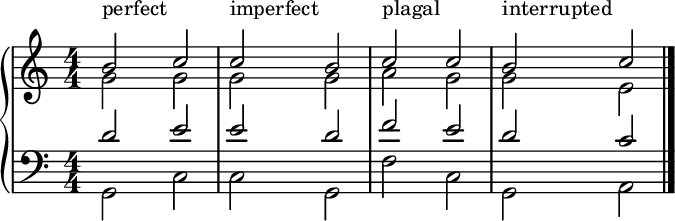
6.2 The perfect cadence
V to I, both in root position, with the tonic in the soprano of the final chord. That last condition is what makes the cadence fully conclusive; the same chords with degree 3 or degree 5 on top close the phrase less firmly, and older British writing sometimes calls those weaker versions imperfect endings of the perfect cadence.
The voice leading is fixed. The leading note rises to the tonic. The bass leaps from degree 5 to degree 1, either up a fourth or down a fifth, whichever keeps it in range. The remaining upper voices move by step or hold the common tone G.
There is one useful licence. If the leading note is in an inner part, it may fall a third to degree 5 instead of rising, and this is what allows a complete final chord when the soprano also takes the tonic. If the leading note is in the soprano it must rise, without exception, at a cadence of this kind.
6.3 The imperfect cadence
Anything to V, with the phrase coming to rest on the dominant. The chord before it is most often I, ii, IV or Ib, and each gives a different colour: I to V is plain and neutral, IV to V is broad, ii to V has the strongest pull because it is a fifth-related approach.
Nothing new is needed technically. The one thing to watch is that V arrives as a root-position triad on a strong beat, and that the soprano lands on a note that sounds like a resting place, usually degree 2, degree 5 or degree 7.
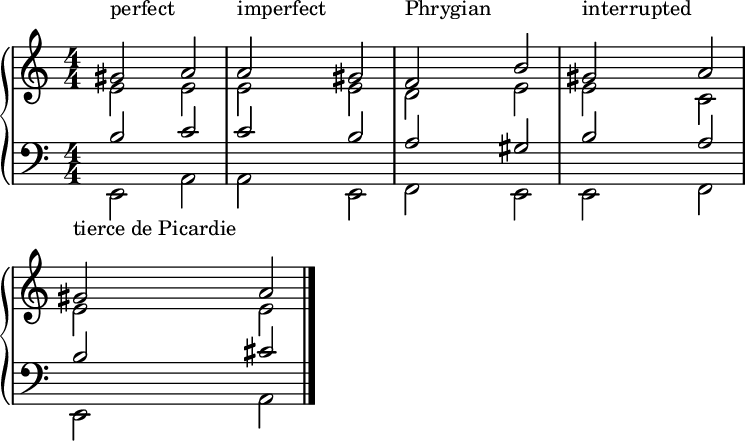
The Phrygian cadence is the important special case, and it belongs to the minor key. Chord iv in first inversion moves to chord V, so the bass falls by a semitone from degree 6 to degree 5 while an upper part rises. The half-step descent in the bass is the sound of it, and Baroque composers used it constantly to end a slow movement in the minor with the expectation of a fast one in the major to follow.
6.4 The plagal cadence
IV to I, both in root position. The bass moves by a fourth or a fifth, there is one common tone, and the recipe of chapter 4 applies unchanged. There is no leading note in either chord, which is why the cadence sounds settled rather than driven, and why it works so well after a perfect cadence has already done the closing.
The plagal cadence is a confirmation, not a conclusion in its own right. Used to end a phrase that has not already reached its tonic, it sounds unfinished.
6.5 The interrupted cadence
V to vi in the major, V to VI in the minor. The ear is set up for a perfect cadence and receives the relative or submediant chord instead. The technical demands were given in chapters 3 and 4 and are repeated here in full because this is the cadence students most often write incorrectly:
The bass rises a step, degree 5 to degree 6. The leading note rises to the tonic. The other two upper voices fall to the nearest note of the new chord. The third of the new chord ends up doubled, and that is correct, not an error.
In the minor key the same formula applies and the resulting chord VI is a major triad, which makes the surprise brighter than the interruption in a major key.
6.6 The minor key
Everything above works in the minor with three adjustments, and all three come from the same source: the minor scale's variable sixth and seventh degrees.
The leading note is sharpened in chord V. The dominant triad in a minor key is major, always, whenever it is functioning as a dominant. A minor v with a flattened seventh is a modal effect, not a cadence chord. The sharpened seventh must be written as an accidental, because the key signature gives the natural minor.
The augmented second is forbidden as a melodic interval. Between degree 6 and the sharpened degree 7 lies an augmented second, and no voice may sing it. This is what forces the melodic minor's raised sixth in ascending lines, and it is the commonest source of trouble in minor-key exercises.
Chord VI is major and chord iv is minor. The interrupted cadence therefore lands on a major triad, and the Phrygian cadence uses a minor triad in first inversion.
The tierce de Picardie is the option of ending a minor-key piece with a major tonic chord, achieved by sharpening the third of the final chord. It was near-universal in the sixteenth and seventeenth centuries and remained available throughout the eighteenth. The sharpened third is a chromatic note and is never doubled.
6.7 The cadence table
| Cadence | Chords | Bass movement | The thing to check |
|---|---|---|---|
| perfect | V to I (or V7 to I) | degree 5 to degree 1 | leading note rises if it is in the soprano |
| imperfect | I, ii, IV or Ib to V | various, ending on degree 5 | V is a root-position major triad, on a strong beat |
| Phrygian (minor only) | ivb to V | degree 6 down a semitone to degree 5 | double the bass note of ivb |
| plagal | IV to I | degree 4 to degree 1 | hold the common tone; no leading note involved |
| interrupted | V to vi, or V to VI in minor | degree 5 up to degree 6 | third of the new chord doubled |
6.8 Exercises for chapter 6
- Write a perfect cadence in E flat major in four parts with the soprano ending on the tonic. State which voice has the leading note and what it does.
- Write the same cadence with the soprano ending on degree 3. What has to change in the inner parts, and why is the ending less final?
- Write a Phrygian cadence in C minor. Give the two bass notes and the note you have doubled in the first chord.
- In F minor, write an interrupted cadence. Name the quality of the second chord and the note doubled in it.
- Why can a plagal cadence not be used to end a phrase that has not already reached the tonic?
7. Sevenths in four parts
7.1 What a seventh chord asks of you
Add a seventh above the root of a triad and two things follow. The chord now has four different notes, so in four parts every voice takes one and nothing is doubled. And the chord now contains a dissonance, the seventh itself, which the ear treats as a note under tension and expects to see resolved.
Two rules cover almost every seventh in the style, and both are consequences of that tension.
The seventh falls by step. It resolves downward to the nearest note of the next chord, and it does so in the voice that has it. This is not negotiable in the strict style.
The seventh is never doubled. Two voices carrying the seventh would both have to fall by step, giving consecutive octaves.
To these the dominant seventh adds its own third rule, inherited from the triad: the leading note rises to the tonic, with the inner-part licence described in 7.3.
7.2 The dominant seventh in root position
V7 is the seventh every student meets first, and it is the one chord whose dissonance may enter without preparation. The reason is that the ear knows this chord: the tritone between the leading note and the seventh identifies the key so unmistakably that the seventh does not need to be eased in.
Written complete, V7 uses all four voices on four different notes, and its resolution then produces an incomplete tonic chord: the leading note rises to the tonic, the seventh falls to degree 3, the fifth falls to the tonic, and the result is a tonic triad with its root tripled and no fifth. This is correct and standard, not a compromise.
Written incomplete, with the fifth omitted and the root doubled, V7 resolves to a complete tonic triad. When you need a full-sounding final chord, this is the version to use.
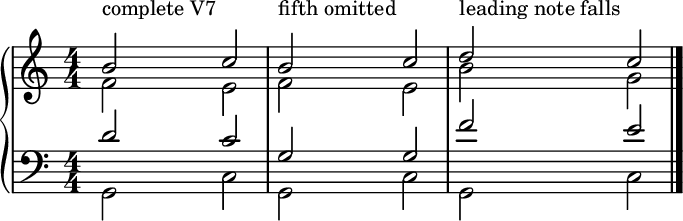
The third route to a complete tonic chord is the licence already met at the plain perfect cadence: if the leading note is in an inner part it may fall a third to degree 5 rather than rise. Keep this for inner parts only.
7.3 The inversions of the dominant seventh
Each inversion has its own figuring, its own bass note and its own preferred resolution, and all four are used constantly.
| Chord | Figures | Bass note | Usual resolution |
|---|---|---|---|
| V7 | 7 (or 7/5/3) | degree 5 | I, tonic in root position |
| V65 | 6/5 | degree 7 | I, because the bass leading note must rise to the tonic |
| V43 | 4/3 | degree 2 | I, with the bass stepping down; or Ib with it stepping up |
| V42 | 4/2 | degree 4, the seventh itself | Ib, because the bass seventh must fall to degree 3 |
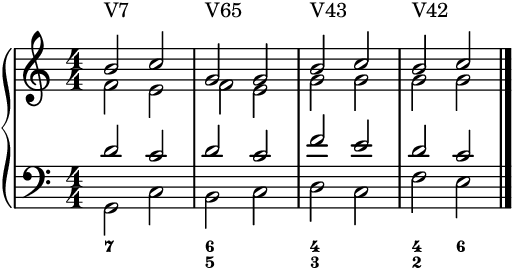
The last row is the one worth fixing in the memory. The third inversion puts the seventh in the bass, the seventh must fall by step, and the note a step below degree 4 is degree 3, so the resolution has degree 3 in the bass. V42 always goes to a first-inversion tonic. There is no exception in the style.
7.4 The supertonic seventh
ii7 in the major, or the half-diminished chord on degree 2 in the minor, is the next seventh to learn, and it behaves differently from V7 in one respect: its seventh must be prepared.
Preparation means the note that becomes the seventh is already sounding, in the same voice, in the chord before. It arrives as a consonance, is held or repeated as the harmony changes beneath it, and only then is it a dissonance. That is the older treatment of every dissonance except the dominant seventh, and it is the same mechanism that produces the suspension in chapter 10.
The seventh of ii7 in C major is C, the tonic, which is why chord I is the natural preparation: hold the tonic in an upper voice, move the bass to degree 2, and the seventh has prepared itself.
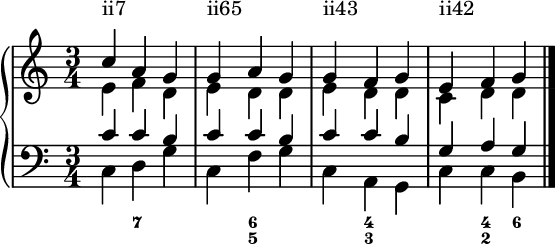
The resolution is to V, in one of its forms, with the seventh falling by step to the leading note. ii7 to V to I is the strongest standard cadential approach in tonal harmony, and once the sevenths are added it becomes ii7 to V7 to I, with two dissonances falling by step in succession.
7.5 Other sevenths
Sevenths can be built on every degree of the scale, and all of them behave like ii7 rather than like V7: the seventh is prepared, held and resolved downward by step. The chain of sevenths falling by fifths, vii7 to iii7 to vi7 to ii7 to V7 to I, is the standard sequence built from them, and in four parts it alternates complete and incomplete chords automatically if each seventh falls by step and each root moves by a fifth.
The diminished seventh and the secondary dominants belong to chromatic harmony and are covered in Musical Harmony and in ABRSM Music Theory Grade 7. Their part-writing follows the rules of this chapter without change: the seventh falls, the leading note rises, nothing chromatic is doubled.
7.6 Exercises for chapter 7
- Write V7 in D major in four parts, complete, and resolve it. Describe the tonic chord you have produced.
- Write the same V7 with the fifth omitted, and resolve it. What is different about the tonic chord this time?
- In B flat major, write V42 and resolve it. Which chord must follow, and why is there no alternative?
- Why may the seventh of V7 enter without preparation when the seventh of ii7 may not?
- In G major, write chord I then ii65 then V, in four parts. Name the note that is prepared, the voice that prepares it, and the note it falls to.
8. The complete figured-bass table
8.1 What figured bass is
From about 1600 to 1780 the bass line of almost every ensemble piece in Europe was printed with numbers under it. The player at the harpsichord, organ or chamber organ read the bass with the left hand and built the chords above it with the right, deciding on the spot how many notes to play, in what register, and with what decoration. The bass and its figures together were called the thoroughbass or basso continuo, and the practice is why the period from Monteverdi to Haydn is sometimes called the age of the thoroughbass.
The numbers are intervals above the bass note, counted in the key of the moment, and they are printed in a column, largest at the top. That single rule generates the entire system. A 6 under a bass note means "put the note a sixth above this bass into the chord". Which octave, which voice, and whether to double anything are left to the player.
Two conventions make the shorthand short. Anything not printed is assumed. A bass with no figure carries the plain root-position triad, a fifth and a third above it, so 5/3 is almost never written. Compound intervals are reduced. A 10 is a 3, a 12 is a 5, and figures above 9 appear only where a composer wants to insist on register.
For a modern reader the practical value is different but no smaller. Figures are the fastest notation there is for describing what a chord does over a bass, they are what examination questions in this subject are written in, and reading them fluently forces you to think of harmony as intervals above a bass line rather than as a stack of letter names.
8.2 How to read a column of figures
Read from the bottom of the column up, or from the top down, but read every number as an interval above the printed bass note, measured within the key signature unless an accidental says otherwise.
A figure never tells you which voice takes which note, and it never tells you what to double. Those are yours to decide, using chapters 2 and 4. A figure also never tells you the chord's root: you work that out yourself by rearranging the notes into thirds, which is exactly the mental step that makes figured bass good training.
Where two sets of figures appear under one bass note, they are two harmonies in succession over the same bass, and the rhythm of the change is judged from the beat. Where a horizontal line follows a figure, the harmony it named is still sounding.
8.3 The triads
| Figure | Read as | Chord over a bass C |
|---|---|---|
| no figure | 5/3 | C-E-G, root position |
| 5/3 | as printed | C-E-G, root position |
| 5 | 5/3 | C-E-G, root position |
| 3 | 5/3 | C-E-G, root position |
| 8 | the octave above the bass is wanted in the chord | C-E-G with C also in an upper part |
| 6 | 6/3 | C-E-A, first inversion of A minor |
| 6/3 | as printed | C-E-A, first inversion of A minor |
| 6/4 | as printed | C-F-A, second inversion of F major |
8.4 The sevenths and ninths
| Figure | Read as | Chord over a bass C |
|---|---|---|
| 7 | 7/5/3 | C-E-G-B, root-position seventh |
| 7/5/3 | as printed | the same |
| 6/5 | 6/5/3 | C-E-G-A, first inversion of A-C-E-G |
| 4/3 | 6/4/3 | C-E-F-A, second inversion of F-A-C-E |
| 4/2 | 6/4/2 | C-D-F-A, third inversion of D-F-A-C |
| 2 | 6/4/2 | the same as 4/2 |
| 9 | 9/5/3 | C-E-G-D, ninth over the root |
| 9/7 | 9/7/5/3 | C-E-G-B-D, one note omitted in four parts |
| 5/4 | as printed | C-F-G, the fourth held against the fifth |
| 4 | 5/4 | the same as 5/4 |
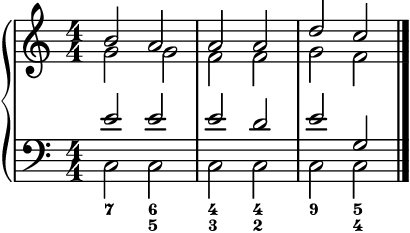
The third inversion is worth a second look. A 4/2 or a bare 2 always means the bass is carrying the seventh of the chord, so the bass must fall by step to the next note. There is no figure in the whole system that constrains the bass more tightly.
8.5 Accidentals in the figuring
This is the part of the system most often misread, and there are only four rules.
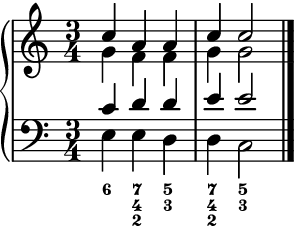
An accidental standing alone under a bass note applies to the third above the bass. No number is printed because none is needed. This is how the sharpened leading note of a minor key is written under a dominant bass, and it is by far the commonest accidental in the repertoire.
An accidental beside a number applies to the interval that number names. A flat beside a 6 lowers the sixth above the bass; a sharp beside a 4 raises the fourth. The accidental may be printed before or after the figure and means the same either way.
A stroke through a figure, or a plus sign beside it, raises that interval by a semitone. The two signs are interchangeable, and both are ways of writing a sharp without printing one. A crossed 6 and a sharpened 6 are the same instruction.
An accidental means what the key signature makes it mean. A sharp under a bass note in a key with three flats does not necessarily produce a sharp note: it raises the third above the bass by a semitone from whatever the key signature gives, so it may well produce a natural. The natural sign is used the same way, and in the older sources a sharp sign is often printed where a modern editor would print a natural.
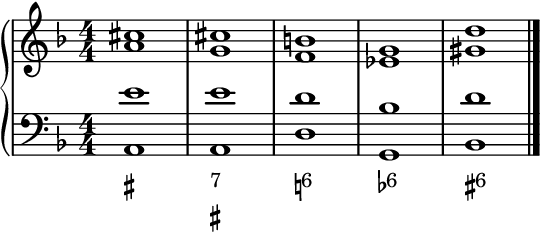
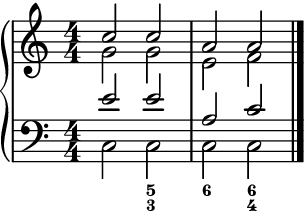
The five chords engraved above are, in order: the sharp alone raising the third to give the dominant of D minor; the same with a seventh added; a natural against a 6, raising the sixth above the bass to give the melodic-minor form; a flat against a 6, giving the Neapolitan sixth; and a sharp against a 6, giving the augmented sixth. The last two are chromatic chords, treated fully in Musical Harmony and in ABRSM Music Theory Grade 7, and they are printed here so the table is complete.
8.6 Suspensions, lines and the other signs
| Sign | Means |
|---|---|
| 4-3 | the fourth above the bass falls to the third; a suspension |
| 9-8 | the ninth falls to the octave |
| 7-6 | the seventh falls to the sixth |
| 6-5 | the sixth falls to the fifth |
| 5-6 | the fifth rises to the sixth, usually to avoid consecutives over a stationary bass |
| 2-3 | the bass itself is suspended and falls, so the second above it becomes a third |
| horizontal line after a figure | the harmony just named continues while the bass moves |
| t.s. or tasto solo | play the bass note alone, no chord above it |
| unis. or all' unisono | the accompaniment doubles the bass line in octaves |
| a rest under the bass | no chord |
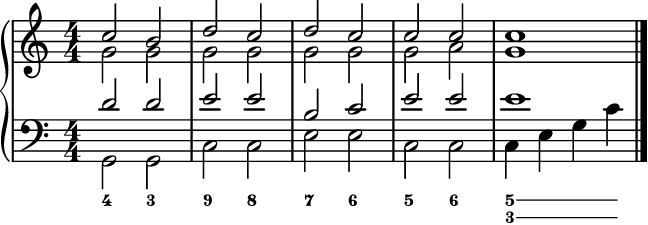
The horizontal line is the sign most often misunderstood by modern readers. It does not mean "hold the bass"; the bass is printed and speaks for itself. It means the chord already sounding is still the chord, so a bass that arpeggiates from C up to G under a line is still playing the C chord and not a six-four.
8.7 What the figures do not tell you
Four things, and forgetting any of them produces a realisation that is technically right and musically wrong.
The register. Figures give intervals, not octaves. Keep the right hand in a comfortable middle range, roughly from the G below middle C to the G an octave and a half above, and let the bass do the work at the bottom.
The doubling. Decide it by chapter 2, not by the figures.
The number of parts. A continuo player in a big work might play six notes; in a thin trio texture, three. In an exercise, four parts throughout unless you are told otherwise.
The rhythm and decoration. Real continuo playing spreads chords, adds passing notes, imitates the melody and thins out when the soloist is busy. None of that is in the figures. What is in the figures is the harmony, and the harmony is what the exercise is testing.
8.8 Exercises for chapter 8
- A bass note G carries the figure 6. Name the three notes of the chord and its root.
- A bass note D carries the figures 4/2. What must the bass do next, and why?
- Under a bass note E in the key of A minor stands a single sharp. Which note does it alter and to what?
- Write the full form of the figures 6/5, 4/3 and 4/2, and name the chord member in the bass for each.
- A bass moves C, E, G, C under a horizontal line following the figure 5/3. How many chords have sounded?
9. Realisation method
9.1 The algorithm
Realising a figured bass is a procedure, and following it in order is what separates the students who finish with time to spare from the ones who are still rubbing out at the end. Nothing here is a matter of taste until step 5.
Step 1. Read the key, the metre and the phrase lengths. Write the key at the top of the page. Mark where the phrases end: a longer note in the bass, a rest, a repeated bass note, or a bass that falls to the tonic all mean the same thing.
Step 2. Name every chord before writing a note. Go through the bass from beginning to end, work out each chord from its figures, and write the Roman numeral under the stave. Do this for the whole exercise first. A wrong chord discovered in bar 7 costs nothing at this stage and costs everything after the parts are written.
Step 3. Mark the cadences. Find each phrase end and name the cadence. These are the fixed points of the exercise, and their voice leading is already decided by chapter 6. Write them in first.
Step 4. Write the soprano. The top line is the one a listener follows, so give it a shape: a high point somewhere near the middle, mostly stepwise motion, no leaps that are not filled in afterwards, and no repeated notes across a barline unless the harmony demands it. Work backwards from each cadence, because the cadence fixes the last two or three notes and the rest of the line has to arrive there.
Step 5. Fill in the alto and tenor. Apply the recipes of chapter 4 join by join: common tone held, remaining voices to the nearest note, contrary to the bass where there is a choice. Keep both parts inside their ranges and inside an octave of their neighbours.
Step 6. Check, in this order. Ranges first, because a fault there is fatal and instant to spot. Then spacing. Then doubling, with particular attention to leading notes and sevenths. Then consecutives, reading each pair of voices in turn: bass and tenor, bass and alto, bass and soprano, tenor and alto, tenor and soprano, alto and soprano. Six passes, and they take two minutes.
9.2 First worked realisation: SATB
Here is the bass, four bars in C major.
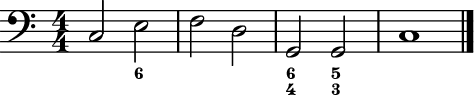
Step 2, the chords. Bar 1: C unfigured is I; E with a 6 is the same chord in first inversion, Ib. Bar 2: F unfigured is IV; D unfigured is ii. Bar 3: G with 6/4 over G with 5/3 is the cadential six-four, Ic to V. Bar 4: C unfigured is I.
So the progression is I, Ib, IV, ii, Ic, V, I.
Step 3, the cadence. Only one phrase, ending with the cadential six-four into a perfect cadence in bar 4. That fixes bars 3 and 4: the six-four takes the strong beat, the soprano falls from the fourth above the bass to the third, and the leading note in bar 3 rises to the tonic in bar 4.
Step 4, the soprano. Working backwards from the tonic in bar 4: B in bar 3, C above it in the six-four, and before that a line that reaches a high D in bar 2 and comes down. The result, C, C, C, D, C, B, C, is deliberately plain. It stays inside a fourth, it steps everywhere except the held notes, and it lets the harmony do the work. A first realisation should sound like this.
Step 5 and 6, the inner parts. The alto holds G through the first two chords, then falls to F for chord IV, keeps F through chord ii, and steps down E, D, E through the cadence. The tenor takes the leftovers, moving E, C, A, A, G, G, G, so it barely moves at all in the second half; a static tenor under an active cadence is good writing, not laziness.
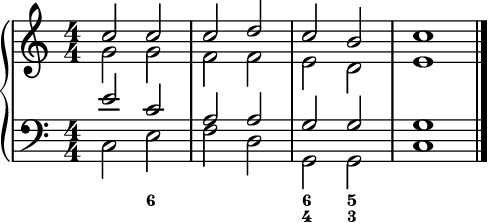
Three details in that answer are worth naming.
The move from IV to ii, in bar 2, is root movement by a third with two common tones, so the tenor and alto simply hold and only the bass and soprano move. That is the chapter 4 recipe working exactly as advertised.
The six-four in bar 3 has its bass doubled, tenor G against the bass G, as chapter 5 requires. Both dissonant notes above it, the sixth and the fourth, fall by step to the fifth and the third.
The final chord has its root doubled and is complete, because the leading note is in the soprano and rises, while the tenor holds G from the previous chord. Nothing had to be omitted.
9.3 Second worked realisation: keyboard style
The same method, a different layout. The bass goes in the left hand alone; the other three parts go in the right hand as a chord, kept within an octave so that one hand can hold them.
Here is a four-bar bass in G major: G, B with a 6, C, A, then D under 6/4 and 5/3, then G.
The chords are I, Ib, IV, ii, Ic, V, I again, transposed, which makes the comparison with the SATB version direct.
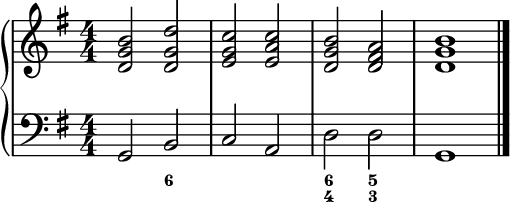
Two things change in keyboard style and nothing else does.
The right hand stays put. Because all three upper parts are in one hand, they move as little as possible, and the top of the right hand rather than a separate soprano part carries whatever melodic interest there is. Notice how often a note is simply held.
The doubling follows the hand. In the first-inversion chord in bar 1 the right hand takes D, G and D rather than D, G and B, because that keeps the hand shape identical to the previous chord. The fifth of the chord is doubled, which chapter 2 allows in a first inversion.
Everything else is unchanged. The six-four still has its bass doubled and still resolves downward by step, the leading note still rises, and the same six consecutive checks still apply between the four real parts.
9.4 The traps
Naming the chord from the bass note rather than the figures. A bass D with a 6 is not chord ii; it is the chord whose notes are D, F and B, which is viib. Work out the notes, then rearrange them into thirds, then name the chord.
Forgetting that the figures change mid-note. Two sets of figures under one long bass note mean two chords, and the second usually falls on a weak beat.
Writing the inner parts first. The soprano is the line a listener hears. Written last, it always comes out as leftovers.
Letting the six-four resolve upward. Both dissonant notes above the bass of a cadential six-four fall. If your soprano rises from the fourth above the bass, the chord has not resolved.
Missing the accidental in a minor key. Every dominant chord in a minor key needs its leading note sharpened, and the figures will usually tell you with a bare sharp sign. If they do not, the harmony still does.
9.5 Exercises for chapter 9
- Name the chords in this bass, in C major: C unfigured, A with a 6, D unfigured, G with 4 then 3, C unfigured.
- In the worked SATB realisation above, why does the tenor take G rather than B in the six-four chord?
- A figured bass in D minor has a bass note A with a bare sharp under it. Write out the three notes of the chord.
- Rewrite the last two chords of the worked SATB realisation so that the soprano ends on degree 3 instead of degree 1. State what has to change in the inner parts.
10. Suspensions in four parts
10.1 The three stages
A suspension is a note that arrives on time and leaves late. It has three stages, and naming them is the whole technique.
Preparation. The note sounds as an ordinary consonant member of a chord, on a weak beat.
Suspension. The harmony changes underneath it, on a strong beat, and the note stays where it is. It is now a dissonance, because it belongs to the chord that has gone rather than the one that has arrived.
Resolution. The note falls by step, on the following weaker beat, into the chord that is already sounding.
The effect is entirely rhythmic in origin. Nothing unusual has been played; a single voice has simply been late, and the friction between it and the new harmony is what the listener hears as expressive tension. That is why suspensions are the main source of expression in a texture whose harmony is otherwise plain, and why the chorale style leans on them so heavily.
10.2 The rules
The preparation must be a consonance and must be at least as long as the suspension. A dissonance cannot prepare a dissonance, and a preparation shorter than the note it prepares does not sound like a note being held over.
The suspension must fall on a stronger beat than its resolution. Reverse the accents and the effect vanishes: the ear hears an ordinary passing note instead.
The resolution is always downward and always by step. A suspension that resolves upward is not a suspension; it is a retardation, and it is treated in 10.6.
A suspension is never doubled. Two voices holding the same suspended note must both fall by step, which gives consecutive octaves.
The note of resolution should not sound in another upper voice while the suspension is sounding. If the soprano is suspending C over a B, having the alto already on B makes the clash into a plain wrong note rather than a suspension. The bass is exempt, and in the 9-8 suspension it is exempt by definition: the ninth resolves to the octave above a bass that is already sounding that note.
Consecutives are counted from the resolution, not from the suspension. A suspension delays a fault but does not cancel it. If removing the suspension would leave consecutive fifths between two voices, the fifths are still there.
10.3 The family
Suspensions are named by the interval they form above the bass, followed by the interval they resolve to.
| Name | Suspension | Resolution | Where it is used |
|---|---|---|---|
| 4-3 | fourth above the bass | third | the commonest of all; standard at a perfect cadence, over the dominant |
| 7-6 | seventh above the bass | sixth | over a bass note carrying a first-inversion chord; the basis of the chain |
| 9-8 | ninth above the bass | octave | over a root-position chord; the mildest, because the resolution note is already in the bass |
| 2-3 | the bass itself is suspended | the bass falls to a third below an upper part | the only suspension in the bass |
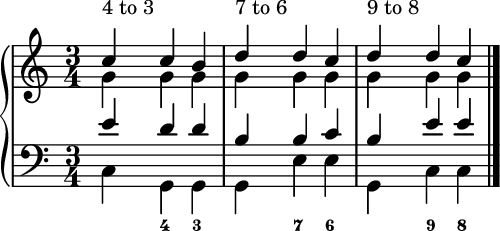
The 2-3 is the odd one out and is worth writing once to understand. Everything that has been said applies, but the suspended voice is the bass, so the dissonant interval is measured from the bass upward as a second and the resolution turns that second into a third. In figures it appears as a 2 or a 4/2 resolving to a 5/3 or a 6/3.
10.4 Choosing the voice and the beat
Any of the four voices can carry a suspension, and the choice changes the effect.
In the soprano the suspension is at its most audible and is the standard place for the 4-3 at a cadence.
In an inner part it colours the harmony without drawing attention. Alto suspensions are the workhorses of the chorale style.
In the bass only the 2-3 is available, and it changes the chord's inversion rather than its identity.
The beat is not a choice. The suspension takes the stronger of the two beats involved, always. In 4/4 that means beats 1 and 3 carry suspensions and beats 2 and 4 carry resolutions; in 3/4 a suspension on beat 1 resolves on beat 2, and one on beat 2 will only work if beat 3 is genuinely weaker, which in a minuet it is not.
10.5 Chains
Because the resolution of one suspension is a consonance, it can serve as the preparation of the next. Link enough of these together and you have a chain, which is one of the most useful devices in the whole style: it carries a phrase forward over a stepwise bass while keeping every voice moving smoothly.
The 7-6 chain over a descending bass is the standard example. Each bass note carries a first-inversion chord, the suspending voice is always a seventh above the bass and always falls to a sixth, and the resolution note is a seventh above the next bass note down, so it suspends again without any new preparation being needed.
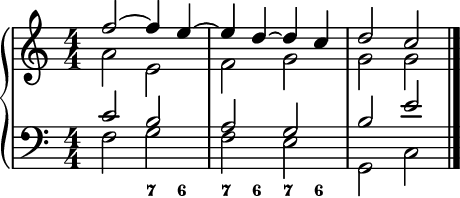
Two things make a chain work in four parts. The remaining two upper voices must move in contrary motion to the bass where they can, because a stepwise descending bass with everything moving in parallel is a consecutive machine. And the doubling has to alternate, exactly as in the first-inversion chains of chapter 5: notice in the engraving that the alto rises through E, F and G while the bass falls through G, F and E, so no interval between them is ever repeated.
10.6 Ornamental resolutions and the retardation
Two variations are worth knowing because they appear constantly in real music.
The ornamented resolution. Instead of falling straight to its note of resolution, the suspended voice decorates the descent: it may leap down to another chord note and step back up, or drop to the note below the resolution and rise to it, or repeat the suspended note first. The harmony is unchanged and the rule is unchanged, because the note of resolution is still reached, just later and with more interest.
The retardation. A suspension that resolves upward by step. It is much rarer, it is usually a leading note held over and then rising to the tonic, and it is the one legitimate exception to the downward rule. Do not use it as an excuse: an upward resolution in any other context is an error.
The anticipation is the mirror image of a suspension and belongs beside it: a note arrives early rather than late, sounding on a weak beat as a member of the chord that is about to come. It is most familiar at cadences, where the soprano touches the tonic just before the final chord.
10.7 Exercises for chapter 10
- In C major, write a 4-3 suspension over a bass G in four parts, with the suspension in the soprano. Name the chord that prepares it.
- Why can a suspension not be prepared by a note shorter than itself?
- A soprano suspends C above a chord of G-B-D and the alto is on B. Name the fault.
- Write two links of a 7-6 chain over a bass falling A, G, F in C major. Give all four parts for the second link.
- What is the difference between a retardation and a suspension, and which single rule does the retardation break?
11. Harmonising a melody
11.1 The task reversed
Every chapter so far has given you a bass and asked for the upper parts. Harmonising a melody reverses the problem: the soprano is fixed and everything below it, including the bass, is yours to invent. It is the harder direction, because the melody rarely states its harmony unambiguously and because a weak bass line cannot be rescued by good inner parts.
The method below works from the outside in. Choose the chords, write the bass, then fill the middle, checking as you go.
11.2 The melody

Read it before touching a pencil. It is in G major, in 4/4, eight bars long, moving in minims, and it divides into two four-bar phrases. The first ends on D in bar 4, the second on G in bar 8. Nothing in it is chromatic, so no modulation is required, though one would be possible.
11.3 Step one: mark the cadences
Cadences come first because they are the fixed points everything else has to reach. The phrase ending on D in bar 4 wants an imperfect cadence, so bar 4 is chord V. The phrase ending on G in bar 8 wants a perfect cadence, so bar 8 is chord I and bar 7 must supply the dominant that precedes it. With a minim on each half of bar 7, the cadential six-four fits exactly: Ic then V.
11.4 Step two: choose a chord for every note
Work backwards from the cadences, and for each melody note list the chords that contain it before choosing between them.
| Bar | Melody | Contains it | Chosen | Why |
|---|---|---|---|---|
| 1 | D, B | I, V, vi | I, then vi in first inversion | open on the tonic; keep the bass still under the second chord |
| 2 | C, A | IV, ii | IV, then V | a rising fifth into the dominant |
| 3 | B, C | I, IV | I, then IV in first inversion | restore the tonic, then lean towards the cadence |
| 4 | D (whole bar) | V | V | the imperfect cadence |
| 5 | D, C | I, IV | I, then IV | begin the second phrase as the first |
| 6 | B, A | vi, ii | vi, then ii | the descending chain that sets up the cadence |
| 7 | G, F sharp | Ic, V | Ic, then V | the cadential six-four |
| 8 | G | I | I | the perfect cadence |
Two principles decided most of those choices. A chord change on every minim keeps the harmonic rhythm steady, which suits a melody that moves in minims. And approaching the cadences through chords a fifth apart, ii to V and IV to V, gives the phrase endings their pull.
11.5 Step three: write the bass
Now put the roots, thirds or fifths under the melody, choosing inversions to make the bass line singable.
The bass here is mostly in root position, which is the right default. Two inversions earn their place. In bar 1 the submediant is put in first inversion so that the bass can hold its G while the harmony changes above it, which is smoother than leaping down a sixth. In bar 3 the subdominant is put in first inversion so that the bass rises by step into the cadence rather than jumping.
Check the finished bass on its own before continuing. It should be a line you would be content to sing: no repeated leaps in the same direction, no interval larger than an octave, and a shape that arrives somewhere at each cadence.
11.6 Step four: fill the inner parts
Alto and tenor supply whatever notes the chord still needs, using the recipes of chapter 4: keep common tones, move the rest to the nearest available note, and check each pair of voices for consecutives as you go.
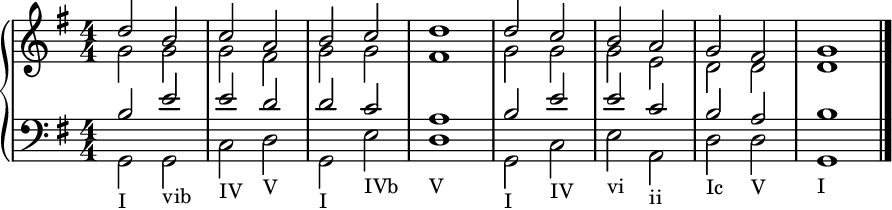
Three moments in the finished version are worth pointing at.
Bar 1. The bass holds G while the chord changes from I to vi in first inversion. This is the smoothest possible way to change harmony, and it avoids a pair of fifths between bass and soprano that a root-position submediant would have produced here.
Bar 6. The chords vi and ii both arrive with their roots doubled, and the four voices descend together. Similar motion in all parts is acceptable when it is stepwise and when no perfect interval is reached by it.
Bar 7. The cadential six-four doubles its bass, as the rule requires, and both upper notes resolve downward by step into the dominant. The soprano's F sharp in the second half of the bar is the leading note and rises to G in bar 8.
11.7 The final check
Run the routine from chapter 3 over the finished exercise: number every pair of voices bar by bar, mark every perfect interval, and confirm that none is approached in parallel. Then check the three things students most often miss: every leading note accounted for, no voice out of range, no chord missing its third.
12. The error catalogue
12.1 How to use this chapter
These are the twenty faults that account for nearly all lost marks in four-part writing. Each is stated as a rule, with the reason it exists, because a rule you understand is one you can apply to a case the rule did not anticipate.
12.2 Faults of motion
1. Consecutive fifths. Two voices a perfect fifth apart move to another perfect fifth. The two lines lose their independence for the duration. See chapter 3.3.
2. Consecutive octaves. The same fault with octaves, and more audible, since the voices merge completely.
3. Consecutive unisons. As above, and worse: four parts become three.
4. Fifths or octaves by contrary motion. Still consecutives. Contrary motion does not remove the parallel perfect sound.
5. Exposed octaves and fifths. Outer voices reaching a perfect interval by similar motion with the soprano leaping. Let the soprano step instead.
6. Overlapping. A voice moves above the previous note of the voice above it, or below the previous note of the voice below. The ear loses which line is which.
7. Voice crossing. Permissible for a specific effect, and confusing otherwise.
12.3 Faults of spacing and doubling
8. A gap over an octave between adjacent upper voices. Soprano, alto and tenor must stay within an octave of each other; only tenor and bass may be further apart.
9. Doubling the leading note. It has to rise, and two voices rising to the same note produce consecutive octaves. Never double it.
10. Doubling a chromatically altered note. The same argument: an altered note has an obligatory resolution.
11. Doubling the seventh of a seventh chord. It must fall by step, so doubling it guarantees consecutives.
12. Doubling the bass of a six-four chord wrongly. In a six-four the bass is doubled, not the root. Doubling the root here is the commonest inversion error.
13. An incomplete chord without cause. The fifth may be omitted and the root tripled; the third may not be omitted except in a final chord written deliberately bare.
12.4 Faults of melody and voice leading
14. The leading note failing to rise. At a cadence it rises. Only in an inner part, and only when the final chord would otherwise be incomplete, may it fall to the dominant.
15. The seventh failing to fall. The seventh of any seventh chord resolves down by step. There are no exceptions worth learning at this stage.
16. An augmented interval in any part. Melodic augmented seconds and augmented fourths are forbidden. The augmented second between the sixth and seventh degrees of the harmonic minor is the usual culprit.
17. A voice out of range. Each part must stay within the compass given in chapter 1, and should spend most of its time in the comfortable middle of it.
18. An unapproachable leap. Leaps larger than a sixth in an inner part, or any leap not followed by a step in the opposite direction, will sound awkward when sung.
12.5 Faults of harmony
19. Retrogression. The progression V to IV, or vii to any chord other than I, runs the harmonic argument backwards. It is not forbidden outright, but at this level it is nearly always a mistake.
20. A six-four used without one of its four justifications. The cadential, passing, auxiliary and arpeggiated six-fours are the only ones that carry their weight. Any other second inversion needs an explanation.
12.6 The engraved cases
The corrections for the motion faults are engraved in chapter 3, the spacing and doubling faults in chapter 2, and the resolution faults in chapters 7 and 10. Rather than repeat them here, use this chapter as the checklist and those chapters as the illustrations.
13. Quick reference
13.1 The voices
| Voice | Working compass | Comfortable middle |
|---|---|---|
| Soprano | C4 to G5 | E4 to E5 |
| Alto | G3 to D5 | A3 to C5 |
| Tenor | C3 to G4 | E3 to E4 |
| Bass | E2 to C4 | G2 to C4 |
Soprano, alto and tenor stay within an octave of the voice next to them. Tenor and bass may be further apart.
13.2 What to double
| Chord | Double |
|---|---|
| root position, major or minor | the root |
| first inversion, major or minor | the root or the fifth; the bass third only if the soprano has it too |
| first inversion of a diminished triad | the bass |
| any six-four | the bass |
| dominant seventh | nothing; use all four notes, or omit the fifth and double the root |
| chord vi after V (interrupted) | the third |
Never double the leading note, a chromatically altered note, or the seventh of a seventh chord.
13.3 The figures
| Figure | Full form | Chord | Bass is the |
|---|---|---|---|
| blank | 5/3 | root position triad | root |
| 6 | 6/3 | first inversion triad | third |
| 6/4 | 6/4 | second inversion triad | fifth |
| 7 | 7/5/3 | root position seventh | root |
| 6/5 | 6/5/3 | first inversion seventh | third |
| 4/3 | 6/4/3 | second inversion seventh | fifth |
| 4/2 | 6/4/2 | third inversion seventh | seventh |
| accidental alone | applies to the third above the bass | ||
| accidental beside a figure | applies to that interval | ||
| horizontal line | the harmony continues unchanged | ||
| 4-3, 7-6, 9-8 | suspension and its resolution |
13.4 The obligations
| Note | Must |
|---|---|
| leading note | rise to the tonic, except in an inner part completing a final chord |
| seventh of any seventh chord | fall by step |
| suspended note | fall by step to the note below |
| bass of a 4/2 chord | fall by step, forcing a first inversion next |
| the fourth and sixth of a cadential six-four | fall by step into the dominant |
13.5 The checking routine
- Sing each part alone. Is it singable and in range?
- Take the six pairs of voices in turn and number the intervals. Any consecutive fifths, octaves or unisons, in any motion?
- Mark every perfect interval reached by similar motion. Is the soprano stepping?
- Circle every leading note and every seventh. Has each done what it must?
- Check spacing: no gap over an octave between soprano and alto, or alto and tenor.
- Check each chord is complete, or incomplete for a stated reason.
14. Answers
14.1 Chapter 2
1. Close position: bass C3, tenor G4, alto C5, soprano E5, with the upper three voices as close together as the chord allows. Open position: bass C3, tenor C4, alto G4, soprano E5. The soprano is unchanged; what changes is how the two inner voices are distributed beneath it.
2. The chord has no fifth: the root is tripled and the third is present, but C is missing. Change the tenor from F to C, giving bass F, tenor C, alto A, soprano F, a complete chord with the root doubled.
3. Double D, the bass. The chord is the diminished triad on B, and in a major key B is the leading note, which may never be doubled; F is the seventh degree of the scale and tends downward. The third, in the bass, is the only note free to be doubled, which is why first-inversion diminished triads always double the bass.
4. The two rules are: never double the leading note, and never write consecutive octaves. The reason common to both is that the leading note has an obligatory resolution. Two voices on F sharp must both rise to G, and two voices moving to the same note a moment apart produce consecutive octaves.
14.2 Chapter 3
1. (a) parallel motion, and specifically parallel fifths, since both voices rise a fourth and the interval stays a fifth; (b) contrary motion; (c) oblique motion; (d) parallel motion in thirds.
2. With the tenor a fifth above the bass, the pair sounds F and C. If the tenor rises by step to D while the bass rises to G, the two fifths F-C and G-D sound in succession: consecutive fifths. Move the tenor down to B instead, which makes the second interval a third and also gives chord V its leading note.
3. Because the diminished fifth is a dissonance and must resolve inwards by step. When it comes first and a perfect fifth follows, the dissonance has not resolved, and the ear hears two fifths in succession with nothing to justify the first. When the perfect fifth comes first, the diminished fifth that follows is a dissonance being introduced, and it can still resolve properly in the next chord.
4. An exposed octave, sometimes called a hidden octave: the outer parts reach a perfect octave by similar motion with the soprano leaping. Change the soprano so that it arrives at its G by step rather than by leap, and the fault disappears, since a stepwise soprano makes the arrival unobtrusive.
5. Neither. The tenor's new note stays above the bass, so there is no crossing, and it does not move below the bass's previous note either, so there is no overlapping. It is a large leap in an inner part, which is a separate matter of style.
14.3 Chapter 4
1. Chord IV is B flat, D, F. The common tone is F, and the soprano holds it, since the bass must leave its F to take the root of the new chord. The tenor rises a step from A to B flat and the alto rises a step from C to D, giving bass B flat, tenor B flat, alto D, soprano F.
2. V is A, C sharp, E; vi is B, D, F sharp. The soprano's leading note C sharp rises to D, the bass rises a step from A to B, and the two remaining upper voices fall to the nearest notes of the new chord. The third of vi, D, ends up doubled. That is required rather than merely permitted: with the leading note obliged to rise and the other voices obliged to fall, no other doubling is available without producing consecutives.
3. Because two of the four voices can hold their notes, so only two voices move, and consecutive fifths need two voices moving in parallel between the same pair of parts.
4. Root movement by a fourth, so the common-tone recipe applies. The common tone D is held in the alto, the tenor rises a step from A to B, the soprano rises a step from F to G, and the bass moves from D to G, giving a complete chord V with the root doubled.
14.4 Chapter 5
1. With the bass on D and the soprano on D, the third of the chord is doubled between the outer voices, and the two inner voices take the root B flat and the fifth F. Doubling the third is normally avoided in a first inversion, but when bass and soprano both carry it there is no alternative, and the pairing of outer voices a tenth or an octave apart is a standard and pleasant sound.
2. Chord viib in G major is F sharp, A, C with A in the bass. Double A, the bass. F sharp is the leading note and C is the seventh degree, which falls; neither may be doubled, so the third of the chord, in the bass, is the only candidate.
3. The missing chord is V in second inversion, G, B and D with D in the bass. It is a passing six-four: the bass note D is a passing note between the C and E of the tonic chord, and the six-four exists only to harmonise it.
4. Because its fourth and sixth above the bass are dissonances that resolve down by step on to the third and fifth of the dominant. A dissonance falls on the stronger beat and its resolution on the weaker; reversing that makes the six-four sound like an arrival rather than a delay.
5. Double the bass. In any six-four the bass is the fifth of the chord, and it is the only note not under an obligation to resolve: the fourth above it and, in the cadential case, the sixth above it, both fall by step.
14.5 Chapter 6
1. V is B flat, D, F; I is E flat, G, B flat. With the soprano ending on the tonic, the simplest version puts the leading note D in the soprano, where it rises by step to E flat. The bass moves from B flat to E flat, and the inner voices take the remaining notes, giving a complete tonic chord.
2. Ending on degree 3, the soprano approaches G from F. The leading note now lies in an inner part and rises to E flat there, or falls to B flat if a complete chord requires it. The ending is less final because the ear takes the top voice as the melody, and a melody that stops on the third has not yet reached its goal.
3. The Phrygian cadence is iv in first inversion moving to V. In C minor the bass moves A flat down a semitone to G. In the first chord double the root F: A flat lies in the bass as the third of the chord, and the point of the cadence is the semitone fall of that bass note, which does not need reinforcing.
4. V is C, E natural, G; VI is D flat, F, A flat. The second chord is major. Double its third, F, which is where the descending upper voices land when the leading note rises to the tonic.
5. Because it contains neither the leading note nor the dominant, so it cannot establish a key. IV to I confirms a tonic the ear has already accepted; arriving at a tonic for the first time by this route leaves the phrase sounding unfinished.
14.6 Chapter 7
1. V7 in D major is A, C sharp, E, G. Resolving it with all four notes present, the third rises to D, the seventh falls to F sharp, the fifth falls to D and the bass moves to D. The tonic chord that results has its root tripled and no fifth: it is incomplete, and that is the accepted price of resolving a complete dominant seventh strictly.
2. With the fifth omitted, the root is doubled: A, A, C sharp, G. On resolution one A moves to D with the bass, while the other stays where it is and becomes the fifth of the tonic chord. The tonic chord is therefore complete.
3. V42 in B flat major is F, A, C, E flat with the seventh, E flat, in the bass. The seventh must fall by step, so the bass moves to D and the chord that follows is the tonic in first inversion. There is no alternative, because the bass's obligation fixes both the next bass note and therefore the inversion.
4. The seventh of the dominant seventh is the subdominant degree, and the chord it belongs to is the most strongly characterised in the key, so the ear hears the dissonance as part of the chord's identity rather than as an intrusion. The seventh of the supertonic seventh is the tonic note, which struck freely sounds like an accident, so convention prepares it by holding it over from the previous chord.
5. The prepared note is G. It is the root of chord I, held over by whichever upper voice has it, and it becomes the seventh of ii65. It falls by step to F sharp in chord V.
14.7 Chapter 8
1. A sixth and a third above G give E and B, so the notes are G, B and E. Rearranged in thirds they are E, G, B, so the root is E and the chord is the submediant in first inversion.
2. The figures 4/2 mean the bass is the seventh of the chord, so it must fall by step. The chord that follows is therefore a first inversion.
3. An accidental standing alone under a bass note applies to the third above it. The third above E is G, which becomes G sharp, giving E, G sharp, B, the dominant chord of A minor.
4. 6/5 in full is 6/5/3 and puts the third of the chord in the bass. 4/3 in full is 6/4/3 and puts the fifth in the bass. 4/2 in full is 6/4/2 and puts the seventh in the bass.
5. One. The horizontal line means the harmony continues unchanged, so the bass is arpeggiating a single chord.
14.8 Chapter 9
1. I, then IVb, then ii, then V carrying a 4-3 suspension, then I.
2. Because a six-four doubles its bass. The chord is the tonic in second inversion, G, C and E with G in the bass, and the tenor takes the second G. Giving the tenor B instead would leave the bass undoubled and add a third the chord does not need.
3. A sharp standing alone alters the third above the bass, so C becomes C sharp, and the chord is A, C sharp, E.
4. Give the soprano D in the dominant chord and let it rise to E in the tonic. The leading note then moves to the alto, which rises from B to C, and the tenor keeps its G, which becomes the fifth of the tonic chord. The final chord is still complete, and the cadence is correspondingly less conclusive.
14.9 Chapter 10
1. The soprano holds C over the bass G, making a fourth, and resolves down to B. The chord that prepares it is the tonic, where C is the root and can be held in the soprano into the next beat.
2. Because the ear must accept the note as a consonance before it becomes a dissonance. A preparation shorter than the suspension makes the held note sound struck rather than held over, and the suspension is heard as an accented dissonance rather than as a delay.
3. The note of resolution is already sounding: the alto has the B that the soprano's C is about to fall to. The suspension and its resolution collide, and the effect is a bare second between the two voices rather than a delayed consonance.
4. Over the falling bass A, G, F, the first link suspends the seventh above A, resolving to the sixth; the second link suspends the seventh above G, F, resolving to the sixth, E. In four parts the second link runs: bass G, tenor G, alto B, soprano F resolving to E. On resolution the chord is G, G, B, E, the submediant in first inversion with its bass doubled.
5. A retardation resolves upward by step; a suspension resolves downward. The rule broken is the one requiring the resolution to fall.
Four-part writing looks at first like a set of prohibitions and turns, with practice, into a set of habits. When the habits are secure the rules stop being obstacles and become what they always were: a description of how four independent lines can sound well together.